Results by title
73 books match the query 'German literature' and 15 start with t
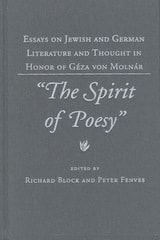
The "Spirit of Poesy"
Essays on Jewish and German Literature and Thought in Honor of Geza von MolnarRichard Block and Peter Fenves
Northwestern University Press, 2000
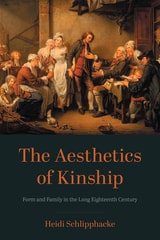
The Aesthetics of Kinship
Form and Family in the Long Eighteenth CenturyHeidi Schlipphacke
Bucknell University Press, 2023

The Anti-Journalist
Karl Kraus and Jewish Self-Fashioning in Fin-de-Siècle EuropePaul Reitter
University of Chicago Press, 2008

The Apocalypse in Germany
Klaus Vondung & Translated by Stephen D. Ricks
University of Missouri Press, 2001
Originally published in German in 1988, The Apocalypse in Germany is now available for the first time in English. A fitting subject for the dawn of the new millennium, the apocalypse has intrigued humanity for the last two thousand years, serving as both a fascinating vision of redemption and a profound threat.
A cross-disciplinary study, The Apocalypse in Germany analyzes fundamental aspects of the apocalypse as a religious, political, and aesthetic phenomenon. Author Klaus Vondung draws from religious, philosophical, and political texts, as well as works of art and literature. Using classic Jewish and Christian apocalyptic texts as symbolic and historical paradigms, Vondung determines the structural characteristics and the typical images of the apocalyptic worldview. He clarifies the relationship between apocalyptic visions and utopian speculations and explores the question of whether modern apocalypses can be viewed as secularizations of the Judeo-Christian models.
Examining sources from the eighteenth century to the present, Vondung considers the origins of German nationalism, World War I, National Socialism, and the apocalyptic tendencies in Marxism as well as German literature—from the fin de siècle to postmodernism. His analysis of the existential dimension of the apocalypse explores the circumstances under which particular individuals become apocalyptic visionaries and explains why the apocalyptic tradition is so prevalent in Germany.
The Apocalypse in Germany offers an interdisciplinary perspective that will appeal to a broad audience. This book will also be of value to readers with an interest in German studies, as it clarifies the riddles of Germany's turbulent history and examines the profile of German culture, particularly in the past century.

The Author and His Publisher
Lectures Delivered in Mainz and AustinSiegfried Unseld
University of Chicago Press, 1980
Through close examination of four writers, Unseld shows how the author's personality can affect the publisher's dilemma. Hermann Hesse, by virtue of his loyalty and his desire for financial independence, enjoyed an exemplary relationship with his publishers. With Bertolt Brecht it was all confusion; with Rainer Maria Rilke, a one-author-one-publisher lifetime alliance; with Swiss poet Robert Walser, a mire of difficulties ("Each book printed," he once said, was "a grave for its author").

The Fate of the Self
German Writers and French TheoryStanley Corngold
Duke University Press, 1994

The Inability to Love
Jews, Gender, and America in Recent German LiteratureAgnes C. Mueller
Northwestern University Press, 2014
The Inability to Love borrows its title from Alexander and Margarete Mitscherlich’s 1967 landmark book The Inability to Mourn, which discussed German society’s lack of psychological reckoning with the Holocaust. Challenging that notion, Agnes Mueller turns to recently published works by prominent contemporary German, non-Jewish writers to examine whether there has been a thorough engagement with German history and memory. She focuses on literature that invokes Jews, Israel, and the Holocaust. Mueller’s aim is to shed light on pressing questions concerning German memories of the past, and on German images of Jews in Germany at a moment that s ideologically and historically fraught.

The Janus Face of the German Avant-Garde
From Expressionism Toward PostmodernismRainer Rumold
Northwestern University Press, 2002
The Making of a Terrorist
On Classic German RoguesJeffrey Champlin
Northwestern University Press, 2014
In The Making of a Terrorist, Jeffrey Champlin examines key figures from three canonical texts from the German-language literature of the late eighteenth and early nineteenth centuries: Goethe’s Gotz von Berlichingen, Schiller’s Die Rauber, and Kleist’s Michael Kohlhaas. Champlin situates these readings within a larger theoretical and historical context, exploring the mechanics, aesthetics, and poetics of terror while explicating the emergence of the terrorist personality in modernity. In engaging and accessible prose, Champlin explores the ethical dimensions of violence and interrogates an ethics of textual violence.
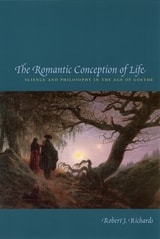
The Romantic Conception of Life
Science and Philosophy in the Age of GoetheRobert J. Richards
University of Chicago Press, 2002
Integrating Romantic literature, science, and philosophy with an intimate knowledge of the individuals involved—from Goethe and the brothers Schlegel to Humboldt and Friedrich and Caroline Schelling—Richards demonstrates how their tempestuous lives shaped their ideas as profoundly as their intellectual and cultural heritage. He focuses especially on how Romantic concepts of the self, as well as aesthetic and moral considerations—all tempered by personal relationships—altered scientific representations of nature. Although historians have long considered Romanticism at best a minor tributary to scientific thought, Richards moves it to the center of the main currents of nineteenth-century biology, culminating in the conception of nature that underlies Darwin's evolutionary theory.
Uniting the personal and poetic aspects of philosophy and science in a way that the German Romantics themselves would have honored, The Romantic Conception of Life alters how we look at Romanticism and nineteenth-century biology.
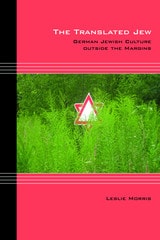
The Translated Jew
German Jewish Culture outside the MarginsLeslie Morris
Northwestern University Press, 2018
The Translated Jew brings together an eclectic set of literary and visual texts to reimagine the transnational potential for German Jewish culture in the twenty-first century. Departing from scholarship that has located the German Jewish text as an object that can be defined geographically and historically, Leslie Morris challenges national literary historiography and redraws the maps by which transnational Jewish culture and identity must be read.
Morris explores the myriad acts of translation, actual and metaphorical, through which Jewishness leaves its traces, taking as a given the always provisional nature of Jewish text and Jewish language. Although the focus is on contemporary German Jewish literary cultures, The Translated Jew also turns its attention to a number of key visual and architectural projects by American, British, and French artists and writers, including W. G. Sebald, Anne Blonstein, Hélène Cixous, Ulrike Mohr, Daniel Blaufuks, Paul Celan, Raymond Federman, and Rose Ausländer.
In thus realigning German Jewish culture with European and American Jewish culture and post-Holocaust aesthetics, this book explores the circulation of Jewishness between the United States and Europe. The insistence on the polylingualism of any single language and the multidirectionality of Jewishness are at the very center of The Translated Jew.
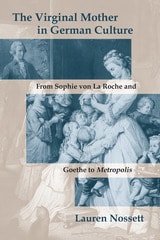
The Virginal Mother in German Culture
From Sophie von La Roche and Goethe to MetropolisLauren Nossett
Northwestern University Press, 2019
Examining the virginal mother in the first novel by a German woman (Sophie von La Roche), canonical texts by Goethe, nineteenth-century popular fiction, autobiographical works, and Thea von Harbou’s novel Metropolis and Fritz Lang’s film by the same name, this book highlights the virginal mother at pivotal moments in German history and cultural development: the entrance of women into the literary market, the Goethezeit, the foundation of the German Empire, and the volatile Weimar Republic. The Virginal Mother in German Culture will be of interest to students and scholars of German literature, history, cultural and social studies, and women’s studies.
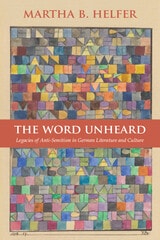
The Word Unheard
Legacies of Anti-Semitism in German Literature and CultureMartha B. Helfer
Northwestern University Press, 2011
The publication of Martha B. Helfer’s The Word Unheard: Legacies of Anti-Semitism in German Literature and Culture marks a stunningly original new direction in the interpretation of canonical works of eighteenth- and nineteenth-century German literature.
Between 1749 and 1850—the formative years of the so-called Jewish Question in Germany—the emancipation debates over granting full civil and political rights to Jews provided the topical background against which all representations of Jewish characters and concerns in literary texts were read. Helfer focuses sharply on these debates and demonstrates through close readings of works by Gotthold Lessing, Friedrich Schiller, Achim von Arnim, Annette von Droste- Hülshoff, Adalbert Stifter, and Franz Grillparzer how disciplinary practices within the field of German studies have led to systematic blind spots in the scholarship on anti-Semitism to date.
While all the authors discussed are well known and justly celebrated, the particular works addressed represent an effective mix of enduring classics and less recognized, indeed often scandalously overlooked, texts whose consideration leads to a reevaluation of the author’s more mainstream oeuvre. Although some of the works and authors chosen have previously been noted for their anti-Semitic proclivities, the majority have not, and some have even been marked by German scholarship as philo-Semitic—a view that The Word Unheard undertakes not so much to refute as to complicate, and in the process to question not only these texts but also the deafness of the German scholarly tradition. With implications that reach into many disciplines, The Word Unheard will be a foundational study for all scholars of modern Germany.

Theory as Practice
A Critical Anthology of Early German Romantic WritingsJochen Schulte-Sasse, Haynes Horne, Elizabeth Mittman, Lisa C. Roetzel, Andreas Michel, Assenka Oksiloff, and Mary R. Strand, EditorsTranslated by Jochen Schulte-Sasse
University of Minnesota Press, 1997
Theory as Practice was first published in 1997. Minnesota Archive Editions uses digital technology to make long-unavailable books once again accessible, and are published unaltered from the original University of Minnesota Press editions.
In light of recent, dramatic revisions in criticism of European-particularly German-Romanticism, this anthology brings together key texts of the movement, especially those written in the last quarter of the eighteenth century by a small, influential circle centered at Jena.
In their introductory essays, the editors locate writings by Fichte, Schelling, Novalis, August Wilhelm Schlegel, and Friedrich Schlegel, among others, in this context. The selections include extensive excerpts from the correspondence of the Jena Romantics, their commentaries on each other's work, their most pertinent essays, fragments, and dialogues as well as diary entries and reviews. These works, together with the editors' articulation and elaboration of their significance, provide a new perspective on the provenance of postmodern thought and literary theory.
Jochen Schulte-Sasse is professor of German and comparative literature at the University of Minnesota and coeditor (with Wlad Godzich) of the Theory and History of Literature series at the University of Minnesota Press. Haynes Horne (University of Alabama), Andreas Michel (Indiana University), Assenka Oksiloff (New York University), Elizabeth Mittman (Michigan State University), Lisa C. Roetzel (University of Rochester), and Mary R. Strand each received a Ph.D. from the University of Minnesota.
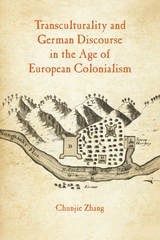
Transculturality and German Discourse in the Age of European Colonialism
Chunjie Zhang
Northwestern University Press, 2017