Results by title
412 books match the query 'Japan' and 94 start with t
Tales of Times Now Past
Sixty-Two Stories from a Medieval Japanese CollectionMarian Ury
University of Michigan Press, 1993
Tanegashima
The Arrival of Europe in JapanOlof Lidin
National University of Singapore Press, 2002
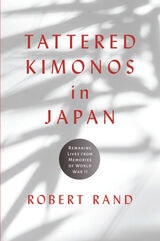
Tattered Kimonos in Japan
Remaking Lives from Memories of World War IIRobert Rand
University of Alabama Press, 2024
Examines Japan’s war generation—Japanese men and women who survived World War Two and rebuilt their lives from memories of that conflict.
Since John Hersey’s Hiroshima—the classic account, published in 1946, of the aftermath of the atomic bombing of that city—very few books have examined the meaning and impact of World War II through the eyes of Japanese men and women who survived that conflict. Tattered Kimonos in Japan does just that: It is an intimate journey into contemporary Japan from the perspective of the generation of Japanese soldiers and civilians who survived World War II, by a writer whose American father and Japanese father-in-law fought on opposite sides of the conflict.
The author, a former NPR senior editor, is Jewish, and he approaches the subject with the sensibilities of having grown up in a community of Holocaust survivors. Mindful of the power of victimhood, memory, and shared suffering, he travels across Japan, including Hiroshima and Nagasaki, meeting a compelling group of men and women whose lives, even now, are defined by the trauma of war, and by lingering questions of responsibility and repentance for Japan’s wartime aggression.
The image of a tattered kimono from Hiroshima is the thread that drives the narrative arc of this emotional story about a writer’s encounter with history, inside the Japan of his father’s generation, on the other side of his father’s war. This is a book about history with elements of family memoir. It offers a fresh and truly unique perspective for readers interested in World War II, Japan, or Judaica; readers seeking cross-cultural journeys; and readers intrigued by Japanese culture, particularly the kimono.
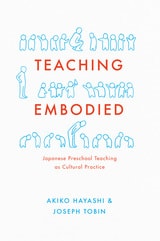
Teaching Embodied
Cultural Practice in Japanese PreschoolsAkiko Hayashi and Joseph Tobin
University of Chicago Press, 2015
Akiko Hayashi and Joseph Tobin embed themselves in the classrooms of three different teachers at three different schools to examine how teachers act, think, and talk. Drawing on extended interviews, their own real-time observations, and hours of video footage, they focus on how teachers embody their lessons: how they use their hands to gesture, comfort, or discipline; how they direct their posture, gaze, or physical location to indicate degrees of attention; and how they use the tone of their voice to communicate empathy, frustration, disapproval, or enthusiasm. Comparing teachers across schools and over time, they offer an illuminating analysis of the gestures that comprise a total body language, something that, while hardly ever explicitly discussed, the teachers all share to a remarkable degree. Showcasing the tremendous importance of—and dearth of attention to—this body language, they offer a powerful new inroad into educational study and practice, a deeper understanding of how teaching actually works, no matter what culture or country it is being practiced in.
Teaching Expertise in Three Countries
Japan, China, and the United StatesAkiko Hayashi
University of Chicago Press, 2022
In Teaching Expertise in Three Countries, Akiko Hayashi shows how teachers from Japan, China, and the United States think about what it means to be an expert teacher. Based on interviews with teachers conducted over the span of fifteen years and videos taken in their classrooms, Hayashi gives us a valuable portrait of expert teachers in the making. While Hayashi’s research uncovered cultural variations in the different national contexts, her analysis of how teachers adapted their pedagogy throughout their careers also revealed many cross-national similarities. Younger teachers often describe themselves as being in a rush, following scripts, and “talking too much,” while experienced teachers describe themselves as being quieter, knowing children better, and being more present.
Including a foreword by scholar of early childhood education Joseph Tobin, Teaching Expertise in Three Countries provides a foundation for understanding the sequence and pathways of development over the first decade of teaching in three national contexts, demonstrating the value of the field of comparative education in the process.
Television, Japan, and Globalization
Mitsuhiro Yoshimoto, Eva Tsai, and JungBong Choi, Editors
University of Michigan Press, 2010
Tensions Of Empire
Japan and Southeast Asia in the Colonial and Postcolonial WorldKen’ichi Goto
Ohio University Press, 2003
Beginning with the closing decade of European colonial rule in Southeast Asia and covering the wartime Japanese empire and its postwar disintegration, Tensions of Empire focuses on the Japanese in Southeast Asia, Indonesians in Japan, and the legacy of the war in Southeast Asia. It also examines Japanese perceptions of Southeast Asia and the lingering ambivalence toward Japanese involvement in Asia and toward the war in particular.
Drawing on extensive multilingual archival research and interviews, Ken‘ichi Goto has produced a factually rich and balanced view of this region’s historical events of the last century.
Tensions of Empire features detailed discussions of Portuguese Timor in the 1930s and 1940s, the decolonization of Malaya, and twentieth-century Indonesia. This extended inquiry yields a unique view of the complicated network within and beyond the colonial and imperial relationships between a one-time nonwestern colonial power and an entire region.
Of great interest to students of Japan-Southeast Asia relations and to specialists in the modern history of both Southeast Asia and Japan, Professor Goto’s Tensions of Empire is a fascinating account of Japan’s recent past from the inside.
Territorial Natures
Imperial Japan and the Mongolian QuestionSakura Christmas
University of Chicago Press, 2026
A critical account of the Japanese occupation in Inner Mongolia.
Early in the twentieth century, the steppe borderlands between China and Mongolia erupted in violence. As imperial Japan expanded into the area, this crisis between nomadic and settler communities posed fundamental problems in governance. In response, Japanese and Mongol leaders together proposed a radical solution: demarcating an autonomous region in Manchukuo for minority peoples, a new kind of political space that would later define the territorial structure of Communist China.
In Territorial Natures, Sakura Christmas explores how the fraught partition of this autonomous region warped the ethnic and environmental boundaries of Manchukuo. She challenges its origin story as a socialist invention by the Chinese state, instead seeing it as also a fascist extension of the Japanese occupation. By reading Chinese and Mongolian sources against Japanese archives, Christmas reveals how this contested history seeded the volatile landscape of autonomous regions in the People’s Republic of China today.
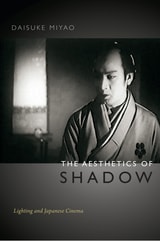
The Aesthetics of Shadow
Lighting and Japanese CinemaDaisuke Miyao
Duke University Press, 2013
The American Automobile Industry
Rebirth or Requiem?Robert E. Cole, Editor
University of Michigan Press, 1984
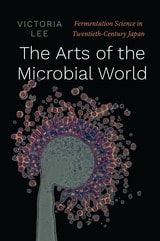
The Arts of the Microbial World
Fermentation Science in Twentieth-Century JapanVictoria Lee
University of Chicago Press, 2021
The Arts of the Microbial World explores the significance of fermentation phenomena, both as life processes and as technologies, in Japanese scientific culture. Victoria Lee’s careful study documents how Japanese scientists and skilled workers sought to use the microbe’s natural processes to create new products, from soy-sauce mold starters to MSG, vitamins to statins. In traditional brewing houses as well as in the food, fine chemical, and pharmaceutical industries across Japan, they showcased their ability to deal with the enormous sensitivity and variety of the microbial world.
Charting developments in fermentation science from the turn of the twentieth century, when Japan was an industrializing country on the periphery of the world economy, to 1980 when it had emerged as a global technological and economic power, Lee highlights the role of indigenous techniques in modern science as it took shape in Japan. In doing so, she reveals how knowledge of microbes lay at the heart of some of Japan’s most prominent technological breakthroughs in the global economy.
At a moment when twenty-first-century developments in the fields of antibiotic resistance, the microbiome, and green chemistry suggest that the traditional eradication-based approach to the microbial world is unsustainable, twentieth-century Japanese microbiology provides a new, broader vantage for understanding and managing microbial interactions with society.

The Ashio Riot of 1907
A Social History of Mining in JapanKazuo Nimura, ed.
Duke University Press, 1997
Arguing against the spontaneous resistance theory that has long dominated Japanese social history accounts, Nimura traces the laborers’ unrest prior to the riots as well as the development of the event itself. Drawing from such varied sources as governmental records, media reports, and secret legal documents relating to the riot, Nimura discusses the active role of the metal mining workers’ trade organization and the stance taken by mine labor bosses. He examines how technological development transformed labor-management relations and details the common characteristics of the laborers who were involved in the riot movement. In the course of this historical analysis, Nimura takes on some of the most influential critical perspectives on Japanese social and labor history. This translation of Nimura’s prize-winning study—originally published in Japan—contains a preface by Andrew Gordon and an introduction and prologue written especially for this edition.
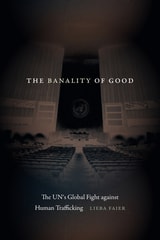
The Banality of Good
The UN's Global Fight against Human TraffickingLieba Faier
Duke University Press, 2024
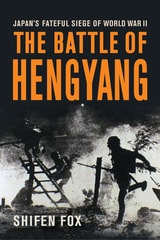
The Battle of Hengyang
Japan's Fateful Siege of World War IIShifen Fox
Westholme Publishing, 2026
The first English language history of China's Most Important Battle in World War II
In April 1944, Imperial Japan launched Operation Ichigo to secure a transport route linking Japanese forces in northern China and Southeast Asia, while eliminating American airfields in the region. The Japanese army quickly overran Chinese resistance and pushed fast toward the city of Hengyang, a key railway junction in south-central China. The Battle of Hengyang began on June 23, 1944. With just 17,000 troops and besieged in an area of less than ten square miles, the Chinese 10th Army held off a Japanese force totaling more than 110,000 men, supported by aircraft, tanks, chemical weapons, and artillery, for forty-seven days. The fighting was among the most savage of the entire Second World War. Hengyang finally fell on August 8, but the Chinese defenders and undaunted American pilots had stopped Ichigo’s momentum. The Japanese military’s failure to quickly conquer such a small city led to the fall of Japanese Prime Minister Tojo’s cabinet in July 1944, ultimately weakening Japan’s resolve to prosecute the war. News accounts compared the battle to the German defeat at Stalingrad in its ferocity and to the Battle of Suiyang, the most famous siege in ancient Chinese history.
In the aftermath of World War II, the battle was erased from Chinese history books since Communist propaganda insisted that only they, not the Nationalists, had successfully resisted the Japanese. But the survivors, both soldiers and civilians, kept the battle alive in their memories, and during the early part of the twenty-first century, the truth of Hengyang was finally presented to the Chinese people. The Battle of Hengyang: Japan’s Fateful Siege of World War II by Shifen Fox is the first English language history of one of the most important battles of the Second World War. The author returned to China where she interviewed survivors and children of survivors, read private letters, and had access to normally closed archives; in addition, she read memoirs written by Japanese survivors and referenced Japanese historical records. Learning late in life that her father perished in the battle, she also explains how the role of her father and this heroic defense was censored by China, but more than eighty years later has now been restored to its place in Chinese and world history.
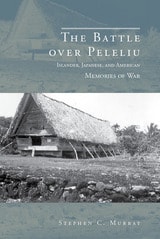
The Battle over Peleliu
Islander, Japanese, and American Memories of WarStephen C. Murray
University of Alabama Press, 2016
The expansionist Japanese empire annexed the inhabited archipelago of Palau in 1914. The airbase built on Peleliu Island became a target for attack by the United States in World War II. The Battle over Peleliu: Islander, Japanese, and American Memories of War offers an ethnographic study of how Palau and Peleliu were transformed by warring great powers and further explores how their conflict is remembered differently by the three peoples who shared that experience.
Author Stephen C. Murray uses oral histories from Peleliu’s elders to reconstruct the island’s prewar way of life, offering a fascinating explanation of the role of land and place in island culture. To Palauans, history is conceived geographically, not chronologically. Land and landmarks are both the substance of history and the mnemonic triggers that recall the past. Murray then offers a detailed account of the 1944 US invasion against entrenched Japanese forces on Peleliu, a seventy-four-day campaign that razed villages, farms, ancestral cemeteries, beaches, and forests, and with them, many of the key nodes of memory and identity.
Murray also explores how Islanders’ memories of the battle as shattering their way of life differ radically from the ways Japanese and Americans remember the engagement in their histories, memoirs, fiction, monuments, and tours of Peleliu. Determination to retrieve the remains of 11,000 Japanese soldiers from the caves of Peleliu has driven high-profile civic groups from across the Japanese political spectrum to the island. Contemporary Japan continues to debate pacifist, right-wing apologist, and other interpretations of its aggression in Asia and the Pacific. These disputes are exported to Peleliu, and subtly frame how Japanese commemoration portrays the battle in stone and ritual. Americans, victors in the battle, return to the archipelago in far fewer numbers. For them, the conflict remains controversial but is most often submerged into the narrative of “the good war.”
The Battle over Peleliu is a study of public memory, and the ways three peoples swept up in conflict struggle to create a common understanding of the tragedy they share.
The Book of the Dead
Orikuchi Shinobu
University of Minnesota Press, 2017
First published in 1939 and extensively revised in 1943, The Book of the Dead, loosely inspired by the tale of Isis and Osiris from ancient Egypt, is a sweeping historical romance that tells a gothic tale of love between a noblewoman and a ghost in eighth-century Japan. Its author, Orikuchi Shinobu, was a well-received novelist, distinguished poet, and an esteemed scholar. He is often considered one of the fathers of Japanese folklore studies, and The Book of the Dead is without a doubt the most important novel of Orikuchi’s career—and it is a book like no other.
Here, for the first time, is the complete English translation of Orikuchi’s masterwork, whose vast influence is evidenced by multiple critical studies dedicated to it and by its many adaptations, which include an animated film and a popular manga. This translation features an introduction by award-winning translator Jeffrey Angles discussing the historical background of the work as well as its major themes: the ancient origins of the Japanese nation, the development of religion in a modernizing society, and the devotion necessary to create a masterpiece. Also included are three chapters from The Mandala of Light by Japanese intellectual historian Andō Reiji, who places the novel and Orikuchi’s thought in the broader intellectual context of early twentieth-century Japan.
The Book of the Dead focuses on the power of faith and religious devotion, and can be read as a parable illustrating the suffering an artist must experience to create great art. Readers will soon discover that a great deal lies hidden beneath the surface of the story; the entire text is a modernist mystery waiting to be decoded.
The Burden of the Past
Problems of Historical Perception in Japan-Korea RelationsKan Kimura; Translated by Marie Speed
University of Michigan Press, 2019
Utilizing Japanese and South Korean newspaper databases to review discussion of the two countries’ disputed historical perceptions from the end of World War II to the present, The Burden of the Past provides readers with the historical framework and the major players involved, offering much-needed clarity on such polarizing issues. By seeing behind the public discourse and political rhetoric, this book offers a firmer footing for a discussion and the steps toward resolution.
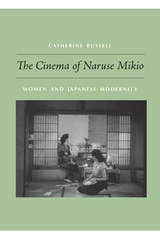
The Cinema of Naruse Mikio
Women and Japanese ModernityCatherine Russell
Duke University Press, 2008
Naruse was a studio-based director, a company man renowned for bringing films in on budget and on time. During his long career, he directed movies in different styles of melodrama while displaying a remarkable continuity of tone. His films were based on a variety of Japanese literary sources and original scripts; almost all of them were set in contemporary Japan. Many were “women’s films.” They had female protagonists, and they depicted women’s passions, disappointments, routines, and living conditions. While neither Naruse or his audiences identified themselves as “feminist,” his films repeatedly foreground, if not challenge, the rigid gender norms of Japanese society. Given the complex historical and critical issues surrounding Naruse’s cinema, a comprehensive study of the director demands an innovative and interdisciplinary approach. Russell draws on the critical reception of Naruse in Japan in addition to the cultural theories of Harry Harootunian, Miriam Hansen, and Walter Benjamin. She shows that Naruse’s movies were key texts of Japanese modernity, both in the ways that they portrayed the changing roles of Japanese women in the public sphere and in their depiction of an urban, industrialized, mass-media-saturated society.
The Comfort Women of Singapore in History and Memory
Kevin Blackburn
National University of Singapore Press, 2022
A balanced, sensitive study of the history of comfort women in Singapore during World War II.
“Comfort women” or ianfu is the euphemism used by the Japanese military for the women they compelled to do sex work in the Second World War, and has become the term generally used in English to discuss the subject. The role of comfort women in the Japanese empire during World War II remains an important and emotional topic around the world. Most scholarship concentrates on Korean comfort women, with less on their counterparts in Japan, China, and Taiwan, and even less on Southeast Asia. That gap persists despite widespread knowledge of the elaborate series of comfort stations, or comfort houses, that were organized by the Japanese administration across Singapore during the Occupation from 1942 to 1945. So why, the author asks, did no former comfort women from Singapore come forward and tell their stories when others across Asia began to do publicly in the 1990s?
To understand this silence, this book offers a detailed examination of the sex industry serving the Japanese military during the wartime occupation of Singapore: the comfort stations, managers, procuresses, girls, and women who either volunteered or were forced into service and in many cases sexual slavery. Kevin Blackburn then turns from history to the public presence of the comfort women in Singapore’s memory, including newspapers, novels, plays, television, and touristic heritage sites, showing how comfort women became known in Singapore during the 1990s and 2000s. Bringing great care, balance, and sensitivity to a difficult subject, Blackburn helps to fill an important gap in our understanding of this period.
The Comfort Women
Sexual Violence and Postcolonial Memory in Korea and JapanC. Sarah Soh
University of Chicago Press, 2008
A powerful debunking of simplistic views of a wartime tragedy
In an era marked by atrocities perpetrated on a grand scale, the tragedy of the so-called comfort women—mostly Korean women forced into prostitution by the Japanese army—endures as one of the darkest events of World War II. These women have usually been labeled victims of a war crime, a simplistic view that makes it easy to pin blame on the policies of imperial Japan and therefore easier to consign the episode to a war-torn past. In this revelatory study, C. Sarah Soh provocatively disputes this master narrative.
Soh reveals that the forces of Japanese colonialism and Korean patriarchy together shaped the fate of Korean comfort women—a double bind made strikingly apparent in the cases of women cast into sexual slavery after fleeing abuse at home. Other victims were press-ganged into prostitution, sometimes with the help of Korean procurers. Drawing on historical research and interviews with survivors, Soh tells the stories of these women from girlhood through their subjugation and beyond to their efforts to overcome the traumas of their past. Finally, Soh examines the array of factors— from South Korean nationalist politics to the aims of the international women’s human rights movement—that have contributed to the incomplete view of the tragedy that still dominates today.
The Community of Nuchi Du Takara ("Life Is the Ultimate Treasure") in Postwar Okinawa
Local Subjectivity within and against EmpireMasamichi (Marro) Inoue
University of Michigan Press, 2025
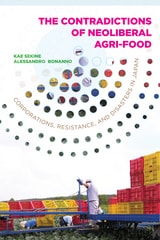
The Contradictions of Neoliberal Agri-Food
Corporations, Resistance, and Disasters in JapanKae Sekine
West Virginia University Press, 2016
Sekine and Bonanno stress the incompatibility of the requirements of neoliberalism with the structural and cultural conditions of Japanese agri-food. Local farmers’ and fishermen’s emphasis on community collective management of natural resources, they argue, clashes with neoliberalism’s focus on individualism and competitiveness. The authors conclude by pointing out the resulting fundamental contradiction: The lack of recognition of this incompatibility allows the continuous implementation of market solutions to problems that originate in these very market mechanisms.
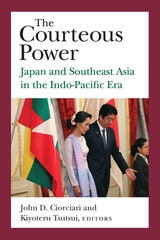
The Courteous Power
Japan and Southeast Asia in the Indo-Pacific EraJohn D. Ciorciari and Kiyoteru Tsutsui, editors
University of Michigan Press, 2021
The Courteous Power seeks to provide a nuanced view of the current relationship between Japan and Southeast Asia. Much of the current scholarship on East–Southeast Asian engagement has focused on the multidimensional chess game playing out between China and Japan, as the dominant post-imperialist powers. Alternatively, there has been renewed attention on ASEAN and other Southeast Asian–centered initiatives, explicitly minimizing the influence of East Asia in the region. Given the urgency of understanding the careful balance in the Indo-Pacific region, this volume brings together scholars to examine the history and current engagement from a variety of perspectives, ranging from economic and political, to the cultural and technological, while also focusing more clearly on the specific relationship between the region and Japan.
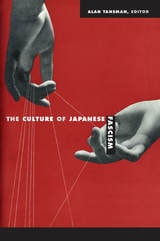
The Culture of Japanese Fascism
Alan Tansman, ed.
Duke University Press, 2009
Several contributors examine how fascism was understood in the 1930s by, for example, influential theorists, an antifascist literary group, and leading intellectuals responding to capitalist modernization. Others explore the idea that fascism’s solution to alienation and exploitation lay in efforts to beautify work, the workplace, and everyday life. Still others analyze the realization of and limits to fascist aesthetics in film, memorial design, architecture, animal imagery, a military museum, and a national exposition. Contributors also assess both manifestations of and resistance to fascist ideology in the work of renowned authors including the Nobel-prize-winning novelist and short-story writer Kawabata Yasunari and the mystery writers Edogawa Ranpo and Hamao Shirō. In the work of these final two, the tropes of sexual perversity and paranoia open a new perspective on fascist culture. This volume makes Japanese fascism available as a critical point of comparison for scholars of fascism worldwide. The concluding essay models such work by comparing Spanish and Japanese fascisms.
Contributors. Noriko Aso, Michael Baskett, Kim Brandt, Nina Cornyetz, Kevin M. Doak, James Dorsey, Aaron Gerow, Harry Harootunian, Marilyn Ivy, Angus Lockyer, Jim Reichert, Jonathan Reynolds, Ellen Schattschneider, Aaron Skabelund, Akiko Takenaka, Alan Tansman, Richard Torrance, Keith Vincent, Alejandro Yarza
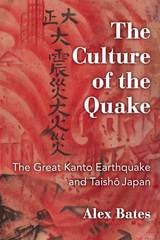
The Culture of the Quake
The Great Kanto Earthquake and Taisho JapanAlex Bates
University of Michigan Press, 2015
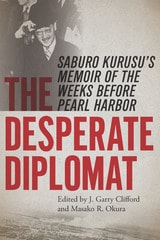
The Desperate Diplomat
Saburo Kurusu's Memoir of the Weeks before Pearl HarborEdited by J. Garry Clifford and Masako R. Okura
University of Missouri Press, 2014
The Economic Effects of Aging in the United States and Japan
Edited by Michael D. Hurd and Naohiro Yashiro
University of Chicago Press, 1997
The most obvious effects will be on social programs such as public pension systems and the provision for medical needs of the elderly. But, the contributors demonstrate, aging will also affect markets for labor, capital, housing, and health care services. It will affect firms through their participation in the demand side of the labor market and through their provisions for pensions. And aging will influence saving rates, the rate of return on assets, the balance of payments, and, most likely, economic growth.
This volume will interest scholars and policy makers concerned with the economics of aging.
The Effects of U.S. Trade Protection and Promotion Policies
Edited by Robert C. Feenstra
University of Chicago Press, 1997
The volume concludes that some policies can act to both protect imports and promote exports, that the threat of protectionist policies can often have effects that are as pronounced as their implementation, and that regulatory policy has as great an impact on trade and investment patterns as does trade policy itself. It will be of crucial interest to international trade economists, policy specialists, and political scientists.
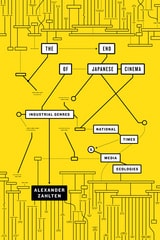
The End of Japanese Cinema
Industrial Genres, National Times, and Media EcologiesAlexander Zahlten
Duke University Press, 2017
A Study of the Weatherhead East Asian Institute, Columbia University
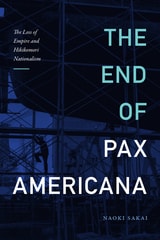
The End of Pax Americana
The Loss of Empire and Hikikomori NationalismNaoki Sakai
Duke University Press, 2022
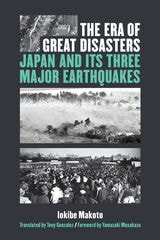
The Era of Great Disasters
Japan and Its Three Major EarthquakesMakoto Iokibe; Translated by Tony Gonzalez
University of Michigan Press, 2020
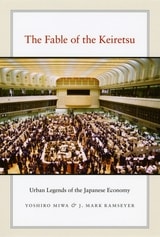
The Fable of the Keiretsu
Urban Legends of the Japanese EconomyYoshiro Miwa and J. Mark Ramseyer
University of Chicago Press, 2006
In their insightful analysis, the authors show that the very idea of the keiretsu was created and propagated by Marxist scholars in post-war Japan. Western scholars merely repatriated the legend to show the culturally contingent nature of modern economic analysis. Laying waste to the notion of keiretsu, the authors debunk several related “facts” as well: that Japanese firms maintain special arrangements with a “main bank,” that firms are systematically poorly managed, and that the Japanese government guided post-war growth. In demolishing these long-held assumptions, they offer one of the few reliable chronicles of the realities of Japanese business.
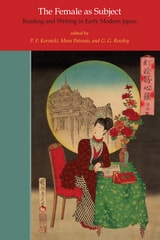
The Female as Subject
Reading and Writing in Early Modern JapanP. F. Kornicki, Mara Patessio, and G. G. Rowley, Editors
University of Michigan Press, 2010
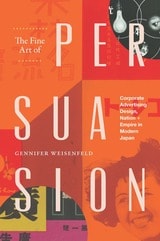
The Fine Art of Persuasion
Corporate Advertising Design, Nation, and Empire in Modern JapanGennifer Weisenfeld
Duke University Press, 2025
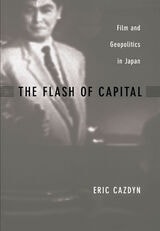
The Flash of Capital
Film and Geopolitics in JapanEric Cazdyn
Duke University Press, 2002
Cazdyn focuses on three key moments of historical contradiction: colonialism, post-war reconstruction, and globalization. Considering great classics of Japanese film, documentaries, works of science fiction, animation, and pornography, he brings to light cinematic attempts to come to terms with the tensions inherent in each historical moment—tensions between the colonizer and the colonized, between the individual and the collective, and between the national and the transnational. Paying close attention to political context, Cazdyn shows how formal inventions in the realms of acting, film history and theory, thematics, documentary filmmaking, and adaptation articulate a struggle to solve implacable historical problems. This innovative work of cultural history and criticism offers explanations of historical change that challenge conventional distinctions between the aesthetic and the geopolitical.
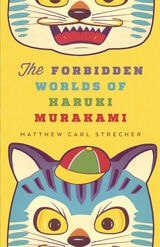
The Forbidden Worlds of Haruki Murakami
Matthew Carl Strecher
University of Minnesota Press, 2014
In an “other world” composed of language—it could be a fathomless Martian well, a labyrinthine hotel or forest—a narrative unfolds, and with it the experiences, memories, and dreams that constitute reality for Haruki Murakami’s characters and readers alike. Memories and dreams in turn conjure their magical counterparts—people without names or pasts, fantastic animals, half-animals, and talking machines that traverse the dark psychic underworld of this writer’s extraordinary fiction.
Fervently acclaimed worldwide, Murakami’s wildly imaginative work in many ways remains a mystery, its worlds within worlds uncharted territory. Finally in this book readers will find a map to the strange realm that grounds virtually every aspect of Murakami’s writing. A journey through the enigmatic and baffling innermost mind, a metaphysical dimension where Murakami’s most bizarre scenes and characters lurk, The Forbidden Worlds of Haruki Murakami exposes the psychological and mythological underpinnings of this other world. Matthew Carl Strecher shows how these considerations color Murakami’s depictions of the individual and collective soul, which constantly shift between the tangible and intangible but in this literary landscape are undeniably real.
Through these otherworldly depths The Forbidden Worlds of Haruki Murakami also charts the writer’s vivid “inner world,” whether unconscious or underworld (what some Japanese critics call achiragawa, or “over there”), and its connectivity to language. Strecher covers all of Murakami’s work—including his efforts as a literary journalist—and concludes with the first full-length close reading of the writer’s newest novel, Colorless Tsukuru Tazaki and His Years of Pilgrimage.
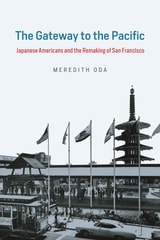
The Gateway to the Pacific
Japanese Americans and the Remaking of San FranciscoMeredith Oda
University of Chicago Press, 2018
Focusing on the development of the Center, Meredith Oda shows how this multilayered story was embedded within a larger story of the changing institutions and ideas that were shaping the city. During these formative decades, Oda argues, San Francisco’s relations with and ideas about Japan were being forged within the intimate, local sites of civic and community life. This shift took many forms, including changes in city leadership, new municipal institutions, and especially transformations in the built environment. Newly friendly relations between Japan and the United States also meant that Japanese Americans found fresh, if highly constrained, job and community prospects just as the city’s African Americans struggled against rising barriers. San Francisco’s story is an inherently local one, but it also a broader story of a city collectively, if not cooperatively, reimagining its place in a global economy.
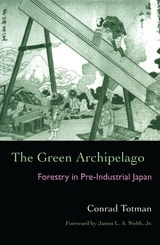
The Green Archipelago
Forestry in Preindustrial JapanConrad Totman
Ohio University Press, 1998
This inaugural volume in the Ohio University Press Series in Ecology and History is the paperback edition of Conrad Totman’s widely acclaimed study of Japan’s environmental policies over the centuries.
Professor Totman raises the critical question of how Japan’s steeply mountainous woodland has remained biologically healthy despite centuries of intensive exploitation by a dense human population that has always been dependent on wood and other forest products. Mindful that in global terms this has been a rare outcome, and one that bears directly on Japan’s recent experience as an affluent, industrial society, Totman examines the causes, forms, and effects of forest use and management in Japan during the millennium to 1870. He focuses mainly on the centuries after 1600 when the Japanese found themselves driven by their own excesses into programs of woodland protection and regenerative forestry.
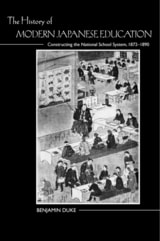
The History of Modern Japanese Education
Constructing the National School System, 1872-1890Duke, Benjamin
Rutgers University Press, 2014
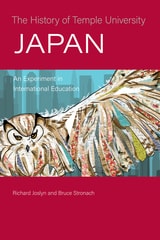
The History of Temple University Japan
An Experiment in International EducationRichard Joslyn and Bruce Stronach
Temple University Press, 2023
The authors recount the development of the academic program, the recruitment of students, and the support from Temple that enabled curricular and pedagogical improvement.
They also address the university’s relationships with three Japanese partners, and the financial threats and crises TUJ faced over the decades.
The History of Temple University Japan is not only an important documentation of TUJ, but also a history of U.S.-Japanese relations. What emerges is the significant impact TUJ has had on the thousands of students, faculty, and staff who have been a part of this international academic institution.
The Invention of Religion in Japan
Jason Ananda Josephson Storm
University of Chicago Press, 2012
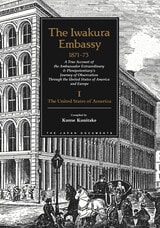
The Iwakura Embassy, 1871-1873, Volume I
The United States of AmericaKunitake Kume
MHM Limited, 2002
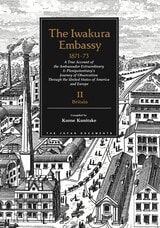
The Iwakura Embassy, 1871-1873, Volume II
BritainKunitake Kume
MHM Limited, 2002
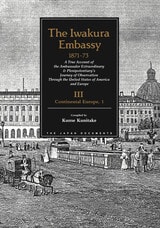
The Iwakura Embassy, 1871-1873, Volume III
Continental Europe, 1Kunitake Kume
MHM Limited, 2002
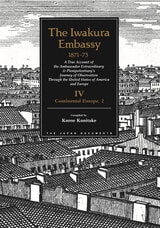
The Iwakura Embassy, 1871-1873, Volume IV
Continental Europe, 2Kunitake Kume
MHM Limited, 2002
The Iwakura Embassy, 1871-1873, Volume V
Continental Europe, 3; and the Voyage HomeKunitake Kume
MHM Limited, 2002

The Japan of Pure Invention
Gilbert and Sullivan’s The MikadoJosephine Lee
University of Minnesota Press, 2010
The Japanese 'New Woman'
Images of Gender and ModernityLowy, Dina
Rutgers University Press, 2007
The dawn of the twentieth century in Japan witnessed the rise of a peculiar problem: the “Woman Problem.” This, at least, was the term used in an ongoing debate among the government and various intellectuals over how to define gender roles. While the government worked hard to promote the “good wife, wise mother” paradigm, certain female members of society had other notions about how to engage with their world.
In The Japanese “New Woman,” Dina Lowy focuses on this new female image as it was revealed, discussed, and debated in popular newspapers and magazines in the 1910s, as well as on the lives of a specific group of women—members of the feminist literary organization known as the Seitosha. These women drew on a variety of sources, including Zen training, Western writings and ideas, and Japanese morals and arts as they tried to open up new spaces for female activity beyond the confines of the home. Lowy shows how the Seitosha set a precedent that would be emulated in the decades to follow as Japanese women continued to question the patriarchal order, experiment with alternative visions, and pursue their rights in a variety of forms. This work also provides a context for comparative studies of New Women, gender debates, and the modernizing process.
The Japanese Automotive Industry
Model and Challenge for the Future?Robert E. Cole, Editor
University of Michigan Press, 1981

The Japanese Experience in Indonesia
Selected Memoirs of 1942-1945Anthony Reid
Ohio University Press, 1986
Although the wartime Japanese military administration of Indonesia was critical to the making of modern Indonesia, it remains shrouded in mystery, in part because of the systematic destruction of records following the Japanese surrender. These excerpts from personal memoirs of individual Japanese soldiers and administrators provide unique glimpses of the occupation—from the Japanese landing on Java and the Dutch surrender, to the independence proclamation in Jakarta, to the violence in Surabaya following the Japanese surrender. Through the eyes of Japanese at all levels of responsibility, we see the internal Indonesian turmoil, the struggle toward an independence movement, and the efforts of some Japanese to promote independence, despite the policies of imperial headquarters.
Not only does this collection illuminate modern Indonesian history, it provides students of Japanese history with a feeling for the variety of Japanese responses to the war effort. The Japanese Experience in Indonesia will therefore be of interest to Southeast and East Asian historians and political scientists, as well as to those with a more general interest in World War II.