Results by title
52 books match the query 'Kant, Immanuel' and 15 start with t
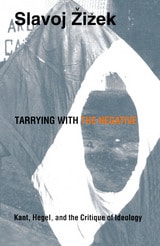
Tarrying with the Negative
Kant, Hegel, and the Critique of IdeologySlavoj Zizek
Duke University Press, 1993
In Tarrying with the Negative, Žižek challenges the contemporary critique of ideology, and in doing so opens the way for a new understanding of social conflict, particularly the recent outbursts of nationalism and ethnic struggle. Are we, Žižek asks, confined to a postmodern universe in which truth is reduced to the contingent effect of various discursive practices and where our subjectivity is dispersed through a multitude of ideological positions? No is his answer, and the way out is a return to philosophy. This revisit to German Idealism allows Žižek to recast the critique of ideology as a tool for disclosing the dynamic of our society, a crucial aspect of which is the debate over nationalism, particularly as it has developed in the Balkans—Žižek's home. He brings the debate over nationalism into the sphere of contemporary cultural politics, breaking the impasse centered on nationalisms simultaneously fascistic and anticolonial aspirations. Provocatively, Žižek argues that what drives nationalistic and ethnic antagonism is a collectively driven refusal of our own enjoyment.
Using examples from popular culture and high theory to illuminate each other—opera, film noir, capitalist universalism, religious and ethnic fundamentalism—this work testifies to the fact that, far more radically than the postmodern sophists, Kant and Hegel are our contemporaries.

The Coherence of Kant's Doctrine of Freedom
Bernard Carnois
University of Chicago Press, 1987
Widely praised when first published in France, The Coherence of Kant's Doctrine of Freedom articulates and interrelates the disparate senses of freedom in Kant's work. Bernard Carnois organizes all Kant's usages into a logical "grammar," isolating and defining the individual meanings and pointing out their implications and limits. In a first step, he shows how Kant's notion of intelligible character makes possible a synthesis of transcendental freedom, as a problematic concept of theoretical reason, and practical freedom, as a fact demonstrated by experience. He then develops the concept of freedom under the rubric of the will's autonomy in the context of the moral law. And finally, Carnois persistently explores the role of negativity in Kant's idea of freedom. For within the magisterial coherence of the system the imperfection of human finitude is inscribed. This introduces the "history" of our freedom—a freedom which posits itself, but then inevitably denies itself, even while preserving the possibility of its regeneration.
The only work in English to consider in detail all of Kant's writings on freedom, this book also introduces French Kant scholars whose works have often been unavailable to English-speaking readers. As both an interpretation of Kant and a trenchant analysis of the relationship between ethical commitments and metaphysical assumptions, it will be a useful addition to moral, religious, and political philosophy as well as to Kant scholarship.
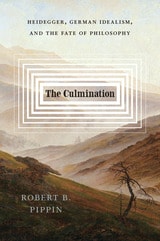
The Culmination
Heidegger, German Idealism, and the Fate of PhilosophyRobert B. Pippin
University of Chicago Press, 2024
Heidegger claimed that Western philosophy ended—failed, even—in the German Idealist tradition. In The Culmination, Robert B. Pippin explores the ramifications of this charge through a masterful survey of Western philosophy, especially Heidegger’s critiques of Hegel and Kant. Pippin argues that Heidegger’s basic concern was to determine sources of meaning for human life, particularly those that had been obscured by Western philosophy’s attention to reason. The Culmination offers a new interpretation of Heidegger, German Idealism, and the fate of Western rationalism.
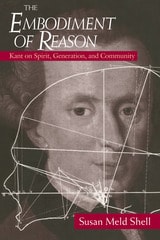
The Embodiment of Reason
Kant on Spirit, Generation, and CommunitySusan Meld Shell
University of Chicago Press, 1996
Shell argues that the central animating issues of Kant's lifework concerned the perplexing relation of spirit to body. Through an exacting analysis of individual writings, Shell maps the philosophical contours of Kant's early intellectual struggles and their relation to his more mature thought. The paradox of mind in matter and the tensions it generates—between freedom and determinacy, independence and community, ideal and real—are shown to inform the whole of his work. Shell's fresh, penetrating analysis of the precritical works will surely catapult them to new prominence in Kant studies.
Shell's critique goes further to consider the context of contemporary intellectual life. She explores the fascinating realm of Kant's sexual and medical idiosyncracies, linking them to the primary concerns of his critical philosophy. She develops a sure-to-be controversial treatment of the connection between Kant's philosophy and his chronic hypochondria, and illuminates previously unforeseen connections in a remarkable convergence of life and thought, with important theoretical and practical implications for modern times.
The Genesis of Kant's Critique of Judgment
John H. Zammito
University of Chicago Press, 1992
The austerity and grandeur of Kant's philosophical writings sometimes make it hard to recognize them as the products of a historical individual situated in the particular constellation of his time and society. Here Kant emerges as a concrete historical figure struggling to preserve the achievements of cosmopolitan Aufkl-rung against challenges in natural science, religion, and politics in the late 1780s. More specifically Zammito suggests that Kant's Third Critique was animated throughout by a fierce personal rivalry with Herder and by a strong commitment to traditional Christian ideas of God and human moral freedom.
"A work of extraordinary erudition. Zammito's study is both comprehensive and novel, connecting Kant's work with the aesthetic and religious controversies of the late eighteenth century. He seems to have read everything. I know of no comparable historical study of Kant's Third Critique."-Arnulf Zweig, translator and editor of Kant's ;IPhilosophical Correspondence, 1759-1799;X
"An intricate, subtle, and exciting explanation of how Kant's thinking developed and adjusted to new challenges over the decade from the first edition of the Critique of Pure Reason to the appearance of the Critique of Judgment."—John W. Burbidge, Review of Metaphysics
"There has been for a long time a serious gap in English commentary on Kant's Critique of Judgment; Zammito's book finally fills it. All students and scholars of Kant will want to consult it."—Frederick Beiser, Times Literary Supplement
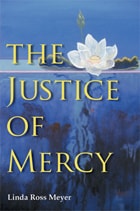
The Justice of Mercy
Linda Ross Meyer
University of Michigan Press, 2010
"The Justice of Mercy is exhilarating reading. Teeming with intelligence and insight, this study immediately establishes itself as the unequaled philosophical and legal exploration of mercy. But Linda Meyer's book reaches beyond mercy to offer reconceptualizations of justice and punishment themselves. Meyer's ambition is to rethink the failed retributivist paradigm of criminal justice and to replace it with an ideal of merciful punishment grounded in a Heideggerian insight into the gift of being-with-others. The readings of criminal law, Heideggerian and Levinasian philosophy, and literature are powerful and provocative. The Justice of Mercy is a radical and rigorous exploration of both punishment and mercy as profoundly human activities."
---Roger Berkowitz, Director of the Hannah Arendt Center for Ethical and Political Thinking, Bard College
"This book addresses a question both ancient and urgently timely: how to reconcile the law's call to justice with the heart's call to mercy? Linda Ross Meyer's answer is both philosophical and pragmatic, taking us from the conceptual roots of the supposed conflict between justice and mercy to concrete examples in both fiction and contemporary criminal law. Energetic, eloquent, and moving, this book's defense of mercy will resonate with philosophers, legal scholars, lawyers, and policymakers engaged with criminal justice, and anyone concerned about our current harshly punitive legal system."
---Carol Steiker, Harvard Law School
"Far from being a utopian, soft and ineffectual concept, Meyer shows that mercy already operates within the law in ways that we usually do not recognize. . . . Meyer's piercing insights and careful analysis bring the reader to think of law, justice, and mercy itself in a new and far more profound light."
---James Martel, San Francisco State University
How can granting mercy be just if it gives a criminal less punishment than he "deserves" and treats his case differently from others like it? This ancient question has become central to debates over truth and reconciliation commissions, alternative dispute resolution, and other new forms of restorative justice. The traditional response has been to marginalize mercy and to cast doubt on its ability to coexist with forms of legal justice.
Flipping the relationship between justice and mercy, Linda Ross Meyer argues that our rule-bound and harsh system of punishment is deeply flawed and that mercy should be, not the crazy woman in the attic of the law, but the lady of the house. This book articulates a theory of punishment with mercy and illustrates the implications of that theory with legal examples drawn from criminal law doctrine, pardons, mercy in military justice, and fictional narratives of punishment and mercy.
Linda Ross Meyer is Carmen Tortora Professor of Law at Quinnipiac University School of Law; President of the Association for the Study of Law, Culture and the Humanities; and Associate Editor of Journal of Law, Culture and the Humanities.
The Linguistic Dimension of Kant's Thought
Historical and Critical EssaysEdited by Frank Schalow and Richard Velkley
Northwestern University Press, 2014
Among modern philosophers, Immanuel Kant (1724–1804) has few rivals for his influence over the development of contemporary philosophy as a whole. While the issue of language has become a key fulcrum of continental philosophy since the twentieth century, Kant has been overlooked as a thinker whose breadth of insight has helped to spearhead this advance.
The Linguistic Dimension of Kant’s Thought remedies this historical gap by gathering new essays by distinguished Kant scholars. The chapters examine the many ways that Kant’s philosophy addresses the nature of language. Although language as a formal structure of thought and expression has always been part of the philosophical tradition, the “linguistic dimension” of these essays speaks to language more broadly as a practice including communication, exchange, and dialogue.

The Moment of Racial Sight
A HistoryIrene Tucker
University of Chicago Press, 2012
The Nonsense of Kant and Lewis Carroll
Unexpected Essays on Philosophy, Art, Life, and DeathBen-Ami Scharfstein
University of Chicago Press, 2014
Scharfstein begins with essays on the nature of philosophy itself, moving from an autobiographical account of the trials of being a comparativist to philosophy’s function in the outside world to the fear of death in Kant and Hume. From there he explores an impressive array of art: from China and Japan to India and the West; from an essay on sadistic and masochistic body art to one on the epistemology of the deaf and the blind. He then returns to philosophy, writing on Machiavelli and political ruthlessness, then on the ineffable, and closes with a review of Walter Kaufmann’s multivolume look at the essence of humanity, Discovering the Mind. Altogether, these essays are a testament to adventurous thought, the kind that leaps to the furthest reaches of the possible.
The Notion of the A Priori
Mikel Dufrenne
Northwestern University Press, 2009
Originally published in 1966, this pivotal work of Mikel Dufrenne revises Kant’s notion of a priori, a concept previously given insufficient attention by philosophers, to realize a rich understanding that finally does justice to one of Kant’s most troubling cruxes. Following the Husserlian analytics of phenomenology, Dufrenne postulates a dualistic conception of the a priori as a structure that expresses itself outside the human subject, but also as a virtual knowledge that points to a philosophy of immediate apprehension or feeling. A friend of Paul Ricoeur, with whom he was detained as a prisoner of war during World War II, Dufrenne’s work until now has been sorely overlooked by American philosophers.
The Origins of the Philosophy of Symbolic Forms
Kant, Hegel, and CassirerDonald Phillip Verene
Northwestern University Press, 2012
Verene takes as his departure point that Cassirer never wishes to argue Kant over Hegel. Instead he takes from each what he needs, realizing that philosophical idealism itself did not stop with Kant but developed to Hegel, and that much of what remains problematic in Kantian philosophy finds particular solutions in Hegel’s philosophy. Cassirer never replaces transcendental reflection with dialectical speculation, but he does transfer dialectic from a logic of illusion, that is, the form of thinking beyond experience as Kant conceives it in the Critique of Pure Reason, to a logic of consciousness as Hegel employs it in the Phenomenology of Spirit. Cassirer rejects Kant’s thing-in-itself but he also rejects Hegel’s Absolute as well as Hegel’s conception of Aufhebung. Kant and Hegel remain the two main characters on his stage, but they are accompanied by a large secondary cast, with Goethe in the foreground. Cassirer not only contributes to Goethe scholarship, but in Goethe he finds crucial language to communicate his assertions. Verene introduces us to the originality of Cassirer’s philosophy so that we may find access to the riches it contains.
The Powers of Pure Reason
Kant and the Idea of Cosmic PhilosophyAlfredo Ferrarin
University of Chicago Press, 2015
Ferrarin blows the dust off of two egregiously overlooked sections of the First Critique—the Transcendental Dialectic and the Doctrine of Method. There he discovers what he argues is the Critique’s greatest achievement: a conception of the unity of reason and an exploration of the powers it has to reach beyond itself and legislate over the world. With this in mind, Ferrarin dismantles the common vision of Kant as a philosopher writing separately on epistemology, ethics, and aesthetics and natural teleology, showing that the three Critiques are united by this underlying theme: the autonomy and teleology of reason, its power and ends. The result is a refreshing new view of Kant, and of reason itself.
Themes in Kant's Metaphysics and Ethics
Arthur Melnick
Catholic University of America Press, 2004
Thinking and the I
Hegel and the Critique of KantAlfredo Ferrarin
Northwestern University Press, 2019
What is the relation between thinking and the I that thinks? And what is the relation between thought and reality? The ordinary view shared by modern philosophers from Descartes to Kant, as well as by common sense, is that there is only thought when someone thinks something, and thoughts and concepts are mental acts that refer to objects outside us.
In Thinking and the I: Hegel and the Critique of Kant, Alfredo Ferrarin shows that Hegel’s philosophy entails a radical criticism of this ordinary conception of thinking. Breaking with the habitual presuppositions of both modern philosophy and common sense, Ferrarin explains that thought, negation, truth, reflection, and dialectic for Hegel are not properties of an I and cannot be reduced to the subjective activity of a self-conscious subject. Rather, he elucidates, thought is objective for Hegel in different senses. Reality as a whole is animated by a movement of thought and an unconscious logic as a spontaneity that reifies itself in determinate forms. Ferrarin concludes the book with a comprehensive comparison of Hegel’s and Kant’s concepts of reason.
While it mainly focuses on Hegel’s Phenomenology, Science of Logic, and Encyclopaedia, this ambitious book covers all aspects of Hegel’s philosophy. Its originality and strength lie in its recovery of the original core of Hegel’s dialectic over and above its currently predominant transcendental, neopragmatist, or realist appropriations. It will be essential reading for all students of Hegel, Kant, and German idealism in general for years to come.
Transculturality and German Discourse in the Age of European Colonialism
Chunjie Zhang
Northwestern University Press, 2017