Results by title
622 books match the query 'Language Study' and 93 start with t
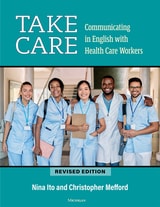
Take Care
Communicating in English with Health Care WorkersNina Ito and Christopher Mefford
University of Michigan Press, 2023
A high level of communicative skills are essential and expected for health care workers. Take Care is designed to give readers the strategies and tools to build, maintain, and repair communication within interactions that take place in health care settings. It is designed for students who are enrolled in health care training as well as nurses or health care workers who are already on the job but may want to improve their English. This text is designed to provide readers with a firm grasp of verbal and non-verbal communication strategies for more successful interactions. It will also help readers develop strategic competence by asking them to practice formulaic phrases needed to get things done. Carefully selected situations will also help readers to understand some of the social situations health care workers need to prepare for, such as apologizing, expressing condolences, or giving advice.
Take Care breaks each unit into the following sections to teach readers new skills:
- Listening for Language
- Dialogue
- Vocabulary
- Communication Strategy
- Pronunciation
- Dialogue Review
- Role Plays
- End-of-Unit Discussion
- Culture Point
This revised edition is updated to include information about pandemics, vaccines, and other medical developments. Audio files for the listening activities are available online.

Take Care
Communicating in English with U.S. Health Care WorkersNina Ito and Christopher Mefford
University of Michigan Press, 2011
Take Care was written to help nursing students and other health care workers communicate better in health care settings, with a focus on improving speaking and listening skills, vocabulary, and pronunciation. The aim was to provide users with the tools and specific communication strategies to build, maintain, or repair interactions that take place on the job. This book is also designed to develop the pragmatic competence necessary to get things done on the job and to understand some of the social situations required by health care workers, like expressing condolences or giving advice.
The individuals most likely to benefit from the material in the book are:
- Nursing students enrolled in community college (e.g., pre-nursing courses or RN students who have a special class)
· ESL students enrolled in specific CNA or medical assistant classes
· ESL students enrolled in U.S. universities who are here to learn more about nursing or health care as profession (they may or may not already have a degree in their own countries)
· Nurses or health care workers who already work in a health care setting but who are not proficient in English and so may be taking an English course sponsored by the hospital or local health system
It is therefore generally assumed that students have some knowledge of common medical and health care terms, so the book does not attempt to teach medical terminology, except in the context of communicating effectively in a health care setting. The various Vocabulary sections in each unit can therefore be used as review or as a new lesson—whatever works best for your students.
Instructors using this book do not need knowledge of the field of nursing or health care because the majority of material covered focuses on the language, not the industry.
Talk to Me in Cantonese
Betty Hung
Hong Kong University Press, 2019
Task-Based Listening
What Every ESL Teacher Needs to KnowSteven Brown
University of Michigan Press, 2019
Teacher's Answer Pack for The Official MET Go! Practice Test Book
Michigan Language Assessment
University of Michigan Press, 2019
The MET Go! is intended for early adolescents at the middle school to lower-secondary school level who want to measure their general English language proficiency in a variety of linguistic contexts. The test results can be used for educational purposes, such as when finishing an English language course, as a motivational tool to encourage students as they progress in their English study, or as a supporting credential for youth opportunities requiring English skills. It may also be used as a bridge to a higher-level exam such as the MET.
The Teacher’s Answer Pack for The Official MET Go! Practice Test Book includes:
- answer keys
- audio transcripts for the Listening practice tests
- Writing test responses with commentary for two of the practice tests
- examiner instructions and script for the Speaking test prompts
- selected practice test vocabulary lists
- a progress tracking log for recording practice test scores
- actual test form instructions and a sample answer sheet
Teacher’s Manual for Norsk, nordmenn og Norge 1
Beginning NorwegianKathleen Stokker
University of Wisconsin Press, 1981
This teacher's manual was written to accompany the textbook Norsk, nordemenn og Norge, published by the University of Wisconsin Press (text ISBN 0-299-08690-9)
Teaching Academic Writing in the Health Sciences
A Guide for Instructors, Mentors, and TrainersElla August
University of Michigan Press, 2026
Part 1 offers the pedagogical basis teachers need to apply best practices, as well as:
- Tips for collaborative writing and writing productivity
- Strategies for using generative artificial intelligence (AI) technology in teaching and writing
- Open-access resources and instruction planning activities
Part 2 focuses on the steps of writing a scientific paper, offering:
- A strong foundation in the structure of and strategies for successful writing
- Customizable teaching materials on how to write a scientific paper
- Strategies for planning a paper, crafting writing to reach readers, developing persuasive arguments, and building a successful author team
- How-to write each section of a paper, from the title to the conclusion
- Guidance on navigating the publishing process, including selecting the appropriate journal and effectively responding to peer-reviewer comments
Teaching College Writing to Diverse Student Populations
Dana R. Ferris
University of Michigan Press, 2013
Statistical and anecdotal evidence documents that even states with relatively little ethnic or cultural diversity are beginning to notice and ask questions about long-term resident immigrants in their classes. As shifts in student population become more widespread, there is an even greater need for second language specialists, composition specialists, program administrators, and developers in colleges and universities to understand and adapt to the needs of the changing student audience(s).
Teaching English as a Foreign or Second Language, Second Edition
A Teacher Self-Development and Methodology GuideJerry G. Gebhard
University of Michigan Press, 2006
The second edition of Teaching English as a Foreign or Second Language includes a wider range of examples to coincide with a variety of teaching contexts-from K-12 schools, to university intensive language programs and refugee programs. It is also updated with discussions of technology throughout, and it considers ways in which technology can be used in teaching language skills. Sources for further study are included in each chapter and in the appendixes.
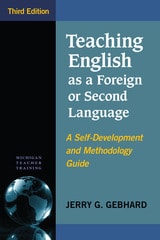
Teaching English as a Foreign or Second Language, Third Edition
A Self-Development and Methodology GuideJerry G. Gebhard
University of Michigan Press, 2017
This edition has the same three major sections: (1) Self-Development, Exploration, and Settings; (2) Principles of EFL/ESL Teaching; and (3) Teaching Language Skills. New to this edition are:
- a chapter on digital literacy, technology, and teaching
- the addition of technology issues as they relate to the teaching of the various skills in Part 3
- discussions of task-based teaching, student presentations, how corpus linguistics can inform teaching, metacognitive reading strategies, collaborative writing, assessing writing, and the teaching of grammar.
Teaching Foreign Language Skills
Second EditionWilga M. Rivers
University of Chicago Press, 1981
Teaching Speaking Online
What Every ESL Teacher Needs to KnowPamela S.H. Bogart
University of Michigan Press, 2020
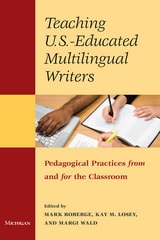
Teaching U.S.-Educated Multilingual Writers
Pedagogical Practices from and for the ClassroomMark Roberge, Kay M. Losey, Margi Wald
University of Michigan Press, 2015
All of the contributors are teachers who are writing about and reflecting on their own experiences and outcomes and interweaving those experiences and outcomes with current theory and research in the field. The volume thus portrays teachers as active, reflective participants engaged in critical inquiry. Contributors represent community college, college, and university contexts; academic ESL, developmental writing, and first-year composition classes; and face-to-face, hybrid, and online contexts.
This book was developed primarily to meet the needs of practicing writing teachers in college-level ESL, basic writing, and college composition classrooms, but will also be useful to pre-service teachers in TESOL, Composition, and Education graduate programs.
Teaching Vocabulary Is the Writing Teacher's Job
Why and HowKeith S. Folse
University of Michigan Press, 2020
Teaching Writing That Works
A Group Approach to Practical EnglishEric S. Rabkin and Macklin Smith
University of Michigan Press, 1990
Teaching for a Better World
Cultivating Social-Emotional Learning in English Language PedagogyEdited by Luis Javier Pentón Herrera, Gilda Martínez-Alba, and Michal B. Paradowski
University of Michigan Press, 2026
In a world where language connects people across cultures, Teaching for a Better World invites readers to imagine classrooms where words do more than teach grammar; they build empathy, resilience, and understanding. This groundbreaking volume is the first to focus on the integration of social-emotional learning (SEL) into English language teaching from a global perspective, bringing together educators and researchers from diverse cultural and educational contexts. Through conceptual discussions, research, and practical examples, the authors demonstrate how English lessons can also be lessons in compassion, collaboration, and global citizenship.
Organized into three sections—Conceptual Pieces, Empirical Studies, and Practical Examples—the book offers a comprehensive examination of SEL’s theoretical foundations, evidence-based practices, and real-world classroom applications. Contributors explore SEL through lenses such as culturally responsive pedagogy, trauma-sensitive practices, teacher and student well-being, ecolinguistics, and intercultural dialogue. Readers will find innovative and practical ways to create inclusive, culturally responsive classrooms; support student and teacher well-being; and use English as a bridge for intercultural dialogue. Accessible and inspiring, this book’s combination of conceptual depth, empirical rigor, and applied strategies position it as a foundational resource for advancing research and practice in SEL-informed English language pedagogy worldwide.
Readers of Teaching for a Better World will
- Learn pedagogically sound ways to foster empathy and resilience while creating inclusive, culturally responsive classrooms.
- Find ready-to-use lesson plans and activities.
- Encounter diverse perspectives of educators from a range of contexts, including conflict-affected regions, refugee resettlement contexts, and higher education.
Teaching the Pronunciation of English
Focus on Whole CoursesJohn Murphy, Editor
University of Michigan Press, 2017
Teaching the Pronunciation of English illustrates that pronunciation teaching is compatible with communicative, task-based, post-method, and technology-mediated approaches to language teaching. This theme permeates the volume as a whole and is well represented in Chapters 3-12, which are dedicated to specialist-teachers’ firsthand depictions of pronunciation-centered courses. Each of these ten chapters features a set of innovative teaching strategies and contemporary course design structures developed by the chapter contributor(s).
To prepare readers to more fully appreciate the substance and quality of Chapters 3-12, the volume’s two initial chapters are more foundational. Chapters 1 and 2 provide an overview of core topics language teachers need to know about to become pronunciation teachers: suprasegmentals (thought groups, prominence, word stress, intonation, and pitch jumps) and the English consonants and vowel sounds.
Technology for the Process
Teaching Academic Writing to Multilingual Students in the Age of AIM. Sidury Christiansen and Qian Du
University of Michigan Press, 2027
As digital tools and artificial intelligence (AI) reshape how writing is taught and learned, instructors face new questions about how to integrate technology without losing sight of sound pedagogy. Technology for the Process offers a research-informed and practice-driven response. Written by experienced writing teachers, the book presents ready-to-use, adaptable, classroom-tested approaches for teaching academic writing to multilingual students through purposeful use of digital tools, including generative AI. Rather than treating technology as an add-on or a substitute for instruction, the book shows how it can meaningfully support writing as a process: from generating ideas and revising drafts to making rhetorical decisions and developing academic voice. Designed for university-level and adult learning contexts, this book serves as both a practical resource and a thoughtful guide for educators, librarians, and institutions seeking accessible, effective, and sustainable approaches to writing instruction in the age of AI.
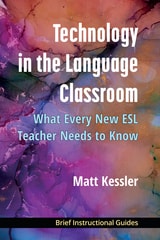
Technology in the Language Classroom
What Every New ESL Teacher Needs to KnowMatt Kessler
University of Michigan Press, 2026
Technology in the Language Classroom provides early-career and pre-service second language (L2) instructors with an overview of important issues involved in effectively integrating technology into the L2 classroom. Each chapter provides practical strategies, resources, and application activities to help new teachers gain familiarity with utilizing a variety of digital tools for teaching different skills, including listening, speaking, reading, grammar, vocabulary, and writing. Readers will be encouraged to think critically about the key factors to consider when choosing tools that work for them, their lessons, and their students.

Television Drama in Spain and Latin America
Genre and Format TranslationPaul Julian Smith
University of London Press, 2018
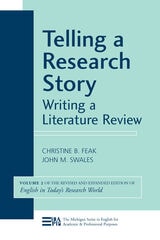
Telling a Research Story
Writing a Literature ReviewChristine B. Feak and John M. Swales
University of Michigan Press, 2009
Telling a Research Story: Writing a Literature Review is concerned with the writing of a literature review and is not designed to address any of the preliminary processes leading up to the actual writing of the literature review.
This volume represents a revision and expansion of the material on writing literature reviews that appeared in English in Today's Research World.
This volume progresses from general to specific issues in the writing of literature reviews. It opens with some orientations that raise awareness of the issues that surround the telling of a research story. Issues of structure and matters of language, style, and rhetoric are then discussed. Sections on metadiscourse, citation, and paraphrasing and summarizing are included.
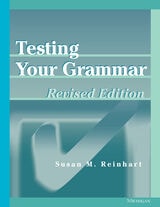
Testing Your Grammar, Revised Edition
Susan M. Reinhart
University of Michigan Press, 2002
With all units enlarged or significantly modified, the new and improved edition of Testing Your Grammar features reworked grammatical explanations and more example sentences so grammar points are easier to understand. Other features of the new edition:
- Explanations have been added to the answer key.
- A review test is found at the end of every two units.
- At the end of the book are four examinations that can be used for either pre-testing or post-testing.

Textbook of Israeli Hebrew
Haiim B. Rosén
University of Chicago Press, 1976
The work is organized into sections that can be worked through in an academic year—presentation of features, text samples, exercises, grammatical synopses, and individual and comprehensive glossaries. This text may be used by teachers without specialized training in linguistics. It can be used by self-teaching students as well as by those at college level, and it will valuable for immigrants to Israel.
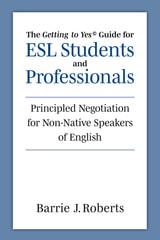
The "Getting to Yes" Guide for ESL Students and Professionals
Principled Negotiation for Non-Native Speakers of EnglishBarrie J. Roberts
University of Michigan Press, 2024
The Getting to Yes Guide for ESL Students and Professionals prepares non-native speakers of English to join the global community of people who use Getting to Yes to negotiate win-win agreements in English. It provides page-by-page explanations of over 1,000 words, phrases, concepts, and examples that these readers may misunderstand; short stories that use these new words and concepts to help readers apply them to new contexts; delightful cartoons to highlight main ideas; optional ESL activities; and a glossary of the key negotiation idioms and terms used in Getting to Yes. In this guide, author Barrie J. Roberts applies her experience as a public interest attorney, court Alternative Dispute Resolution administrator, ESL instructor, and court interpreter trainer to help readers improve their professional-level English along with their negotiation skills.
Benefits for teachers:
- Each Chapter Guide provides a ready-made lesson plan with activities to do before, while, and after reading each chapter of Getting to Yes
- The book can be used as a recommended self-study reference
- This book can be used for selected chapters of Getting to Yes or for a complete standalone course on Getting to Yes for non-native speakers of English or Generation 1.5 students
- Optional activities throughout the book can be assigned for in or out of the classroom. These include activities for reading comprehension, vocabulary building, paraphrasing, critical thinking, discussing, and writing
- Short stories written to accompany each chapter require students to apply new vocabulary and negotiation concepts to real-world disputes
The Afterlife of Virgil
Edited by P Mack and John North
University of London Press, 2017
The Ahhiyawa Texts
Gary M. Beckman
SBL Press, 2011
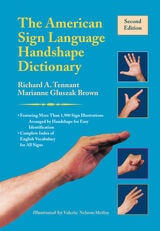
The American Sign Language Handshape Dictionary
Richard A. Tennant
Gallaudet University Press, 2020
Featuring
•More than 1,900 Sign Illustrations Including 327 New Signs•Plus DVD Showing How to Form Signs
•Arranged by Handshape for Easy Identification
•Complete Index of English Vocabulary for All Signs
•An Introduction to Deaf Culture and ASL Structure
The first reference source that allows users to access ASL signs without previous knowledge of their English equivalents (far superior to those in most other English-ASL glossaries). Likely to become indispensable on many educators’ and students’ bookshelves.—CHOICE
Now, the bestselling resource The American Sign Language Handshape Dictionary has been completely revised with more than 320 new signs and a new DVD. This unique reference can help users locate a sign whose meaning they have forgotten, or help them find the meaning of a new sign they have just seen for the first time. It organizes more than 1,900 ASL signs by 40 basic handshapes and includes detailed descriptions on how to form these signs to represent the different English words that they might mean. ASL students can begin to track down a sign by determining whether it is formed with one hand or two. Further distinctions of handshape, palm orientation, location, movement, and other nonmanual body signals help them pinpoint their search while also refining their grasp of ASL syntax and grammar. A complete English word index provides the option of referring to an alphabetical listing of English terms to locate an equivalent sign or choice of signs.
The new DVD shows how each sign is formed from beginning to end. Users can watch a sign at various speeds to learn precisely how to master it themselves. Together, the new edition of The American Sign Language Handshape Dictionary and its accompanying DVD presents students, sign language teachers, and deaf and hearing people alike with the perfect combination for enhancing communication skills in both ASL and English.

The Arabic Language
Its Role in HistoryAnwar G. Chejne
University of Minnesota Press, 1969
The Arabic Language was first published in 1969. Minnesota Archive Editions uses digital technology to make long-unavailable books once again accessible, and are published unaltered from the original University of Minnesota Press editions.
Arabic, with its rich literary heritage, is one of the major languages of the world. It is spoken by about one hundred million people inhabiting a wide and important area of the Middle East. Yet the language and its significant role in history are little known in the English-speaking countries except among specialists. This book will, it is hoped, help to introduce the language and demonstrate its importance to a wider audience.
Professor Philip K. Hitti of Princeton University writes in the foreword: "Until recently Arabic studies in this country had been limited to the graduate level and confined to a few universities. Since World War II they have inched their way to the undergraduate curriculum of a small number of universities. But they are still top-heavy and anemic. They will so remain unless they send their roots deeper down into high schools and enlist the interest of a widening circle of nonspecialists.
"Hence the value of this work by Professor Chejne. It is a commendable attempt to introduce the Arabic language, with its features and problems, to students and nonspecialists, to tell the story of its dramatic evolution from a tribal dialect to one of the few carriers of world culture, to indicate its unique relation to the religion of Islam and its role in the development of modern Arab nationalism. The book, written in a language intelligible to the layman, sums up what is already known and presents the contribution of the author."
The Arapaho Language
Andrew Cowell
University Press of Colorado, 2015
Cowell and Moss detail strategies used by speakers of this highly polysynthetic language to form complex words and illustrate how word formation interacts with information structure. They discuss word order and discourse-level features, treat the special features of formal discourse style and traditional narratives, and list gender-specific particles, which are widely used in conversation. Appendices include full sets of inflections for a variety of verbs.
Arapaho is spoken primarily in Wyoming, with a few speakers in Oklahoma. The corpus used in The Arapaho Language spans more than a century of documentation, including multiple speakers from Wyoming and Oklahoma, with emphasis on recent recordings from Wyoming. The book cites approximately 2,000 language examples drawn largely from natural discourse - either recorded spoken language or texts written by native speakers.
With The Arapaho Language, Cowell and Moss have produced a comprehensive document of a language that, in its departures from its nearest linguistic neighbors, sheds light on the evolution of grammar.
The Art of Teaching Speaking
Research and Pedagogy for the ESL/EFL ClassroomKeith S. Folse
University of Michigan Press, 2006
*Which tasks or activities really help build speaking fluency?
*What does the research show regarding speaking activities?
*What mistakes do ESL teachers often make in speaking activity design?
In this highly accessible and practical resource, Keith S. Folse provides a wealth of information to help ESL/EFL teachers design and use speaking tasks that will actually improve students' speaking fluency. The book presents and discusses the relevant research and assessment issues and includes case studies from twenty different settings and classrooms around the world so that readers learn from others about the problems and successes of using various speaking activities.
Teachers will find the chapters on Twenty Successful Activities and Ten Unsuccessful Activities particularly valuable. The successful activities are provided for classroom use and are reproducible. The book also contains five appendixes that explain what teachers need to know about vocabulary, pronunciation, and grammar and how they affect the teaching of speaking. Samples of successful lesson plans and a list of resources useful for teaching speaking are also included.
Keith S. Folse, Ph.D., is Coordinator, TESOL Programs, University of Central Florida (Orlando). He is the author of Vocabulary Myths (University of Michigan Press, 2004) and more than 35 second language textbooks, including texts on grammar, reading, speaking, listening, and writing.
The Article Book
Practice toward Mastering a, an, and theTom Cole
University of Michigan Press, 2000
A comprehensive guide and workbook for improving ESL/EFL students' understanding of English articles, The Article Book can be used as either a supplement to any ESL/EFL core text or as a self-study tool for intermediate through advanced learners. Cole involves students in "learning by doing" through an integrated approach to skill acquisition that includes other grammar structures, reading, vocabulary, and speaking. Each chapter of the book is organized into teachable units or lessons and includes presentation of a grammatical rule with examples, exercises, quizzes, and a comprehensive test. While the fifty rules (and fifteen exceptions) are taught to provide a logical framework for the text and serve as a handy reference, students will learn through guided practice instead of memorization.
The Basque Language
A Practical IntroductionAlan R. King
University of Nevada Press, 2012
The Best of the Grammarians
Aristarchus of Samothrace on the IliadFrancesca Schironi
University of Michigan Press, 2018
Francesca Schironi presents a more robust picture of Aristarchus as a scholar than anyone has offered previously. Based on her analysis of over 4,300 fragments from his commentary on the Iliad, she reconstructs Aristarchus’ methodology and its relationship to earlier scholarship, especially Aristotelian poetics. Schironi departs from the standard commentary on individual fragments, and instead organizes them by topic to produce a rigorous scholarly examination of how Aristarchus worked.
Combining the accuracy and detail of traditional philology with a big-picture study of recurrent patterns and methodological trends across Aristarchus’ work, this volume offers a new approach to scholarship in Alexandrian and classical philology. It will be the go-to reference book on this topic for many years to come, and will usher in a new way of addressing the highly technical work of ancient scholars without losing philological accuracy. This book will be valuable to classicists and philologists interested in Homer and Homeric criticism in antiquity, Hellenistic scholarship, and ancient literary criticism.
The Bible in Greek
Translation, Transmission, and Theology of the SeptuagintSiegfried Kreuzer
SBL Press, 2015
This volume presents English and German papers that give an overview on important stages, developments, and problems of the Septuagint and the research related to it. Four sections deal with the cultural and theological background and beginnings of the Septuagint, the Old Greek and recensions of the text, the Septuagint and New Testament quotations, and a discussion of Papyrus 967 and Codex Vaticanus.
Features:
- A complete list of Kreuzer’s publications on the text and textual history of the Hebrew Bible and the Septuagint
- Criteria for analysis of the Antiochene/Lucianic Text and the Kaige-Recension
- A close examination of the origins and development of the Septuagint in the context of Alexandrian and early Jewish culture and learning
The Carnivalesque Defunto
Death and the Dead in Modern Brazilian LiteratureRobert H. Moser
Ohio University Press, 2008
Robert H. Moser details the emergence of a prominent motif in modern Brazilian literature, namely the carnivalesque defunto (the dead) that, in the form of a protagonist or narrator, returns to beseech, instruct, chastise, or even seduce the living. Drawing upon the works of esteemed Brazilian writers such as Machado de Assis, Érico Veríssimo, and Jorge Amado, Moser demonstrates how the defunto, through its mocking laughter and Dionysian resurrection, simultaneously subverts and inverts the status quo, thereby exposing underlying points of tension within Brazilian social and political history.
Incorporating elements of both a celestial advocate and an untrustworthy specter, the defunto also serves as a metaphor for one of modern Brazil’s greatest dilemmas: reconciling the past with the present.
The Carnivalesque Defunto offers a comparative framework by juxtaposing the Brazilian literary ghost with other Latin American, Caribbean, and North American examples. It also presents a cross-disciplinary approach toward understanding the complex relationship forged between Brazil’s spiritual traditions and literary expressions.
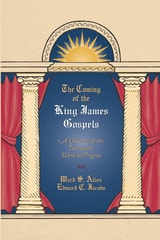
The Coming of the King James Gospels
A Collection of the Translators’ Work-in-ProgressWard S. Allen
University of Arkansas Press, 1994
The Coming of the King James Gospels is a primary publication exploring the handwritten annotations of the Oxford New Testament Company, made as members completed Matthew, Mark, Luke, and John. Their original edited pages, gathered into one binding as the Bodleian Bishops’ Bible ([1602] b.1), offer us the only known surviving record of their monumental work.
Ward Allen’s painstakingly produced collation of this Bishops’ Bible is available for the first time in acessible visual layout. It allows a reader to study simultaneously the three texts, that of the original Bishops’ Bible, the revisions suggested for the 1602 text, and the final King James version of the Gospels. Rejected readings reveal the reasoning which led to the wording of the final text. Beautifully produced, The Coming of the King James Gospels is now a prime resource for all students of the Bible and the English language.
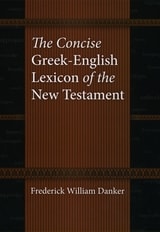
The Concise Greek-English Lexicon of the New Testament
Frederick William Danker
University of Chicago Press, 2009
Frederick William Danker, a world-renowned scholar of New Testament Greek, is widely acclaimed for his 2000 revision of Walter Bauer’s A Greek-English Lexicon of the New Testament and Other Early Christian Literature. With more than a quarter of a million copies in print, it is considered the finest dictionary of its kind.
Danker’s Concise Greek-English Lexicon of the New Testament will prove to be similarly invaluable to ministers, seminarians, translators, and students of biblical Greek. Unlike other lexica of the Greek New Testament, which give only brief glosses for headwords, The Concise Greek-English Lexicon offers extended definitions or explanations in idiomatic English for all Greek terms.
Each entry includes basic etymological information, short renderings, information on usage, and plentiful biblical references. Greek terms that could have different English definitions, depending on context, are thoughtfully keyed to the appropriate passages. An overarching aim of The Concise Greek-English Lexicon is to assist the reader in recognizing the broad linguistic and cultural context for New Testament usage of words.
The Concise Greek-English Lexicon retains all the acclaimed features of A Greek-English Lexicon in a succinct and affordable handbook, perfect for specialists and nonspecialists alike.
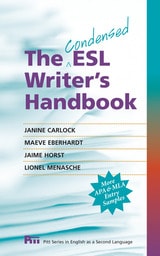
The Condensed ESL Writer's Handbook
Janine Carlock, Maeve Eberhardt, Jaime Horst, Lionel Menasche
University of Michigan Press, 2013
The CondensedESL Writer’s Handbook is a reference work for ESL students who are taking college-level courses. Because its purpose is to provide help with the broad variety of writing questions students may have when working on school assignments, the text focuses on English for Academic Purposes. Unlike other handbooks on the market, this book’s sole purpose is to address the issues of primary importance to language learners.
The Condensed Handbook complements a student writer’s dictionary, thesaurus, and grammar reference book. It would be suitable as a text for an advanced ESL writing course.
The Condensed Handbook is concise and easily navigated; is accessible, with clear and direct explanatory language; and limits its focus to the grammatical and style aspects of writing and reference material.
Included as special features in the Condensed Handbook are:
• The explanatory language is appropriate for ESL students, in contrast to the more complex and idiomatic language of other English handbooks.
• The level of detail is more manageable for ESL students, compared to what is in other English handbooks.
• Many of the examples of paragraphs and exercise sentences were written by ESL students; this encourages users of this Handbook to realize that they too can also become effective writers.
• Additional samples of MLA and APA reference entries.
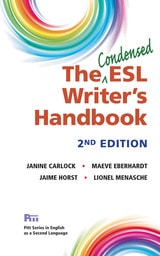
The Condensed ESL Writer's Handbook, 2nd Ed.
Janine Carlock, Maeve Eberhardt, Jaime Horst, and Lionel Menasche
University of Michigan Press, 2018
The Condensed version is concise and easily navigated; is accessible with clear and direct explanatory language; and limits its focus to the grammatical and style aspects of writing and reference material.
The 2nd Edition of The Condensed ESL Writer’s Handbook has been revised to better align with the exercises in Workbook for The ESL Writer’s Handbook, 2nd Ed.(978-0-472-03726-1). It also features an expanded Section 1 (to include more on pre-writing, drafting, revising, and editing), updated exercise items, and completely revised APA and MLA style guides (featuring MLA, 8th Edition). Overall, this handbook has these special features:
- The topic selection is based on ESL writers’ needs as observed by the authors over many years.
- The coverage of topics is more complete than the limited amount usually provided for ESL writers in first language or L1 handbooks.
- The explanatory language is appropriate for ESL students, in contrast to the more complex and idiomatic language of other English handbooks.
- Many of the text examples and exercise sentences were written by ESL students to help users realize that they too can become effective writers.
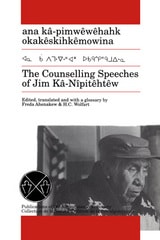
The Counselling Speeches of Jim Ka-Nipitehtew
Freda Ahenakew
University of Manitoba Press, 1998
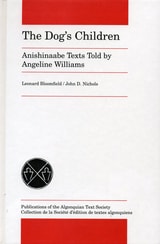
The Dog's Children
Anishinaabe Texts told by Angeline WilliamsLeonard Bloomfield
University of Manitoba Press, 1991
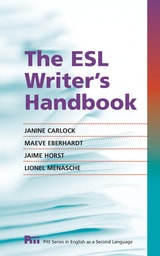
The ESL Writer's Handbook
Janine Carlock, Maeve Eberhardt, Jaime Horst, Lionel Menasche
University of Michigan Press, 2010
The ESL Writer’s Handbook is a reference work for ESL students who are taking college-level courses. Because its purpose is to provide help with the broad variety of writing questions students may have when working on school assignments, the text focuses on
English for Academic Purposes. Unlike other handbooks on the market, this book’s sole purpose is to address the issues of second language learners.
This spiral-bound Handbook complements a student writer’s dictionary, thesaurus, and grammar reference book. It would be suitable as a text for an advanced ESL writing course when used together with the companion Workbook (978-0-472-03404-8). The Handbook is concise and easily navigated; is accessible, with clear and direct explanatory language; features information on both APA and MLA styles (including a sample paper for each); and includes many examples from ESL student writers to provide realistic models.
Included as special features in the Handbook are:
• The topic selection is based on ESL writers’ needs as observed by the authors over many years.
• The coverage of topics is more complete than the limited amount usually provided for ESL writers in first language or L1 handbooks.
• The explanatory language is appropriate for ESL students, in contrast to the more complex and idiomatic language of other English handbooks.
• The level of detail is more manageable for ESL students, compared to what is in other English handbooks.
- Many of the examples of paragraphs, essays, research papers, and exercise sentences were written by ESL students; this encourages users of this Handbook to realize that they can also become effective writers.
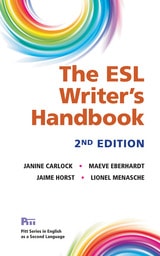
The ESL Writer's Handbook, 2nd Ed.
Janine Carlock, Maeve Eberhardt, Jaime Horst, Lionel Menasche
University of Michigan Press, 2018
The spiral-bound Handbook complements a student writer’s dictionary, thesaurus, and grammar reference book. It would be suitable as a text for an advanced ESL writing course when used together with the companion Workbook (978-0-472-03726-1).
The new edition features significant revisions to Sections 3 and 4; in particular, both APA and MLA style guides have been updated and new sample papers for each are included. The new edition includes new and revised exercises and many new samples of student writing.
Like its predecessor, the 2nd Edition has these special features:
- The topic selection is based on ESL writers’ needs as observed by the authors over many years.
- The coverage of topics is more complete than the limited amount usually provided for ESL writers in first language or L1 handbooks.
- The explanatory language is appropriate for ESL students, in contrast to the more complex and idiomatic language of other English handbooks.
- Many of the examples of paragraphs, essays, research papers, and exercise sentences were written by ESL students to help users realize that they too can become effective writers.
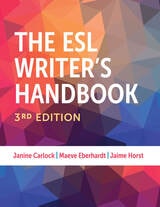
The ESL Writer's Handbook, 3rd Edition
Janine Carlock, Maeve Eberhardt, Jaime Horst
University of Michigan Press, 2025
In addition to updated style guides, sample student papers, writing examples, and exercises, the 3rd edition highlights “tech tips” on different technologies that may be useful to students, explains inclusive language, and expands the section on taking notes as a research tool.
With this handbook, students will learn:
- The concept of genre and apply it to unpacking assignments and writing effectively.
- The process for generating ideas, structuring those ideas into a paper, and checking over a paper before turning it in.
- Five common patterns for organizing an academic essay: narrative, process, comparison/contrast, cause and effect, and argument.
- Different steps for creating a good research paper, including major citation styles.
- Guidance for addressing the grammar, punctuation, and style issues most often encountered by international students writing in English.
- How to differentiate between other types of writing U.S. undergraduate students are expected to complete, such as emails, resumes, cover letters, and personal statements.
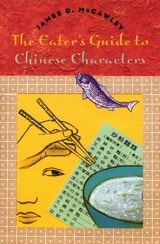
The Eater's Guide to Chinese Characters
James D. McCawley
University of Chicago Press, 1984
With this guide in hand, English speakers hold the key to a world of tantalizing—and otherwise unavailable—Chinese dishes.
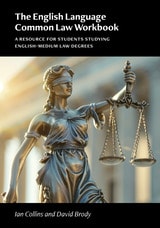
The English Language Common Law Workbook
A Resource for Students Studying English-medium Law DegreesIan Collins and David Brody
University of Michigan Press, 2025
The English Language Common Law Workbook is designed to support students in developing the core competencies necessary for studying in a common law context. It provides readings and exercises based on authentic legal materials for practicing critical reading and writing skills. In particular, it includes an extensive number of statutes and cases and accompanying exercises that give students an opportunity to work with the type of sources they will encounter in English-medium law degree programs. By emphasizing common law principles throughout, the book helps international students coming from non–common law jurisdictions familiarize themselves with how statutes and cases in common law countries are written and structured. Students are supported in critically reading statutes and cases by focusing on key terminology and language structures. Finally, the book supports students in applying the skills they learn to construct basic case briefs and answer hypothetical legal questions using the IRAC structure.
CEFR Levels: B2–C2

The Exegetical Value of the Masoretic Pointing
Jan Joosten
SBL Press, 2020
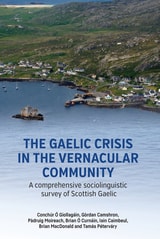
The Gaelic Crisis in the Vernacular Community
A Comprehensive Sociolinguistic Survey of Scottish GaelicConchúr Ó Giollagáin, Gòrdan Camshron, Pàdruig Moireach, Brian Ó Curnáin, Iain Caimbeul, Brian MacDonald and Tamás Péterváry
Aberdeen University Press, 2020
The Genesis of Lachmann's Method
Sebastiano Timpanaro
University of Chicago Press, 2005
This important work, which brought Timpanaro international repute, now appears in its first English translation. The Genesis of Lachmann's Method examines the origin, development, and validity of Lachmann's model as well as its association with Lachmann himself. It remains a fundamental work on the history and methods of philology, and Glenn W. Most's translation makes this seminal study available to an English-speaking audience. Revealing Timpanaro's extraordinary talent as a textual critic and world-class scholar, this book will be indispensable to classicists, textual critics, biblical scholars, historians of science, and literary theorists.

The Germanic Languages
Origins and Early Dialectal InterrelationsHans Frede Nielsen
University of Alabama Press, 1989
The book is especially concerned with the grouping of the Germanic languages: with the research history of this much-debated question and with a discussion of the methods applied to past attempts and indeed applicable to future research in the field.