Results by title
172 books match the query 'Legislative Branch' and 43 start with t
THE INDIRECT EFFECT OF DIRECT LEGISLATION
HOW INSTITUTIONS SHAPE INTEREST GROUP SYSTEMSFREDERICK J BOEHMKE
The Ohio State University Press, 2005
To demonstrate this, the author models the incentives that the initiative process creates for interests to organize and for how they communicate their preferences to policy makers. Interests that represent a broader range of the public are found to gain the most from the option to propose initiatives, implying that the set of organized interests in initiative states should reflect this advantage. Ironically, an effect of direct legislation is to potentially increase the effectiveness of special interest lobbying in state legislatures—in a sense, the opposite of the direct control that gives direct legislation its theoretical appeal. Yet, the clear effect is one of empowering voices that traditionally had very little effect in the legislative process. If greater representation is the goal of direct legislation, it is a clear success, even though that success does not really come in the act of ballot initiatives itself.
THE PRESIDENTIAL AGENDA
SOURCES OF EXECUTIVE INFLUENCE IN CONGRESSROGER T LAROCCA
The Ohio State University Press, 2006
Larocca develops a theoretical model that explains how the president can raise the public salience of issues in his major addresses, long accepted as one of the president’s strongest agenda-setting tools. He also develops a theoretical model that explains how control over executive agency expertise yields a more reliable and persistent influence on the congressional agenda than presidential addresses.
The Presidential Agenda tests these theoretical models with an innovative empirical study of presidential agenda setting. Using data from all House and Senate Commerce Committee bills from 1979 to 2002, Larocca converts information about bills into information about policy issues and then traces the path of presidential influence through the committee and floor stages of legislative consideration.
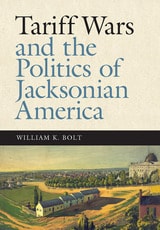
Tariff Wars and the Politics of Jacksonian America
William K. Bolt
Vanderbilt University Press, 2016
The spreading of democracy caused by the tariff evoked bitter sectional controversy among Americans. Northerners claimed they needed a tariff to protect their industries and also their wages. Southerners alleged the tariff forced them to buy goods at increased prices. Having lost the argument against the tariff on its merits, in the 1820s, southerners began to argue the Constitution did not allow Congress to enact a protective tariff. In this fight, we see increased tensions between northerners and southerners in the decades before the Civil War began.
As Tariff Wars reveals, this struggle spawned a controversy that placed the nation on a path that would lead to the early morning hours of Charleston Harbor in April of 1861.
The Adaptability Paradox
Political Inclusion and Constitutional ResilienceStephen Skowronek
University of Chicago Press, 2025
Has American democracy outstripped its constitutional accommodations?
Faith in the resilience and adaptability of the US Constitution rests on a long history of finding new ways to make the system work. In The Adaptability Paradox, political scientist Stephen Skowronek examines the rearrangements that regenerated the American government in the past and brings that experience to bear on our current predicament. He shows how a constitution framed in writing some 230 years ago can run into serious difficulties directly related to its long and impressive history of adaptation.
Skowronek connects questions about the Constitution’s adaptability to the challenges of democratization. For most of American history, serial rearrangements of constitutional relationships widened the government’s purview as a national democracy without giving either nationalism or democracy free rein. Skowronek argues that the politics of adaptation shifted fundamentally with the “Rights Revolution” of the 1960s and `70s when American national democracy approached the inclusion of all its citizens on equal footing. Since then, power and authority have been reconfigured in ways that have steadily magnified conflicts over the essentials of good order. Conservatives aim to dismantle a Constitution that progressives are intent on building upon, and the consensus necessary for a constitutional democracy to function effectively has all but evaporated. No longer a socially bound framework for national action, the Constitution has become an abstract matrix of possibilities, a disembodied opportunity structure open to starkly different, mutually unacceptable futures.
Rather than being liberated by this unbound Constitution, the American people now appear entrapped by it. Is it possible that the development of American democracy has exhausted the adaptive capacities of the Constitution? A timely reminder that constitutional democracies do not survive on faith alone, The Adaptability Paradox is a sober appraisal of the unfamiliar ground on which we now tread.
The American Warfare State
The Domestic Politics of Military SpendingRebecca U. Thorpe
University of Chicago Press, 2014
The Changing Face of Representation
The Gender of U.S. Senators and Constituent CommunicationsKim L. Fridkin and Patrick J. Kenney
University of Michigan Press, 2015
As the number of women in the U.S. Senate grows, so does the number of citizens represented by women senators. At the same time, gender remains a key factor in senators’ communications to constituents as well as in news media portrayals of senators. Focusing on 32 male and female senators during the 2006 congressional election year, Kim L. Fridkin and Patrick J. Kenney examine in detail senators’ official websites, several thousand press releases and local news stories, and surveys of 18,000 citizens to discern constituents’ attitudes about their senators.
The authors conclude that gender role expectations and stereotypes do indeed constrain representational and campaign messages and influence news coverage of both candidates and elected senators. Further, while citizens appear to be less influenced by entrenched stereotypes, they pay more attention to female senators’ messages and become more knowledgeable about them, in comparison to male senators.
The Committee
A Study of Policy, Power, Politics and Obama's Historic Legislative Agenda on Capitol HillBryan W. Marshall and Bruce C. Wolpe
University of Michigan Press, 2018
The Committee
A Study of Policy, Power, Politics and Obama’s Historic Legislative Agenda on Capitol HillBryan W. Marshall and Bruce C. Wolpe
University of Michigan Press, 2021
For three years while serving as a senior adviser to Rep. Henry A. Waxman (D-CA), chairman of the House Committee on Energy and Commerce—one of the most powerful committees in Congress—Bruce C. Wolpe kept a diary, a senior staffer’s look at how committees develop and promote legislation. With its insider’s view of the rough-and-tumble politics of cap-and-trade, healthcare reform, tobacco, oversight, and the debt ceiling agreement, The Committee uniquely melds the art of politics and policymaking with the theory and literature of political science. The authors engage with the important questions that political science asks about committee power, partisanship, and the strategies used to build winning policy coalitions both in the Committee and on the floor of the House. In this new edition, the authors revisit the relationship between the executive and Congress in the wake of the sweeping changes wrought by the Trump administration, as well as thoughts about how that relationship will change again as President Biden faces a 117th Congress that is strikingly similar to Obama’s 111th. The insider politics and strategies about moving legislation in Congress, from internal and external coalition building to a chairman’s role in framing policy narratives, will captivate both novice and die-hard readers of politics.
The Congressional Black Caucus, Minority Voting Rights, and the U.S. Supreme Court
Christina R. Rivers
University of Michigan Press, 2014
Both the U.S. Supreme Court and the Congressional Black Caucus (CBC) claim to advocate minority political interests, yet they disagree over the intent and scope of the Voting Rights Act (VRA), as well as the interpretation of the equal protection clause of the 14th Amendment. Whereas the Court promotes color-blind policies, the CBC advocates race-based remedies. Setting this debate in the context of the history of black political thought, Rivers examines a series of high-profile districting cases, from Rodgers v. Lodge (1982) through NAMUDNO v. Holder (2009). She evaluates the competing approaches to racial equality and concludes, surprisingly, that an originalist, race-conscious interpretation of the 14th Amendment, along with a revised states' rights position regarding electoral districting, may better serve minority political interests.
The Congressional Endgame
Interchamber Bargaining and CompromiseJosh M. Ryan
University of Chicago Press, 2018
With The Congressional Endgame, Josh M. Ryan offers a coherent explanation of how the bicameral legislative process works in Congress and shows that the types of policy outcomes it produces are in line with those intended by the framers of the Constitution. Although each bargaining outcome may seem idiosyncratic, the product of strong leadership and personality politics, interchamber bargaining outcomes in Congress are actually structured by observable institutional factors. Ryan finds that the characteristics of the winning coalition are critically important to which chamber “wins” after bargaining, with both conference committees and an alternative resolution venue, amendment trading, creating policy that approximates the preferences of the more moderate chamber. Although slow and incremental, interchamber negotiations serve their intended purpose well, The Congressional Endgame shows; they increase the odds of compromise while at the same time offering a powerful constraint on dramatic policy changes.
The Constitution in Congress
The Federalist Period, 1789-1801David P. Currie
University of Chicago Press, 1997
"A joy to read."—Appellate Practive Journal and Update
"[A] patient and exemplary analysis of the work of the first six Congresses."—Geoffrey Marshall, Times Literary Supplement
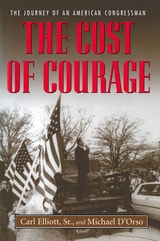
The Cost of Courage
The Journey of an American CongressmanCarl Elliott
University of Alabama Press, 2001
This deeply moving story chronicles the tenacity and vision that carried Carl Elliott from the hills of northwest Alabama to eight distinguished terms in the United States House of Representatives.
Born in a log cabin on a tenant farm in 1913, Carl Elliott worked his way through The University of Alabama during the Great Depression and was elected to Congress in 1948. With a no-nonsense philosophy of fairness and equal opportunity, he established himself as one of the most effective members of the House of Representatives during the 1950s. He was a progressive Democrat and he fought hard for the dirt farmers and coal miners he grew up with and who sent him to Congress.
In an era when racial segregationists dominated southern politics, Elliott worked with many of the important political leaders of the 20th century, including Presidents Truman, Eisenhower, and Kennedy and powerful House Speaker Sam Rayburn. He was instrumental in passing the National Defense Education Act of 1958, which continues to provide college loans to more than 20 million Americans. But his brave stand against racism and George Wallace in the 1966 Alabama gubernatorial race ruined him professionally (he never returned to elected office) and financially (he cashed in his congressional pension to help fund the campaign). Even as a destitute invalid in his old age, however, Elliott kept his dignity and integrity intact.
The life story of Carl Elliott is full of humor and wry wisdom and explains how he made his way across a stage as big as America, influencing its politics and future, and then emerged, belatedly, as an unsung hero of the fight for civil rights and equality.
The Difference Women Make
The Policy Impact of Women in CongressMichele L. Swers
University of Chicago Press, 2002
Swers combines quantitative analyses of bills with interviews with legislators and their staff to compare legislative activity on women's issues by male and female members of the House of Representatives during the 103rd (1993-94) and 104th (1995-96) Congresses. Tracking representatives' commitment to women's issues throughout the legislative process, from the introduction of bills through committee consideration to final floor votes, Swers examines how the prevailing political context and members' positions within Congress affect whether and how aggressively they pursue women's issues.
Anyone studying congressional behavior, the role of women, or the representation of social identities in Congress will benefit from Swers's balanced and nuanced analysis.
The Electorate, the Campaign, and the Office
A Unified Approach to Senate and House ElectionsPaul Gronke
University of Michigan Press, 2001
The Evolution of American Legislatures
Colonies, Territories, and States, 1619-2009Peverill Squire
University of Michigan Press, 2014
The institutional development of American legislatures, beginning with the first colonial assembly of 1619, has been marked by continuity as well as change. Peverill Squire draws upon a wealth of primary sources to document this institutional history. Beginning with the ways in which colonial assemblies followed the precedents of British institutions, Squire traces the fundamental ways they evolved to become distinct. He next charts the formation of the first state legislatures and the Constitutional Congress, describes the creation of territorial and new state legislatures, and examines the institutionalization of state legislatures in the nineteenth century and their professionalization since 1900.
With his conclusion, Squire discusses the historical trajectory of American legislatures and suggests how they might further develop over the coming decades. While Squire's approach will appeal to historians, his focus on the evolution of rules, procedures, and standing committee systems, as well as member salaries, legislative sessions, staff, and facilities, will be valuable to political scientists and legislative scholars.
The Fallacy of Campaign Finance Reform
John Samples
University of Chicago Press, 2006
At first glance, campaign finance reform looks like a good idea. McCain-Feingold, for instance, regulates campaigns by prohibiting national political parties from accepting soft money contributions from corporations, labor unions, and wealthy individuals. But are such measures, or any of the numerous and similarly restrictive proposals that have circulated through Washington in recent years, really good for our democracy?
John Samples says no, and here he takes a penetrating look into the premises and consequences of the long crusade against big money in politics. How many Americans, he asks, know that there is little to no evidence that campaign contributions really influence members of Congress? Or that so-called negative political advertising actually improves the democratic process by increasing voter turnout and knowledge? Or that limits on campaign contributions make it harder to run for office, thereby protecting incumbent representatives from losing their seats of power?
Posing tough questions such as these, Samples uncovers numerous fallacies beneath proposals for campaign finance reform. He argues that our most common concerns about money in politics are misplaced because the ideals implicit in our notion of corruption are incoherent or indefensible. The chance to regulate money in politics allows representatives to serve their own interests at a cost to their constituents. And, ironically, this long crusade against the corruption caused by campaign contributions allows public officials to reduce their vulnerability by suppressing electoral competition.
Defying long-held ssumptions and conventional political wisdom, The Fallacy of Campaign Finance Reform is a provocative and decidedly nonpartisan work that will be essential for anyone concerned about the future of American government.

The Federal Impeachment Process
A Constitutional and Historical AnalysisMichael J. Gerhardt
University of Chicago Press, 2000
In this edition, Michael Gerhardt draws on his experience as a commentator and expert witness to examine the likely political and constitutional consequences of President Clinton's impeachment and trial. Placing the President's acquittal in historical perspective, he argues that it fits easily within the impeachment process as it has evolved over the past two centuries. Impeachment, he shows, is an inherently political process designed to expose and remedy political crimes. Subject neither to judicial review nor to presidential veto, it is a unique congressional power that involves both political and constitutional considerations, including the gravity of the offense charged, the harm to the constitutional order, and the link between an official's misconduct and duties.
Significantly updated, this book will be the standard work on the federal impeachment process for years to come.
On the first edition:
"The most comprehensive, analytic study of the federal impeachment process to date."—Choice
"This book is by some margin the most successful . . . analysis of impeachment issues to have been written, and it will be the standard work for years to come."—Constitutional Commentary
The Floor in Congressional Life
Andrew J. Taylor
University of Michigan Press, 2013
The House and the Senate floors are the only legislative forums where all members of the U.S. Congress participate and each has a vote. Andrew J. Taylor explores why floor power and floor rights in the House are more restricted than in the Senate and how these restrictions affect the legislative process. After tracing the historical development of floor rules, Taylor assesses how well they facilitate a democratic legislative process---that is, how well they facilitate deliberation, transparency, and widespread participation.
Taylor not only compares floor proceedings between the Senate and the House in recent decades; he also compares recent congressional proceedings with antebellum proceedings. This unique, systematic analysis reveals that the Senate is generally more democratic than the House---a somewhat surprising result, given that the House is usually considered the more representative and responsive of the two. Taylor concludes with recommendations for practical reforms designed to make floor debates more robust and foster representative democracy.
The Gentleman from Illinois
Stories from Forty Years of Elective Public ServiceAlan J. Dixon
Southern Illinois University Press, 2013
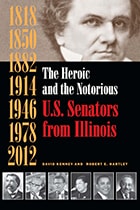
The Heroic and the Notorious
U.S. Senators from IllinoisDavid Kenney and Robert E. Hartley
Southern Illinois University Press, 2012
This sweeping survey constitutes the first comprehensive treatment of the men and women who have been chosen to represent Illinois in the United States Senate from 1818 to the present day. David Kenney and Robert E. Hartley underscore nearly two centuries of Illinois history with these biographical and political portraits, compiling an incomparably rich resource for students, scholars, teachers, journalists, historians, politicians, and any Illinoisan interested in the state’s senatorial heritage.
Originally published as An Uncertain Tradition: U.S. Senators From Illinois 1818–2003, this second edition brings readers up to date with new material on Paul Simon, Richard Durbin, and Peter Fitzgerald, as well as completely new sections on Roland Burris, Barack Obama, and Illinois’s newest senator, Mark Kirk. This fresh and careful study of the shifting set of political issues Illinois’s senators encountered over time is illuminated by the lives of participants in the politics of choice and service in the Senate. Kenney and Hartley offer incisive commentary on the quality of Senate service in each case, as well as timeline graphs relating to the succession of individuals in each of the two sequences of service, the geographical distribution of senators within the state, and the variations in party voting for Senate candidates. Rigorously documented and supremely readable, this convenient reference volume is enhanced by portraits of many of the senators.
The House at Work
Edited by Joseph Cooper and G. Calvin Mackenzie
University of Texas Press, 1981
There exists a rich literature on the workings of the United States Congress, but The House at Work is the first book to focus on the institutional performance of the House of Representatives. A complete overview of the complex functioning and dynamics of Congress is presented by distinguished contributors, drawing upon both real-life experience and organization theory.
Each essay presents material on activities central to legislative work in the House, including the internal operations of member and committee offices, the administrative support system of the House, the impact of organizational structure and information resources on individual decision making, the expanding application of computer technology, the character of the personnel system, and the processing of constituent casework.
Nearly all contributors were professional staff members of the U.S. House Commission on Administrative Review in 1976 and 1977, whose analysis of the internal operations of the House was acomprehensive investigation. Their academic training, buttressed by significant practical experience on Capitol Hill, makes this book of great value to both students and scholars of the legislative process. In addition to the editors, the contributors include Glenn R. Parker, Thomas E. Cavanagh, Allan J. Katz, John R. Johannes, Thomas J. O'Donnell, David W. Brady, Louis Sandy Maisel, Susan Webb Hammond, Jarold A. Kieffer, James A. Thurber, and Jeffrey A. Goldberg.
The Indispensable Minority
Why Congressional Majorities Cannot Govern AloneAndrew Ballard and James M. Curry
University of Chicago Press, 0
A provocative reevaluation of the power that the minority party in Congress wields beyond obstruction.
In The Indispensable Minority, Andrew Ballard and James M. Curry dispel a common assumption about American politics: that congressional majorities govern and congressional minorities merely obstruct. Drawing on four decades of legislative data, an original database of the most consequential lawmaking efforts since 1987, and candid interviews with veteran Capitol Hill staffers, the authors reveal that minority parties shape major legislation far more often than typically thought—both collectively and through the efforts of individual lawmakers.
As Ballard and Curry show, the key to minority influence lies not in procedural tricks like the filibuster, but in the interplay of raw political forces: how constrained the majority party is as it tries to act on its legislative agenda, how well the minority party can hold together as a cohesive bloc, and whether the minority chooses to engage in legislating rather than electoral posturing. When these conditions align, congressional minority parties don't just block bills—they help write them.
Rich with historical cases and sharp new evidence, The Indispensable Minority reshapes how we understand party power, congressional gridlock, and the health of American democracy itself. Far from a symptom of dysfunction, the authors argue, minority party influence is a vital—and indispensable—feature of how the American system is supposed to work.
The Influence of Campaign Contributions in State Legislatures
The Effects of Institutions and PoliticsLynda W. Powell
University of Michigan Press, 2012
Campaign contributions are widely viewed as a corrupting influence but most scholarly research concludes that they have marginal impact on legislative behavior. Lynda W. Powell shows that contributions have considerable influence in some state legislatures but very little in others. Using a national survey of legislators, she develops an innovative measure of influence and delineates the factors that explain this great variation across the 99 U.S. state legislative chambers.
Powell identifies the personal, institutional, and political factors that determine how much time a legislator devotes to personal fundraising and fundraising for the caucus. She shows that the extent of donors' legislative influence varies in ways corresponding to the same variations in the factors that determine fundraising time. She also confirms a link between fundraising and lobbying with evidence supporting the theory that contributors gain access to legislators based on donations, Powell's findings have important implications for the debate over the role of money in the legislative process.
The Jeffords Switch
Changing Majority Status and Causal Processes in the U.S. SenateChris Den Hartog and Nathan W. Monroe
University of Michigan Press, 2019
Senator Jim Jeffords left the Republican Party in May 2001 and became an independent. Because he agreed to vote with the Democrats on organizational votes, this gave that party a 51–49 majority in the Senate.
Using the “Jeffords switch,” Chris Den Hartog and Nathan W. Monroe examine how power is shared and transferred in the Senate, as well as whether Democratic bills became more successful after the switch. They also use the data after the switch, when the Republican Party still held a majority on many Democratic Party-led committees, to examine the power of the committee chairs to influence decisions. While the authors find that the majority party does influence Senate decisions, Den Hartog and Monroe are more interested in exploring the method and limits of the majority party to achieve its goals.
The Joy of Politics
Surviving Cancer, a Campaign, a Pandemic, an Insurrection, and Life’s Other Unexpected CurveballsAmy Klobuchar
University of Minnesota Press, 2023
An intimate and revelatory memoir on personal challenges, political turmoil, and the state of American democracy―now in paperback with a new preface
During the past few years, as our country has faced unprecedented challenges, Senator Amy Klobuchar has been in the room where it happens―on the Senate floor for critical votes during the pandemic, at the debate podium during one of the most crucial presidential primaries in U.S. history, and in the Capitol on January 6, 2021, when insurrectionists stormed the building, interrupting the certification of the Electoral College. It was well past midnight when Klobuchar stood beside then–Vice President Pence to officially certify President Biden's victory.
In her candid, honest, and at times bitingly funny memoir, the pragmatic senator shares insider stories from these historic moments, while also inviting readers into her personal life. An underdog in the 2020 Democratic presidential primary campaign, she built surprising early momentum, only to suspend her candidacy in order to support Joe Biden. Within weeks of returning to work in the Senate, the sudden onslaught of Covid-19 hit her family directly: her husband was hospitalized for a week and spent a month in isolation. Klobuchar shares her experience facing a cancer diagnosis while her beloved father succumbs to Alzheimer's. She recounts the dramatic narrative of January 6 and how close we came to losing our democracy. And, with her signature humor, she reveals what it's like to work with some of her more . . . well, interesting . . . colleagues.
At the crux of these stories is a narrative of resilience—of personal resilience and the resilience of a nation—and, improbably, joy.
The Judicial Power of the Purse
How Courts Fund National Defense in Times of CrisisNancy Staudt
University of Chicago Press, 2011
Congress and the president are not the only branches that deal with fiscal issues in times of war. In this innovative book, Nancy Staudt focuses on the role of federal courts in fiscal matters during warfare and high-cost national defense emergencies. There is, she argues, a judicial power of the purse that becomes evident upon examining the budgetary effects of judicial decision making. The book provides substantial evidence that judges are willing—maybe even eager—to redirect private monies into government hands when the country is in peril, but when the judges receive convincing cues that ongoing wartime activities undermine the nation’s interests, they are more likely to withhold funds from the government by deciding cases in favor of private individuals and entities who show up in court.
In stark contrast with conventional legal, political, and institutional thought that privileges factors associated with individual preferences, The Judicial Power of the Purse sheds light on environmental factors in judicial decision making and will be an excellent read for students of judicial behavior in political science and law.

The Less Responsive Chamber?
Politics and Development in the Early US SenateJoel Sievert
University of Michigan Press, 2027
Who did members of the early US Senate represent? Many scholarly and popular political accounts of the Antebellum era assume that senators were exclusively representatives of the state governments because pre-reform senators were chosen by state legislatures. However, The Less Responsive Chamber? examines senators’ relationships with three potential targets of representation—the state governments, the state legislature, and the electorate of the state.
Through both empirical analyses and detailed case studies, the book demonstrates that senators cared about the public and did not strictly view their representational role as one of being faithful agents to state governments. While senators’ floor speeches, circulars, and correspondences frequently referenced the state electorate as their primary constituency, they were often directed to represent a variety of interests. Further, senators were aware of and responded to public opinion as well as intrastate political dynamics. By documenting how the interests of political parties, states, and the public influenced the Senate’s behavior during the early years of the United States, this book offers insight into a period whose fraught politics continue to impact our lives today.
The Limits of Party
Congress and Lawmaking in a Polarized EraJames M. Curry and Frances E. Lee
University of Chicago Press, 2020
In The Limits of Party, James M. Curry and Frances E. Lee challenge this conventional wisdom. By constructing legislative histories of congressional majority parties’ attempts to enact their policy agendas in every congress since the 1980s and by drawing on interviews with Washington insiders, the authors analyze the successes and failures of congressional parties to enact their legislative agendas.
Their conclusions will surprise many congressional observers: Even in our time of intense party polarization, bipartisanship remains the key to legislative success on Capitol Hill. Congressional majority parties today are neither more nor less successful at enacting their partisan agendas. They are not more likely to ram though partisan laws or become mired in stalemate. Rather, the parties continue to build bipartisan coalitions for their legislative priorities and typically compromise on their original visions for legislation in order to achieve legislative success.
The Logic of Delegation
D. Roderick Kiewiet and Mathew D. McCubbins
University of Chicago Press, 1991
In The Logic of Delegation, however, D. Roderick Kiewiet and Mathew D. McCubbins persuasively argue that political scientists have paid far too much attention to what congressional parties can't do. The authors draw on economic and management theory to demonstrate that the effectiveness of delegation is determined not by how much authority is delegated but rather by how well it is delegated.
In the context of the appropriations process, the authors show how congressional parties employ committees, subcommittees, and executive agencies to accomplish policy goals. This innovative study will force a complete rethinking of classic issues in American politics: the "autonomy" of congressional committees; the reality of runaway federal bureaucracy; and the supposed dominance of the presidency in legislative-executive relations.
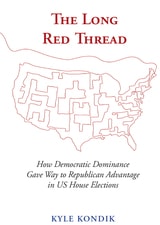
The Long Red Thread
How Democratic Dominance Gave Way to Republican Advantage in US House ElectionsKyle Kondik
Ohio University Press, 2021
The Mild Voice of Reason
Deliberative Democracy and American National GovernmentJoseph M. Bessette
University of Chicago Press, 1994
Drawing on original research, case studies of policymaking in Congress, and portraits of American lawmakers, Bessette demonstrates not only the limitations of nondeliberative explanations for how laws are made but also the continued vitality of genuine reasoning on the merits of public policy. Bessette discusses the contributions of the executive branch to policy deliberation, and looks at the controversial issue of the proper relationship of public opinion to policymaking.
Informed by Bessette's nine years of public service in city and federal government, The Mild Voice of Reason offers important insights into the real workings of American democracy, articulates a set of standards by which to assess the workings of our governing institutions, and clarifies the forces that promote or inhibit the collective reasoning about common goals so necessary to the success of American democracy.
"No doubt the best-publicized recent book-length work on Congress is columnist George Will's diatribe in praise of term limits in which the core of his complaint is that Congress does not deliberate in its decision-making. Readers who are inclined to share that fantasy would do well to consult the work of Joseph M. Bessette. He turns up massive amounts of material attesting to the centrality of deliberation in congressional life."—Nelson W. Polsby, Presidential Studies Quarterly
The Modern Legislative Veto
Macropolitical Conflict and the Legacy of ChadhaMichael J. Berry
University of Michigan Press, 2016
Berry argues that, since the U.S. Supreme Court declared the legislative veto unconstitutional in Immigration and Naturalization Service (INS) v. Chadha (1983), Congress has strategically modified its use of the veto to give more power to appropriations committees. Using an original dataset of legislative veto enactments, Berry finds that Congress has actually increased its use of this oversight mechanism since Chadha, especially over defense and foreign policy issues. Democratic and Republican presidents alike have fought back by vetoing legislation containing legislative vetoes and by using signing statements with greater frequency to challenge the legislative veto’s constitutionality. A complementary analysis of state-level use of the legislative veto finds variation in oversight powers granted to state legislatures, but similar struggles between the legislature and the executive.
This ongoing battle over the legislative veto points to broader efforts by legislative and executive actors to control policy, efforts that continually negotiate how the democratic republic established by the Constitution actually operates in practice.
The Money Signal
How Fundraising Matters in American PoliticsDanielle M. Thomsen
University of Chicago Press, 2025
A data-rich, eye-opening look at how, when, and why political fundraising is consequential.
Over the last two decades, the number of competitive congressional races has declined precipitously. Yet candidates and officeholders dial for more and more dollars each election, and they do so earlier and earlier in the campaign cycle.
In The Money Signal, Danielle M. Thomsen offers a new perspective on the role of money in politics. She shows that fundraising matters because it is widely used as an indicator of a candidate’s viability and strength, which shapes subsequent donations, dropout decisions, media attention, and rewards in office. Put simply, money is a focal point that candidates, donors, journalists, and party leaders rally around. For candidates, fundraising is a highly public form of self-presentation that pays dividends long before the election and well after the votes are cast.
Thomsen draws on comprehensive fundraising data that spans more than four decades, in addition to interviews, surveys of candidates and donors, newspaper coverage, committee assignments, and analysis of legislative success. The Money Signal highlights the numerous ways that dollars influence the perceptions and behavior of key actors and observers throughout the election cycle.
The Politics of Herding Cats
When Congressional Leaders FailJohn Lovett
University of Michigan Press, 2021
The Right of Instruction and Representation in American Legislatures, 1778 to 1900
Peverill Squire
University of Michigan Press, 2021
The Rise of the Representative
Lawmakers and Constituents in Colonial AmericaPeverill Squire
University of Michigan Press, 2017
The Third Space of Sovereignty
The Postcolonial Politics of U.S.–Indigenous RelationsKevin Bruyneel
University of Minnesota Press, 2007
The imposition of modern American colonial rule has defined U.S.–indigenous relations since the time of the American Civil War. In resistance, Kevin Bruyneel asserts, indigenous political actors work across American spatial and temporal boundaries, demanding rights and resources from the government while also challenging the imposition of colonial rule over their lives. This resistance engenders what he calls a “third space of sovereignty,” which resides neither inside nor outside the U.S. political system but rather exists on its boundaries, exposing both the practices and limitations of American colonial rule.
The Third Space of Sovereignty offers fresh insights on such topics as the crucial importance of the formal end of treaty-making in 1871, indigenous responses to the prospect of U.S. citizenship in the 1920s, native politics during the tumultuous civil rights era of the 1960s, the question of indigenousness in the special election of California’s governor in 2003, and the current issues surrounding gaming and casinos.
In this engaging and provocative work, Bruyneel shows how native political actors have effectively contested the narrow limits that the United States has imposed on indigenous people’s ability to define their identity and to develop economically and politically on their own terms.
Kevin Bruyneel is assistant professor of politics at Babson College.

The Unicameral Legislature
Alvin Johnson
University of Minnesota Press, 1938
The Whips
Building Party Coalitions in CongressC. Lawrence Evans
University of Michigan Press, 2018
The party whips are essential components of the U.S. legislative system, responsible for marshalling party votes and keeping House and Senate party members in line. In The Whips, C. Lawrence Evans offers a comprehensive exploration of coalition building and legislative strategy in the U.S. House and Senate, ranging from the relatively bipartisan, committee-dominated chambers of the 1950s to the highly polarized congresses of the 2000s. In addition to roll call votes and personal interviews with lawmakers and staff, Evans examines the personal papers of dozens of former leaders of the House and Senate, especially former whips. These records allowed Evans to create a database of nearly 1,500 internal leadership polls on hundreds of significant bills across five decades of recent congressional history.
The result is a rich and sweeping understanding of congressional party leaders at work. Since the whips provide valuable political intelligence, they are essential to understanding how coalitions are forged and deals are made on Capitol Hill.
Trust
Representatives and ConstituentsWilliam T. Bianco
University of Michigan Press, 1994
Why do constituents sometimes defer to their representative's judgment, rewarding her for acting as she thinks best, even when she ignores their demands? By making decisions about trust, constituents determine whether their representative is rewarded for implementing their demands or for using her judgment. These decisions shape legislator behavior and, through behavior, policy outcomes. Therefore, any attempt to explain or evaluate representative institutions such as the modern Congress requires an answer to a simple question: When do constituents trust their representative, and what is the basis of that trust?
This book is the first systematic analysis of constituent trust. It assumes that elected officials and ordinary citizens are rational actors. However, the book moves beyond the standard rational choice framework in three ways. It avoids narrow, unrealistic assumptions about motivations and information. It shows that many kinds of behavior not usually thought of as rational choices, such as a voter's desire to be represented by "someone like them," are the product of a systematic, predictable calculus---a calculus aimed at securing favorable policy outcomes. Finally, the book uses interviews with ninety-three members of the U.S. House of Representatives to test its predictions about trust.
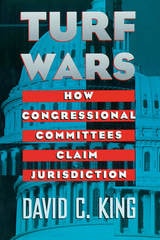
Turf Wars
How Congressional Committees Claim JurisdictionDavid C. King
University of Chicago Press, 1997
Political scientists have long maintained that jurisdictions are relatively static, changing only at times of dramatic reforms. Not so, says King. Combining quantitative evidence with interviews and case studies, he shows how on-going turf wars make jurisdictions fluid.
According to King, jurisdictional change stems both from legislators seeking electoral advantage and from nonpartisan House parliamentarians referring ambiguous bills to committees with the expertise to handle the issues. King brilliantly dissects the politics of turf grabbing and at the same time shows how parliamentarians have become institutional guardians of the legislative process.
Original and insightful, Turf Wars will be valuable to those interested in congressional studies and American politics more generally.
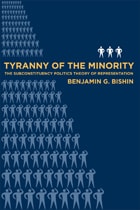
Tyranny of the Minority
The Subconstituency Politics Theory of RepresentationBenjamin G. Bishin
Temple University Press, 2009
Why do politicians frequently heed the preferences of small groups of citizens over those of the majority? Breaking new theoretical ground, Benjamin Bishin explains how the desires of small groups, which he calls “subconstituencies,” often trump the preferences of much larger groups.
Tyranny of the Minority provides a “unified theory of representation,” based in social psychology and identity theory, to explain how citizens’ intensity fosters knowledge and participation and drives candidates’ behavior in campaigns and legislators' behavior in Congress. Demonstrating the wide applicability of the theory, Bishin traces politicians' behavior in connection with a wide range of issues, including the Cuban trade embargo, the extension of hate-crimes legislation to protect gay men and lesbians, the renewal of the assault-weapons ban, abortion politics, and Congress's attempt to recognize the Armenian genocide. He offers a unique explanation of when, why, and how special interests dominate American national politics.