Results by title
204 books match the query 'Massachusetts' and 46 start with t
The Antinomian Controversy, 1636-1638
A Documentary HistoryDavid D. Hall, ed.
Duke University Press, 1990
This new edition of the 1968 volume, published now for the first time in paperback, includes an expanding bibliography and a new preface, treating in more detail the prime figures of Anne Hutchinson and her chief clerical supporter, John Cotton. Among the documents gathered here are transcripts of Anne Hutchinson’s trial, several of Cotton’s writings defending the Antinomian position, and John Winthrop’s account of the controversy. Hall’s increased focus on Hutchinson reveals the harshness and excesses with which the New England ministry tried to discredit her and reaffirms her place of prime importance in the history of American women.
The Athens of America
Boston, 1825-1845Thomas H. O'Connor
University of Massachusetts Press, 2006
Many people are generally familiar with the fact that Boston was once known as “the Athens of America.” Very few, however, are clear about exactly why, except for their recollections of the famous writers and poets who gave the city a reputation for literature and learning.
In this book, historian Thomas H. O'Connor sets the matter straight by showing that Boston's eminence during the first half of the nineteenth century was the result of a much broader community effort. After the nation emerged from its successful struggle for independence, most Bostonians visualized their city not only as the Cradle of Liberty, but also as the new world's Cradle of Civilization.
According to O'Connor, a leadership elite, composed of men of prominent family background, Unitarian beliefs, liberal education, and managerial experience in a variety of enterprises, used their personal talents and substantial financial resources to promote the cultural, intellectual, and humanitarian interests of Boston to the point where it would be the envy of the nation. Not only did writers, scholars, and philosophers see themselves as part of this process, but so did physicians and lawyers, ministers and teachers, merchants and businessmen, mechanics and artisans, all involved in creating a well-ordered city whose citizens would be committed to the ideals of social progress and personal perfectibility.
To accomplish their noble vision, leading members of the Boston community joined in programs designed to cleanse the old town of what they felt were generations of accumulated social stains and human failures, and then to create new programs and more efficient institutions that would raise the cultural and intellectual standards of all its citizens. Like ancient Athens, Boston would be a city of great statesmen, wealthy patrons, inspiring artists, and profound thinkers, headed by members of the “happy and respectable classes” who would assume responsibility for the safety, welfare, and education of the “less prosperous portions of the community.”
Designed for the general reader and the historical enthusiast, The Athens of America is an interpretive synthesis that explores the numerous secondary sources that have concentrated on individual subjects and personalities, and draws their various conclusions into a single comprehensive narrative.
The Captain’s Best Mate
The Journal of Mary Chipman Lawrence on the Whaler Addison, 1856–1860Mary Chipman. Lawrence
University Press of New England, 1986
The Case of the Slave-Child, Med
Free Soil in Antislavery BostonKaren Woods Weierman
University of Massachusetts Press, 2019
The Centenary Edition of the Works of Nathaniel Hawthorne
Vol. VI, True Stories From History and BiographyNathaniel Hawthorne
The Ohio State University Press, 1972
The Citizen Poets of Boston
A Collection of Forgotten Poems, 1789–1820Edited by Paul Lewis
University Press of New England, 2016
The Combat Zone
Murder, Race, and Boston's Struggle for JusticeJan Brogan
University of Massachusetts Press, 2021
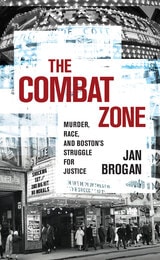
At the end of the 1976 football season, more than forty Harvard athletes went to Boston's Combat Zone to celebrate. In the city's adult entertainment district, drugs and prostitution ran rampant, violent crime was commonplace, and corrupt police turned the other way. At the end of the night, Italian American star athlete Andy Puopolo, raised in the city's North End, was murdered in a stabbing. Three African American men were accused of the crime. His murder made national news and led to the eventual demise of the city's red-light district.
Starting with this brutal murder, The Combat Zone tells the story of the Puopolo family's struggle with both a devastating loss and a criminal justice system that produced two trials with opposing verdicts, all within the context of a racially divided Boston. Brogan traces the contentious relationship between Boston’s segregated neighborhoods during the busing crisis; shines a light on a court system that allowed lawyers to strike potential jurors based purely on their racial or ethnic identity; and lays bare the deep-seated corruption within the police department and throughout the Combat Zone. What emerges is a fascinating snapshot of the city at a transitional moment in its recent past.
The Courage to Connect
Sexuality, Citizenship, and Community in ProvincetownSandra L. Faiman-Silva
University of Illinois Press, 2003
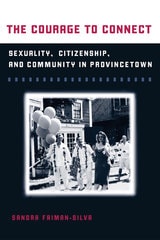
Based on over six years of fieldwork, Sandra L. Faiman-Silva's The Courage to Connect traces the transformation of the Cape Cod community of Provincetown from its nineteenth-century origins as a fishing town where Portuguese immigrants settled to its present status as a welcoming, sexually diverse tourist enclave. Faiman-Silva examines the community’s history and economy as well as how gay and straight cultures intersect in areas such as public education, local government, and law enforcement. Using queer and critical culture theory to deconstruct day-to-day local encounters, Faiman-Silva describes the causes of social conflicts and how these conflicts can be resolved. Capturing the pathos and joy of a community that has struggled to accommodate radical social changes, The Courage to Connect yields understanding of the ways in which communities can construct themselves to overcome differences.

The Crux
Charlotte Perkins Gilman
Duke University Press, 2003
Dana Seitler’s introduction provides historical context, revealing The Crux as an allegory for social and political anxieties—including the rampant insecurities over contagion and disease—in the United States at the beginning of the twentieth century. Seitler highlights the importance of The Crux to understandings of Gilman’s body of work specifically and early feminism more generally. She shows how the novel complicates critical history by illustrating the biological argument undergirding Gilman’s feminism. Indeed, The Crux demonstrates how popular conceptions of eugenic science were attractive to feminist authors and intellectuals because they suggested that ideologies of national progress and U.S. expansionism depended as much on women and motherhood as on masculine contest.

The Education of Phillips Brooks
John F. Woolverton
University of Illinois Press, 1995
The Education of Phillips Brooks probes the formative years of one of the best-known figures of Victorian America's "Gilded Age". Rigorously researched, bringing as yet untapped archival material into play, John F. Woolverton's book is an extremely readable and fascinating look at a gifted, persuasive clergyman and public figure. The sermon Brooks delivered at his Holy Trinity Church in Philadelphia while Abraham Lincoln's body lay in state overnight in Independence Hall was published, making him nationally famous overnight. He also is known for penning the lyrics to "O Little Town of Bethlehem". Although Brooks was not a major theologian, he was nurtured in an atmosphere of serious religious thought. In the crisis era of pre-Civil War America, he sought a religious and cultural ideal in the "perfect manhood" of Jesus Christ and consequently "won a name" for himself, as his slightly envious cousin, Henry Adams, once remarked. Woolverton places Brooks in his cultural context and shows how this religious leader was shaped psychologically and by his times and how those factors helped him forge a spiritual ideal for a troubled nation.
The Elusive Ideal
Equal Educational Opportunity and the Federal Role in Boston's Public Schools, 1950-1985Adam R. Nelson
University of Chicago Press, 2005
An ambitious study that spans more than thirty years and covers all facets of educational policy, from legal battles to tax strategies, The Elusive Ideal provides a model from which future inquiries will proceed. A probing and provocative work of urban history with deep relevance for urban public schools today, Nelson's book reveals why equal educational opportunity remains such an elusive ideal.
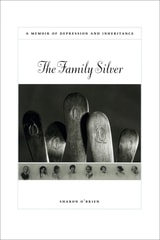
The Family Silver
A Memoir of Depression and InheritanceSharon O'Brien
University of Chicago Press, 2004
A compassionate and engaging writer, O'Brien uses the biographer's methods to understand her family history, weaving the scattered pieces of the past—her mother's memo books, her father's reading journal, family photographs, tombstones, dance cards, hospital records, the family silver—into a compelling narrative. In the lives of her Irish-American relatives she finds that the American values of upward mobility, progress, and the pressure to achieve sparked both desire and depression, following her family through generations, across the sea, from the Irish famine of the 1840s to Harvard Yard in the late 1960s.
"Many people who write stories of depression or other chronic illnesses tell tales of recovery in the upward-mobility sense, the 'once I was ill, but now I am well' formula that we may find appealing, but doesn't match the messiness of our lives," she writes. "Mine is not such a tale. But it is a recovery tale in another sense—a story of salvage, of rescuing stories from silence." Told with humor and honesty, O'Brien's story will captivate all readers who want to know how they, and their families, have been shaped by the past.
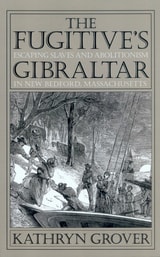
The Fugitive’s Gibraltar
Escaping Slaves and Abolitionism in New Bedford, MassachusettsKathryn Grover
University of Massachusetts Press, 2001
The Fugitive's Gibraltar is a richly researched work of social and cultural history that examines the city of New Bedford, Massachusetts as one of the most important and welcoming refuges for freedom-seeking enslaved people in antebellum America. The book's title derives from the phrase used by Frederick Douglass—himself among the most famous of New Bedford's many fugitive residents—to describe the city's reputation as a place of relative safety and freedom for Black Americans fleeing enslavement in the South.
Grover draws on an extraordinary breadth of primary sources to reconstruct the lives of fugitive slaves who came to New Bedford before the Civil War, as well as the city's larger African American community and the white and Black abolitionists who worked alongside them. The book explores how New Bedford's booming whaling economy—which depended heavily on Black labor and offered Black sailors wages equal to those of white sailors—created economic and social conditions unusually hospitable to free and freedom-seeking Black people. New Bedford's maritime character is thus deeply intertwined with its abolitionist identity.
The work examines the networks of people and organizations that sheltered, employed, and advocated for fugitives; traces individual stories of escape and resettlement; and situates New Bedford's experience within the broader national struggle over slavery, the Fugitive Slave Acts, and the abolitionist movement. Notable figures discussed include Frederick Douglass and Henry "Box" Brown. The book also sheds light on the daily lives, livelihoods, and community institutions of New Bedford's African American population—their churches, mutual aid societies, and social networks—providing a nuanced portrait of Black life in a northern city during this turbulent era.

The Garden at the End of Time
Getting By in the Age of Climate ChangeJohn Hanson Mitchell
University of Massachusetts Press, 2025
John Hanson Mitchell has long written about his garden outside of Boston, and about the plants and animals with whom he shares this land. In 2022, the United Nations and others started reporting the true severity of the climate crisis as the Earth passed a point of no return. All across the globe it was the worst year on record for climate-related disasters, including extinctions, deadly floods, massive fires, and dramatic droughts, all of which have worsened since that year. Mitchell, like so many, felt overwhelmed. He looked to the story of Voltaire’s Candide, and settled on the famous aphorism from that book: “We must cultivate our garden.”
The Garden at the End of Time features Mitchell’s trademark blend of science, literature, and anecdote as he processes both the information he is reading from various sources and what it prompts him to do in his own small corner of the world. The story that unfolds is one of Mitchell diversifying his plantings; fighting what he sees as unnecessary local development; walking through and observing changes in the wild lands nearby; continuing to read the news from around the world; and meditating on other moments, real and imagined, when people sought refuge even as they did their part to improve a personally and collectively stressful situation.
Readers discover the impossibility of separating gardening from global warming, while also seeing the solace that exposure to plants can offer, in addition to their contribution to carbon consumption. With gravitas, kindness, and wit, Mitchell offers a model for maintaining a connection to nature even as it reels from manmade threats.
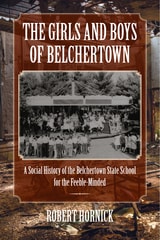
The Girls and Boys of Belchertown
A Social History of the Belchertown State School for the Feeble-MindedRobert Hornick
University of Massachusetts Press, 2012
During much of the twentieth century, people labeled “feeble-minded,” “mentally deficient,” and “mentally retarded” were often confined in large, publicly funded, residential institutions located on the edges of small towns and villages some distance from major population centers. At the peak of their development in the late 1960s, these institutions—frequently called “schools” or “homes”—housed 190,000 men, women, and children in the United States.
The Girls and Boys of Belchertown offers the first detailed history of an American public institution for intellectually disabled persons. Robert Hornick recounts the story of the Belchertown State School in Belchertown, Massachusetts, from its beginnings in the 1920s to its closure in the 1990s following a scandalous exposé and unprecedented court case that put the institution under direct supervision of a federal judge. He draws on personal interviews, private letters, and other unpublished sources as well as local newspapers, long out-of-print materials, and government reports to re-create what it was like to live and work at the school. More broadly, he gauges the impact of changing social attitudes toward intellectual disability and examines the relationship that developed over time between the school and the town where it was located.
What emerges is a candid and complex portrait of the Belchertown State School that neither vilifies those in charge nor excuses the injustices perpetrated on its residents, but makes clear that despite the court-ordered reforms of its final decades, the institution needed to be closed.

The Golden Age of Boston Television
Terry Ann Knopf
University Press of New England, 2017
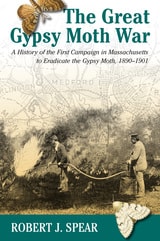
The Great Gypsy Moth War
A History of the First Campaign in Massachusetts to Eradicate the Gypsy Moth, 1890-1901Robert J. Spear
University of Massachusetts Press, 2005
During the Civil War, when the supply of cotton from southern fields was disrupted, the owners of northern textile mills looked elsewhere for raw fiber. One source was silk. Among those experimenting with silkworm production was a Frenchman named Etienne Leopold Trouvelot, who had settled outside of Boston. It was Trouvelot who imported the gypsy moths and inadvertently allowed them to escape. Soon the invasion was on and a counteroffensive was required.
Spear reveals the turbulent undercurrents in the eradication campaign when the enthusiasm of the entomologists in charge turned into desperation upon the discovery that their alien adversary was much tougher than they thought. Fighting a war they could not win and dared not lose, the leaders of the campaign resorted to political maneuvering, cheap tricks, and outright misrepresentation to maintain a façade of success, urging the Commonwealth to continue funding the war long after any chance of victory had faded.
More than just reviewing the important events of this historic episode, Spear tells the story in an engaging way, often through the first-hand accounts of those who were directly involved. Much of what Spear has written is new, the recounting is lively, and the information he presents shows that almost all of the previous beliefs about the campaign to eradicate the gypsy moths are myths. In the process, he also traces the rise of modern economic entomology and the birth of the pesticide industry.

The House on Ipswich Marsh
Exploring the Natural History of New EnglandWilliam Sargent
University Press of New England, 2015
The Impact of College Diversity
Struggles and Successes at Age 30Elizabeth Aries
Temple University Press, 2023
The Impact of College Diversity details how exposure to diversity in college helped shape Black and white graduates process issues of economic and racial privilege and inequality at age 30. She investigates how college diversity experiences also facilitate the attainment of upward social mobility in lower-income students and the role that mobility played in their relationships with family and friends in their home communities. Aries further examines how interactions with peers of another race and class influenced development of citizenship skills and civic engagement, as well as Black students’ ability to cope with the challenges they faced in the professional world.
Aries concludes her study with a discussion of why elite colleges have been beneficial in promoting upward mobility in lower-income students, and the importance of achieving equity and inclusion in making diversity initiatives successful.
The Invisible World
John Smolens
Michigan State University Press, 2017
After Sam's mother dies and is cremated, her ashes are stolen. Believing that his father is responsible, Sam pursues the man he has not seen in years. He discovers that he is not the only one searching for his father—federal agents, a disgraced politician, a retired Boston cop, and several journalists join the chase.
“The Invisible World is more than a first-rate political thriller,” says The Boston Globe. “It’s an absorbing tale of alienation and loss, and the ramifications of a rootless, troubled family.” What Sam Adams ultimately discovers is that the shadowy realm of conspiracies conjures a world of hidden truths and intrigue in which the familiar is the most mysterious force of all.
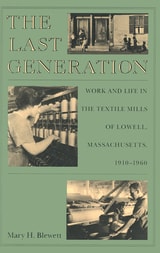
The Last Generation
Work and Life in the Textile Mills of Lowell, Massachusetts, 1910-1960Mary H. Blewett
University of Massachusetts Press, 1990
Oral histories of many of the last generation of Lowell, MA, textile mill workers preceded by two introductory sections. The first presents the historic setting of economic development and subsequent decline of the textile industry in Lowell. The second is a brief explanation of the production process wherein the last generation of mill workers expended so many of their skills and so much of their energy.
The Last Great Colonial Lawyer
The Life and Legacy of Jeremiah GridleyCharles R. McKirdy
University of Massachusetts Press, 2018
Jeremiah Gridley (1702–1767) is considered “the greatest New England lawyer of his generation,” yet we know little about him. Most of his renown is a product of the fame of his students, most notably John Adams. Gridley deserves more. He was an active participant in the Writs of Assistance trial and the Stamp Act controversy, and as a leader of the Boston bar, an editor, speculator, legislator, and politician, his life touched and was touched by much that was integral to eighteenth-century Massachusetts.
The Last Great Colonial Lawyer presents a portrait of Gridley against the background of his times. Religious controversies enter into this narrative, as do colonial wars and the increasing strains with Great Britain, but Charles R. McKirdy also rescues from the footnotes of time subjects such as the smallpox epidemic of 1721 and the currency crisis of the 1740s. Because Gridley was above all a lawyer, the primary focus is on his cases, which illuminate in a unique and very human way attitudes regarding race, status, commerce, property, and power.
The Last Hurrah
A NovelEdwin O'Connor
University of Chicago Press, 2016
Not quite a roman á clef of notorious Boston mayor James Michael Curley, The Last Hurrah tells the story of Skeffington’s final campaign as witnessed through the eyes of his nephew, who learns a great deal about politics as he follows his uncle to fundraisers, wakes, and into smoke-filled rooms, ultimately coming—almost against his will—to admire the man. Adapted into a 1958 film starring Spencer Tracy and directed by John Ford (and which Curley tried to keep from being made), Edwin O’Connor’s opus reveals politics as it really is, and big cities as they really were. An expansive, humorous novel offering deep insight into the Irish-American experience and the ever-changing nature of the political machine, The Last Hurrah reveals political truths still true today: what the cameras capture is just the smiling face of the sometimes sordid business of giving the people what they want.
The Lowell Experiment
Public History in a Postindustrial CityCathy Stanton
University of Massachusetts Press, 2006
In the early nineteenth century, Lowell, Massachusetts, was widely studied and emulated as a model for capitalist industrial development. One of the first cities in the United States to experience the ravages of deindustrialization, it was also among the first places in the world to turn to its own industrial and ethnic history as a tool for reinventing itself in the emerging postindustrial economy. The Lowell Experiment explores how history and culture have been used to remake Lowell and how historians have played a crucial yet ambiguous role in that process.
The book focuses on Lowell National Historical Park, the flagship project of Lowell's new cultural economy. When it was created in 1978, the park broke new ground with its sweeping reinterpretations of labor, immigrant, and women's history. It served as a test site for the ideas of practitioners in the new field of public history—a field that links the work of professionally trained historians with many different kinds of projects in the public realm.
The Lowell Experiment takes an anthropological approach to public history in Lowell, showing it as a complex cultural performance shaped by local memory, the imperatives of economic redevelopment, and tourist rituals—all serving to locate the park's audiences and workers more securely within a changing and uncertain new economy characterized by growing inequalities and new exclusions.
The paradoxical dual role of Lowell's public historians as both interpreters of and contributors to that new economy raises important questions about the challenges and limitations facing academically trained scholars in contemporary American culture. As a long-standing and well-known example of “culture-led re-development,” Lowell offers an outstanding site for exploring questions of concern to those in the fields of public and urban history, urban planning, and tourism studies.
The Making of the New Deal Democrats
Voting Behavior and Realignment in Boston, 1920-1940Gerald H. Gamm
University of Chicago Press, 1990
Almost all previous work on the subject has dealt with large-scale national patterns which make it difficult to pin down the precise processes by which the alignment took place. Gamm's work is most remarkable in that it is a close analysis of shifting voter alignments on the precinct and block level in the city of Boston. His extremely detailed and painstaking work of isolating homogeneous ethnic units over a twenty-year period allows one to trace the voting behavior of the particular ethnic groups that ultimately formed the core of the New Deal realignment."—Sidney Verba, Harvard University
The Needle's Eye
Women and Work in the Age of RevolutionMarla R. Miller
University of Massachusetts Press, 2006
In this book, Marla R. Miller illuminates the significance of women's work in the clothing trades of the early Republic. Drawing on diaries, letters, reminiscences, ledgers, and material culture, she explores the contours of working women's lives in rural New England, offering a nuanced view of their varied ranks and roles—skilled and unskilled, black and white, artisanal and laboring—as producers and consumers, clients and craftswomen, employers and employees. By plumbing hierarchies of power and skill, Miller explains how needlework shaped and reflected the circumstances of real women's lives, at once drawing them together and setting them apart.
The heart of the book brings into focus the entwined experiences of six women who lived in and around Hadley, Massachusetts, a thriving agricultural village nestled in a bend in the Connecticut River about halfway between the Connecticut and Vermont borders. Miller's examination of their distinct yet overlapping worlds reveals the myriad ways that the circumstances of everyday lives positioned women in relationship to one another, enlarging and limiting opportunities and shaping the trajectories of days, years, and lifetimes in ways both large and small. The Needle's Eye reveals not only how these women thought about their work, but how they thought about their world.
The New Bostonians
How Immigrants Have Transformed the Metro Area since the 1960sMarilynn S. Johnson
University of Massachusetts Press, 2015
How immigrants helped rebuild a city—and redefined what it means to be American
Among the most consequential pieces of Great Society legislation, the Immigration Act of 1965 opened the nation's doors to large-scale immigration from Africa, Asia, and Latin America. A half century later, the impact of the "new immigration" is evident in the transformation of the country's demographics, economy, politics, and culture, particularly in urban America.
In The New Bostonians, Marilynn S. Johnson examines the historical confluence of recent immigration and urban transformation in greater Boston, a region that underwent dramatic decline after World War II. Since the 1980s, the Boston area has experienced an astounding renaissance—a development, she argues, to which immigrants have contributed in numerous ways. From 1970 to 2010, the percentage of foreign-born residents of the city more than doubled, representing far more diversity than earlier waves of immigration. Like the older Irish, Italian, and other European immigrant groups whose labor once powered the region's industrial economy, these newer migrants have been crucial in re-building the population, labor force, and metropolitan landscape of the New Boston, although the fruits of the new prosperity have not been equally shared.
The New Metaphysicals
Spirituality and the American Religious ImaginationCourtney Bender
University of Chicago Press, 2010
The Other Boston Busing Story
What's Won and Lost Across the Boundary LineSusan E. Eaton
Brandeis University Press, 2020
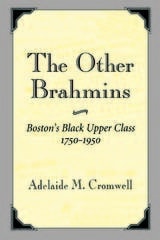
The Other Brahmins
Boston's Black Upper Class 1750-1950Adelaide Cromwell
University of Arkansas Press, 1995
Adelaide Cromwell’s pioneering work explores race and the social caste system in an atypical northern environment over a period of two centuries. Based on scholarly sources, interviews, and questionnaires, the study identifies those blacks in Boston who exercised political, economic, and social leadership from the end of the eighteenth century to the middle of the twentieth. The central focus is a comparison of black and white upper-class women in the 1940s.
This rare look at a black social microcosm not located in the South is seminal and timely. Because it concludes at a critical period in American history, The Other Brahmins paints a colorful backdrop for evaluating subsequent changes in urban sociology and stratification. In a groundbreaking study, Cromwell effectively challenges the simplistic notions of hierarchy as they pertain to race.
The Paddy Camps
The Irish of Lowell, 1821-61Brian C. Mitchell
University of Illinois Press, 1988
The dramatic story of the fights and compromises that shaped an Irish community
Disdained by many Yankee residents as Catholic lowlifes, the growing Irish population of the Lowell, Massachusetts, “paddy camps” in the nineteenth century proved a tempting source of cheap labor for local mill owners, who took advantage of the immigrants’ proximity to exploit them to the fullest. Displaced by their cheaper labor, other workers blamed the Irish for job losses and added to their plight through repression and segregation.
Now in paperback and featuring a new preface, Brian C. Mitchell’s The Paddy Camps demonstrates how the Irish community in Lowell overcame adversity to develop strong religious institutions, an increased political presence, and a sense of common traditions.
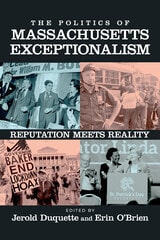
The Politics of Massachusetts Exceptionalism
Reputation Meets RealityEdited by Jerold Duquette and Erin O'Brien
University of Massachusetts Press, 2022
Are claims of Massachusetts’s special and instructive place in American history and politics justified? Alternately described as a “city upon a hill” and “an organized system of hatreds,” Massachusetts politics has indisputably exerted an outsized pull on the national stage. The Commonwealth’s leaders often argue for the state’s distinct position within the union, citing its proud abolitionist history and its status as a policy leader on health care, gay marriage, and transgender rights, not to mention its fertile soil for budding national politicians. Detractors point to the state’s busing crisis, sky high levels of economic inequality, and mixed support for undocumented immigrants.
The Politics of Massachusetts Exceptionalism tackles these tensions, offering a collection of essays from public policy experts that address the state’s noteworthy contributions to the nation’s political history. This is a much-needed volume for Massachusetts policymakers, journalists, and community leaders, as well as those learning about political power at the state level, inside and outside of the classroom. Contributors include the editors as well as Maurice T. Cunningham, Lawrence Friedman, Shannon Jenkins, Luis F. Jiménez, and Peter Ubertaccio.
The River Gods
Brian Kiteley
University of Alabama Press, 2009
Each of the voices--including a character named Brian Kiteley and his family, the original Native American inhabitants, the actor Richard Burton, Sojourner Truth, Richard Nixon, Ludwig Wittgenstein, Jonathan Edwards, and many nameless others--ruminate on a past that is startlingly present and tangible. The main character, though, is the world of Northampton, irrevocably woven into the fabric of Western history, yet still grounded by the everyday concerns of health, money, food, love, and family. It is a novel of voices, the living and the dead, that illuminate the passage of time.
The Saloon
Public Drinking in Chicago and Boston, 1880-1920Perry R. Duis
University of Illinois Press, 1983
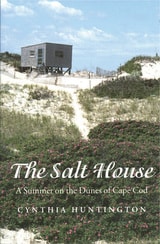
The Salt House
A Summer on the Dunes of Cape CodCynthia Huntington
Dartmouth College Press, 2003
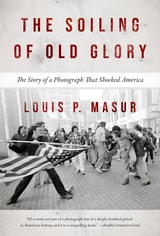
The Soiling of Old Glory
The Story of a Photograph That Shocked AmericaLouis P. Masur
Brandeis University Press, 2024
In 1976, Boston was bitterly divided over a court order to desegregate its public schools. Plans to bus students between predominantly white and Black neighborhoods stoked backlash and heated protests. Photojournalist Stanley Forman was covering one such demonstration at City Hall when he captured an indelible image: a white protester attacking a Black attorney with the American flag. A second white man grabs at the victim, appearing to assist the assailant.
The photo appeared in newspapers across the nation and went on to win the Pulitzer Prize. In The Soiling of Old Glory, esteemed historian Louis P. Masur reveals what happened the day of the assault and the ways these events reverberated long afterward. He interviews the men involved: Forman, who took the photo; Ted Landsmark, a Black, Yale-educated attorney and an activist; Joseph Rakes, the white protester lunging with the flag, a disaffected student; and Jim Kelly, a local politician who opposed busing, but who helped Landsmark to his feet after protesters knocked him to the ground. The photo, Masur discovers, holds more complexities than initially meet the eye. The flag never made contact with the victim, for example, and Kelly was attempting to protect Landsmark, not hurt him.
Masur delves into the history behind Boston’s efforts to desegregate the schools and the anti-busing protests that shook the city. He examines photography’s power to move, inform, and persuade us, as well as the assumptions we each bring to an image as viewers. And he delves into the flag, to explore how other artists and photographers have shaped, bolstered, or challenged its patriotic significance.
Gripping and deeply researched, The Soiling of Old Glory shows how a disturbing event, frozen on a film, impacted Boston and the nation. In an age of renewed calls for visual literacy and disagreements about the flag’s meaning, Masur’s history, now updated with a new foreword by Ted Landsmark and a new preface by the author, is as relevant as ever.
The Specter of Salem
Remembering the Witch Trials in Nineteenth-Century AmericaGretchen A. Adams
University of Chicago Press, 2008
In The Specter of Salem, Gretchen A. Adams reveals the many ways that the Salem witch trials loomed over the American collective memory from the Revolution to the Civil War and beyond. Schoolbooks in the 1790s, for example, evoked the episode to demonstrate the new nation’s progress from a disorderly and brutal past to a rational present, while critics of new religious movements in the 1830s cast them as a return to Salem-era fanaticism, and during the Civil War, southerners evoked witch burning to criticize Union tactics. Shedding new light on the many, varied American invocations of Salem, Adams ultimately illuminates the function of collective memories in the life of a nation.
“Imaginative and thoughtful. . . . Thought-provoking, informative, and convincingly presented, The Specter of Salem is an often spellbinding mix of politics, cultural history, and public historiography.”— New England Quarterly
“This well-researched book, forgoing the usual heft of scholarly studies, is not another interpretation of the Salem trials, but an important major work within the scholarly literature on the witch-hunt, linking the hysteria of the period to the evolving history of the American nation. A required acquisition for academic libraries.”—Choice, Outstanding Academic Title 2009
The Virtuous and Violent Women of Seventeenth-Century Massachusetts
Emily C.K. Romeo
University of Massachusetts Press, 2020
Dismantling the image of the peaceful and serene colonial goodwife and countering the assumption that New England was inherently less violent than other regions of colonial America, Emily C. K. Romeo offers a revealing look at acts of violence by Anglo-American women in colonial Massachusetts, from the everyday to the extraordinary. Using Essex County as a case study, Romeo deftly utilizes seventeenth- and eighteenth-century sources to demonstrate that Puritan women, both “virtuous” and otherwise, learned to negotiate the shifting boundaries between acceptable and unacceptable violence in their daily lives and communities.
The Virtuous and Violent Women of Seventeenth-Century Massachusetts shows that more dramatic violence by women—including infanticide, the scalping of captors during the Indian Wars, and even witchcraft accusations—was not necessarily intended to challenge the structures of authority but often sprung from women's desire to protect property, safety, and standing for themselves and their families. The situations in which women chose to flout powerful social conventions and resort to overt violence expose the underlying, often unspoken, priorities and gendered expectations that shaped this society.
The Women of Provincetown, 1915–1922
Cheryl Black
University of Alabama Press, 2001
In this fascinating work, Cheryl Black reveals that, in addition to its role in developing an American tradition of non-commercial theatre, Provincetown has another, largely unacknowledged claim to fame as one of the first theatre companies in America in which women achieved prominence in every area of operation. At a time when women playwrights were rare, women directors rarer, and women scenic designers unheard of, Provincetown’s female members excelled in all of these roles.
In addition to the well-known playwright Susan Gaspell, the company’s female membership included luminaries such poets Edna St. Vincent Millay, Mina Loy, and Djuna Barnes; journalists Louise Bryant and Mary Heaton Vorce; novelists Neith Boyce and Evelyn Scott; and painter Marguerite Zorach. Illuminating a fascinating chapter in the history of one of the world's most picturesque and beloved artist colonies, The Women of Provincetown is an engaging work of social history, offering new insights into the relationship between gender and theatre. This work includes 40 images of the key artists in the book.
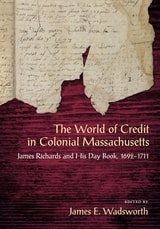
The World of Credit in Colonial Massachusetts
James Richards and His Daybook, 1692-1711James E. Wadsworth
University of Massachusetts Press, 2017
For years, James Richards, a prosperous and typical colonial farmer, tracked nearly five thousand transactions, involving more than six hundred individuals and stretching from Charlestown to Barnstable. Richards and his neighbors were bound together in a heterogeneous economy, reliant on networks of credit, barter, and sometimes cash. Richards practiced mixed husbandry farming, shipped goods by cart and by sloop, and produced and sold malt, salt, wool, and timber. The day book also reveals significant social details of Richards and his household, including his diverse trading partners, his extensive family connections, an Indian slave girl, and a well-dressed female servant. Available in both print and electronic editions, fully transcribed, annotated, and introduced by the editor, this record of economic life reinforces and challenges our understanding of colonial America.
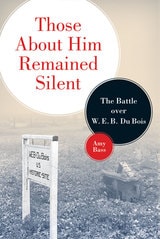
Those About Him Remained Silent
The Battle over W. E. B. Du BoisAmy Bass
University of Minnesota Press, 2012
On the eve of Martin Luther King Jr.’s 1963 March on Washington, W. E. B. Du Bois died in exile in Ghana at the age of 95, more than a half century after cofounding the NAACP. Five years after his death, residents of Great Barrington, the small Massachusetts town where Du Bois was born in 1868, proposed recognizing his legacy through the creation of a memorial park on the site of his childhood home. Supported by the local newspaper and prominent national figures including Harry Belafonte and Sydney Poitier, the effort to honor Du Bois set off an acrimonious debate that bitterly divided the town. Led by the local chapter of the Veterans of Foreign Wars, opponents compared Du Bois to Hitler, vilifying him as an anti-American traitor for his communist sympathies, his critique of American race relations, and his pan-Africanist worldview.
In Those About Him Remained Silent, Amy Bass provides the first detailed account of the battle over Du Bois and his legacy, as well as a history of Du Bois’s early life in Massachusetts. Bass locates the roots of the hostility to memorialize Du Bois in a cold war worldview that reduced complicated politics to a vehement hatred of both communism and, more broadly, anti-Americanism. The town’s reaction was intensified, she argues, by the racism encoded within cold war patriotism.
Showing the potency of prevailing, often hidden, biases, Those About Him Remained Silent is an unexpected history of how racism, patriotism, and global politics played out in a New England community divided on how—or even if—to honor the memory of its greatest citizen.

Tommy Gun Winter
Jewish Gangsters, a Preacher's Daughter, and the Trial That Shocked 1930s BostonNathan Gorenstein
University Press of New England, 2015

Trail Running Eastern Massachusetts
Ben Kimball
University of Massachusetts Press, 2022
Eastern Massachusetts offers incredible trail-running opportunities, ranging from popular long-distance routes like the Bay Circuit Trail to lesser-known loops that run through the mountains and forests of the Quabbin watershed and Merrimack Valley region, and trails that pass alongside the shores of Cape Cod. All over the Bay State, there are trails suitable for runners of all levels waiting to be discovered and explored.
Avid trail runner Ben Kimball offers a selection of fifty-one of eastern Massachusetts’s most spectacular trail sites, including detailed trail descriptions, topographic maps, directions, parking information, safety tips, and much more. Both experienced and novice trail runners will find Trail Running Eastern Massachusetts to be an invaluable resource for exploring nature and getting a good workout, in the Boston area and beyond.

Trail Running Western Massachusetts
Ben Kimball
University Press of New England, 2015
Trespassing
An Inquiry into the Private Ownership of LandJohn Hanson Mitchell
University Press of New England, 2015
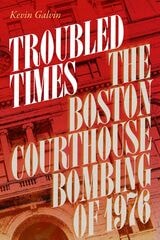
Troubled Times
The Boston Courthouse Bombing of 1976Kevin Galvin
Brandeis University Press, 2026
Interweaves the stories of a revolutionary and a bombing victim to explore the roots and unintended consequences of political violence.
1976. The Vietnam War had ended, but radical political groups still operated clandestinely throughout the United States. Nowhere was the threat of civil unrest greater than in Boston. Racial tensions had been building since a federal judge ordered the desegregation of the Boston Public Schools, and civic leaders were counting on the pageantry of the nation’s Bicentennial to boost both tourism and investment. In April, the Sam Melville-Jonathan Jackson Unit, prison reformers schooled in Marxism and angered by US interventions abroad, bombed the Suffolk County Courthouse, injuring twenty-two people. The site of the blast marked the spot where the lives of two men intersected: a mill town kid who’d been radicalized in Vietnam and prison, and an immigrant waiting in line because he needed to renew a cab license.
Fifty years after the bombing shook the city, Troubled Times tells the story of lives changed by political violence at a time when the American experiment is again in crisis.