Results by title
479 books match the query 'Methodology' and 116 start with t
Taking Society's Measure
A Personal History of Survey ResearchHerbert Hyman
Russell Sage Foundation, 1991

Teaching Information Literacy Online
Trudi E. Jacobson
American Library Association, 2011

Teaching Information Literacy Threshold Concepts
LessonPatricia Bravender
Assoc of College & Research Libraries, 2015
Teaching Information Literacy Threshold Concepts
Lesson Plans for LibrariansPatricia Bravender
Assoc of College & Research Libraries, 2015
Teaching Information Literacy
50 Standards-Based Exercises for College StudentsJoanna M. Burkhardt
American Library Association, 2010
Teaching for Inquiry
Engaging the Learner WithinBarbara K. Stripling
American Library Association, 2012
Teaching the Eighteenth Century Now
Pedagogy as Ethical EngagementKate Parker
Bucknell University Press, 2024
Published by Bucknell University Press. Distributed worldwide by Rutgers University Press.
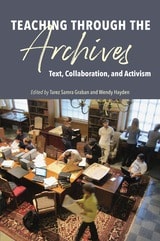
Teaching through the Archives
Text, Collaboration, and ActivismEdited by Tarez Samra Graban and Wendy Hayden
Southern Illinois University Press, 2022
Disruptive pedagogies for archival research
In a cultural moment when institutional repositories carry valuable secrets to the present and past, this collection argues for the critical, intellectual, and social value of archival instruction. Graban and Hayden and 37 other contributors examine how undergraduate and graduate courses in rhetoric, history, community literacy, and professional writing can successfully engage students in archival research in its many forms, and successfully model mutually beneficial relationships between archivists, instructors, and community organizations.
Combining new and established voices from related fields, each of the book’s three sections includes a range of form-disrupting pedagogies. Section I focuses on how approaching the archive primarily as text fosters habits of mind essential for creating and using archives, for critiquing or inventing knowledge-making practices, and for being good stewards of private and public collections. Section II argues for conducting archival projects as collaboration through experiential learning and for developing a preservationist consciousness through disciplined research. Section III details praxis for revealing, critiquing, and intervening in historic racial omissions and gaps in the archives in which we all work.
Ultimately, contributors explore archives as sites of activism while also raising important questions that persist in rhetoric and composition scholarship, such as how to decolonize research methodologies, how to conduct teaching and research that promote social justice, and how to shift archival consciousness toward more engaged notions of democracy. This collection highlights innovative classroom and curricular course models for teaching with and through the archives in rhetoric and composition and beyond.
Teaching with Primary Sources
Christopher Prom
Society of American Archivists, 2016
Technological Perspectives on Behavioral Change
Michael Brian Schiffer
University of Arizona Press, 1992
Technology and the Historian
Transformations in the Digital AgeAdam Crymble
University of Illinois Press, 2021
Historians have seen their field transformed by the digital age. Research agendas, teaching and learning, scholarly communication, the nature of the archive—all have undergone a sea change that in and of itself constitutes a fascinating digital history. Yet technology's role in the field's development remains a glaring blind spot among digital scholars.
Adam Crymble mines private and web archives, social media, and oral histories to show how technology and historians have come together. Using case studies, Crymble merges histories and philosophies of the field, separating issues relevant to historians from activities in the broader digital humanities movement. Key themes include the origin myths of digital historical research; a history of mass digitization of sources; how technology influenced changes in the curriculum; a portrait of the self-learning system that trains historians and the problems with that system; how blogs became a part of outreach and academic writing; and a roadmap for the continuing study of history in the digital era.
Telling About Society
Howard S. Becker
University of Chicago Press, 2007
Taking Perec’s book as its cue, Telling About Society explores the unconventional ways we communicate what we know about society to others. The third in distinguished teacher Howard Becker’s best-selling series of writing guides for social scientists, the book explores the many ways knowledge about society can be shared and interpreted through different forms of telling—fiction, films, photographs, maps, even mathematical models—many of which remain outside the boundaries of conventional social science. Eight case studies, including the photographs of Walker Evans, the plays of George Bernard Shaw, the novels of Jane Austen and Italo Calvino, and the sociology of Erving Goffman, provide convincing support for Becker’s argument: that every way of telling about society is perfect—for some purpose. The trick is, as Becker notes, to discover what purpose is served by doing it this way rather than that.
With Becker’s trademark humor and eminently practical advice, Telling About Society is an ideal guide for social scientists in all fields, for artists interested in saying something about society, and for anyone interested in communicating knowledge in unconventional ways.
Telling Women's Lives
The New BiographyWagner-Martin, Linda
Rutgers University Press, 1996
Placing herself in the avid reader’s chair, Linda Wagner-Martin writes about women’s biography from George Eliot and Virginia Woolf to Eleanor Roosevelt and Margaret Mead, and even to Cher and Elizabeth Taylor. Along the way, she looks at dozens of other life stories, probing at the differences between biographies of men and women, prevailing stereotypes about women’s lives and roles, questions about what is public and private, and the hazy margins between autobiography, biography, and other genres. In quick paced and wide-ranging discussions, she looks at issues of authorial stance (who controls the narrative? who chooses which story to tell?), voice (is this story told in the traditional objective tone? and if it is, what effect does that telling have on our reading?), and the politics of publishing (why aren’t more books about women’s lives published? and when they are, what happens to their advertising budgets?). She discusses the problems of writing biography of achieving women who were also wives (how does the biographer balance the two?), of daughters who attempt to write about their mothers, and of husbands trying to portray their wives.
Telling Women’s Lives is the first overview of the writing and the history of biographies about women. It is a significant contribution to the reassessment of the work of the hundreds of women writers who have made a difference in our conception of what women’s stories--and women’s lives--have been, and are becoming. The book is a must read for anyone who loves reading biographies, particularly biographies of women.
Telling a Research Story
Writing a Literature ReviewChristine B. Feak and John M. Swales
University of Michigan Press, 2009
Telling a Research Story: Writing a Literature Review is concerned with the writing of a literature review and is not designed to address any of the preliminary processes leading up to the actual writing of the literature review.
This volume represents a revision and expansion of the material on writing literature reviews that appeared in English in Today's Research World.
This volume progresses from general to specific issues in the writing of literature reviews. It opens with some orientations that raise awareness of the issues that surround the telling of a research story. Issues of structure and matters of language, style, and rhetoric are then discussed. Sections on metadiscourse, citation, and paraphrasing and summarizing are included.
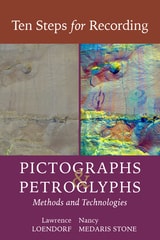
Ten Steps for Recording Pictographs and Petroglyphs
Methods and TechnologiesLawrence Loendorf and Nancy Medaris Stone
University of Utah Press, 2024
Despite having survived for thousands of years, erosion, decay, and even vandalism are all threats to these important cultural sites. A field session involving documentation might be the only opportunity to record these unique and significant images. The ten steps laid out here by Loendorf and Stone offer a general overview of current best practices to maintain a scientific and professional documentation program.
The American Literature Scholar in the Digital Age
Edited by Amy E. Earhart and Andrew Jewell
University of Michigan Press, 2010
"By casting the collection explicitly as an outreach to the larger community of Americanists---not primarily those who self-identify as 'digital scholars'---Earhart and Jewell have made an important choice, and one that will likely make this a landmark publication."
---Andrew Stauffer, University of Virginia
The American Literature Scholar in the Digital Age, which features a wide range of practitioner-scholars, is the first of its kind: a gathering of people who are expert in American literary studies and in digital technologies, scholars uniquely able to draw from experience with building digital resources and to provide theoretical commentary on how the transformation to new technologies alters the way we think about and articulate scholarship in American literature. The volume collects articles from those who are involved in tool development, usability testing, editing and textual scholarship, digital librarianship, and issues of race and ethnicity in digital humanities, while also situating digital humanities work within the larger literary discipline. In addition, the volume examines the traditional structures of the fields, including tenure and promotion criteria, modes of scholarly production, the skill sets required for scholarship, and the training of new scholars.
The American Literature Scholar in the Digital Age will attract practitioners of digital humanities in multiple fields, Americanists who utilize digital materials, and those who are intellectually curious about the new movement and materials.
Amy E. Earhart is Assistant Professor in the Department of English at Texas A&M University.
Andrew Jewell is Associate Professor of Digital Projects, University Libraries, at the University of Nebraska–Lincoln.
Cover art: Book background ©iStockphoto.com/natashika
digitalculturebooks is an imprint of the University of Michigan Press and the Scholarly Publishing Office of the University of Michigan Library dedicated to publishing innovative and accessible work exploring new media and their impact on society, culture, and scholarly communication. Visit the website at www.digitalculture.org.

The Anatomy of Judgment
Philip J. Regal
University of Minnesota Press, 1990
The Anatomy of Judgment was first published in 1990. Minnesota Archive Editions uses digital technology to make long-unavailable books once again accessible, and are published unaltered from the original University of Minnesota Press editions.
"The Anatomy of Judgment is a unique and valuable contribution to the literature of the social and humanistic contexts for science . . . The book will illuminate dark corners for any reader, and dozens of interesting points come to light." –Neil Greenberg, University of Tennessee
Tracing the emergence of science and the social institutions that govern it, The Anatomy of Judgment is an odyssey into what human thinking or judgment means. Philip Regal moves deftly from the history of Western philosophy to concepts of rationality in non-Western cultures, from the conceptual issues of the Salem witch trials to the basic structure of the human brain. The Anatomy of Judgment offers new perspectives on the workings of individual judgment and the social responsibility it entails.
Philip Regal is a professor of ecology and behavioral biology at the University of Minnesota. He served, during his pre- and postdoctoral work, as Coordinator's Appointee to the Mental Health Training Program at UCLA's Brain Research Institute.
The Anthropology of Experience
Edited by Victor W. Turner and Edward M. Bruner
University of Illinois Press, 1986
explore how people actually experience their culture and how those experiences are expressed in forms as varied as narrative, literary work, theater, carnival, ritual, reminiscence, and life review. Their studies will be
of special interest for anyone working in anthropological theory, symbolic
anthropology, and contemporary social and cultural anthropology, and useful as well for other social scientists, folklorists, literary theorists, and philosophers.
The Archaeology of Kinship
Advancing Interpretation and Contributions to TheoryBradley E. Ensor
University of Arizona Press, 2013
The Archaeology of Kinship supports Ensor’s objectives: to demonstrate the relevance of kinship to major archaeological questions, to describe archaeological methods for kinship analysis independent of ethnological interpretation, to illustrate the use of those techniques with a case study, and to provide specific examples of how diachronic analyses address broader theory. As Ensor shows, archaeological diachronic analyses of kinship are independently possible, necessary, and capable of providing new insights into past cultures and broader anthropological theory. Although it is an old subject in anthropology, The Archaeology of Kinship can offer new and exciting frontiers for inquiry.
Kinship research in general—and prehistoric kinship in particular—is rapidly reemerging as a topical subject in anthropology. This book is a timely archaeological contribution to that growing literature otherwise dominated by ethnology.
The Architectonics of Meaning
Foundations of the New PluralismWalter Watson
University of Chicago Press, 1993
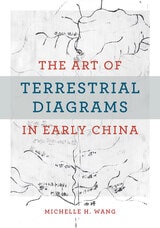
The Art of Terrestrial Diagrams in Early China
Michelle H. Wang
University of Chicago Press, 2023
This is the first English-language monograph on the early history of maps in China, centering on those found in three tombs that date from the fourth to the second century BCE and constitute the entire known corpus of early Chinese maps (ditu). More than a millennium separates them from the next available map in the early twelfth century CE. Unlike extant studies that draw heavily from the history of cartography, this book offers an alternative perspective by mobilizing methods from art history, archaeology, material culture, religion, and philosophy. It examines the diversity of forms and functions in early Chinese ditu to argue that these pictures did not simply represent natural topography and built environments, but rather made and remade worlds for the living and the dead. Wang explores the multifaceted and multifunctional diagrammatic tradition of rendering space in early China.
The Autonomy of History
Truth and Method from Erasmus to GibbonJoseph M. Levine
University of Chicago Press, 1999
Levine's first three essays discuss Thomas More's preoccupation with the distinction between history and fiction; Erasmus's biblical criticism and the contribution of Renaissance philology to critical method; and the way in which Renaissance rhetoric, as in Thomas Elyot's Book of the Governor, continued to inhibit the autonomy of history. He then shows how these issues persisted into the eighteenth century, even as critical method developed. He concludes with a close description of the great controversy that culminated in Edward Gibbon's day over the authenticity of a biblical text that had been used for centuries to defend the Trinity but which turned out to be a forgery. Levine shows how by then all sides were ready to concede the autonomy of history.
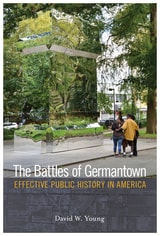
The Battles of Germantown
Effective Public History in AmericaDavid W. Young
Temple University Press, 2019
2020 Philip S. Klein Book Prize Winner, Pennsylvania Historical Association
Known as America’s most historic neighborhood, the Germantown section of Philadelphia (established in 1683) has distinguished itself by using public history initiatives to forge community. Progressive programs about ethnic history, postwar urban planning, and civil rights have helped make historic preservation and public history meaningful. The Battles of Germantown considers what these efforts can tell us about public history’s practice and purpose in the United States.
Author David Young, a neighborhood resident who worked at Germantown historic sites for decades, uses his practitioner’s perspective to give examples of what he calls “effective public history.” The Battles of Germantown shows how the region celebrated “Negro Achievement Week” in 1928 and, for example, how social history research proved that the neighborhood’s Johnson House was a station on the Underground Railroad. These encounters have useful implications for addressing questions of race, history, and memory, as well as issues of urban planning and economic revitalization.
Germantown’s historic sites use public history and provide leadership to motivate residents in an area challenged by job loss, population change, and institutional inertia. The Battles of Germantown illustrates how understanding and engaging with the past can benefit communities today.
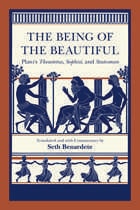
The Being of the Beautiful
Plato's Theaetetus, Sophist, and StatesmanPlato
University of Chicago Press, 1984
“The translations are masterpieces of literalness. . . . They are honest, accurate, and give the reader a wonderful sense of the Greek.”—Drew A. Hyland, Review of Metaphysics
The Black Shoals
Offshore Formations of Black and Native StudiesTiffany Lethabo King
Duke University Press, 2019
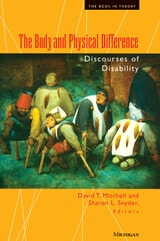
The Body and Physical Difference
Discourses of DisabilityDavid T. Mitchell and Sharon L. Snyder, Editors
University of Michigan Press, 1997
The book provides a provocative range of topics and perspectives: the absence of physical "otherness" in Ancient Greece, the depiction of the female invalid in Victorian literature, the production of tragic innocence in British and American telethons, the reconstruction of Civil War amputees, and disability as the aesthetic basis for definitions of expendable life within the modern eugenics movement. With this new, secure anchoring in the humanities, disability studies now emerges as a significant strain in contemporary theories of identity and social marginality.
Moving beyond the oversimplication that disabled people are marginalized and made invisible by able-ist assumptions and practices, the contributors demonstrate that representation is founded upon the perpetual exhibition of human anomalies. In this sense, all art can be said to migrate toward the "freakish" and the "grotesque." Such a project paradoxically makes disability the exception and the rule of the desire to represent that which has been traditionally out-of-bounds in polite discourse.
The Body and Physical Difference has relevance across a wide range of academic specialties such as cultural studies, the sociology of medicine, history, literature and medicine, the allied health professions, rehabilitation, aesthetics, philosophical discourses of the body, literary and film studies, and narrative theory.
David T. Mitchell is Assistant Professor of English, Northern Michigan University. Sharon L. Snyder teaches film and literature at Northern Michigan University.
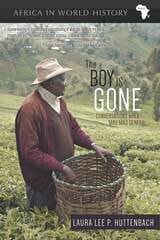
The Boy Is Gone
Conversations with a Mau Mau GeneralLaura Lee P. Huttenbach
Ohio University Press, 2015
A story with the power to change how people view the last years of colonialism in East Africa, The Boy Is Gone portrays the struggle for Kenyan independence in the words of a freedom fighter whose life spanned the twentieth century’s most dramatic transformations. Born into an impoverished farm family in the Meru Highlands, Japhlet Thambu grew up wearing goatskins and lived to stand before his community dressed for business in a pressed suit, crisp tie, and freshly polished shoes. For most of the last four decades, however, he dressed for work in the primary school classroom and on his lush tea farm.
The General, as he came to be called from his leadership of the Mau Mau uprising sixty years ago, narrates his life story in conversation with Laura Lee Huttenbach, a young American who met him while backpacking in Kenya in 2006. A gifted storyteller with a keen appreciation for language and a sense of responsibility as a repository of his people’s history, the General talks of his childhood in the voice of a young boy, his fight against the British in the voice of a soldier, and his long life in the voice of shrewd elder. While his life experiences are his alone, his story adds immeasurably to the long history of decolonization as it played out across Africa, Asia, and the Americas.
The Chicago Guide to Collaborative Ethnography
Luke Eric Lassiter
University of Chicago Press, 2005
The Chicago Guide to Collaborative Ethnography presents a historical, theoretical, and practice-oriented road map for this shift from incidental collaboration to a more conscious and explicit collaborative strategy. Luke Eric Lassiter charts the history of collaborative ethnography from its earliest implementation to its contemporary emergence in fields such as feminism, humanistic anthropology, and critical ethnography. On this historical and theoretical base, Lassiter outlines concrete steps for achieving a more deliberate and overt collaborative practice throughout the processes of fieldwork and writing. As a participatory action situated in the ethical commitments between ethnographers and consultants and focused on the co-construction of texts, collaborative ethnography, argues Lassiter, is among the most powerful ways to press ethnographic fieldwork and writing into the service of an applied and public scholarship.
A comprehensive and highly accessible handbook for ethnographers of all stripes, The Chicago Guide to Collaborative Ethnography will become a fixture in the development of a critical practice of anthropology, invaluable to both undergraduates, graduate students, and faculty alike.

The Cognitive Paradigm
Marc De Mey
University of Chicago Press, 1992
"A most stimulating, and intellectually delightful book."—John Goldsmith
"[De Mey] has brought together an unusually wide range of material, and suggested some interesting lines of thought, about what should be an important application of cognitive science: The understanding of science itself."—Cognition and Brain Theory
"It ought to be on the shelf of every teacher and researcher in the field and on the reading list of any student or practitioner seriously interested in how those they serve are likely to set about knowing."—ISIS
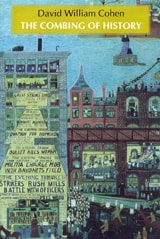
The Combing of History
David William Cohen
University of Chicago Press, 1994
Drawing from a wide range of examples, including African legal proceedings, German and American museum exhibits, Native American commemorations, public and academic debates, and scholarly research, David William Cohen explores the "walls and passageways" between academic and non-academic productions of history.
The Comity and Grace of Method
Essays in Honor of Edmund F. PerryThomas Ryba
Northwestern University Press, 2004
The essays in the first section—"Theory and Method in the History and Study of Religion"—clarify the role of scientific, phenomenological, and comparative approaches within the history of the study of religion; collectively, they represent a multifaceted statement about recurring and subtle problems in the field. In the second section—"Theories and Methods in Application"—the authors move from overarching theoretical concerns to the application of these methods in specific religious traditions, Western and Eastern. The third section demonstrates the effectiveness of these theories and methods as guidelines for promoting global inter-religious comity.
More than a fitting tribute to a revered and highly influential scholar, this book gives even those who knew nothing of Perry and his work much to learn from and ponder about the study of religion.
The Community-Based PhD
Complexities and Triumphs of Conducting CBPREdited by Sonya Atalay and Alexandra McCleary
University of Arizona Press, 2022
The Community-Based PhD brings together the experiences of PhD students from a range of disciplines discussing CBPR in the arts, humanities, social sciences, public health, and STEM fields. They write honestly about what worked, what didn’t, and what they learned. Essays address the impacts of extended research time frames, why specialized skill sets may be needed to develop community-driven research priorities, the value of effective relationship building with community partners, and how to understand and navigate inter- and intra-community politics.
This volume provides frameworks for approaching dilemmas that graduate student CBPR researchers face. They discuss their mistakes, document their successes, and also share painful failures and missteps, viewing them as valuable opportunities for learning and pushing the field forward. Several chapters are co-authored by community partners and provide insights from diverse community perspectives. The Community-Based PhD is essential reading for graduate students, scholars, and the faculty who mentor them in a way that truly crosses disciplinary boundaries.
Contributors: Anna S. Antoniou, Amy Argenal, Sonya Atalay, Stacey Michelle Chimimba Ault, Victoria Bochniak, Megan Butler, Elias Capello, Ashley Collier-Oxandale, Samantha Cornelius, Annie Danis, Earl Davis, John Doyle, Margaret J. Eggers, Cyndy Margarita García-Weyandt, R. Neil Greene, D. Kalani Heinz, Nicole Kaechele, Myra J. Lefthand, Emily Jean Leischner, Christopher B. Lowman, Geraldine Low-Sabado, Alexandra G. Martin, Christine Martin, Alexandra McCleary, Chelsea Meloche, Bonnie Newsom, Katherine L. Nichols, Claire Novotny, Nunanta (Iris Siwallace), Reidunn H. Nygård, Francesco Ripanti, Elena Sesma, Eric Simons, Cassie Lynn Smith, Tanupreet Suri, Emery Three Irons, Arianna Trott, Cecilia I. Vasquez, Kelly D. Wiltshire, Julie Woods, Sara L. Young
The Concepts, Process and Methods of Social Impact Assessment
Rabel Burdge
University Press of Colorado, 2015
The Craft of Research
Wayne C. Booth, Gregory G. Colomb, and Joseph M. Williams
University of Chicago Press, 1995
This book is organized into four parts. Part One is a spirited introduction to the distinctive nature, values, and protocols of research. Part Two demystifies the art of discovering a topic. It outlines a wide range of sources, among them personal interests and passions. Parts Three and Four cover the essentials of argument—how to make a claim and support it—and ways to outline, draft, revise, rewrite, and polish the final report. Part Three is a short course in the logic, structure, uses, and common pitfalls of argumentation. The writing chapters in Part Four show how to present verbal and visual information effectively and how to shape sentences and paragraphs that communicate with power and precision.
"A well-constructed, articulate reminder of how important fundamental questions of style and approach, such as clarity and precision, are to all research."—Times Literary Supplement
The Craft of Research, 2nd edition
Wayne C. Booth, Gregory G. Colomb, and Joseph M. Williams
University of Chicago Press, 2003
Like its predecessor, this new edition reflects the way researchers actually work: in a complex circuit of thinking, writing, revising, and rethinking. It shows how each part of this process influences the others and how a successful research report is an orchestrated conversation between a researcher and a reader. Along with many other topics, The Craft of Research explains how to build an argument that motivates readers to accept a claim; how to anticipate the reservations of thoughtful yet critical readers and to respond to them appropriately; and how to create introductions and conclusions that answer that most demanding question, "So what?"
Celebrated by reviewers for its logic and clarity, this popular book retains its five-part structure. Part 1 provides an orientation to the research process and begins the discussion of what motivates researchers and their readers. Part 2 focuses on finding a topic, planning the project, and locating appropriate sources. This section is brought up to date with new information on the role of the Internet in research, including how to find and evaluate sources, avoid their misuse, and test their reliability.
Part 3 explains the art of making an argument and supporting it. The authors have extensively revised this section to present the structure of an argument in clearer and more accessible terms than in the first edition. New distinctions are made among reasons, evidence, and reports of evidence. The concepts of qualifications and rebuttals are recast as acknowledgment and response. Part 4 covers drafting and revising, and offers new information on the visual representation of data. Part 5 concludes the book with an updated discussion of the ethics of research, as well as an expanded bibliography that includes many electronic sources.
The new edition retains the accessibility, insights, and directness that have made The Craft of Research an indispensable guide for anyone doing research, from students in high school through advanced graduate study to businesspeople and government employees. The authors demonstrate convincingly that researching and reporting skills can be learned and used by all who undertake research projects.
New to this edition:
Extensive coverage of how to do research on the internet, including how to evaluate and test the reliability of sources
New information on the visual representation of data
Expanded bibliography with many electronic sources
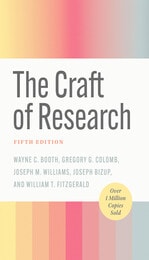
The Craft of Research, Fifth Edition
Wayne C. Booth, Gregory G. Colomb, Joseph M. Williams, Joseph Bizup, and William T. FitzGerald
University of Chicago Press, 2024
With more than a million copies sold since its first publication, The Craft of Research has helped generations of researchers at every level—from high-school students and first-year undergraduates to advanced graduate students to researchers in business and government. Conceived by seasoned researchers and educators Wayne C. Booth, Gregory G. Colomb, and Joseph M. Williams, this fundamental work explains how to choose significant topics, pose genuine and productive questions, find and evaluate sources, build sound and compelling arguments, and convey those arguments effectively to others.
While preserving the book’s proven approach to the research process, as well as its general structure and accessible voice, this new edition acknowledges the many ways research is conducted and communicated today. Thoroughly revised by Joseph Bizup and William T. FitzGerald, it recognizes that research may lead to a product other than a paper—or no product at all—and includes a new chapter about effective presentations. It features fresh examples from a variety of fields that will appeal to today’s students and other readers. It also accounts for new technologies used in research and offers basic guidelines for the appropriate use of generative AI. And it ends with an expanded chapter on ethics that addresses researchers’ broader obligations to their research communities and audiences as well as systemic questions about ethical research practices.
This new edition will be welcomed by a new and more diverse generation of researchers.
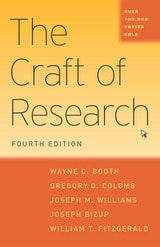
The Craft of Research, Fourth Edition
Wayne C. Booth, Gregory G. Colomb, Joseph M. Williams, Joseph Bizup and William T. FitzGerald
University of Chicago Press, 2016
With more than three-quarters of a million copies sold since its first publication, The Craft of Research has helped generations of researchers at every level—from first-year undergraduates to advanced graduate students to research reporters in business and government—learn how to conduct effective and meaningful research. Conceived by seasoned researchers and educators Wayne C. Booth, Gregory G. Colomb, and Joseph M. Williams, this fundamental work explains how to find and evaluate sources, anticipate and respond to reader reservations, and integrate these pieces into an argument that stands up to reader critique.
The fourth edition has been thoroughly but respectfully revised by Joseph Bizup and William T. FitzGerald. It retains the original five-part structure, as well as the sound advice of earlier editions, but reflects the way research and writing are taught and practiced today. Its chapters on finding and engaging sources now incorporate recent developments in library and Internet research, emphasizing new techniques made possible by online databases and search engines. Bizup and FitzGerald provide fresh examples and standardized terminology to clarify concepts like argument, warrant, and problem.
Following the same guiding principle as earlier editions—that the skills of doing and reporting research are not just for elite students but for everyone—this new edition retains the accessible voice and direct approach that have made The Craft of Research a leader in the field of research reference. With updated examples and information on evaluation and using contemporary sources, this beloved classic is ready for the next generation of researchers.
- Over 700,000 copies sold
- Every step of the academic research process, from the “why” of research through forming the research question, formulating an argument, and revision
- Helpful chapters on research ethics, formulation of writing assignments for teachers, and an appendix of research tools for both off and online
- Clear advice on building a strong argument in an age of false claims
- Careful attention to both the how and why of objective research-based writing
- Easy to follow, time-tested advice
- A must-have for any college or graduate student
The Craft of Research, Third Edition
Wayne C. Booth, Gregory G. Colomb, and Joseph M. Williams
University of Chicago Press, 2008
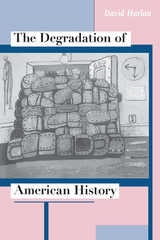
The Degradation of American History
David Harlan
University of Chicago Press, 1997
Part One, "The Legacy of the Sixties," describes the impact of literary theory in the 1970s and beyond, the rise of women's history, the various forms of ideological analysis developed by historians on the left, and the crippling obsession with professionalism in the 1980s. Part Two, "The Renewal of American Historical Writing," focuses on the contributions of John Patrick Diggins, Hayden White, Richard Rorty, Elaine Showalter, Henry Louis Gates Jr., and others. Harlan argues that at the end of the twentieth century American historical writing is perfectly poised to become what it once was: not one of the social sciences in historical costume, but a form of moral reflection that speaks to all Americans.
"[A] wholly admirable work. This book will be talked about for years."—Library Journal
The Discourses of Science
Marcello Pera
University of Chicago Press, 1994
Pera begins with an attack of what he calls the "Cartesian syndrome"—the fixation on method common to both defenders of traditional philosophy of science and its detractors. He argues that in assuming the primacy of methodological rules, both sides get it wrong. Scientific knowledge is neither the simple mirror of nature nor a cultural construct imposed by contingent interests, thus we must replace the idea of scientific method with that of scientific rhetoric.
Pera proposes a new dialectics of science to overcome the tension between normative and descriptive philosophies of science by focusing on the rhetoric in the proposition, defense, and argumentation of theories. Examining the uses of rhetoric in debates drawn from Galileo's Dialogues, Darwin's Origins, and the Big Bang-Steady State controversy in cosmology, Pera shows how the conduct of science involves not just nature and the inquiring mind, but nature, the inquiring mind, and a questioning community which, through the process of attack, defense, and dispute, determines what is science. Rhetoric, then, is an essential element in the constitution of science as the practice of persuasive argumentation through which results gain acceptance.
The Diversity of Religions
A Christian PerspectiveJ. A. DiNoia, O.P.
Catholic University of America Press, 1992
The Ecology of Others
Philippe Descola
Prickly Paradigm Press, 2013
Since the end of the nineteenth century, the division between nature and culture has been fundamental to Western thought. In this groundbreaking work, renowned anthropologist Philippe Descola seeks to break down this divide, arguing for a departure from the anthropocentric model and its rigid dualistic conception of nature and culture as distinct phenomena. In its stead, Descola proposes a radical new worldview, in which beings and objects, human and nonhuman, are understood through the complex relationships that they possess with one another.
The Ecosystem Approach in Anthropology
From Concept to PracticeEmilio F. Moran, Editor
University of Michigan Press, 1990
The Elements of Foucault
Gregg Lambert
University of Minnesota Press, 2020
A new conceptual diagram of Foucault’s original vision of the biopolitical order
The history around the critical reception of Michel Foucault’s published writings is troubled, according to Gregg Lambert, especially in light of the controversy surrounding his late lectures on biopolitics and neoliberal governmentality. In this book, Lambert’s unique approach distills Foucault’s thought into its most basic components in order to more fully understand its method and its own immanent rules of construction.
The Elements of Foucault presents a critical study of Foucault’s concept of method from the earlier History of Sexuality, Volume 1, to his later lectures. Lambert breaks down Foucault’s post-1975 analysis of the idea of biopower into four elements: the method, the conceptual device (i.e., dispositif), the grid of intelligibility, and the notion of “milieu.” Taken together, these elements compose the diagram of Foucault’s early analysis and the emergence of the neoliberal political economy. Lambert further delves into how Foucault’s works have been used and misused over time, challenging the periodization of Foucault’s later thought in scholarship as well as the major and most influential readings of Foucault by other contemporary philosophers—in particular Gilles Deleuze and Giorgio Agamben.
The Elements of Foucault is the first generally accessible, yet rigorous and comprehensive, discussion of lectures and major published works of Foucault’s post-1975 theory of biopower and of the major innovation of the concept of dispositif. It is also the first critical work to address the important influence of French philosopher Georges Canghuilhem on Foucault’s thought.
The Emperor's Mirror
Understanding Cultures through Primary SourcesRussell Barber
University of Arizona Press, 1998
As an introduction to ethnohistory, this book clearly defines terminology and provides practical and accessible examples, effectively integrating the concerns of historians and anthropologists as well as addressing the needs of anyone using primary sources for research in any academic field. A leading theme throughout the book is the importance of a researcher's awareness of the inherent biases of documents while doing research on another culture. Documents are the result of people interpreting reality through the filter of their own experience, personality, and culture.
Barber and Berdan's reality mediation model shows students how to analyze documents to detect the implicit biases or subtexts inherent in primary-source materials. Students and scholars working with primary sources will particularly appreciate the case studies that Barber and Berdan use to illustrate the practical implications of using each methodology. These case studies not only apply method to actual research but also are fascinating in their own right: they range from a discussion of the debate over Tupinamba cannibalism to the illustration of Nahuatl, Spanish, and hybrid place names of Tlaxcala, Mexico.
The Empirical Base of Linguistics
Grammaticality Judgments and Linguistic MethodologyCarson T. Schütze
University of Chicago Press, 1996
Integrating substantive and methodological findings, Schütze proposes a model in which judgments result from interactions of linguistic competence with general cognitive processes, and offers practical suggestions about collecting more useful data. The result is a work of importance to linguists, cognitive psychologists, and philosophers of language alike.
The Enchantment Of Reason
Pierre Schlag
Duke University Press, 1998
In examining the fierce resistance to questioning reason’s primacy, this renowned critic and professor of American law demonstrates how those who use and study the law perpetuate their own methodological blind spots. Claiming that reason has been endowed with a virtually mystical power to organize social life, Schlag unravels the seemingly rational world of judicial opinions, statutes, doctrines, and legal principles. In the process, he paints a shocking—and sure to be controversial—picture of the chaos and, indeed, violence of the American legal tradition.
This bold commentary on the irrationality of reason in American law and legal studies will interest not only legal scholars and philosophers but also serious thinkers across a broad disciplinary spectrum.
The Ethnographer's Way
A Handbook for Multidimensional Research DesignKristin Peterson and Valerie Olson
Duke University Press, 2024
The Experimental Side of Modeling
Isabelle F. Peschard
University of Minnesota Press, 2018
An innovative, multifaceted approach to scientific experiments as designed by and shaped through interaction with the modeling process
The role of scientific modeling in mediation between theories and phenomena is a critical topic within the philosophy of science, touching on issues from climate modeling to synthetic models in biology, high energy particle physics, and cognitive sciences. Offering a radically new conception of the role of data in the scientific modeling process as well as a new awareness of the problematic aspects of data, this cutting-edge volume offers a multifaceted view on experiments as designed and shaped in interaction with the modeling process.
Contributors address such issues as the construction of models in conjunction with scientific experimentation; the status of measurement and the function of experiment in the identification of relevant parameters; how the phenomena under study are reconceived when accounted for by a model; and the interplay between experimenting, modeling, and simulation when results do not mesh. Highlighting the mediating role of models and the model-dependence (as well as theory-dependence) of data measurement, this volume proposes a normative and conceptual innovation in scientific modeling—that the phenomena to be investigated and modeled must not be precisely identified at the start but specified during the course of the interactions arising between experimental and modeling activities.
Contributors: Nancy D. Cartwright, U of California, San Diego; Anthony Chemero, U of Cincinnati; Ronald N. Giere, U of Minnesota; Jenann Ismael, U of Arizona; Tarja Knuuttila, U of South Carolina; Andrea Loettgers, U of Bern, Switzerland; Deborah Mayo, Virginia Tech; Joseph Rouse, Wesleyan U; Paul Teller, U of California, Davis; Michael Weisberg, U of Pennsylvania; Eric Winsberg, U of South Florida.
The Flight from Ambiguity
Essays in Social and Cultural TheoryDonald N. Levine
University of Chicago Press, 1985