Results by title
4917 books match the query 'Philosophy' and 1267 start with t
T?he Commons
Economic Alternatives in the Digital AgeVangelis Papadimitropoulos
University of Westminster Press, 2020
This book explores the potential creation of a broader collaborative economy through commons-based peer production (P2P) and the emergent role of information and communication technologies (ICTs). The book seeks to critically engage in the political discussion of commons-based peer production, which can be classified into three basic arguments: the liberal, the reformist and the anti-capitalist. This book categorises the liberal argument as being in favour of the coexistence of the commons with the market and the state. Reformists, on the other hand, advocate for the gradual adjustment of the state and of capitalism to the commons, while anti-capitalists situate the commons against capitalism and the state. By discussing these three viewpoints, the book contributes to contemporary debates concerning the future of commons-based peer production.
Further, the author argues that for the commons to become a fully operational mode of peer production, it needs to reach critical mass arguing that the liberal argument underestimates the reformist insight that technology has the potential to decentralise production, thereby forcing capitalism to transition to post-capitalism. Surveying the three main strands of commons-based peer production, this book makes the case for a post-capitalist commons-orientated transition that moves beyond neoliberalism.
TASTE
Andrea Pavoni, Danilo Mandic, Caterina Nirta and Andreas Philippopoulos-Mihalopoulos
University of Westminster Press, 2018
TOUCH
Caterina Nirta, Danilo Mandic, Andrea Pavoni and Andreas Philippopoulos-Mihalopoulos
University of Westminster Press, 2020
Described by Aristotle as the most vital of senses, touch contains both the physical and the metaphysical in its ability to express the determination of being. To manifest itself, touch makes a movement outwards, beyond the body, and relies on a specific physical involvement other senses do not require: to touch is already to be active and to activate. This fundamental ontology makes touch the most essential of all senses.
This volume of ‘Law and the Senses’ attempts to illuminate and reconsider the complex and interflowing relations and contradictions between the tactful intrusion of the law and the untactful movement of touch. Compelling contributors from arts, literature and social science disciplines alongside artist presentations explore touch’s boundaries and formal and informal ‘laws’ of the senses. Each contribution unveils a multi-faceted new dimension to the force of touch, its ability to form, deform and reform what it touches. In unique ways, each of the several contributions to this volume recognises the trans-corporeality of touch to traverse the boundaries on the body and entangle other bodies and spaces, thus challenging the very notion of corporeal integrity and human being.

Take Heart
Encouragement for Earth’s Weary LoversKathleen Dean Moore
Oregon State University Press, 2022
To this question, environmental philosopher Kathleen Dean Moore and Canadian artist Bob Haverluck bring twenty-two life-affirming essays and drawings. Their entwined art offers pluck, stubborn resolve, and even some laughter to those who have for years been working for environmental sanity, social justice, and ecological thriving.
What Moore and Haverluck offer is encouragement to join or keep on with Earth’s work—not distractions, but deep and honest reasons to remember that the struggle matters. Rather than another to-do list or an empty promise of hope, Take Heart is a thank-you gift to the multitudes of Earth’s defenders. Inside its pages, they will find reason to take heart.
Taking heart is not hope exactly, but maybe it’s courage. Not solutions to the planetary crisis, but some modest advice for the inevitable crisis of the heart. A rueful grin, and gratitude to be part of this strange and necessary work for the endangered Earth.
Taking the Naturalistic Turn, Or How Real Philosophy of Science Is Done
Edited Organized and Moderated by Werner Callebaut
University of Chicago Press, 1993
This innovative book presents candid, informal debates among scholars who examine the benefits and problems of studying science in the same way that scientists study the natural world. Callebaut achieves the effect of face-to-face engagement through separate interviews with participants.
Contributors include William Bechtel, Robert Brandon, Richard M. Burian, Donald T. Campbell, Patricia Churchland, Jon Elster, Ronald N. Giere, David L. Hull, Philip Kitcher, Karin Knorr Cetina, Bruno Latour, Richard Levins, Richard C. Lewontin, Elisabeth Lloyd, Helen Longino, Thomas Nickles, Henry C. Plotkin, Robert J. Richards, Alexander Rosenberg, Michael Ruse, Dudley Shapere, Elliott Sober, Ryan Tweney, and William Wimsatt.
"Why can't we have both theoretical ecology and natural histories, lovingly done?"—Philip Kitcher
"Don't underestimate the arrogance of philosophers!"—Elisabeth Lloyd
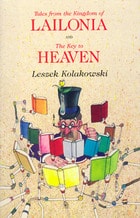
Tales from the Kingdom of Lailonia and The Key to Heaven
Leszek Kolakowski
University of Chicago Press, 1989
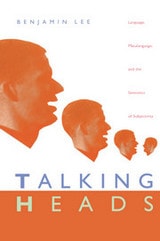
Talking Heads
Language, Metalanguage, and the Semiotics of SubjectivityBenjamin Lee
Duke University Press, 1997
Talking Heads synthesizes the views and works of a breathtaking range of the most influential modern theorists of the humanities and social sciences, including Austin, Searle, Derrida, Jakobson, Bakhtin, Wittgenstein, Peirce, Frege, Kripke, Donnellan, Putnam, Saussure, and Whorf. After illuminating these many strands of thought, Lee moves beyond disciplinary biases and re-embeds within the context of the public sphere the questions of subjectivity and language raised by these theorists. In his examination of how subjectivity relates not just to grammatical patterns but also to the specific social institutions in which these patterns develop and are sustained, Lee discusses such topics as the concept of public opinion and the emergence of Western nation-states.
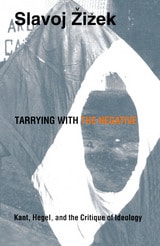
Tarrying with the Negative
Kant, Hegel, and the Critique of IdeologySlavoj Zizek
Duke University Press, 1993
In Tarrying with the Negative, Žižek challenges the contemporary critique of ideology, and in doing so opens the way for a new understanding of social conflict, particularly the recent outbursts of nationalism and ethnic struggle. Are we, Žižek asks, confined to a postmodern universe in which truth is reduced to the contingent effect of various discursive practices and where our subjectivity is dispersed through a multitude of ideological positions? No is his answer, and the way out is a return to philosophy. This revisit to German Idealism allows Žižek to recast the critique of ideology as a tool for disclosing the dynamic of our society, a crucial aspect of which is the debate over nationalism, particularly as it has developed in the Balkans—Žižek's home. He brings the debate over nationalism into the sphere of contemporary cultural politics, breaking the impasse centered on nationalisms simultaneously fascistic and anticolonial aspirations. Provocatively, Žižek argues that what drives nationalistic and ethnic antagonism is a collectively driven refusal of our own enjoyment.
Using examples from popular culture and high theory to illuminate each other—opera, film noir, capitalist universalism, religious and ethnic fundamentalism—this work testifies to the fact that, far more radically than the postmodern sophists, Kant and Hegel are our contemporaries.
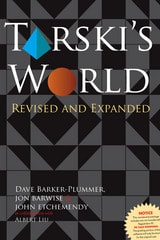
Tarski's World
Revised and ExpandedDavid Barker-Plummer, Jon Barwise, and John Etchemendy
CSLI, 2004
A brand new feature in this revised and expanded edition is student access to Grade Grinder, an innovative Internet-based grading service that provides accurate and timely feedback to students whenever they need it. Students can submit solutions for the program’s more than 100 exercises to the Grade Grinder for assessment, and the results are returned quickly to the students and optionally to the teacher as well. A web-based interface also allows instructors to manage assignments and grades for their classes.
Intended as a supplement to a standard logic text, Tarski’s World is an essential tool for helping students learn the language of logic.
Taste
Giorgio Agamben
Seagull Books, 2017
Taste, Agamben argues, is a category that has much to reveal to the contemporary world. Taking a step into the history of philosophy and reaching to the very origins of aesthetics, Agamben critically recovers the roots of one of Western culture’s cardinal concepts. Agamben is the rare writer whose ideas and works have a broad appeal across many fields, and with Taste he turns his critical eye to the realm of Western art and aesthetic practice. This volume will not only engage the author’s devoted fans in philosophy, sociology, and literary criticism but also his growing audience among art theorists and historians.
Teachers of the People
Political Education in Rousseau, Hegel, Tocqueville, and MillDana Villa
University of Chicago Press, 2017
In Teachers of the People, Dana Villa takes us back to the moment in history when “the people” first appeared on the stage of modern European politics. That moment—the era just before and after the French Revolution—led many major thinkers to celebrate the dawning of a new epoch. Yet these same thinkers also worried intensely about the people’s seemingly evident lack of political knowledge, experience, and judgment. Focusing on Rousseau, Hegel, Tocqueville, and Mill, Villa shows how reformist and progressive sentiments were often undercut by skepticism concerning the political capacity of ordinary people. They therefore felt that “the people” needed to be restrained, educated, and guided—by laws and institutions and a skilled political elite. The result, Villa argues, was less the taming of democracy’s wilder impulses than a pervasive paternalism culminating in new forms of the tutorial state.
Ironically, it is the reliance upon the distinction between “teachers” and “taught” in the work of these theorists which generates civic passivity and ignorance. And this, in turn, creates conditions favorable to the emergence of an undemocratic and illiberal populism.
Teachers, Leaders, and Schools
Essays by John DeweyEdited by Douglas J. Simpson and Sam F. Stack Jr.
Southern Illinois University Press, 2010
John Dewey was one of the most prominent philosophers and educational thinkers of the twentieth century, and his influence on modern education continues today. In Teachers, Leaders, and Schools: Essays by John Dewey, educators Douglas J. Simpson and Sam F. Stack Jr. have gathered some of Dewey’s most user-friendly and insightful essays concerning education with the purpose of aiding potential and practicing teachers, administrators, and policy makers to prepare students for participation in democratic society.
Selected largely, but not exclusively, for their accessibility, relevance, and breadth of information, these articles are grouped into five parts—The Classroom Teacher, The School Curriculum, The Educational Leader, The Ideal School, and The Democratic Society. Each part includes an introductory essay that connects Dewey’s thoughts not only to each other but also to current educational concerns. The sections build on one another, revealing Dewey’s educational theories and interests and illustrating how his thoughts remain relevant today.
Teaching Israel
Studies of Pedagogy from the FieldEdited by Sivan Zakai and Matt Reingold
Brandeis University Press, 2024
Jewish Americans are divided in their views on Israel. While scholars have outlined philosophical principles to guide educators who teach about Israel, there has been less scholarship focused on the pedagogy surrounding the country. This book resituates teaching—the questions, dilemmas, and decision-making that teachers face—as central to both Israel studies and Israel education. Contributors illuminate how educators from differing pedagogical orientations, who teach in a range of educational settings learn, understand, undertake, and ultimately improve the work of teaching Israel. The volume also looks at the professional support and learning opportunities teachers may need to engage with these pedagogical questions.
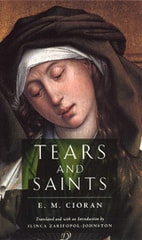
Tears and Saints
E. M. Cioran
University of Chicago Press, 1995
"Who can tell?" he wrote in the first paragraph of this book, first published in Romania in 1937. "To be sure, tears are their trace. Tears did not enter the world through the saints; but without them we would never have known that we cry because we long for a lost paradise." By following in their traces, "wetting the soles of one's feet in their tears," Cioran hoped to understand how a human being can renounce being human. Written in Cioran's characteristic aphoristic style, this flamboyant, bold, and provocative book is one of his most important—and revelatory—works.
Cioran focuses not on martyrs or heroes but on the mystics—primarily female—famous for their keening spirituality and intimate knowledge of God. Their Christianity was anti-theological, anti-institutional, and based solely on intuition and sentiment. Many, such as Catherine of Siena, Teresa of Avila, and Saint John of the Cross, have produced classic works of mystical literature; but Cioran celebrates many more minor and unusual figures as well.
Following Nietzsche, he focuses explicitly on the political element hidden in saints' lives. In his hands, however, their charitable deeds are much less interesting than their thirst for pain and their equally powerful capacity to endure it. Behind their suffering and their uncanny ability to renounce everything through ascetic practices, Cioran detects a fanatical will to power.
"Like Nietzsche, Cioran is an important religious thinker. His book intertwines God and music with passion and tears. . . . [Tears and Saints] has a chillingly contemporary ring that makes this translation important here and now."—Booklist
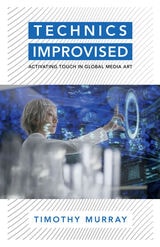
Technics Improvised
Activating Touch in Global Media ArtTimothy Murray
University of Minnesota Press, 2022
Seeing new media art as an entry point for better understanding of technology and worldmaking futures
In this challenging work, a leading authority on new media art examines that curatorial and aesthetic landscape to explore how art resists and rewires the political and economic structures that govern technology. How do inventive combinations of artistic and theoretical improvisation counter the extent to which media art remains at risk, not just from the quarantines of a global pandemic but also from the very viral and material conditions of technology? How does global media art speak back to the corporate closures of digital euphoria as clothed in strategies of digital surveillance, ecological deprivation, and planned obsolescence? In Technics Improvised, Timothy Murray asks these questions and more.
At the intersection of global media art, curatorial practice, tactical media, and philosophy, Murray reads a wide range of creative performances and critical texts that envelop artistic and digital materials in unstable, political relations of touch, body, archive, exhibition, and technology. From video to net art and interactive performance, he considers both canonical and unheralded examples of activist technics that disturb the hegemony of biopolitical/digital networks by staging the very touch of the unsettling discourse erupting from within. In the process, critical dialogues emerge between a wide range of artists and theorists, from Hito Steyerl, Ricardo Dominguez, Joan Jonas, Isaac Julien, Ryoji Ikeda, and Shadi Nazarian to Gilles Deleuze, Jean-Luc Nancy, Elizabeth Povinelli, Jean-François Lyotard, Erin Manning, Achille Mbembe, and Samuel Weber.
Brilliantly conceived and argued and eloquently written, Technics Improvised points the way to how artistic and theoretical practice can seize on the improvisational accidents of technics to activate creativity, thought, and politics anew.
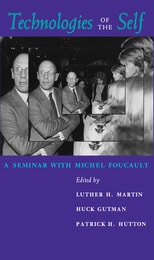
Technologies of the Self
A Seminar with Michel FoucaultLuther H. Martin
University of Massachusetts Press, 1988
Shortly before his death in 1984, Michel Foucault spoke of an idea for a new book on “technologies of the self.” He described it as “composed of different papers about the self. . . . about the role of reading and writing in constituting the self. . . . and so on.” The book Foucault envisioned was based on a faculty seminar on “Technologies of the Self,” originally presented at the University of Vermont in the fall of 1982. This volume is a partial record of that seminar.
In many ways, Foucault's project on the self was the logical conclusion to his historical inquiry over twenty-five years into insanity, deviancy, criminality, and sexuality. Because Foucault died before he completed the revisions of his seminar presentations, this volume includes a careful transcription instead...as a prolegomenon to that unfinished task.
Foucault was a French philosopher, historian of ideas, social theorist, philologist and literary critic.
This volume was edited by Luther H. Martin, Huck Gutman, and Patrick H. Hutton.
Technology and the Character of Contemporary Life
A Philosophical InquiryAlbert Borgmann
University of Chicago Press, 1987
Technology and the Good Life?
Edited by Eric Higgs, Andrew Light, and David Strong
University of Chicago Press, 2000
Technology and the Good Life? uses a careful collective analysis of Albert Borgmann's controversial and influential ideas as a jumping-off point from which to address questions such as these about the role and significance of technology in our lives. Contributors both sympathetic and critical examine Borgmann's work, especially his "device paradigm"; apply his theories to new areas such as film, agriculture, design, and ecological restoration; and consider the place of his thought within philosophy and technology studies more generally.
Because this collection carefully investigates the issues at the heart of how we can take charge of life with technology, it will be a landmark work not just for philosophers of technology but for students and scholars in the many disciplines concerned with science and technology studies.
Technology, Pessimism, and Postmodernism
Yaron Ezrahi
University of Massachusetts Press, 1995
This collection of essays from international scholars across various disciplines addresses the compelling theme of technological pessimism—the conviction that technology has simultaneously given humanity the means to achieve unlimited progress while simultaneously providing the tools for self-destruction and the degradation of our most cherished values.
Edited by Yaron Ezrahi, Everett Mendelsohn, and Howard P. Segal, this intellectually rigorous anthology examines the paradoxes and contradictions inherent in contemporary technological society through a postmodern lens. The contributors explore how technology shapes human experience, culture, and social structures in the late twentieth century, questioning the foundational narratives of technological progress and enlightenment that have dominated Western thought.
Technology
Critical History of a ConceptEric Schatzberg
University of Chicago Press, 2018
The tension between scholars and technicians continued from Aristotle through Francis Bacon and into the nineteenth century. It was only in the twentieth century that modern meanings of technology arose: technology as the industrial arts, technology as applied science, and technology as technique. Schatzberg traces these three meanings to the present day, when discourse about technology has become pervasive, but confusion among the three principal meanings of technology remains common. He shows that only through a humanistic concept of technology can we understand the complex human choices embedded in our modern world.
Telemorphosis
Jean Baudrillard
University of Minnesota Press, 2015
The art of living today has shifted to a continuous state of the experimental. In one of his last texts, Telemorphosis, renowned thinker and anti-philosopher Jean Baudrillard takes on the task of thinking and reflecting on the coming digital media architectures of the social. While “the social” may have never existed, according to Baudrillard, his analysis at the beginning of the twenty-first century of the coming social media–networked cultures cannot be ignored. One need not look far in order to find oneself snared within some sort of screenification of a techno-social community. “What the most radical critical critique, the most subversive delirious imagination, what no Situationist drift could have done . . . television has done.” Collective reality has entered a realm of telemorphosis.
Telemorphosis
Theory in the Era of Climate ChangeTom Cohen
Michigan Publishing Services, 2012

Teleology and the Conceptual Genesis of the Modern State
Essays on the Nature of PhilosophyFrancis Slade
Catholic University of America Press, 2027
Televisuality
Style, Crisis, and Authority in American TelevisionJohn T Caldwell
Rutgers University Press, 2020
Telling Rhythm
Body and Meaning in PoetryAmittai Aviram
University of Michigan Press, 1994
Tendencies
Eve Kosofsky Sedgwick
Duke University Press, 1983
The essays range from Diderot, Oscar Wilde, and Henry James to queer kids and twelve-step programs; from "Jane Austen and the Masturbating Girl" to a performance piece on Divine written with Michael Moon; from political correctness and the poetics of spanking to the experience of breast cancer in a world ravaged and reshaped by AIDS. What unites Tendencies is a vision of a new queer politics and thought that, however demanding and dangerous, can also be intent, inclusive, writerly, physical, and sometimes giddily fun.
Territories and Trajectories
Cultures in CirculationDiana Sorensen, editor
Duke University Press, 2018
Contributors. Homi Bhabha, Jacqueline Bhabha, Lindsay Bremner, Finbarr Barry Flood, Rosario Hubert, Alina Payne, Kay Kaufman Shelemay, Shu-mei Shih, Diana Sorensen, Karen Thornber, Xiaofei Tian
Terror, Theory and the Humanities
Jeffrey R. Di Leo and Uppinder Mehan, editors
Michigan Publishing Services, 2012

Terrorism for Humanity
Inquiries in Political PhilosophyTed Honderich
Pluto Press, 2003
Terrorism, Ticking Time-Bombs, and Torture
A Philosophical AnalysisFritz Allhoff
University of Chicago Press, 2012

Testing Scientific Theories
John Earman, Editor
University of Minnesota Press, 1984
Testing Scientific Theories was first published in 1984. Minnesota Archive Editions uses digital technology to make long-unavailable books once again accessible, and are published unaltered from the original University of Minnesota Press editions.
Since much of a scientist's work consists of constructing arguments to show how experiments and observation bear on a particular theory, the methodologies of theory testing and their philosophical underpinnings are of vital concern to philosophers of science. Confirmation of scientific theories is the topic of Clark Glymour's important book Theory and Evidence,published in 1980. His negative thesis is that the two most widely discussed accounts of the methodology of theory testing - hypothetico-deductivism and Bayesianism - are flawed. The issues Glymour raises and his alternative "bootstrapping" method provided the focus for a conference sponsored by the Minnesota Center for Philosophy of Science and for this book. As editor John Earman says in his preface, the papers presented in Testing Scientific Theories germinate so many new ideas that philosophers of science will reap the harvest for years to come.
Topics covered include a discussion of Glymour's bootstrapping theory of confirmation, the Bayesian perspective and the problems of old evidence, evidence and explanation, historical case studies, alternative views on testing theories, and testing particular theories, including psychoanalytic hypotheses and hypotheses about the completeness of the fossil record.
Testing scientific theories
John. Earman
University of Minnesota Press, 1983
Text and Culture
The Politics of InterpretationDaniel Cottom
University of Minnesota Press, 1989
Text and Culture was first published in 1989. Minnesota Archive Editions uses digital technology to make long-unavailable books once again accessible, and are published unaltered from the original University of Minnesota Press editions.
In Text & Culture, Daniel Cottom examines the political aspects of contemporary disciplines of interpretation. He pleads against limiting the act of reading by disqualifying some readings as "wrong" or unscholarly, and he argues for the necessity of multiple readings, claiming that a closed-off text glosses over differences that are political in nature. He proceeds, then, from the notion of text to culture. Just as the reading of the text is conditioned by irreducible political differences, so is the reading of culture. Finally, to illustrate and further develop his arguments, Cottom presents an extensive analysis of Great Expectations.
Cottom's materials range from academic jokes to King Lear, and the writers he discusses range from Kant to Derrida, from Freud to Basil Bernstein, from Ludwig Wittgenstein and Bronislaw Malinowski to Erving Goffman, Clifford Geertz, and Stanley Fish. This study is especially concerned with the way "culture" and related terms, such as "context" and "norm," are part of a larger discourse in the contemporary humanities and social sciences - a discourse in which their effect is to repress recognition of important historical differences, conflicts, and possibilities. At the same time that he shows how difficult it is to get "beyond culture," he tries to indicate how interpretation may be turned into a more socially responsible practice.
Daniel Cottom is associate professor of English at the University of Florida. He is the author of Social Figures: George Eliot, Social History, and Literary Representation (Minnesota, 1987) and The Civilized Imagination: A Study of Ann Radcliffe, Jane Austen, and Sir Walter Scott.
Textual Conspiracies
Walter Benjamin, Idolatry, and Political TheoryJames R. Martel
University of Michigan Press, 2012
“This is a sophisticated and fascinating argument written in a very enjoyably entertaining style. It is hard for me to see how readers initially interested in these texts will not be ‘swept off their feet’ by the core assertions of this author, and the devastatingly comprehensive way in which he demonstrates those arguments.”
—Brent Steele, University of Kansas
In Textual Conspiracies, James R. Martel applies the literary, theological, and philosophical insights of Walter Benjamin to the question of politics and the predicament of the contemporary left. Through the lens of Benjamin’s theories, as influenced by Kafka, of the fetishization of political symbols and signs, Martel looks at the ways in which various political and literary texts “speak” to each other across the gulf of time and space, thereby creating a “textual conspiracy” that destabilizes grand narratives of power and authority and makes the narratives of alternative political communities more apparent.
However, in keeping with Benjamin’s insistence that even he is complicit with the fetishism that he battles, Martel decentralizes Benjamin’s position as the key theorist for this conspiracy and contextualizes Benjamin in what he calls a “constellation” of pairs of thinkers and writers throughout history, including Alexis de Tocqueville and Edgar Allen Poe, Hannah Arendt and Federico García Lorca, and Frantz Fanon and Assia Djebar.
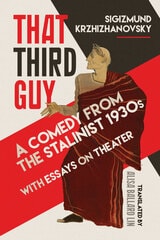
That Third Guy
A Comedy from the Stalinist 1930s with Essays on TheaterSigizmund Krzhizhanovsky, Translated and edited by Alisa Ballard Lin, Foreword by Caryl Emerson
University of Wisconsin Press, 2018
The volume also features selections from Krzhizhanovsky's compelling and idiosyncratic essays on Shakespeare, Pushkin, Shaw, and the philosophy of theater. Professionally, he worked with director Alexander Tairov at the Moscow Kamerny Theater, and his original philosophy of the stage bears comparison with the great theater theorists of the twentieth century. In these writings, he reflects on the space and time of the theater, the resonance of language onstage, the experience of the actor, and the relationship between the theater and the everyday. Commentary by Alisa Ballard Lin and Caryl Emerson contextualizes Krzhizhanovsky's writings.
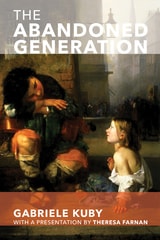
The Abandoned Generation
Gabriele Kuby
St. Augustine's Press, 2021
Reading Kuby’s analysis of cultural, sociological and biological data, the danger is clear and present. Yet Kuby asserts that, generally, our plight goes unnoticed and is veiled from our eyes. We need to see children for who and what they really are to us, to the family, and society at large. In the words of Fulton Sheen, “Children play a redeemer role in the family. The represent the victory of love over the insatiable ego. They symbolize the defeat of selfishness and the triumph of giving love.” Tragically, children are increasingly less a part of Western culture. This leaves the family, in the best case scenario, an artifact, and in the worst case, a casualty.
The topics addressed by Kuby cover towering influences in postmodern family life: Gender politics, the abortion mentality, daycare (“Socialism 2.0”), premature stress, rights of children, digital distractions, pornography, and divorce. A native German, Kuby’s work is, heartbreakingly, as relevant to American society as her own. This European perspective drives home the urgent need to recognize our situation as global and embedded, and one that requires more than political mobilization of mainstream efforts and responses. What really is good and normal, and how to we realize it? Listen to the heartstrings that yearn for true knowledge of oneself, Kuby implores, of God, and how in the surprise of God’s mercy we are guided through life. Kuby backs up this invitation to personal conversion and betterment with hard data.
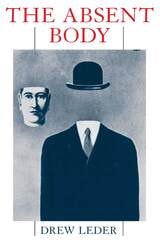
The Absent Body
Drew Leder
University of Chicago Press, 1990
In part 1, Leder explores a wide range of bodily functions with an eye to structures of concealment and alienation. He discusses not only perception and movement, skills and tools, but a variety of "bodies" that philosophers tend to overlook: the inner body with its anonymous rhythms; the sleeping body into which we nightly lapse; the prenatal body from which we first came to be. Leder thereby seeks to challenge "primacy of perception." In part 2, Leder shows how this phenomenology allows us to rethink traditional concepts of mind and body. Leder argues that Cartesian dualism exhibits an abiding power because it draws upon life-world experiences. Descartes' corpus is filled with disruptive bodies which can only be subdued by exercising "disembodied" reason. Leder explores the origins of this notion of reason as disembodied, focusing upon the hidden corporeality of language and thought. In a final chapter, Leder then proposes a new ethic of embodiment to carry us beyond Cartesianism.
This original, important, and accessible work uses examples from the author's medical training throughout. It will interest all those concerned with phenomenology, the philosophy of mind, or the Cartesian tradition; those working in the health care professions; and all those fascinated by the human body.
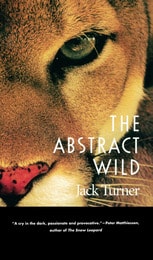
The Abstract Wild
Jack Turner
University of Arizona Press, 1996
How wild is wilderness and how wild are our experiences in it, asks Jack Turner in the pages of The Abstract Wild. His answer: not very wild. National parks and even so-called wilderness areas fall far short of offering the primal, mystic connection possible in wild places. And this is so, Turner avows, because any managed land, never mind what it's called, ceases to be wild. Moreover, what little wildness we have left is fast being destroyed by the very systems designed to preserve it.
Natural resource managers, conservation biologists, environmental economists, park rangers, zoo directors, and environmental activists: Turner's new book takes aim at these and all others who labor in the name of preservation. He argues for a new conservation ethic that focuses less on preserving things and more on preserving process and "leaving things be." He takes off after zoos and wilderness tourism with a vengeance, and he cautions us to resist language that calls a tree "a resource" and wilderness "a management unit."
Eloquent and fast-paced, The Abstract Wild takes a long view to ask whether ecosystem management isn't "a bit of a sham" and the control of grizzlies and wolves "at best a travesty." Next, the author might bring his readers up-close for a look at pelicans, mountain lions, or Shamu the whale. From whatever angle, Turner stirs into his arguments the words of dozens of other American writers including Thoreau, Hemingway, Faulkner, and environmentalist Doug Peacock.
We hunger for a kind of experience deep enough to change our selves, our form of life, writes Turner. Readers who take his words to heart will find, if not their selves, their perspectives on the natural world recast in ways that are hard to ignore and harder to forget.
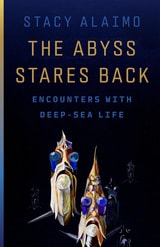
The Abyss Stares Back
Encounters with Deep-Sea LifeStacy Alaimo
University of Minnesota Press, 2025
In an era of accelerating extinctions, what does it mean to discover thousands of new species in the deep sea?
As we see the catastrophic effects of the Anthropocene proliferate, advanced technologies also grant us greater access to the furthest reaches of the world’s oceans, facilitating the discovery of countless new species. Sorting through the implications of this strange paradox, Stacy Alaimo explores the influence this newfound intimacy with the deep sea might have on our broader relationship to the nonhuman world. While many images of these abyssal creatures circulate as shallow clickbait, aesthetic representations can be enticing lures for speculating about their lives, profoundly expanding our environmental concern.
The Abyss Stares Back analyzes a diverse range of scientific, literary, and artistic accounts of deep-sea exploration, including work from the naturalist William Beebe and the artist Else Bostelmann as well as results of the Census of Marine Life that began at the turn of the twenty-first century. As she focuses on oft-overlooked creatures of the deep, such as tubeworms, hatchetfish, siphonophores, and cephalopods, which are typically cast as “alien,” Alaimo shows how depictions of the deep seas have been enmeshed in long colonial histories and racist constructions of a threatening abyss.
Drawing on feminist environmentalism, posthumanism, science and technology studies, and Indigenous and non-Western perspectives, Alaimo details how our understanding of science is fundamentally altered by aesthetic encounters with these otherworldly life forms. She argues that, although the deep sea is often thought of as a lifeless void with little connection to human existence, our increasing devastation of this realm underscores our ethical obligation to protect the biodiverse life in the depths. When the abyss stares back, it demands recognition.
Retail e-book files for this title are screen-reader friendly with images accompanied by short alt text and/or extended descriptions.
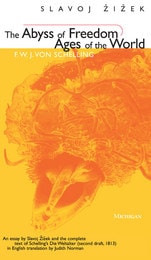
The Abyss of Freedom/Ages of the World
Slavoj Zizek and F.W.J. von Schelling
University of Michigan Press, 1997
Zizek argues that Schelling's most profound thoughts are found in the series of three consecutive attempts he made to formulate the "ages of the world/Weltalter," the stages of the self-development of the Absolute. Of the three versions, claims Zizek, it is the second that is the most eloquent and definitive encompassing of Schelling's lyrical thought. It centers on the problem of how the Absolute (God) himself, in order to become actual, to exist effectively, has to accomplish a radically contingent move of acquiring material, bodily existence. Never before available in English, this version finally renders accessible one of the key texts of modern philosophy, a text that is widely debated in philosophical circles today.
The Abyss of Freedom is Zizek's own reading of Schelling based upon Lacanian psychoanalytic theory. It focuses on the notion that Lacan's theory--which claims that the symbolic universe emerged from presymbolic drives--is prefigured in Schelling's idea of logos as given birth to from the vortex of primordial drives, or from what "in God is not yet God." For Zizek, this connection is monumental, showing that Schelling's ideas forcefully presage the post-modern "deconstruction" of logocentrism.
Slavoj Zizek is not a philosopher who stoops to conquer objects but a radical voice who believes that philosophy is nothing if it is not embodied, nothing if it is only abstract. For him, true philosophy always speaks of something rather than nothing. Those interested in the genesis of contemporary thought and the fate of reason in our "age of anxiety" will find this coupling of texts not only philosophically relevant, but vitally important.
Slavoj Zizek is the author of The Sublime Object of Ideology, Tarrying with the Negative: Kant, Hegel and the Critique of Ideology, and most recently, The Indivisible Remainder: An Essay on Schelling and Related Matters. Currently he is a Senior Researcher at the Institute for Social Sciences, University of Ljubljana. Judith Norman is Assistant Professor of Philosophy at Trinity University in San Antonio, Texas.
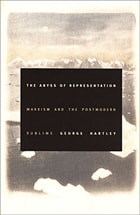
The Abyss of Representation
Marxism and the Postmodern SublimeGeorge Hartley
Duke University Press, 2003
Hartley describes how modern theory from Kant through Lacan attempts to come to terms with the sublime limits of representation and how ideas developed with the Marxist tradition—such as Marx’s theory of value, Althusser’s theory of structural causality, or Zizek’s theory of ideological enjoyment—can be seen as variants of the sublime object. Representation, he argues, is ultimately a political problem. Whether that problem be a Marxist representation of global capitalism, a deconstructive representation of subaltern women, or a Chicano self-representation opposing Anglo-American images of Mexican Americans, it is only through this grappling with the negative, Hartley explains, that a Marxist theory of postmodernism can begin to address the challenges of global capitalism and resurgent imperialism.
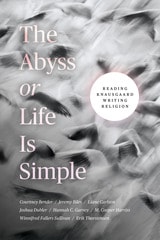
The Abyss or Life Is Simple
Reading Knausgaard Writing ReligionCourtney Bender, Jeremy Biles, Liane Carlson, Joshua Dubler, Hannah C. Garvey, M. Cooper Harriss, Winnifred Fallers Sullivan, and Erik Thorstensen
University of Chicago Press, 2022
Min kamp, or My Struggle, is a six-volume novel by Karl Ove Knausgaard and one of the most significant literary works of the young twenty-first century. Published in Norwegian between 2009 and 2011, the novel presents an absorbing first-person narrative of the life of a writer with the same name as the author, in a world at once fully disillusioned and thoroughly enchanted.
In 2015, a group of scholars began meeting to discuss the peculiarly religious qualities of My Struggle. Some were interested in Knausgaard’s attention to explicitly religious subjects and artworks, others to what they saw as more diffuse attention to the religiousness of contemporary life. The group wondered what reading these textures of religion in these volumes might say about our times, about writing, and about themselves. The Abyss or Life Is Simple is the culmination of this collective endeavor—a collection of interlocking essays on ritual, beauty, and the end of the world.
The Actor's Instrument
Body, Theory, StageHollis Huston
University of Michigan Press, 1993
The Actual and the Rational
Hegel and Objective SpiritJean-Francois Kervegan
University of Chicago Press, 2018
Kervégan begins with Hegel’s term “objective spirit,” the public manifestation of our deepest commitments, the binding norms that shape our existence as subjects and agents. He examines objective spirit in three realms: the notion of right, the theory of society, and the state. In conversation with Tocqueville and other theorists of democracy, whether in the Anglophone world or in Europe, Kervégan shows how Hegel—often associated with grand metaphysical ideas—actually had a specific conception of civil society and the state. In Hegel’s view, public institutions represent the fulfillment of deep subjective needs—and in that sense, demonstrate that the real is the rational, because what surrounds us is the product of our collective mindedness. This groundbreaking analysis will guide the study of Hegel and nineteenth-century political thought for years to come.
The Aesthetic Character of Blackness
Sounds Like UsJemma DeCristo
Duke University Press, 2025
The Aesthetics of Environment
Arnold Berleant
Temple University Press, 1995
The Aesthetics of Kinship
Form and Family in the Long Eighteenth CenturyHeidi Schlipphacke
Bucknell University Press, 2023
The Aesthetics of Meaning and Thought
The Bodily Roots of Philosophy, Science, Morality, and ArtMark Johnson
University of Chicago Press, 2018
This book gathers the best of philosopher Mark Johnson’s essays addressing questions of our embodiment as they deal with aesthetics—which, he argues, we need to rethink so that it takes into account the central role of body-based meaning. Viewed that way, the arts can give us profound insights into the processes of meaning making that underlie our conceptual systems and cultural practices. Johnson shows how our embodiment shapes our philosophy, science, morality, and art; what emerges is a view of humans as aesthetic, meaning-making creatures who draw on their deepest physical processes to make sense of the world around them.
The Affection in Between
From Common Sense to Sensing in CommonApril Flakne
Ohio University Press, 2022
The Aftermath of War
Jean-Paul Sartre
Seagull Books, 2008