Results by title
95 books match the query 'Plato' and 24 start with t
The Argument and the Action of Plato's Laws
Leo Strauss
University of Chicago Press, 1977
"Strauss's The Argument and the Action of Plato's 'Laws' reflects his interest in political thought, his dogged method of following the argument of the Laws step by step, and his vigorous defense of this dialogue's integrity in respect to the ideals of the Republic."—Cross Currents
"The unique characteristics of this commentary on the Laws reflect the care and precision which were the marks of Professor Strauss's efforts to understand the complex thoughts of other men."—Allan D. Nelson, Canadian Journal of Political Science
"Thorough and provocative, an important addition to Plato scholarship."—Library Journal
"The major purpose of the commentary is to provide a reading of the dialogue which displays its structural arrangement and the continuity of the argument."—J. W. Dy, Bibliographical Bulletin of Philosophy
"The reader of Strauss's book is indeed guided closely through the whole text."— M. J. Silverthorne, The Humanities Association Review
Leo Strauss (1899-1973) was the Robert Maynard Hutchins Distinguished Service Professor Emeritus of political science at the University of Chicago.
The Argument of the Action
Essays on Greek Poetry and PhilosophySeth Benardete
University of Chicago Press, 2000
This volume brings together Seth Benardete’s studies of Hesiod, Homer, and Greek tragedy, eleven Platonic dialogues, and Aristotle’s Metaphysics.
The Argument of the Action spans four decades of Seth Benardete’s work, documenting its impressive range. Benardete’s philosophic reading of the poets and his poetic reading of the philosophers share a common ground, guided by the key he found in the Platonic dialogue: probing the meaning of speeches embedded in deeds, he uncovers the unifying intention of the work by tracing the way it unfolds through a movement of its own. Benardete’s original interpretations of the classics are the fruit of this discovery of the “argument of the action.”
The Being of the Beautiful
Plato's Theaetetus, Sophist, and StatesmanPlato
University of Chicago Press, 1984
“The translations are masterpieces of literalness. . . . They are honest, accurate, and give the reader a wonderful sense of the Greek.”—Drew A. Hyland, Review of Metaphysics
The Divine Spark of Syracuse
Ingrid D. Rowland
Brandeis University Press, 2018
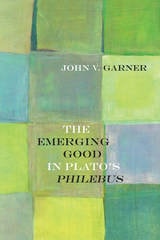
The Emerging Good in Plato's Philebus
John V. Garner
Northwestern University Press, 2017
John V. Garner convincingly refines previous interpretations and uncovers a profound thesis in the Philebus: genuine learners find value not only in stable being but also in the process of becoming. Further, since genuine learning arises in pluralistic communities where people form and inform one another, those who are truly open to learning are precisely those who actively shape the betterment of humanity.
The Emerging Good in Plato’s "Philebus" thus connects the Philebus’s grand philosophical ideas about the order of values, on the one hand, to its intimate and personal account of the experience of learning, on the other. It shows that this dialogue, while agreeing broadly with themes in more widely studied works by Plato such as the Republic, Gorgias, and Phaedo, also develops a unique way of salvaging the whole of human life, including our ever-changing nature.
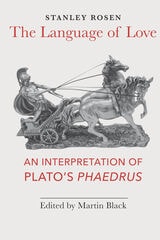
The Language of Love
An Interpretation of Plato's PhaedrusStanley Rosen
St. Augustine's Press, 2016
Here Rosen’s argue for the possibility of philosophy or the retrieval of human self-knowledge on the basis of a renewed argument for the partial intelligibility of ordinary experience or, in other words, for the Platonic Ideas. His book on the Symposium was an important contribution to the subsequent sea change in Plato scholarship that returned attention to the dialogue form and to the poetic side of philosophy even in its quarrel with philosophy. That change allowed us search for understanding in the light of the whole, a whole which is otherwise, as Rosen has shown elsewhere, fragmented by the scientism of analytical philosophy or the historicism of “Continental” philosophy.
The Language of Love represents a missing key to Stanley Rosen’s work and, much more significantly, to the rediscovery of philosophy in our time. The title of the book is not merely a play on words. It points to the incommensurability between the constructed or historical nature of language or culture and the pre-discursive apprehension of things that is necessary if speech is to make sense and be understood, as opposed to being mere nonsense.
Among many valuable insights along the way, Rosen unites the dialogue in two parts, treating both eros and rhetoric, showing the linkage between eros and writing, as between myth and analysis. He connects the comic attempt to subject eros to diaeresis in the Phaedrus with the attempt to understand non-being as an eidos in the Sophist. In both cases, the inadequacy of a technical understanding of philosophy returns us to the pre-technical world of ordinary experience.
Rosen’s interpretation is an expression of the Socratic claim that we can’t speak beautifully without knowing the truth and that whatever truth we speak or write is a reflection of the silent invisibility of beauty as the unity of form. However, “Like every good teacher, it does not simply state that link for us to memorize. Instead, we must recollect it.”
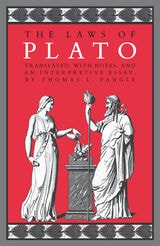
The Laws of Plato
Plato
University of Chicago Press, 1988
"Because it succeeds in being both literal and comprehensive, it is by far superior to any translation available. By reproducing dramatic detail often omitted, such as oaths, hesitations, repetitions, and forms of address, Pangle allows the reader to follow the dialogue's interplay between argument and dramatic context. . . . Pangle's translation captures the excitement and the drama of Plato's text."—Mary P. Nichols, Ancient Philosophy
"Pangle's achievement is remarkable. . . . The accompanying interpretive essay is an excellent distillation of a dialogue three times its size. The commentary is thoughtful, even profound; and it amply demonstrates the importance of reading Plato carefully and from a translation that is true to his language."—Patrick Coby, American Political Science Review
The Liberalism of Care
Community, Philosophy, and EthicsShawn C. Fraistat
University of Chicago Press, 2021
To recover that language, Fraistat turns to three prominent philosophers—Plato, Jean-Jacques Rousseau, and William Godwin—who illuminate the varied ways caring language and caring values have structured core debates in the history of Western political thought about the proper role of government, as well as the rights and responsibilities of citizens. The Liberalism of Care presents a distinctive vision for our liberal politics where political communities and citizens can utilize the ethic and practices of care to face practical challenges.
The Modern Age
James V. Schall
St. Augustine's Press, 2011
The One and the Others
Metaphysics, Poetry, and the Antinomies of Plato’s "Parmenides"Andrew Cutrofello
Northwestern University Press, 2026
At the end of Plato’s Parmenides, Parmenides concludes that “whether ‘the One’ is or is not, it and ‘the Others’ both are and are not, and both appear and do not appear, all things in all ways.” Throughout the history of philosophy various attempts have been made to make sense of Plato’s puzzling dialectical exercise. In this ambitious book Andrew Cutrofello shows how Kant and Hegel extended it, how contemporary philosophers, including Graham Priest and Alain Badiou, have reinterpreted it, and how poets such as Dante, Shakespeare, Blake, Wordsworth, and Susan Howe have channeled it. What emerges is an original conception of the history of metaphysics as a series of antinomies, and of metaphysical poetry as a type of antinomianism.
The Pedagogy of Wisdom
An Interpretation of Plato's TheaetetusGregory Kirk
Northwestern University Press, 2015
In this interpretive commentary on Theaetetus, Gregory Kirk makes a major contribution to scholarship on Plato by emphasizing the relevance of the interpersonal dynamics between the interlocutors for the interpretation of the dialogue’s central arguments about knowledge. Kirk attends closely to the personalities of the participants in the dialogue, focusing especially on the unique demands faced by a student—in this case, Theaetetus—and the ways in which one can embrace or deflect the responsibilities of learning. Kirk’s approach gives equal consideration to the dual demands of dramatic interpretation and philosophical argument that constitute the unique character of the Platonic text, and he develops an original interpretation of the Theaetetus, concluding that the uncertainty that characterizes wisdom supersedes the certainty of knowledge.
The Philosopher in Plato's Statesman
Mitchell Miller
Parmenides Publishing, 2004
"This study demonstrates how the Statesman is the culminating expression of Plato''s lifelong effort, both in Athens and in the Academy, to bring metaphysical insight to the unending political crisis of his times."The Philosopher in Plato's Statesman a trail-blazing work. While not every reader will agree with the lessons Miller himself draws from this approach, none should fail to be impressed by its interpretive power. All this is exciting stuff. The interpretive pathway on which Miller has embarked has the potential for changing the face of scholarship on the late Platonic dialogues. Parmenides [Publishing] is to be commended for making these two important contributions available under a single cover." --Kenneth Sayre, Professor of Philosophy, University of Notre Dame
"Miller casts considerable light on virtually every aspect of the dialogue. . . . All in all, this book is an outstanding contribution to our understanding of the Statesman." --Stanley Rosen, Borden Parker Bowne Professor of Philosophy, Boston University
MITCHELL MILLER is Professor of Philosophy at Vassar College. He is the author of Plato's Parmenides.
The Platonic Tradition
Peter Kreeft
St. Augustine's Press, 2016
In the first of his eight lectures, Peter Kreeft defines Platonism and its “Big Idea,” the idea of a transcendent reality that the history of philosophy has labeled “Platonic Ideas” or Platonic Forms. In the second lecture, he briefly explores Plato’s two basic predecessors or sources, myth and Socrates; and then looks at 12 applications of the Forms in Plato’s own dialogues. The third lecture covers the three most important modifications or additions to Plato himself in the Platonic tradition: Aristotle, Plotinus, and Augustine, each of whom gave the Forms a new metaphysical address. The fourth lecture explores six Christian Platonists, three in the New Testament and three philosophers, Justin Martyr, Bonaventure, and Aquinas.
The Rhetoric of Morality and Philosophy
Plato's Gorgias and PhaedrusSeth Benardete
University of Chicago Press, 1991
The Rhetoric of Morality and Philosophy, one of the most groundbreaking works of twentieth-century Platonic studies, is now back in print for a new generation of students and scholars to discover. In this volume, distinguished classicist Seth Benardete interprets and pairs two important Platonic dialogues, the Gorgias and the Phaedrus, illuminating Socrates’ notion of rhetoric and Plato’s conception of morality and eros in the human soul.
Following his discussion of the Gorgias as a dialogue about the rhetoric of morality, Benardete turns to the Phaedrus as a discourse about genuine rhetoric, namely the science of eros, or true philosophy. This novel interpretation addresses numerous issues in Plato studies: the relation between the structure of the Gorgias and the image of soul/city in the Republic, the relation between the structure of Phaedrus and the concept of eros, and Socrates’ notion of ignorance, among others.
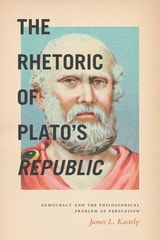
The Rhetoric of Plato's Republic
Democracy and the Philosophical Problem of PersuasionJames L. Kastely
University of Chicago Press, 2015
As Kastely shows, the Republic begins with two interrelated crises: one rhetorical, one philosophical. In the first, democracy is defended by a discourse of justice, but no one can take this discourse seriously because no one can see—in a world where the powerful dominate the weak—how justice is a value in itself. That value must be found philosophically, but philosophy, as Plato and Socrates understand it, can reach only the very few. In order to reach its larger political audience, it must become rhetoric; it must become a persuasive part of the larger culture—which, at that time, meant epic poetry. Tracing how Plato and Socrates formulate this transformation in the Republic, Kastely isolates a crucial theory of persuasion that is central to how we talk together about justice and organize ourselves according to democratic principles.
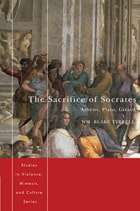
The Sacrifice of Socrates
Athens, Plato, GirardWm. Blake Tyrrell
Michigan State University Press, 2012
When Athenians suffered the shame of having lost a war from their own greed and foolishness, around 404 BCE the public’s blame was directed at Socrates, a man whose unique appearance and behavior, as well as his disapproval of the democracy, made him a ready target. Socrates was subsequently put on trial and sentenced to death. However, as René Girard has pointed out, no individual can be held responsible for a communal crisis. Plato’s Apology depicts Socrates as both the bane and the cure of Greek society, while his Crito shows a sacrificial Socrates, what some might consider a pharmakos figure, the human drug through whom Plato can dispense his philosophical remedies. With tremendous insight and satisfying complexity, this book analyzes classical texts through the lens of Girard’s mimetic mechanism.
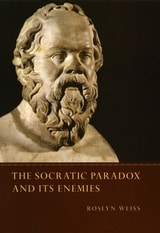
The Socratic Paradox and Its Enemies
Roslyn Weiss
University of Chicago Press, 2006

The Symposium of Plato
Suzy Q. Groden
University of Massachusetts Press, 1970
This new translation of Plato’s dialogue on love avoids the cumbersome locutions of Victorian versions and presents Plato’s ancient drinking party in a vigorous contemporary idiom. The character of Socrates emerges with unexpected wit and humor, adding new dimensions to his familiar irony. A poet and philosopher have collaborated to give an English version that is fresh and clear, and accurately renders the ideas of the speakers.
A detailed internal analysis of the structure of the dialogue is given in the introduction. The afterword presents an historical interpretation of the two ways of love, eros and agapé, an a reinterpretation of eros in Plato.

The Thinker As Artist
From Homer To Plato and AristotleGeorge Anastaplo
Ohio University Press, 1997
The Thought of John Sallis
Phenomenology, Plato, ImaginationBernard Freydberg
Northwestern University Press, 2012
Sallis’s work possesses an intrinsic power and originality, as well as deep interpretive insight. This book is a descriptive and critical journey through his thought, providing an overview for readers who wish to gain a sense of its sweep, along with discrete sections on particular philosophical disciplines for readers whose interests are more specific. It grapples with the challenges Sallis’s thought presents, making them explicit and opening them up to further consideration. And it attempts to locate his thought within both contemporary continental philosophy and philosophy as a whole. Essential for any student of continental philosophy, The Thought of John Sallis expounds on his work in a manner that increases access, honors its depth, and opens up unexplored possibilities for philosophy.
The Tragedy and Comedy of Life
Plato's PhilebusPlato
University of Chicago Press, 1993
In The Tragedy and Comedy of Life, Seth Benardete focuses on the idea of the good in what is widely regarded as one of Plato's most challenging and complex dialogues, the Philebus. Traditionally the Philebus is interpreted as affirming the doctrine that the good resides in thought and mind rather than in pleasure or the body. Benardete challenges this view, arguing that Socrates vindicates the life of the mind over the life of pleasure not by separating the two and advocating a strict asceticism, but by mixing pleasure and pain with mind in such a way that the philosophic life emerges as the only possible human life.
Benardete combines a probing and challenging commentary that subtly mirrors and illuminates the complexities of this dialogue with the finest English translation of the Philebus yet available. The result is a work that will be of great value to classicists, philosophers, and political theorists alike.
The Verge of Philosophy
John Sallis
University of Chicago Press, 2007
The Verge of Philosophy is both an exploration of the limits of philosophy and a memorial for John Sallis’s longtime friend and interlocutor Jacques Derrida. The centerpiece of the book is an extended examination of three sites in Derrida’s thought: his interpretation of Heidegger regarding the privileging of the question; his account of the Platonic figure of the good; and his interpretation of Plato’s discourse on the crucial notion of the chora, the originating space of the universe.
Sallis’s reflections are given added weight—even poignancy—by his discussion of his many public and private philosophical conversations with Derrida over the decades of their friendship. This volume thus simultaneously serves to mourn and remember a friend and to push forward the deeply searching discussions that lie at the very heart of that friendship.
“All of John Sallis’s work is essential, but [this book] in particular is remarkable. . . . Sallis shows better than anyone I have ever read what it means to practice philosophy on the verge.”—Walter Brogan, Villanova University
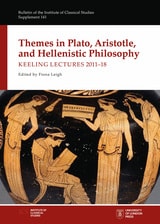
Themes in Plato, Aristotle, and Hellenistic Philosophy
Keeling Lectures 2011-18Edited by Fiona Leigh
University of London Press, 2020
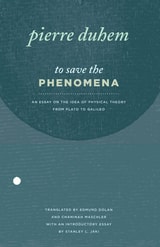
To Save the Phenomena
An Essay on the Idea of Physical Theory from Plato to GalileoPierre Duhem
University of Chicago Press, 1969
Duhem's 1908 essay questions the relation between physical theory and metaphysics and, more specifically, between astronomy and physics–an issue still of importance today. He critiques the answers given by Greek thought, Arabic science, medieval Christian scholasticism, and, finally, the astronomers of the Renaissance.