Results by title
2018 books match the query 'Political aspects' and 377 start with t

Talk about Sex
How Sex Ed Battles Helped Ignite the RightJanice M. Irvine
Temple University Press, 2023
“Must reading for scholars, sexuality researchers, activists, and public policy and public health planners engaged in efforts to promote education on sex, sexually transmitted diseases, and HIV infection prevention for adolescents in schools.”—JAMA
Talk about Sex is a rich social history about the political transformations, cultural dynamics, and emotional rhetorical strategies that helped the right wing manufacture controversies on the local and national levels in the United States. Although the emergence of a politicized Christian Right is commonly dated at the mid-seventies, with the founding of groups like the Moral Majority, Talk about Sex tells the story of a powerful right-wing Christian presence in politics a full decade earlier. These activists used inflammatory sexual rhetoric—oftentimes deceptive and provocative—to capture the terms of public debate, galvanize voters, and reshape the culture according to their own vision.
This 20th Anniversary Edition includes a new preface and epilogue by the author that examines current controversies over public education on sexuality, gender, and race.
Demonstrating how the right wing draws on the cultural power of sexual shame and fear to build a political movement, Talk about Sex explores the complex entanglements of sexual knowledge, politics, and discourses.
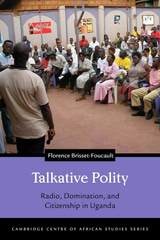
Talkative Polity
Radio, Domination, and Citizenship in UgandaFlorence Brisset-Foucault
Ohio University Press, 2019
For the first decade of the twenty-first century, every weekend, people throughout Uganda converged to participate in ebimeeza, open debates that invited common citizens to share their political and social views. These debates, also called “People’s Parliaments,” were broadcast live on private radio stations until the government banned them in 2009. In Talkative Polity, Florence Brisset-Foucault offers the first major study of ebimeeza, which complicate our understandings of political speech in restrictive contexts and force us to move away from the simplistic binary of an authoritarian state and a liberal civil society.
Brisset-Foucault conducted fieldwork from 2005 to 2013, primarily in Kampala, interviewing some 150 orators, spectators, politicians, state officials, journalists, and NGO staff. The resulting ethnography invigorates the study of political domination and documents a short-lived but highly original sphere of political expression. Brisset-Foucault thus does justice to the richness and depth of Uganda’s complex political and radio culture as well as to the story of ambitious young people who didn’t want to behave the way the state expected them to. Positioned at the intersection of media studies and political science, Talkative Polity will help us all rethink the way in which public life works.
Talking Back to the West
How Turkey Uses Counter-Hegemony to Reshape the Global Communication OrderBilge Yesil
University of Illinois Press, 2024
Insightfully exploring the crossroads of communications and authoritarianism, Talking Back to the West illuminates how the Erdogan government and its media allies use history, religion, and identity to pursue complementary agendas and tighten the AKP’s grip on power.
Teaching Readers in Post-Truth America
Ellen C. Carillo
Utah State University Press, 2018
Readers in this post-truth culture are under unprecedented pressure to interpret an overwhelming quantity of texts in many forms, including speeches, news articles, position papers, and social media posts. In response, Carillo describes pedagogical interventions designed to help students become more metacognitive about their own reading and, in turn, better equipped to respond to texts in a post-truth culture.
Teaching Readers in Post-Truth America is an invaluable source of support for writing instructors striving to prepare their students to resist post-truth rhetoric and participate in an information-rich, divisive democratic society.
Techniques of Pleasure
BDSM and the Circuits of SexualityMargot Weiss
Duke University Press, 2012

Technocapitalism
A Critical Perspective on Technological Innovation and CorporatismLuis Suarez-Villa
Temple University Press, 2012
In his provocative book Technocapitalism, Luis Suarez-Villa addresses this phenomenon from the perspective of radical political economy and social criticism. Grounded in the premise that relations of power influence how human creativity and technology are exploited by the new corporatism, the author argues that new forms of democratic participation and resistance are needed, if the social pathologies created by this new version of capitalism are to be checked.
Considering the new sectors affected by technocapitalism, such as biotechnology, nanotechnology, bioinformatics, and genomics, Suarez-Villa deciphers the common threads of power and organization that drive their corporatization. These new sectors, and the corporate apparatus set up to extract profit and power through them, are imposing standards, creating business models, molding social governance, and influencing social relations at all levels. The new reality they create is likely to affect most every aspect of human existence, including work, health, life, and nature itself.
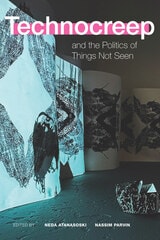
Technocreep and the Politics of Things Not Seen
Neda Atanasoski and Nassim Parvin, editors
Duke University Press, 2025
Contributors. Neda Atanasoski, Katherine Bennett, Iván Chaar López, Sushmita Chatterjee, Hayri Dortdivanlioglu, Sanaz Haghani, Jacob Hagelberg, Jennifer Hamilton, Antonia Hernández, Marjan Khatibi, Tamara Kneese, Erin McElroy, Vernelle A. A. Noel, Jessica Olivares, Nassim Parvin, Beth Semel, Renee Shelby, Tanja Wiehn
Technology and the Resilience of Metropolitan Regions
Edited by Michael E. Pagano
University of Illinois Press, 2015
In this new collection, Michael A. Pagano curates engagement with such questions by public intellectuals, stakeholders, academics, policy analysts, and citizens. Each essay explores issues related to the impact and opportunities technology provides in government and citizenship, health care, workforce development, service delivery to citizens, and metropolitan growth. As the authors show, rapidly emerging technologies and access to such technologies shape the ways people and institutions interact in the public sphere and private marketplace. The direction of metropolitan growth and development, in turn, depends on access to appropriate technology scaled and informed by the individual, household, and community needs of the region.
Contributors include Randy Blankenhorn, Bénédicte Callan, Jane Fountain, Sandee Kastrul, Karen Mossberger, Dan O'Neil, Michelle Russell, Alfred Tatum, Stephanie Truchan, Darrel West, and Howard Wial.
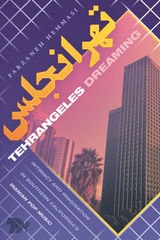
Tehrangeles Dreaming
Intimacy and Imagination in Southern California's Iranian Pop MusicFarzaneh Hemmasi
Duke University Press, 2020
Telecommunications and Empire
Jill Hills
University of Illinois Press, 2007
Jill Hills picks up from her pathbreaking study The Struggle for Control of Global Communication: The Formative Century to continue her examination of the political, technological, and economic forces at work in the global telecommunications market from World War II to the World Trade Organization agreement of 1997. In the late twentieth century, focus shifted from the creation and development of global communication markets to their intense regulation. The historical framework behind this control--where the market was regulated, by what institution, controlled by what power, and to whose benefit--masterfully complements Hills's analysis of power relations within the global communications arena.
Hills documents attempts by governments to direct, replace, and bypass international telecommunications institutions. As she shows, the results have offered indirect control over foreign domestic markets, government management of private corporations, and government protection of its own domestic communication market. Hills reveals that the motivation behind these powerful, regulatory efforts on person-to-person communication lies in the unmatched importance of communication in the world economy.
As ownership of communications infrastructure becomes more valuable, governments have scrambled to shape international guidelines. Hills provides insight into struggles between U.S. policymakers and the rest of the world, illustrating the conflict between a growing telecommunications empire and sovereign states that are free to implement policy changes. Freshly detailing the interplay between U.S. federal regulation and economic power, Hills fosters a deep understanding of contemporary systems of power in global communications.
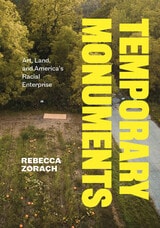
Temporary Monuments
Art, Land, and America's Racial EnterpriseRebecca Zorach
University of Chicago Press, 2024
Art has long played a key role in constructing how people understand and imagine America. Starting with contemporary controversies over public monuments in the United States, Rebecca Zorach carefully examines the place of art in the occupation of land and the upholding of White power in the US, arguing that it has been central to the design of America’s racial enterprise. Confronting closely held assumptions of art history, Zorach looks to the intersections of art, nature, race, and place, working through a series of symbolic spaces—the museum, the wild, islands, gardens, home, and walls and borders—to open and extend conversations on the political implications of art and design.
Against the backdrop of central moments in American art, from the founding of early museums to the ascendancy of abstract expressionism, Zorach shows how contemporary artists—including Dawoud Bey, Theaster Gates, Maria Gaspar, Kerry James Marshall, Alan Michelson, Dylan Miner, Postcommodity, Cauleen Smith, and Amanda Williams—have mined the relationship between environment and social justice, creating works that investigate and interrupt White supremacist, carceral, and environmentally toxic worlds. The book also draws on poetry, creative nonfiction, hip-hop videos, and Disney films to illuminate crucial topics in art history, from the racial politics of abstraction to the origins of museums and the formation of canons.
Tense Times
Rhetoric, Syntax, and Politics in US Crisis CultureLee M. Pierce
University of Alabama Press, 2023
American public culture is obsessed with crisis. Political polarization, economic collapse, moral decline—the worst seems always yet to come and already here. Tense Times argues that the ways we discuss these crises, especially through verb tenses, not only contribute to our perception and description of such crises but create them.
Past. Present. Future. These are the three principal verb tenses—the category of syntax that allows us to discuss time—that account for much of what is written about our crisis culture. Lee M. Pierce invites readers to expand their syntactic inventory beyond tense to include aspect (duration) and mood (attitude). Doing so opens new possibilities for understanding crisis discourse, as Pierce demonstrates with close readings of three syntaxes: the historical present, the past imperfective, and the retroactive subjunctive. Each mode produces a different experience of crisis and can help us understand our current political reality.
The book investigates a dozen widely circulated discourses from the past decade of US political culture, from Beyoncé’s controversial hit single “Formation” to the presidential campaign slogans of Hillary Clinton and Donald Trump, from the dueling rallies of Glenn Beck and Jon Stewart at the National Mall to the Ground Zero Mosque controversy and the 2007–2008 bailout. Taking a comparative approach that integrates theories of syntax from rhetorical, literary, affect, and cultural studies as well as linguistics, computer science, and Black studies, Tense Times suggests that the public’s conjuring of crisis is not inherently problematic. Rather, it is the openness of that crisis to contingency—the possibility that things could have been otherwise—that ought to concern anyone interested in language, politics, American culture, current events, or the direction this country is headed.

Terracene
A Crude AestheticsSalar Mameni
Duke University Press, 2023
Terror And Its Discontents
Suspect Words In Revolutionary FranceCaroline Weber
University of Minnesota Press, 2003
A timely exploration of the political uses of language and rhetoric
Camille Desmoulins, a journalist writing under the Montagnard regime of 1793-94, remarked that France’s government had replaced “the language of democracy” with “the cold poison of fear, which paralyzed thought in the bottom of people’s souls, and prevented it from pouring forth at the tribunal, or in writing.” How this happened, how the Reign of Terror reached even into the realms of thought and language, is the subject of Caroline Weber’s book, a revealing look into the paradoxical embargo on free expression that underpinned the Robespierrists’s self-proclaimed “despotism of liberty” during the French Revolution.
Weber examines Jean-Jacques Rousseau’s and the Robespierrists’s articulation of a series of initiatives designed to curtail and control the dissemination of alternative political and philosophical messages in the republic. Here Weber underscores the internal contradictions and limitations of an enterprise that promised universal freedom while oppressing particularism, and that railed against the very language that it was compelled to adopt as a principal political tool. The book then focuses on two eloquent contemporary critics of this phenomenon, Desmoulins and the Marquis de Sade, the infamous libertine author. Weber demonstrates how Desmoulins reconfigured the Montagnard regime’s rhetoric to conjure up a political system based on tolerance, not terror, and how Sade deftly parodied the Robespierrists’s brutality and hypocrisy, proposing a republic based on the ruthless elimination of dissident voices and on the unabashed celebration of despotism and bloodshed.A balanced account of how the “discourse of totality” actually restricted particular freedoms in the wake of the French Revolution, this book provides a highly original—and timely—exposition of the political uses of rhetoric and of the links between language and power.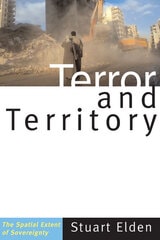
Terror and Territory
The Spatial Extent of SovereigntyStuart Elden
University of Minnesota Press, 2009
Today's global politics demands a new look at the concept of territory. From so-called deterritorialized terrorist organizations such as al-Qaeda to U.S.-led overthrows of existing regimes in the Middle East, the relationship between territory and sovereignty is under siege. Unfolding an updated understanding of the concept of territory, Stuart Elden shows how the contemporary "war on terror" is part of a widespread challenge to the connection between the state and its territory.
Although the importance of territory has been disputed under globalization, territorial relations have not come to an abrupt end. Rather, Elden argues, the territory/sovereignty relation is being reconfigured. Traditional geopolitical analysis is transformed into a critical device for interrogating hegemonic geopolitics after the Cold War, and is employed in the service of reconsidering discourses of danger that include "failed states," disconnection, and terrorist networks.
Looking anew at the "war on terror"; the development and application of U.S. policy; the construction and demonization of rogue states; events in Lebanon, Somalia, and Pakistan; and the wars continuing in Afghanistan and Iraq, Terror and Territory demonstrates how a critical geographical analysis, informed by political theory and history, can offer an urgently needed perspective on world events.
Terrorist Assemblages
Homonationalism in Queer TimesJasbir K. Puar
Duke University Press, 2007
Puar combines transnational feminist and queer theory, Foucauldian biopolitics, Deleuzian philosophy, and technoscience criticism, and draws from an extraordinary range of sources, including governmental texts, legal decisions, films, television, ethnographic data, queer media, and activist organizing materials and manifestos. Looking at various cultural events and phenomena, she highlights troublesome links between terrorism and sexuality: in feminist and queer responses to the Abu Ghraib photographs, in the triumphal responses to the Supreme Court’s Lawrence decision repealing anti-sodomy laws, in the measures Sikh Americans and South Asian diasporic queers take to avoid being profiled as terrorists, and in what Puar argues is a growing Islamophobia within global queer organizing.

Terrorist Assemblages
Homonationalism in Queer TimesJasbir K. Puar
Duke University Press, 2017
Ten years on, Jasbir K. Puar’s pathbreaking Terrorist Assemblages remains one of the most influential queer theory texts and continues to reverberate across multiple political landscapes, activist projects, and scholarly pursuits. Puar argues that configurations of sexuality, race, gender, nation, class, and ethnicity are realigning in relation to contemporary forces of securitization, counterterrorism, and nationalism. She examines how liberal politics incorporate certain queer subjects into the fold of the nation-state, shifting queers from their construction as figures of death to subjects tied to ideas of life and productivity. This tenuous inclusion of some queer subjects depends, however, on the production of populations of Orientalized terrorist bodies. Heteronormative ideologies that the U.S. nation-state has long relied on are now accompanied by what Puar calls homonationalism—a fusing of homosexuality to U.S. pro-war, pro-imperialist agendas.
As a concept and tool of biopolitical management, homonationalism is here to stay. Puar’s incisive analyses of feminist and queer responses to the Abu Ghraib photographs, the decriminalization of sodomy in the wake of the Patriot Act, and the profiling of Sikh Americans and South Asian diasporic queers are not instances of a particular historical moment; rather, they are reflective of the dynamics saturating power, sexuality, race, and politics today.
This Tenth Anniversary Expanded Edition features a new foreword by Tavia Nyong’o and a postscript by Puar entitled “Homonationalism in Trump Times.” Nyong’o and Puar recontextualize the book in light of the current political moment while reposing its original questions to illuminate how Puar’s interventions are even more vital and necessary than ever.

Text/Politics in Island Southeast Asia
Essays in InterpretationD.M. Roskies
Ohio University Press, 1993
Textual Carnivals
The Politics of CompositionSusan Miller
Southern Illinois University Press, 1993
This is the first book-length study of the status of composition in English studies and the uneasy relationship between composition and literature. Composition studies and institutional histories of English studies have long needed this kind of clarification of the historical and political contexts of composition teaching, research, and administration.
Susan Miller argues that composition constitutes a major national industry, citing the four million freshman-level students enrolled in such courses each year, the $40 million annual expenditure for textbooks, and the more than $50 million in teacher salaries. But this concrete magnitude is not expressed in political power within departments. Miller calls on her associates in composition to engage in a persistent critique of the social practices and political agenda of the discipline that have been responsible for its institutional marginalization. Drawing on her own long experience as a composition administrator, teacher, and scholar, as well as on a national survey of composition professionals, Miller argues that composition teachers inadvertently continue to foster the negative myth about composition’s place in the English studies hierarchy by assuming an assigned, self-sacrificial cultural identity. Composition has been regarded as subcollegiate, practical, a "how-to," and has been denied intellectual rigor in order to preserve literature’s presentations of quasi-religious textual ideals.
Winner of three major book awards:
The Modern Language Association’s Mina P. Shaughnessy Prize
The Conference on College Composition and Communication’s Outstanding Book Award
The Teachers of Advanced Composition’s W. Ross Winterowd Award

The Afterlife of Reproductive Slavery
Biocapitalism and Black Feminism’s Philosophy of HistoryAlys Eve Weinbaum
Duke University Press, 2019
The Amalgamation Waltz
Race, Performance, and the Ruses of MemoryTavia Nyong’o
University of Minnesota Press, 2009
Does racial hybridity offer a future beyond racial difference?
At a time when the idea of a postracial society has entered public discourse, The Amalgamation Waltz investigates the practices that conjoined blackness and whiteness in the nineteenth and twentieth centuries. Scrutinizing widely diverse texts—archival, musical, visual, and theatrical—Tavia Nyong’o traces the genealogy of racial hybridity, analyzing how key events in the nineteenth century spawned a debate about interracialism that lives on today.
Deeply interested in how discussions of racial hybridity have portrayed the hybrid as the recurring hope for a distant raceless future, Nyong’o is concerned with the ways this discourse deploys the figure of the racial hybrid as an alibi for a nationalism that reinvents the racist logics it claims to have broken with. As Nyong’o demonstrates, the rise of a pervasive image of racially anomalous bodies responded to the appearance of an independent black public sphere and organized politics of black uplift. This newfound mobility was apprehended in the political imaginary as a bodily and sexual scandal, and the resultant amalgamation discourse, he argues, must be recognized as one of the earliest and most enduring national dialogues on sex and sexuality. Nyong’o tracks the emergence of the concept of the racial hybrid as an ideological modernization of the older concept of the mongrel and shows how this revision brought race-thinking in line with new understandings of sex and gender, providing a racial context for the shift toward modern heterosexuality, the discourse on which postracial metaphors so frequently rely. A timely rebuttal to our contemporary fascination with racial hybridity, The Amalgamation Waltz questions the vision of a national future without racial difference or conflict.The American Moralist
On Law, Ethics, And GovernmentGeorge Anastaplo
Ohio University Press, 1994

The Anarchist Roots of Geography
Toward Spatial EmancipationSimon Springer
University of Minnesota Press, 2016
The Anarchist Roots of Geography sets the stage for a radical politics of possibility and freedom through a discussion of the insurrectionary geographies that suffuse our daily experiences. By embracing anarchist geographies as kaleidoscopic spatialities that allow for nonhierarchical connections between autonomous entities, Simon Springer configures a new political imagination.
Experimentation in and through space is the story of humanity’s place on the planet, and the stasis and control that now supersede ongoing organizing experiments are an affront to our survival. Singular ontological modes that favor one particular way of doing things disavow geography by failing to understand the spatial as a mutable assemblage intimately bound to temporality. Even worse, such stagnant ideas often align to the parochial interests of an elite minority and thereby threaten to be our collective undoing. What is needed is the development of new relationships with our world and, crucially, with each other.
By infusing our geographies with anarchism we unleash a spirit of rebellion that foregoes a politics of waiting for change to come at the behest of elected leaders and instead engages new possibilities of mutual aid through direct action now. We can no longer accept the decaying, archaic geographies of hierarchy that chain us to statism, capitalism, gender domination, racial oppression, and imperialism. We must reorient geographical thinking towards anarchist horizons of possibility. Geography must become beautiful, wherein the entirety of its embrace is aligned to emancipation.

The Anarchy of Black Religion
A Mystic SongJ. Kameron Carter
Duke University Press, 2023
The Animal Claim
Sensibility and the Creaturely VoiceTobias Menely
University of Chicago Press, 2015
In the Restoration and eighteenth century, philosophers emphasized the role of sympathy in collective life and began regarding the passionate expression humans share with animals, rather than the spoken or written word, as the elemental medium of community. Menely shows how poetry came to represent this creaturely voice and, by virtue of this advocacy, facilitated the development of a viable discourse of animal rights in the emerging public sphere. Placing sensibility in dialogue with classical and early-modern antecedents as well as contemporary animal studies, The Animal Claim uncovers crucial connections between eighteenth-century poetry; theories of communication; and post-absolutist, rights-based politics.
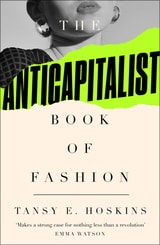
The Anti-Capitalist Book of Fashion
Tansy E.
Pluto Press, 2022
The award-winning classic on why we must revolutionise the fashion industry
*Selected by Emma Watson for her Ultimate Book List*
Fashion is political. From the red carpets of the Met Gala to online fast fashion, clothes tell a story of inequality, racism, and climate crisis. In The Anti-Capitalist Book of Fashion, Tansy E. Hoskins unpicks the threads of capitalist industry to reveal the truth about our clothes.
Fashion brands entice us to consume more by manipulating us to feel ugly, poor and worthless, sentiments that line the pockets of billionaires exploiting colonial supply chains. Garment workers on poverty pay risk their lives in dangerous factories, animals are tortured, fossil fuels extracted and toxic chemicals spread just to keep this season's collections fresh.
We can do better than this. Moving between Karl Lagerfeld and Karl Marx, The Anti-Capitalist Book of Fashion goes beyond ethical fashion and consumer responsibility showing that if we want to feel comfortable in our clothes, we need to reshape the system and ensure this is not our last season.
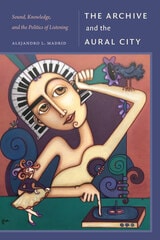
The Archive and the Aural City
Sound, Knowledge, and the Politics of ListeningAlejandro L. Madrid
Duke University Press, 2025

The Archive and the Repertoire
Performing Cultural Memory in the AmericasDiana Taylor
Duke University Press, 2003
Examining various genres of performance including demonstrations by the children of the disappeared in Argentina, the Peruvian theatre group Yuyachkani, and televised astrological readings by Univision personality Walter Mercado, Taylor explores how the archive and the repertoire work together to make political claims, transmit traumatic memory, and forge a new sense of cultural identity. Through her consideration of performances such as Coco Fusco and Guillermo Gómez-Peña’s show Two Undiscovered Amerindians Visit . . . , Taylor illuminates how scenarios of discovery and conquest haunt the Americas, trapping even those who attempt to dismantle them. Meditating on events like those of September 11, 2001 and media representations of them, she examines both the crucial role of performance in contemporary culture and her own role as witness to and participant in hemispheric dramas. The Archive and the Repertoire is a compelling demonstration of the many ways that the study of performance enables a deeper understanding of the past and present, of ourselves and others.

The Argentine Folklore Movement
Sugar Elites, Criollo Workers, and the Politics of Cultural Nationalism, 1900–1955Oscar Chamosa
University of Arizona Press, 2010
Oscar Chamosa combines intellectual history with ethnographic and sociocultural analysis to reconstruct the process by which mestizo culture—in Argentina called criollo culture—came to occupy the center of national folklore in a country that portrayed itself as the only white nation in South America. The author finds that the conservative plantation owners—the “sugar elites”—who exploited the criollo peasants sponsored the folklore movement that romanticized them as the archetypes of nationhood. Ironically, many of the composers and folk singers who participated in the landowner-sponsored movement adhered to revolutionary and reformist ideologies and denounced the exploitation to which those criollo peasants were subjected. Chamosa argues that, rather than debilitating the movement, these opposing and contradictory ideologies permitted its triumph and explain, in part, the enduring romanticizing of rural life and criollo culture, essential components of Argentine nationalism.
The book not only reveals the political motivations of culture in Argentina and Latin America but also has implications for understanding the articulation of local culture with national politics and entertainment markets that characterizes contemporary cultural processes worldwide today.

The Art of Defiance
Graffiti, Politics and the Reimagined City in PhiladelphiaTyson Mitman
Intellect Books, 2018
In order to both demystify and complicate our understanding of the practice of graffiti writing, this book pushes past the narrative that links the origins of graffiti to criminal gangs and instead offers a detailed portrait of graffiti as a rich urban culture with its own rules and practices. To do so, it examines the cultural history of graffiti in Philadelphia from the early 1970s onward and explores what it is like to be a graffiti writer in the city today. Ultimately, Tyson Mitman aims to humanize graffiti writers and to show that what they do is not merely destructive or puerile, but, rather, adds something important to the urban experience that is a conscious and deliberate act on the part of its practitioners.

The Art of Memes in Feminist Digital Culture
Shana MacDonald
The Ohio State University Press, 2025
In The Art of Memes in Feminist Digital Culture, Shana MacDonald argues that memes are a unique medium of communication that both respond to and reflect the current cultural moment. The book—the first to treat memes as a unique medium of communication distinct from other internet and digital media—examines feminist and queer activist uses of memes as a form of digital resistance, demonstrating through collage, reenactment, and montage that countercultural meme makers intervene in the status quo and offer cultural critiques with potentially broad circulation. In this way, MacDonald situates memes as part of a lineage of aesthetic resistance, exploring the operational logic of bricolage, intertextuality, and intermediality within contemporary internet meme cultures on the left.
MacDonald examines memes from feminist, queer, antiracist, and anticapitalist accounts on Instagram, as well as how meme genres and themes shift when they travel across different platforms and subcultures. By considering memes as a medium, she sheds light on how they operate within contemporary digital culture as a beacon for online public discourse that pushes against dominant norms.
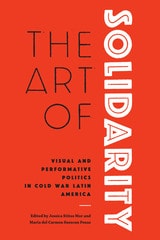
The Art of Solidarity
Visual and Performative Politics in Cold War Latin AmericaEdited by Jessica Stites Mor and Maria del Carmen Suescun Pozas
University of Texas Press, 2018
The Cold War claimed many lives and inflicted tremendous psychological pain throughout the Americas. The extreme polarization that resulted from pitting capitalism against communism held most of the creative and productive energy of the twentieth century captive. Many artists responded to Cold War struggles by engaging in activist art practice, using creative expression to mobilize social change. The Art of Solidarity examines how these creative practices in the arts and culture contributed to transnational solidarity campaigns that connected people across the Americas from the early twentieth century through the Cold War and its immediate aftermath.
This collection of original essays is divided into four chronological sections: cultural and artistic production in the pre–Cold War era that set the stage for transnational solidarity organizing; early artistic responses to the rise of Cold War polarization and state repression; the centrality of cultural and artistic production in social movements of solidarity; and solidarity activism beyond movements. Essay topics range widely across regions and social groups, from the work of lesbian activists in Mexico City in the late 1970s and 1980s, to the exchanges and transmissions of folk-music practices from Cuba to the United States, to the uses of Chilean arpilleras to oppose and protest the military dictatorship. While previous studies have focused on politically engaged artists or examined how artist communities have created solidarity movements, this book is one of the first to merge both perspectives.

The Art of Transition
Latin American Culture and Neoliberal CrisisFrancine Masiello
Duke University Press, 2001
Masiello views representation as both a political and artistic device, concerned with the tensions between truth and lies, experience and language, and intellectuals and the marginal subjects they study and claim to defend. These often contentious negotiations, she argues, are most provocatively displayed through the spectacle of difference, which constantly crosses the literary stage, the market, and the North/South divide. While forcefully defending the ability of literature and art to advance ethical positions and to foster a critical view of neoliberalism, Masiello especially shows how issues of gender and sexuality function as integrating threads throughout this cultural project. Through discussions of visual art as well as literary work by prominent novelists and poets, Masiello sketches a broad landscape of vivid intellectual debate in the Southern Cone of Latin America.
The Art of Transition will interest Latin Americanists,literary and political theorists, art critics and historians, and those involved with the study of postmodernism and globalization.

The Battle for Alabama's Wilderness
Saving the Great Gymnasiums of NatureJohn N. Randolph
University of Alabama Press, 2005
Traces the development of Alabama's environmental movement from its beginnings with the establishment of The Alabama Conservancy in the late 1960s and early '70s to the preservation efforts of present-day activist groups
The grassroots effort to preserve Alabama's Wilderness Areas spanned thirty years, from 1967 to 1997. The first battle, to establish the Sipsey Wilderness in the Bankhead National Forest, was the catalyst for reform of national policy regarding public land preserves in the eastern United States. It, and the later campaigns—to establish the Cheaha Wilderness, to enlarge the Sipsey, and to create the Dugger Mountain Wilderness—are classic tales of citizen activists overcoming the quagmire of federal bureaucracy and the intransigence of hostile politicians. Early political opposition to proposed designation or expansion of wilderness areas in Alabama was based on the belief that limiting development of these lands would negatively impact the state's powerful timber industry. In response to such opposition, serious environmental activism was born in Alabama.
Using newspaper reports, Congressional testimony, interviews, and his own recollections, John Randolph traces the development of Alabama's environmental movement from its beginnings with the establishment of The Alabama Conservancy in the late 1960s and early '70s to the preservation efforts of present-day activist groups, such as the Alabama Environmental Council, the Cahaba River Society, and the Alabama Wilderness Alliance.
The Battle for Alabama's Wilderness permits all of the players—pro and con—to speak for themselves, but the heroes—people like Mary Burks, Blanche Dean, Joab Thomas, and Pete Conroy—embody the vision, hope, and persistence required of those who succeed in their preservation efforts. Randolph's account is a testament to the power of grassroots citizen groups who are committed to a common cause and inspired by a shared ideal.
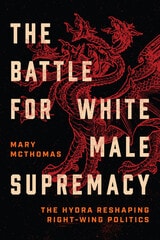
The Battle for White Male Supremacy
The Hydra Reshaping Right-Wing PoliticsMary McThomas
University of Chicago Press, 2027
Explains how interconnected race and gender ideologies underlie grievance politics on the Right and reveals how both are transforming American politics, policy, and law.
In The Battle for White Male Supremacy, Mary McThomas sheds new light on the entwined racial and gender ideologies that have come to define large segments of the American Right and are roiling American law and politics. Individual chapters trace the development, ideas, and influence of several key groups: incels, alt-right vigilante groups, Christian nationalists, and men’s rights groups at war with the judiciary. While these groups are often treated as discrete phenomena with distinct histories and ostensibly different goals, all share an interconnected belief system of victimhood and embattled white masculinity. By tracking these similarities, McThomas exposes how racial and gendered belief systems are connected both within and across groups.
What is more, McThomas shows that these groups’ beliefs and tactics have moved from the extremist fringes of society to the mainstream of American politics. They’ve gained broad traction in public opinion and political discourse, and they are transforming law and policy at both the state and federal levels.
The Battle for the Mind
War and Peace in the Era of Mass CommunicationGary S. Messinger
University of Massachusetts Press, 2011
Most people typically think of armed conflict in physical terms, involving guns and bombs, ships and planes, tanks and missiles. But today, because of mass communication, war and the effort to prevent it are increasingly dependent on non-physical factors—the capacity to persuade combatants and citizens to engage in violence or avoid it, and the packaging of the information on which decision making is based. This book explores the many ways that mass communication has revolutionized international relations, whether the aim is to make war effectively or to prevent it.
Gary Messinger shows that over the last 150 years a succession of breakthroughs in the realm of media has reshaped the making of war and peace. Along with mass newspapers, magazines, books, motion pictures, radio, television, computer software, and telecommunication satellites comes an array of strategies for exploiting these media to control popular beliefs and emotions. Images of war now arrive in many forms and reach billions of people simultaneously. Political and military leaders must react to crowd impulses that sweep around the globe. Nation-states and nongovernmental groups, including terrorists, use mass communication to spread their portrayals of reality.
Drawing on a wide range of media products, from books and articles to films and television programs, as well as his own research in the field of propaganda studies, Messinger offers a fresh and comprehensive overview. He skillfully charts the path that has led us to our current situation and suggests where we might go next.

The Beginning of History
Value Struggles and Global CapitalMassimo De Angelis
Pluto Press, 2007
The Big Tomorrow
Hollywood and the Politics of the American WayLary May
University of Chicago Press, 2000
"The most exhilarating work of revisionist film history since Pauline Kael's Citizen Kane. . . . May's take on what movies once were (energizing, as opposed to enervating), and hence can become again, is enough to get you believing in them again as one of the regenerative forces America so sorely needs."—Jay Carr, Boston Globe
"A startling, revisionist history of Hollywood's impact on politics and American culture. . . . A convincing and important addition to American cultural criticism."—Publishers Weekly
"A controversial overview of 30 years of American film history; must reading for any serious student of the subject."—Choice
"A provocative social history of Hollywood's influence in American life from the 1930s to the 1950s. May argues persuasively that movies in the period offered a good deal of tough criticism of economic and social conditions in U.S. society. . . . May challenges us to engage in some serious rethinking about Hollywood's impact on American society in the middle of the twentieth century."—Robert Brent Toplin, American Historical Review

The Biopolitics of Breast Cancer
Changing Cultures of Disease and ActivismMaren Klawiter
University of Minnesota Press, 2008
For nearly forty years, feminists and patient activists have argued that medicine is a deeply individualizing and depoliticizing institution. According to this view, medical practices are incidental to people’s transformation from patients to patient activists. The Biopolitics of Breast Cancer turns this understanding upside down.
Maren Klawiter analyzes the evolution of the breast cancer movement to show the broad social impact of how diseases come to be medically managed and publicly administered. Examining surgical procedures, adjuvant therapies, early detection campaigns, and the rise in discourses of risk, Klawiter demonstrates that these practices created a change in the social relations-if not the mortality rate-of breast cancer that initially inhibited, but later enabled, collective action. Her research focuses on the emergence and development of new forms of activism that range from grassroots patient empowerment to environmental activism and corporate-funded breast cancer awareness.
The Biopolitics of Breast Cancer opens a window onto a larger set of changes currently transforming medically advanced societies and ultimately challenges our understanding of the origins, politics, and future of the breast cancer movement.
Maren Klawiter holds a PhD in sociology from the University of California, Berkeley. She is currently pursuing a law degree at Yale University.

The Birth of Energy
Fossil Fuels, Thermodynamics, and the Politics of WorkCara New Daggett
Duke University Press, 2019

The Body Soviet
Propaganda, Hygiene, and the Revolutionary StateTricia Starks
University of Wisconsin Press, 2008
Health, though essential to the revolutionary vision and crucial to Soviet plans for utopia, has been neglected by traditional histories caught up in Cold War debates. The Body Soviet recovers this significant aspect of Soviet thought by providing a cross-disciplinary, comparative history of Soviet health programs that draws upon rich sources of health care propaganda, including posters, plays, museum displays, films, and mock trials. The analysis of propaganda makes The Body Soviet more than an institutional history; it is also an insightful critique of the ideologies of the body fabricated by health organizations.
"A masterpiece that will thoroughly fascinate and delight readers. Starks's understanding of propaganda and hygiene in the early Soviet state is second to none. She tells the stories of Soviet efforts in this field with tremendous insight and ingenuity, providing a rich picture of Soviet life as it was actually lived."— Elizabeth Wood, author of From Baba to Comrade: Gender and Politics in Revolutionary Russia
The Book of Politics
China in TheoryMichael Dutton
Duke University Press, 2024
The Boundaries of Blackness
AIDS and the Breakdown of Black PoliticsCathy Cohen
University of Chicago Press, 1999
The Boundaries of Blackness is the first full-scale exploration of the social, political, and cultural impact of AIDS on the African-American community. Informed by interviews with activists, ministers, public officials, and people with AIDS, Cathy Cohen unflinchingly brings to light how the epidemic fractured, rather than united, the black community. She traces how the disease separated blacks along different fault lines and analyzes the ensuing struggles and debates.
More broadly, Cohen analyzes how other cross-cutting issues—of class, gender, and sexuality—challenge accepted ideas of who belongs in the community. Such issues, she predicts, will increasingly occupy the political agendas of black organizations and institutions and can lead to either greater inclusiveness or further divisiveness.
The Boundaries of Blackness, by examining the response of a changing community to an issue laced with stigma, has much to teach us about oppression, resistance, and marginalization. It also offers valuable insight into how the politics of the African-American community—and other marginal groups—will evolve in the twenty-first century.

The Burden of Responsibility
Blum, Camus, Aron, and the French Twentieth CenturyTony Judt
University of Chicago Press, 1998
Through the prism of the lives of Leon Blum, Albert Camus, and Raymond Aron, Judt examines pivotal issues in the history of contemporary French society—antisemitism and the dilemma of Jewish identity, political and moral idealism in public life, the Marxist moment in French thought, the traumas of decolonization, the disaffection of the intelligentsia, and the insidious quarrels rending Right and Left. Judt focuses particularly on Blum's leadership of the Popular Front and his stern defiance of the Vichy governments, on Camus's part in the Resistance and Algerian War, and on Aron's cultural commentary and opposition to the facile acceptance by many French intellectuals of communism's utopian promise. Severely maligned by powerful critics and rivals, each of these exemplary figures stood fast in their principles and eventually won some measure of personal and public redemption.
Judt constructs a compelling portrait of modern French intellectual life and politics. He challenges the conventional account of the role of intellectuals precisely because they mattered in France, because they could shape public opinion and influence policy. In Blum, Camus, and Aron, Judt finds three very different men who did not simply play the role, but evinced a courage and a responsibility in public life that far outshone their contemporaries.
"An eloquent and instructive study of intellectual courage in the face of what the author persuasively describes as intellectual irresponsibility."—Richard Bernstein, New York Times
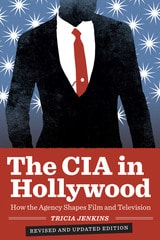
The CIA in Hollywood
How the Agency Shapes Film and TelevisionBy Tricia Jenkins
University of Texas Press, 2016
What’s your impression of the CIA? A bumbling agency that can’t protect its own spies? A rogue organization prone to covert operations and assassinations? Or a dedicated public service that advances the interests of the United States? Astute TV and movie viewers may have noticed that the CIA’s image in popular media has spanned this entire range, with a decided shift to more positive portrayals in recent years. But what very few people know is that the Central Intelligence Agency has been actively engaged in shaping the content of film and television, especially since it established an entertainment industry liaison program in the mid-1990s.
The CIA in Hollywood offers the first full-scale investigation of the relationship between the Agency and the film and television industries. Tricia Jenkins draws on numerous interviews with the CIA’s public affairs staff, operations officers, and historians, as well as with Hollywood technical consultants, producers, and screenwriters who have worked with the Agency, to uncover the nature of the CIA’s role in Hollywood. In particular, she delves into the Agency’s and its officers’ involvement in the production of The Agency, In the Company of Spies, Alias, The Recruit, The Sum of All Fears, Enemy of the State, Syriana, The Good Shepherd, and more. Her research reveals the significant influence that the CIA now wields in Hollywood and raises important and troubling questions about the ethics and legality of a government agency using popular media to manipulate its public image.

The Caning
The Assault That Drove America to Civil WarStephen Puleo
Westholme Publishing, 2012
Early in the afternoon of May 22, 1856, ardent pro-slavery Congressman Preston S. Brooks of South Carolina strode into the United States Senate Chamber in Washington, D.C., and began beating renowned anti-slavery Senator Charles Sumner with a gold-topped walking cane. Brooks struck again and again—more than thirty times across Sumner’s head, face, and shoulders—until his cane splintered into pieces and the helpless Massachusetts senator, having nearly wrenched his desk from its fixed base, lay unconscious and covered in blood. It was a retaliatory attack. Forty-eight hours earlier, Sumner had concluded a speech on the Senate floor that had spanned two days, during which he vilified Southern slaveowners for violence occurring in Kansas, called Stephen A. Douglas of Illinois a “noise-some, squat, and nameless animal,” and famously charged Brooks’s second cousin, South Carolina Senator Andrew Butler, as having “a mistress. . . who ugly to others, is always lovely to him. . . . I mean, the harlot, Slavery.” Brooks not only shattered his cane during the beating, but also destroyed any pretense of civility between North and South.
One of the most shocking and provocative events in American history, the caning convinced each side that the gulf between them was unbridgeable and that they could no longer discuss their vast differences of opinion regarding slavery on any reasonable level.The Caning: The Assault That Drove America to Civil War tells the incredible story of this transformative event. While Sumner eventually recovered after a lengthy convalescence, compromise had suffered a mortal blow. Moderate voices were drowned out completely; extremist views accelerated, became intractable, and locked both sides on a tragic collision course.
The caning had an enormous impact on the events that followed over the next four years: the meteoric rise of the Republican Party and Abraham Lincoln; the Dred Scott decision; the increasing militancy of abolitionists, notably John Brown’s actions; and the secession of the Southern states and the founding of the Confederacy. As a result of the caning, the country was pushed, inexorably and unstoppably, to war. Many factors conspired to cause the Civil War, but it was the caning that made conflict and disunion unavoidable five years later.
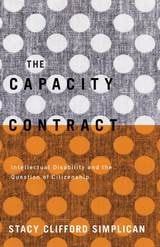
The Capacity Contract
Intellectual Disability and the Question of CitizenshipStacy Clifford Simplican
University of Minnesota Press, 2015
In the first sustained examination of disability through the lens of political theory, The Capacity Contract shows how the exclusion of disabled people has shaped democratic politics. Stacy Clifford Simplican demonstrates how disability buttresses systems of domination based on race, sex, and gender. She exposes how democratic theory and politics have long blocked from political citizenship anyone whose cognitive capacity falls below a threshold level⎯marginalization with real-world repercussions on the implementation of disability rights today.
Simplican’s compelling ethnographic analysis of the self-advocacy movement describes the obstacles it faces. From the outside, the movement must confront stiff budget cuts and dwindling memberships; internally, self-advocates must find ways to demand political standing without reinforcing entrenched stigma against people with profound cognitive disabilities. And yet Simplican’s investigation also offers democratic theorists and disability activists a more emancipatory vision of democracy as it relates to disability⎯one that focuses on enabling people to engage in public and spontaneous action to disrupt exclusion and stigma.
Taking seriously democratic promises of equality and inclusion, The Capacity Contract rejects conceptions of political citizenship that privilege cognitive capacity and, instead, centers such citizenship on action that is accessible to all people.
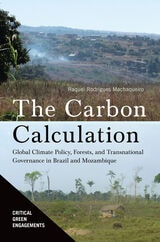
The Carbon Calculation
Global Climate Policy, Forests, and Transnational Governance in Brazil and MozambiqueRaquel Rodrigues Machaqueiro
University of Arizona Press, 2023
Focusing on REDD+ (Reducing Emissions from Deforestation and Forest Degradation), the book demonstrates how industrialized countries are able to maintain their socioeconomic models largely unaltered while claiming to address global warming using forests in the Global South to offset their pollution. By examining the creation and implementation of REDD+ historically and ethnographically, the book traces the social life of this mechanism as it travels across a complex network spanning several interacting levels: international, national, and local. Through cases in the Brazilian state of Acre and the Zambézia province in Mozambique, the author demonstrates how global climate policy has created new opportunities and rationales for unprecedented levels of intervention in the Global South—all under the guise of saving the planet.
The Carbon Calculation critically highlights the ways in which politics has reinforced a scientific focus on one possible solution to the problem of climate change—namely those that largely absolve the industrialized world from undertaking politically painful transformations in its own economic model.
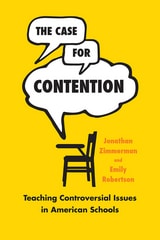
The Case for Contention
Teaching Controversial Issues in American SchoolsJonathan Zimmerman and Emily Robertson
University of Chicago Press, 2017
Zimmerman and Robertson highlight an aspect of American politics that we know all too well: We are terrible at having informed, reasonable debates. We opt instead to hurl insults and accusations at one another or, worse, sit in silence and privately ridicule the other side. Wouldn’t an educational system that focuses on how to have such debates in civil and mutually respectful ways improve our public culture and help us overcome the political impasses that plague us today? To realize such a system, the authors argue that we need to not only better prepare our educators for the teaching of hot-button issues, but also provide them the professional autonomy and legal protection to do so. And we need to know exactly what constitutes a controversy, which is itself a controversial issue. The existence of climate change, for instance, should not be subject to discussion in schools: scientists overwhelmingly agree that it exists. How we prioritize it against other needs, such as economic growth, however—that is worth a debate.
With clarity and common-sense wisdom, Zimmerman and Robertson show that our squeamishness over controversy in the classroom has left our students woefully underserved as future citizens. But they also show that we can fix it: if we all just agree to disagree, in an atmosphere of mutual respect.
The Changing Face of Representation
The Gender of U.S. Senators and Constituent CommunicationsKim L. Fridkin and Patrick J. Kenney
University of Michigan Press, 2015
As the number of women in the U.S. Senate grows, so does the number of citizens represented by women senators. At the same time, gender remains a key factor in senators’ communications to constituents as well as in news media portrayals of senators. Focusing on 32 male and female senators during the 2006 congressional election year, Kim L. Fridkin and Patrick J. Kenney examine in detail senators’ official websites, several thousand press releases and local news stories, and surveys of 18,000 citizens to discern constituents’ attitudes about their senators.
The authors conclude that gender role expectations and stereotypes do indeed constrain representational and campaign messages and influence news coverage of both candidates and elected senators. Further, while citizens appear to be less influenced by entrenched stereotypes, they pay more attention to female senators’ messages and become more knowledgeable about them, in comparison to male senators.