Results by title
56 books match the query 'Press' and 19 start with t
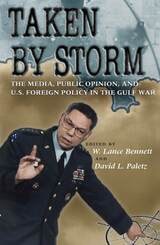
Taken by Storm
The Media, Public Opinion, and U.S. Foreign Policy in the Gulf WarEdited by W. Lance Bennett and David L. Paletz
University of Chicago Press, 1994
Tracing the flow of news, public opinion, and policy decisions from Sadam Hussein's rise to power in 1979, to the Iraqi invasion of Kuwait, through the outbreak and conclusion of the war, the contributors look at how the media have become key players in the foreign policy process. They examine the pre-war media debate, news coverage during and after the war, how the news-gathering process shaped the content of the coverage, and the media's effect on public opinion and decision makers. We see what goes on behind the scenes in the high tech world of political communication, and are confronted by troubling questions about the ways the government managed coverage of the war and captured journalists at their own news game.
Taken by Storm also examines more general patterns in post-Cold war journalism and foreign policy, particularly how contemporary journalistic practices determine whose voices and what views are heard in foreign policy coverage. At stake are the reactions of a vast media audience and the decision of government officials who see both the press and the public and key elements of the policy game.
The first book to fully integrate our understanding of the news business, public opinion, and government action, Taken by Storm transcends the limits of the Gulf War to illuminate the complex relationship between the media, the public, and U.S. foreign policy in the late twentieth century.
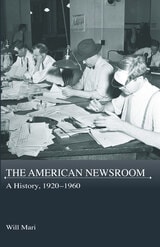
The American Newsroom
A History, 1920-1960Will Mari
University of Missouri Press, 2023
The American Revolution and the Press
The Promise of IndependenceCarol Sue Humphrey
Northwestern University Press, 2013
Carol Sue Humphrey’s The American Revolution and the Pressargues that newspapers played an important role during America’s struggle for independence by keeping Americans engaged in the war even when the fighting occurred in distant locales. From the moment that the colonials received word of Britain’s new taxes in 1764 until reports of the peace treaty arrived in 1783, the press constituted the major source of information about events and developments in the conflict with the mother country. Both Benjamin Franklin, one of the Revolution’s greatest leaders, and Ambrose Serle, a Loyalist, described the press as an “engine” that should be used to advance the cause. The efforts of Patriot printers to keep readers informed about the war helped ensure ultimate success by boosting morale and rallying Americans to the cause until victory was achieved. As Humphrey illustrates, Revolutionary-era newspapers provided the political and ideological unity that helped Americans secure their independence and create a new nation.
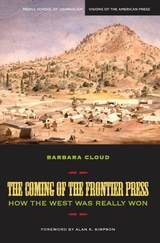
The Coming of the Frontier Press
How the West Was Really WonBarbara Cloud
Northwestern University Press, 2008
From the first story about the discovery of gold in California in 1848 to features on today’s western boomtowns, western expansion and journalism have had a symbiotic relationship. By examining this relationship along its entire timeline, this book argues that newspapers played a crucial role in pushing aside both wildlife and Native Americans to make room for the settlers who would become their readers. The western news sheets not only shaped reader attitudes but also undertook innovations in content and appearance that would affect newspapers nationwide.
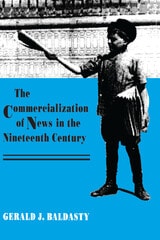
The Commercialization of News in the Nineteenth Century
Gerald J. Baldasty
University of Wisconsin Press, 1992
The Commercialization of News in the Nineteenth Century traces the major transformation of newspapers from a politically based press to a commercially based press in the nineteenth century. Gerald J. Baldasty argues that broad changes in American society, the national economy, and the newspaper industry brought about this dramatic shift.
Increasingly in the nineteenth century, news became a commodity valued more for its profitablility than for its role in informing or persuading the public on political issues. Newspapers started out as highly partisan adjuncts of political parties. As advertisers replaced political parties as the chief financial support of the press, they influenced newspapers in directing their content toward consumers, especially women. The results were recipes, fiction, contests, and features on everything from sports to fashion alongside more standard news about politics.
Baldasty makes use of nineteenth-century materials—newspapers from throughout the era, manuscript letters from journalists and politicians, journalism and advertising trade publications, government reports—to document the changing role of the press during the period. He identifies three important phases: the partisan newspapers of the Jacksonian era (1825-1835), the transition of the press in the middle of the century, and the influence of commercialization of the news in the last two decades of the century.
The Conservative Resurgence and the Press
The Media's Role in the Rise of the RightJames Brian McPherson
Northwestern University Press, 2008
Consumers of American media find themselves in a news world that has shifted toward more conservative reporting. This book takes a measured, historical view of the shift, addressing factors that include the greater skill with which conservatives have used the media, the media’s gradual trend toward conservatism, the role of religion, and the effects of media conglomeration. The book makes the case that the media have managed to not only enable today’s conservative resurgence but also ignore, largely, the consequences of that change for the American people.
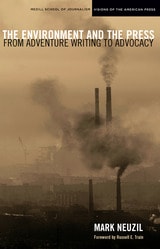
The Environment and the Press
From Adventure Writing to AdvocacyMark Neuzil
Northwestern University Press, 2008
This history of environmental journalism looks at how the practice now defines issues and sets the public agenda evolving from a tradition that includes the works of authors such as Pliny the Elder, John Muir, and Rachel Carson. It makes the case that the relationship between the media and its audience is an ongoing conversation between society and the media on what matters and what should matter.
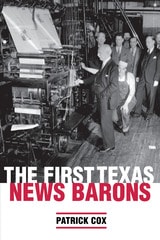
The First Texas News Barons
By Patrick Cox
University of Texas Press, 2005
Newspaper publishers played a crucial role in transforming Texas into a modern state. By promoting expanded industrialization and urbanization, as well as a more modern image of Texas as a southwestern, rather than southern, state, news barons in the early decades of the twentieth century laid the groundwork for the enormous economic growth and social changes that followed World War II. Yet their contribution to the modernization of Texas is largely unrecognized.
This book investigates how newspaper owners such as A. H. Belo and George B. Dealey of the Dallas Morning News, Edwin Kiest of the Dallas Times Herald, William P. Hobby and Oveta Culp Hobby of the Houston Post, Jesse H. Jones and Marcellus Foster of the Houston Chronicle, and Amon G. Carter Sr. of the Fort Worth Star-Telegram paved the way for the modern state of Texas. Patrick Cox explores how these news barons identified the needs of the state and set out to attract the private investors and public funding that would boost the state's civic and military infrastructure, oil and gas industries, real estate market, and agricultural production. He shows how newspaper owners used events such as the Texas Centennial to promote tourism and create a uniquely Texan identity for the state. To balance the record, Cox also demonstrates that the news barons downplayed the interests of significant groups of Texans, including minorities, the poor and underemployed, union members, and a majority of women.
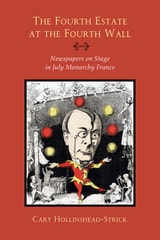
The Fourth Estate at the Fourth Wall
Newspapers on Stage in July Monarchy FranceCary Hollinshead-Strick
Northwestern University Press, 2019
July Monarchy plays, which provided affordable entertainment to a broad section of the public, constitute a large, nearly untapped reservoir of commentary on the arrival of the forty-franc press. Vaudevilles and comedies ask whether journalism that benefits from advertisement can be unbiased. Dramas explore whether threatening to spread false news is an acceptable way for journalists to exercise their influence. Hollinshead-Strick uses both plays and novels to show that despite their claims to enlighten their readers, newspapers were often accused of obscuring public access to information. Balzac’s interventions in this media sphere reveal his utopian views on print technology. Nerval’s and Pyat’s demonstrate the nefarious impact that corrupt theater critics could have on authors and on the public alike.
Scholars of press and media studies, French literature, theater, and nineteenth-century literature more generally will find this book a valuable introduction to a cross-genre debate about press publicity that remains surprisingly resonant today.
The Military and the Press
An Uneasy TruceMichael Sweeney
Northwestern University Press, 2006
Author Michael S. Sweeney takes a chronological approach, considering freedoms and restraints such as the First Amendment, court decisions, and government and military directives that have affected the press during World Wars I and II, the Korean War, the Vietnam War, and the more recent conflicts. He explores the ongoing themes of wartime censorship and propaganda, as well as operational security in the battle zone. In chapters addressing the recent shift in military strategy in dealing with the press, Sweeney discusses new forms of control--from embedding journalists and discouraging unaccredited "unilaterals" to developing the news agenda through a barrage of briefings, sound bites, and visuals and appeals to patriotism that border on domestic propaganda. With profiles of a few specific journalists--from Richard Harding Davis covering the Spanish-American War to Christiane Amanpour reporting from the conflicts in Bosnia and Iraq--this deft blend of journalistic history and analysis should serve as a call-to-arms to a public not always well served by a military-press standoff.

The Newspaper Indian
Native American Identity in the Press, 1820-90John M. Coward
University of Illinois Press, 1999
How newspapers shaped the image of Native Americans
John M. Coward looks at how nineteenth-century newspapers and news making practices shaped the contradictory and still persistent representation of Native Americans. As Coward reveals, journalism failed to describe Indigenous people on their own terms. Instead, reporters chose portrayals that adhered to the norms of the majority white, Anglo-Saxon, Protestant society that read their papers. In addition, Coward shows how journalists turned Native Americans into symbolic and ambiguous figures used to measure American progress.
An in-depth look at the power of the press, The Newspaper Indian provides insight into how journalism wove a skewed idea of Native Americans into the fabric of American life.
The Nixon Memo
Political Respectability, Russia, and the PressMarvin Kalb
University of Chicago Press, 1994
The story begins on March 10, 1992. Nixon had written a private memo critical of president George Bush's policy toward Russia. The memo leaked and exploded on the front page of The New York Times. Why would Nixon attack Bush, a fellow party member fighting for re-election? Why on an issue of foreign affairs, which was Bush's strength? The questions are as intriguing as the answers, and distinguished journalist and scholar Marvin Kalb offers a suspenseful, eye-opening account of how our conventional wisdom on United States foreign policy is shaped by the insider's game of press/politics.
This story of Nixon's Machiavellian efforts to pressure the White House, by way of the press, into helping Boris Yeltsin and Russia sheds new light on the inner workings of the world inside the government of the United States. Marvin Kalb read the documents behind the Nixon memo and interviewed scores of journalists, scholars, and officials in and from Washington and Moscow. Drawing on his years of experience as a diplomatic correspondent, he identifies and illuminates the intersection of press and politics in the fashioning of public policy.
"An absorbing and often compelling argument that Richard Nixon directed his own political rehabilitation on the world stage, using presidents, lesser politicians, and the press as his supporting cast. This is a first-class job of unraveling a complex and usually unseen tapestry."—Ted Koppel
"With Marvin Kalb's captivating account, Richard Nixon continues to fascinate us even in death."—Al Hunt
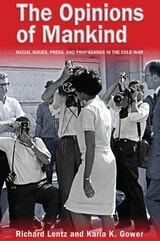
The Opinions of Mankind
Racial Issues, Press, and Propaganda in the Cold WarRichard Lentz and Karla K. Gower
University of Missouri Press, 2011
Throughout this period, the American press provided the foreign media with information about racially charged events in the United States. Such news coverage sometimes put Washington at a disadvantage, making it difficult for government officials to assuage foreign reactions to the injustices occurring on U.S. soil. Yet in other instances, the domestic press helped to promote favorable opinions abroad by articulating themes of racial progress. While still acknowledging racial abuses, these press spokesmen asserted that the situation in America was improving. Such paradoxical messages, both aiding and thwarting the efforts of the U.S. government, are the subject of The Opinions of Mankind: Racial Issues, Press, and Propaganda in the Cold War.
The study, by scholars Richard Lentz and Karla K. Gower, describes and analyzes the news discourse regarding U.S. racial issues from 1946 to 1965. The Opinions of Mankindnot only delves into the dissemination of race-related news to foreign outlets but also explores the impact foreign perceptions of domestic racism had on the U.S. government and its handling of foreign relations during the period. What emerges is an original, insightful contribution to Cold War studies. While other books examine race and foreign affairs during this period of American history, The Opinions of Mankind is the first to approach the subject from the standpoint of press coverage and its impact on world public opinion.
This exhaustively researched and compellingly written volume will appeal to media scholars, political historians, and general readers alike. By taking a unique approach to the study of this period, The Opinions of Mankind presents the workings behind the battles for public opinion that took place between 1946 and 1965.

The Political Power of the Word
Press and Oratory in Nineteenth-century Latin AmericaEdited by Ivan Jaksic
University of London Press, 2002
The Press and Main Street
El Pais--Journalism in Democratic SpainJuan Luis Cebrian, Translated by Brian Nienhaus
University of Michigan Press, 1990

The Press and the Constitution, 1931-1947
J. Edward Gerald
University of Minnesota Press, 1948
The Press and the Constitution, 1931–1947 was first published in 1948. Minnesota Archive Editions uses digital technology to make long-unavailable books once again accessible, and are published unaltered from the original University of Minnesota Press editions.
Sixteen dramatic years—from the Minnesota gag law case in 1931 to the Taft-Hartley Act in 1947. Sixteen years in which the American system of freedom developed new strength and conferred new benefits on the common man. In The Press and the Constitution J. Edward Gerald has told the story of these years as they have influenced the development of freedom of the press.
During this turbulent time American newspapers, in spite of their claims to protection under the First and Fourteenth amendments, have found themselves subjected to increasing legal restraints. The guarantee of freedom of the press affects the lives of a wide range of individuals—from publishers to pickets, from Big Business leaders to itinerant evangelists. To show this, Mr. Gerald includes in his discussion the anti-trust laws, newspaper taxes, wage and hour legislation, censorship, picketing, licensing, and the contempt power.
The book analyzes a series of cases decided by the United States Supreme Court from 1931 to 1947. Among the more celebrated are the Chicago Sun-Chicago Tribune antitrust case, the Esquire case, in which the powers of the Postmaster General were limited, and the Jehovah's Witnesses cases, in which the line between religion and commerce was defined.
The author concludes that American law definitely establishes—and carries out—the concept of the common welfare, even to the point of government intervention to increase freedom of the press for some while restricting it for others.
The Supreme Court and the Press
The Indispensable ConflictJoe Mathewson
Northwestern University Press, 2011
The Terrorism News Beat
Professionalism, Profit, and the PressAaron M. Hoffman
University of Michigan Press, 2025
The Terrorism News Beat engages thinking about terrorism and the news media from the fields of political science, communication, criminology, economics, and sociology using multimethod research involving more than 2,500 newspaper articles published between 1997 and 2018. Chapters analyze the terrorism news beat’s subject matter, language, and coverage of the Oklahoma City Bombing, Olympic Park bombing, 9/11 attacks, DC Sniper case, and Dallas Police shooting. When it comes to language use, Hoffman finds that, rather than giving into the temptation to convey the news in lurid detail, journalists are minimalists. The language used to depict events on the terrorism beat is typically moderate and extreme words like “torture” appear only as necessary. The Terrorism News Beat shows that contrary to claims of sensationalism, the tone of terrorism coverage becomes even more sober during terrorism crises than it is during non-crisis periods and meets journalistic standards for quality.
The Yellow Journalism
The Press and America's Emergence as a World PowerDavid R. Spencer
Northwestern University Press, 2007
Most notable among Hearst's competitors was New York City's The World, owned and managed by a European Jewish immigrant named Joseph Pulitzer. The Yellow Journalism describes how these two papers and others exploited the scandal, corruption, and crime among the city's most influential citizens, and its most desperate inhabitants--a policy that made this "journalism of action" remarkably effective, not just as a commercial force, but also as an advocate for the city's poor and defenseless. Spencer shows how many of the innovations first introduced during this period--from investigative reporting to the use of color, entertainment news, and cartoons in papers--have had a lasting effect on journalism; and how media in our day reflects the Yellow Press's influence, but also its threatened irrelevance within the broader realities of contemporary society.