Results by title
386 books match the query 'Russia' and 85 start with t
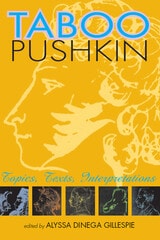
Taboo Pushkin
Topics, Texts, InterpretationsEdited by Alyssa Dinega Gillespie
University of Wisconsin Press, 2012
Since his death in 1837, Alexander Pushkin—often called the “father of Russian literature”—has become a timeless embodiment of Russian national identity, adopted for diverse ideological purposes and reinvented anew as a cultural icon in each historical era (tsarist, Soviet, and post-Soviet). His elevation to mythic status, however, has led to the celebration of some of his writings and the shunning of others. Throughout the history of Pushkin studies, certain topics, texts, and interpretations have remained officially off-limits in Russia—taboos as prevalent in today’s Russia as ever before.
The essays in this bold and authoritative volume use new approaches, overlooked archival materials, and fresh interpretations to investigate aspects of Pushkin’s biography and artistic legacy that have previously been suppressed or neglected. Taken together, the contributors strive to create a more fully realized Pushkin and demonstrate how potent a challenge the unofficial, taboo, alternative Pushkin has proven to be across the centuries for the Russian literary and political establishments.
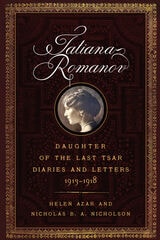
Tatiana Romanov, Daughter of the Last Tsar
Diaries and Letters, 1913–1918Helen Azar
Westholme Publishing, 2016
Grand Duchess Tatiana Nikolaevna of Russia was the second of the four daughters of Tsar Nicholas II and his wife, the Empress Alexandra Feodorovna. Long recognized by historians as the undisputed “beauty” of the family, Tatiana was acknowledged for her poise, her elegance, and her innate dignity within her own family. Helen Azar, translator of the diaries of Olga Romanov, and Nicholas B. A. Nicholson, Russian Imperial historian, have joined together to present a truly comprehensive picture of this extraordinarily gifted, complex, and intelligent woman in her own words. Tatiana Romanov, Daughter of the Last Tsar: Diaries and Letters, 1913–1918, presents translations of material never before published in Russian or in English, as well as materials never published in their entirety in the West.
The brisk, modern prose of Tatiana’s diary entries reveals the character of a young woman who was far more than the sheltered imperial beauty as she previously has been portrayed. While many historians and writers describe her as a cold, haughty, and distant aristocrat, this book shows instead a remarkably down-to-earth and humorous young woman, full of life and compassion. A detail-oriented and observant participant in some of the most important historical events of the early twentieth century, she left firsthand descriptions of the tercentenary celebrations of the House of Romanov, the early years of Russia’s involvement in World War I, and the road to her family’s final days in Siberian exile. Her writings reveal extraordinary details previously unknown or unacknowledged. Lavishly annotated for the benefit of the nonspecialist reader, this book is not only a reevaluation of Tatiana’s role as more than just one of four sisters, but also a valuable reference on Russia, the First World War, the Russian Revolution, and the people closest to the Grand Duchess and her family.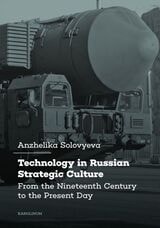
Technology in Russian Strategic Culture
From the Nineteenth Century to the Present DayAnzhelika Solovyeva
Karolinum Press, 2024
This book traces the dynamics of military-technological innovation in Russia over the last hundred and fifty years, particularly focusing on three distinct periods: the introduction of rifled breech-loading weapons in Imperial Russia in the nineteenth century, the invention of nuclear weapons in the Soviet Union in the twentieth century, and the development of precision-guided weapons in post-Soviet Russia in the twenty-first century. The analysis relies extensively on primary data obtained from Russian archives, complemented by a series of expert interviews, and deciphers Russia’s distinct strategic cultural approach to military-technological innovation.
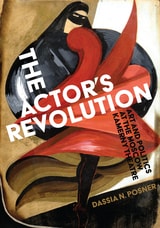
The Actor’s Revolution
Art and Politics at the Moscow Kamerny TheatreDassia N. Posner
Northwestern University Press, 2027
Reclaims the lost history of one of the twentieth century’s most innovative theaters
The Moscow Kamerny Theatre created stage worlds of movement, color, and light. Cofounded in 1914 by Alexander Tairov, a Jewish director from Ukraine, and Alisa Koonen, a Moscow-born actress from an immigrant family, the company celebrated the actor’s virtuosic inventiveness during an era when most theaters imitated daily life or prioritized the autocratic director’s vision. By the 1920s, it had become the most famous Soviet theater in the world, renowned for its actors’ acrobatic grace, its bold collaborations with avant-garde artists, and its revolutionary redefinition of what theater can be. But the accusations of Soviet disloyalty that were used to destroy the Kamerny during Stalin’s post–World War II antisemitic purge have rendered it little known outside Russia today and frequently misunderstood even there.
The Actor’s Revolution vividly reclaims this lost history by reconstructing the theater’s most illustrious premieres, analyzing them within the turbulent artistic and political context of the early Soviet era. Drawing on a decade of archival research, Dassia N. Posner restores Tairov’s legacy as one of history’s most significant directors and celebrates Koonen’s liberatory creative expressiveness as a vital alternative to Konstantin Stanislavsky’s better-known acting system. Building on rich archival sources, from unpublished memoirs to vibrant scenic and costume designs, this timely volume grapples with the entangled histories of art, politics, and erasure and celebrates the radical power of human creativity under—and in spite of—totalitarianism.
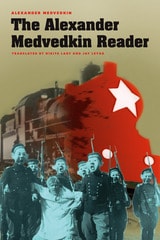
The Alexander Medvedkin Reader
Alexander Medvedkin
University of Chicago Press, 2016
Although he was a dedicated Communist, Medvedkin’s satirical approach and social critiques ultimately led to his suppression by the Soviet regime. State institutions held back or marginalized his work, and for many years, his films were assumed to have been lost or destroyed. These texts, many assembled for this volume by Medvedkin himself, document for the first time his considerable achievements, experiments in film and theater, and attempts to develop satire as a major Soviet film genre. Through scripts, letters, autobiographical writings, and more, we see a Medvedkin supported and admired by figures like Eisenstein, Dovzhenko, and Maxim Gorky.
The Ambivalence of Power in the Twenty-First Century Economy
Cases from Russia and BeyondEdited by Vadim Radaev and Zoya Kotelnikova
University College London, 2022
This book explores the ambivalent nature of power as wielded in economic practices from an empirical perspective. It offers a collection of country-based cases and critically assesses the existing conceptions of power from a cross-disciplinary perspective. Analyzing power at the macro, meso, and micro levels allows the volume to highlight the complexity of political economy in the twenty-first century. Each chapter addresses key elements of a given political economy (from the ambivalence of the cases of former communist countries that do not conform with the grand narratives about democracy and markets to the dual utility of new technologies such as face-recognition), thus providing mounting evidence for the centrality of understanding ambivalence in the analysis of power.
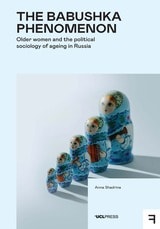
The Babushka Phenomenon
Older Women and the Political Sociology of Ageing in RussiaAnna Shadrina
University College London, 2025
The word “babushka” literally means “grandmother,” but it has come to represent much more since the Soviet era, not least the family caregiver. In her new study, Anna Shadrina explores the marginalization of older women in post-Soviet Russia, shedding light on the complex image of the babushka as both the cornerstone of the family unit and a passive recipient of social benefits. The author argues that this image has been shaped in no small part by welfare cutbacks that shifted the responsibility of family care from the state to individual women, as well as the increasing frustration of working-age people with the post-socialist economic system. Ultimately, she shows that despite being ostracized from society for defying age- and gender-specific social expectations, older women occupy a crucial position as active contributors to the economy.
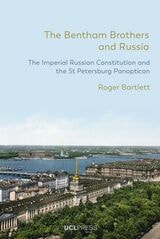
The Bentham Brothers and Russia
The Imperial Russian Constitution and the St Petersburg PanopticonRoger Bartlett
University College London, 2022
The jurist and philosopher, Jeremy Bentham, and his lesser-known brother, Samuel, a talented naval architect, engineer, and inventor, had a long love affair with Russia. Jeremy hoped to assist Empress Catherine II with her legislative projects. Samuel went to St Petersburg to seek his fortune in 1780 and came back with the rank of Brigadier-General and the idea, famously publicized by Jeremy, of the Panopticon. The Bentham Brothers and Russia chronicles the brothers’ later involvement with the Russian Empire when Jeremy focused his legislative hopes on Catherine’s grandson Emperor Alexander I and Samuel found a unique opportunity to build a Panopticon in St Petersburg—the only one ever built by the Benthams themselves. Setting the Benthams’ projects within an in-depth portrayal of the Russian context, Roger Bartlett illuminates an important facet of their later careers and offers insight into their worldview and thought. He also contributes to the history of legal codification in Russia and the demythologizing of the Panopticon, made notorious by Michel Foucault.
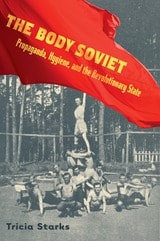
The Body Soviet
Propaganda, Hygiene, and the Revolutionary StateTricia Starks
University of Wisconsin Press, 2008
Health, though essential to the revolutionary vision and crucial to Soviet plans for utopia, has been neglected by traditional histories caught up in Cold War debates. The Body Soviet recovers this significant aspect of Soviet thought by providing a cross-disciplinary, comparative history of Soviet health programs that draws upon rich sources of health care propaganda, including posters, plays, museum displays, films, and mock trials. The analysis of propaganda makes The Body Soviet more than an institutional history; it is also an insightful critique of the ideologies of the body fabricated by health organizations.
"A masterpiece that will thoroughly fascinate and delight readers. Starks's understanding of propaganda and hygiene in the early Soviet state is second to none. She tells the stories of Soviet efforts in this field with tremendous insight and ingenuity, providing a rich picture of Soviet life as it was actually lived."— Elizabeth Wood, author of From Baba to Comrade: Gender and Politics in Revolutionary Russia
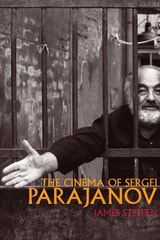
The Cinema of Sergei Parajanov
James Steffen
University of Wisconsin Press, 2013
The Cinema of Sergei Parajanov is the first English-language book on the director's films and the most comprehensive study of his work. James Steffen provides a detailed overview of Parajanov's artistic career: his identity as an Armenian in Georgia and its impact on his aesthetics; his early films in Ukraine; his international breakthrough in 1964 with Shadows of Forgotten Ancestors; his challenging 1969 masterpiece, The Color of Pomegranates, which was reedited against his wishes; his unrealized projects in the 1970s; and his eventual return to international prominence in the mid-to-late 1980s with The Legend of the Surami Fortress and Ashik-Kerib. Steffen also provides a rare, behind-the-scenes view of the Soviet film censorship process and tells the dramatic story of Parajanov's conflicts with the authorities, culminating in his 1973–77 arrest and imprisonment on charges related to homosexuality.
Ultimately, the figure of Parajanov offers a fascinating case study in the complicated dynamics of power, nationality, politics, ethnicity, sexuality, and culture in the republics of the former Soviet Union.
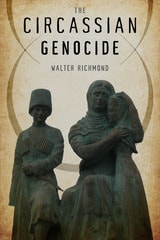
The Circassian Genocide
Richmond, Walter
Rutgers University Press, 2013
Using rare archival materials, Walter Richmond chronicles the history of the war, describes in detail the final genocidal campaign, and follows the Circassians in diaspora through five generations as they struggle to survive and return home. He places the periods of acute genocide, 1821–1822 and 1863–1864, in the larger context of centuries of tension between the two nations and updates the story to the present day as the Circassian community works to gain international recognition of the genocide as the region prepares for the 2014 Winter Olympics in Sochi, the site of the Russians’ final victory.
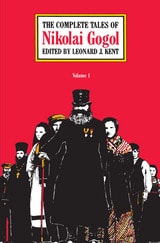
The Complete Tales of Nikolai Gogol, Volume 1
Nikolai Gogol
University of Chicago Press, 1985
The Complete Tales of Nikolai Gogol, Volume 2
Nikolai Gogol
University of Chicago Press, 1983

The Conundrum of Russian Capitalism
The Post-Soviet Economy in the World SystemRuslan Dzarasov
Pluto Press, 2013
The Conundrum of Russian Capitalism looks at the nature of Russian capitalism following the fall of the Soviet Union, showing how the system originated in the degenerated Soviet bureaucracy and the pressures of global capital. Ruslan Dzarasov provides a detailed analysis of Russian corporate governance, labour practices and investment strategies.
By comparing the practices of Russian companies to the typical models of corporate governance and investment behaviour of big firms in the West, Dzarasov sheds light on the relationship between the core and periphery of the capitalist world-system.
This groundbreaking study shows that Russia's new capitalism is not a break with the country's Stalinist past, but in fact the continuation of that tradition.
The Crooked Mirror
Plays from a Modernist Russian CabaretEdited and translated from the Russian by Laurence Senelick
Northwestern University Press, 2023
“Don’t blame the mirror if your mug is crooked!”
Parody dominated early twentieth-century Russian cabaret, but the Crooked Mirror extended its lampooning to theatrical practice itself. Eclectic in its targets, the Saint Petersburg theater mocked not only naturalism but also symbolism, futurism, and “Meyerholditis.” Its shows parodied both the stale conventions of melodrama and opera and the stylized trends in staging, wielding satire to provoke artistic and social reform. Though the theater was liquidated in 1931, many of its innovations would become standard techniques in cabaret repertoires and improv revues.
As a cultural phenomenon of the Silver Age, the Crooked Mirror deserves critical attention, yet it has received only fleeting mention in histories of Russian theater and biographies of its major figures. This anthology fills a critical gap in our understanding of that heady era by bringing together key plays—most appearing in English here for the first time—together with short biographies of their authors and robust commentary and annotations. Laurence Senelick guides readers through the artistic and ideological evolution of the Crooked Mirror and provides performers with the material to bring its innovations back to the stage.
The Development of a Russian Legal Consciousness
Richard S. Wortman
University of Chicago Press, 1976
The Diary of Olga Romanov
Royal Witness to the Russian RevolutionHelen Azar
Westholme Publishing, 2014
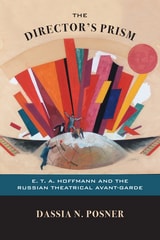
The Director's Prism
E. T. A. Hoffmann and the Russian Theatrical Avant-GardeDassia N. Posner
Northwestern University Press, 2016
Shortlist, 2019 Prague Quadrennial Best Scenography and Design Publication Award
The Director's Prism investigates how and why three of Russia's most innovative directors— Vsevolod Meyerhold, Alexander Tairov, and Sergei Eisenstein—used the fantastical tales of German Romantic writer E. T. A. Hoffmann to reinvent the rules of theatrical practice. Because the rise of the director and the Russian cult of Hoffmann closely coincided, Posner argues, many characteristics we associate with avant-garde theater—subjective perspective, breaking through the fourth wall, activating the spectator as a co-creator—become uniquely legible in the context of this engagement. Posner examines the artistic poetics of Meyerhold's grotesque, Tairov's mime-drama, and Eisenstein's theatrical attraction through production analyses, based on extensive archival research, that challenge the notion of theater as a mirror to life, instead viewing the director as a prism through whom life is refracted. A resource for scholars and practitioners alike, this groundbreaking study provides a fresh, provocative perspective on experimental theater, intercultural borrowings, and the nature of the creative process.
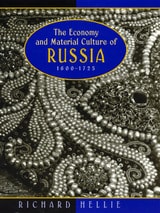
The Economy and Material Culture of Russia, 1600-1725
Richard Hellie
University of Chicago Press, 1999
Impressive in scope and data analysis, Economy and Material Culture of Russia, 1600-1725 will be an invaluable resource and reference work for all readers interested in economic history and the history of material culture. Since there is no comparable one-volume work for any other society at any other time in history, Hellie's is a truly unique and profound achievement.
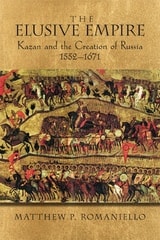
The Elusive Empire
Kazan and the Creation of Russia, 1552–1671Matthew P. Romaniello
University of Wisconsin Press, 2012
In 1552, Muscovite Russia conquered the city of Kazan on the Volga River. It was the first Orthodox Christian victory against Islam since the fall of Constantinople, a turning point that, over the next four years, would complete Moscow’s control over the river. This conquest provided a direct trade route with the Middle East and would transform Muscovy into a global power. As Matthew Romaniello shows, however, learning to manage the conquered lands and peoples would take decades.
Russia did not succeed in empire-building because of its strength, leadership, or even the weakness of its neighbors, Romaniello contends; it succeeded by managing its failures. Faced with the difficulty of assimilating culturally and religiously alien peoples across thousands of miles, the Russian state was forced to compromise in ways that, for a time, permitted local elites of diverse backgrounds to share in governance and to preserve a measure of autonomy. Conscious manipulation of political and religious language proved more vital than sheer military might. For early modern Russia, empire was still elusive—an aspiration to political, economic, and military control challenged by continuing resistance, mismanagement, and tenuous influence over vast expanses of territory.
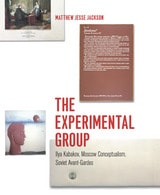
The Experimental Group
Ilya Kabakov, Moscow Conceptualism, Soviet Avant-GardesMatthew Jesse Jackson
University of Chicago Press, 2010
A compelling study of unofficial postwar Soviet art, The Experimental Group takes as its point of departure a subject of strange fascination: the life and work of renowned professional illustrator and conceptual artist Ilya Kabakov.
Kabakov’s art—iconoclastic installations, paintings, illustrations, and texts—delicately experiments with such issues as history, mortality, and disappearance, and here exemplifies a much larger narrative about the work of the artists who rose to prominence just as the Soviet Union began to disintegrate. By placing Kabakov and his conceptualist peers in line with our own contemporary perspective, Matthew Jesse Jackson suggests that the art that emerged in the wake of Stalin belongs neither entirely to its lost communist past nor to a future free from socialist nostalgia. Instead, these artists and their work produced a critical and controversial chapter in the as yet unwritten history of global contemporary art.
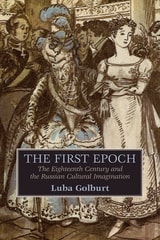
The First Epoch
The Eighteenth Century and the Russian Cultural ImaginationLuba Golburt
University of Wisconsin Press, 2014
Why did nineteenth-century Russians put the eighteenth century so quickly behind them? How does a meaningful present become a seemingly meaningless past? Interpreting texts by Lomonosov, Derzhavin, Pushkin, Viazemsky, Turgenev, Tolstoy, and others, Golburt finds surprising answers, in the process innovatively analyzing the rise of periodization and epochal consciousness, the formation of canon, and the writing of literary history.
Winner, Marc Raeff Book Prize, Eighteenth-Century Russian Studies Association
Winner, Heldt Prize for the Best Book by a Woman in Slavic/Eastern European/Eurasian Studies, Association for Women in Slavic Studies
Winner, Best Book in Literary and Cultural Studies, American Association of Teachers of Slavic and Eastern European Languages
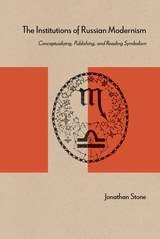
The Institutions of Russian Modernism
Conceptualizing, Publishing, and Reading SymbolismJonathan Stone
Northwestern University Press, 2017
The Institutions of Russian Modernism illuminates the key role of Symbolism as the earliest form of modernism in Russia, emerging seemingly ex nihilo at the end of the nineteenth century. Combining book history, periodical studies, and reception theory, Jonathan Stone examines the poetry and theory of Russian Symbolism within the framework of the institutions that organized, published, and disseminated the works to Russian readers. Surveying a wealth of examples of books, journals, and almanacs, Stone traces how publishers of Symbolist works marketed the movement and fashioned a Symbolist reader. His persuasive argument that after its eclipse Symbolism's legacy remained embedded in the heart of Russian modernism will be of interest to scholars and general readers.
The KGB and the Vatican
Secrets of the Mitrokhin FilesSean Brennan
Catholic University of America Press, 2022
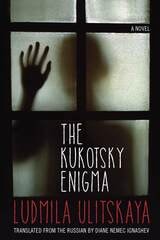
The Kukotsky Enigma
A NovelLudmila Ulitskaya; Translated from the Russian by Diane Nemec Ignashev
Northwestern University Press, 2016
Translated from the Russian by Diane Nemec Ignashev
The central character in Ludmila Ulitskaya’s celebrated novel The Kukotsky Enigma is a gynecologist contending with Stalin’s prohibition of abortions in 1936. But, in the tradition of Russia’s great family novels, the story encompasses the history of two families and unfolds in Moscow, St. Petersburg, and the ruins of ancient civilizations on the Black Sea. Their lives raise profound questions about family heritage and genetics, nurture and nature, and life and death. In his struggle to maintain his professional integrity and to keep his work from dividing his family, Kukotsky confronts the moral complexity of reproductive science. Winner of the 2001 Russian Booker Prize and the basis for a blockbuster television miniseries, The Kukotsky Enigma is an engrossing, searching novel by one of contemporary literature’s most brilliant writers.
The Letters and the Law
Legal and Literary Culture in Late Imperial RussiaAnna Schur
Northwestern University Press, 2022
Anna Schur combines historical research and literary analysis to argue that the first generations of Russian trial lawyers shaped their professional identity with an eye to the celebrated figure of the writer and that they considered their own activities to be a form of verbal art. A fuller understanding of writers’ antipathy to the law, Schur contends, must take into account this overlooked cultural backdrop. Laced with the better‑known critique of the lawyer’s legalistic proclivities and lack of moral principle are the writer’s reactions to a whole network of explicit and implicit claims of similarity between the two professions’ goals, methods, and missions that were central to the lawyer’s professional ideal. Viewed in this light, writers’ critiques of the law and lawyers emerge as a concerted effort at protecting literature’s exclusive cultural status in the context of modernization and the rapidly expanding public sphere.
The study draws upon a mix of well-known and rarely studied nineteenth-century authors and texts—with particular attention paid to Fyodor Dostoevsky and Mikhail Saltykov-Shchedrin—and on a wide range of nonliterary sources, including courtroom speeches, guides to forensic oratory, legal treatises, and specialized press.
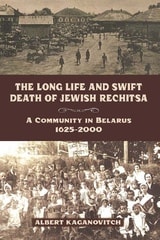
The Long Life and Swift Death of Jewish Rechitsa
A Community in Belarus, 1625–2000Albert Kaganovitch
University of Wisconsin Press, 2013
Based on extensive use of Soviet and Israeli archives, interviews, memoirs, and secondary sources, Kaganovitch’s acclaimed work, originally published in Russian, is presented here in a significantly revised English translation by the author. Details of demographic, social, economic, and cultural changes in Rechitsa’s evolution, presented over the sweep of centuries, reveal a microcosm of daily Jewish life in Rechitsa and similar communities. Kaganovitch looks closely at such critical developments as the spread of Chabad Hasidism, the impact of multiple political transformations and global changes, and the mass murder of Rechitsa’s remaining Jews by the German army in November to December 1941.
Kaganovitch also documents the evolving status of Jews in the postwar era, starting with the reconstitution of a Jewish community in Rechitsa not long after liberation in 1943 and continuing with economic, social, and political trends under Stalin, Khrushchev, and Brezhnev, and finally emigration from post-Soviet Belarus. The Long Life and Swift Death of Jewish Rechitsa is a major achievement.
Winner, Helen and Stan Vine Canadian Jewish Book Award for Scholarship, Koffler Centre of the Arts
The Loss
A Novella and Two Short StoriesVladimir Makanin
Northwestern University Press, 1998
In his celebrated short story "The Prisoner of the Caucasus," two Russian soldiers take a Chechen prisoner during the war, and as events unfold, Makanin reveals the casual brutality of the war but also the secret truths of the character's lives. In the novella The Loss, Pekalov, a drunkard and dreamer obsessed with the idea of building a tunnel under the Ural River, disappears in a ditch while working and is made a saint by the people of his village. "Klyucharyov and Alimushkin" tells the story of what happens when one man becomes remarkably lucky while the other loses all his luck.
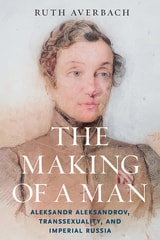
The Making of a Man
Aleksandr Aleksandrov, Transsexuality, and Imperial RussiaRuth Averbach
University of Wisconsin Press, 2026
Aleksandr Aleksandrov was an author and soldier in service of the Russian tsar, active in the Prussian theater of the War of the Fourth Coalition (1806–7) and in the Napoleonic Wars. In scholarship, he is better known by his birth name, Nadezhda Andreevna Durova, and often referred to with the female pronouns bestowed upon him at birth. In this first book-length study of Aleksandrov, Ruth Averbach argues that we should understand this celebrated figure of Imperial Russia, whose sex was legally changed by Tsar Aleksandr I, simply as a man, one whose masculinity was intimately connected to the imperialist cause and Russian nationalism.
For the majority of his life, Aleksandrov lived, wrote, and fought as a man and was recognized as such by most of his contemporaries. This contradicts the dominant position in especially Western feminist scholarship, which understands “Durova” either as a woman so patriotic that she dressed as a man to fight Russia’s wars or as a woman so frustrated by gender restrictions that she dramatically sought to cast them aside. Averbach instead asserts that we should take Aleksandrov at his word and accept his transition as genuine. Doing so allows for fresh interpretations of both his autobiographical writings and his works of fiction, interpretations that Averbach deftly shows have salience not just for a single man’s life but also for how we understand masculinity, imperialism, and nationalism in nineteenth-century Russia more broadly.

The Market-Planned Economy of Yugoslavia
Svetozar Pejovich
University of Minnesota Press, 1966
The Market-Planned Economy of Yugoslavia was first published in 1966. Minnesota Archive Editions uses digital technology to make long-unavailable books once again accessible, and are published unaltered from the original University of Minnesota Press editions.
The Yugoslavian economic system, combining, as it does, elements of Marxist socialism with many aspects of free enterprise, represents a challenging experiment which is being closely watched by students of economic and political theory. The system has attracted serious attention in the emerging nations of Asia and Africa and, more recently, in the Soviet Union itself. Though they retain socialist, state-centered goals, the Yugoslavs have introduced a great deal of decentralization and individual incentive and have allowed production to be largely regulated by the demand of a relatively free market instead of by predetermined quotas and plans.
Professor Pejovich describes and analyzes this economic system, as it affects both the overall economy and the individual firm. He then provides a theoretical analysis in which he points out implications for economic theory and for the theory of socialism as well as the practical significance of the Yugoslavian experiment. The stud makes an important contribution in combining the economic theory of socialism formulated in the pioneering work of Oskar Lange with the theory of economic development if Joseph Schumpeter, whose concepts are discussed by Dr. Pejovich in an appendix.
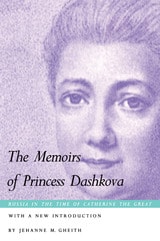
The Memoirs of Princess Dashkova
Ekaterina Romanovna Dashkova
Duke University Press, 1995
Originally written in French, first published in English, and long out of print, Dashkova’s Memoirs tell the story of a woman who at age eighteen played an important role in the coup that brought Catherine the Great to the throne. The relationship between these two women, often tense, is a central theme throughout this story. Dashkova, occupying the highly unusual position of both stateswoman and mother, also reveals her own path between the demands and limitations of the "private" and "public" spheres of her society. She provides a view of the expectations of Russian aristocratic women, the possibilities available to them, and the ways in which gender roles were conceived in the eighteenth century.
With a new introduction by Jehanne M Gheith, The Memoirs of Princess Dashkova will renew interest in the life of a fascinating woman for students of Russian history, women’s studies, and eighteenth-century studies. It will be a significant text for those engaged in the cross-cultural study of the traditions of women’s autobiographical writing.
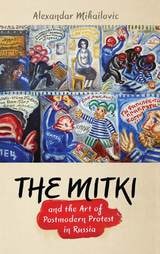
The Mitki and the Art of Postmodern Protest in Russia
Alexandar Mihailovic
University of Wisconsin Press, 2019
More broadly, Alexandar Mihailovic shows, the Mitki pioneered a form of political protest art that has since become a centerpiece of activism in post-Soviet Russia, most visibly today in groups such as Pussy Riot. He draws on extensive interviews with members of the collective and illuminates their critique of the authoritarian state, militarism, and social strictures from the Brezhnev years to the present.
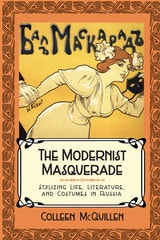
The Modernist Masquerade
Stylizing Life, Literature, and Costumes in RussiaColleen McQuillen
University of Wisconsin Press, 2013
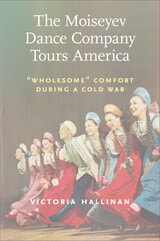
The Moiseyev Dance Company Tours America
"Wholesome" Comfort during a Cold WarVictoria Hallinan
University of Massachusetts Press, 2023
During the Cold War, dancers and musicians from the United States and the USSR were drawn into the battle for hearts and minds, crossing the Iron Curtain to prove their artistic and ideological prowess. After the passage of the Lacy-Zarubin Agreement, direct cultural exchange between the two superpowers opened up, and the Moiseyev Dance Company arrived in the United States in 1958. The first Soviet cultural representatives to tour America, this folk-dance troupe’s repertoire included dances from territories controlled or influenced by the USSR, including Uzbekistan, Crimea, and Poland.
Drawing on contemporary personal and published accounts, Victoria Hallinan explores why the dancers garnered overwhelming acclaim during their multicity tour and Ed Sullivan Show appearance. The “boy-meets-girl” love stories of the dances, and their idealized view of multiple Soviet cultures living together in harmony, presented a comforting image of post–World War II gender norms and race relations for audiences. Americans saw the dancers—their supposed enemies—as humans rather than agents of communist contagion.
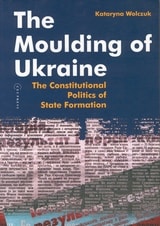
The Moulding of Ukraine
The Constitutional Politics of State FormationKataryna Wolczuk
Central European University Press, 2002
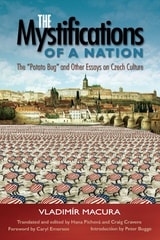
The Mystifications of a Nation
"The Potato Bug" and Other Essays on Czech CultureVladimír Macura
University of Wisconsin Press, 2010
A keen observer of culture, Czech writer Vladimír Macura (1945–99) devoted a lifetime to illuminating the myths that defined his nation. The Mystifications of a Nation, the first book-length translation of Macura’s work in English, offers essays deftly analyzing a variety of cultural phenomena that originate, Macura argues, in the “big bang” of the nineteenth-century Czech National Revival, with its celebration of a uniquely Czech identity.
In reflections on two centuries of Czech history, he ponders the symbolism in daily life. Bridges, for example—once a force of civilization connecting diverse peoples—became a sign of destruction in World War I. Turning to the Soviet and post-Soviet eras, Macura probes a range of richly symbolic practices, from the naming of the Prague metro system, to the mass gymnastic displays of the Communist period, to post–Velvet Revolution preoccupations with the national anthem. In “The Potato Bug,” he muses on one of the stranger moments in the Cold War—the claim that the United States was deliberately dropping insects from airplanes to wreak havoc on the crops of Czechoslovakia.
While attending to the distinctively Czech elements of such phenomena, Macura reveals the larger patterns of Soviet-brand socialism. “We were its cocreators,” he declares, “and its analysis touches us as a scalpel turned on its own body.” Writing with erudition, irony, and wit, Macura turns the scalpel on the authoritarian state around him, demythologizing its mythology.
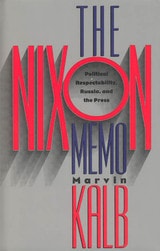
The Nixon Memo
Political Respectability, Russia, and the PressMarvin Kalb
University of Chicago Press, 1994
The story begins on March 10, 1992. Nixon had written a private memo critical of president George Bush's policy toward Russia. The memo leaked and exploded on the front page of The New York Times. Why would Nixon attack Bush, a fellow party member fighting for re-election? Why on an issue of foreign affairs, which was Bush's strength? The questions are as intriguing as the answers, and distinguished journalist and scholar Marvin Kalb offers a suspenseful, eye-opening account of how our conventional wisdom on United States foreign policy is shaped by the insider's game of press/politics.
This story of Nixon's Machiavellian efforts to pressure the White House, by way of the press, into helping Boris Yeltsin and Russia sheds new light on the inner workings of the world inside the government of the United States. Marvin Kalb read the documents behind the Nixon memo and interviewed scores of journalists, scholars, and officials in and from Washington and Moscow. Drawing on his years of experience as a diplomatic correspondent, he identifies and illuminates the intersection of press and politics in the fashioning of public policy.
"An absorbing and often compelling argument that Richard Nixon directed his own political rehabilitation on the world stage, using presidents, lesser politicians, and the press as his supporting cast. This is a first-class job of unraveling a complex and usually unseen tapestry."—Ted Koppel
"With Marvin Kalb's captivating account, Richard Nixon continues to fascinate us even in death."—Al Hunt
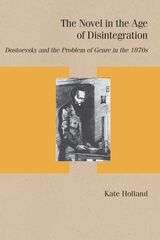
The Novel in the Age of Disintegration
Dostoevsky and the Problem of Genre in the 1870sKate Holland
Northwestern University Press, 2013
Scholars have long been fascinated by the creative struggles with genre manifested throughout Dostoevsky’s career. In The Novel in the Age of Disintegration, Kate Holland brings historical context to bear, showing that Dostoevsky wanted to use the form of the novel as a means of depicting disintegration brought on by various crises in Russian society in the 1860s. This required him to reinvent the genre. At the same time he sought to infuse his novels with the capacity to inspire belief in social and spiritual reintegration, so he returned to some older conventions of a society that was already becoming outmoded.
In thoughtful readings of Demons, The Adolescent, A Writer’s Diary, and The Brothers Karamazov, Holland delineates Dostoevsky’s struggle to adapt a genre to the reality of the present, with all its upheavals, while maintaining a utopian vision of Russia’s future mission.

The People's War
Responses to World War II in the Soviet UnionEdited by Robert W. Thurston and Bernd Bonwetsch
University of Illinois Press, 2000
Drawing on a wealth of archival and recently published material, contributors detail the calculated destruction of a Jewish town by the Germans and present a chilling picture of life in occupied Minsk. They look at the cultural developments of the war as well as the wartime experience of intellectuals, for whom the period was a time of relative freedom. They discuss women's myriad roles in combat and other spheres of activity. They also reassess the behavior and morale of ordinary Red Army troops and offer new conclusions about early crushing defeats at the hands of the Germans–-defeats that were officially explained as cowardice on the part of high officers.
A frank investigation of civilian life behind the front lines, The People's War provides a detailed, balanced picture of the Stalinist USSR by describing not only the command structure and repressive power of the state but also how people reacted to them, cooperated with or opposed them, and adapted or ignored central policy in their own ways. By putting the Soviet people back in their war, this volume helps restore the range and complexity of human experience to one of history's most savage periods.
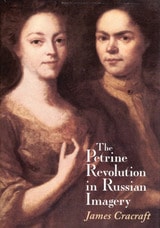
The Petrine Revolution in Russian Imagery
James Cracraft
University of Chicago Press, 1997
In this second volume of the series, Cracraft considers the impact of Peter's intensive program of Europeanization on the visual arts, and shows how modern forms of imagery came into being in Russia along with allied techniques of image-making.
Drawing on a wealth of primary sources as well as numerous secondary works in Russian and other languages, Cracraft discusses the advent in Russia of painting in the Renaissance tradition, bronze and stone sculpture, and the modern graphic arts. He also discusses the decline of manuscript illumination, the rise of modern coinage, the production of new-style flags and altar cloths, and the arrival in Russia of the new cartography and the new heraldry. Cracraft draws special attention to the early history of the St. Petersburg Academy of Fine Arts, and to the impact of Peter's program on popular imagery and on the cult art of the Russian Orthodox Church. He argues in sum that the imagery of the Russian Empire can tell us as much or more about its dominant ethos and ideology as can the written texts normally studied by historians.
Like its predecessor, The Petrine Revolution in Russian Architecture, this second volume presents a highly original argument supported by numerous illustrations, many of them not previously published. It will appeal to art historians as well as to those more generally interested in European or modern history.

The Plow, the Hammer, and the Knout
An Economic History of Eighteenth-Century RussiaArcadius Kahan
University of Chicago Press, 1985
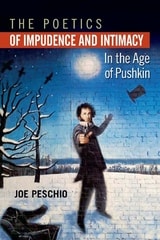
The Poetics of Impudence and Intimacy in the Age of Pushkin
Joe Peschio
University of Wisconsin Press, 2012
Joe Peschio offers the first comprehensive history of a set of associated behaviors known in Russian as “shalosti,” a word which at the time could refer to provocative behaviors like practical joking, insubordination, ritual humiliation, or vandalism, among other things, but also to literary manifestations of these behaviors such as the use of obscenities in poems, impenetrably obscure allusions, and all manner of literary inside jokes. One of the period’s most fashionable literary and social poses became this complex of behaviors taken together. Peschio explains the importance of literary shalosti as a form of challenge to the legitimacy of existing literary institutions and sometimes the Russian regime itself. Working with a wide variety of primary texts—from verse epistles to denunciations, etiquette manuals, and previously unknown archival materials—Peschio argues that the formal innovations fueled by such “prankish” types of literary behavior posed a greater threat to the watchful Russian government and the literary institutions it fostered than did ordinary civic verse or overtly polemical prose.
The Popular Theatre Movement in Russia
1862-1919Gary Thurston
Northwestern University Press, 2016
After the emancipation of the serfs in 1861, educated Russians began to present plays as part of a crusade to "civilize" the peasants. Relying on archival and published material virtually unknown outside Russia, this study looks at how playwrights criticized Russian social and political realities, how various groups perceived their plays, and how the plays motivated viewers to change themselves or change their circumstances. The picture that emerges is of a potent civic art influential in a way that eluded and challenged authoritarian control.
The Privatization Process in Russia, the Ukraine, and the Baltic States
Roman Frydman
Central European University Press, 1993
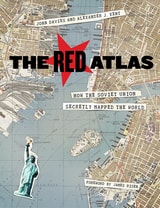
The Red Atlas
How the Soviet Union Secretly Mapped the WorldJohn Davies and Alexander J. Kent
University of Chicago Press, 2017
From 1950 to 1990, the Soviet Army conducted a global topographic mapping program, creating large-scale maps for much of the world that included a diversity of detail that would have supported a full range of military planning. For big cities like New York, DC, and London to towns like Pontiac, MI and Galveston, TX, the Soviets gathered enough information to create street-level maps. What they chose to include on these maps can seem obvious like locations of factories and ports, or more surprising, such as building heights, road widths, and bridge capacities. Some of the detail suggests early satellite technology, while other specifics, like detailed depictions of depths and channels around rivers and harbors, could only have been gained by actual Soviet feet on the ground. The Red Atlas includes over 350 extracts from these incredible Cold War maps, exploring their provenance and cartographic techniques as well as what they can tell us about their makers and the Soviet initiatives that were going on all around us.
A fantastic historical document of an era that sometimes seems less distant, The Red Atlas offers an uncanny view of the world through the eyes of Soviet strategists and spies.

The Reincarnation of Russia
Struggling with the Legacy of Communism, 1990–1994John Löwenhardt
Duke University Press, 1995
Building on analysis of the failure of the Soviet system, Löwenhardt compares the emergence of Russia as a newborn state with other countries that have undergone transitions from authoritarianism toward democracy. Although it is often claimed that Russia is a unique case, the author argues that the lessons of other nations are relevant to the Russian situation. In conjunction with this comparative analysis and with consideration of the significance of the communist and Russian past, Löwenhardt discusses political and economic developments—including both foreign and domestic policy concerns—in Russia over the last four years. He provides a better understanding of the Russian condition and a guarded optimism regarding the ongoing process taking place in Russia today.
The Reincarnation of Russia will be welcomed by scholars with specialized interests in the democratization of Russia, political leaders, journalists, and general readers concerned with the global impact of Russia’s changing status.
The Resistible Rise of Antisemitism
Exemplary Cases from Russia, Ukraine, and PolandLaura Engelstein
Brandeis University Press, 2020
Antisemitism as a political weapon did not stand unchallenged, even in Eastern Europe, where its consequences were particularly dire. In this region, Jewish leaders mobilized across national borders and in alliance with non-Jewish public figures on behalf of Jewish rights and in opposition to anti-Jewish violence. Antisemites were called to account and forced on the defensive. In Imperial and then Soviet Russia, in newly emerging Poland, and in aspiring Ukraine—notorious in the West as antisemitic hotbeds—antisemitism was sometimes a moral and political liability. These intriguing essays explore the reasons why, and they offer lessons from surprising places on how we can continue to fight antisemitism in our times.
The Romanov Empire and Nationalism
Essays in the Methodology of Historical ResearchAlexei Miller
Central European University Press, 2008
The Russia Reader
History, Culture, PoliticsAdele Barker and Bruce Grant, eds.
Duke University Press, 2010
Illustrated with maps, paintings, photographs, posters, and cartoons, The Russia Reader incorporates song lyrics, jokes, anecdotes, and folktales, as well as poems, essays, and fiction by writers including Akhmatova, Dostoyevsky, Pushkin, and Tolstoi. Transcripts from the show trials of major Party figures and an account of how staff at the Lenin Library in Moscow were instructed to interact with foreigners are among the many selections based on personal memoirs and archival materials only recently made available to the public. From a tenth-century emissary’s description of his encounters in Kyivan Rus’, to a scientist’s recollections of her life in a new research city built from scratch in Siberia during the 1950s, to a novelist’s depiction of the decadence of the “New Russians” in the 2000s, The Russia Reader is an extraordinary introduction to a vast and varied country.
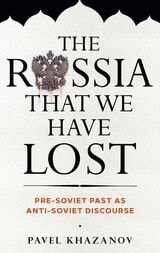
The Russia That We Have Lost
Pavel Khazanov
University of Wisconsin Press, 2023
Khazanov’s careful untangling of this discourse in the late Soviet period reveals a process that involved figures of all political stripes, from staunch conservatives to avowed intelligentsia liberals. Further, Khazanov shows that this process occurred not outside of or in opposition to Soviet guidance and censorship, but in mainstream Soviet culture that commanded wide audiences, especially among the Soviet middle class. Excavating the cultural logic of this newly foundational, mythic memory of a “lost Russia,” Khazanov reveals why, despite the apparently liberal achievement of the collapse of the Soviet Union in 1991, Boris Yeltsin (and later, Vladamir Putin) successfully steered Russia into oligarchy and increasing autocracy. The anti-Soviet memory of the pre-Soviet past, ironically constructed during the late socialist period, became and remains a politically salient narrative, a point of consensus that surprisingly attracts both contemporary regime loyalists and their would-be liberal opposition.