Results by title
151 books match the query 'Sign Language' and 30 start with t
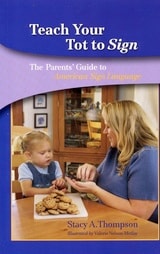
Teach Your Tot to Sign
The Parents' Guide to American Sign LanguageStacy A. Thompson
Gallaudet University Press, 2005
Research has shown that very young children can learn sign language before they learn to speak. Teach Your Tot to Sign: The Parents’ Guide to American Sign Language provides parents and teachers the opportunity to teach more than 500 basic American Sign Language (ASL) signs to their infants, toddlers, and young children. Hearing children, deaf children, and children with special needs can benefit from learning the elementary signs chosen for this handy pocket-size book. Young children who can communicate using simple signs become less frustrated and also bond in a special way with their parents. In teaching ASL to parents of toddlers and preschool teachers, author Stacy A. Thompson recognized the need for a book that could be used at home and in the classroom. Her book features fundamental signs of great appeal to young children and concise instructions on how to sign, including the critical importance of facial expression.
Teach Your Tot to Sign anticipates all of the common desires and interests of young children — food, pets, planes, trains, cars, and boats, games, holidays, vegetables, family — in short, nearly everything. Reflecting children’s endless curiosity, the vocabulary chosen ranges from signs for “baby,” “broken,” “clown,” “dinosaur,” “firefighter,” “gentle,” “hot,” “hurt,” “ketchup,” “pacifier,” “rooster,” “sad,” “spaghetti,” “wagon,” “water,” “wet,” to “you’re welcome,” and even “McDonalds.” This lively assortment of signs will help every child convey earlier in their development their thoughts, feelings, and desires to their parents and teachers.

The Academic Foundations of Interpreting Studies
An Introduction to Its TheoriesCynthia B. Roy
Gallaudet University Press, 2018
As sign language interpreting has emerged and evolved in the last 20 years as an academic field of study, the scope of learning has broadened to include fields beyond the language and culture of deaf people. This text surveys six disciplines that have informed the study of sign language interpreting: history, translation, linguistics, sociology, social psychology, and cognitive psychology, along with their major ideas, principal scholars, and ways of viewing human interaction. Each chapter includes clear learning goals, definitions, discussion questions, and images to aid understanding. The Academic Foundations of Interpreting Studies is required reading for upper-level undergraduate or first-year graduate students in interpreting, Deaf studies, and sign language programs.
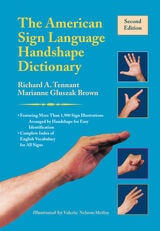
The American Sign Language Handshape Dictionary
Richard A. Tennant
Gallaudet University Press, 2020
Featuring
•More than 1,900 Sign Illustrations Including 327 New Signs•Plus DVD Showing How to Form Signs
•Arranged by Handshape for Easy Identification
•Complete Index of English Vocabulary for All Signs
•An Introduction to Deaf Culture and ASL Structure
The first reference source that allows users to access ASL signs without previous knowledge of their English equivalents (far superior to those in most other English-ASL glossaries). Likely to become indispensable on many educators’ and students’ bookshelves.—CHOICE
Now, the bestselling resource The American Sign Language Handshape Dictionary has been completely revised with more than 320 new signs and a new DVD. This unique reference can help users locate a sign whose meaning they have forgotten, or help them find the meaning of a new sign they have just seen for the first time. It organizes more than 1,900 ASL signs by 40 basic handshapes and includes detailed descriptions on how to form these signs to represent the different English words that they might mean. ASL students can begin to track down a sign by determining whether it is formed with one hand or two. Further distinctions of handshape, palm orientation, location, movement, and other nonmanual body signals help them pinpoint their search while also refining their grasp of ASL syntax and grammar. A complete English word index provides the option of referring to an alphabetical listing of English terms to locate an equivalent sign or choice of signs.
The new DVD shows how each sign is formed from beginning to end. Users can watch a sign at various speeds to learn precisely how to master it themselves. Together, the new edition of The American Sign Language Handshape Dictionary and its accompanying DVD presents students, sign language teachers, and deaf and hearing people alike with the perfect combination for enhancing communication skills in both ASL and English.
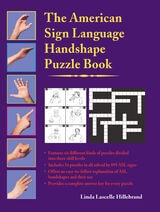
The American Sign Language Handshape Puzzle Book
Linda Lascelle Hillebrand
Gallaudet University Press, 2005
The American Sign Language Handshape Puzzle Book features 54 different puzzles to help students learn, review, and strengthen their signing vocabulary. Inspired by the bestselling dictionary, this unique workbook offers a variety of puzzles at three different levels — easy, medium, and difficult. Author Linda Lascelle Hillebrand provides a concise explanation of the basic handshapes used in American Sign Language (ASL), then invites readers to have fun while solving all sorts of sign puzzles.
Users can practice sign identification with Crossword and Word Search puzzles that have signs as clues rather than words. Easy puzzles show as few as six signs while advanced puzzles contain as many as 30 signs each. Some of the crossword puzzles provide spaces both across and down for the multiple meanings that many signs can represent.
Handshape Order puzzles require users to identify the handshape of the sign in an illustration, then list the sign’s meaning in English. Match puzzles also challenge readers to find corresponding signs for English glosses. Solutions to It Doesn’t Belong and Sign Description puzzles depend upon knowing the parameters of ASL signs—handshape, orientation, location, and movement—to deduce which word in a list doesn’t belong, and to write the English word for the described signs. The American Sign Language Handshape Puzzle Book is a new, different, and entertaining way to practice ASL that students of all ages are sure to enjoy.
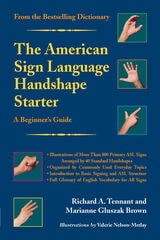
The American Sign Language Handshape Starter
A Beginner's GuideRichard A. Tennant
Gallaudet University Press, 2002
The Deaf Experience
Classics in Language and EducationHarlan Lane
Gallaudet University Press, 2006
The fifth volume in the Gallaudet Classics in Deaf Studies series features works written from 1764 up to1840. Pierre Desloges offers a stirring paean to sign language in an excerpt from his book, the first ever published by a deaf person. Saboureux de Fontenay and Jean Massieu, two prominent leaders, relate their respective experiences in autobiographical accounts. In separate essays, Charles-Michel de l’Epée and Roch-Ambroise Sicard describe systems for teaching manual French, followed by a critique of these methods by Roch-Ambroise Bébian, a well-known hearing friend of Deaf people during that era. Ferdinand Berthier, a renowned Deaf teacher and writer in the 19th century, concludes with a history of Deaf people up to that time.
The Deaf Experience shows clearly how this extraordinary era of French deaf education influenced the adoption of the manual method by the first schools for deaf students in America, in sharp contrast to the oral movement that repressed sign-language-centered education for nearly a century afterward. Deaf studies scholars and students alike will welcome the return of this invaluable resource.
The Deaf Mute Howls
Albert Ballin
Gallaudet University Press, 1998
Originally published in 1930, The Deaf Mute Howls flew in the face of the accepted practice of teaching deaf children to speak and read lips while prohibiting the use of sign language. The sharp observations in Albert Ballin’s remarkable book detail his experiences (and those of others) at a late 19th-century residential school for deaf students and his frustrations as an adult seeking acceptance in the majority hearing society.
The Deaf Mute Howls charts the ambiguous attitudes of deaf people toward themselves at this time. Ballin himself makes matter-of-fact use of terms now considered disparaging, such as “deaf-mute,” and he frequently rues the “atrophying” of the parts of his brain necessary for language acquisition. At the same time, he rails against the loss of opportunity for deaf people, and he commandingly shifts the burden of blame to hearing people unwilling to learn the “Universal Sign Language,” his solution to the communication problems of society. From his lively encounters with Alexander Graham Bell (whose desire to close residential schools he surprisingly supports) to his enthrallment with the film industry, Ballin’s highly readable book offers an appealing look at the deaf world during his richly colored lifetime.
The Deaf Way
Perspectives from the International Conference on Deaf CultureCarol J. Erting
Gallaudet University Press, 1994
The Emergence of the Deaf Community in Nicaragua
“With Sign Language You Can Learn So Much”Laura Polich
Gallaudet University Press, 2005
The sudden discovery of Nicaraguan Sign Language (NSL) enthralled scholars worldwide who hoped to witness the evolution of a new language. But controversy erupted regarding the validity of NSL as a genuinely spontaneous language created by young children. Laura Polich’s fascinating book recounts her nine-year study of the Deaf community in Nicaragua and her findings about its formation and that of NSL in its wake.
Polich crafted The Emergence of the Deaf Community in Nicaragua from her copious research in Nicaragua’s National Archives, field observations of deaf pupils in 20 special education schools, polls of the teachers for deaf children about their education and knowledge of deafness, a survey of 225 deaf individuals about their backgrounds and living conditions, and interviews with the oldest members of the National Nicaraguan Association of the Deaf.
Polich found that the use of a “standardized” sign language in Nicaragua did not emerge until there was a community of users meeting on a regular basis, especially beyond childhood. The adoption of NSL did not happen suddenly, but took many years and was fed by multiple influences. She also discovered the process that deaf adolescents used to attain their social agency, which gained them recognition by the larger Nicaraguan hearing society. Her book illustrates tremendous changes during the past 60 years, and the truth in one deaf Nicaraguan’s declaration, “With sign language you can learn so much.”

The Evidence Is Life
Deaf Pilgrimages to Language and Community in Mexico CityAnne E. Pfister
Gallaudet University Press, 2025
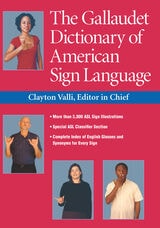
The Gallaudet Dictionary of American Sign Language
Clayton Valli
Gallaudet University Press, 2021
Created by an unparalleled board of experts led by renowned ASL linguist and poet Clayton Valli, The Gallaudet Dictionary of American Sign Language contains over 3,000 illustrations. Each sign illustration, including depictions of fingerspelling when appropriate, incorporates a complete list of English synonyms. A full, alphabetized English index enables users to cross-reference words and signs throughout the entire volume.
The comprehensive introduction lays the groundwork for learning ASL by explaining in plain language the workings of ASL syntax and structure. It also offers examples of idioms and describes the antecedents of ASL, its place in the Deaf community, and its meaning in Deaf culture. This extraordinary reference also provides a special section on ASL classifiers and their use. Readers will find complete descriptions of the various classifiers and examples of how to use these integral facets of ASL. The Gallaudet Dictionary of American Sign Language is an outstanding ASL reference for all instructors, students, and users of ASL.
*Please note that this paperback edition does not include the DVD found in the hardcover edition.
The Geometry of Visual Phonology
Linda Ann N. Uyechi
CSLI, 1996
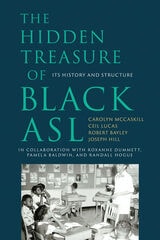
The Hidden Treasure of Black ASL
Its History and StructureCarolyn McCaskill
Gallaudet University Press, 2020
Black ASL has long been recognized as a distinct variety of American Sign Language based on abundant anecdotal evidence. The Hidden Treasure of Black ASL, originally published in 2011, presents the first sociohistorical and linguistic study of this language variety. Based on the findings of the Black ASL Project, which undertook this unprecedented research, Hidden Treasure documents the stories and language of the African American Deaf community. With links to online supplemental video content that includes interviews with Black ASL users (formerly on DVD), this volume is a groundbreaking scholarly contribution and a powerful affirmation for Black Deaf people.
This paperback edition includes an updated foreword by Glenn B. Anderson, a new preface that reflects on the impact of this research, and an expanded list of references and resources on Black ASL.
The supplemental video content is available online at the Gallaudet University Press YouTube Channel. Under Playlists, click “The Hidden Treasure of Black ASL: Companion Video to the Book.” The original Black ASL Project research videos are also available.
Featured in the film Signing Black in America: The Story of Black ASL, produced by The Language and Life Project at North Carolina State University (Dr. Walt Wolfram, Executive Producer). Look for it on PBS.

The Next Generation of Research in Interpreter Education
Pursuing Evidence-Based PracticesCynthia B. Roy
Gallaudet University Press, 2018
The Other Side of Silence
Sign Language and the Deaf Community in AmericaArden Neisser
Gallaudet University Press, 1983
Arden Neisser’s classic book on American Sign Language (ASL) and the Deaf community is again available, with a new prologue. The Other Side of Silence explores the Deaf community through telling interviews and research from across the country.
In widely varying encounters, Neisser heard Deaf individuals recall how their teachers suppressed ASL, how linguists foster conflicting theories, and how various institutions of the deaf dilute ASL to suit hearing patrons. This seminal book reveals the warmth, creativity, and resilience of Deaf people, and offers an update of the community today.
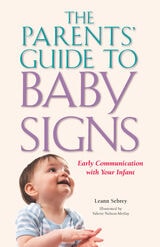
The Parents’ Guide to Baby Signs
Early Communication with Your InfantLeann Sebrey
Gallaudet University Press, 2009
Experienced ASL instructor Leann Sebrey champions two-way sign communication between parents and their infants who are just months old as a way to bond more closely and reduce frustration, while also maximizing the children’s intelligence and emotional quotients.
Sebrey’s book The Parents’ Guide to Baby Signs: Early Communication with Your Infant lays out an easy, step-by-step process that will instill confidence in parents who have never signed before. She begins by explaining why ASL is best for all children, both deaf and hearing. Sebrey also recognizes the different ways young children learn, encouraging parents and caregivers to sign with infants at all times as a natural part of their interaction. She reveals the first indications of when a baby is ready to communicate, and includes a list of signs to provide parents with a good starting point. Sebrey discusses the moments when infants are most receptive to learn signs and outlines numerous practical techniques with plenty of helpful hints to speed the process. She describes the pleasure of seeing a baby’s first sign, and tells parents how to interpret baby signs, including what to do when a baby uses the wrong signs. Full of easy-to-grasp illustrations of child and family-oriented signs, The Parents’ Guide to Baby Signs is the best how-to book for parents, caregivers, and educators to teach early communication to infants.
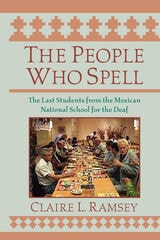
The People Who Spell
The Last Students from the Mexican National School for the DeafClaire L. Ramsey
Gallaudet University Press, 2011
The Escuela Nacional para Sordomudos (ENS), translated as the Mexican National School for the Deaf, opened its doors in the 1860s as part of the republic’s intention to educate its deaf people. The ENS did not use Lengua de Señas Mexicana (LSM), Mexico’s native sign language, for instruction, though they tolerated LSM use by the students. The school was closed permanently in 1972, thus leaving its former students still alive today as the last links to this historic institution. In this compelling social history, Claire L. Ramsey presents these unique Deaf Mexicans from their extraordinary experiences as ENS students and signers to their current personal lives.
One ENS signer, María de los Ángeles Bedolla, inspired the title of the book, The People Who Spell. In her account, she describes herself and her peers as cultured and educated compared to the young deaf people of today. The ENS signers pride themselves on el deletreo, LSM fingerspelling, which they consider key to their sophistication. Ramsey relates each of the signers’ childhoods, marriages, work experiences, and retirements. However, she brings threads of their stories together to reveal a common and abiding disappointment in modern-day Mexico’s failure to educate its deaf citizens according to the promise made more than 100 years ago. The narratives of the ENS signers detail their remarkable lives and heritage but also legitimately question the future of Mexico’s young deaf people.

The Power of Signed Songs
Deaf Artists, Intercultural Reach, and the Politics of Music MakingJoana Morêdo Pereira
Gallaudet University Press, 2026
The first of its kind, The Power of Signed Songs: Deaf Artists, Intercultural Reach, and the Politics of Music Making analyzes musical performances that were translated or created in signed languages. Written by an international team of Deaf community researchers, The Power of Signed Songs explores the politics of music making in the form of signed songs, an often controversial art form in Deaf communities.
While raising questions about culture, translation, and authorship, signed songs demonstrate forms of Deaf cultural resistance, defy traditional conceptions of music, and draw attention to language diversity and intersectionality within Deaf communities in varied European settings. Drawing on both signed music performances and field research, the authors highlight the unique contributions of signing musical artists from both the UK and Portugal. Signed songs and translations illustrate a wide range of creative performance strategies, linguistic word and sign play across languages, and sociolinguistic variation.
By analyzing how translated songs created by Deaf artists serve as cultural products, translations, and performance, The Power of Signed Songs provides a glimpse into how translations of music can be a form of both transnational and localized cultural resistance. Ultimately, Deaf-centered signed songs are not just artistic expressions but also political statements, challenging the idea that music belongs exclusively to the hearing world.

The Proper Way to Educate the Deaf
A Modern Annotated TranslationThe Abbé Charles-Michel de l’Epée
Gallaudet University Press, 2024
De l’Épée provides an anecdotal account of his methods and philosophy for educating deaf children using a sign system based on the French Sign Language of the era but adapted to visually represent the linguistic features of spoken and written French. His work laid the foundation for the use of the “manual method,” or sign language, in deaf education. One section of the text, originally published in Latin, outlines the intellectual clash between de l’Épée and Samuel Heinicke, an early proponent of oral education who contested the use of sign language.
De l’Épée’s text holds significant cultural and historical value for the fields of deaf studies and deaf education. This English language translation reveals de l’Épée’s own story of how he came to be known as the “father of the deaf” and is enriched by scholarly contributions that provide essential historical context and a framework for modern understanding.

The Role of the Educational Interpreter
Perceptions of Administrators and TeachersStephen B. Fitzmaurice
Gallaudet University Press, 2021
Through a series of qualitative interviews and quantitative questionnaires with district administrators, school administrators, general education teachers, and teachers of the deaf, Fitzmaurice documents their perceptions of educational interpreters. Findings from the data reveal the perceptions of administrators and teachers set the stage for role ambiguity, role conflicts, and subsequent role overload for educational interpreters. Fitzmaurice elaborates on the implications of the research, and also provides concrete recommendations for researchers and practitioners, including an emphasis on the importance of involving the Deaf community in this work. This volume aims to offer clarity on the role of the educational interpreter, and dispel the confusion and conflicts created by divergent perspectives. A shared understanding of the role of the educational interpreter will allow administrators, teachers, and interpreters to work collaboratively to improve educational outcomes for deaf students.

The Second International Symposium on Signed Language Interpretation and Translation Research
Selected PapersDanielle I. J. Hunt
Gallaudet University Press, 2020
Signed chapter summaries will be available on the Gallaudet University Press YouTube channel upon publication.
The Sociolinguistics of Ethiopian Sign Language
A Study of Language Use and AttitudesEyasu Hailu Tamene
Gallaudet University Press, 2017
Tamene collects data from three principal groups of people: deaf participants, teachers of deaf students, and parents of deaf children. He examines EthSL use within families, in formal and informal settings, and in various community spaces. He documents the awareness among different groups of the services available for deaf people, such as sign language interpreters and Deaf associations. He finds that members of the Deaf community show positive attitudes toward the use of EthSL and investigates the factors that impact those attitudes. His work indicates that there are still critical gaps in recognition and support for the use of EthSL, which can pose a threat to the vitality of the language. The Sociolinguistics of Ethiopian Sign Language will help to advance public understanding of EthSL and contribute to improved educational and social outcomes for the Deaf community in Ethiopia.

The Study of Signed Languages
Essays in Honor of William C. StokoeDavid F. Armstrong
Gallaudet University Press, 2002
In 1999, many of today’s notable researchers assembled at a special conference in honor of William C. Stokoe to explore the remarkable research that grew out of his original insights on American Sign Language. The Study of Signed Languages presents the fascinating findings from that conference.
Part 1, Historical Perspectives, begins with a description of the decline of sign language studies in the 1800s. Past research on signed languages and its relationship to language origins theory follows, along with a consideration of modality and conflicting agendas for its study.
In Part 2, Language Origins, the first entry intrigues with the possibility that sign language could answer conundrums posed by Noam Chomsky’s linguistic theories. The next essay considers how to build a better language model by citing continuity, ethology, and Stokoe’s work as key elements. Stokoe’s own research on the gestural theory of language origins is examined in the section’s closing chapter.
Part 3, Diverse Populations, delineates the impact of sign language research on black deaf communities in America, on deaf education, on research into variation in sign language, and even on sign communication and the motor functioning of autistic children and others. In its wide-ranging, brilliant scholarship, The Study of Signed Languages serves as a fitting tribute to William C. Stokoe and his work.

Theoretical Issues in Sign Language Research, Volume 1
LinguisticsEdited by Susan D. Fischer and Patricia Siple
University of Chicago Press, 1990
Edited by Susan Fischer and Patricia Siple, this collection is divided into four sections, reflecting the traditional core areas of phonology, morphology, syntax, and semantics. Although most of the contributions consider American Sign Language (ASL), five treat sign languages unrelated to ASL, offering valuable perspectives on sign universals. Since some of these languages or systems are only recently established, they provide a window onto the evolution and growth of sign languages.
Theoretical Issues in Sign Language Research, Volume 2
PsychologyEdited by Patricia Siple and Susan D. Fischer
University of Chicago Press, 1991
This collection, edited by Patricia Siple and Susan D. Fischer, brings together theoretically important contributions from both basic research and applied settings. The studies include native sign language acquisition; acquisition and processing of sign language through a single mode under widely varying conditions; acquisition and processing of bimodal (speech and sign) input; and the use of sign language with atypical, autistic, and mentally retarded groups.
All the chapters in this collection of state-of-the-art research address one or more issues related to universality of language processes, language plasticity, and the relative contributions of biology and input to language acquisition and use.
To the Lexicon and Beyond
Sociolinguistics in European Deaf CommunitiesMieke Van Herreweghe
Gallaudet University Press, 2004
Volume 10 of the series explores sociolinguistics in various European Deaf communities. Editors Van Herreweghe and Vermeerbergen present a wide array of research inspired by the Sociolinguistics Symposium 14 held at Ghent University, Belgium, in April 2002. Noted contributors from Finland, Belgium, Ireland, the Netherlands, Germany, Sweden, Spain and the United Kingdom offer insights gleaned from the languages of their countries.
Part One of this five-part volume investigates multilingualism and language contact among Finland-Swedish Deaf People. Part Two looks at regional variation and the evolution of signs in Flemish Sign Language, as well as gender-influenced variation in Irish Sign Language. Language policy and planning receives consideration in the third part, with a study of sign language lexical variation in the Netherlands and an analysis of the risks of codification in Flemish Sign Language. Part Four examines the implementation of bilingual programs for deaf students throughout Europe, and updates research on language use visually oriented in Swedish Deaf education classrooms.
The final part of To the Lexicon and Beyond: Sociolinguistics in European Deaf Communities presents data on language attitudes, including a census of sign language users in Spain that reveal a changing language community. The last chapter of this fascinating assembly assays British Deaf communities and language identity in relation to issues of transnationality in the 21st century.
Total Communication
Structure and StrategyLionel Evans
Gallaudet University Press, 1982
Toward a Deaf Translation Norm
Christopher A. Stone
Gallaudet University Press, 2009
As access to deaf people grows around the world, a new profession has begun to emerge as well, that of Deaf translators and interpreters (T/Is). In his new study Toward a Deaf Translation Norm, Christopher Stone explores this innovation, including its antecedents and how it is manifested in public places. Most importantly, Stone investigates whether or not a translation norm has evolved for Deaf T/Is as increasing numbers of them work in the mainstream translating for websites, public services, government literature, and television media.
For his study, the sixth volume in the Studies in Interpretation series, Stone concentrated his research in the United Kingdom. Specifically, he examined the rendering of English broadcast television news into British Sign Language (BSL) by both Deaf and hearing T/Is. Segments of the data feature simultaneous Deaf and hearing in-vision T/I broadcasts. Recording these broadcasts produced a controlled product that enabled direct comparison of the Deaf and hearing T/Is. Close analysis of these examples revealed to Stone that Deaf T/s not only employ a Deaf translation norm, they take labors to shape their BSL text into a stand-alone product rather than a translation. Ultimately, Toward a Deaf Translation Norm opens up engrossing new vistas on current deliberation about neutrality in translation and interpretation.
Translation, Sociolinguistic, and Consumer Issues in Interpreting
Melanie Metzger
Gallaudet University Press, 2007
The Third Volume in the Studies in Interpretation Series
This new volume focuses on scholarship over a refined spectrum of issues that confront interpreters internationally. Editors Melanie Metzger and Earl Fleetwood call upon researchers from the United States, Ireland, Australia, and the Philippines to share their findings in six chapters.
In the first chapter, Roberto R. Santiago and Lisa A. Frey Barrick reveal how interpreters deal with translating source language idioms into American Sign Language (ASL). In Chapter 2, Lorraine Neeson and Susan Foley-Cave review the particular demands for decision-making that face interpreters on several levels in a class on semantics and pragmatics. Liza B. Martinez explains in Chapter 3 the complicated, multilingual process of code switching by Filipino interpreters when voice-interpreting Filipino Sign Language.
Chapter 4 offers a deconstruction by Daniel Roush of the stereotype that Deaf ASL-users are direct or blunt, based on his analysis of two speech/social activities of requests and refusals. Jemina Napier investigates interpreting from the perspective of deaf consumers in Australia in Chapter 5 to explore their agenda for quality interpreting services. In the final chapter, Amy Frasu evaluates methods for incorporating visual aids into interpretations from spoken English to American Sign Language and the potential cognitive dissonance for deaf persons that could result.
Turn-Taking, Fingerspelling, and Contact in Signed Languages
Ceil Lucas
Gallaudet University Press, 2002