Results by title
22279 books match the query 'Social Science' and 4007 start with t
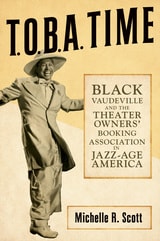
T.O.B.A. Time
Black Vaudeville and the Theater Owners’ Booking Association in Jazz-Age AmericaMichelle R. Scott
University of Illinois Press, 2023
Michelle R. Scott’s institutional history details T.O.B.A.’s origins and practices while telling the little-known stories of the managers, producers, performers, and audience members involved in the circuit. Looking at the organization over its eleven-year existence (1920–1931), Scott places T.O.B.A. against the backdrop of what entrepreneurship and business development meant in black America at the time. Scott also highlights how intellectuals debated the social, economic, and political significance of black entertainment from the early 1900s through T.O.B.A.’s decline during the Great Depression.
Clear-eyed and comprehensive, T.O.B.A. Time is a fascinating account of black entertainment and black business during a formative era.
T?he Commons
Economic Alternatives in the Digital AgeVangelis Papadimitropoulos
University of Westminster Press, 2020
This book explores the potential creation of a broader collaborative economy through commons-based peer production (P2P) and the emergent role of information and communication technologies (ICTs). The book seeks to critically engage in the political discussion of commons-based peer production, which can be classified into three basic arguments: the liberal, the reformist and the anti-capitalist. This book categorises the liberal argument as being in favour of the coexistence of the commons with the market and the state. Reformists, on the other hand, advocate for the gradual adjustment of the state and of capitalism to the commons, while anti-capitalists situate the commons against capitalism and the state. By discussing these three viewpoints, the book contributes to contemporary debates concerning the future of commons-based peer production.
Further, the author argues that for the commons to become a fully operational mode of peer production, it needs to reach critical mass arguing that the liberal argument underestimates the reformist insight that technology has the potential to decentralise production, thereby forcing capitalism to transition to post-capitalism. Surveying the three main strands of commons-based peer production, this book makes the case for a post-capitalist commons-orientated transition that moves beyond neoliberalism.
TASTE
Andrea Pavoni, Danilo Mandic, Caterina Nirta and Andreas Philippopoulos-Mihalopoulos
University of Westminster Press, 2018

THE ECONOMICS OF FANTASY
RAPE IN TWENTIETH-CENTURY LITERATURESharon Stockton
The Ohio State University Press, 2006
It is important to make clear that the genre of rape story studied here presumes a white masculine subject and a white feminine object. Stockton makes the case that the aestheticized rape narrative reveals particular things about the way white masculinity represents itself. Plotting violent sexual fantasy on the grid of economic concerns locates masculine agency in relation to an explicitly contingent material system of power, value, and order. It is in this way that The Economics of Fantasy discloses the increased desperation with which the body has been made to carry ideology under systems of advanced capitalism.

TRANS(per)FORMING Nina Arsenault
An Unreasonable Body of WorkEdited by Judith Rudakoff
Intellect Books, 2012
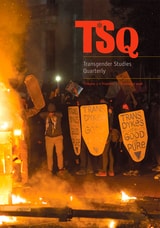
TSQ
Transgender Studies Quarterly (5:1)Paisley Currah and Susan Stryker, special issue editors
Duke University Press, 0

TSQ
Transgender Studies Quarterly (6:1)Paisley Currah and Susan Stryker, special issue editors
Duke University Press, 0

TV Family Values
Gender, Domestic Labor, and 1980s SitcomsAlice Leppert
Rutgers University Press, 2019
TV Format Mogul
Reg Grundy's Transnational CareerAlbert Moran
Intellect Books, 1995
Since the late 1990s, when broadcasters began adapting such television shows as Big Brother, Survivor, and Who Wants to Be a Millionaire? for markets around the world, the global television industry has been struggling to come to grips with the prevalence of program franchising across international borders. In TV Format Mogul, Albert Moran traces the history of this phenomenon through the lens of Australian producer Reg Grundy’s transnational career.
Program copycatting, Moran shows, began long before its most recent rise to prominence. Indeed, he reveals that the practice of cultural and commercial cloning from one place to another, and one time to another, has occurred since the early days of broadcasting. Beginning in the late 1950s, Grundy brought non-Australian shows to Australian audiences, becoming the first person to take local productions to an overseas market. By following Grundy’s career, Moran shows how adaptation and remaking became the billion-dollar business they are today. An exciting new contribution from Australia’s foremost scholar of television, TV Format Mogul will be a definitive history of program franchising.
TV Formats Worldwide
Localizing Global ProgramsEdited by Albert Moran
Intellect Books, 2009
Beginning around 2003, the growth of interest in the genre of reality shows has dominated the field of television studies. However, concentrating on this genre has tended to sideline the even more significant emergence of the program format as a central mode of business and culture in the new television landscape. TV Formats Worldwide redresses this balance and heralds the emergence of an important, exciting, and challenging area of television studies. Topics explored include reality TV, makeover programs, sitcoms, talent shows, and fiction serials, as well as broadcaster management policies, production decision chains, and audience participation processes. This seminal work will be of considerable interest to media scholars worldwide.
TV Museum
Contemporary Art and the Age of TelevisionMaeve Connolly
Intellect Books, 2014
Lavishly illustrated and with in-depth discussion of over fifty canonical and contemporary artworks, TV Museum offers a new approach to the analysis of television’s place within contemporary art and culture.

TV Violence and the Child
Evolution and Fate of the Surgeon General's ReportDouglass Cater
Russell Sage Foundation, 1975
Table Talk
Building Democracy One Meal at a TimeJanet A. Flammang
University of Illinois Press, 2016
The civic virtues of a seat at the table
Etiquette books insist that we never discuss politics during a meal. In Table Talk, Janet A. Flammang offers a polite rebuttal, presenting vivid firsthand accounts of people's lives at the table to show how mealtimes can teach us the conversational give-and-take foundational to democracy. Delving into the ground rules about listening, sharing, and respect that we obey when we break bread, Flammang shows how conversations and table activities represent occasions for developing our civil selves. If there are cultural differences over practices--who should speak, what behavior is acceptable, what topics are off limits, how to resolve conflict--our exposure to the making, enforcement, and breaking of these rules offers a daily dose of political awareness and growth. Political table talk provides a forum to practice the conversational skills upon which civil society depends. It also ignites the feelings of respect, trust, and empathy that undergird the idea of a common good that is fundamental to the democratic process.
Tabloid Culture
Trash Taste, Popular Power, and the Transformation of American TelevisionKevin Glynn
Duke University Press, 2000
Glynn begins by situating these media shifts within the context of Reaganism, which gave rise to distinctive ideological currents in society and led the socially and economically disenfranchised to access new forms of information via the exploding television industry. He then tackles specific daytime talk shows and tabloid newscasts such as Jerry Springer and A Current Affair, reality-TV programs such as Cops and America’s Most Wanted, and two different supermarket tabloids’ coverage of the O.J. Simpson case. Tabloid Culture is the first book to treat these diverse yet related media forms and events in tandem. Rejecting the elitist dismissal of sensationalist media, Glynn instead traces the cultural currents and countercurrents running through their forms and products. Locating both reactionary and oppositional meanings in these texts, he demonstrates how these particular media genres draw on and contribute to important cultural struggles over the meanings of race, sexuality, gender, class, “normality,” “truth,” and “reality.” The study ends by discussing how the growing use of the Internet provides an entirely new realm in which such material can circulate, distort, inform, and flourish.
This innovative and provocative study of contemporary mainstream media culture in the United States will be valuable to those interested in both print and television media, the cultural-political influence of the Reagan era, and American culture in general.
Taboo
Boyer Rickel
University of Wisconsin Press, 1999
An impressionistic memoir offers images of a life in progress, including scenes from Boyer Rickel’s rural Tempe, Arizona, childhood in the 1950s; his relationship with a physically shrinking father; his eccentric teenage friendships; his growing awareness of his sexuality among young, Hispanic gays; and a trip through Italy with his lover. A personal book, but also wholly universal, Taboo investigates the way one breaks through taboos and becomes a self-realized adult.
Taboo Memories, Diasporic Voices
Ella Shohat
Duke University Press, 2006
Shohat’s critical method boldly transcends disciplinary and geographical boundaries. She explores such issues as the relations between ethnic studies and area studies, the paradoxical repercussions for audio-visual media of the “graven images” taboo, the allegorization of race through the refiguring of Cleopatra, the allure of imperial popular culture, and the gender politics of medical technologies. She also examines the resistant poetics of exile and displacement; the staging of historical memory through the commemorations of the two 1492s, the anomalies of the “national” in Zionist discourse, the implications of the hyphen in the concept “Arab-Jew,” and the translation of the debates on orientalism and postcolonialism across geographies. Taboo Memories, Diasporic Voices not only illuminates many of the concerns that have animated the study of cultural politics over the past two decades; it also points toward new scholarly possibilities.

Taboo Subjects
Race, Sex, and PsychoanalysisGwen Bergner
University of Minnesota Press, 2005

Tacit Racism
Anne Warfield Rawls and Waverly Duck
University of Chicago Press, 2020
Every time we interact with another human being, we unconsciously draw on a set of expectations to guide us through the encounter. What many of us in the United States—especially white people—do not recognize is that centuries of institutional racism have inescapably molded those expectations. This leads us to act with implicit biases that can shape everything from how we greet our neighbors to whether we take a second look at a resume. This is tacit racism, and it is one of the most pernicious threats to our nation.
In Tacit Racism, Anne Warfield Rawls and Waverly Duck illustrate the many ways in which racism is coded into the everyday social expectations of Americans, in what they call Interaction Orders of Race. They argue that these interactions can produce racial inequality, whether the people involved are aware of it or not, and that by overlooking tacit racism in favor of the fiction of a “color-blind” nation, we are harming not only our society’s most disadvantaged—but endangering the society itself.
Ultimately, by exposing this legacy of racism in ordinary social interactions, Rawls and Duck hope to stop us from merely pretending we are a democratic society and show us how we can truly become one.

Tacit Subjects
Belonging and Same-Sex Desire among Dominican Immigrant MenCarlos Ulises Decena
Duke University Press, 2011
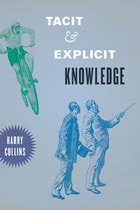
Tacit and Explicit Knowledge
Harry Collins
University of Chicago Press, 2010
Much of what humans know we cannot say. And much of what we do we cannot describe. For example, how do we know how to ride a bike when we can’t explain how we do it? Abilities like this were called “tacit knowledge” by physical chemist and philosopher Michael Polanyi, but here Harry Collins analyzes the term, and the behavior, in much greater detail, often departing from Polanyi’s treatment.
In Tacit and Explicit Knowledge, Collins develops a common conceptual language to bridge the concept’s disparate domains by explaining explicit knowledge and classifying tacit knowledge. Collins then teases apart the three very different meanings, which, until now, all fell under the umbrella of Polanyi’s term: relational tacit knowledge (things we could describe in principle if someone put effort into describing them), somatic tacit knowledge (things our bodies can do but we cannot describe how, like balancing on a bike), and collective tacit knowledge (knowledge we draw that is the property of society, such as the rules for language). Thus, bicycle riding consists of some somatic tacit knowledge and some collective tacit knowledge, such as the knowledge that allows us to navigate in traffic. The intermixing of the three kinds of tacit knowledge has led to confusion in the past; Collins’s book will at last unravel the complexities of the idea.
Tacit knowledge drives everything from language, science, education, and management to sport, bicycle riding, art, and our interaction with technology. In Collins’s able hands, it also functions at last as a framework for understanding human behavior in a range of disciplines.
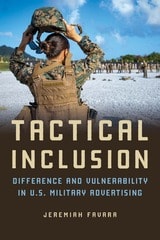
Tactical Inclusion
Difference and Vulnerability in U.S. Military AdvertisingJeremiah Favara
University of Illinois Press, 2024
Compelling and eye-opening, Tactical Inclusion combines original analysis with personal experience to chart advertising’s role in building the all-volunteer military.

Tactical Media
Rita Raley
University of Minnesota Press, 2009
In Tactical Media, Rita Raley provides a critical exploration of the new media art activism that has emerged out of, and in direct response to, postindustrialism and neoliberal globalization. Through close readings of projects by the DoEAT group, the Critical Art Ensemble, Electronic Civil Disobedience, and other tactical media groups, she articulates their divergent methods and goals and locates a virtuosity that is also boldly political. Contemporary models of resistance and dissent, she finds, mimic the decentralized and virtual operations of global capital and the post-9/11 security state to exploit and undermine the system from within.
Emphasizing the profound shift from strategy to tactics that informs new media art-activism, Raley assesses the efficacy of its symbolic performances, gamings, visualizations, and hacks. With its cogent analyses of new media art and their social impact, Tactical Media makes a timely and much needed contribution to wider debates about political activism, contemporary art, and digital technology.

Tactics of the Human
Experimental Technics in American FictionLaura Shackelford
University of Michigan Press, 2015
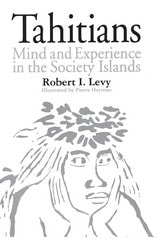
Tahitians
Mind and Experience in the Society IslandsRobert I. Levy llustrated by Pierre Heyman
University of Chicago Press, 1973
"This is a unique addition to anthropological literature. . . . No review could substitute for reading it."—Margaret Mead, American Anthropologist
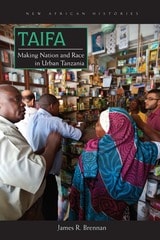
Taifa
Making Nation and Race in Urban TanzaniaJames R. Brennan
Ohio University Press, 2012
Taifa is a story of African intellectual agency, but it is also an account of how nation and race emerged out of the legal, social, and economic histories in one major city, Dar es Salaam. Nation and race—both translatable as taifa in Swahili—were not simply universal ideas brought to Africa by European colonizers, as previous studies assume. They were instead categories crafted by local African thinkers to make sense of deep inequalities, particularly those between local Africans and Indian immigrants. Taifa shows how nation and race became the key political categories to guide colonial and postcolonial life in this African city.
Using deeply researched archival and oral evidence, Taifa transforms our understanding of urban history and shows how concerns about access to credit and housing became intertwined with changing conceptions of nation and nationhood. Taifa gives equal attention to both Indians and Africans; in doing so, it demonstrates the significance of political and economic connections between coastal East Africa and India during the era of British colonialism, and illustrates how the project of racial nationalism largely severed these connections by the 1970s.

Take Me to My Paradise
Tourism and Nationalism in the British Virgin IslandsCohen, Colleen B
Rutgers University Press, 2010
Interweaving more than twenty years of field notes, Cohen provides a firsthand analysis of how tourism transformed the BVI from a small neglected British colony to a modern nation that competes in a global economic market. With its close reading of everything from advertisements to political manifestos and constitutional reforms, Take Me to My Paradise deepens our understanding of how nationalism develops hand-in-hand with tourism, and documents the uneven impact of economic prosperity upon different populations. We hear multiple voices, including immigrants working in a tourism economy, nationalists struggling to maintain some control, and the anthropologist trying to make sense of it all. The result is a richly detailed and accessible ethnography on the impact of tourism on a country that came into being as a tourist destination.

Take Two
Adapting the Contemporary American Novel to FilmBarbara Tepa Lupack
University of Wisconsin Press, 1994
Different in its complexities from the classic novels of Dickens, London, and Tolstoy to which earlier filmmakers turned, the contemporary American novel poses a real challenge to the filmmaker, who must translate its occasionally unfilmable essence for a new audience. Take Two closely analyzes the adaptations of ten such works: Catch-22, One Flew over the Cuckoo's Nest, Slaughterhouse-Five, Being There, The World According to Garp, Sophie’s Choice, The Color Purple, Ironweed, Tough Guys Don't Dance, and Billy Bathgate.
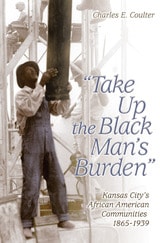
Take Up the Black Man's Burden
Kansas City's African American Communities, 1865-1939Charles E. Coulter
University of Missouri Press, 2006
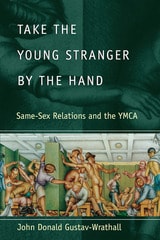
Take the Young Stranger by the Hand
Same-Sex Relations and the YMCAJohn Donald Gustav-Wrathall
University of Chicago Press, 1998
"Gustav-Wrathall's book offers an in-depth history of the origins and purposes of the Young Men's Christian Association and how it evolved into—and out of—a gay playland."—Arnie Kantrowitz, Lambda Book Report
"The book's absorbing exploration of the sometimes schismatic, sometimes synergistic relationship between spirituality and sexuality is a fascinating addition to the growing body of social history."—Jim Van Buskirk, San Francisco Bay Guardian

Taking Chances
The Coast after Hurricane SandyO'Neill, Karen M.
Rutgers University Press, 2016
Taking Her Seriously
Penelope and the Plot of Homer's OdysseyRichard Heitman
University of Michigan Press, 2005
---Choice
---Bryn Mawr Classical Review

Taking It to the Streets
The Social Protest Theater of Luis Valdez and Amiri BarakaHarry J. Elam, Jr.
University of Michigan Press, 2001
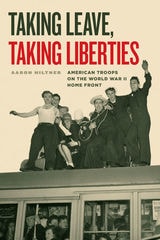
Taking Leave, Taking Liberties
American Troops on the World War II Home FrontAaron Hiltner
University of Chicago Press, 2020
With unsettling clarity, Aaron Hiltner reveals what American troops really did on the home front. While GIs are imagined to have spent much of the war in Europe or the Pacific, before the run-up to D-Day in the spring of 1944 as many as 75% of soldiers were stationed in US port cities, including more than three million who moved through New York City. In these cities, largely uncontrolled soldiers sought and found alcohol and sex, and the civilians living there—women in particular—were not safe from the violence fomented by these de facto occupying armies. Troops brought their pocketbooks and demand for “dangerous fun” to both red-light districts and city centers, creating a new geography of vice that challenged local police, politicians, and civilians. Military authorities, focused above all else on the war effort, invoked written and unwritten legal codes to grant troops near immunity to civil policing and prosecution.
The dangerous reality of life on the home front was well known at the time—even if it has subsequently been buried beneath nostalgia for the “greatest generation.” Drawing on previously unseen military archival records, Hiltner recovers a mostly forgotten chapter of World War II history, demonstrating that the war’s ill effects were felt all over—including by those supposedly safe back home.
Taking Liberties
Gender, Transgressive Patriotism, and Polish Drama, 1786–1989Halina Filipowicz
Ohio University Press, 2014
As narrow, nationalist views of patriotic allegiance have become widespread and are routinely invoked to justify everything from flag-waving triumphalism to xenophobic bigotry, the concept of a nonnationalist patriotism has vanished from public conversation. Taking Liberties is a study of what may be called patriotism without borders: a nonnational form of loyalty compatible with the universal principles and practices of democracy and human rights, respectful of ethnic and cultural diversity, and, overall, open-minded and inclusive.
Moving beyond a traditional study of Polish dramatic literature, Halina Filipowicz turns to the plays themselves and to archival materials, ranging from parliamentary speeches to polemical pamphlets and verse broadsides, to explore the cultural phenomenon of transgressive patriotism and its implications for society in the twenty-first century.
In addition to recovering lost or forgotten materials, the author builds an innovative conceptual and methodological framework to make sense of those materials. The result is not only a significant contribution to the debate over the meaning and practice of patriotism, but a masterful intellectual history.
Taking Off the White Gloves
Southern Women and Women HistoriansEdited & Intro by Michele Gillespie & Catherine Clinton
University of Missouri Press, 1998
When southern women remove their gloves, they speak their minds. The ten timely and provocative essays in Taking Off the White Gloves represent the collective wisdom of some of the finest scholars on women's history in the American South. On the eve of the thirtieth anniversary of the Southern Association for Women Historians, this volume brings together some of the outstanding lectures delivered by distinguished members of the association over the past fifteen years.
Spanning four centuries of women's experiences in the South, the topics featured in Taking Off the White Gloves range from Native American sexuality and European conquest to woman suffrage in the South, from black women's protest history to the status of women in the historical profession at the end of the twentieth century.
Despite diverse subject matter, these rich essays share a number of important qualities. They take an integrative approach, combining literary analysis, social history, cultural interpretation, labor history, popular culture, and oral history. Embracing the distinctiveness of the southern past and women's experiences within that past, they also recognize the inextricability of critical categories such as sexuality and gender, race and gender, and women and work. Finally, these essays emphasize the authors' commitment to the belief that the personal is political; they reveal the subtle and not so subtle ways that women transform theory into practice.
Taking Off the White Gloves invites a new understanding of the complexities that surround the history of southern women across race, class, place, and time. A model of innovative and imaginative scholarly historical writing, this book provides fertile ground for young scholars and is sure to inspire new research. This thought- provoking volume has much to offer scholars and students, as well as the general reader.
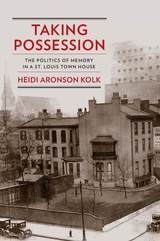
Taking Possession
The Politics of Memory in a St. Louis Town HouseHeidi Aronson Kolk
University of Massachusetts Press, 2019
In Taking Possession, Heidi Aronson Kolk explores the complex and sometimes contradictory motivations for safeguarding the house as a site of public memory. Crafting narratives about the past that comforted business elites and white middle-class patrons, museum promoters assuaged concerns about the city's most pressing problems, including racial and economic inequality, segregation and privatization, and the legacies of violence for which St. Louis has been known since Ferguson. Kolk's case study illuminates the processes by which civic pride and cultural solidarity have been manufactured in a fragmented and turbulent city, showing how closely linked are acts of memory and forgetting, nostalgia and shame.
Taking Society's Measure
A Personal History of Survey ResearchHerbert Hyman
Russell Sage Foundation, 1991

Taking Stock of Homicide
Trends, Emerging Themes, and Research ChallengesEdited by Karen F. Parker, Richard Stansfield, and Ashley M. Mancik
Temple University Press, 2024
Featuring leading scholars, this volume is organized around key themes and areas that reflect major contemporary trends and patterns in criminological literature. Chapters consider fundamentals such as data collection, sources, and histories; structural dynamics, including methodologies and fieldwork plus factors involving race and public health; the circumstances, types, and variations in homicide, from intimate partner violence to gangs, drugs, and firearms; as well as the prevention of and responses to homicide.
An essential state-of-the-discipline examination, Taking Stock of Homicide expands our knowledge while offering a toolkit for how to conduct future research on this serious, violent crime.
Contributors: Mark Berg, Laura Boisten, Anthony Braga, Fiona Brookman, Shytierra Gaston, Veronica Valencia Gonzalez, Elizabeth Griffiths, Chris Guerra, John Hipp, John Jarvis, Helen Jones, Sharon Jones-Eversley, Jungmyung Kim, Kenneth Land, Marieke Liem, Michael Light, Xiaoshuang Iris Luo, Amy Magnus, Patricia McCall, Erin Orrick, Alex Piquero, William Pridemore, David Pyrooz, Arnaldo Rabolini, Kasey Ragan, Wendy Regoeczi, Johnny Rice II, Jacqueline Rhoden-Trader, Ethan Rogers, Meghan Rodgers, Randolph Roth, Jose Antonio Sanchez, Daniel Semenza, James Tuttle, Jolien van Breen, Kirk Williams, and the editors
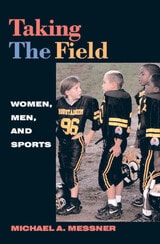
Taking The Field
Women, Men, and SportsMichael A. Messner
University of Minnesota Press, 2002
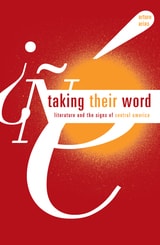
Taking Their Word
Literature and the Signs of Central AmericaArturo Arias
University of Minnesota Press, 2007
Central Americans are one of the largest Latino population groups in the United States. Yet, Arturo Arias argues, the cultural production of Central Americans remains little known to North Americans.
In Taking Their Word, Arias complicates notions of the cultural production of Central America, from Mexico in the North to Panama in the South. He charts the literature of Central America’s liberation struggles of the 1970s and 1980s, its transformation after peace treaties were signed, the emergence of a new Maya literature that decenters Latin American literature written in Spanish, and the rise and fall of testimonio. Arias demonstrates that Central America and its literature are marked by an indigenousness that has never before been fully theorized or critically grasped. Never one to avoid controversy, Arias proffers his views of how the immigration of Central Americans to North America has changed the cultural topography of both zones.
With this groundbreaking work, Arias establishes the importance of Central American literature and provides a frame for future studies of the region’s culture.
Arturo Arias is director of Latin American studies at the University of Redlands. He is the author of six novels in Spanish and editor of The Rigoberta Menchú Controversy (Minnesota, 2001).

Taking Time
Mindy Fried
Temple University Press, 1998
This timely book provides an inside look at life in a major U.S. corporation, focusing on the impact of workplace culture on the use of parental leave and those who use it. Fried begins by describing why parental leave is critical to making parenting the job of both parents in two-parent families. She examines the varied experiences of different levels of workers in how parental leave policy is used.
The author tells a rich and textured tale of day-to-day life in the skyscraper offices of a large corporation. How people dress, what their offices look like, which cafeteria they eat in, how the supervisors and supervised talk -- all these things are part of the fabric of corporate culture that Fried describes.
Most of us live in work cultures that value overtime. Fried argues that, as a "time policy" parental leave clashes with the powerful norm that corporate employees must work long and hard. Taking time for parenting -- a job that is devalued in our culture -- may be perceived as "taking time away" from the company, and, in particular, from the company's productivity.
Taking Up McLuhan's Cause
Perspectives on Media and Formal CausalityEdited by Corey Anton, Robert K. Logan, and Lance Strate
Intellect Books, 2017

Taking the Heat
Women Chefs and Gender Inequality in the Professional KitchenHarris, Deborah A
Rutgers University Press, 2015
Click here to access the Taking the Heat teaching guide (https://d3tto5i5w9ogdd.cloudfront.net/wp-content/uploads/2021/09/02142601/Taking-the-Heat-Questions-for-Instructors.docx).
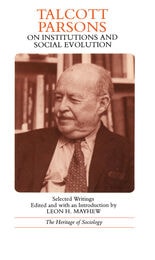
Talcott Parsons on Institutions and Social Evolution
Selected WritingsTalcott Parsons
University of Chicago Press, 1983
In his extensive introduction to this volume, Leon H. Mayhew brings a new focus and clarity to Talcott Parsons's work. Explicating Parsons on his own terms, Mayhew discusses the basic tools of Parsonian analysis and interprets the larger themes of his work. He provides a chronological account of the development of Parsons's thought, his presuppositions, and his position on the ideological spectrum of social thought.
Mayhew then presents twenty of Parsons's essays, touching on each of the major aspects of his work, including "action" theory and the celebrated four-function scheme. Other topics covered include the role of theory in social research, evolutionary universals in society, influence, control, and the mass media.
"Talcott Parsons on Institutions and Social Evolution will become a standard reference for those studying that development of his sociological ideas."—Martin Bulmer, The Times Higher Education Supplement

Tales From the Field
The Adventures of an ArchaeologistDr. Richard W. Redding, edited by Alexis Redding
Michigan Publishing Services, 2026
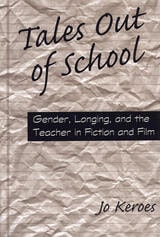
Tales Out of School
Gender, Longing, and the Teacher in Fiction and FilmJo Keroes
Southern Illinois University Press, 1999
Jo Keroes's scope is wide: she examines the teacher as represented in fiction and film in works ranging from the twelfth-century letters of Abelard and Heloise to contemporary films such as Dangerous Minds and Educating Rita. And from the twelfth through the twentieth century, Keroes shows, the teaching encounter is essentially erotic.
Tracing the roots of eros from cultural as well as psychological perspectives, Keroes defines erotic in terms broader than the merely sexual. She analyzes ways in which teachers serve as convenient figures on whom to map conflicts about gender, power, and desire. To show how portrayals of men and women differ, she examines pairs of texts, using a film or a novel with a woman protagonist (Up the Down Staircase, for example) as counterpoint to one featuring a male teacher (Blackboard Jungle) or The Prime of Miss Jean Brodie balanced against Dead Poets Society.
The portrayals of teachers, like all images a culture presents of itself, reveal much about our private and social selves. Keroes points out authentic accounts of authoritative women teachers who are admired and respected by colleagues and students alike. Real teachers differ from the stereotypes we see in fiction and film, however. Male teachers are often portrayed as heroes in film and fallibly human in fiction, whereas women in either genre are likely to be monstrous or muddled and are virtually never women of color. Among other things, Keroes demonstrates, the tension between reality and representation reveals society's ambivalence about power in the hands of women.
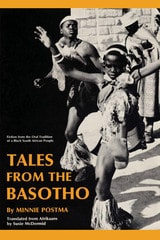
Tales from the Basotho
By Minnie Postma
University of Texas Press, 1974
"They say that the eldest of the chief's daughters..." So begins a tale from the Basotho, unfolded by the meager light of a dung fire that burns smokily behind the reed screen sheltering the entrance of the hut. The old ones of the tribe wait until dark before telling their stories, for everyone knows horns will grow from the head of one who tells a story during daylight hours. Tales from the Basotho abounds with elements familiar to folk narrative. The heroes and heroines are the chiefs and their wives, their sons and their daughters. Fantastic creatures frequent the narratives. exhibiting their awful powers.
Rustic peace and beauty pervade the stories, as Minnie Postma amply demonstrates in her versions of the tales. Something fearful may be occurring—the dreaded Koeoko pulling the only son of the chief under water—but, at the same time, girls with babies tied to their backs are searching for edible bulbs in the veld, and an old woman dreams in the gentle sunlight in front of the huts.
These tales from the Basotho are for entertainment only. There is a tabu against telling tales while the sun shines, because daylight hours must be saved for work. The telling itself is the· reason the story exists, for the audience is already aware of the outcome of each tale. As Wm. Hugh Jansen emphasizes in his foreword, "text" and "context" are often easily interpreted and made accessible in a translation, but Tales from the Basotho is ultimately successful for its rendering of "texture." And texture is doubly hard to convey when the telling itself is of primary importance. Minnie Postma and Susie McDermid have transferred the art of the Basotho raconteur onto the printed page. All the simple, understandable formulas, exclamations, and repetitions used so skillfully by the native storyteller are present. Rhythm is an important element in the tales, and a word, a phrase, even a whole paragraph will be repeated until the rhythm satisfies the storyteller, in tum increasing the appreciation of the listeners.
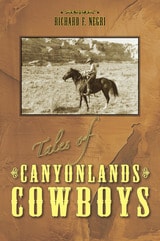
Tales of Canyonlands Cowboys
Richard Negri
Utah State University Press, 1997
Before Canyonlands was a national park, before tourists discovered the wildness and wonder of the Maze and the Land of Standing Rocks, before the San Rafael Desert became a hive of the mineral exploration, the lands west of the Colorado and Green Rivers to the San Rafael Swell and from the Book Cliffs and San Rafael River south to the dirty Devil River and the Henry Mountains were pastures for the stock of hardscrabble cowboys and sheep ranchers.
Often based in the nearby villages of Green River or Hanksville, sometimes residing on remote ranches, such as the famous Robbers Roost Ranch or the Chaffin Ranch at the mouth of the San Rafael, the cowboys and ranchers spent much of their time camped out on the range with their stock. They herded under the Ledge, along the river south across Elaterite Basin, Ernie Country, and Waterhole Flat, and above on the flats, mesas, and head canyons running from the west.
They named many of the places, opened many of the trails, and were there to meet and guide the first petroleum explorers, archaeologists, and tourists. And they bristled at government management of the public lands, which they had grown accustomed to considering their own.
Richard Negri interviewed members of the last generation of those cowboys for stories of their early days in canyon country. Their tales provide an oral history of the first non-Indians to roam and reside in the Maze District of Canyonlands National Park and much of the surrounding wild and remote country.
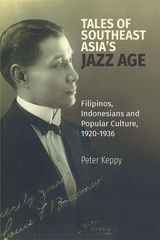
Tales of Southeast Asia’s Jazz Age
Filipinos, Indonesians and Popular Culture, 1920-1936Peter Keppy
National University of Singapore Press, 2019
This artistic era was marked by experimentation and adaption, and this was reflected in both Borromeo’s and Riboet’s styles. They were pioneering cultural brokers who dealt in hybrids. They were adept at combining high art and banal entertainment, tradition and modernity, and the foreign and the local.
Leaning on cultural studies and the work on cosmopolitanism and modernity by Henry Jenkins and Joel Kahn, Peter Keppy examines pop culture at this time as a contradictory social phenomenon. He challenges notions of Southeast Asia’s popular culture as lowbrow entertainment created by elites and commerce to manipulate the masses, arguing instead that audiences seized on this popular culture to channel emancipatory activities, to articulate social critique, and to propagate an inclusive nationalism without being radically anticolonial.

Tales of Times Now Past
Sixty-Two Stories from a Medieval Japanese CollectionMarian Ury
University of Michigan Press, 1993