Results by title
3027 books match the query 'Sociology' and 538 start with t
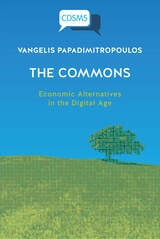
T?he Commons
Economic Alternatives in the Digital AgeVangelis Papadimitropoulos
University of Westminster Press, 2020
This book explores the potential creation of a broader collaborative economy through commons-based peer production (P2P) and the emergent role of information and communication technologies (ICTs). The book seeks to critically engage in the political discussion of commons-based peer production, which can be classified into three basic arguments: the liberal, the reformist and the anti-capitalist. This book categorises the liberal argument as being in favour of the coexistence of the commons with the market and the state. Reformists, on the other hand, advocate for the gradual adjustment of the state and of capitalism to the commons, while anti-capitalists situate the commons against capitalism and the state. By discussing these three viewpoints, the book contributes to contemporary debates concerning the future of commons-based peer production.
Further, the author argues that for the commons to become a fully operational mode of peer production, it needs to reach critical mass arguing that the liberal argument underestimates the reformist insight that technology has the potential to decentralise production, thereby forcing capitalism to transition to post-capitalism. Surveying the three main strands of commons-based peer production, this book makes the case for a post-capitalist commons-orientated transition that moves beyond neoliberalism.
TASTE
Andrea Pavoni, Danilo Mandic, Caterina Nirta and Andreas Philippopoulos-Mihalopoulos
University of Westminster Press, 2018

Tacit Racism
Anne Warfield Rawls and Waverly Duck
University of Chicago Press, 2020
Every time we interact with another human being, we unconsciously draw on a set of expectations to guide us through the encounter. What many of us in the United States—especially white people—do not recognize is that centuries of institutional racism have inescapably molded those expectations. This leads us to act with implicit biases that can shape everything from how we greet our neighbors to whether we take a second look at a resume. This is tacit racism, and it is one of the most pernicious threats to our nation.
In Tacit Racism, Anne Warfield Rawls and Waverly Duck illustrate the many ways in which racism is coded into the everyday social expectations of Americans, in what they call Interaction Orders of Race. They argue that these interactions can produce racial inequality, whether the people involved are aware of it or not, and that by overlooking tacit racism in favor of the fiction of a “color-blind” nation, we are harming not only our society’s most disadvantaged—but endangering the society itself.
Ultimately, by exposing this legacy of racism in ordinary social interactions, Rawls and Duck hope to stop us from merely pretending we are a democratic society and show us how we can truly become one.
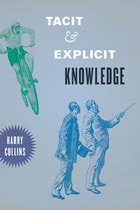
Tacit and Explicit Knowledge
Harry Collins
University of Chicago Press, 2010
Much of what humans know we cannot say. And much of what we do we cannot describe. For example, how do we know how to ride a bike when we can’t explain how we do it? Abilities like this were called “tacit knowledge” by physical chemist and philosopher Michael Polanyi, but here Harry Collins analyzes the term, and the behavior, in much greater detail, often departing from Polanyi’s treatment.
In Tacit and Explicit Knowledge, Collins develops a common conceptual language to bridge the concept’s disparate domains by explaining explicit knowledge and classifying tacit knowledge. Collins then teases apart the three very different meanings, which, until now, all fell under the umbrella of Polanyi’s term: relational tacit knowledge (things we could describe in principle if someone put effort into describing them), somatic tacit knowledge (things our bodies can do but we cannot describe how, like balancing on a bike), and collective tacit knowledge (knowledge we draw that is the property of society, such as the rules for language). Thus, bicycle riding consists of some somatic tacit knowledge and some collective tacit knowledge, such as the knowledge that allows us to navigate in traffic. The intermixing of the three kinds of tacit knowledge has led to confusion in the past; Collins’s book will at last unravel the complexities of the idea.
Tacit knowledge drives everything from language, science, education, and management to sport, bicycle riding, art, and our interaction with technology. In Collins’s able hands, it also functions at last as a framework for understanding human behavior in a range of disciplines.
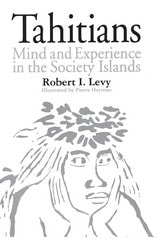
Tahitians
Mind and Experience in the Society IslandsRobert I. Levy llustrated by Pierre Heyman
University of Chicago Press, 1973
"This is a unique addition to anthropological literature. . . . No review could substitute for reading it."—Margaret Mead, American Anthropologist
Taifa
Making Nation and Race in Urban TanzaniaJames R. Brennan
Ohio University Press, 2012
Taifa is a story of African intellectual agency, but it is also an account of how nation and race emerged out of the legal, social, and economic histories in one major city, Dar es Salaam. Nation and race—both translatable as taifa in Swahili—were not simply universal ideas brought to Africa by European colonizers, as previous studies assume. They were instead categories crafted by local African thinkers to make sense of deep inequalities, particularly those between local Africans and Indian immigrants. Taifa shows how nation and race became the key political categories to guide colonial and postcolonial life in this African city.
Using deeply researched archival and oral evidence, Taifa transforms our understanding of urban history and shows how concerns about access to credit and housing became intertwined with changing conceptions of nation and nationhood. Taifa gives equal attention to both Indians and Africans; in doing so, it demonstrates the significance of political and economic connections between coastal East Africa and India during the era of British colonialism, and illustrates how the project of racial nationalism largely severed these connections by the 1970s.
Taking Possession
The Politics of Memory in a St. Louis Town HouseHeidi Aronson Kolk
University of Massachusetts Press, 2019
In Taking Possession, Heidi Aronson Kolk explores the complex and sometimes contradictory motivations for safeguarding the house as a site of public memory. Crafting narratives about the past that comforted business elites and white middle-class patrons, museum promoters assuaged concerns about the city's most pressing problems, including racial and economic inequality, segregation and privatization, and the legacies of violence for which St. Louis has been known since Ferguson. Kolk's case study illuminates the processes by which civic pride and cultural solidarity have been manufactured in a fragmented and turbulent city, showing how closely linked are acts of memory and forgetting, nostalgia and shame.

Taking Time
Mindy Fried
Temple University Press, 1998
This timely book provides an inside look at life in a major U.S. corporation, focusing on the impact of workplace culture on the use of parental leave and those who use it. Fried begins by describing why parental leave is critical to making parenting the job of both parents in two-parent families. She examines the varied experiences of different levels of workers in how parental leave policy is used.
The author tells a rich and textured tale of day-to-day life in the skyscraper offices of a large corporation. How people dress, what their offices look like, which cafeteria they eat in, how the supervisors and supervised talk -- all these things are part of the fabric of corporate culture that Fried describes.
Most of us live in work cultures that value overtime. Fried argues that, as a "time policy" parental leave clashes with the powerful norm that corporate employees must work long and hard. Taking time for parenting -- a job that is devalued in our culture -- may be perceived as "taking time away" from the company, and, in particular, from the company's productivity.

Tales of the Field
On Writing EthnographyJohn Van Maanen
University of Chicago Press, 1988
For more than twenty years, John Van Maanen’s Tales of the Field has been a definitive reference and guide for students, scholars, and practitioners of ethnography and beyond. Originally published in 1988, it was the one of the first works to detail and critically analyze the various styles and narrative conventions associated with written representations of culture. This is a book about the deskwork of fieldwork and the various ways culture is put forth in print. The core of the work is an extended discussion and illustration of three forms or genres of cultural representation—realist tales, confessional tales, and impressionist tales. The novel issues raised in Tales concern authorial voice, style, truth, objectivity, and point-of-view. Over the years, the work has both reflected and shaped changes in the field of ethnography.
In this second edition, Van Maanen’s substantial new Epilogue charts and illuminates changes in the field since the book’s first publication. Refreshingly humorous and accessible, Tales of the Field remains an invaluable introduction to novices learning the trade of fieldwork and a cornerstone of reference for veteran ethnographers.

Tales of the Field
On Writing Ethnography, Second EditionJohn Van Maanen
University of Chicago Press, 2011
For more than twenty years, John Van Maanen’s Tales of the Field has been a definitive reference and guide for students, scholars, and practitioners of ethnography and beyond. Originally published in 1988, it was the one of the first works to detail and critically analyze the various styles and narrative conventions associated with written representations of culture. This is a book about the deskwork of fieldwork and the various ways culture is put forth in print. The core of the work is an extended discussion and illustration of three forms or genres of cultural representation—realist tales, confessional tales, and impressionist tales. The novel issues raised in Tales concern authorial voice, style, truth, objectivity, and point-of-view. Over the years, the work has both reflected and shaped changes in the field of ethnography.
In this second edition, Van Maanen’s substantial new Epilogue charts and illuminates changes in the field since the book’s first publication. Refreshingly humorous and accessible, Tales of the Field remains an invaluable introduction to novices learning the trade of fieldwork and a cornerstone of reference for veteran ethnographers.

Talk of Love
How Culture MattersAnn Swidler
University of Chicago Press, 2001
Talking Art
The Culture of Practice and the Practice of Culture in MFA EducationGary Alan Fine
University of Chicago Press, 2018
Talking Together
Public Deliberation and Political Participation in AmericaLawrence R. Jacobs, Fay Lomax Cook, and Michael X. Delli Carpini
University of Chicago Press, 2009
Challenging the conventional wisdom that Americans are less engaged than ever in national life and the democratic process, Talking Together paints the most comprehensive portrait available of public deliberation in the United States and explains why it is important to America’s future.
The authors’ original and extensive research reveals how, when, and why citizens talk to each other about the issues of the day. They find that—in settings ranging from one-on-one conversations to e-mail exchanges to larger and more formal gatherings—a surprising two-thirds of Americans regularly participate in public discussions about such pressing issues as the Iraq War, economic development, and race relations. Pinpointing the real benefits of public discourse while considering arguments that question its importance, Talking Together presents an authoritative and clear-eyed assessment of deliberation’s function in American governance. In the process, it offers concrete recommendations for increasing the power of talk to foster political action.
Talking about Race
Community Dialogues and the Politics of DifferenceKatherine Cramer Walsh
University of Chicago Press, 2007
It is a perennial question: how should Americans deal with racial and ethnic diversity? More than 400 communities across the country have attempted to answer it by organizing discussions among diverse volunteers in an attempt to improve race relations. In Talking about Race, Katherine Cramer Walsh takes an eye-opening look at this strategy to reveal the reasons behind the method and the effects it has in the cities and towns that undertake it.
With extensive observations of community dialogues, interviews with the discussants, and sophisticated analysis of national data, Walsh shows that while meeting organizers usually aim to establish common ground, participants tend to leave their discussions with a heightened awareness of differences in perspective and experience. Drawing readers into these intense conversations between ordinary Americans working to deal with diversity and figure out the meaning of citizenship in our society, she challenges many preconceptions about intergroup relations and organized public talk. Finally disputing the conventional wisdom that unity is the only way forward, Walsh prescribes a practical politics of difference that compels us to reassess the place of face-to-face discussion in civic life and the critical role of conflict in deliberative democracy.
Tangled Goods
The Practical Life of Pro Bono AdvertisingIddo Tavory, Sonia Prelat and Shelly Ronen
University of Chicago Press, 2022
The advertising industry may seem like one of the most craven manifestations of capitalism, turning consumption into a virtue. In Tangled Goods, authors Iddo Tavory, Sonia Prelat, and Shelly Ronen consider an important dimension of the advertising industry that appears to depart from the industry’s consumerist foundations: pro bono ad campaigns. Why is an industry known for biting cynicism and cutthroat competition also an industry in which people dedicate time and effort to “doing good”?
Interviewing over seventy advertising professionals and managers, the authors trace the complicated meanings of the good in these pro bono projects. Doing something altruistic, they show, often helps employees feel more at ease working for big pharma or corporate banks. Often these projects afford them greater creative leeway than they normally have, as well as the potential for greater recognition. While the authors uncover different motivations behind pro bono work, they are more interested in considering how various notions of the good shift, with different motivations and benefits rising to the surface at different moments. This book sheds new light on how goodness and prestige interact with personal and altruistic motivations to produce value for individuals and institutions and produces a novel theory of the relationship among goods: one of the most fraught questions in sociological theory.

Tangled Loyalties
Conflict of Interest in Legal PracticeSusan P. Shapiro
University of Michigan Press, 2002
This unique, empirical study examines the actual attitudes and perceptions of legal practitioners. The author discusses the realities of the profession--what lawyers face day to day, how they deal with conflicts of interest, and how those experiences vary from LaSalle Street to Wall Street to Main Street, from megafirms to solo practices. In describing how conflicts arise in their daily work, Shapiro sheds light on the nature of legal work--on clients, colleagues, law firm power and politics, economics, markets, malpractice insurance, careers, ethics, values, business judgments, and lawyers' most anguishing moments. In short, we learn what it means to be a lawyer at the end of the twentieth century.
Tangled Loyalties also looks at how these conflicts in law affect other fiduciaries--accountants, doctors, psychotherapists, journalists, and academics--and the way in which they respond to competing interests and the honoring of those interests.
Tangled Loyalties will appeal to readers interested in the legal and other professions, social institutions and relations, and issues of trust, ethics, social control and regulation.
Susan P. Shapiro is Senior Research Fellow, American Bar Foundation.
Technology and the Resilience of Metropolitan Regions
Edited by Michael E. Pagano
University of Illinois Press, 2015
In this new collection, Michael A. Pagano curates engagement with such questions by public intellectuals, stakeholders, academics, policy analysts, and citizens. Each essay explores issues related to the impact and opportunities technology provides in government and citizenship, health care, workforce development, service delivery to citizens, and metropolitan growth. As the authors show, rapidly emerging technologies and access to such technologies shape the ways people and institutions interact in the public sphere and private marketplace. The direction of metropolitan growth and development, in turn, depends on access to appropriate technology scaled and informed by the individual, household, and community needs of the region.
Contributors include Randy Blankenhorn, Bénédicte Callan, Jane Fountain, Sandee Kastrul, Karen Mossberger, Dan O'Neil, Michelle Russell, Alfred Tatum, Stephanie Truchan, Darrel West, and Howard Wial.

Teen Mothers--Citizens or Dependents?
Ruth Horowitz
University of Chicago Press, 1994
"Rich vignettes reveal the complexities of teenage mothers' lives, particularly the disjuncture between classroom and street identities, 'inside' and 'outside.' . . . Original and illuminating as well as timely."—Sharon Thompson, Women's Review of Books
"Horowitz offers insights that should be considered in the debate over welfare reform. . . . Teen Mothers . . . places Horowitz's results in the context of major theories about the role of welfare in the U.S. and offers a microlevel critique of the implicit assumptions and probable consequences of each theory's approach to welfare reform."—Booklist

Teenage Wasteland
Suburbia's Dead End KidsDonna Gaines
University of Chicago Press, 1998
"A powerful book."—Samuel G. Freedman, New York Times Book Review
"[Gaines] sheds light on a poorly understood world and raises compelling questions about what society might do to help this alienated group of young people."—Ann Grimes, Washington Post Book World
"There is no comparable study of teenage suburban culture . . . and very few ethnographic inquiries written with anything like Gaines's native gusto or her luminous eye for detail."—Andrew Ross, Transition
"An outstanding case study. . . . Gaines shows how teens engage in cultural production and how such social agency is affected by economic transformations and institutional interventions."—Richard Lachman, Contemporary Sociology
"The best book on contemporary youth culture."—Rolling Stone
Television Violence and Public Policy
James T. Hamilton, Editor
University of Michigan Press, 2000
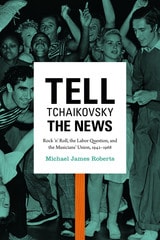
Tell Tchaikovsky the News
Rock 'n' Roll, the Labor Question, and the Musicians' Union, 1942-1968Michael James Roberts
Duke University Press, 2014
Telling About Society
Howard S. Becker
University of Chicago Press, 2007
Taking Perec’s book as its cue, Telling About Society explores the unconventional ways we communicate what we know about society to others. The third in distinguished teacher Howard Becker’s best-selling series of writing guides for social scientists, the book explores the many ways knowledge about society can be shared and interpreted through different forms of telling—fiction, films, photographs, maps, even mathematical models—many of which remain outside the boundaries of conventional social science. Eight case studies, including the photographs of Walker Evans, the plays of George Bernard Shaw, the novels of Jane Austen and Italo Calvino, and the sociology of Erving Goffman, provide convincing support for Becker’s argument: that every way of telling about society is perfect—for some purpose. The trick is, as Becker notes, to discover what purpose is served by doing it this way rather than that.
With Becker’s trademark humor and eminently practical advice, Telling About Society is an ideal guide for social scientists in all fields, for artists interested in saying something about society, and for anyone interested in communicating knowledge in unconventional ways.
Ten Thousand Years of Inequality
The Archaeology of Wealth DifferencesEdited by Timothy A. Kohler and Michael E. Smith
University of Arizona Press, 2018
Ten Thousand Years of Inequality addresses these and other questions by presenting the first set of consistent quantitative measurements of ancient wealth inequality. The authors are archaeologists who have adapted the Gini index, a statistical measure of wealth distribution often used by economists to measure contemporary inequality, and applied it to house-size distributions over time and around the world. Clear descriptions of methods and assumptions serve as a model for other archaeologists and historians who want to document past patterns of wealth disparity.
The chapters cover a variety of ancient cases, including early hunter-gatherers, farmer villages, and agrarian states and empires. The final chapter synthesizes and compares the results. Among the new and notable outcomes, the authors report a systematic difference between higher levels of inequality in ancient Old World societies and lower levels in their New World counterparts.
For the first time, archaeology allows humanity’s deep past to provide an account of the early manifestations of wealth inequality around the world.
Contributors
Nicholas Ames
Alleen Betzenhauser
Amy Bogaard
Samuel Bowles
Meredith S. Chesson
Abhijit Dandekar
Timothy J. Dennehy
Robert D. Drennan
Laura J. Ellyson
Deniz Enverova
Ronald K. Faulseit
Gary M. Feinman
Mattia Fochesato
Thomas A. Foor
Vishwas D. Gogte
Timothy A. Kohler
Ian Kuijt
Chapurukha M. Kusimba
Mary-Margaret Murphy
Linda M. Nicholas
Rahul C. Oka
Matthew Pailes
Christian E. Peterson
Anna Marie Prentiss
Michael E. Smith
Elizabeth C. Stone
Amy Styring
Jade Whitlam
Tensions in the American Dream
Rhetoric, Reverie, or RealityRoderick Bush
Temple University Press, 2015
Tensions in the American Dream also addresses the relevancy of nation to empire in the context of the historical world capitalist system. The authors ask, is the American Dream a reality only questioned by those unwilling or unable to achieve it? What is the "good life" and how is it particularly "American"?
Terminal City
Infrastructures of Racial Colonial Capitalism in VancouverMichael Simpson
University of Minnesota Press, 2026
The entanglement of Vancouver’s infrastructure in settler colonialism and racialized exploitation
Vancouver, Canada, has long been held up as an environmentally conscious coastal refuge and model of progressive urban planning. Unpacking the troubling complexities that lie beneath the city’s otherwise tidy self-image, Terminal City reveals the long, recurring patterns of racialized violence and Indigenous dispossession crucial to its formation.
Examining the histories of Vancouver’s infrastructures, including railways, ports, the freeway system, fossil-fuel pipelines, and property, Michael Simpson details the various spatial manifestations of settler colonialism and racial capitalism that constitute the city’s urban environment—using it as a case study to reveal such tendencies around the world. Simpson exposes how the seizure of Indigenous lands and the destruction of Black communities has been foundational to the development of the city, and he highlights its structural dependency on these violent legacies, as well as the ongoing struggles to dismantle them.
Bringing together theoretical insights from the fields of urban geography, political ecology, and Indigenous studies, Simpson provides a distinctive intervention into contemporary debates around the material basis of logistics and circulation. At a time when massive upheavals to urban infrastructure are taking place in the hopes of establishing greater sustainability, Terminal City raises important questions about how this moment of transition might be harnessed to bring about decolonial abolitionist futures that redefine what a city can become.
Retail e-book files for this title are screen-reader friendly with images accompanied by short alt text and/or extended descriptions.
Terms of Exchange
Brazilian Intellectuals and the French Social SciencesIan Merkel
University of Chicago Press, 2022
Would the most recognizable ideas in the French social sciences have developed without the influence of Brazilian intellectuals? While any study of Brazilian social sciences acknowledges the influence of French scholars, Ian Merkel argues the reverse is also true: the “French” social sciences were profoundly marked by Brazilian intellectual thought, particularly through the University of São Paulo. Through the idea of the “cluster,” Merkel traces the intertwined networks of Claude Lévi-Strauss, Fernand Braudel, Roger Bastide, and Pierre Monbeig as they overlapped at USP and engaged with Brazilian scholars such as Mário de Andrade, Gilberto Freyre, and Caio Prado Jr..
Through this collective intellectual biography of Brazilian and French social sciences, Terms of Exchange reveals connections that shed new light on the Annales school, structuralism, and racial democracy, even as it prompts us to revisit established thinking on the process of knowledge formation through fieldwork and intellectual exchange. At a time when canons are being rewritten, this book reframes the history of modern social scientific thought.

Territories of Difference
Place, Movements, Life, RedesArturo Escobar
Duke University Press, 2008
Escobar illuminates many interrelated dynamics, including the Colombian government’s policies of development and pluralism that created conditions for the emergence of black and indigenous social movements and those movements’ efforts to steer the region in particular directions. He examines attempts by capitalists to appropriate the rainforest and extract resources, by developers to set the region on the path of modernist progress, and by biologists and others to defend this incredibly rich biodiversity “hot-spot” from the most predatory activities of capitalists and developers. He also looks at the attempts of academics, activists, and intellectuals to understand all of these complicated processes. Territories of Difference is Escobar’s effort to think with Afro-Colombian intellectual-activists who aim to move beyond the limits of Eurocentric paradigms as they confront the ravages of neoliberal globalization and seek to defend their place-based cultures and territories.

Texas-Style Exclusion
Mexican Americans and the Legacy of Limited OpportunityJennifer Van Hook
Russell Sage Foundation, 2024
Drawing on census and archival data on the quality of public schooling, Van Hook and Bachmeier find that Industrial Era European immigrants, who were primarily located in the northeastern U.S., benefited from programs and policies championed by the Americanization and Progressive movements. The Americanization movement sought to help acclimate new arrivals and transform “foreigners” into “Americans” by providing night school programs to promote civic integration and basic education, as well as other services. The Progressive movement, which aimed to improve education, work, and health conditions, sought to expand investment in public schools and make primary and secondary schooling mandatory, which kept working class children in school as opposed to entering the workforce. This access to education allowed for integration and astonishing intergenerational mobility.
Mexican immigrants in the 1920s and 1930s, the majority of whom resided in Texas, had radically different experiences from their European counterparts. Mexicans in Texas were subjected to racism, segregation, labor exploitation, and intentional school failures. This resulted in tremendous generational disadvantage that persists to the current day. Mexicans from this cohort who left Texas for states with strong Americanization and Progressive movements saw improved educational outcomes and integration. Additionally, Mexicans who immigrated after the Civil Rights Movement saw significantly greater inter-generational mobility and educational attainment than earlier cohorts due to the protections provided by civil rights laws. Van Hook and Bachmeier conclude that whether one is optimistic or pessimistic about the integration of Mexican Americans depends on when and where one looks.
Texas-Style Exclusion is an engaging examination of policies and practices that have been glossed over and forgotten that promoted mobility and integration for certain immigrant groups and impeded them for others.
The Accidental Equalizer
How Luck Determines Pay after CollegeJessi Streib
University of Chicago Press, 2023
As a gateway to economic opportunity, a college degree is viewed by many as America’s great equalizer. And it’s true: wealthier, more connected, and seemingly better-qualified students earn exactly the same pay as their less privileged peers. Yet, the reasons why may have little to do with bootstraps or self-improvement—it might just be dumb luck. That’s what sociologist Jessi Streib proposes in The Accidental Equalizer, a conclusion she reaches after interviewing dozens of hiring agents and job-seeking graduates.
Streib finds that luck shapes the hiring process from start to finish in a way that limits class privilege in the job market. Employers hide information about how to get ahead and force students to guess which jobs pay the most and how best to obtain them. Without clear routes to success, graduates from all class backgrounds face the same odds at high pay. The Accidental Equalizer is a frank appraisal of how this “luckocracy” works and its implications for the future of higher education and the middle class. Although this system is far from eliminating American inequality, Streib shows that it may just be the best opportunity structure we have—for better and for worse.

The Accidental Equalizer
How Luck Determines Pay after CollegeJessi Streib
University of Chicago Press, 2023
A startling discovery—that job market success after college is largely random—forces a reappraisal of education, opportunity, and the American dream.
As a gateway to economic opportunity, a college degree is viewed by many as America’s great equalizer. And it’s true: wealthier, more connected, and seemingly better-qualified students earn exactly the same pay as their less privileged peers. Yet, the reasons why may have little to do with bootstraps or self-improvement—it might just be dumb luck. That’s what sociologist Jessi Streib proposes in The Accidental Equalizer, a conclusion she reaches after interviewing dozens of hiring agents and job-seeking graduates.
Streib finds that luck shapes the hiring process from start to finish in a way that limits class privilege in the job market. Employers hide information about how to get ahead and force students to guess which jobs pay the most and how best to obtain them. Without clear routes to success, graduates from all class backgrounds face the same odds at high pay. The Accidental Equalizer is a frank appraisal of how this “luckocracy” works and its implications for the future of higher education and the middle class. Although this system is far from eliminating American inequality, Streib shows that it may just be the best opportunity structure we have—for better and for worse.
The Affect Theory Reader
Melissa Gregg and Gregory J. Seigworth, eds.
Duke University Press, 2010
Contributors. Sara Ahmed, Ben Anderson, Lauren Berlant, Lone Bertelsen, Steven D. Brown, Patricia Ticineto Clough, Anna Gibbs,Melissa Gregg, Lawrence Grossberg, Ben Highmore, Brian Massumi, Andrew Murphie, Elspeth Probyn, Gregory J. Seigworth, Kathleen Stewart, Nigel Thrift, Ian Tucker, Megan Watkins

The Affect Theory Reader 2
Worldings, Tensions, FuturesGregory J. Seigworth and Carolyn Pedwell, editors
Duke University Press, 2023
Contributors. Lauren Berlant, Lisa Blackman, Rizvana Bradley, Ann Cvetkovich, Ezekiel J. Dixon-Román, Adam J. Frank, M. Gail Hamner, Omar Kasmani, Cecilia Macón, Hil Malatino, Erin Manning, Derek P. McCormack, Patrick Nickleson, Susanna Paasonen, Tyrone S. Palmer, Carolyn Pedwell, Jasbir K. Puar, Jason Read, Michael Richardson, Dylan Robinson, Tony D. Sampson, Kyla Schuller, Gregory J. Seigworth, Nathan Snaza, Kathleen Stewart, Elizabeth A. Wilson
The Affective Turn
Theorizing the SocialPatricia Ticineto Clough, ed.
Duke University Press, 2007
In the mid-1990s, scholars turned their attention toward the ways that ongoing political, economic, and cultural transformations were changing the realm of the social, specifically that aspect of it described by the notion of affect: pre-individual bodily forces, linked to autonomic responses, which augment or diminish a body’s capacity to act or engage with others. This “affective turn” and the new configurations of bodies, technology, and matter that it reveals, is the subject of this collection of essays. Scholars based in sociology, cultural studies, science studies, and women’s studies illuminate the movement in thought from a psychoanalytically informed criticism of subject identity, representation, and trauma to an engagement with information and affect; from a privileging of the organic body to an exploration of nonorganic life; and from the presumption of equilibrium-seeking closed systems to an engagement with the complexity of open systems under far-from-equilibrium conditions. Taken together, these essays suggest that attending to the affective turn is necessary to theorizing the social.
Contributors. Jamie “Skye” Bianco, Grace M. Cho, Patricia Ticineto Clough, Melissa Ditmore, Ariel Ducey, Deborah Gambs, Karen Wendy Gilbert, Greg Goldberg, Jean Halley, Hosu Kim, David Staples, Craig Willse , Elizabeth Wissinger , Jonathan R. Wynn
The Age of Experiences
Harnessing Happiness to Build a New EconomyBenjamin Kline Hunnicutt
Temple University Press, 2020
In The Age of Experiences, Benjamin Kline Hunnicutt examines how the advance of happiness science is impacting the economy, making possible new experience-products that really make people happy and help forward-looking businesses expand and develop new technologies. In today’s marketplace there is less interest in goods and services and more interest in buying and selling personal improvements and experiences. Hunnicutt traces how this historical shift in consumption to the “softer” technologies of happiness represents not only a change in the modern understanding of progress, but also a practical, economic transformation, profoundly shaping our work and the ordering of our life goals.
Based on incisive historical research, Hunnicutt demonstrates that we have begun to turn from material wealth to focus on the enrichment of our personal and social lives. The Age of Experiences shows how industry, technology, and the general public are just beginning to realize the potential of the new economy. Exploring the broader implications of this historical shift, Hunnicutt concludes that the new demand for experiences will result in the reduction of work time, the growth of jobs, and the regeneration of virtue—altogether an increasingly healthy public life.
The Age of Noise in Britain
Hearing ModernityJames G Mansell
University of Illinois Press, 2017
The Ageless Self
Sources of Meaning in Late LifeSharon R. Kaufman
University of Wisconsin Press, 1994
Among the many studies of aging and the aged, there is comparatively little material in which the aged speak for themselves. In this compelling study, Sharon Kaufman encourages just such expression, recording and presenting the voices of a number of old Americans. Her informants tell their life stories and relate their most personal feelings about becoming old. Each story is unique, and yet, presented together, they inevitable weave a clear pattern, one that clashes sharply with much current gerontological thought. With this book, Sharon Kaufman allows us to understand the experience of the aging by listening to the aged themselves.
Kaufman, while maintaining objectivity, is able to draw an intimate portrait of her subjects. We come to know these people as individuals and we become involved with their lives. Through their words, we find that the aging process is not merely a period of sensory, functional, economic, and social decline. Old people continue to participate in society, and—more important—continue to interpret their participation in the social world. Through themes constructed from these stories, we can see how the old not only cope with losses, but how they create new meaning as they reformulate and build viable selves. Creating identity, Kaufman stresses, is a lifelong process.
Sharon Kaufman's book will be of interest and value not only to students of gerontology and life span development, and to professionals in the field of aging, but to everyone who is concerned with the aging process itself. As Sharon Kaufman says, "If we can find the sources of meaning held by the elderly and see how individuals put it all together, we will go a long way toward appreciating the complexity of human aging and the ultimate reality of coming to terms with one's whole life."

The Alchemy of Meth
A DecompositionJason Pine
University of Minnesota Press, 2019
Meth cooks practice late industrial alchemy—transforming base materials, like lithium batteries and camping fuel, into gold
Meth alchemists all over the United States tap the occulted potencies of industrial chemical and big pharma products to try to cure the ills of precarious living: underemployment, insecurity, and the feeling of idleness. Meth fires up your attention and makes repetitive tasks pleasurable, whether it’s factory work or tinkering at home. Users are awake for days and feel exuberant and invincible. In one person’s words, they “get more life.”
The Alchemy of Meth is a nonfiction storybook about St. Jude County, Missouri, a place in decomposition, where the toxic inheritance of deindustrialization meets the violent hope of this drug-making cottage industry. Jason Pine bases the book on fieldwork among meth cooks, recovery professionals, pastors, public defenders, narcotics agents, and pharmaceutical executives. Here, St. Jude is not reduced to its meth problem but Pine looks at meth through materials, landscapes, and institutions: the sprawling context that makes methlabs possible. The Alchemy of Meth connects DIY methlabs to big pharma’s superlabs, illicit speed to the legalized speed sold as ADHD medication, uniquely implicating the author’s own story in the narrative.
By the end of the book, the backdrop of St. Jude becomes the foreground. It could be a story about life and work anywhere in the United States, where it seems no one is truly clean and all are complicit in the exploitation of their precious resources in exchange for a livable present—or even the hope of a future.
The Ambitious Elementary School
Its Conception, Design, and Implications for Educational EqualityElizabeth McGhee Hassrick, Stephen W. Raudenbush, and Lisa Rosen
University of Chicago Press, 2017
Drawing on an in-depth study of real schools on the South Side of Chicago, Elizabeth McGhee Hassrick, Stephen W. Raudenbush, and Lisa Rosen argue that effectively meeting the challenge of educational inequality requires a complete reorganization of institutional structures as well as wholly new norms, values, and practices that are animated by a relentless commitment to student learning. They examine a model that pulls teachers out of their isolated classrooms and places them into collaborative environments where they can share their curricula, teaching methods, and assessments of student progress with a school-based network of peers, parents, and other professionals. Within this structure, teachers, school leaders, social workers, and parents collaborate to ensure that every child receives instruction tailored to his or her developing skills. Cooperating schools share new tools for assessment and instruction and become sites for the training of new teachers. Parents become respected partners, and expert practitioners work with researchers to evaluate their work and refine their models for educational organization and practice. The authors show not only what such a model looks like but the dramatic results it produces for student learning and achievement.
The result is a fresh, deeply informed, and remarkably clear portrait of school reform that directly addresses the real problems of educational inequality.
The American College Town
Blake Gumprecht
University of Massachusetts Press, 2008
In this highly readable book—the first work published on the subject—Blake Gumprecht identifies the distinguishing features of college towns, explains why they have developed as they have in the United States, and examines in depth various characteristics that make them unusual. In eight thematic chapters, he explores some of the most interesting aspects of college towns—their distinctive residential and commercial districts, their unconventional political cultures, their status as bohemian islands, their emergence as high-tech centers, and more. Each of these chapters focuses on a single college town as an example, while providing additional evidence from other towns.
Lively, richly detailed, and profusely illustrated with original maps and photographs, as well as historical images, this is an important book that firmly establishes the college town as an integral component of the American experience.

The American Jeremiad
Sacvan Bercovitch
University of Wisconsin Press, 1978
When Sacvan Bercovitch’s The American Jeremiad first appeared in 1978, it was hailed as a landmark study of dissent and cultural formation in America, from the Puritans’ writings through the major literary works of the antebellum era. For this long-awaited anniversary edition, Bercovitch has written a deeply thoughtful and challenging new preface that reflects on his classic study of the role of the political sermon, or jeremiad, in America from a contemporary perspective, while assessing developments in the field of American studies and the culture at large.
The American School Counselor
A Case Study in the Sociology of ProfessionsDavid J. Armor
Russell Sage Foundation, 1969

The Americanization of Social Science
Intellectuals and Public Responsibility in the Postwar United StatesDavid Paul Haney
Temple University Press, 2008
A highly readable introduction to and overview of the postwar social sciences in the United States, The Americanization of Social Science explores a critical period in the evolution of American sociology’s professional identity from the late 1940s through the early 1960s. David Paul Haney contends that during this time leading sociologists encouraged a professional secession from public engagement in the name of establishing the discipline’s scientific integrity.
According to Haney, influential practitioners encouraged a willful withdrawal from public sociology by separating their professional work from public life. He argues that this separation diminished sociologists’ capacity for conveying their findings to wider publics, especially given their ambivalence towards the mass media, as witnessed by the professional estrangement that scholars like David Riesman and C. Wright Mills experienced as their writing found receptive lay audiences. He argues further that this sense of professional insularity has inhibited sociology’s participation in the national discussion about social issues to the present day.

The Amish Struggle with Modernity
Edited by Donald B. Kraybill and Marc A. Olshan
University Press of New England, 1994

The Anarchist Roots of Geography
Toward Spatial EmancipationSimon Springer
University of Minnesota Press, 2016
The Anarchist Roots of Geography sets the stage for a radical politics of possibility and freedom through a discussion of the insurrectionary geographies that suffuse our daily experiences. By embracing anarchist geographies as kaleidoscopic spatialities that allow for nonhierarchical connections between autonomous entities, Simon Springer configures a new political imagination.
Experimentation in and through space is the story of humanity’s place on the planet, and the stasis and control that now supersede ongoing organizing experiments are an affront to our survival. Singular ontological modes that favor one particular way of doing things disavow geography by failing to understand the spatial as a mutable assemblage intimately bound to temporality. Even worse, such stagnant ideas often align to the parochial interests of an elite minority and thereby threaten to be our collective undoing. What is needed is the development of new relationships with our world and, crucially, with each other.
By infusing our geographies with anarchism we unleash a spirit of rebellion that foregoes a politics of waiting for change to come at the behest of elected leaders and instead engages new possibilities of mutual aid through direct action now. We can no longer accept the decaying, archaic geographies of hierarchy that chain us to statism, capitalism, gender domination, racial oppression, and imperialism. We must reorient geographical thinking towards anarchist horizons of possibility. Geography must become beautiful, wherein the entirety of its embrace is aligned to emancipation.
The Anatomy of Post-Communist Regimes
A Conceptual FrameworkBálint Magyar
Central European University Press, 2021
Offering a single, coherent framework of the political, economic, and social phenomena that characterize post-communist regimes, this is the most comprehensive work on the subject to date. Focusing on Central Europe, the post-Soviet countries and China, the study provides a systematic mapping of possible post-communist trajectories.
At exploring the structural foundations of post-communist regime development, the work discusses the types of state, with an emphasis on informality and patronalism; the variety of actors in the political, economic, and communal spheres; the ways autocrats neutralize media, elections, etc. The analysis embraces the color revolutions of civil resistance (as in Georgia and in Ukraine) and the defensive mechanisms of democracy and autocracy; the evolution of corruption and the workings of “relational economy”; an analysis of China as “market-exploiting dictatorship”; the sociology of “clientage society”; and the instrumental use of ideology, with an emphasis on populism. Beyond a cataloguing of phenomena—actors, institutions, and dynamics of post-communist democracies, autocracies, and dictatorships—Magyar and Madlovics also conceptualize everything as building blocks to a larger, coherent structure: a new language for post-communist regimes.
While being the most definitive book on the topic, the book is nevertheless written in an accessible style suitable for both beginners who wish to understand the logic of post-communism and scholars who are interested in original contributions to comparative regime theory. The book is equipped with QR codes that link to www.postcommunistregimes.com, which contains interactive, 3D supplementary material for teaching.
The Anatomy of Public Opinion
Jacob Shamir and Michal Shamir
University of Michigan Press, 2000
Building upon recent work in communication, social psychology, social cognition, and political science, Jacob Shamir and Michal Shamir approach public opinion as a multidimensional concept with a multitude of expressions. Public opinion is not comprised merely of a distribution of attitudes obtained in the polls. It also expresses and is expressed by a climate of opinion, expectations, public speeches and political actions, including aggregate distributions of individual values, beliefs, and attitudes. Often these different facets coincide, but they may also diverge. Public opinion can evolve along different dynamic paths; the nature of the information environment is a major factor in determining which dynamic path will be set in motion.
While social information and social construction are important in public opinion processes, major information events play a central role in moving public opinion and in constraining processes of social construction. In this book these postulates are explored on the micro and macro levels, but the focus is on public opinion dynamics at the system level: how the facets of public opinion respond to the variability in information technology. This is approached from different directions and with different parameters. The authors use as their case study Israeli public opinion on issues of peace and terrorism during the Intifada.
The Anatomy of Public Opinion will form an important part in the body of study on the role of information in public opinion processes. It will be of interest to students and scholars of political science, communication, public opinion, and political psychology.
Jacob Shamir is Lecturer of Communication and Journalism, The Hebrew University, Jerusalem. Michal Shamir is Associate Professor of Political Science, Tel Aviv University.

The Anti-Black City
Police Terror and Black Urban Life in BrazilJaime Amparo Alves
University of Minnesota Press, 2018
An important new ethnographic study of São Paulo’s favelas revealing the widespread use of race-based police repression in Brazil
While Black Lives Matter still resonates in the United States, the movement has also become a potent rallying call worldwide, with harsh police tactics and repressive state policies often breaking racial lines. In The Anti-Black City, Jaime Amparo Alves delves into the dynamics of racial violence in Brazil, where poverty, unemployment, residential segregation, and a biased criminal justice system create urban conditions of racial precarity.
The Anti-Black City provocatively offers race as a vital new lens through which to view violence and marginalization in the supposedly “raceless” São Paulo. Ironically, in a context in which racial ambiguity makes it difficult to identify who is black and who is white, racialized access to opportunities and violent police tactics establish hard racial boundaries through subjugation and death. Drawing on two years of ethnographic research in prisons and neighborhoods on the periphery of this mega-city, Alves documents the brutality of police tactics and the complexity of responses deployed by black residents, including self-help initiatives, public campaigns against police violence, ruthless gangs, and self-policing of communities.
The Anti-Black City reveals the violent and racist ideologies that underlie state fantasies of order and urban peace in modern Brazil. Illustrating how “governing through death” has become the dominant means for managing and controlling ethnic populations in the neoliberal state, Alves shows that these tactics only lead to more marginalization, criminality, and violence. Ultimately, Alves’s work points to a need for a new approach to an intractable problem: how to govern populations and territories historically seen as “ungovernable.”
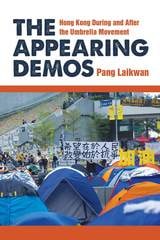
The Appearing Demos
Hong Kong During and After the Umbrella MovementPang Laikwan
University of Michigan Press, 2020
The 79-day-long Hong Kong Umbrella Movement occupied major streets in the busiest parts of the city, creating tremendous inconvenience to this city famous for capitalist order and efficiency. It was also a peaceful collective effort of appearance, and it was as much a political event as a cultural one. The urge for expressing an independent cultural identity underlined both the Occupy movement and the remarkably rich cultural expressions it generated. While understanding the specificity of Hong Kong’s situations, The Appearing Demos also comments on some global predicaments we are facing in the midst of neoliberalism and populism. It directs our attention from state-based sovereignty to city-based democracy, and emphasizes the importance of participation and cohabitation. The book also examines how the ideas of Hannah Arendt are useful to those happenings much beyond the political circumstances that gave rise to her theorization. The book pays particular attention to the actual intersubjective experiences during the protest. These experiences are local, fragile, and sometimes inarticulable, therefore resisting rationality and debates, but they define the fullness of any individual, and they also make politics possible. Using the Umbrella Movement as an example, this book examines the “freed” political agents who constantly take others into consideration in order to guarantee the political realm as a place without coercion and discrimination. In doing so, Pang Laikwan demonstrates how politics means neither to rule nor to be ruled, and these movements should be defined by hope, not by goals.

The Archive of Loss
Lively Ruination in Mill Land MumbaiMaura Finkelstein
Duke University Press, 2019
The Argentine Silent Majority
Middle Classes, Politics, Violence, and Memory in the SeventiesSebastián Carassai
Duke University Press, 2014