Results by title
149 books match the query 'Spanish & Portuguese' and 35 start with t
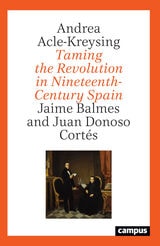
Taming the Revolution
Andrea Acle-Kreysing
Campus Verlag, 2022
Jaime Balmes and Juan Donoso Cortés–the two most important conservative thinkers in nineteenth-century Spain–actively sought to preserve the centrality of church and monarchy in the wake of the rise of liberalism, while at the same time discrediting the stereotypical view of Spain as a backward and isolated country. Although they pursued a similar goal, their positions differed: while Balmes’ works anticipated a socially oriented Catholicism, Donoso presented Christianity as the supreme social good, incompatible with modern liberalism. In Taming the Revolution, Andrea Acle-Kreysing highlights the unresolved tensions in their works, escaping the dualistic interpretations of this period that defines tradition from modernity. This work endeavors to show how Spanish political thought was a compelling variation–rather than an aberration–of contemporary European debates.
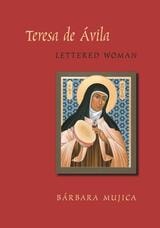
Teresa de Avila, Lettered Woman
Barbara Mujica
Vanderbilt University Press, 2009
Teresa's epistolary writing reveals how she used her political acumen to dodge inquisitors and negotiate the thorny issues of the reform, facing off the authorities--albeit with considerable tact--and reprimanding priests and nuns who failed to follow her orders. Her letters bring to light the different strategies she used--code names, secret routing--in order to communicate with nuns and male allies. They show how she manipulated language, varying her tone and rhetoric according to the recipient or slipping into deliberate vagueness in order to avoid divulging secrets. What emerges from her correspondence is a portrait of extraordinary courage, ability, and shrewdness.
In the sixteenth century, the word letrado (lettered) referred to the learned men of the Church. Teresa treated letrados with great respect and always insisted on her own lack of learning. The irony is that although women could not be letradas, Teresa was, as her correspondence shows, "lettered" in more ways than one.
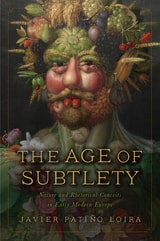
The Age of Subtlety
Nature and Rhetorical Conceits in Early Modern EuropeJavier Patiño Loira
University of Delaware Press, 2024
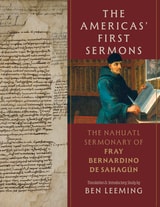
The Americas' First Sermons
The Nahuatl Sermonary of Fray Bernardino de SahagúnTranslation and Introduction study by Ben Leeming
University of Utah Press, 2025
The Americas’ First Sermons presents the first English translation and critical study of the complete set of sermons composed by Franciscan friar Bernardino de Sahagún and his Nahua students at the Imperial College of Santa Cruz in Tlatelolco, Mexico in 1540. The volume represents a crucial moment in the cultural exchange between European and Indigenous civilizations in sixteenth-century colonial Mexico.
With the collaboration of Mario Alberto Sánchez Aguilera, this edition offers unprecedented access to the collaboration between European friars and Nahua scholars in translating Christian concepts into Native languages. It captures Sahagún’s evolving methods across three phases (1530s–1560s) through his extensive annotations, bridging the divide between his ethnographic and doctrinal works. Unique in its analysis of both text and manuscript features—such as rare maguey paper—it highlights Indigenous intellectual contributions at the Colegio de Santa Cruz. This translation provides essential insights into early colonial religious negotiations and makes previously inaccessible material available to scholars across multiple disciplines.
The Art of Time
Levinas, Ethics, and the Contemporary Peninsular NovelNina L. Molinaro
Bucknell University Press, 2019
Academicians and journalists in Spain and abroad have recently fastened on an emerging cluster of peninsular writers who, they argue, pertain to a discernible literary generation, provisionally referred to as Generación X. These writers are distinct from their predecessors; they and their literary texts are closely related to the specific socio-political and historical circumstances in Spain and their novels relate stories of more and less proximity, more and less responsibility, and more and less temporality. In short, they trace the temporal movement of alterity through narrative.
Published by Bucknell University Press. Distributed worldwide by Rutgers University Press.
The Azure Cloister
Thirty-Five PoemsCarlos Germán Belli
Swan Isle Press, 2021
This selection of poems by internationally renowned Peruvian poet Carlos Germán Belli tempers a dark, ironic vision of worldly injustice with the “red midnight sun” of hope. Belli’s contemplative verses express faith in language, in bodily joy, and in artistic form. These thirty-five poems explore public and domestic spaces of confinement and freedom, from paralysis to the ease of a bird in its “azure cloister.”
Translations by Karl Maurer retain Belli’s original meter, follow his complex syntax, and meet the challenges of his poetic language, which ranges from colloquial Peruvian slang to the ironic use of seventeenth-century Spanish. This bilingual edition also includes notes and reflections on Belli and on the art of translation. Beyond introducing American readers to a major presence in world poetry, The Azure Cloister offers a fresh approach to the translation of contemporary verse in Spanish.
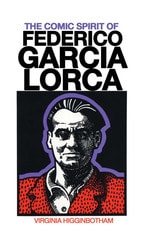
The Comic Spirit of Federico Garcia Lorca
By Virginia Higginbotham
University of Texas Press, 1976
During the years since his death, Federico García Lorca, Spain's best-known twentieth-century poet and playwright, has generally been considered a writer of tragedy. Three of his major plays are fatalistic stories of suffering and death, and his poetry is filled with dread. Yet most of Lorca's dramatic production consists of comedies and farces. Throughout his poetry and prose, as well as in his most somber plays, runs an undercurrent of humor—dark irony and satire—that is in no way contradictory to his tragic view of life. On the contrary, as Virginia Higginbotham demonstrates, through humor Lorca defines, intensifies, and tries to come to terms with what he sees as the essentially hopeless condition of humankind.
Although Lorca's comic moments and techniques have been discussed in isolated articles, the importance of humor has largely been ignored in the fundamental studies of his work. Higginbotham is concerned with Lorca's total output: lyric poetry, tragicomedies and farces, avant-garde prose and plays, puppet farces, and master plays. She describes Lorca's place in the mainstream of the Spanish theater and shows his relationship to some relevant non-Spanish dramatists. Furthermore, she discusses ways in which Lorca's work anticipates the modern theater of the absurd. The result is a comprehensive study of an important, but previously ignored, aspect of Lorca's work.
The Comic Spirit of Federico García Lorca includes a Lorca chronology and an extensive bibliography.

The Ethics of Autobiography
Replacing the Subject in Modern SpainAngel G. Loureiro
Vanderbilt University Press, 2000
To address this oversight, Loureiro draws from his own experiences as well as from a wide range of previous theoretical works on autobiography, especially from the writings of Emmanuel Levinas, who believed that the self does not begin as a self-positing consciousness but as a response to an address from the other. On this basis, Loureiro then brilliantly traces the complex interplays between the political, discursive, rhetorical, and ethical dimensions of autobiography.
After laying out these theoretical foundations, Loureiro puts them to work in analyzing four of the most fascinating autobiographies written by Spanish exiles: The Life of Joseph Blanco White, who lived from 1775 to 1841, Memoria de la Melancolia by Maria Teresa Leon (1904-1988), Coto vedado and En los reinos de taifa by Juan Goytisolo (born 1931), and Literature or Life by Jorge Semprun (born 1923). The lives of these authors, all of whom were exiled for political reasons, were disrupted by some of the most crucial events in Spain's tortuous road to modernity and democracy.
The book closes with a discussion of why there have been so few critical examinations of autobiographies written in modern Spain. Loureiro proposes that, even in today's Spain, stifling social and political forces smother ethical responsibility, which is an essential ingredient in creating autobiographies that dare to be more than a humdrum inventory of personal recollections. Only in exile have Spanish authors seemed able to find the conditions to write their lives in a truly responsible manner. This answer to a call that grounds the subject in an other is ultimately the only form of truth available in autobiography.
The Gallant Spaniard
Miguel de Cervantes; Translated by Philip Krummrich
Vanderbilt University Press, 2023
This edition, translated by Philip Krummrich, consists of a critical introduction and a full verse translation of the play with notes.
The Illusions of Doctor Faustino
Juan Valera
Catholic University of America Press, 2008
The Indies of the Setting Sun
How Early Modern Spain Mapped the Far East as the Transpacific WestRicardo Padrón
University of Chicago Press, 2020
Narratives of Europe’s westward expansion often tell of how the Americas came to be known as a distinct landmass, separate from Asia and uniquely positioned as new ground ripe for transatlantic colonialism. But this geographic vision of the Americas was not shared by all Europeans. While some imperialists imagined North and Central America as undiscovered land, the Spanish pushed to define the New World as part of a larger and eminently flexible geography that they called las Indias, and that by right, belonged to the Crown of Castile and León. Las Indias included all of the New World as well as East and Southeast Asia, although Spain’s understanding of the relationship between the two areas changed as the realities of the Pacific Rim came into sharper focus. At first, the Spanish insisted that North and Central America were an extension of the continent of Asia. Eventually, they came to understand East and Southeast Asia as a transpacific extension of their empire in America called las Indias del poniente, or the Indies of the Setting Sun.
The Indies of the Setting Sun charts the Spanish vision of a transpacific imperial expanse, beginning with Balboa’s discovery of the South Sea and ending almost a hundred years later with Spain’s final push for control of the Pacific. Padrón traces a series of attempts—both cartographic and discursive—to map the space from Mexico to Malacca, revealing the geopolitical imaginations at play in the quest for control of the New World and Asia.
The Inner Sea
Maritime Literary Culture in Early Modern PortugalJosiah Blackmore
University of Chicago Press, 2022
In this book, Josiah Blackmore considers how the sea and seafaring shaped literary creativity in early modern Portugal during the most active, consequential decades of European overseas expansion. Blackmore understands “literary” in a broad sense, including a diverse archive spanning genres and disciplines—epic and lyric poetry, historical chronicles, nautical documents, ship logs, shipwreck narratives, geographic descriptions, and reference to texts of other seafaring powers and literatures of the period—centering on the great Luís de Camões, arguably the sea poet par excellence of early modern Europe.
Blackmore shows that the sea and nautical travel for Camões and his contemporaries were not merely historical realities; they were also principles of cultural creativity that connected to larger debates in the widening field of the maritime humanities. For Blackmore, the sea, ships, and nautical travel unfold into a variety of symbolic dimensions, and the oceans across the globe that were traversed in the fifteenth and sixteenth centuries correspond to vast reaches within the literary self. The sea and seafaring were not merely themes in textual culture but were also principles that created individual and collective subjects according to oceanic modes of perception. Blackmore concludes with a discussion of depth and sinking in shipwreck narratives as metaphoric and discursive dimensions of the maritime subject, foreshadowing empire’s decline.
The Inverted Conquest
The Myth of Modernity and the Transatlantic Onset of ModernismAlejandro Mejias-Lopez
Vanderbilt University Press, 2009
Expanding Bourdieu's concepts of cultural field and symbolic capital beyond national boundaries, The Inverted Conquest shows how modernismo originated in Latin America and traveled to Spain, where it provoked a complete renovation of Spanish letters and contributed to a national identity crisis. In the process, described by Latin American writers as a reversal of colonial relations, modernismo wrested literary and cultural authority away from Spain, moving the cultural center of the Hispanic world to the Americas.
Mejias-Lopez further reveals how Spanish American modernistas confronted the racial supremacist claims and homogenizing force of an Anglo-American modernity that defined the Hispanic as un-modern. Constructing a new Hispanic genealogy, modernistas wrote Spain as the birthplace of modernity and themselves as the true bearers of the modern spirit, moved by the pursuit of knowledge, cosmopolitanism, and cultural miscegenation, rather than technology, consumption, and scientific theories of racial purity.
Bound by the intrinsic limits of neocolonial and postcolonial theories, scholarship has been unwilling or unable to explore modernismo's profound implications for our understanding of Western modernities.
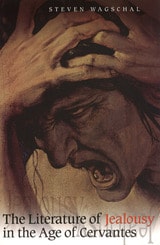
The Literature of Jealousy in the Age of Cervantes
Steven Wagschal
University of Missouri Press, 2007
Frequent and complex representations of jealousy in early modern Spanish literature offer symbolically rich and often contradictory images. Steven Wagschal examines these occurrences by illuminating the theme of jealousy in the plays of Lope de Vega, the prose of Miguel de Cervantes, and the complex poetry of Luis de Góngora. Noting the prevalence of this emotion in their work, he reveals what jealousy offered these writers at a time when Spain was beginning its long decline.
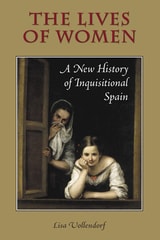
The Lives of Women
A New History of Inquisitional SpainLisa Vollendorf
Vanderbilt University Press, 2007
During this period, more women wrote for the public book market and participated in literary culture than ever before. In addition, the rise in convents and female education contributed to a marked increase in texts produced by and about women in religious orders. Vollendorf argues that, in conjunction with Inquisition and legal documents, this wealth of writing offers unprecedented access to women's perspectives on life in early modern Spain, and that those perspectives encompass diverse ethnic backgrounds and class differences. Many of the documents touch on issues of sex and intimacy; others provide new ways of understanding religious practice in the period. Perhaps most important, these writings give a richly textured view of how women reacted to the dominant culture's attempts to define, limit, and contain femininity. Vollendorf shows that the texts reflect a shared preoccupation with redefining gender and creating legitimate spaces for women.
As The Lives of Women vividly illustrates, hundreds, if not thousands, of women's stories await rediscovery in archives. The book provides a roadmap for understanding the experiences and concerns of wives, widows, sisters, and daughters who lived in a key moment in the development of the Spanish nation and the Hispanic world. At its core, The Lives of Women argues for a reconceptualization of history, one that will rely on the experiences of women and minorities as much as on the words and actions of kings and conquistadors.
The Magellan Fallacy
Globalization and the Emergence of Asian and African Literature in SpanishAdam Lifshey
University of Michigan Press, 2012
The Magellan Fallacy argues that literature in Spanish from Asia and Africa, though virtually unknown, reimagines the supposed centers and peripheries of the modern world in fundamental ways. Through archival research and comparative readings, The Magellan Fallacy rethinks mainstream mappings of diverse cultures while advocating the creation of a new field of scholarship: global literature in Spanish. As the first attempt to analyze Asian and African literature in Spanish together, and doing so while ranging over all continents, The Magellan Fallacy crosses geopolitical and cultural borders without end. The implications of the book, therefore, extend far beyond the lands formerly ruled by the Spanish empire. The Magellan Fallacy shows that all theories of globalization, including those focused on the Americas and Europe, must be able to account for the varied significances of hispanophone Asia and Africa as well.
The Men Who Killed My Mother | Los hombres que mataron a mi madre
Poetry | PoesíaFernando Valverde
Swan Isle Press, 2025
From the first poem in this bilingual edition of The Men Who Killed My Mother, it is evident that the mother in “Our Mother” (“Nuestra Madre”) is not only Fernando Valverde’s. The soulful refrain of “mother/madre” might be anyone’s mother whose suffering is palpable in a world legislated over by men. Issues such as orphanhood, abuse, violence, manipulation, and fear are treated with the rawness of someone who has tasted the venom of betrayal. This is a lyrical dark garden of faith and family, exposing treachery and cruelty, and anger at injustice, from the voice of a son with deep love for his mother—for her honor, dignity, and dreams.
Valverde leads us into a forest full of wolves and serpents under the governance of civil society. He has received many awards for his poetry and is recognized as one of the most highly acclaimed poets of his generation in Spain. This heartfelt English translation by Gordon E. McNeer captures the power of Valverde’s poetic cadences and its haunting evocative lyricism.
The Object of the Atlantic
Concrete Aesthetics in Cuba, Brazil, and Spain, 1868–1968Rachel Price
Northwestern University Press, 2014
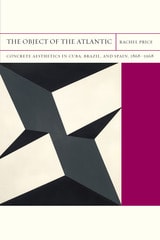
The Object of the Atlantic is a wide-ranging study of the transition from a concern with sovereignty to a concern with things in Iberian Atlantic literature and art produced between 1868 and 1968. Rachel Price uncovers the surprising ways that concrete aesthetics from Cuba, Brazil, and Spain drew not only on global forms of constructivism but also on a history of empire, slavery, and media technologies from the Atlantic world. Analyzing Jose Marti’s notebooks, Joaquim de Sousandrade’s poetry, Ramiro de Maeztu’s essays on things and on slavery, 1920s Cuban literature on economic restructuring, Ferreira Gullar’s theory of the “non-object,” and neoconcrete art, Price shows that the turn to objects—and from these to new media networks—was rooted in the very philosophies of history that helped form the Atlantic world itself.
The Paradox of Paradise
Creative Destruction and the Rise of Urban Coastal Tourism in Contemporary Spanish CultureWilliam J. Nichols
Vanderbilt University Press, 2023
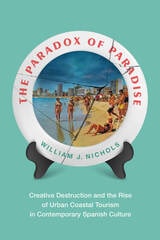
In addition to inserting the coasts into the scope of Iberian urban studies (typically dominated by studies of Madrid and Barcelona), this project breaks new ground by bringing to the fore unexplored cultural artifacts vital to the narrative of development along the coasts in Spain—in particular the ubiquitous tourist postcard, which advances not only the post-Franco economic miracle, but does so by highlighting the transformation of the actual Spanish landscape along its coasts.
The Paradox of Paradise features more than twenty-five striking images of coastal Spain in the throes of its own coming of age. Author William J. Nichols has unlocked a strange, self-conscious archive that tells us as much about our own age of advertising as it does about the hotels and resorts and people on display.
The Poems of Renata Ferreira
Frank X. Gaspar
Tagus Press, 2020
The Poetics of Epiphany in the Spanish Lyric of Today
Judith Nantell
Bucknell University Press, 2020
Published by Bucknell University Press. Distributed worldwide by Rutgers University Press.
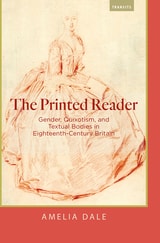
The Printed Reader
Gender, Quixotism, and Textual Bodies in Eighteenth-Century BritainAmelia Dale
Bucknell University Press, 2019
The Printed Reader explores the transformative power of reading in the eighteenth century, and how this was expressed in the fascination with Don Quixote and in a proliferation of narratives about quixotic readers, readers who attempt to reproduce and embody their readings. Through intersecting readings of quixotic narratives, including work by Charlotte Lennox, Laurence Sterne, George Colman, Richard Graves, and Elizabeth Hamilton, Amelia Dale argues that literature was envisaged as imprinting—most crucially, in gendered terms—the reader’s mind, character, and body. The Printed Reader brings together key debates concerning quixotic narratives, print culture, sensibility, empiricism, book history, and the material text, connecting developments in print technology to gendered conceptualizations of quixotism. Tracing the meanings of quixotic readers’ bodies, The Printed Reader claims the social and political text that is the quixotic reader is structured by the experiential, affective, and sexual resonances of imprinting and impressions.
Published by Bucknell University Press. Distributed worldwide by Rutgers University Press.
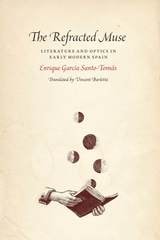
The Refracted Muse
Literature and Optics in Early Modern SpainEnrique Garcia Santo-Tomas
University of Chicago Press, 2017
While Spain is often thought to have taken little notice of the Scientific Revolution, García Santo-Tomás tells a different story, one that reveals Golden Age Spanish literature to be in close dialogue with the New Science. Drawing on the work of writers such as Cervantes, Lope de Vega, Calderón de la Barca, and Quevedo, he helps us trace the influence of science and discovery on the rapidly developing and highly playful genre of the novel. Indeed, García Santo-Tomás makes a strong case that the rise of the novel cannot be fully understood without taking into account its relationship to the scientific discoveries of the period.

The Reframing of Realism
Galdós & the Discourses of the 19th-Century Spanish NovelHazel Gold
Duke University Press, 1993
A close look at Galdós's novels reveals the artist at pains to contain and interpret what he perceived to be the distinctive and often disheartening experience of bourgeois liberalism of his day. At the same time, he can be seen here undermining or negating the accepted conventions of realist fiction. Looking beyond text to context, Gold examines the ways in which Galdós's work itself has been framed by readers and critics in accordance with changing allegiances to contemporary literary theory and the canon.
The highly ambiguous status of the frame in Galdós's fictions confirms the author's own signal position as a writer poised at the limits between realism and modernity. Gold's work will command the interest of students of Spanish and comparative literature, narrative theory, and the novel, as well as all those for whom realism and representation are at issue.
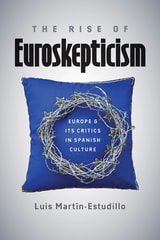
The Rise of Euroskepticism
Europe and Its Critics in Spanish CultureLuis Martín-Estudillo
Vanderbilt University Press, 2018
Covering from 1915 to the present, this book deals with the role that artists and intellectuals have played regarding projects of European integration. Consciously or not, they partake of a tradition of Euroskepticism. Because Euroskepticism is often associated with the discourse of political elites, its literary and artistic expressions have gone largely unnoticed. This book addresses that gap.
Taking Spain as a case study, author Luis Martín-Estudillo analyzes its conflict over its own Europeanness or exceptionalism, as well as the European view of Spain. He ranges from canonical writers like Unamuno, Ortega y Gasset, and Zambrano to new media artists like Valeriano López, Carlos Spottorno, and Santiago Sierra. Martín-Estudillo provides a new context for the current refugee crisis, the North-South divide among EU countries, and the generalized disaffection toward the project of European integration.
The eclipsed critical tradition he discusses contributes to a deeper understanding of the notion of Europe and its institutional embodiments. It gives resonance to the intellectual and cultural history of Europe's "peripheries" and re-evaluates Euroskeptic contributions as one of the few hopes left to imagine ways to renew the promise of a union of the European nations.
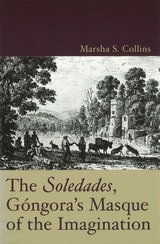
The Soledades, Góngora's Masque of the Imagination
Marsha S. Collins
University of Missouri Press, 2002
Prince of Darkness or Angel of Light? The pastoral masterpiece the Soledades garnered both titles for its author, Luis de Góngora, one of Spain's premier poets. In The Soledades, Góngora's Masque of the Imagination, Marsha S. Collins focuses on the brilliant seventeenth-century Spanish poet's contentious work of art. The Soledades have sparked controversy since they were first circulated at court in 1612-1614 and continue to do so even now, as Góngora has become for some critics the poster child of postmodernism. These perplexing 2,000-plus line pastoral poems garnered endless debates over the value and meaning of the author's enigmatic, challenging poetry and gave rise to his reputation, causing his very name to become an English term for obscurity.
Collins views these controversial poems in a different light, as a literary work that is a product of European court culture. She shows that the Soledades are in essence a court masque, an elaborate theatrical genre that combines a variety of cultural forms and that unfolds in the mind of the reader. Collins maintains that far from serving as an example of "art for art's sake," the Soledades represent Góngora's bid to transform poetic language into a new kind of visionary discourse that allows readers to access secret truths invisible to the average member of the reading public.
Each of Collins's four chapters analyzes a different facet of the Soledades, offering readers varied means of approaching Góngora's great work and helping the audience read the poems with greater understanding and appreciation.
The Soledades, Góngora's Masque of the Imagination demystifies the daunting, hermetic language of the Soledades to make this masterpiece of imperial Spain accessible to a new, and wider, circle of modern readers. Collins's book transports readers to the court of Habsburg Spain, offering a window to court culture—art, music, alchemy, emblems, garden architecture—and revealing the remarkable beauty of one of Spain's greatest literary masterpieces. Interdisciplinary and cross-cultural in approach, this book will appeal to all Hispanists, including those interested in the current "New Baroque" vogue in Hispanic scholarship, as well as specialists in Renaissance and Baroque English and European literature.
The Subject in Question
Early Contemporary Spanish Literature and ModernismC. Christopher Soufas
Catholic University of America Press, 2007
The Sublime South
Andalusia, Orientalism, and the Making of Modern SpainJose Luis Venegas
Northwestern University Press, 2018
The Sublime South: Andalusia, Orientalism, and the Making of Modern Spain is the first systematic study on cultural images of Andalusia as Spain’s “Orient” and the impact they have had on nation-building and modernization since the late nineteenth century. While a wealth of studies have examined how northern Europeans from the Romantic period viewed Spain and Andalusia as Europe’s Orient, little attention has been paid to how contemporary Spanish artists and intellectuals assimilated Romantic legacies to engage in an internal form of orientalism.
José Luis Venegas deftly explores Spain’s shifting engagements with oriental identity and otherness by looking, not just beyond national, ethnic, and racial borders, but at a territory that is institutionally embedded in the nation-state while symbolically placed between inclusion and abjection. The Sublime South shifts the focus and scale of Edward Said’s notion of orientalism by examining how it evolves and manifests transnationally, as the result of European colonialism in Africa and Asia, and intra-nationally, in a European yet orientalized country. Finally, Venegas challenges ethnocentric notions of Iberian cultures and fosters an understanding of the encounters between Western and Muslim cultures beyond opposing, and often mutually negating, essentialisms.
The Traveling Eye
Retrospection, Vision, and Prophecy in the Portuguese RenaissanceFernando Gil
Tagus Press, 2009
The idea for The Traveling Eye came as a new departure in an old dialogue between the two authors, one a literary scholar, the other a philosopher. Our focus was initially centered on a philosophical hypothesis concerning evidence, with specific reference to the prophetic writings of Father António Vieira, but it occurred to us that this perspective could be applied to literary works, particularly those of the Portuguese Renaissance. The studies that one of us had dedicated to the initiatory aspects of The Lusiads and to the codification of esoteric meanings in the work of Bernardim Ribeiro suggested a possible convergence of our two lines of research. But there are other issues raised by the Portuguese Renaissance: voyages, the new, the encounter with difference and how to understand it. The most obvious and direct expression of these issues is found in the chronicles of voyage and empire, whose importance is duly noted in the study by Luís de Sousa Rebelo included in Chapter III of this book. The literary treatment of this material seems to us no less revealing. Seeing ("seeing clearly seen" as Camões says in The Lusiads) poses the problem of simultaneously seeing "what is there" and of how what is there could be seen. This questioning from the outside by "the traveling eye" went hand in hand with new ways of relating to oneself and to others. Three key Renaissance authors, Luís de Camões (1525?-1580), Francisco de Sá de Miranda (1481?-1558?) and Bernardim Ribeiro (b.1480s?), address the human subject's relationship as a perplexing issue. Their works transform the feeling of love into a multifaceted investigation that questions the identity of the individual. A recurring theme in this book is the metamorphoses of the self brought about by love.
The Utopian Nexus in Don Quixote
Myriam Yvonne Jehenson
Vanderbilt University Press, 2006
Three Spanish Querelle Texts
Grisel and Mirabella, The Slander against Women, and The Defense of Ladies against SlanderersPere Torrellas and Juan de Flores
Iter Press, 2013
Tilting Cervantes
Baroque Reflections on Postmodern CultureBruce R. Burningham
Vanderbilt University Press, 2008
Transatlantic Correspondence
Modernity, Epistolarity, and Literature in Spain and Spanish America, 1898–1992José Luis Venegas
The Ohio State University Press, 2014
Each chapter frames literary works by authors from both sides of the Atlantic within key historical events spanning the loss of Spain’s overseas possessions in 1898 to the commemoration of Columbus’s quincentennial in 1992. This broad range of historical reference is counterpointed by the nuanced examination of a single formal feature in a wide variety of canonical and non-canonical texts. Drawing on insights from postcolonial studies, the book addresses the link between historical transformations that traverse decades and continents and specific stylistic choices in order to foster an understanding of Hispanic literary and cultural studies that is not limited by categories such as “movement,” “generation,” and “national literature.”
Transpoetic Exchange
Haroldo de Campos, Octavio Paz, and Other Multiversal DialoguesMarília Librandi
Bucknell University Press, 2020
The volume is divided into three parts. “Essays” unites seven texts by renowned scholars who focus on the relationship between the two authors, their impact and influence, and their cultural resonance by exploring explore the historical background and the different stylistic and cultural influences on the authors, ranging from Latin America and Europe to India and the U.S. The second section, “Remembrances,” collects four experiences of interaction with Haroldo de Campos in the process of transcreating Paz’s poem and working on Transblanco and Galáxias. In the last section, “Poems,” five poets of international standing--Jerome Rothenberg, Antonio Cicero, Keijiro Suga, André Vallias, and Charles Bernstein.
Paz and Campos, one from Mexico and the other from Brazil, were central figures in the literary history of the second half of the 20th century, in Latin America and beyond. Both poets signal the direction of poetry as that of translation, understood as the embodiment of otherness and of a poetic tradition that every new poem brings back as a Babel re-enacted.
This volume is a print corollary to and expansion of an international colloquium and poetic performance held at Stanford University in January 2010 and it offers a discussion of the role of poetry and translation from a global perspective. The collection holds great value for those interested in all aspects of literary translation and it enriches the ongoing debates on language, modernity, translation and the nature of the poetic object.
Published by Bucknell University Press. Distributed worldwide by Rutgers University Press.
Travels into Spain
Marie-Catherine Le Jumel de Barneville, baronne d'Aulnoy
Iter Press, 2022
While mysteries remain in her biography, Madame d’Aulnoy’s tremendous literary talent is finally being rediscovered. Marie-Catherine Le Jumel de Barneville, baronne d’Aulnoy (1652–1705) was the first Frenchwoman to write, publicize, and publish the account of her travels into Spain as an independent woman. Considered the authority on Spain for nearly two centuries until historiographers labeled them as disreputable, Travels into Spain can now be appreciated for its ironic gaze on realities concealed from male travelers and Madame d’Aulnoy’s unabashedly female and often playful voice. Her writing casts a unique light on gender relations, the condition of women, cultural biases, national rivalries, and religious superstitions at a critical time in early modern cultural and literary history. The first modern translation of Travels into Spain, this book situates Madame d’Aulnoy’s account in its historical context. Travels into Spain is a masterpiece of ethnographic observation, expressing a woman’s view on gender relations, marriage, religion, fashion, food, bullfights, and the Inquisition.