Results by title
104 books match the query 'Times' and 22 start with t

Texas Tornado
The Times and Music of Doug SahmBy Jan Reid, with Shawn Sahm
University of Texas Press, 2010
Doug Sahm was a singer, songwriter, and guitarist of legendary range and reputation. The first American musician to capitalize on the 1960s British invasion, Sahm vaulted to international fame leading a faux-British band called the Sir Douglas Quintet, whose hits included "She's About a Mover," "The Rains Came," and "Mendocino." He made the cover of Rolling Stone magazine in 1968 and 1971 and performed with the Grateful Dead, Dr. John, Willie Nelson, Boz Scaggs, and Bob Dylan.
Texas Tornado is the first biography of this national music legend. Jan Reid traces the whole arc of Sahm's incredibly versatile musical career, as well as the manic energy that drove his sometimes turbulent personal life and loves. Reid follows Sahm from his youth in San Antonio as a prodigy steel guitar player through his breakout success with the Sir Douglas Quintet and his move to California, where, with an inventive take on blues, rock, country, and jazz, he became a star in San Francisco and invented the "cosmic cowboy" vogue. Reid also chronicles Sahm's later return to Texas and to chart success with the Grammy Award–winning Texas Tornados, a rowdy "conjunto rock and roll band" that he modeled on the Beatles and which included Sir Douglas alum Augie Meyers and Tejano icons Freddy Fender and Flaco Jimenez.
With his exceptional talent and a career that bridged five decades, Doug Sahm was a rock and roll innovator whose influence can only be matched among his fellow Texas musicians by Buddy Holly, Roy Orbison, Janis Joplin, and Stevie Ray Vaughan. Texas Tornado vividly captures the energy and intensity of this musician whose life burned out too soon, but whose music continues to rock.

The Formation of a Modern Rabbi
The Life and Times of the Viennese Scholar and Preacher Adolf JellinekSamuel Joseph Kessler
SBL Press, 2022
An intellectual biography that critically engages Adolf Jellinek’s scholarship and communal activities
Adolf Jellinek (1821–1893), the Czech-born, German-educated, liberal chief rabbi of Vienna, was the most famous Jewish preacher in Central Europe in the second half of the nineteenth century. As an innovative rhetorician, Jellinek helped mold and define the modern synagogue sermon into an instrument for expressing Jewish religious and ethical values for a new era. As a historian, he made groundbreaking contributions to the study of the Zohar and medieval Jewish mysticism. Jellinek was emblematic of rabbi-as-scholar-preacher during the earliest, formative years of communal synagogues as urban religious space. In a world that was rapidly losing the felt and remembered past of premodern Jewish society, the rabbi, with Jellinek as prime exemplar, took hold of the Sabbath sermon as an instrument to define and mold Judaism and Jewish values for a new world.

The Last Dinosaur Book
The Life and Times of a Cultural IconW. J. T. Mitchell
University of Chicago Press, 1998
Mitchell aims to trace the cultural family tree of the dinosaur, and what he discovers is a creature of striking flexibility, linked to dragons and mammoths, skyscrapers and steam engines, cowboys and Indians. In the vast territory between the cunning predators of Jurassic Park and the mawkishly sweet Barney, from political leviathans to corporate icons, from paleontology to Barnum and Bailey, Mitchell finds a cultural symbol whose plurality of meaning and often contradictory nature is emblematic of modern society itself. As a scientific entity, the dinosaur endured a near-eclipse for over a century, but as an image it is enjoying its widest circulation. And it endures, according to Mitchell, because it is uniquely malleable, a figure of both innovation and obsolescence, massive power and pathetic failure—the totem animal of modernity.
Drawing unforeseen and unusual connections at every turn between dinosaurs real and imagined, The Last Dinosaur Book is the first to delve so deeply, so insightfully, and so enjoyably into our modern dino-obsession.

The Life and Times of A.D. Blumlein
Russell Burns
The Institution of Engineering and Technology, 2000
The Life and Times of Grandfather Alonso
Culture and History in the Upper AmazonMuratorio, Blanca
Rutgers University Press, 1991
In Blanca Muratorio's book, we are introduced to Rucuyaya Alonso, an elderly Quichua Indian of the Upper Ecuadorean Amazon. Alonso is a hunter, but like most Quichuas, he has done other work as well, bearing loads, panning gold, tapping rubber trees, and working for Shell Oil. He tells of his work, his hunting, his marriage, his fights, his fears, and his dreams. His story covers about a century because he incorporates the oral tradition of his father and grandfather along with his own memories. Through his life story, we learn about the social and economic life of that region.
Chapters of Alonso's life history and oral tradition alternate with chapters detailing the history of the world around him--the domination of missionaries, the white settlers' expropriation of land, the debt system workers were subjected to, the rubber boom, the world-wide crisis of the 1930s, and the booms and busts of the international oil market. Muratorio explains the larger social, economic, and ideological bases of white domination over native peoples in Amazonia. She shows how through everyday actions and thoughts, the Quichua Indians resisted attacks against their social identity, their ethnic dignity, and their symbolic systems. They were far from submissive, as they have often been portrayed.
The Life and Times of John Steele
Mormon Kingdom BuilderKerry William Bate
University of Utah Press, 2025
Among the founders of Salt Lake City, Parowan, and Las Vegas, and an explorer of Zion National Park and the Grand Canyon, John Steele's legacy is etched across the American West. The Life and Times of John Steele follows the remarkable journey of this Irish-born convert to Mormonism from his birth into scarcity through his final days in Kanarraville, Utah.
A fervent believer in utopian ideals, Steele sought to build an egalitarian Kingdom of Christ in the last days, becoming a key figure in early Utah history. His multifaceted roles—missionary, city founder, militia major, justice of the peace, and self-taught doctor using folk medicine, charms, and the occult—make his story unique. This meticulously researched biography offers new insights into pivotal events such as the Mountain Meadows Massacre and the communal economics of the Church of Jesus Christ of Latter-day Saints, drawing from Steele’s extensive personal diaries and papers to bring his complex, colorful life and times to light.

The Life and Times of Louis Lomax
The Art of Deliberate DisunityThomas Aiello
Duke University Press, 2021

The Life and Times of Richard J. Hughes
The Politics of CivilityWefing, John B
Rutgers University Press, 2009
This biography illuminates the governor's accomplishments between 1962 and 1970, including the creation of the Hackensack Meadowlands Commission, formation of the county college system, establishment of stringent antipollution laws, design of the public defender system, and the adoption of a New Jersey sales tax, as well as his pivotal role during the Newark riots. As chief justice, Hughes faced difficult issuesùschool funding, low and moderate income housing needs, freedom of speech, and his decision in the rightto-die case involving Karen Ann Quinlan. With a career characterized by liberal activism, Hughes also contributed nationally and internationally, from serving as host of the 1964 Democratic National Convention to monitoring elections in South Vietnam.
John B. Wefing's research includes interviews with prominent politicians and leaders who worked with Hughes at various points in his career. The result is a rich story of a public servant who possessed a true ability to work with members of both political parties and played a significant role in shaping modern New Jersey.
The Life and Times of T. H. Gallaudet
Edna Edith Sayers
University Press of New England, 2017

The Lives and Times of Bonnie & Clyde
E. R. Milner
Southern Illinois University Press, 2003
Although the mythology surrounding Bonnie and Clyde is charged with drama and fascination, Milner reveals the truth behind the bloody legend, carefully gleaning materials from obscure locally published accounts, previously untapped court records, and archived but unpublished oral history accounts from some sixty victims, neighbors, relatives, and police who were involved in the exploits of the infamous duo. And the truth proves to be sufficiently exciting. Romance aside, the Barrow gang carved a grisly swath through Texas, Arkansas, Oklahoma, and Missouri. The string of deaths was long— and real: Akota, Oklahoma, sheriff severely wounded, deputy killed; Sherman, Texas, grocery clerk killed; Temple, Texas, man killed as gang attempts to steal his car; Joplin, Missouri, two officers killed; Alma, Arkansas, police officer killed; Crockette, Texas, prison guard killed; Miami, Oklahoma, police officer killed.
Milner traces this violent path until 23 May 1934, when Bonnie and Clyde die in an ambush. Even dead, they draw crowds and are buried in a circus-like atmosphere. In death they continue to intrigue us in ways few criminals had before or have since.
The Memoirs of Captain Hugh Crow
The Life and Times of a Slave Trade CaptainEdited by the Bodleian Library
Bodleian Library Publishing, 2007
Numerous documents attest to the horrific conditions endured by African slaves during the centuries of the Atlantic slave trade. Less well known is the perspective of those who wielded power during this dark time in human history. The Bodleian Library fills that gap here with the memoirs of a principal figure in the slave trade, Captain Hugh Crow.
The first-hand account of a man who commanded one of the last legal slave vessels to cross the Atlantic, Life and Times of a Slave Trade Captain offers a revealing if frequently troubling look into the psyche of a slave trader. His chronicle leaves nothing to the imagination, as he recounts the harsh routine of daily life on a slave vessel, where on average a fifth of the crew—let alone the human cargo—never survived the crossing. Crow portrays himself as an “enlightened” slaver, a claim he justifies through the link between his close attention to his “negroes” and his financial success, and the songs composed for him by the slaves. His account also includes commentary on the social propriety of the slave trade and notes about the conditions on West Indian and Caribbean plantations as well as on slave ships. John Pinfold’s illuminating introduction recounts the life of Hugh Crow and sets him in the rich historical context of eighteenth-century mercantilism and its battle with the abolitionist movement. An eye-opening read, Life and Times of a Slave Trade Captain reveals an often overlooked facet in the complicated history of transatlantic slavery.

The SPHAS
The Life and Times of Basketball's Greatest Jewish TeamAuthored by Doug Stark
Temple University Press, 2011
Founded in 1918, the South Philadelphia Hebrew Association's basketball team, known as the SPHAS, was a top squad in the American Basketball League-capturing seven championships in thirteen seasons-until it disbanded in 1959. In The SPHAS, the first book to chronicle the history of this team and its numerous achievements, Douglas Stark uses rare and noteworthy images of players and memorabilia as well as interviews and anecdotes to recall how players like Inky Lautman, Cy Kaselman, and Shikey Gotthoffer fought racial stereotypes of weakness and inferiority while spreading the game's popularity. Team owner Eddie Gottlieb and Temple University coach Harry Litwack, among others profiled here, began their remarkable careers with the SPHAS.
Stark explores the significance of basketball to the Jewish community during the game's early years, when Jewish players dominated the sport and a distinct American Jewish identity was on the rise. At a time when basketball teams were split along ethnic lines, the SPHAS represented the Philadelphia Jewish community. The SPHAS is an inspiring and heartfelt tale of the team on and off the court.

The Silver Man
The Life and Times of Indian Agent John KinziePeter Shrake
Wisconsin Historical Society Press, 2016
In The Silver Man: The Life and Times of John Kinzie, readers witness the dramatic changes that swept the Wisconsin frontier in the early and mid-1800s, through the life of Indian agent John Harris Kinzie. From the War of 1812 and the monopoly of the American Fur Company, to the Black Hawk War and the forced removal of thousands of Ho-Chunk people from their native lands—John Kinzie’s experience gives us a front-row seat to a pivotal time in the history of the American Midwest.
As an Indian agent at Fort Winnebago—in what is now Portage, Wisconsin—John Kinzie served the Ho-Chunk people during a time of turbulent change, as the tribe faced increasing attacks on its cultural existence and very sovereignty, and struggled to come to terms with American advancement into the upper Midwest. The story of the Ho-Chunk Nation continues today, as the tribe continues to rebuild its cultural presence in its native homeland.
Through John Kinzie’s story, we gain a broader view of the world in which he lived—a world that, in no small part, forms a foundation for the world in which we live today.

Thinking Like a Climate
Governing a City in Times of Environmental ChangeHannah Knox
Duke University Press, 2020
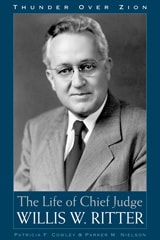
Thunder Over Zion
The Life and Times of Chief Judge Willis W RitterCowley & Nielson
University of Utah Press, 2006
Ritter was clearly ahead of his time, for his opinions on criminal justice, police interrogation, and the rights to counsel have now become accepted standards in jurisprudence. They are, indeed, so universally accepted that few if any viewers of televised police court dramas would even question them. In his personal life he was a man flawed on a grand scale and he lived a life fraught with contradictions. This is his compelling story, compellingly recounted.

Times of History
Universal Topics in Islamic HistoriographyAziz Al-Azmeh
Central European University Press, 2007

Times of Mobility
Transnational Literature and Gender in TranslationJasmina Lukic
Central European University Press, 2020

Times of Trouble
Violence in Russian Literature and CultureEdited by Marcus C. Levitt and Tatyana Novikov
University of Wisconsin Press, 2007
From the country that has added to our vocabulary such colorful terms as "purges," "pogroms," and "gulag," this collection investigates the conspicuous marks of violence in Russian history and culture.
Russians and non-Russians alike have long debated the reasons for this endemic violence. Some have cited Russia's huge size, unforgiving climate, and exposed geographical position as formative in its national character, making invasion easy and order difficult. Others have fixed the blame on cultural and religious traditions that spurred internecine violence or on despotic rulers or unfortunate episodes in the nation's history, such as the Mongol invasion, the rule of Ivan the Terrible, or the "Red Terror" of the revolution. Even in contemporary Russia, the specter of violence continues, from widespread mistreatment of women to racial antagonism, the product of a frustrated nationalism that manifests itself in such phenomena as the wars in Chechnya.
Times of Trouble is the first in English to explore the problem of violence in Russia. From a variety of perspectives, essays investigate Russian history as well as depictions of violence in the visual arts and in literature, including the works of Fyodor Dostoevsky, Isaac Babel, Mikhail Lermontov, and Nina Sadur. From the Mongol invasion to the present day, topics include the gulag, genocide, violence against women, anti-Semitism, and terrorism as a tool of revolution.
Times of Upheaval
Four Medievalists in Twentieth-Century Central Europe. Conversations with Jerzy Kloczowski, János M. Bak, František Šmahel, and Herwig WolframPavlína Rychterová
Central European University Press, 2019

Tony Oliva
The Life and Times of a Minnesota Twins LegendThom Henninger
University of Minnesota Press, 2019
If not for the botched Bay of Pigs invasion, Minnesota might never have known one of its most popular baseball players, Twins three-time batting champion and eight-time All-Star Tony Oliva. In April 1961, the twenty-two-year-old Cuban prospect failed to impress the Twins in a tryout, but the sudden rupture in U.S.–Cuba relations made a return visa all but impossible. The story of how Oliva’s unexpected stay led to a second chance and success with the Twins—as well as decades of personal and cultural isolation—is told for the first time in this full-scale biography of the man the fans affectionately call “Tony O.”
With unprecedented access to the very private Oliva, baseball writer Thom Henninger captures what life was like for the Cuban newcomer as he adjusted to major league play and American culture—and at the same time managed to earn Rookie of the Year honors and win the American League batting title in his first two seasons, all while playing with a knuckle injury. Packed with never-before-published photographs, the book follows Oliva through the 1965 season, all the way to the World Series, and then, with repaired knuckle and knee, into one of the most dramatic pennant races in baseball history in 1967. Through the voices of Oliva, his family, and his teammates—including the Cuban players who shared his cultural challenges and the future Hall of Famers he mentored, Rod Carew and Kirby Puckett—the personal and professional highs and lows of the years come alive: the Gold Glove Award in 1966, a third batting title in 1971, the devastating injury that curtailed his career, and, through it all, the struggle to build a family and recover the large and close-knit one he had left behind in Cuba.
Nearly forty years after Oliva’s retirement, the debate continues over whether his injury-shortened career was Hall of Fame caliber—a question that gets a measured and resounding answer here.
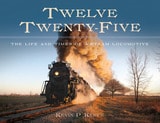
Twelve Twenty-Five
The Life and Times of a Steam LocomotiveKevin P. Keefe
Michigan State University Press, 2016
Pere Marquette 1225 was built in 1941 at the peak of steam locomotive development. The narrative traces the 1225’s regular freight service in Michigan, its unlikely salvation from the scrapyard for preservation at Michigan State University, and the subsequent work to bring it back to steam, first by a student club and later by a railroad museum. Milestones along the way include 1225’s retirement in 1951, its donation to MSU in 1957, its return to steam in 1988, a successful career hauling tens of thousands of excursion riders, and its starring role in the 2004 movie The Polar Express. The massive infrastructure that supported American steam locomotives in their heyday disappeared long ago, forcing 1225’s faithful to make their own spare parts, learn ancient railroad skills, and interpret the entire effort for the public. As such, the continuing career of 1225 is a triumph of historic preservation.
the lives & times of hrh
Herman Hochstadt
National University of Singapore Press, 2020