Results by title
205 books match the query 'University' and 47 start with t

T.S. Eliot - American Writers 8
University of Minnesota Pamphlets on American WritersLeonard Unger
University of Minnesota Press, 1961
T.S. Eliot - American Writers 8 was first published in 1961. Minnesota Archive Editions uses digital technology to make long-unavailable books once again accessible, and are published unaltered from the original University of Minnesota Press editions.
Tennessee Williams - American Writers 53
University of Minnesota Pamphlets on American WritersGerald Weales
University of Minnesota Press, 1965
Tennessee Williams - American Writers 53 was first published in 1965. Minnesota Archive Editions uses digital technology to make long-unavailable books once again accessible, and are published unaltered from the original University of Minnesota Press editions.
The American Short Story - American Writers 14
University of Minnesota Pamphlets on American WritersDanforth Ross
University of Minnesota Press, 1961
The American Short Story - American Writers 14 was first published in 1961. Minnesota Archive Editions uses digital technology to make long-unavailable books once again accessible, and are published unaltered from the original University of Minnesota Press editions.
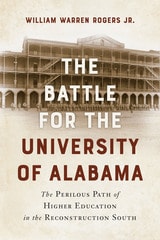
The Battle for the University of Alabama
The Perilous Path of Higher Education in the Reconstruction SouthWilliam Warren Rogers, Jr.
University of Alabama Press, 2025
Traces the little-known story of the bitter contest for the fate of the University of Alabama after the Civil War.
In The Battle for the University of Alabama, William Warren Rogers Jr. gives a fascinating account of the fierce struggle over the nature of the University of Alabama after the Civil War. Union forces reduced the campus to ruins as the war ended, and the university did not reopen until 1869. In the interregnum, powerful forces shifted the trajectory of the school. Alabama Republicans authored an egalitarian state constitution that delivered oversight of the university to the Republican Party. That set the stage for turmoil and confrontation. This book tells the story of that conflict.
In the next few years, Democrats charged Republicans with turning the university into a “radical” institution. They alleged that a handful of unqualified individuals had gained faculty positions because of their political allegiance, which resulted in the university’s academic desecration. Professors were bitterly denounced in the state newspaper press and quite personally in Tuscaloosa. Administration of the university became part of the fratricidal political debate in the state. Political violence and questions concerning race, specifically the possible integration of the university, illuminated the controversies of the Reconstruction years. Many of these questions resonate even today.
This authoritative account sets events at the University of Alabama against the backdrop of what occurred at other state universities in the Reconstruction South. The University of North Carolina experienced controversy similar to Alabama’s. At the University of Georgia, however, calm prevailed. This story of the incendiary events at Alabama’s flagship university charts new ground and provides a revelatory look into the extraordinary partisanship that characterized the South after the Civil War.

The Best in Children's Books
The University of Chicago Guide to Children's Literature, 1966-72Edited by Zena Sutherland
University of Chicago Press, 1973
This guide contains 1,400 reviews of the best children's literature published between 1966 and 1972.
The Best in Children's Books
The University of Chicago Guide to Children's Literature, 1973-78Zena Sutherland
University of Chicago Press, 1980
The Best in Children's Books
The University of Chicago Guide to Children's Literature, 1979-84Zena Sutherland
University of Chicago Press, 1986
This volume carries on the tradition established by Zena Sutherland's two earlier collections covering the periods from 1966 to 1972 and 1973 to 1978. Her 1973 edition of The Best in Children's Books was cited by the American School Board Journal as one of the outstanding books of the year in education.
The Conscience of the University, and Other Essays
By Harry Huntt Ransom
University of Texas Press, 1982
In 1982, a century after the laying of the cornerstone of its first building, the University of Texas was ranked by the New York Times among the best in the nation. No one had more to do with that extraordinary achievement than Harry Huntt Ransom. From 1935 to his death in 1976, he served the University in positions ranging from instructor in English to chancellor of The University of Texas System. In the fifties, sixties, and seventies, he held a succession of administrative posts requiring him to face a myriad of perplexing problems. Among the critical issues calling for analysis and decision in those years were the post-Sputnik pressure for greater emphasis on science and technology, the student revolts during the 1960s, and the defection of growing numbers of university faculty to industry and government.
Harry Huntt Ransom did not merely respond to the problems of the times. He had his own large ambitions for the University of Texas, in particular the improvement of student programs, the development of a vigorous faculty, and—the achievement for which he is best remembered—the building of a world-renowned library.
He was concerned with the role of the university in society, what the university should do and do well, and what it should not do. Always he viewed these matters in broad perspective, and his approach to them was far-sighted and deeply philosophical.
As dean, vice-president, president, and chancellor, Ransom wrote and spoke often on these and other important subjects. Aside from the books that he wrote and edited, he left a prodigious amount of material, some of which had been published in various journals and some of which had been delivered as lectures and addresses and never made available in printed form.
For the last twenty-five years of Ransom's life his wife, Hazel, was his closest companion and confidant. At the urging of Harry's friends, colleagues, and admirers, she undertook the task of sifting through her late husband's papers in an effort to organize and preserve some of the important contributions he had made to the thought and planning that were so instrumental in shaping the University of Texas and higher education in general. In these essays we see the force of reasoning and grace of style for which Ransom was so widely admired. It was he who reminded us that books last longer than buildings. This is a book of lasting importance that Harry Ransom himself might have given us had he lived longer.

The Division of Literature
Or the University in DeconstructionPeggy Kamuf
University of Chicago Press, 1996
Kamuf begins by analyzing the complex history of literary study within the modern university, critically reading developments from the French Revolution through the nineteenth century and beyond in Europe. She then turns to one of the most troubling works in the American literary canon—Melville's The Confidence-Man—to show how academic literary history has avoided confronting the implications of works in which meaning is never solely confined within a past. By engaging a future readership to which it applies for credit, Kamuf argues, literature cannot serve as a stable object of study. It locates, rather, a site of "the university in deconstruction."
Ranging from disciplinary histories of literature to our current culture wars, Kamuf offers a fascinating critique of academic literary study.
The Ethnobotanical Laboratory at the University of Michigan
Melvin R. Gilmore
University of Michigan Press, 1932
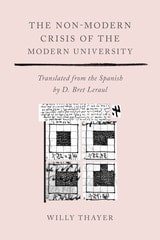
The Non-Modern Crisis of the Modern University
D. Bret Leraul and Willy Thayer
Northwestern University Press, 2025
A landmark work of critical theory about the Western university from the Southern Cone
Renowned Chilean philosopher Willy Thayer’s La crisis no moderna de la universidad moderna, first published in 1996 and in an updated edition in 2019, is a landmark work of critical theory from the Southern Cone. Presented in English for the first time, The Non-Modern Crisis of the Modern University rewrites the idea of the Western university while also diagnosing the ills of postdictatorship Chile through a philosophically informed dismantling of its neoliberal institutionalization of higher education. Bret Leraul’s translation advances the vital work of globalizing critical university studies by disseminating theory from the Global South. If the university helped to construct Chile’s neoliberal society, Thayer’s polemical deconstruction of both will help readers reconstruct the cultural politics of the era to better understand the global hegemony of neoliberalism today.
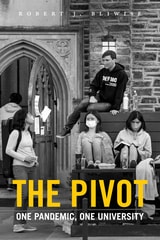
The Pivot
One Pandemic, One UniversityRobert J. Bliwise
Duke University Press, 2022
The Production of Living Knowledge
The Crisis of the University and the Transformation of Labor in Europe and North AmericaGigi Roggero
Temple University Press, 2011
Evaluating higher education institutions—particularly the rise of the “global university”—and their rapidly changing role in the global era, Gigi Roggero finds the system in crisis. In his groundbreaking book, The Production of Living Knowledge, Roggero examines the university system as a key site of conflict and transformation within “cognitive capitalism”—a regime in which knowledge has become increasingly central to the production process at large. Based on extensive fieldwork carried out through the activist method of conricerca, or “co-research,” wherein researchers are also subjects, Roggero’s book situates the crisis of the university and the changing composition of its labor force against the backdrop of the global economic crisis.
Combining a discussion of radical experiments in education, new student movements, and autonomist Marxian (or post-operaista) social theory, Roggero produces a distinctly transnational and methodologically innovative critique of the global university from the perspective of what he calls “living knowledge.”
In light of new student struggles in the United States and across the world, this first English-language edition is particularly timely.
The Reorder of Things
The University and Its Pedagogies of Minority DifferenceRoderick A. Ferguson
University of Minnesota Press, 2012
In the 1960s and 1970s, minority and women students at colleges and universities across the United States organized protest movements to end racial and gender inequality on campus. African American, Chicano, Asia American, American Indian, women, and queer activists demanded the creation of departments that reflected their histories and experiences, resulting in the formation of interdisciplinary studies programs that hoped to transform both the university and the wider society beyond the campus.
In The Reorder of Things, however, Roderick A. Ferguson traces and assesses the ways in which the rise of interdisciplines—departments of race, gender, and ethnicity; fields such as queer studies—were not simply a challenge to contemporary power as manifest in academia, the state, and global capitalism but were, rather, constitutive of it. Ferguson delineates precisely how minority culture and difference as affirmed by legacies of the student movements were appropriated and institutionalized by established networks of power.
Critically examining liberationist social movements and the cultural products that have been informed by them, including works by Adrian Piper, Toni Cade Bambara, Jhumpa Lahiri, and Zadie Smith, The Reorder of Things argues for the need to recognize the vulnerabilities of cultural studies to co-option by state power and to develop modes of debate and analysis that may be in the institution but are, unequivocally, not of it.

The Schoolhouse Door
Segregation's Last Stand at the University of AlabamaE. Culpepper Clark
University of Alabama Press, 2007
E. Culpepper Clark's book is a well-researched and crisply written narrative that draws its energy from the drama of the desegregation crisis in the postwar South. The first part of the story, covering the period 1943-57, centers on the admission to and expulsion from the University of Alabama of Autherine Lucy in 1956. In retrospect this appears as an opportunity for peaceful change that was tragically lost by inept university administrators and trustees, who stalled until Alabama's populist-New Deal politics shifted sharply toward segregationist defiance following the bus boycott in Montgomery in 1955-56. The second part centers on the events culminating in Wallace’s spectacular stand at Foster Auditorium in June 1963.
The flagship at Tuscaloosa, threatened by the research pace of the branch campuses at Birmingham and Huntsville, unable to keep or recruit superior faculty during the post-Sputnik boom years, weakly led by strong politicians like John Patterson and Wallace, emerged from the drama as a badly mauled institution, notable chiefly for its football team and Coach Paul 'Bear' Bryant

The Texas Book Two
More Profiles, History, and Reminiscences of the UniversityEdited by David Dettmer
University of Texas Press, 2012
In every corner of the sprawling enterprise that is the University of Texas at Austin, you will find teaching, research, artistic creation, and sports achievement that are among the best in the world. Mandated by the Texas constitution to be “a university of the first class,” UT Austin strives for excellence across the curriculum, from the most traditional of liberal arts disciplines to the cutting edge of science and technology. For Texans interested in progress, whether students of the university or members of the public, there are few pleasures greater than uncovering the intellectual treasures that can be found by exploring the university’s “Forty Acres” and all that they contain.
The Texas Book, edited by Richard A. Holland and published in 2006, offered the first in-depth exploration of UT’s history and traditions through a collection of profiles, histories, and reminiscences. Now The Texas Book Two continues the story, with a variety of contributors recalling particular events and personalities that have helped shape the university and the people whose lives it has touched. Twenty-one essays present personalities such as John A. Lomax, Anna Hiss, J. R. Parten, Harvey Penick, John W. Hargis, and Jorge Luis Borges; accounts of legislative battles and debates over campus architecture; histories of crown jewels such as the McDonald Observatory and Austin City Limits; and the reminiscences of Barbara Smith Conrad, Sam Hurt, and Cat Osterman, among others.
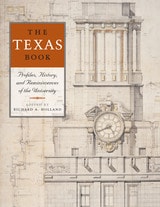
The Texas Book
Profiles, History, and Reminiscences of the UniversityEdited by Richard A. Holland
University of Texas Press, 2006
As the University of Texas at Austin celebrates its 125th anniversary, it can justly claim to be a "university of the first class," as mandated in the Texas Constitution. The university's faculty and student body include winners of the Nobel Prize, the Pulitzer Prize, the MacArthur "genius award," and Rhodes and Marshall Scholarships, as well as members of learned societies all over the world. UT's athletic programs are said to be the best overall in the United States, and its libraries, museums, and archives are lauded in every educated part of the world. Texas alumni have made their marks in law, engineering, geology, business, journalism, and all fields of the sciences, arts, and entertainment.
The Texas Book gathers together personality profiles, historical essays, and first-person reminiscences to create an informal, highly readable history of UT. Many fascinating characters appear in these pages, including visionary president and Ransom Center founder Harry Huntt Ransom, contrarian English professor and Texas folklorist J. Frank Dobie, legendary regent and lightning rod Frank C. Erwin, and founder of the field of Mexican American Studies, Américo Paredes. The historical pieces recall some of the most dramatic and challenging episodes in the university's history, including recurring attacks on the school by politicians and regents, the institution's history of segregation and struggles to become a truly diverse university, the sixties' protest movements, and the Tower sniper shooting. Rounding off the collection are reminiscences by former and current students and faculty, including Walter Prescott Webb, Willie Morris, Betty Sue Flowers, J. M. Coetzee, and Barbara Jordan, who capture the spirit of the campus at moments in time that defined their eras.
The Uberfication of the University
Gary Hall
University of Minnesota Press, 2016
Even after the 2008 financial crisis, neoliberalism has been able to advance its program of privatization and deregulation. The Uberfication of the University analyzes the emergence of the sharing economy—an economy that has little to do with sharing access to good and services and everything to do with selling this access—and the companies behind it: LinkedIn, Uber, and Airbnb. In this society, we all are encouraged to become microentrepreneurs of the self, acting as if we are our own precarious freelance enterprises at a time when we are being steadily deprived of employment rights, public services, and welfare support. The book considers the contemporary university, itself subject to such entrepreneurial practices, as one polemical site for the affirmative disruption of this model.
Forerunners is a thought-in-process series of breakthrough digital works. Written between fresh ideas and finished books, Forerunners draws on scholarly work initiated in notable blogs, social media, conference plenaries, journal articles, and the synergy of academic exchange. This is gray literature publishing: where intense thinking, change, and speculation take place in scholarship.
The University and Social Justice
Struggles Across the GlobeAziz Choudry
Pluto Press, 2020
Whether calling for the decommodification or the decolonization of education, many of these struggles have attempted to draw on (and in turn, resonate with) longer histories of popular resistance, broader social movements and radical visions of a fairer world. In this critical collection, Aziz Choudry, Salim Vally and a host of international contributors bring grounded, analytical accounts of diverse struggles relating to higher education into conversation with each other.
Featuring contributions written by students and staff members on the frontline of struggles from 12 different countries, including Canada, Chile, France, India, Mexico, Nigeria, Occupied Palestine, the Philippines, South Africa, Turkey, the UK and the USA, the book asks what can be learned from these movements' strategies, demands and visions.
The University and the People
Envisioning American Higher Education in an Era of Populist ProtestScott M. Gelber
University of Wisconsin Press, 2011
The University and the People chronicles the influence of Populism—a powerful agrarian movement—on public higher education in the late nineteenth century. Revisiting this pivotal era in the history of the American state university, Scott Gelber demonstrates that Populists expressed a surprising degree of enthusiasm for institutions of higher learning. More fundamentally, he argues that the mission of the state university, as we understand it today, evolved from a fractious but productive relationship between public demands and academic authority.
Populists attacked a variety of elites—professionals, executives, scholars—and seemed to confirm academia’s fear of anti-intellectual public oversight. The movement’s vision of the state university highlighted deep tensions in American attitudes toward meritocracy and expertise. Yet Populists also promoted state-supported higher education, with the aims of educating the sons (and sometimes daughters) of ordinary citizens, blurring status distinctions, and promoting civic engagement. Accessibility, utilitarianism, and public service were the bywords of Populist journalists, legislators, trustees, and sympathetic professors. These “academic populists” encouraged state universities to reckon with egalitarian perspectives on admissions, financial aid, curricula, and research. And despite their critiques of college “ivory towers,” Populists supported the humanities and social sciences, tolerated a degree of ideological dissent, and lobbied for record-breaking appropriations for state institutions.
The University in the Twenty-first Century
Teaching the New Enlightenment in the Digital AgeHannes Klöpper
Central European University Press, 2016
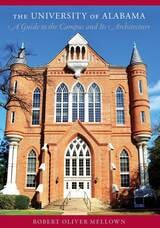
The University of Alabama
A Guide to the Campus and Its ArchitectureRobert Oliver Mellown
University of Alabama Press, 2013
In 1988 the University of Alabama Press published Robert Oliver Mellown’s The University of Alabama: A Guide to the Campus, a culmination of a decade’s worth of research into both the facts and the legends surrounding the architecture, history, and traditions of the Capstone.
Over twenty years later, this new guide brings to light the numerous additions, expansions, and renovations the university has undergone on its spacious grounds in Tuscaloosa. In addition to updated sections devoted to the university’s historic landmarks—such as Foster Auditorium, where “the stand in the schoolhouse door” occurred; Denny Chimes,where the handprints and footprints of famous Tide athletes are memorialized in concrete; and the Gorgas House, which with stood the destruction of Union troops at the end of the Civil War—new sections account for the acquisition of Bryce Hospital’s campus, the expansions at Bryant-Denny Stadium to accommodate the growing Crimson Tide fan base, and the burgeoning student recreation facilities, playing fields, and residential communities.
Chapters are arranged into various campus tours for walking or driving—Antebellum, Victorian, Early Twentieth-Century, East Quad, West Quad, Science and Engineering Corridor, Student Life, Bryce, Medical, Southeast, Athletics, and Off Campus. Alumni, prospective students and their parents, new faculty, out-of-state visitors, and foreign dignitaries will all welcome this useful, compact, and colorful guide to one of the most beautiful campuses in the country.
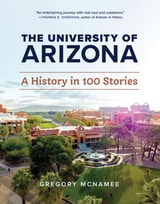
The University of Arizona
A History in 100 StoriesGregory McNamee
University of Arizona Press, 2024
The University of Arizona: A History in 100 Stories is a celebration of the people, ideas, inventions, teaching, and structures that have been part of the school’s evolution from a small land-grant institution to an internationally renowned research institution. Drawing on half a century of connection with the University of Arizona as a student, staff member, and faculty member, Gregory McNamee presents a history through the lens of a hundred subjects.
That story begins in 1885, with the establishment of the school, which quickly proved itself to be a powerhouse in its foundational “four pillars”: agriculture and earth sciences, followed by astronomy and anthropology. In the years following World War II, those four pillars became ever more important to the University, even as countless other fields of study gained prominence: optical sciences, women’s studies, the humanities, mathematics, and more. This phenomenal institution has as its setting the Sonoran Desert, and, closer to home, to a built environment that is widely considered among the most scenic in the country, from the Historic District with its buildings that are more than a century old to the latest steel-and-glass constructions on the edges of the ever-expanding campus.
McNamee relates this history in an entertaining manner, peppering discussion of serious intellectual and institutional themes with lighter moments—the origins of the university's rivalry with Arizona State, the ghosts that are said to lurk about campus, and more. Wildcats everywhere will delight in McNamee’s celebration of the people, places, learning, books, and pastimes that have distinguished our school.
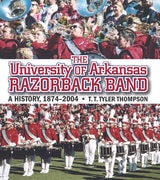
The University of Arkansas Razorback Band
A History, 1874-2004T.T. Tyler Thompson
University of Arkansas Press, 2004
From the small Cadet Band that supported the school’s military department to the “best in sight and sound” Marching Razorbacks that are a staple of the university’s athletic program, the band has provided the soundtrack to the University of Arkansas.
The rich history of the Razorback Band has spanned almost the entire existence of the University of Arkansas. This book documents the distinguished 130-year history of the band from its humble beginnings in 1874 as an adjunct to the military cadet squad to the major college organization that it is today. Both as a supporting player of the military and ROTC programs and of the athletic department, the Razorback Band has provided the spirited musical excitement required through the years, as well as performing concerts on its own for an appreciative student body and community audience with the Concert Band and Wind Ensemble. Add to that the parallel story of the evolution of an exciting basketball and volleyball spirit band—the Hogwild Band—and you have in this lavishly illustrated book the first-ever history of the music makers of the University of Arkansas.
The University of Chicago Spanish Dictionary, Fifth Edition, Spanish-English, English-Spanish
Universidad de Chicago Diccionario Español-Inglés, Inglés-EspañolEdited by David A. Pharies
University of Chicago Press, 2002
With thousands of added entries, the Dictionary builds on the features that have made it the leader in its field for more than fifty years: authority, scope, clarity, and conciseness. And with this edition, the Dictionary brilliantly captures the current core vocabularies of two rapidly changing—and increasingly connected—languages and cultures.
Entirely bilingual, the fifth edition focuses on two contemporary international languages—American English and a basic, worldwide Spanish that draws from both Latin American and Iberian sources.
Designed for a wide range of users, including travelers, businesspeople, students, teachers, and professionals, the new Dictionary is the essential first resource for speakers of both languages—from beginners to those at all other stages. Up to date, just comprehensive enough, and extraordinarily clear and easy to use, the new edition of The University of Chicago Spanish Dictionary stands alone. No other dictionary offers so many users so much help—or so much value.
The University of Chicago Spanish-English Dictionary, Sixth Edition
Diccionario Universidad de Chicago Inglés-Español, Sexta EdiciónDavid A. Pharies, Editor in Chief
University of Chicago Press, 2012
A concise, authoritative, up-to-date guide to Spanish and English
The University of Chicago Spanish–English Dictionary has long set the standard for concise bilingual dictionaries. Portable yet remarkably thorough, the dictionary enables users to find the precise equivalents of the words and phrases they seek.
The University of Chicago
A HistoryJohn W. Boyer
University of Chicago Press, 2015
With The University of Chicago: A History, John W. Boyer, Dean of the College since 1992, presents a deeply researched and comprehensive history of the university. Boyer has mined the archives, exploring the school’s complex and sometimes controversial past to set myth and hearsay apart from fact. The result is a fascinating narrative of a legendary academic community, one that brings to light the nature of its academic culture and curricula, the experience of its students, its engagement with Chicago’s civic community, and the conditions that have enabled the university to survive and sustain itself through decades of change.
Boyer’s extensive research shows that the University of Chicago’s identity is profoundly interwoven with its history, and that history is unique in the annals of American higher education. After a little-known false start in the mid-nineteenth century, it achieved remarkable early successes, yet in the 1950s it faced a collapse of undergraduate enrollment, which proved fiscally debilitating for decades. Throughout, the university retained its fierce commitment to a distinctive, intense academic culture marked by intellectual merit and free debate, allowing it to rise to international acclaim. Today it maintains a strong obligation to serve the larger community through its connections to alumni, to the city of Chicago, and increasingly to its global community.
Published to coincide with the 125th anniversary of the university, this must-have reference will appeal to alumni and anyone interested in the history of higher education of the United States.
The University of Chicago
A HistoryJohn W. Boyer
University of Chicago Press, 2024
One of the most influential institutions of higher learning in the world, the University of Chicago has a powerful and distinct identity, and its name is synonymous with intellectual rigor. With nearly 170,000 alumni living and working in more than one hundred and fifty countries, its impact is far-reaching and long-lasting.
With The University of Chicago: A History, John W. Boyer, Dean of the College from 1992 to 2023, thoroughly engages with the history and the lived politics of the university. Boyer presents a history of a complex academic community, focusing on the nature of its academic culture and curricula, the experience of its students, its engagement with Chicago’s civic community, and the resources and conditions that have enabled the university to sustain itself through decades of change. He has mined the archives, exploring the school’s complex and sometimes controversial past to set myth and hearsay apart from fact.
Boyer’s extensive research shows that the University of Chicago’s identity is profoundly interwoven with its history, and that history is unique in the annals of American higher education. After a little-known false start in the mid-nineteenth century, it achieved remarkable early successes, yet in the 1950s it faced a collapse of undergraduate enrollment, which proved fiscally debilitating for decades. Throughout, the university retained its fierce commitment to a distinctive, intense academic culture marked by intellectual merit and free debate, allowing it to rise to international acclaim. Today it maintains a strong obligation to serve the larger community through its connections to alumni, to the city of Chicago, and increasingly to its global community. Boyer’s tale is filled with larger-than-life characters—John D. Rockefeller, Robert Maynard Hutchins, and many other famous figures among them—and episodes that reveal the establishment and rise of today’s institution.
Newly updated, this edition extends through the presidency of Robert Zimmer, whose long tenure was marked by significant developments and controversies over subjects as varied as free speech, medical inequity, and community relations.
The University of Hip-Hop
PoemsMayda Del Valle, foreword by Chris Abani
Northwestern University Press, 2017

The University of Illinois, 1894-1904
THE SHAPING OF THE UNIVERSITYWinton U. Solberg
University of Illinois Press, 2000
The years 1894 to 1904 mark the stormy tenure of Andrew S. Draper as president of the University of Illinois. Draper, a successful superintendent of schools with no college or university experience and no credentials as a post-secondary administrator, presided over many crucial improvements in the university's physical plant, curricula, and other areas. However, he failed to infuse the university with a spirit of cohesion, and his term as president was fraught with conflict.
From his inauguration on, the autocratic Draper collided with deans and faculty who opposed both the substance of his changes and the manner in which he presented and implemented them.
This volume closely examines the Draper years from the perspectives of faculty, students, and administrators. Solberg outlines the administrative, faculty, staff, and physical infrastructure. He also reveals a vibrant and varied student life, including a whirl of social activities, literary societies, intercollegiate debate and athletics, hazing, religion, and increasingly prominent fraternities.
A sharply delineated and detailed picture of a university in transition, The University of Illinois, 1894-1904 traces the school's shift from an institution known primarily as a training ground for engineers to a full-fledged university poised to compete on the national level.
The University of Illinois
Engine of InnovationEdited by Frederick E. Hoxie
University of Illinois Press, 2017
The University of Iowa Guide to Campus Architecture
John Beldon Scott
University of Iowa Press, 2006
The University of Iowa Guide to Campus Architecture, Second Edition
John Beldon Scott and Rodney P. Lehnertz
University of Iowa Press, 2016
The University of Iowa in the Twentieth Century
An Institutional HistoryStow Persons
University of Iowa Press, 1990

The University of Manitoba
An Illustrated HistoryJ.M. Bumsted
University of Manitoba Press, 2001

The University of Michigan & China, 1845 – 2017
Neal McKenna
Michigan Publishing Services, 2017
Throughout the last two centuries U.S. administrations from President Lincoln to President Clinton have relied on U-M leaders and faculty to engage China and develop political and cultural relationships. The University of Michigan was one of the first universities in the U.S. to enroll Chinese students and has many prominent Chinese graduates, including a Nobel Laureate and the first female college president in China.
As U-M celebrates its own bicentennial, this book recounts the university's considerable history with Chinese governments, people and culture. The book also updates readers on the current and ongoing partnerships between different U-M departments and schools with Chinese institutions, and provides a list of several prominent Chinese graduates of the University of Michigan.
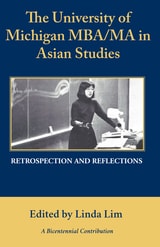
The University of Michigan MBA/MA in Asian Studies Retrospection and Reflections
A Bicentennial ContributionLinda Lim
Michigan Publishing Services, 2020
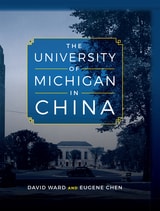
The University of Michigan in China
David Ward and Eugene Chen
Michigan Publishing Services, 2017
This book tells the story of twenty remarkable individuals, the country they transformed, and the University that helped them do it. There are many “firsts” in this book—first Chinese students at U-M, first female college president of China—and there are many “fathers” of disciplines: Wu Dayou, father of physics in China; Zheng Zuoxin, father of Chinese ornithology; Zeng Chengkui, father of marine botany.
While much has been written about these leaders and scholars in both English and Chinese, nowhere else is their collective story told or their shared bond with the University of Michigan celebrated.
The University of Michigan in China celebrates this nearly 200-year-old legacy.
The University of Michigan
A Pictorial HistoryRuth Bordin
University of Michigan Press, 1967
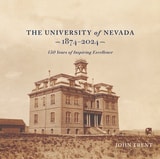
The University of Nevada, 1874-2024
150 Years of Inspiring ExcellenceJohn Trent
University of Nevada Press, 2024
As both the University’s student body and the state’s population grew, the campus was transferred to Reno in 1885-86 as an effort to secure the fledgling institution’s prospects for survival. Many of the initial class of thirty-five students resided in Morrill Hall, the only building on campus, where they also received instruction and ate their meals. As the University enhanced its academic offerings, enrollment grew to more than 1,000 students by the turn of the century. A strong belief that the University must always be changing and evolving to meet the needs of its students and answer the challenges of a particular era became the guiding forces behind the administration’s decision-making. With an increasingly diverse student body and one of the most productive academic faculties in the country, the little school on the hill expanded during its first 100 years to become a leading public university in the western United States.
Today, the University continues to achieve institutional benchmarks, including a record 5,000 graduates during the 2019–20 academic year. It is exactly this kind of student success that has always been at the heart of the Wolf Pack Family’s mission to help students find the path that is right for them, and beckon others to share in their journey.
The 150th anniversary book is published in honor of this milestone and highlights numerous parts of the University’s history, showcasing why the University of Nevada, Reno has truly been a catalyst for success and change throughout the state’s story.

The University of Oxford
A Brief HistoryLaurence Brockliss
Bodleian Library Publishing, 2018
This book offers a succinct illustrated account of the university’s colorful and controversial eight-hundred-year history, from medieval times through the Reformation and on to the nineteenth century, in which the foundations of the modern tutorial system were laid. It describes the extraordinary and influential people who shaped the development of the institution and helped to create today’s world-class research university.
Richly illustrated with archival material, prints, and portraits, this book explores how a university in a small provincial town rose to become one of the top universities in the world at the beginning of the twenty-first century.

The University, Volume 27
Paul A. Bové, ed.
Duke University Press, 0
Theodore Dreiser - American Writers 102
University of Minnesota Pamphlets on American WritersW.M. Frohock
University of Minnesota Press, 1972
Theodore Dreiser - American Writers 102 was first published in 1972. Minnesota Archive Editions uses digital technology to make long-unavailable books once again accessible, and are published unaltered from the original University of Minnesota Press editions.
Theodore Roethke - American Writers 30
University of Minnesota Pamphlets on American WritersRalph J. Mills Jr.
University of Minnesota Press, 1963
Theodore Roethke - American Writers 30 was first published in 1963. Minnesota Archive Editions uses digital technology to make long-unavailable books once again accessible, and are published unaltered from the original University of Minnesota Press editions.
Thomas Wolfe - American Writers 6
University of Minnesota Pamphlets on American WritersC. Hugh Holman
University of Minnesota Press, 1960
Thomas Wolfe - American Writers 6 was first published in 1960. Minnesota Archive Editions uses digital technology to make long-unavailable books once again accessible, and are published unaltered from the original University of Minnesota Press editions.
Thornton Wilder - American Writers 34
University of Minnesota Pamphlets on American WritersBernard Grebanier
University of Minnesota Press, 1964
Thornton Wilder - American Writers 34 was first published in 1964. Minnesota Archive Editions uses digital technology to make long-unavailable books once again accessible, and are published unaltered from the original University of Minnesota Press editions.
Turning the Tide
The University of Alabama in the 1960sEarl H. Tilford
University of Alabama Press, 2014
Earl H. Tilford details the origins of the student movement from within the Student Government Association, whose leaders included Ralph Knowles and future governor Don Siegelman, among others; the participation of key members of “The Machine,” the political faction made up of the powerful fraternities and sororities on campus; and the efforts of more radical non-Greek students like Jack Drake, Ed Still, and Sondra Nesmith. Tilford also details the political maneuverings that drove the cause of social change through multiple administrations at the university. Turning the Tide highlights the contributions of university presidents Frank A. Rose and David Mathews, as well as administrators like the dean of men John L. Blackburn, who supported the student leaders but also encouraged them to work within the system rather than against it.
Based on archival research, interviews with many of the principal participants, and the author’s personal experiences, Tilford’s Turning the Tide is a compelling portrait of a university in transition during the turbulence surrounding the civil rights and anti-war movements of the 1960s.