Results by title
349 books match the query 'Violence' and 68 start with t
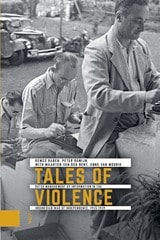
Tales of Violence
Dutch Management of Information in the Indonesian War of Independence, 1945-1949Remco Raben
Amsterdam University Press, 2027
How were the violence of war and the numerous excesses between 1945-1949 discussed, concealed, passed on, manipulated, and used politically? What did Dutch, colonial, and Indonesian politicians and administrators know about the nature of the actions of their own and enemy troops?
Why did investigations into specific scandals grind to a halt or were their outcomes hidden from the public? What did those in charge do with their knowledge and how did communications influence public support for warfare? The authors argue that the way the war in Indonesia has long been viewed has its origins partly in the language and manipulation of information during the conflict.

Terror and Violence
Imagination and the UnimaginableEdited by Pamela J. Stewart, Andrew Strathern, and Neil L. Whitehead
Pluto Press, 2005
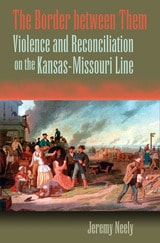
The Border between Them
Violence and Reconciliation on the Kansas-Missouri LineJeremy Neely
University of Missouri Press, 2007
The most bitter guerrilla conflict in American history raged along the Kansas-Missouri border from 1856 to 1865, making that frontier the first battleground in the struggle over slavery. That fiercely contested boundary represented the most explosive political fault line in the United States, and its bitter divisions foreshadowed an entire nation torn asunder. Jeremy Neely now examines the significance of the border war on both sides of the Kansas-Missouri line and offers a comparative, cross-border analysis of its origins, meanings, and consequences.
A narrative history of the border war and its impact on citizens of both states, The Border between Them recounts the exploits of John Brown, William Quantrill, and other notorious guerrillas, but it also uncovers the stories of everyday people who lived through that conflict. Examining the frontier period to the close of the nineteenth century, Neely frames the guerrilla conflict within the larger story of the developing West and squares that violent period with the more peaceful—though never tranquil—periods that preceded and followed it.
Focusing on the countryside south of the big bend in the Missouri River, an area where there was no natural boundary separating the states, Neely examines three border counties in each state that together illustrate both sectional division and national reunion. He draws on the letters and diaries of ordinary citizens—as well as newspaper accounts, election results, and census data—to illuminate the complex strands that helped bind Kansas and Missouri together in post–Civil War America. He shows how people on both sides of the line were already linked by common racial attitudes, farming practices, and ambivalence toward railroad expansion; he then tells how emancipation, industrialization, and immigration eventually eroded wartime divisions and facilitated the reconciliation of old foes from each state.
Today the “border war” survives in the form of interstate rivalries between collegiate Tigers and Jayhawks, allowing Neely to consider the limits of that reconciliation and the enduring power of identities forged in wartime. The Border between Them is a compelling account of the terrible first act of the American Civil War and its enduring legacy for the conflict’s veterans, victims, and survivors, as well as subsequent generations.

The Civilization of Crime
Violence in Town and Country since the Middle AgesEdited by Eric A. Johnson and Eric H. Monkkonen
University of Illinois Press, 1996
of Western culture, has crime itself become more "civilized"?
This book exposes as myths the beliefs that society has become more violent
than it has been in the past and that violence is more likely to occur
in cities than in rural areas.
The product of years of study
by scholars from North America and Europe, The Civilization of Crime
shows that, however violent some large cities may be now, both rural and
urban communities in Sweden, Holland, England, and other countries were
far more violent during the late Middle Ages than any cities are today.
Contributors show that the
dramatic change is due, in part, to the fact that violence was often tolerated
or even accepted as a form of dispute settlement in village-dominated
premodern society. Interpersonal violence declined in the seventeenth
and eighteenth centuries, as dispute resolution was taken over by courts
and other state institutions and the church became increasingly intolerant
of it.
The book also challenges a
number of other historical-sociological theories, among them that contemporary
organized crime is new, and addresses continuing debate about the meaning
and usefulness of crime statistics.
CONTRIBUTORS: Esther Cohen,
Herman Diederiks, Florike Egmond, Eric A. Johnson, Michele Mancino, Eric
H. Monkkonen, Eva Österberg, James A. Sharpe, Pieter Spierenburg,
Jan Sundin, Barbara Weinberger

The Colfax County War
Violence and Corruption in Territorial New MexicoCorey Recko
University of North Texas Press, 2024
The Colors of Violence
Cultural Identities, Religion, and ConflictSudhir Kakar
University of Chicago Press, 1996
With honesty, insight, and unsparing self-reflection, Kakar confronts the profoundly enigmatic relations that link individual egos to cultural moralities and religious violence. His innovative psychological approach offers a framework for understanding the kind of ethnic-religious conflict that has so vexed social scientists in India and throughout the world.
Through riveting case studies, Kakar explores cultural stereotypes, religious antagonisms, ethnocentric histories, and episodic violence to trace the development of both Hindu and Muslim psyches. He argues that in early childhood the social identity of every Indian is grounded in traditional religious identifications and communalism. Together these bring about deep-set psychological anxieties and animosities toward the other. For Hindus and Muslims alike, violence becomes morally acceptable when communally and religiously sanctioned. As the changing pressures of modernization and secularism in a multicultural society grate at this entrenched communalism, and as each group vies for power, ethnic-religious conflicts ignite. The Colors of Violence speaks with eloquence and urgency to anyone concerned with the postmodern clash of religious and cultural identities.
The Complexity of Evil
Perpetration and GenocideTimothy Williams
Rutgers University Press, 2021
Download the open access ebook here.
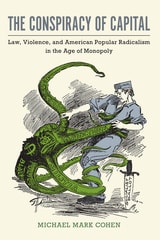
The Conspiracy of Capital
Law, Violence, and American Popular Radicalism in the Age of MonopolyMichael Mark Cohen
University of Massachusetts Press, 2019
In this detailed cultural history, Michael Mark Cohen argues that a legal, ideological, and representational politics of conspiracy contributed to the formation of a genuinely revolutionary mass culture in the United States, starting with the 1886 Haymarket bombing. Drawing on a wealth of primary sources, The Conspiracy of Capital offers a new history of American radicalism and the alliance between the modern business corporation and national security state through a comprehensive reassessment of the role of conspiracy laws and conspiracy theories in American social movements.
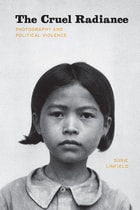
The Cruel Radiance
Photography and Political ViolenceSusie Linfield
University of Chicago Press, 2010
The Cultural Origins of the French Revolution
Roger Chartier
Duke University Press, 1991
Chartier has set himself two important tasks. First, while acknowledging the seminal contribution of Daniel Mornet’s Les origens intellectuelles de la Révolution française (1935), he synthesizes the half-century of scholarship that has created a sociology of culture for Revolutionary France, from education reform through widely circulated printed literature to popular expectations of government and society. Chartier goes beyond Mornet’s work, not be revising that classic text but by raising questions that would not have occurred to its author.
Chartier’s second contribution is to reexamine the conventional wisdom that there is a necessary link between the profound cultural transformation of the eighteenth century (generally characterized as the Enlightenment) and the abrupt Revolutionary rupture of 1789. The Cultural Origins of the French Revolution is a major work by one of the leading scholars in the field and is likely to set the intellectual agenda for future work on the subject.

The Culture of Violence
Essays on Tragedy and HistoryFrancis Barker
University of Chicago Press, 1993
Central to his argument is the contention that, contrary to post-Enlightenment humanist, liberal and conservative thought, 'culture' does not necessarily stand in opposition to political inequality and social injustice, but may be complicit with the oppressive exercise of power.
The book focuses on Shakespearean tragedy and on the historicism and culturalism of much present-day cultural theory. Barker's analysis moves dialectically backwards and forwards between these two moments in order to illuminate aspects of early modern culture, and to critique the ways in which the complicity between culture and violence has been occluded. Rejecting the tendency of both modernism and post-modernism to homogenise historical time, Barker argues for a genuinely new, 'diacritical' understanding of the violence of history.
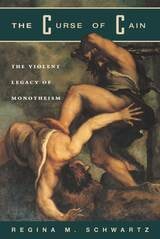
The Curse of Cain
The Violent Legacy of MonotheismRegina M. Schwartz
University of Chicago Press, 1997
"[A] provocative and timely examination of the interrelationship of monotheism and violence. . . . This is a refreshing alternative to criticism-biblical and otherwise-that so often confuses interpretation with closure; it is an invitation to an ethic of possibility, plenitude, and generosity, a welcome antidote to violence, as important for its insights into memory, identity, and place as for its criticism of monotheism's violent legacy."—Booklist
"Brilliant and provocative, this is a work demanding close attention from critics, theologians, and all those interested in the imaginative roots of common life."—Rowan Williams, Bishop of Monmouth
"A stunningly important book."—Walter Brueggemann, Theology Today
"Artfully rendered, endlessly provocative."—Lawrence Weschler, New Yorker

The Devil's Triangle
Ben Bickerstaff, Northeast Texans, and the War of Reconstruction in TexasJames M. Smallwood
University of North Texas Press, 2007
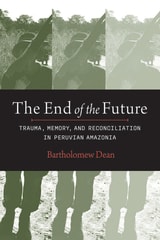
The End of the Future
Trauma, Memory, and Reconciliation in Peruvian AmazoniaBartholomew Dean
Vanderbilt University Press, 2023
To give context to the causes and consequences of the MRTA's presence in the lower and central Huallaga, this book relies on the written works and testimony of Sístero García Torres, an MRTA rebel commander; the government's Truth and Reconciliation Commission; MRTA propaganda; media accounts; and critical historical texts. Besides exposing Huallaga Valley human rights abuses, the book's contribution to political anthropology is consequential for its insistence that reconciliation is by no means equivalent to local, Indigenous notions of "justice" or customary forms of dispute resolution. Without deliberately addressing the diverse socio-cultural contours defining overlapping epistemologies of justice, freedom, and communal well-being, enduring reconciliation will likely remain elusive.
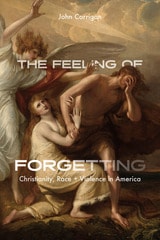
The Feeling of Forgetting
Christianity, Race, and Violence in AmericaJohn Corrigan
University of Chicago Press, 2023
The dual traumas of colonialism and slavery are still felt by Native Americans and African Americans as victims of ongoing violence toward people of color today. In The Feeling of Forgetting, John Corrigan calls attention to the trauma experienced by white Americans as perpetrators of this violence. By tracing memory’s role in American Christianity, Corrigan shows how contemporary white Christian nationalism is motivated by a widespread effort to forget the role race plays in American society. White trauma, Corrigan argues, courses through American culture like an underground river that sometimes bursts forth into brutality, terrorism, and insurrection. Tracing the river to its source is a necessary first step toward healing.
The Feeling of Forgetting
Christianity, Race, and Violence in AmericaJohn Corrigan
University of Chicago Press, 2023
A provocative examination of how religious practices of forgetting drive white Christian nationalism.
The dual traumas of colonialism and slavery are still felt by Native Americans and African Americans as victims of ongoing violence toward people of color today. In The Feeling of Forgetting, John Corrigan calls attention to the trauma experienced by white Americans as perpetrators of this violence. By tracing memory’s role in American Christianity, Corrigan shows how contemporary white Christian nationalism is motivated by a widespread effort to forget the role race plays in American society. White trauma, Corrigan argues, courses through American culture like an underground river that sometimes bursts forth into brutality, terrorism, and insurrection. Tracing the river to its source is a necessary first step toward healing.
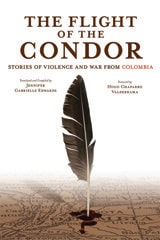
The Flight of the Condor
Stories of Violence and War from ColombiaTranslated and compiled by Jennifer Gabrielle Edwards; Foreword by Hugo Chaparro
University of Wisconsin Press, 2007
This anthology reflects some of Colombia’s finest literary talent, and most of these stories appear here for the first time in English translation. They reveal the contradictions and complexities of the human condition, yet they also offer hope for the future. In their bold revelations of the depths of despair, these writers provide gripping portrayals of humanity’s tenacious resistance to those very depths.

The Future of Youth Violence Prevention
A Mixtape for Practice, Policy, and ResearchPaul Boxer
Rutgers University Press, 2025
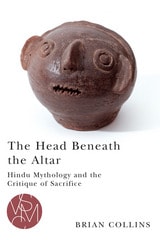
The Head Beneath the Altar
Hindu Mythology and the Critique of SacrificeBrian Collins
Michigan State University Press, 2014

The Hirschfeld Archives
Violence, Death, and Modern Queer CultureHeike Bauer
Temple University Press, 2017
Influential sexologist and activist Magnus Hirschfeld founded Berlin’s Institute of Sexual Sciences in 1919 as a home and workplace to study homosexual rights activism and support transgender people. It was destroyed by the Nazis in 1933. This episode in history prompted Heike Bauer to ask, Is violence an intrinsic part of modern queer culture? The Hirschfeld Archives answers this critical question by examining the violence that shaped queer existence in the first part of the twentieth century.
Hirschfeld himself escaped the Nazis, and many of his papers and publications survived. Bauer examines his accounts of same-sex life from published and unpublished writings, as well as books, articles, diaries, films, photographs and other visual materials, to scrutinize how violence—including persecution, death and suicide—shaped the development of homosexual rights and political activism.
The Hirschfeld Archives brings these fragments of queer experience together to reveal many unknown and interesting accounts of LGBTQ life in the early twentieth century, but also to illuminate the fact that homosexual rights politics were haunted from the beginning by racism, colonial brutality, and gender violence.

The Horrell Wars
Feuding in Texas and New MexicoDavid Johnson
University of North Texas Press, 2014
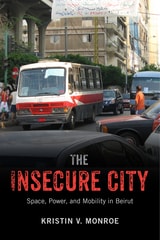
The Insecure City
Space, Power, and Mobility in BeirutMonroe, Kristin V
Rutgers University Press, 2016
Download open access ebook here.
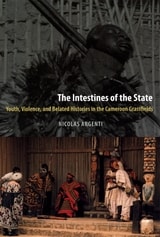
The Intestines of the State
Youth, Violence, and Belated Histories in the Cameroon GrassfieldsNicolas Argenti
University of Chicago Press, 2007
Beginning his study with a political analysis of youth in the Grassfields from the eighteenth century to the present, Argenti pays special attention to the repeated violent revolts staged by young victims of political oppression. He then combines this history with extensive ethnographic fieldwork in the Oku chiefdom, discovering that the specter of past violence lives on in the masked dance performances that have earned intense devotion from today’s youth. Argenti contends that by evoking the imagery of past cataclysmic events, these masquerades allow young Oku men and women to address the inequities they face in their relations with elders and state authorities today.
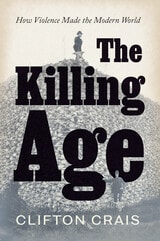
The Killing Age
How Violence Made the Modern WorldClifton Crais
University of Chicago Press, 2025
We are used to speaking of the Anthropocene and the outsized impact humans have had on the planet. But we sometimes lose sight of a fundamental truth at the heart of modern world history: the legacy of human predation, slavery, and imperialism that has devastated the natural world and led us to our present moment. As historian Clifton Crais shows in this magisterial work, the period that we most associate with human progress—which gave us the Enlightenment, the rise of democracies, the Industrial Revolution, and more—was at the same time catastrophically destructive.
In this bracing, landmark book, Crais urges us to view the growth of global capitalism between 1750 and the early 1900s not as the Anthropocene, but as the Mortecene: the Killing Age. Killing brought the world together and tore it apart, as profiteering warlords committed mass-scale slaughter of humans and animals across Africa, Asia, and the Americas. The newfound ease and profitability of killing created a disturbing network of global connections and economies, eliminating tens of millions of people and sparking an environmental crisis that remains the most urgent catastrophe facing the world today.
Drawing on years of scholarship and marshaling myriad sources across world history, The Killing Age turns our vision of past and present on its head, illuminating the Mortecene in all its horror—how it shaped who we are, what we value and fear, and the precarious present we inhabit today.

The Last Cheater's Waltz
Beauty and Violence in the Desert SouthwestEllen Meloy
University of Arizona Press, 1999
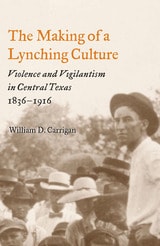
The Making of a Lynching Culture
Violence and Vigilantism in Central Texas, 1836-1916William D. Carrigan
University of Illinois Press, 2006
How a culture of violence legitimized lynching among ordinary people
On May 15, 1916, a crowd of fifteen thousand witnessed the lynching of an eighteen-year-old black farm worker named Jesse Washington. Most central Texans of the time failed to call for the punishment of the mob’s leaders. In The Making of a Lynching Culture, now in paperback, William D. Carrigan seeks to explain not how a fiendish mob could lynch one man but how a culture of violence that nourished this practice could form and endure for so long among ordinary people.
Beginning with the 1836 independence of Texas, The Making of a Lynching Culture reexamines traditional explanations of lynching, including the role of the frontier, economic tensions, and political conflicts. Using a voluminous body of court records, newspaper accounts, oral histories, and other sources, Carrigan shows how notions of justice and historical memory were shaped to glorify violence and foster a culture that legitimized lynching.
The Mason County "Hoo Doo" War, 1874-1902
David Johnson
University of North Texas Press, 2006
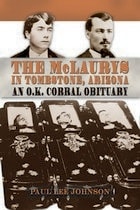
The McLaurys in Tombstone, Arizona
An O.K. Corral ObituaryPaul Lee Johnson
University of North Texas Press, 2012
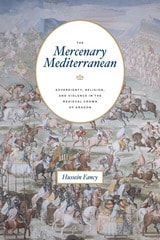
The Mercenary Mediterranean
Sovereignty, Religion, and Violence in the Medieval Crown of AragonHussein Fancy
University of Chicago Press, 2016
They were not the first or only Muslim soldiers to do so. Over the course of the thirteenth and fourteenth centuries, the Christian kings of Aragon recruited thousands of foreign Muslim soldiers to serve in their armies and as members of their royal courts. Based on extensive research in Arabic, Latin, and Romance sources, The Mercenary Mediterranean explores this little-known and misunderstood history. Far from marking the triumph of toleration, Hussein Fancy argues, the alliance of Christian kings and Muslim soldiers depended on and reproduced ideas of religious difference. Their shared history represents a unique opportunity to reconsider the relation of medieval religion to politics, and to demonstrate how modern assumptions about this relationship have impeded our understanding of both past and present.

The Nail in the Tree
Essays on Art, Violence, and ChildhoodCarol Ann Davis
Tupelo Press, 2020

The Nation's Tortured Body
Violence, Representation, and the Formation of a Sikh "Diaspora"Brian Keith Axel
Duke University Press, 2001
Based on ethnographic and archival research conducted by Axel at several sites in India, England, and the United States, the text delineates a theoretical trajectory for thinking about the proliferation of diaspora studies and area studies in America and England. After discussing this trajectory in relation to the colonial and postcolonial movement of Sikhs, Axel analyzes the production and circulation of images of Sikhs around the world, beginning with visual representations of Maharaja Duleep Singh, the last Sikh ruler of Punjab, who died in 1893. He argues that imagery of particular male Sikh bodies has situated—at different times and in different ways—points of mediation between various populations of Sikhs around the world. Most crucially, he describes the torture of Sikhs by Indian police between 1983 and the present and discusses the images of tortured Sikh bodies that have been circulating on the Internet since 1996. Finally, he returns to questions of the homeland, reflecting on what the issues discussed in The Nation's Tortured Body might mean for the ongoing fight for Khalistan.
Specialists in anthropology, history, cultural studies, diaspora studies, and Sikh studies will find much of interest in this important work.

The One by Whom Scandal Comes
René Girard (Translated by M. B. DeBevoise)
Michigan State University Press, 2014
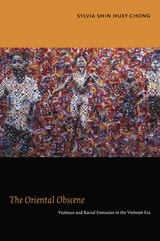
The Oriental Obscene
Violence and Racial Fantasies in the Vietnam EraSylvia Shin Huey Chong
Duke University Press, 2011
The Origins of Violence
Religion, History and GenocideJohn Docker
Pluto Press, 2008
Genocide is commonly understood to be a terrible aberration in human behaviour, performed by evil, murderous regimes such as the Nazis and dictators like Suharto and Pinochet. John Docker argues that the roots of genocide go far deeper into human nature than most people realise.
Genocide features widely in the Bible, the literature of ancient Greece and Rome, and debates about the Enlightenment. These texts are studied in depth to trace the origins of violence through time and across civilisations. Developing the groundbreaking work of Raphaël Lemkin, who invented the term 'genocide', Docker guides us from the dawn of agricultural society, through classical civilisation to the present, showing that violence between groups has been integral to all periods of history.
This revealing book will be of great interest to those wishing to understand the roots of genocide and why it persists in the modern age.
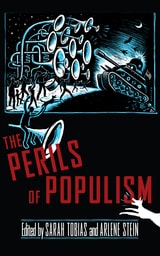
The Perils of Populism
Sarah Tobias
Rutgers University Press, 2022
The Perils of Populism shows how a feminist lens can help diagnose the factors behind the global rise of right-wing populism and teach us how to resist the threat it presents to democracy. Featuring interdisciplinary essays about politics in the United States, the Middle East, Europe, and India from a variety of acclaimed theorists and activists, the volume contributes to a rapidly expanding literature on gender and the far right. Together, these chapters offer a truly intersectional analysis of the problem, addressing everything from how populism has thrived in a “post-truth” era to the ways it appeals to working-class voters looking for an alternative to neoliberalism. Yet the authors also find reasons to be hopeful, as they showcase forms of grassroots feminist activism that challenge right-wing populism by advocating for racial and economic justice.
The Persistence of Violence
Colombian Popular CultureToby Miller
Rutgers University Press, 2020
The Provisional IRA
From Insurrection to ParliamentTommy McKearney
Pluto Press, 2011
This book analyses the underlying reasons behind the formation of the Provisional Irish Republican Army (IRA), its development, where this current in Irish republicanism is at present and its prospects for the future.
Tommy McKearney, a former IRA member who was part of the 1980 hunger strike, challenges the misconception that the Provisional IRA was only, or even wholly, about ending partition and uniting Ireland. He argues that while these objectives were always the core and headline demands of the organisation, opposition to the old Northern Ireland state was a major dynamic for the IRA’s armed campaign. As he explores the makeup and strategy of the IRA he is not uncritical, examining alternative options available to the movement at different periods, arguing that its inability to develop a clear socialist programme has limited its effectiveness and reach.
This authoritative and engaging history provides a fascinating insight into the workings and dynamics of a modern resistance movement.
The Restless Dead
Necrowriting and DisappropriationCristina Rivera Garza
Vanderbilt University Press, 2020
Disappropriating is a political operation at the core of projects acknowledging, both at ethical and aesthetic levels, that writers always work with materials that are not their own. Writers borrow from the practitioners of a language, entering in a debt relationship that can only be covered by ushering the text back to the communities from which it grew. In a world rife with violence, where the experiences of many are erased by pillage and extraction, writing among and for the dead is a form of necrowriting that may well become a life-affirming act of decolonization and resistance.
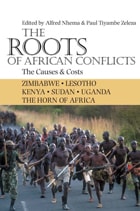
The Roots of African Conflicts
The Causes and CostsAlfred Nhema
Ohio University Press, 2007
“Africa is no more prone to violent conflicts than other regions. Indeed, Africa’s share of the more than 180 million people who died from conflicts and atrocities in the twentieth century is relatively modest.… This is not to underestimate the immense impact of violent conflicts on Africa; it is merely to emphasize the need for more balanced debate and commentary.”
—From the introduction by Paul Tiyambe Zeleza
Violent conflicts have exacted a heavy toll on Africa’s societies, polities, and economies. This book presents African scholars’ views of why conflicts start in their continent. The causes of conflict are too often examined by scholars from the countries that run the proxy wars and sell the arms to fuel them. This volume offers theoretically sophisticated, empirically grounded, and compelling analyses of the roots of African conflicts.
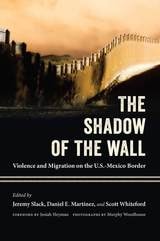
The Shadow of the Wall
Violence and Migration on the U.S.-Mexico BorderEdited by Jeremy Slack, Daniel E. Martínez, and Scott Whiteford; Foreword by Josiah Heyman; Photographs by Murphy Woodhouse
University of Arizona Press, 2018
The authors analyze data from the Migrant Border Crossing Study (MBCS), a mixed-methods, binational research project that offers socially relevant, rigorous social science about migration, immigration enforcement, and violence on the border. Using information gathered from more than 1,600 post-deportation surveys, this volume examines the different faces of violence and migration along the Arizona-Sonora border and shows that deportees are highly connected to the United States and will stop at nothing to return to their families. The Shadow of the Wall underscores the unintended social consequences of increased border enforcement, immigrant criminalization, and deportation along the U.S.-Mexico border.
Contributors
Howard Campbell
Josiah Heyman
Alison Elizabeth Lee
Daniel E. Martínez
Ricardo Martínez-Schuldt
Emily Peiffer
Jeremy Slack
Prescott L. Vandervoet
Matthew Ward
Scott Whiteford
Murphy Woodhouse
The Spaces of Violence
James R. Giles
University of Alabama Press, 2006
Exploring the landscapes, cultures, and psychological spaces where violence takes root in contemporary American fiction.
The Spaces of Violence is an insightful work of literary criticism in which James R. Giles investigates the complex relationship between violence and space in contemporary American fiction. Through close readings of novels by influential writers including Russell Banks, Cormac McCarthy, Lewis Nordan, Dorothy Allison, Don DeLillo, Denis Johnson, Sherman Alexie, Robert Stone, and Bret Easton Ellis, Giles demonstrates how violence is shaped by the physical, social, and psychological environments in which it occurs.
Drawing on spatial and cultural theory, Giles argues that these novels inhabit a distinctive "fourthspace," a realm existing at the margins of mainstream society where violence permeates everyday life and destabilizes traditional boundaries of identity, community, and morality. Whether set in rural landscapes, urban centers, suburban communities, football stadiums, or transient spaces such as highways and bus stations, the works examined reveal how environments become intertwined with systems of power, alienation, trauma, and destruction.
The book concludes by extending its analysis to representations of violence within family structures, highlighting the far-reaching effects of social and cultural fragmentation. Offering a sophisticated framework for understanding violence in literature, The Spaces of Violence is an important contribution to contemporary literary and cultural studies.
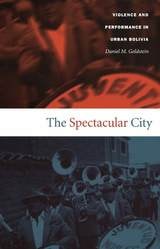
The Spectacular City
Violence and Performance in Urban BoliviaDaniel M. Goldstein
Duke University Press, 2004
During the period of Goldstein’s fieldwork in Villa Pagador in the mid-1990s, residents attempted to lynch several thieves and attacked the police who tried to intervene. Since that time, there have been hundreds of lynchings in the poor barrios surrounding Cochabamba. Goldstein presents the lynchings of thieves as a form of horrific performance, with elements of critique and political action that echo those of local festivals. He explores the consequences and implications of extralegal violence for human rights and the rule of law in the contemporary Andes. In rich detail, he provides an in-depth look at the development of Villa Pagador and of the larger metropolitan area of Cochabamba, illuminating a contemporary Andean city from both microethnographic and macrohistorical perspectives. Focusing on indigenous peoples’ experiences of urban life and their attempts to manage their sociopolitical status within the broader context of neoliberal capitalism and political decentralization, The Spectacular City highlights the deep connections between performance, law, violence, and the state.

The Sutton-Taylor Feud
The Deadliest Blood Feud in TexasChuck Parsons
University of North Texas Press, 2009
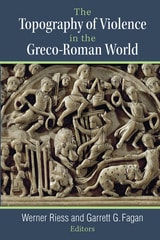
The Topography of Violence in the Greco-Roman World
Werner Riess and Garrett G. Fagan, editors
University of Michigan Press, 2016
The contributors to The Topography of Violence in the Greco-Roman World take on a task not yet addressed in classical scholarship: they examine how topography shaped the perception and interpretation of violence in Greek and Roman antiquity. After an introduction explaining the “spatial turn” in the theoretical study of violence, “paired” chapters review political assassination, the battlefield, violence against women and slaves, and violence at Greek and Roman dinner parties. No other book either adopts the spatial theoretical framework or pairs the examination of different classes of violence in classical antiquity in this way.
Both undergraduate and graduate students of classics, history, and political science will benefit from the collection, as will specialists in those disciplines. The papers are original and stimulating, and they are accessible to the educated general reader with some grounding in classical history.
The Truth Machines
Policing, Violence, and Scientific Interrogations in IndiaJinee Lokaneeta
University of Michigan Press, 2020
The Truth Machines examines the emergence and use of these three scientific techniques to analyze two primary themes. First, the book questions whether existing theoretical frameworks for understanding state power and legal violence are adequate to explain constant innovations of the state. Second, it explores the workings of law, science, and policing in the everyday context to generate a theory of state power and legal violence, challenging the monolithic frameworks about this relationship, based on a study of both state and non-state actors.
Jinee Lokaneeta argues that the attempt to replace physical torture with truth machines in India fails because it relies on a confessional paradigm that is contiguous with torture. Her work also provides insights into a police institution that is founded and refounded in its everyday interactions between state and non-state actors. Theorizing a concept of Contingent State, this book demonstrates the disaggregated, and decentered nature of state power and legal violence, creating possible sites of critique and intervention.
The Unpast
Elite Violence and Social Control in Brazil, 1954–2000R. S. Rose
Ohio University Press, 2005
Portuguese and Brazilian slave-traders shipped at least four million slaves to Brazil—in contrast to the five hundred thousand slaves that English vessels brought to the Americas. Controlling the vast number of slaves in Brazil became of primary importance. The Unpast: Elite Violence and Social Control in Brazil, 1954–2000 documents the ways in which the brutal methods used on plantations led directly to the phenomenon of Brazilian death squads.
The Unpast examines how and why, after the abolition of slavery, elites in Brazil imported new methods of killing, torturing, or disfiguring dissidents and the poor to maintain dominance. Bringing a critical-historical analysis to events following the 1954 suicide of President Getúlio Vargas, R. S. Rose takes the reader along a fifty-year path that helped to shape a nation’s morals. He covers the misunderstood presidency of João Goulart; the overthrow of his government by a U.S.-assisted military; the appalling dictatorship that followed; the efforts to rid the countryside of troublemakers; and the ongoing attempt to cleanse the urban environment of the needy, an endeavor that produced 32,675 victims in just two Brazilian states between 1954 and 2000.
The largest and most comprehensive documentation of suspected death-squad victims ever undertaken, The Unpast is an exposé of practices and attitudes toward the poor in Latin America’s largest country.
The Violence of Austerity
Edited by David Whyte and Vickie Cooper
Pluto Press, 2017
In The Violence of Austerity, David Whyte and Vickie Cooper bring together the passionate voices of campaigners and academics to show that rather than stimulating economic growth, austerity policies have led to a dismantling of the social systems that operated as a buffer against economic hardship. Chapters from major contributors—including Danny Dorling, Mary O’Hara and Rizwaan Sabir—show how austerity is a form of institutional violence more socially harmful and far-reaching than other more politicized and publicized forms of violence, such as terrorism or gun violence. Contributors expose highly significant cases of this institutional violence driven by public sector cuts: police attacks on the homeless, violent evictions of the rented sector, risks faced by people on workfare, and more. The Violence of Austerity is a devastating, authoritative study of the myriad ways austerity policies harm people in Britain that will resonate with anyone concerned with the increasing power of the political elite and the future of social welfare.

The Violence of Protection
Policing, Immigration Law, and Asian American WomenLee Ann S. Wang
Duke University Press, 2026
The Violence of the Letter
Toward a Theory of WritingMelanie McMahon
University of Michigan Press, 2023
Co-Winner of the 2024 ACLA Renè Wellek Prize for Monograph
The emergence of the alphabet in ancient Greece, usually heralded as the first step in the inexorable march toward reason and progress, in fact signaled the introduction of a chance technology that hijacked the future, with devastating consequences for humanity. By investigating an array of cultural artifacts, ranging from Kubrick's 2001: A Space Odyssey to the Oracle at Delphi to Luther's challenge to the Church, this book demonstrates how the apparently benign emergence of writing made possible far-ranging systems of organized domination and unprecedented levels of violence. The Violence of the Letter considers how a twenty-six-letter code changed the face of the world, and not always for the better.

The Virtuous and Violent Women of Seventeenth-Century Massachusetts
Emily C.K. Romeo
University of Massachusetts Press, 2020
Dismantling the image of the peaceful and serene colonial goodwife and countering the assumption that New England was inherently less violent than other regions of colonial America, Emily C. K. Romeo offers a revealing look at acts of violence by Anglo-American women in colonial Massachusetts, from the everyday to the extraordinary. Using Essex County as a case study, Romeo deftly utilizes seventeenth- and eighteenth-century sources to demonstrate that Puritan women, both “virtuous” and otherwise, learned to negotiate the shifting boundaries between acceptable and unacceptable violence in their daily lives and communities.
The Virtuous and Violent Women of Seventeenth-Century Massachusetts shows that more dramatic violence by women—including infanticide, the scalping of captors during the Indian Wars, and even witchcraft accusations—was not necessarily intended to challenge the structures of authority but often sprung from women's desire to protect property, safety, and standing for themselves and their families. The situations in which women chose to flout powerful social conventions and resort to overt violence expose the underlying, often unspoken, priorities and gendered expectations that shaped this society.