Results by title
3785 books match the query 'Poetry' and 833 start with t
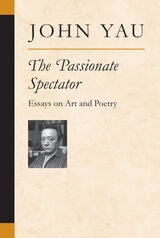
The Passionate Spectator
Essays on Art and PoetryJohn Yau
University of Michigan Press, 2006
Yau’s diverse critical sensibilities permeate The Passionate Spectator as he moves seamlessly between the visual and literary arts. Highlights of this collection include an essay on the poet as art critic, a study of the relationship between Kevin Young’s poetry and the paintings of Jean-Michel Basquiat, and an imaginative piece in which Yau speculates about what Jorge Luis Borges would have created had he been a visual artist. In the title essay, Yau lays out the duty of the spectator—a duty shared by viewer, reader, critic, and artist: “it is up to us to experience art, to engage and believe in its power.”
The Patience of Ice
Renate Wood
Northwestern University Press, 2000
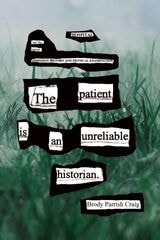
The Patient Is an Unreliable Historian
Brody Parrish Craig
Omnidawn, 2024
The poems of Brody Parrish Craig’s new collection upends narratives around current psychiatric treatment models to focus on the lived experience of survivors and to speak toward liberation, abolition, and disability justice. Titled after the author’s own medical records, The Patient Is an Unreliable Historian questions the prevailing narrative that the medical industry knows stories of disability and madness better than those who have lived them.
Craig uses lyricism to expose the intersection of madness and criminality in contemporary American culture, moving through institutions, community spaces, and loss of kin. Through the course of the collection, the speaker turns toward irreverence and interrogation, carves out their own freedom, and challenges the script of the patient, the mad, and the “criminal.” These poems deconstruct the “patient” to set the person free.
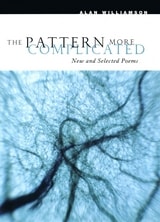
The Pattern More Complicated
New and Selected PoemsAlan Williamson
University of Chicago Press, 2004
The Pattern More Complicated assembles Williamson's most important, representative poems, marking the trajectory of poetic development and the recurrence of themes across the span of four previous collections to present a survey of a major American poet in a single volume.
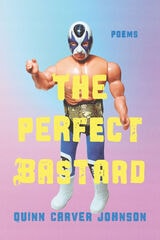
The Perfect Bastard
PoemsQuinn Carver Johnson
Northwestern University Press, 2023
An innovative poetic interrogation of wrestling, queerness, and staying true to oneself
Quinn Carver Johnson’s debut collection, The Perfect Bastard, follows its titular protagonist, a nonbinary and queer professional wrestler, as they travel across Kansas, Oklahoma, Arkansas, and Missouri, working for a booker known as the Puppeteer. Inspired by their idol Adrian Street, the Perfect Bastard strives to positively represent queerness and resist the Puppeteer’s stereotypical and demeaning kayfabe. In the ring, they face off against the likes of champion Jack Holiday and the First Crusher, but their most important battles, against the Puppeteer, take place behind the scenes. They must choose between person and persona, authenticity and humiliating hype, if they want to succeed in the industry.
When offered success on the grandest scale—the championship belt—in exchange for mocking their own queerness, the Perfect Bastard questions their path: Will they betray their identity to achieve their dream, or will they walk away from the world of professional wrestling—a world that refuses to make a genuine, healthy space for them?

The Perfect Life
Lyric EssaysPeter Stitt
Tupelo Press, 2013
The Pink Guitar
Writing as Feminist PracticeRachel Blau DuPlessis
University of Alabama Press, 2006

The Place One Is
Martha Ronk
Omnidawn, 2022
The Place One Is explores the intersection of person and place, the ways in which changes in the tangible world alter one’s vision, bodily posture, vocabulary, and concern for—to take one example—the dwindling water supply in California. The body’s position, its geometry, and the topography of the surrounding land become less and less recognizable as body and world blend together. Gravel giving way underfoot mirrors the way that words dissolve into mumbles, and the skeleton of a rusty car on the sand appears like one’s own skeleton. Ronk shows that disintegration here is disintegration there. These poems also wonder at interdependence, considering how lines intersect and continue to connect us to the sea—and to islands, lagoons, greenery, sky, and space.
In the first part of the collection, the poems focus on a rural landscape, and in the second part, they consider the overly bright urban world of Los Angeles.

The Plath Cabinet
Catherine Bowman
Four Way Books, 2009
The Play of Fictions
Studies in Ovid's Metamorphoses Book 2A. M. Keith
University of Michigan Press, 1992
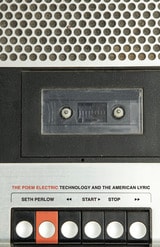
The Poem Electric
Technology and the American LyricSeth Perlow
University of Minnesota Press, 2018
An enlightening examination of the relationship between poetry and the information technologies increasingly used to read and write it
Many poets and their readers believe poetry helps us escape straightforward, logical ways of thinking. But what happens when poems confront the extraordinarily rational information technologies that are everywhere in the academy, not to mention everyday life?
Examining a broad array of electronics—including the radio, telephone, tape recorder, Cold War–era computers, and modern-day web browsers—Seth Perlow considers how these technologies transform poems that we don’t normally consider “digital.” From fetishistic attachments to digital images of Emily Dickinson’s manuscripts to Jackson Mac Low’s appropriation of a huge book of random numbers originally used to design thermonuclear weapons, these investigations take Perlow through a revealingly eclectic array of work, offering both exciting new voices and reevaluations of poets we thought we knew.
With close readings of Gertrude Stein, Frank O’Hara, Amiri Baraka, and many others, The Poem Electric constructs a distinctive lineage of experimental writers, from the 1860s to today. Ultimately, Perlow mounts an important investigation into how electronic media allows us to distinguish poetic thought from rationalism. Posing a necessary challenge to the privilege of information in the digital humanities, The Poem Electric develops new ways of reading poetry, alongside and against the electronic equipment that is now ubiquitous in our world.
The Poem Itself
150 of the Finest Modern Poets in the Original LanguagesStanley Burnshaw
University of Arkansas Press, 1995
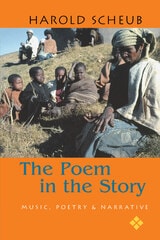
The Poem in the Story
Music, Poetry, and NarrativeHarold Scheub
University of Wisconsin Press, 2002
Fact and fiction meet at the boundaries, the betwixt and between where transformations occur. This is the area of ambiguity where fiction and fact become endowed with meaning, and this is the area—where ambiguity, irony, and metaphor join forces—that Harold Scheub exposes in all its nuanced and evocative complexity in The Poem in the Story.
In a career devoted to exploring the art of the African storyteller, Scheub has conducted some of the most interesting and provocative investigations into nonverbal aspects of storytelling, the complex relationship between artist and audience, and, most dramatically, the role played by poetry in storytelling. This book is his most daring effort yet, an unconventional work that searches out what makes a story artistically engaging and emotionally evocative, the metaphorical center that Scheub calls "the poem in the story." Drawing on extensive fieldwork in southern Africa and decades of experience as a researcher and teacher, Scheub develops an original approach—a blend of field notes, diary entries, photographs, and texts of stories and poems—that guides readers into a new way of viewing, even experiencing, meaning in a story. Though this work is largely focused on African storytelling, its universal applications emerge when Scheub brings the work of storytellers as different as Shakespeare and Faulkner into the discussion.
The Poems
Robert Walser
Seagull Books, 2022
Admired by the likes of Kafka, Musil, and Walter Benjamin and acclaimed “unforgettable, heart-rending” by J. M. Coetzee, Swiss writer Robert Walser (1878–1956) remains one of the most influential authors of modern literature. Walser left school at fourteen and led a wandering and precarious existence while producing poems, stories, essays, and novels. In 1933, he abandoned writing and entered a sanatorium, where he remained for the rest of his life. “I am not here to write,” Walser said, “but to be mad.”
This first collection of Walser’s poems in English translation allows English-speaking readers to experience the author as he saw himself at the beginning and the end of his literary career––as a poet. The book also includes notes on dates of composition, draft versions of the printed poems, and brief biographical information on characters and locations that appear in the poems and may not be known to readers. Few writers have ever experienced such a steady rise in their reputation and public profile as Walser has seen in recent years, and this collection of his poems will help readers discover a unique writer whose off-kilter sensibility and innovations in form are perfectly suited to our fragmented, distracted, bewildering era.
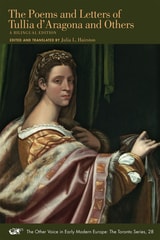
The Poems and Letters of Tullia d'Aragona and Others
A Bilingual EditionTullia d'Aragona and Others, Edited by Julia L. Hairston, Translated by Julia L. Hairston
Iter Press, 2014
Hairston has constructed a full personal, cultural and literary biography for d’Aragona, using newly discovered letters, archival material of other kinds, and contemporary theory about gender in women’s writing. Footnotes establish the intricacy of Tullia’s intellectual networks and her courting of intellectuals in rhyme. Hairston includes poems written to d’Aragona, including Girolamo Muzio’s long pastoral, Tirrhenia. She addresses with tact the question of how sexual Tullia’s relationships were with her various interlocutors. At times, as she says, one just can’t know, but that the issue is much less important than the poems themselves. I agree wholeheartedly. This is the editor Tullia has been waiting for: an indefatigable researcher, a creative biographer, and a precise and appreciative literary critic.
—Ann Rosalind Jones
Esther Cloudman Dunn Professor of Comparative Literature, Smith College
The figure of Tullia d’Aragona has long fascinated readers as the prototype of the “honest courtesan”, a woman who successfully exploited her physical and intellectual charms to win the adoration and respect of the Italian cultural elite. With Julia Hairston’s richly annotated edition of her collected verse, the product of more than a decade of scholarship, d’Aragona finally comes into focus also as poet. She emerges in this volume as one of the most distinctive protagonists in a key transitional moment in Italian literary history, when the aristocratic tradition of Petrarchist lyric began to be reshaped and democratized by its encounter with print.
—Virginia Cox
Professor of Italian, New York University
The Poems of Aimeric de Peguilhan
Aimeric de Peguilhan, edited and translated with introduction and commentary by William P. Shepard and Frank M. Chambers
Northwestern University Press, 1950
The Poems of François Villon
François Villon
Brandeis University Press, 1982
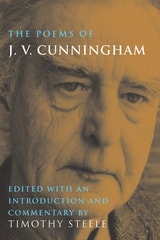
The Poems of J. V. Cunningham
Timothy Steele
Ohio University Press, 1997
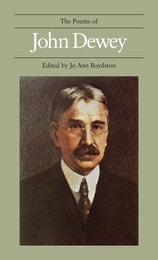
The Poems of John Dewey
Edited by Jo Ann Boydston
Southern Illinois University Press, 1977
A literary discovery of considerable magnitude, these 98 previously unpublished poems by John Dewey, written principally in the 1910–18 period, illuminate an emotive aspect in his intellectual life often not manifest in the prose works.
Rumors of the existence of the poems have circulated among students of Dewey’s life and writings since 1957,when Mrs. Roberta Dewey gained possession of them from the Columbia University Columbiana collection. But except for the few persons who saw copies made by the French scholar Deladelle five years after Dewey’s death, the poems have remained inaccessible until now.
None of the poems has hitherto been published. Mrs. Roberta Dewey and Dewey’s children from his first marriage seem not to have known of Dewey’s experiments in verse during his lifetime. And, as evidence presented here now shows, only two or three acquaintances knew of actual poems written by Dewey, one of them the Polish-American novelist Anzia Yezierska, who had a brief emotional involvement with Dewey in the 1917–18 period. The factual, rather than inferential, evidence of Dewey’s relationship with Anzia Yezierska appears in the poems, which, taken as a whole, provide revealing insights into Dewey’s feelings and illuminate not only aspects of his emotions but of his thought as well.
The fact that Dewey did not publish the poetry himself, together with the circumstances of its discovery and unusual history, has led to the exceptionally careful editorial treatment of the poems given here. Scholars will find all the evidence for the authorship of the manuscripts clearly presented and all the changes and alterations carefully recorded. This edition has received the Modern Language Association of America Center for Editions of American Authors Seal as an “approved text.”
The Poems of Renata Ferreira
Frank X. Gaspar
Tagus Press, 2020
The Poems of St. John of the Cross
St. John of the Cross
University of Chicago Press, 1979
This dual-language edition makes available the original Spanish from the Codex of Sanlúcon de Barrameda with facing English translations. The work concludes with two essays—a critique of the poetry and a short piece on the Spanish text that appears alongside the translation—as well as brief notes on the individual poems.
The Poet Without a Name
Gray's Elegy and the Problem of HistoryHenry Weinfield
Southern Illinois University Press, 1991
Henry Weinfield offers a new reading not only of the Elegy itself but also of its place in English literary history. His central argument is that in Gray’s Elegy the thematic constellation of poverty, anonymity, alienation, and unfulfilled potential—or what Weinfield calls the "problem of history"—is fully articulated for the first time, and that, as a result, the Elegy represents an important turning-point in the history of English poetry.
The Poet's Freedom
A Notebook on MakingSusan Stewart
University of Chicago Press, 2011
Why do we need new art? How free is the artist in making? And why is the artist, and particularly the poet, a figure of freedom in Western culture? The MacArthur Award–winning poet and critic Susan Stewart ponders these questions in The Poet’s Freedom. Through a series of evocative essays, she not only argues that freedom is necessary to making and is itself something made, but also shows how artists give rules to their practices and model a self-determination that might serve in other spheres of work.
The Poet's Work
29 Poets on the Origins and Practice of Their ArtEdited by Reginald Gibbons
University of Chicago Press, 1989

The Poetic Workmanship of Alexander Pope
Rebecca Price Parkin
University of Minnesota Press, 1955
The Poetic Workmanship of Alexander Pope was first published in 1955. Minnesota Archive Editions uses digital technology to make long-unavailable books once again accessible, and are published unaltered from the original University of Minnesota Press editions.
Through a detailed examination of Alexander Pope's poetic practices, Mrs. Parkin throws light both on the craftsmanship and on the philosophical concepts which governed the creative thought of the poet. She analyzes Pope's use of such literary devices as irony, antithesis, metaphor, narrative, paradox, tension, tonal variation, and the dramatic speaker. She discusses the Pope's work as a whole. The study also provides an evaluation of the influence on Pope's work of the neo-classical concepts of genre and imitation.
The Poetics of Epiphany in the Spanish Lyric of Today
Judith Nantell
Bucknell University Press, 2020
Published by Bucknell University Press. Distributed worldwide by Rutgers University Press.

The Poetics of Poetry Film
Film Poetry, Videopoetry, Lyric Voice, ReflectionEdited by Sarah Tremlett
Intellect Books, 2020
Set to generate discussions in the field for years to come, The Poetics of Poetry Film is an encyclopedic work on the ever-evolving art of the poetry film. Poetry films are a genre of short film usually involving three main elements: the poem as verbal message, the moving film image and diegetic sounds, and additional non-diegetic sounds or music, which create a soundscape. In this book, Sarah Tremlett examines the formal characteristics of the poetic in poetry film, film poetry, and videopoetry, particularly in relation to lyric voice and time.
Tremlett sets the emergence and history of poetry film in its proper global context, defining and debating terms both philosophically and materially. Showcasing the work of an international array of practitioners, The Poetics of Poetry Film includes interviews, analysis, and a rigorous investigation of the history of the genre, from its origins to the present. This is an industry bible for anyone interested in poetry, digital media, filmmaking, art, and creative writing, as well as poetry filmmakers.
The Poetics of Repetition in English and Chinese Lyric Poetry
Cecile Chu-chin Sun
University of Chicago Press, 2010
For more than half a century, Chinese-Western comparative literature has been recognized as a formal academic discipline, but critics and scholars in the field have done little to develop a viable, common basis for comparison between these disparate literatures. In this pioneering book, Cecile Chu-chin Sun establishes repetition as the ideal perspective from which to compare the poetry and poetics from these two traditions.
Sun contends that repetition is at the heart of all that defines the lyric as a unique art form and, by closely examining its use in Chinese and Western poetry, she demonstrates howone can identify important points of convergence and divergence. Through a representative sampling of poems from both traditions, she illustrates how the irreducible generic nature of the lyric transcends linguistic and cultural barriers but also reveals the fundamental distinctions between the traditions. Most crucially, she dissects the two radically different conceptualizations of reality—mimesis and xing—that serve as underlying principles for the poetic practices of each tradition.
Skillfully integrating theory and practice, The Poetics of Repetition in English and Chinese Lyric Poetryprovides a much-needed model for future study of Chinese and English poetry as well as lucid, succinct interpretations of individual poems.
The Poetics of Scale
From Apollinaire to Big DataConrad Steel
University of Iowa Press, 2024
The Poetics of Scale takes us back to the years before the First World War in Paris, where the poet Guillaume Apollinaire claimed to have invented a new mode of poetry large enough to take on the challenges of the coming twentieth century. This history follows Apollinaire’s ideas across the Atlantic and examines how and why his work became such a vital source of inspiration for American poets through the era of intensive American economic expansion and up to the present day. Threading together Apollinaire’s work in the 1910s with three of his American successors—Louis Zukofsky in the 1930s, Allen Ginsberg in the 1950s, and Alice Notley from the 1970s onward—it shows how poetry as a cultural technique became the crucial test case for the scale of our collective imagination.
The Poetics of Unremembered Acts
Reading, Lyric, PedagogyBrian McGrath
Northwestern University Press, 2012

The Poetics of Yves Bonnefoy
John Naughton
University of Chicago Press, 1984
Though Bonnefoy's work is familiar to American scholars, the complexity of his thought and style has created a need for a critical introduction to his work. This first major study of Bonnefoy written in English provides an overview of his entire literary career. Naughton situates Bonnefoy in the context of the existential philosophical tradition that nurtured him and in the poetic and artistic tradition that includes Dante and Shakespeare, Piero and Poussin, Baudelaire and Rimbaud. Bonnefoy's poems appear in both French and English, and all quotations from his prose have been translated.
This book will appeal not only to the growing number of students and scholars of French literature interested in Bonnefoy's work, but also to those who study comparative poetry and the relation of poetry to art and to contemporary religious thought.
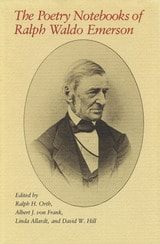
The Poetry Notebooks of Ralph Waldo Emerson
Ralph Waldo Emerson; Edited by Ralph H. Orth, Albert J. von Frank, Linda Allardt, & David W. Hill
University of Missouri Press, 1986
Published here in full are Ralph Waldo Emerson's nine poetry notebooks, the single greatest source of information about his creative habits in poetry. Emerson kept rough drafts, revised versions, and fair copies of hundreds of poems in these notebooks, so that the genesis and development of poems both famous and obscure can be traced closely. The notebooks have been remarkably little consulted, primarily because their unedited textual condition makes them difficult to use. This edition makes them accessible to scholars by presenting a faithful transcription of each notebook, a detailed analysis of the history of each poem, an introduction, and a cross-referenced index.
For this edition, the editors have followed the high standards of textual practice developed for Harvard University Press's edition of The Journals and Miscellaneous Notebooks of Ralph Waldo Emerson. That editorial approach makes possible a logical, clear presentation of material that Emerson often jotted down in segments or with multiple erasures and insertions.
Because it will allow scholars to examine as never before the many facets of Emerson the poet, The Poetry Notebooks of Ralph Waldo Emerson will be a major impetus to study of the man considered by many to be America's greates thinker.
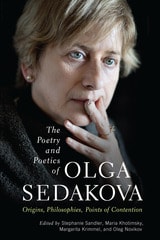
The Poetry and Poetics of Olga Sedakova
Origins, Philosophies, Points of ContentionEdited by Stephanie Sandler, Maria Khotimsky, Margarita Krimmel, and Oleg Novikov
University of Wisconsin Press, 2019
Essayists from Russia, Ukraine, Germany, Italy, and the United States show how Sedakova has contributed to ongoing aesthetic and cultural debates. Like Sedakova's own work, the volume affirms the capacity of words to convey meaning and to change our understanding of life itself. The volume also includes dozens of elegant new translations of Sedakova's poems.
The Poetry of American Women from 1632 to 1945
By Emily Stipes Watts
University of Texas Press, 1977
American women have created an especially vigorous and innovative poetry, beginning in 1632 when Anne Bradstreet set aside her needle and picked up her "poet's pen." The topics of American women poets have been various, their images their own, and their modes of expression original.
Emily Stipes Watts does not imply that the work of American men and that of American women are two different kinds of poetry, although they have been treated as such in the past. It is her aim, rather, to delineate and define the poetic tradition of women as crucial to the understanding of American poetry as a whole.
By 1850, American women of all colors, religions, and social classes were writing and publishing poetry. Within the critical category of "female poetry," developed from 1800 to 1850, these women experimented boldly and prepared the way for the achievement of such women as Emily Dickinson in the second half of the nineteenth century. Indeed at times—for example from 1860 through 1910—it was women who were at the outer edge of prosodic experimentation and innovation in American poetry.
Moving chronologically, Professor Watts broadly characterizes the state of American poetry for each period, citing the dominant male poets; she then focuses on women contemporaries, singling out and analyzing their best work. This volume not only brings to light several important women poets but also represents the discovery of a tradition of women writers. This is a unique and invaluable contribution to the history of American literature.
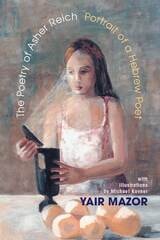
The Poetry of Asher Reich
Portrait of a Hebrew PoetYair Mazor
University of Wisconsin Press, 2004
Asher Reich’s poetry has been characterized as vivid, vibrant, passionate, and expressionistic. Dominated by themes of stormy sensuality and frank sexuality, his dramatic imagery and metaphors interweave Mishnaic, Talmudic, and Biblical references in a colorful, complex poetic texture. The beautiful simplicity of Kovner’s drawings—depicting female figures and natural landscapes—resonates throughout the book. Tender, stark, and striking, the drawings illustrate life’s fragility and grace with a subtlety and dignity that complements Reich’s sensitive style.
Presenting contemporary Hebrew poetry, modern Israeli art, and informed literary commentary in an engaging format, this book promises to delight a broad audience of readers.
The Poetry of Capital
Voices from Twenty-First-Century AmericaEdited by Benjamin S. Grossberg and Clare Rossini
University of Wisconsin Press, 2021
Editors Benjamin S. Grossberg and Clare Rossini selected poems to reflect broad themes of labor, history and economic forces, social equity, and the environment. In addition, they asked each poet to provide a brief prose comment to introduce their work. Some give broad statements on the nature of wealth in America today; others are intimate, offering insight into how life experiences inform their writing; still others reflect on the art of poetry itself and its unique power to speak to economic pressures of the moment.
Contributors include Mary Jo Bang, Xochiquetzal Candelaria, Alan Chazaro, Mark Doty, Denise Duhamel, Tony Hoagland, Yusef Komunyakaa, Dorianne Laux, Kimiko Hahn, Sharon Olds, George Perreault, Robert Pinsky, Minnie Bruce Pratt, Afaa Michael Weaver, David Wojahn, and others.
The Poetry of Indifference
From the Romantics to the RubaiyatErik Irving Gray
University of Massachusetts Press, 2005
of poetic indifference began to emerge.
The Poetry of Indifference analyzes nineteenth-century works by Wordsworth, Keats, Byron, Tennyson, Robert Browning, and Edward FitzGerald, among others—works that do not merely declare themselves to be indifferent but formally enact the indifference they describe. Each poem consciously disregards some aspect of poetry that is usually considered to be crucial or definitive, even at the risk of seeming "indifferent" in the sense of "mediocre." Such gestures discourage critical attention, since the poetry of indifference refuses to make claims for itself.
This is particularly true of FitzGerald's Rubáiyát, one of the most popular poems of the nineteenth century, but one that recent critics have almost entirely ignored. In concentrating on this underexplored mode of poetry, Gray not only traces a major shift in recent literary history, from a Romantic poetics of sympathy to a Modernist poetics of alienation, but also considers how this literature can help us understand the sometimes embarrassing but unavoidable presence of indifference in our lives.
The Poetry of John Tyndall
Edited by Roland Jackson, Nicola Jackson, and Daniel Brown
University College London, 2020
The Poetry of John Tyndall contains annotated transcriptions of all 76 of Tyndall’s extant poems, the majority of which have not been published before. The poems are complemented by an extended introduction, which explores what the poems can tell us about Tyndall’s self-fashioning, his values and beliefs, and the role of poetry for him and his circle. More broadly, this introduction addresses the relationship between the scientific and poetic imaginations, and wider questions of the purpose of poetry in relation to science and religion in the nineteenth century.
The Poetry of Louise Glück
A Thematic IntroductionDaniel Morris
University of Missouri Press, 2021
The Poetry of Pope’s Dunciad
John E. Sitter
University of Minnesota Press, 1972
The Poetry of Pope's Dunciad was first published in 1972. Minnesota Archive Editions uses digital technology to make long-unavailable books once again accessible, and are published unaltered from the original University of Minnesota Press editions.
Alexander Pope's last and longest poem, the Dunciad, is also his most difficult. Attempting to provide the kind of "second reading" that Pope himself felt the work needed, Professor Sitter approaches the poem as an enduring artistic achievement rather than occasional satire (as has been the case in most previous studies). Pope recognized the complexity of the Dunciad when he wrote to a friend, a year after its initial publication, that "the poem itself will bear a second reading, or (to express myself more justly and modestly) will be better borne at the second than the first reading." It is this poetic complexity which the present study helps to clarify.
Professor Sitter considers the imagery, structure, and conception of the poem. In the first chapter, which is almost exclusively critical, he analyzes patterns of imagery and metaphor as they occur throughout the four books of the poem. In the second chapter he considers Pope's poetic practice and irony against the larger background of eighteenth-century ideas of epic and heroic poetry. In the third and final chapter he compares the Dunciad with Pope's much earlier poem The Temple of Fortune.Here he defines the iconographic mode and allegorical form of the Dunciad and places the poem in the context of Pope's sometimes unclassical concern for "visionary" poetry. There are a bibliography and notes.
The study is concerned mainly with the finished version of the Dunciad which was published in 1743, the edition which, as Professor Sitter explains, Pope regarded as authoritative. Earlier versions were published in 1728 and 1729.
The Poetry of the American Civil War
Lee Steinmetz
Michigan State University Press, 2013
Deeply affecting and diverse in perspective, The Poetry of the American Civil War is the first comprehensive volume to focus entirely on poetry written and published during the Civil War. Of the nearly one thousand books of poetry published in the 1860s, some two hundred addressed the war in some way, and these collectively present a textured portrait of life during the conflict. The poets represented here hail from the North and the South, and at times mirror each other uncannily. Among them are housewives, doctors, preachers, bankers, journalists, and teachers. Their verse reflects the day-to-day reality of war, death, and destruction, and it contemplates questions of faith, slavery, society, patriotism, and politics. This is an essential volume for poetry lovers, historians, and Civil War enthusiasts alike.
The Point Is To Change It
Poetry and Criticism in the Continuing PresentJerome McGann
University of Alabama Press, 2007
A preeminent critic maps the frontier of contemporary poetry.
In this book, Jerome McGann argues that contemporary language-oriented writing implies a marked change in the way we think about our poetic tradition on one hand and in the future of criticism on the other. He focuses on Walter Benjamin and Gertrude Stein as important intellectual resources because both see the history of poetry as a crisis of the present rather than as a legacy of the past. The crisis appears as a poetic deficit in contemporary culture, where values of politics and morality are judged prima facie more important than aesthetic values. McGann argues for the fundamental relevance of the aesthetic dimension and the contemporary relevance of cultural works of the past.
McGann moves through several broad categories in his examination of contemporary poetry, including the ways in which poetry must be abstract, change, and give pleasure. The author draws on sources ranging from the poetry of Bruce Andrews and Robert Duncan to Looney Tunes cartoons. The experimental move in contemporary poetry, McGann contends, is an emergency signal for readers and critics as much as it is for writers and poets, a signal that calls us to rethink the aesthetics of criticism. The interpretation of literary works has been dominated by enlightenment models—the expository essay and monograph—for almost two hundred years. With the emergence of new media, especially digital culture, the limitations of those models have grown increasingly apparent.
The Point Is To Change It explores alternative critical methods and provides a powerful call to reinvent our modes of investigation in order to escape the limitations of our inherited academic models. The goal of this process is to widen existing cracks or create new ones because, as McGann points out via the lyrics of Leonard Cohen, "That's how the light gets in."
The Politics of Revelation in the English Renaissance
Ester Gilman Richey
University of Missouri Press, 1998
Recognizing that the seventeenth century's volatile debate over apocalyptic interpretation has since become a one-sided discussion, Esther Gilman Richey develops a context that recovers the dynamism so inherent in the writings of the period and provides illuminating details that enhance the prophetic continuum. The Politics of Revelation in the English Renaissance does not ignore the familiar prophetic verse of Spenser and Milton, but it significantly expands the scope of study by examining the interpretations of both men and women who represent a range of ecclesiastical and political perspectives.
Richey rejects Barbara Lewalski's claim that the radical, prophetic writers and metaphysical poets of the seventeenth century drew inspiration from distinct biblical models, the former from the Apocalypse and the latter from the Psalms. Instead she contends that even writers such as Donne and Herbert, whom we have long considered "literary," were in reality using their poetry to participate in the hottest debates of the time.
While the radical writers, such as Spenser and Milton, were immediately responsive to ecclesiastical and political controversies, the conservative, metaphysical poets—Donne, Herbert, and Vaughan—were posing equally politically charged questions: Is the pope Antichrist? Is the Bride of Christ pure? Is the Temple a model of ecclesiastical reform? The writers of the period did not move in divided and distinguished worlds, but in fact constantly responded to one another through poetic and politically charged dialogue.
By drawing from the writings of various individuals, both radical and conformist, male and female, Richey traces the shifting representations of the apocalyptic Bride and Temple over time. Organized chronologically, the chapters of The Politics of Revelation in the English Renaissance reveal the escalating debate among the pacifists, conformists, militants, and feminists. Not only does Richey uncover the prophetic dimension of conformist writers usually described as apolitical and devotional, but she also explores the writings of lesser-known women prophets: Aemilia Lanyer, Mary Cary, Anna Trapnel, and Margaret Fell. In such biblical passages as the apocalyptic "woman clothed with the sun," these early feminists find the authority for their own prophetic speech.
This provocative analysis—at once far-reaching and tightly focused—reveals the complexity of the apocalyptic discourse that transpired among Renaissance writers and poets.
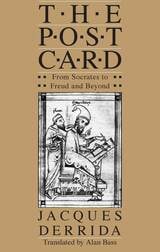
The Post Card
From Socrates to Freud and BeyondJacques Derrida
University of Chicago Press, 1987
You were reading a somewhat retro loveletter, the last in history. But you have not yet received it. Yes, its lack or excess of address prepares it to fall into all hands: a post card, an open letter in which the secret appears, but indecipherably.
What does a post card want to say to you? On what conditions is it possible? Its destination traverses you, you no longer know who you are. At the very instant when from its address it interpellates, you, uniquely you, instead of reaching you it divides you or sets you aside, occasionally overlooks you. And you love and you do not love, it makes of you what you wish, it takes you, it leaves you, it gives you.
On the other side of the card, look, a proposition is made to you, S and p, Socrates and plato. For once the former seems to write, and with his other hand he is even scratching. But what is Plato doing with his outstretched finger in his back? While you occupy yourself with turning it around in every direction, it is the picture that turns you around like a letter, in advance it deciphers you, it preoccupies space, it procures your words and gestures, all the bodies that you believe you invent in order to determine its outline. You find yourself, you, yourself, on its path.
The thick support of the card, a book heavy and light, is also the specter of this scene, the analysis between Socrates and Plato, on the program of several others. Like the soothsayer, a "fortune-telling book" watches over and speculates on that-which-must-happen, on what it indeed might mean to happen, to arrive, to have to happen or arrive, to let or to make happen or arrive, to destine, to address, to send, to legate, to inherit, etc., if it all still signifies, between here and there, the near and the far, da und fort, the one or the other.
You situate the subject of the book: between the posts and the analytic movement, the pleasure principle and the history of telecommunications, the post card and the purloined letter, in a word the transference from Socrates to Freud, and beyond. This satire of epistolary literature had to be farci, stuffed with addresses, postal codes, crypted missives, anonymous letters, all of it confided to so many modes, genres, and tones. In it I also abuse dates, signatures, titles or references, language itself.
J. D.
"With The Post Card, as with Glas, Derrida appears more as writer than as philosopher. Or we could say that here, in what is in part a mock epistolary novel (the long section is called "Envois," roughly, "dispatches" ), he stages his writing more overtly than in the scholarly works. . . . The Post Card also contains a series of self-reflective essays, largely focused on Freud, in which Derrida is beautifully lucid and direct."—Alexander Gelley, Library Journal
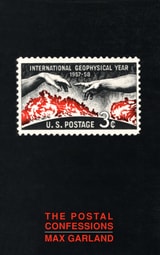
The Postal Confessions
Max Garland
University of Massachusetts Press, 1995
These poems wrestle with the inherited myths of their particular time and place. Often set in a small corner of western Kentucky, they explore moments when an individual life becomes implicated in a larger scheme—the realm of Cold War politics, the mysteries of religious faith, the codes and rituals of romantic love. Max Garland shows a lyrical determination to deal with history through the lives, minds, and emotions of ordinary people “stricken with time.”
In poems about baptism, bowling, Greek goddesses, and the hydrogen bomb, Garland seems to say that knowledge and even revelation might come from anywhere. The book ends with the image of the empty space Michelangelo left between the hands of Adam and God on the ceiling of the Sistine Chapel; that tension between what lasts and what passes away, comprises the territory of these poems.
The Pragmatic Whitman
Reimaining American DemocracyStephen John Mack
University of Iowa Press, 2002
In this surprisingly timely book, Stephen Mack examines Whitman’s particular and fascinating brand of patriotism: his far-reaching vision of democracy. For Whitman, loyalty to America was loyalty to democracy. Since the idea that democracy is not just a political process but a social and cultural process as well is associated with American pragmatism, Mack relies on the pragmatic tradition of Emerson, James, Dewey, Mead, and Rorty to demonstrate the ways in which Whitman resides in this tradition.
Mack analyzes Whitman's democratic vision both in its parts and as a whole; he also describes the ways in which Whitman's vision evolved throughout his career. He argues that Whitman initially viewed democratic values such as individual liberty and democratic processes such as collective decision-making as fundamental, organic principles, free and unregulated. But throughout the 1860s and 1870s Whitman came to realize that democracy entailed processes of human agency that are more deliberate and less natural—that human destiny is largely the product of human effort, and a truly humane society can be shaped only by intelligent human efforts to govern the forces that would otherwise govern us.
Mack describes the foundation of Whitman’s democracy as found in the 1855 and 1856 editions of Leaves of Grass, examines the ways in which Whitman’s 1859 sexual crisis and the Civil War transformed his democratic poetics in “Sea-Drift,” “Calamus,” Drum-Taps,and Sequel to Drum-Taps, and explores Whitman’s mature vision in Democratic Vistas, concluding with observations on its moral and political implications today. Throughout, he illuminates Whitman's great achievement—learning that a full appreciation for the complexities of human life meant understanding that liberty can take many different and conflicting forms—and allows us to contemplate the relevance of that achievement at the beginning of the twenty-first century.
The Pre-Raphaelites and Their Circle
Edited by Cecil Y. Lang
University of Chicago Press, 1975
Lang's Introduction describes briefly the founding of the Pre-Raphaelite Brotherhood, discusses each of the Pre-Raphaelite poets, both individually and in relation to the others, and grapples with the questions of definition of Pre-Raphaelitism and the similarities between its painting and poetry. The book is appropriately illustrated with thirty-two works by D. G. Rossetti, John Ruskin, William H. Hunt, and other Pre-Raphaelite artists.
This is the only anthology available that provides a representative selection of the work of these important poets. It will be indispensable to students of Victorian poetry and appreciated by readers interested in the Pre-Raphaelites.
The Present Hour
Yves Bonnefoy
Seagull Books, 2020
In The Present Hour, Bonnefoy’s latest collection, a personal narrative surfaces in splinters and shards. Every word from Bonnefoy is multifaceted, like the fragmented figures seen from different angles in cubist painting—as befits a poet who has written extensively about artists such as Goya, Picasso, Braque, and Gris. Throughout this moving collection, Bonnefoy’s poems echo each other, returning to and elaborating upon key images, thoughts, feelings, and people. Intriguing and enigmatic, this mixture of sonnet sequences and prose poems—or, as Bonnefoy sees them, “dream texts”—move from his meditations on friendship and friends like Jorge Luis Borges to a long, discursive work in free verse that is a self-reflection on his thought and process. These poems are the ultimate condensation of Bonnefoy’s ninety years of life and writing and they will be a valuable addition to the canon of his writings available in English.
“Beverley Bie Brahic does a splendid job of translating the latest work of Yves Bonnefoy. She catches his unique combination of human detail and a groping for the beyond. . . . Brahic does full justice to the profoundly moving text—with its frequent shifts between the personal and the searchingly philosophical.”—Joseph Frank, author of Responses to Modernity: Essays in the Politics of Culture
The Primitive Observatory
Gregory Kimbrell
Southern Illinois University Press, 2016
Kimbrell explores such themes as memory, class prejudice, family violence, and greed in a flamboyant, yet matter-of-fact style to create verse that is both amusing and unsettling. Combining prose that evokes H. P. Lovecraft, classical mythology, and Marcel Proust with the look and taut line of traditional formalist verse, the poems appear on the page as perfect rectangles, yet revel in narrative and linguistic absurdities.
The Primitive Observatory offers a dark and evocative experience through the tangible grotesque. Fans of David Lynch, Franz Kafka, Edward Gorey and the like will be startled, excited, and pleased by this entertaining and disturbing book of poetry.
The Promised Folly
Judith Hall
Northwestern University Press, 2003