Results by title
4038 books match the query 'Social aspects' and 711 start with t

The Skull Collectors
Race, Science, and America's Unburied DeadAnn Fabian
University of Chicago Press, 2010
When Philadelphia naturalist Samuel George Morton died in 1851, no one cut off his head, boiled away its flesh, and added his grinning skull to a collection of crania. It would have been strange, but perhaps fitting, had Morton’s skull wound up in a collector’s cabinet, for Morton himself had collected hundreds of skulls over the course of a long career. Friends, diplomats, doctors, soldiers, and fellow naturalists sent him skulls they gathered from battlefields and burial grounds across America and around the world.
With The Skull Collectors, eminent historian Ann Fabian resurrects that popular and scientific movement, telling the strange—and at times gruesome—story of Morton, his contemporaries, and their search for a scientific foundation for racial difference. From cranial measurements and museum shelves to heads on stakes, bloody battlefields, and the “rascally pleasure” of grave robbing, Fabian paints a lively picture of scientific inquiry in service of an agenda of racial superiority, and of a society coming to grips with both the deadly implications of manifest destiny and the mass slaughter of the Civil War. Even as she vividly recreates the past, Fabian also deftly traces the continuing implications of this history, from lingering traces of scientific racism to debates over the return of the remains of Native Americans that are held by museums to this day.
Full of anecdotes, oddities, and insights, The Skull Collectors takes readers on a darkly fascinating trip down a little-visited but surprisingly important byway of American history.

The Small Book of Hip Checks
On Queer Gender, Race, and WritingErica Rand
Duke University Press, 2021
The Smoke of the Gods
A Social History of TobaccoEric Burns
Temple University Press, 2006
The Smoking Book
Lesley Stern
University of Chicago Press, 1999
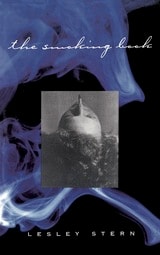
Stern writes of addictions and passionate attachments, of the body and bodily pleasure, of autobiography and cultural history. Smoking is Stern's seductive pretext, her way of entering unknown and mysterious regions. The Smoking Book begins with intimate and vivid accounts of growing up on a tobacco farm in colonial Rhodesia, reminiscences that permeate subsequent excursions into precolonial tobacco production and postcolonial life in Zimbabwe, as well as dramatic vignettes set in Australia, the United States, Scotland, Italy, Japan, and South America. Stern has written a book, at once intensely personal and kaleidoscopically international, that weaves the intimate act of a solitary person smoking a cigarette into a broad cultural picture of desire, exchange, fulfillment, and the acts that bind people together, either in lasting ways or through ephemeral encounters.
The Smoking Book is for anyone who has ever smoked or loved a smoker (against their better judgment); it is for those who have never smoked or for those who mourn the loss of cigarettes as they would grieve for a lost friend. But mostly, The Smoking Book is for all those who are smoldering still.
The Social Benefits of Education
Jere R. Behrman and Nevzer Stacey, Editors
University of Michigan Press, 1997
The Social Citizen
Peer Networks and Political BehaviorBetsy Sinclair
University of Chicago Press, 2012
The Social Life of Biometrics
George C Grinnell
Rutgers University Press, 2020

The Social Life of Financial Derivatives
Markets, Risk, and TimeEdward LiPuma
Duke University Press, 2017
The Social Life of Spirits
Edited by Ruy Blanes and Diana Espírito Santo
University of Chicago Press, 2013
The contributors tour the spiritual globe—the globe of nonthings—in essays on topics ranging from the Holy Ghost in southern Africa to spirits of the “people of the streets” in Rio de Janeiro to dragons and magic in Britain. Avoiding a reliance on religion and belief systems to explain the significance of spirits, they reimagine spirits in a rich network of social trajectories, ultimately arguing for a new ontological ground upon which to examine the intangible world and its interactions with the tangible one.
The Social Lives of Forests
Past, Present, and Future of Woodland ResurgenceEdited by Susanna B. Hecht, Kathleen D. Morrison, and Christine Padoch
University of Chicago Press, 2014
Focusing on the history and current use of woodlands from India to the Amazon, The Social Lives of Forests attempts to build a coherent view of forests sited at the nexus of nature, culture, and development. With chapters covering the effects of human activities on succession patterns in now-protected Costa Rican forests; the intersection of gender and knowledge in African shea nut tree markets; and even the unexpectedly rich urban woodlands of Chicago, this book explores forests as places of significant human action, with complex institutions, ecologies, and economies that have transformed these landscapes in the past and continue to shape them today. From rain forests to timber farms, the face of forests—how we define, understand, and maintain them—is changing.

The Social Worlds of Nineteenth-Century Chamber Music
Composers, Consumers, CommunitiesMarie Sumner Lott
University of Illinois Press, 2018
Marie Sumner Lott examines the music available to musical consumers in the nineteenth century, and what that music tells us about their tastes, priorities, and activities. Her social history of chamber music performance places the works of canonic composers such as Schubert, Brahms, and Dvoøák in relation to lesser-known but influential peers. The book explores the dynamic relationships among the active agents involved in the creation of Romantic music and shows how each influenced the others' choices in a rich, collaborative environment. In addition to documenting the ways companies acquired and marketed sheet music, Sumner Lott reveals how the publication and performance of chamber music differed from that of ephemeral piano and song genres or more monumental orchestral and operatic works. Several distinct niche markets existed within the audience for chamber music, and composers created new musical works for their use and enjoyment.
Insightful and groundbreaking, The Social Worlds of Nineteenth-Century Chamber Music revises prevailing views of middle-class influence on nineteenth-century musical style and presents new methods for interpreting the meanings of musical works for musicians both past and present.

The Social and Political Life of Latin American Infrastructures
Edited by Jonathan Alderman and Geoff Goodwin
University of London Press, 2022
From roads, railways, statues, and bridges, infrastructure provides a unique lens through which to view our own national histories and societies. Serving as an important conduit between individuals and the state, infrastructure can help mediate citizenship, reshape social relations between people both within and across communities, and has the capacity to underpin—or indeed, undermine—nation-building.
Over the last century, infrastructure has transformed Latin America. Roads, railways, and airports have increased connectivity between spaces, peoples, and markets. Cables, switches, and tunnels have connected households to electricity grids, water systems, and digital technology. Public buildings, parks, and monuments have reshaped towns and cities and emerged as sites to construct and contest citizenship. Infrastructure has been welcomed and celebrated in Latin America, but it has also been resisted and destroyed.
Based on recent, original research, the essays in this collection cover a range of pressing infrastructural considerations, including sustainability, water conflict, extractive mining, and public housing in Brazil, Chile, Cuba, Colombia, Ecuador, and Mexico to better understand how infrastructure has reshaped Latin America over the past century.

The Socialist Way of Life in Siberia
Transformation in BuryatiaMelissa Chakars
Central European University Press, 2014
The Socially Responsive Self
Social Theory and Professional EthicsLarry May
University of Chicago Press, 1996
Applying his theory of responsibility to professional ethics, May contends that current methods of professional socialization should be changed so that professionals are not expected to ignore considerations of personal well-being, family, or community. For instance, lawyers should not place client loyalty above concerns for the common good; doctors should not place the physical well-being of patients above their mental and spiritual well-being; scientists and engineers should not feel obliged to blow the whistle on fraud and corruption unless their professional groups protect them from retaliation.
This book should prove provocative reading for philosophers, political scientists, social theorists, professionals of many stripes, and ethicists.

The Sociology of Science
Theoretical and Empirical InvestigationsRobert K. Merton
University of Chicago Press, 1979
"The novelty of the approach, the erudition and elegance, and the unusual breadth of vision make this volume one of the most important contributions to sociology in general and to the sociology of science in particular. . . . Merton's Sociology of Science is a magisterial summary of the field."—Yehuda Elkana, American Journal of Sociology
"Merton's work provides a rich feast for any scientist concerned for a genuine understanding of his own professional self. And Merton's industry, integrity, and humility are permanent witnesses to that ethos which he has done so much to define and support."—J. R. Ravetz, American Scientist
"The essays not only exhibit a diverse and penetrating analysis and a deal of historical and contemporary examples, with concrete numerical data, but also make genuinely good reading because of the wit, the liveliness and the rich learning with which Merton writes."—Philip Morrison, Scientific American
"Merton's impact on sociology as a whole has been large, and his impact on the sociology of science has been so momentous that the title of the book is apt, because Merton's writings represent modern sociology of science more than any other single writer."—Richard McClintock, Contemporary Sociology
The Soiling of Old Glory
The Story of a Photograph That Shocked AmericaLouis P. Masur
Brandeis University Press, 2024
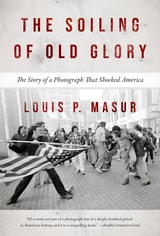
In 1976, Boston was bitterly divided over a court order to desegregate its public schools. Plans to bus students between predominantly white and Black neighborhoods stoked backlash and heated protests. Photojournalist Stanley Forman was covering one such demonstration at City Hall when he captured an indelible image: a white protester attacking a Black attorney with the American flag. A second white man grabs at the victim, appearing to assist the assailant.
The photo appeared in newspapers across the nation and went on to win the Pulitzer Prize. In The Soiling of Old Glory, esteemed historian Louis P. Masur reveals what happened the day of the assault and the ways these events reverberated long afterward. He interviews the men involved: Forman, who took the photo; Ted Landsmark, a Black, Yale-educated attorney and an activist; Joseph Rakes, the white protester lunging with the flag, a disaffected student; and Jim Kelly, a local politician who opposed busing, but who helped Landsmark to his feet after protesters knocked him to the ground. The photo, Masur discovers, holds more complexities than initially meet the eye. The flag never made contact with the victim, for example, and Kelly was attempting to protect Landsmark, not hurt him.
Masur delves into the history behind Boston’s efforts to desegregate the schools and the anti-busing protests that shook the city. He examines photography’s power to move, inform, and persuade us, as well as the assumptions we each bring to an image as viewers. And he delves into the flag, to explore how other artists and photographers have shaped, bolstered, or challenged its patriotic significance.
Gripping and deeply researched, The Soiling of Old Glory shows how a disturbing event, frozen on a film, impacted Boston and the nation. In an age of renewed calls for visual literacy and disagreements about the flag’s meaning, Masur’s history, now updated with a new foreword by Ted Landsmark and a new preface by the author, is as relevant as ever.
The Sonic Episteme
Acoustic Resonance, Neoliberalism, and BiopoliticsRobin James
Duke University Press, 2019
The Sorcery of Color
Identity, Race, and Gender in BrazilElisa Larkin Nascimento
Temple University Press, 2009
Originally published in 2003 in Portuguese, The Sorcery of Color argues that there are longstanding and deeply-rooted relationships between racial and gender inequalities in Brazil. In this pioneering book, Elisa Larkin Nascimento examines the social and cultural movements that have attempted, since the early twentieth century, to challenge and eradicate these conjoined inequalities.
The book's title describes the social sleight-of-hand that disguises the realities of Brazilian racial inequity. According to Nascimento, anyone who speaks of racism—or merely refers to another person as black—traditionally is seen as racist. The only acceptably non-racist attitude is silence. At the same time, Afro-Brazilian culture and history have been so overshadowed by the idea of a general "Brazilian identity" that to call attention to them is also to risk being labeled racist.
Incorporating leading international scholarship on Pan Africanism and Afrocentric philosophy with the writing of Brazilian scholars, Nascimento presents a compelling feminist argument against the prevailing policy that denies the importance of race in favor of a purposefully vague concept of ethnicity confused with color.

The Soul of Anime
Collaborative Creativity and Japan's Media Success StoryIan Condry
Duke University Press, 2013
The Sound of Dove
Singing in Appalachian Primitive Baptist ChurchesBeverly Bush Patterson
University of Illinois Press, 1995

The Sound of Feathers
Attentive Living in a World Beyond OurselvesKathryn Gillespie
Duke University Press, 2026

The Southern Debate over Slavery
Volume 1: Petitions to Southern Legislatures, 1778-1864Edited by Loren Schweninger
University of Illinois Press, 2001
These petitions, filed by slaveholders and nonslaveholders, slaves and free blacks, women and men, abolitionists and staunch defenders of slavery, constitute a uniquely important primary source. Petitioners were compelled to present the most accurate and fully documented case they could, since their claims would be subject to public scrutiny and legal verification. Unlike the many reminiscences and autobiographies of the period, these petitions record with great immediacy and minute detail the dynamics, common understandings, and legal restrictions and parameters that shaped southern society during this period.
Arranged chronologically, with their original spelling and idiosyncratic phraseology intact, these documents reveal the grim and brutal nature of human bondage, the fears of whites who lived among large concentrations of blacks, and the workings of the complicated legal system designed to control blacks. They tell about the yearning of bondspeople to gain their freedom, the attitudes of freed blacks who were forced to leave the South, and the efforts of African Americans to overcome harsh and restrictive laws. They also underscore the unique situation of free women of color and the reliance of manumitted (formally freed) blacks on their former owners for protection, travel passes, guardianship papers, and reference letters.
Astonishingly intimate and frank,The Southern Debate over Slavery illuminates how slavery penetrated nearly every aspect of southern life and how various groups of southerners responded to the difficulties they confronted as a result of living in a slave society.
The Southern Debate over Slavery
Volume 2: Petitions to Southern County Courts, 1775-1867Edited by Loren Schweninger
University of Illinois Press, 2007
An incomparably rich source of period information, the second volume of The Southern Debate over Slavery offers a representative and extraordinary sampling of the thousands of petitions about issues of race and slavery that southerners submitted to county courts between the American Revolution and Civil War. These petitions, filed by slaveholders and nonslaveholders, slaves and free blacks, women and men, abolitionists and staunch defenders of slavery, constitute a uniquely important primary source. The collection records with great immediacy and minute detail the dynamics and legal restrictions that shaped southern society.
The Space of Boredom
Homelessness in the Slowing Global OrderBruce O'Neill
Duke University Press, 2017
The Species Maker
A NovelKristin Johnson
University of Alabama Press, 2021
A historical novel about the role of science in modern life, set against the backdrop of the 1925 Scopes Trial.
When William Jennings Bryan began a campaign to get evolution out of American schools in the 1920s, entomologist Martin Sullivan sought refuge from the tumult in his research. Although the theory of evolution provides the foundation for his scientific work, he prefers the careful methods of observation and classification to the passion of public debate. But when Martin takes a job teaching college biology in Seattle, he finds it increasingly difficult to retreat to the haven of science. His students are taking sides in the debate over whether religion and evolution can be reconciled. Socialists are using evolution to justify revolution. Politicians are citing Darwin in defense of anti-immigration laws. And Martin’s own colleagues are insisting that only eugenic reforms will save the world. As anti-evolution legislation spreads across the country and passions flare on all sides, the effort to apply science to marriage laws and mate choice even begins to touch the lives of those he loves. By the time the state of Tennessee puts John T. Scopes on trial for teaching evolution in the summer of 1925, Martin can no longer ignore the debates that surround him and must take a stand in the fight over the role of science in American society.
Although set a hundred years ago, The Species Maker wrestles with many issues that continue to confront scientists and science watchers in the present day. Kristin Johnson draws on her experiences in the classroom and extensive knowledge of the history of science to depict what it might have been like for a careful scientist to watch the heated debates over teaching evolution in the United States in the 1920s.
Visit www.thespeciesmaker.com for supplemental material including historical essays, links to online primary sources, a glossary, and guiding questions useful for the classroom or book clubs.
The Spectral Jew
Conversion and Embodiment in Medieval EuropeSteven F. Kruger
University of Minnesota Press, 2006
Looking closely at how medieval Jewish and Christian identities are distinguished from each other, yet intimately intertwined, Kruger demonstrates how Jews were often corporealized in ways that posited them as inferior to Christians—archaic and incapable of change—even as the two mutually shaped each other. But such attempts to differentiate Jews and Christians were inevitably haunted by the knowledge that Christianity had emerged out of Judaism and was, in its own self-understanding, a community of converts.
Examining the points of contact between Christian and Jewish communities, Kruger discloses the profound paradox of the Jew as different in all ways, yet capable of converting to fully Christian status. He draws from central medieval authors and texts such as Peter Damian, Guibert of Nogent, the Barcelona Disputation, and the Hebrew chronicles of the First Crusade, as well as lesser known writings such as the disputations of Ceuta, Majorca, and Tortosa and the immensely popular Dialogues of Peter Alfonsi.
By putting the conversion narrative at the center of this analysis, Kruger exposes it as a disruption of categories rather than a smooth passage and reveals the prominent role Judaism played in the medieval Christian imagination.
Steven F. Kruger is professor of English and medieval studies at Queens College and the Graduate Center, CUNY. He is author of several books and editor with Glenn Burger of Queering the Middle Ages (Minnesota, 2001).
The Speed Handbook
Velocity, Pleasure, ModernismEnda Duffy
Duke University Press, 2009
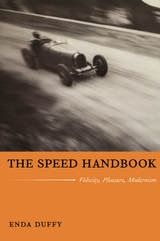
Duffy plunges full-throttle into speed’s “adrenaline aesthetics,” offering deft readings of works ranging from F. Scott Fitzgerald’s The Great Gatsby, through J. G. Ballard’s Crash, to the cautionary consumerism of Ralph Nader. He describes how speed changed understandings of space, distance, chance, and violence; how the experience of speed was commodified in the dawning era of mass consumption; and how society was incited to abhor slowness and desire speed. He examines how people were trained by new media such as the cinema to see, hear, and sense speed, and how speed, demanded of the efficient assembly-line worker, was given back to that worker as the chief thrill of leisure. Assessing speed’s political implications, Duffy considers how speed pleasure was offered to citizens based on criteria including their ability to pay and their gender, and how speed quickly became something to be patrolled by governments. Drawing on novels, news reports, photography, advertising, and much more, Duffy provides a breakneck tour through the cultural dynamics of speed.
The Spirit of 1848
German Immigrants, Labor Conflict, and the Coming of the Civil WarBruce Levine
University of Illinois Press, 1992
The Spirit of 1848 offers much new information and insight concerning craftwork, the nature of the antebellum labor movement (including the great New York City tailors' strike of 1850), the meaning of nativism, the significance of the push for land reform, the diverse character of the free-soil movement, and the popular appeals of both the Democratic and Republican parties.
The Spirit of 1976
Commerce, Community, and the Politics of CommemorationTammy S. Gordon
University of Massachusetts Press, 2013
The most important national commemoration of the twentieth century, the 1976 bicentennial celebration gave rise to a broad-ranging debate over how the American Revolution should be remembered and represented. Federal planners seeking an uncritical glorification of the nation's founding came up against an array of constituencies with other interests and objectives. Inspired by the “new social history” that looked at the past “from the bottom up,” Americans who had previously been disenfranchised by traditional national narratives—African Americans, women, American Indians, workers, young people—demanded a voice and representation in the planning. Local communities, similarly suspicious of federal direction, sought control over their own bicentennial events. Corporate representatives promoted an approach that championed the convergence of patriotism and private enterprise, while commercial interests applied the marketing techniques of an expanding consumerism to hawk every imaginable kind of patriotic souvenir to all of these groups.
The end result of these competing efforts, Tammy S. Gordon shows, was a national celebration that reflected some common themes, including a mistrust of federal power, an embrace of decentralized authority, and a new cultural emphasis on the importance of the self. The American Revolution Bicentennial can thus be seen as both a product of the social and political changes of the 1960s and a harbinger of things to come. After 1976, the postwar myth of a consensus view of American history came to an end, ensuring that future national commemorations would continue to be contested.
The Spirit of Colonial Williamsburg
Ghosts and Interpreting the Recreated PastAlena Pirok
University of Massachusetts Press, 2022
On any given night, hundreds of guests walk the darkened streets of Colonial Williamsburg looking for ghosts. Since the early 2000s, both the museum and private companies have facilitated these hunts, offering year-round ghost tours. Critics have called these excursions a cash grab, but in truth, ghosts and hauntings have long been at the center of the Colonial Williamsburg project.
The Spirit of Colonial Williamsburg examines how the long-dead past comes alive at this living-history museum. In the early twentieth century, local stories about the ghosts of former residents—among them Revolutionary War soldiers and nurses, tavern owners and prominent attorneys, and enslaved African Americans—helped to turn Williamsburg into a desirable site for historical restoration. But, for much of the twentieth century, the museum tried diligently to avoid any discussion of ghosts, considering them frivolous and lowbrow. Alena Pirok explores why historic sites have begun to embrace their spectral residents in recent decades, arguing that through them, patrons experience an emotional connection to place and a palpable understanding of the past through its people.
The Sponsored Life
Ads, TV, and American CultureLeslie Savan
Temple University Press, 1994
How does a blatant lying in TV commercials—like Joe Isuzu's manic claims—create public trust in a product or a company? How does a company associated with a disaster, Exxon or Du Pont for example, restore its reputation? What is the real story behind the rendering of the now infamous Joe Camel? And what is the deeper meaning of living in an ad, ad, ad world? For a decade, journalist Leslie Savan has been exposing the techniques used by advertisers to push products and pump up corporate images. In the lively essays in this collection, Savan penetrates beneath the slick surfaces of specific ads and marketing campaigns to show how they reflect and shape consumer desires.
Savan's interviews with ad agencies and corporate clients—along with her insightful analyses of influential TV sports—reveal how successful advertising works. Ads do more than command attention. They are signposts to the political, cultural, and social trends that infiltrate the individual consumer's psyche. Think of the products associated with corporate mascots—the drum-beating bunny, the cereal-pushing tiger, the doughboy—that have become pop culture icons. Think cool. Think of the clothing manufacturer that uses multiracial imagery. Think progressive. Buy their worldview, buy their product. When virtually every product can be associate with some positive self-image, we are subtly refashioned into the advertiser's concept of a good citizen. Like it or not, we lead "the sponsored life."
The Sporting World of the Modern South
Edited by Patrick B. Miller
University of Illinois Press, 2002
Engaging a medley of perspectives and methodologies, these collected essays explore the sport-related symbols and events that have shaped southern regional identities since the Civil War. The authors range from the "backcountry" fighter stereotypes portrayed in modern professional wrestling to the significance of Crimson Tide coaching legend Paul "Bear" Bryant for white Alabamians while other essays tackle gender and race relations in intercollegiate athletics, the roles athletic competitions played in desegregating the South, and NASCAR's popularity in southern states.
Pairing the action and anecdotes of good sportswriting with rock-solid scholarship, The Sporting World of the Modern South adds historical and anthropological perspectives to legends and lore from the gridiron to the racetrack.
The Sports Revolution
How Texas Changed the Culture of American AthleticsBy Frank Andre Guridy
University of Texas Press, 2021
The story of Texas’s impact on American sports culture during the civil rights and second-wave feminist movements, this book offers a new understanding of sports and society in the state and the nation as a whole.
In the 1960s and 1970s, America experienced a sports revolution. New professional sports franchises and leagues were established, new stadiums were built, football and basketball grew in popularity, and the proliferation of television enabled people across the country to support their favorite teams and athletes from the comfort of their homes. At the same time, the civil rights and feminist movements were reshaping the nation, broadening the boundaries of social and political participation. The Sports Revolution tells how these forces came together in the Lone Star State.
Tracing events from the end of Jim Crow to the 1980s, Frank Guridy chronicles the unlikely alliances that integrated professional and collegiate sports and launched women’s tennis. He explores the new forms of inclusion and exclusion that emerged during the era, including the role the Dallas Cowboys Cheerleaders played in defining womanhood in the age of second-wave feminism. Guridy explains how the sexual revolution, desegregation, and changing demographics played out both on and off the field as he recounts how the Washington Senators became the Texas Rangers and how Mexican American fans and their support for the Spurs fostered a revival of professional basketball in San Antonio. Guridy argues that the catalysts for these changes were undone by the same forces of commercialization that set them in motion and reveals that, for better and for worse, Texas was at the center of America’s expanding political, economic, and emotional investments in sport.
The Stages of Memory
Reflections on Memorial Art, Loss, and the Spaces BetweenJames E. Young
University of Massachusetts Press, 2016
Winner of the 2017 National Council on Public History Book Award
From around the world, whether for New York City's 9/11 Memorial, at exhibits devoted to the arts of Holocaust memory, or throughout Norway's memorial process for the murders at Utøya, James E. Young has been called on to help guide the grief stricken and survivors in how to mark their losses. This poignant, beautifully written collection of essays offers personal and professional considerations of what Young calls the “stages of memory,” acts of commemoration that include spontaneous memorials of flowers and candles as well as permanent structures integrated into sites of tragedy. As he traces an arc of memorial forms that spans continents and decades, Young returns to the questions that preoccupy survivors, architects, artists, and writers: How to articulate a void without filling it in? How to formalize irreparable loss without seeming to repair it?
Richly illustrated, the volume is essential reading for those engaged in the processes of public memory and commemoration and for readers concerned about how we remember terrible losses.

The Stars Are Back
The St. Louis Cardinals, the Boston Red Sox, and Player Unrest in 1946Jerome M. Mileur
Southern Illinois University Press, 2013
But while the nation was riveted by the return of its beloved baseball heroes, the game behind the scenes was just as dramatic. As the threat of unionization loomed and the Mexican League continued to lure players away from the United States with lucrative contracts, tensions between players and team owners mounted. The result was a standoff for control of the game that would culminate in the Magna Carta of baseball and the creation of standard contracts for players, ushering in the modern era of baseball.
Set against the backdrop of a country recovering from war, facing the new adversary of Communism, and absorbing the emotional impact of the atomic bomb, The Stars Are Back tells the story of a nation hungry for a return to normalcy and a game poised on the brink of new horizons.

The Stars Are Not Enough
Scientists--Their Passions and ProfessionsJoseph C. Hermanowicz
University of Chicago Press, 1998
These deeply personal narratives reveal dreams of fame and glory, in which scientists confess their ambitions of becoming the next Newton or Einstein. However, these scientists also discuss the meaning of success and failure. We hear their stories of aspiration and anxiety, disappointment and tragedy, hope and achievement; we are privy to their doubts and to what they consider to be their limitations and weaknesses. As the scientists age in their professions, the specter of failure often visits them, and they have to accept something less than scientific immortality or even the Nobel Prize.
Ultimately these stories give us more than an inside look at the details of careers in science, they also examine ambition by uncovering the forces that drive people in their professions and by describing how these forces persist or fade over time. Ambition for greatness often ignites a career and often sustains it. Yet, as Hermanowicz's study reveals, greatness eludes nearly all people in their heroic quests for extraordinary achievement. The Stars Are Not Enough offers a fascinating account that will appeal to anyone interested in how people's dreams blossom and evolve.
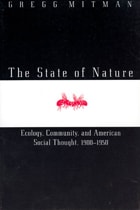
The State of Nature
Ecology, Community, and American Social Thought, 1900-1950Gregg Mitman
University of Chicago Press, 1992
Reacting against the view of nature "red in tooth and claw," ecologists and behavioral biologists such as Warder Clyde Allee, Alfred Emerson, and their colleagues developed research programs they hoped would validate and promote an image of human society as essentially cooperative rather than competitive. Mitman argues that Allee's religious training and pacifist convictions shaped his pioneering studies of animal communities in a way that could be generalized to denounce the view that war is in our genes.
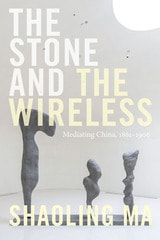
The Stone and the Wireless
Mediating China, 1861–1906Shaoling Ma
Duke University Press, 2021

The Story of Swahili
John M. Mugane
Ohio University Press, 2015
Swahili was once an obscure dialect of an East African Bantu language. Today more than one hundred million people use it: Swahili is to eastern and central Africa what English is to the world. From its embrace in the 1960s by the black freedom movement in the United States to its adoption in 2004 as the African Union’s official language, Swahili has become a truly international language. How this came about and why, of all African languages, it happened only to Swahili is the story that John M. Mugane sets out to explore.
The remarkable adaptability of Swahili has allowed Africans and others to tailor the language to their needs, extending its influence far beyond its place of origin. Its symbolic as well as its practical power has evolved from its status as a language of contact among diverse cultures, even as it embodies the history of communities in eastern and central Africa and throughout the Indian Ocean world.
The Story of Swahili calls for a reevaluation of the widespread assumption that cultural superiority, military conquest, and economic dominance determine a language’s prosperity. This sweeping history gives a vibrant, living language its due, highlighting its nimbleness from its beginnings to its place today in the fast-changing world of global communication.
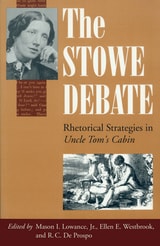
The Stowe Debate
Rhetorical Strategies in "Uncle Tom's Cabin"Mason I. Lowance
University of Massachusetts Press, 1994
The thirteen contributors to this volume enter these debates from a variety of critical perspectives. They address questions of language and ideology, the tradition of the sentimental novel, biblical influences, and the rhetoric of antislavery discourse. As much as they disagree on various points, they share a keen interest in the cultural work that texts can do and an appreciation of the enduring power of Uncle Tom's Cabin.

The Streets of Europe
The Sights, Sounds, and Smells That Shaped Its Great CitiesBrian Ladd
University of Chicago Press, 2020
Merchants’ shouts, jostling strangers, aromas of fresh fish and flowers, plodding horses, and friendly chatter long filled the narrow, crowded streets of the European city. As they developed over many centuries, these spaces of commerce, communion, and commuting framed daily life. At its heyday in the 1800s, the European street was the place where social worlds connected and collided.
Brian Ladd recounts a rich social and cultural history of the European city street, tracing its transformation from a lively scene of trade and crowds into a thoroughfare for high-speed transportation. Looking closely at four major cities—London, Paris, Berlin, and Vienna—Ladd uncovers both the joys and the struggles of a past world. The story takes us up to the twentieth century, when the life of the street was transformed as wealthier citizens withdrew from the crowds to seek refuge in suburbs and automobiles. As demographics and technologies changed, so did the structure of cities and the design of streets, significantly shifting our relationships to them. In today’s world of high-speed transportation and impersonal marketplaces, Ladd leads us to consider how we might draw on our history to once again build streets that encourage us to linger.
By unearthing the vivid descriptions recorded by amused and outraged contemporaries, Ladd reveals the changing nature of city life, showing why streets matter and how they can contribute to public life.

The Structure of World History
From Modes of Production to Modes of ExchangeKojin Karatani
Duke University Press, 2014
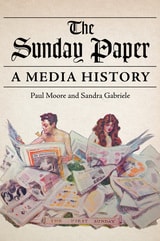
The Sunday Paper
A Media HistoryPaul Moore and Sandra Gabriele
University of Illinois Press, 2022
The Superhero Symbol
Media, Culture, and PoliticsLiam Burke
Rutgers University Press, 2020
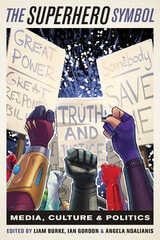
It is hard to imagine a time when superheroes have been more pervasive in our culture. Today, superheroes are intellectual property jealously guarded by media conglomerates, icons co-opted by grassroots groups as a four-color rebuttal to social inequities, masks people wear to more confidently walk convention floors and city streets, and bulletproof banners that embody regional and national identities. From activism to cosplay, this collection unmasks the symbolic function of superheroes.
Bringing together superhero scholars from a range of disciplines, alongside key industry figures such as Harley Quinn co-creator Paul Dini, The Superhero Symbol provides fresh perspectives on how characters like Captain America, Iron Man, and Wonder Woman have engaged with media, culture, and politics, to become the “everlasting” symbols to which a young Bruce Wayne once aspired.
The Switch
An Off and On History of Digital HumansJason Puskar
University of Minnesota Press, 2024
From the telegraph to the touchscreen, how the development of binary switching transformed everyday life and changed the shape of human agency
The Switch traces the sudden rise of a technology that has transformed everyday life for billions of people: the binary switch. By chronicling the rapid growth of binary switching since the mid-nineteenth century, Jason Puskar contends that there is no human activity as common today as pushing a button or flipping a switch—the deceptively simple act of turning something on or off. More than a technical history, The Switch offers a cultural and political analysis of how reducing so much human action to binary alternatives has profoundly reshaped modern society.
Analyzing this history, Puskar charts the rapid shift from analog to digital across a range of devices—keyboards, cameras, guns, light switches, computers, game controls, even the “nuclear button”—to understand how nineteenth-century techniques continue to influence today’s pervasive digital technologies. In contexts that include musical performance, finger counting, machine writing, voting methods, and immersive play, Puskar shows how the switch to switching led to radically new forms of action and thought.
The innovative analysis in The Switch makes clear that binary inputs have altered human agency by making choice instantaneous, effort minimal, and effects more far-reaching than ever. In the process, it concludes, switching also fosters forms of individualism that, though empowering for many, also preserve a legacy of inequality and even domination.
The Sympathetic State
Disaster Relief and the Origins of the American Welfare StateMichele Landis Dauber
University of Chicago Press, 2012
The Synchronized Society
Time and Control From Broadcasting to the InternetRandall Patnode
Rutgers University Press, 2023
The Synchronized Society traces the history of the synchronous broadcast experience of the twentieth century and the transition to the asynchronous media that dominate today. Broadcasting grew out of the latent desire by nineteenth-century industrialists, political thinkers, and social reformers to tame an unruly society by controlling how people used their time. The idea manifested itself in the form of the broadcast schedule, a managed flow of information and entertainment that required audiences to be in a particular place – usually the home – at a particular time and helped to create “water cooler” moments, as audiences reflected on their shared media texts. Audiences began disconnecting from the broadcast schedule at the end of the twentieth century, but promoters of social media and television services still kept audiences under control, replacing the schedule with surveillance of media use. Author Randall Patnode offers compelling new insights into the intermingled roles of broadcasting and industrial/post-industrial work and how Americans spend their time.
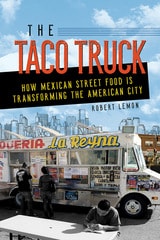
The Taco Truck
How Mexican Street Food Is Transforming the American CityRobert Lemon
University of Illinois Press, 2019
Drawing on interviews with taco truck workers and his own skills as a geographer, Robert Lemon illuminates new truths about foodways, community, and the unexpected places where ethnicity, class, and culture meet. Lemon focuses on the San Francisco Bay Area, Sacramento, and Columbus, Ohio, to show how the arrival of taco trucks challenge preconceived ideas of urban planning even as cities use them to reinvent whole neighborhoods. As Lemon charts the relationships between food practices and city spaces, he uncovers the many ways residents and politicians alike contest, celebrate, and influence not only where your favorite truck parks, but what's on the menu.
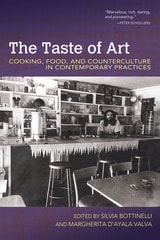
The Taste of Art
Cooking, Food, and Counterculture in Contemporary PracticesSilvia Bottinelli
University of Arkansas Press, 2017
The Taste of Art offers a sample of scholarly essays that examine the role of food in Western contemporary art practices. The contributors are scholars from a range of disciplines, including art history, philosophy, film studies, and history. As a whole, the volume illustrates how artists engage with food as matter and process in order to explore alternative aesthetic strategies and indicate countercultural shifts in society.
The collection opens by exploring the theoretical intersections of art and food, food art’s historical root in Futurism, and the ways in which food carries gendered meaning in popular film. Subsequent sections analyze the ways in which artists challenge mainstream ideas through food in a variety of scenarios. Beginning from a focus on the body and subjectivity, the authors zoom out to look at the domestic sphere, and finally the public sphere.
Here are essays that study a range of artists including, among others, Filippo Tommaso Marinetti, Daniel Spoerri, Dieter Roth, Joseph Beuys, Al Ruppersberg, Alison Knowles, Martha Rosler, Robin Weltsch, Vicki Hodgetts, Paul McCarthy, Luciano Fabro, Carries Mae Weems, Peter Fischli and David Weiss, Janine Antoni, Elżbieta Jabłońska, Liza Lou, Tom Marioni, Rirkrit Tiravanija, Michael Rakowitz, and Natalie Jeremijenko.
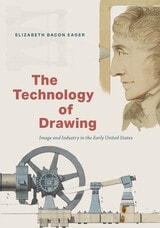
The Technology of Drawing
Image and Industry in the Early United StatesElizabeth Bacon Eager
University of Chicago Press, 2026
A richly illustrated study of how technical drawing shaped culture in the early United States.
With The Technology of Drawing, Elizabeth Bacon Eager explores the importance of manual skill and graphic literacy in the emergence of American industry, offering readers a new lens through which to view the visual culture of the early United States. Focused on questions of materiality and process, the book traces the development of drawing as a technology and argues for it as an embodied way of thinking and knowing, revealing the significance of such knowledge in the construction of both scientific and social authority. Through close analysis of materials, including construction drawings, mechanical treatises, cartographic surveys, and patent drawings, many of which have never been published before, Eager presents a history of American art focused on materiality and process through the view of the mechanic rather than the fine artist.
Reaching beyond the traditional boundaries of art historical study to engage objects rarely considered as art, The Technology of Drawing treats the technical image as a site of extraordinary creativity, in which eighteenth- and nineteenth-century Americans across the social spectrum negotiated critical concepts of identity, invention, and authorship with a remarkable degree of material intelligence and visual sophistication.