Results by title
8812 books match the query 'Political Science' and 1911 start with t
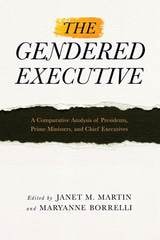
The Gendered Executive
A Comparative Analysis of Presidents, Prime Ministers, and Chief ExecutivesJanet M. Martin
Temple University Press, 2016
Excluded from the ranks of elite executive decision-makers for generations, women are now exercising power as chiefs of government and chiefs of state. As of April 2016, 112 women in 73 countries have served as presidents or prime ministers.
The Gendered Executive is a critical examination of national executives, focusing on matters of identity, representation, and power. The editors and contributors to this volume address the impact of female executives through political mobilization and participation, policy- and decision-making, and institutional change. Other topics include party nomination processes, the intersectionality of race and gender, and women-centered U.S. foreign policy in southern Africa. In addition, case studies from Chile, India, Portugal, and the United States are presented, as are cross-national comparisons of women leaders in Latin America.
The Gendered Executive will enhance our understanding of the complexity of gender in and comparative analyses of executive politics.
Contributors include: Amy C. Alexander, Sheetal Chhabria, Georgia Duerst-Lahti, Maria C. Escobar-Lemmon, Cory Charles Gooding, Lilly Goren, Karen M. Hult, Farida Jalalzai, Daniela F. Melo, Catherine Reyes-Housholder, Ariella R. Rotramel, Leslie A. Schwindt-Bayer, Michelle M. Taylor-Robinson, and the editors

The General Data Protection Regulation in Plain Language
Bart van der Sloot
Amsterdam University Press, 2020
This book sets out the most important obligations of individuals and organisations that process data about others. These include taking technical security measures, carrying out an impact assessment and registering all data-processing procedures within an organisation. It also discusses the rights of citizens whose data are processed, such as the right to be forgotten, the right to information and the right to data portability.

The General Data Protection Regulation in Plain Language
Bart van der Sloot
Amsterdam University Press, 2020
This book sets out the most important obligations of individuals and organisations that process data about others. These include taking technical security measures, carrying out an impact assessment and registering all data-processing procedures within an organisation. It also discusses the rights of citizens whose data are processed, such as the right to be forgotten, the right to information and the right to data portability.
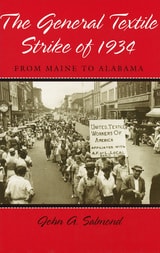
The General Textile Strike of 1934
From Maine to AlabamaJohn A. Salmond
University of Missouri Press, 2002
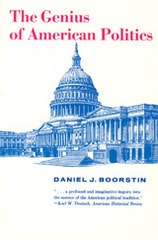
The Genius of American Politics
Daniel J. Boorstin
University of Chicago Press, 1958
". . . a fresh and, on the whole, valid interpretation of American political life."—Reinhold Niebuhr, New Leader
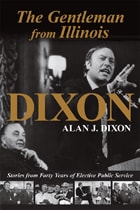
The Gentleman from Illinois
Stories from Forty Years of Elective Public ServiceAlan J. Dixon
Southern Illinois University Press, 2013

The Geoarchaeology of a Terraced Landscape
From Aztec Matlatzinco to Modern CalixtlahuacaAleksander Borejsza, Isabel Rodríguez López, Charles D. Frederick, and Michael E. Smith
University of Utah Press, 2021
Working at a settlement in the Toluca Valley of central Mexico, the authors used fieldwalking, excavation, soil and artifact analyses, maps, aerial photos, land deeds, and litigation records to reconstruct the changing landscape through time. Exploiting the methodologies and techniques of several disciplines, they bring context to eight centuries of the region’s agrarian history, exploring the effects of the Aztec and Spanish Empires, reform, and revolution on the physical shape of the Mexican countryside and the livelihoods of its people. Accessible to specialists and nonspecialists alike, this well-illustrated and well-organized volume provides a step-by-step guide that can be applied to the study of terraced landscapes anywhere in the world.
The four authors share an interest in terraced landscapes and have worked together and on their own on a variety of archaeological projects in Mesoamerica, the Mediterranean, Poland, and the United Kingdom.

The German Problem Transformed
Institutions, Politics, and Foreign Policy, 1945-1995Thomas Banchoff
University of Michigan Press, 1999
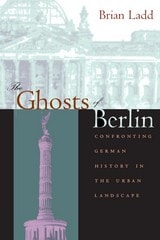
The Ghosts of Berlin
Confronting German History in the Urban LandscapeBrian Ladd
University of Chicago Press, 1997
"Written in a clear and elegant style, The Ghosts of Berlin is not just another colorless architectural history of the German capital. . . . Mr. Ladd's book is a superb guide to this process of urban self-definition, both past and present."—Katharina Thote, Wall Street Journal
"If a book can have the power to change a public debate, then The Ghosts of Berlin is such a book. Among the many new books about Berlin that I have read, Brian Ladd's is certainly the most impressive. . . . Ladd's approach also owes its success to the fact that he is a good storyteller. His history of Berlin's architectural successes and failures reads entertainingly like a detective novel."—Peter Schneider, New Republic
"[Ladd's] well-written and well-illustrated book amounts to a brief history of the city as well as a guide to its landscape."—Anthony Grafton, New York Review of Books
The Ghosts of the Past
Latin Literature, the Dead, and Rome’s Transition to A PrincipateBasil Dufallo
The Ohio State University Press, 2007
Calling into question boundaries of genre and literary form, Dufallo’s study will revise current understandings of Latin literature as a cultural and performance practice. Works as diverse as Cicero’s speeches, Propertian elegy, Horace’s epodes and satires, and Vergil’s Aeneid appear in a new light as performed texts interacting with other kinds of cultural performance from which they might otherwise seem isolated.
The Global Economy and Democracy in South Africa
Koelble, Thomas A.
Rutgers University Press, 1998
The Global Encyclopaedia of Informality, Volume I
Towards Understanding of Social and Cultural ComplexityEdited by Alena Ledeneva
University College London, 2018
The Global Encyclopaedia of Informality, Volume II
Understanding Social and Cultural ComplexityEdited by Alena Ledeneva
University College London, 2018

The Global Hunger Crisis
Tackling Food Insecurity in Developing CountriesMajda Bne Saad
Pluto Press, 2013
Millions across the world face the daily challenge to find enough food to survive. Hunger is on the rise globally, with more than 1.2 billion people suffering from food insecurity. Rising prices are further restricting food access.
In this deeply informative study, Majda Bne Saad identifies the causes for global hunger embedded in the current global political and economic system and highlights the key challenges facing food deficit countries. She shows how Western countries share the blame for global hunger through their support for subsidies to agricultural production and biofuels, which have created new challenges to food security worldwide.
Bne Saad argues that, as world population rises from 7 billion to 9.2 billion by 2050, there needs to be a ‘second green revolution’ to grow more food. She looks at the factors constraining low-income nations from achieving food security and considers policies which could generate income and enhance individuals' entitlement to food.
The Global Police State
William I Robinson
Pluto Press, 2020
"Karl Marx aspired to a world in which our animal needs would be satisfied and our human needs could be addressed. It is a realistic possibility now, as William Robinson outlines—or the alternative that is taking shape before our eyes: a 'global police state' controlled by narrowly concentrated capital with 'surplus humanity' left to survive somehow on its own. The choice is in our hands."
—Noam Chomsky, author of Who Rules the World?
As the world becomes ever more unequal, people become ever more “disposable.” Today, governments systematically exclude sections of their populations from society through heavy-handed policing. But it doesn't always go to plan.
William I. Robinson exposes the nature and dynamics of this out-of-control system, arguing for the urgency of creating a movement capable of overthrowing it. The global police state uses a variety of ingenious methods of control, including mass incarceration, police violence, US-led wars, the persecution of immigrants and refugees, and the repression of environmental activists.
He writes in his Introduction, “I offer a ‘big picture” of the emerging global police state in a short book that is eminently readable. The pages to follow may startle many readers and make them angry. I trust the work will serve as a warning of the dystopic future that is upon us. More importantly, by exposing the nature and dynamic of this out-of-control system, I hope it will contribute to the struggles to bring about an alternative future based on human freedom and liberation.”
Movements have emerged to combat the increasing militarization, surveillance and social cleansing; however, many of them appeal to a moral sense of social justice rather than addressing its root: global capitalism.
Using shocking data which reveals how far capitalism has become a system of repression, Robinson argues that the emerging megacities of the world are becoming the battlegrounds where the excluded and the oppressed face off against the global police state.
The Global Political Economy of Israel
Jonathan Nitzan and Shimshon Bichler
Pluto Press, 2002
Over the past century, Israel has been transformed from an agricultural colony, to a welfare-warfare state, to a globally integrated "market economy" characterised by great income disparities. What lies behind this transformation? In order to understand capitalist development, argue Bichler and Nitzan, we need to break the artificial separation between "economics" and "politics", and think of accumulation itself as "capitalisation of power". Applying this concept to Israel, they reveal the big picture that never makes it to the news. Diverse processes – such as regional conflicts and energy crises, ruling class formation and dominant ideology, militarism and dependency, inflation and recession, the politics of high-technology and the transnationalisation of ownership – are all woven into a single story. The result is a fascinating account of one of the world’s most volatile regions.
The Global Republic
America's Inadvertent Rise to World PowerFrank Ninkovich
University of Chicago Press, 2014
One of the preeminent intellectual historians of our time, Ninkovich delivers here his most ambitious and sweeping book to date. He argues that historically the United States has been driven not by a belief in its destiny or its special character but rather by a need to survive the forces of globalization. He builds the powerful case that American foreign policy has long been based on and entangled in questions of global engagement, while also showing that globalization itself has always been distinct from—and sometimes in direct conflict with—what we call international society.
In the second half of the twentieth century, the United States unexpectedly stumbled into the role of global policeman and was forced to find ways to resolve international conflicts that did not entail nuclear warfare. The United States's decisions were based less in notions of exceptionalism and more in a need to preserve and expand a flourishing global society that had become essential to the American way of life.
Sure to be controversial, The Global Republic compellingly and provocatively counters some of the deepest and most common misconceptions about America’s history and its place in the world.
The Global Shelter Imaginary
Ikea Humanitarianism and Rightless ReliefAndrew Herscher
University of Minnesota Press, 2021
Examines how the humanitarian order advances a message of moral triumph and care while abandoning the dispossessed
Prompted by a growing number of refugees and other displaced people, intersections of design and humanitarianism are proliferating. From the IKEA Foundation’s Better Shelter to Airbnb’s Open Homes program, the consumer economy has engaged the global refugee crisis with seemingly new tactics that normalize an institutionally sanctioned politics of evasion. Exploring “the global shelter imaginary,” this book charts the ways shelter functions as a form of rightless relief that expels recognition of the rights of the displaced and advances political paradoxes of displacement itself.

The Globalization of Supermax Prisons
Ross, Jeffrey Ian
Rutgers University Press, 2013
2013 Choice Outstanding Academic Title
“Supermax” prisons, conceived by the United States in the early 1980s, are typically reserved for convicted political criminals such as terrorists and spies and for other inmates who are considered to pose a serious ongoing threat to the wider community, to the security of correctional institutions, or to the safety of other inmates. Prisoners are usually restricted to their cells for up to twenty-three hours a day and typically have minimal contact with other inmates and correctional staff. Not only does the Federal Bureau of Prisons operate one of these facilities, but almost every state has either a supermax wing or stand-alone supermax prison.
The Globalization of Supermax Prisons examines why nine advanced industrialized countries have adopted the supermax prototype, paying particular attention to the economic, social, and political processes that have affected each state. Featuring essays that look at the U.S.-run prisons of Abu Ghraib and Guantanemo, this collection seeks to determine if the American model is the basis for the establishment of these facilities and considers such issues as the support or opposition to the building of a supermax and why opposition efforts failed; the allegation of human rights abuses within these prisons; and the extent to which the decision to build a supermax was influenced by developments in the United States. Additionally, contributors address such domestic matters as the role of crime rates, media sensationalism, and terrorism in each country’s decision to build a supermax prison.
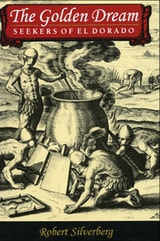
The Golden Dream
Seekers Of El DoradoRobert Silverberg
Ohio University Press, 1996
One of the most persistent legends in the annals of New World exploration is that of the Land of Gold. This mythical site was located over vast areas of South America (and later, North America); the search for it drove some men mad with greed and, as often as not, to their untimely deaths.
In this history of quest and adventure, Robert Silverberg traces the fate of Old World explorers lured westward by the myth of El Dorado. From the German conquistadores licensed by the Spanish king to operate out of Venezuela, to the journeys of Gonzalo Pizarro in the Amazon basin, and to the nearly miraculous voyage of Francisco Orellana to the mouth of the Amazon River, encountering the warlike women who gave the river its name, violence and bloodshed accompanied the determined adventurers. Sir Walter Raleigh and a host of other explorers spent small fortunes and many lives trying to locate Manoa, a city that was rumored to be El Dorado—City of Gold. Celebrated science fiction author Robert Silverberg recreates these legendary quests in The Golden Dream: Seekers of El Dorado.
The Golden Horde
Revolutionary Italy, 1960–1977Edited by Nanni Balestrini and Primo Moroni
Seagull Books, 2021
An anthology of texts and fragments woven together with an original commentary, The Golden Horde widens our understanding of the full complexity and richness of radical thought and practice in Italy during the 1960s and ’70s. The book covers the generational turbulence of Italy’s postwar period, the transformations of Italian capitalism, the new analyses by worker-focused intellectuals, the student movement of 1968, the Hot Autumn of 1969, the extra-parliamentary groups of the early 1970s, the Red Brigades, the formation of a radical women’s movement, the development of Autonomia, and the build-up to the watershed moment of the spontaneous political movement of 1977. Far from being merely a handbook of political history, The Golden Horde also sheds light on two decades of Italian culture, including the newspapers, songs, journals, festivals, comics, and philosophy that these movements produced. The book features writings by Sergio Bologna, Umberto Eco, Elvio Fachinelli, Lea Melandri, Danilo Montaldi, Toni Negri, Raniero Panzieri, Franco Piperno, Rossana Rossanda, Paolo Virno, and others, as well as an in-depth introduction by translator Richard Braude outlining the work’s composition and development.
The Good Neighbor
Franklin D. Roosevelt and the Rhetoric of American PowerMary E. Stuckey
Michigan State University Press, 2013
No modern president has had as much influence on American national politics as Franklin D. Roosevelt. During FDR’s administration, power shifted from states and localities to the federal government; within the federal government it shifted from Congress to the president; and internationally, it moved from Europe to the United States. All of these changes required significant effort on the part of the president, who triumphed over fierce opposition and succeeded in remaking the American political system in ways that continue to shape our politics today. Using the metaphor of the good neighbor, Mary E. Stuckey examines the persuasive work that took place to authorize these changes. Through the metaphor, FDR’s administration can be better understood: his emphasis on communal values; the importance of national mobilization in domestic as well as foreign affairs in defense of those values; his use of what he considered a particularly democratic approach to public communication; his treatment of friends and his delineation of enemies; and finally, the ways in which he used this rhetoric to broaden his neighborhood from the limits of the United States to encompass the entire world, laying the groundwork for American ideological dominance in the post–World War II era.
The Good Project
Humanitarian Relief NGOs and the Fragmentation of ReasonMonika Krause
University of Chicago Press, 2014
In The Good Project, Monika Krause dives into the intricacies of the decision-making process at NGOs and uncovers a basic truth: It may be the case that relief agencies try to help people but, in practical terms, the main focus of their work is to produce projects. Agencies sell projects to key institutional donors, and in the process the project and its beneficiaries become commodities. In an effort to guarantee a successful project, organizations are incentivized to help those who are easy to help, while those who are hardest to help often receive no assistance at all. The poorest of the world are made to compete against each other to become projects—and in exchange they offer legitimacy to aid agencies and donor governments. Sure to be controversial, The Good Project offers a provocative new perspective on how NGOs succeed and fail on a local and global level.
The Good Road
A K’iche’ Revolutionary TheopoliticsCarlota McAllister
Duke University Press, 2026

The Good Ruler
From Herbert Hoover to Richard NixonKuklick, Bruce
Rutgers University Press, 1989
Which American presidents have been good? Which have been bad? Experts on the presidency have never been able to agree on their assessments. Bruce Kuklick suggests that historians and political scientists have approached the problem of defining successful leadership without adequately considering the essential factor. Instead of trying to evaluate which presidents set consistent and worthy policies and brought them to fruition, Kuklick asks us to pay more attention to how the American people feel about their presidents. The citizenry and its emotional responses are sued as the measure of a successful president, rather than the ostensibly rational appraisals of scholars.
Applying this measure to the presidents from the Depression to Watergate, Kuklick begins by tracing the way in which Franklin Roosevelt established the parameters of the inspirational presidency and how his success shaped the study of political history. He then explores the triumphs of Eisenhower and Kennedy and contrasts these triumphs too the failures of Hoover, Truman, Johnson, and Nixon. The ability of leaders to win the respect and admiration of the citizenry is, for Kuklick, the crucial touchstone by which the success of a president is judged.
To highlight this position that is not useful for historians to justify the merits or failures of a president by pointing out what he would have done had he lived longer or in a different era, Kiklick includes and entertaining and enlightening fable, an imaginary view of historical events: Nixon is elected in 1960, giving a youthful tone to the White House until his assassination in 1967; Kennedy is elected in 1968 but resigns after he is accused of misconduct. The fable demonstrates that the specific events are less important than a president’s ability to evoke a positive emotional response from the citizenry. The Good Ruler analyzes our recent political history without partisan bias and examines the basic premises of American democratic politics.
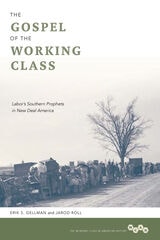
The Gospel of the Working Class
Labor's Southern Prophets in New Deal AmericaErik S. Gellman and Jarod Roll
University of Illinois Press, 2011
In this exceptional dual biography and cultural history, Erik S. Gellman and Jarod Roll trace the influence of two southern activist preachers, one black and one white, who used their ministry to organize the working class in the 1930s and 1940s across lines of gender, race, and geography. Owen Whitfield and Claude Williams, along with their wives Zella Whitfield and Joyce Williams, drew on their bedrock religious beliefs to stir ordinary men and women to demand social and economic justice in the eras of the Great Depression, New Deal, and Second World War.
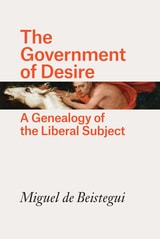
The Government of Desire
A Genealogy of the Liberal SubjectMiguel de Beistegui
University of Chicago Press, 2018
By critically exploring Foucault’s claim that Western civilization is a civilization of desire, de Beistegui crafts a provocative and original genealogy of this shift in thinking. He shows how the relationship between identity, desire, and government has been harnessed and transformed in the modern world, shaping our relations with others and ourselves, and establishing desire as an essential driving force for the constitution of a new and better social order. But is it? The Government of Desire argues that this is precisely what a contemporary politics of resistance must seek to overcome. By questioning the supposed universality of a politics based on recognition and the economic satisfaction of desire, de Beistegui raises the crucial question of how we can manage to be less governed today, and explores contemporary forms of counter-conduct.
Drawing on a host of thinkers from philosophy, political theory, and psychoanalysis, and concluding with a call for a sovereign and anarchic form of desire, The Government of Desire is a groundbreaking account of our freedom and unfreedom, of what makes us both governed and ungovernable.
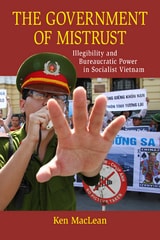
The Government of Mistrust
Illegibility and Bureaucratic Power in Socialist VietnamKen MacLean
University of Wisconsin Press, 2013
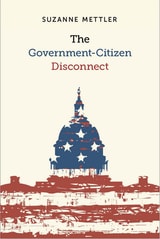
The Government-Citizen Disconnect
Suzanne Mettler
Russell Sage Foundation, 2018
Drawing from original survey data which probed Americans’ experiences of 21 federal social policies -- such as food stamps, Social Security, Medicaid, and the home mortgage interest deduction -- Mettler shows that 96 percent of adults have received benefits from at least one of them, and that the average person has utilized five. Overall usage rates transcend social, economic, and political divisions, and most Americans report positive experiences of their policy experiences. However, the fact that they have benefited from these policies has little positive effect on people’s attitudes toward government. Mettler finds that shared identities and group affiliations, as well as ideological forces, are more powerful and consistent influences. In particular, those who oppose welfare tend to extrapolate their unfavorable views of it to government in general. Deep antipathy toward the government has emerged as the result of a conservative movement that has waged a war on social welfare policies for over forty years, even as economic inequality and benefit use have increased.
Mettler finds that voting patterns exacerbate the government-citizen disconnect, as those holding positive views of federal programs and supporting expanded benefits have lower rates of political participation than those holding more hostile views of the government. As a result, the loudest political voice belongs to those who have benefited from policies but who give government little credit for their economic well-being, seeing their success more as a matter of their own deservingness. This contributes to the election of politicians who advocate cutting federal social programs. According to Mettler, the government-citizen disconnect frays the bonds of representative government and democracy.
The Government-Citizen Disconnect illuminates a paradox that increasingly shapes American politics. Mettler's examination of hostility toward government at a time when most Americans will at some point rely on the social benefits it provides helps us better understand the roots of today's fractious political climate.

The Governor's Hounds
The Texas State Police, 1870–1873By Barry A. Crouch and Donaly E. Brice
University of Texas Press, 2011
In the tumultuous years following the Civil War, violence and lawlessness plagued the state of Texas, often overwhelming the ability of local law enforcement to maintain order. In response, Reconstruction-era governor Edmund J. Davis created a statewide police force that could be mobilized whenever and wherever local authorities were unable or unwilling to control lawlessness. During its three years (1870–1873) of existence, however, the Texas State Police was reviled as an arm of the Radical Republican party and widely condemned for being oppressive, arrogant, staffed with criminals and African Americans, and expensive to maintain, as well as for enforcing the new and unpopular laws that protected the rights of freed slaves.
Drawing extensively on the wealth of previously untouched records in the Texas State Archives, as well as other contemporary sources, Barry A. Crouch and Donaly E. Brice here offer the first major objective assessment of the Texas State Police and its role in maintaining law and order in Reconstruction Texas. Examining the activities of the force throughout its tenure and across the state, the authors find that the Texas State Police actually did much to solve the problem of violence in a largely lawless state. While acknowledging that much of the criticism the agency received was merited, the authors make a convincing case that the state police performed many of the same duties that the Texas Rangers later assumed and fulfilled the same need for a mobile, statewide law enforcement agency.
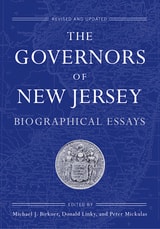
The Governors of New Jersey
Biographical EssaysBirkner, Michael J
Rutgers University Press, 2014
Rogues, aristocrats, and a future U.S. president. These and other governors are portrayed in this revised and updated edition of the classic reference work on the chief executives of New Jersey. Editors Michael J. Birkner, Donald Linky, and Peter Mickulas present new essays on the governors of the last three decades—Brendan T. Byrne, Thomas Kean, James Florio, Christine Todd Whitman, Donald DiFrancesco, James McGreevey, Richard Codey, and Jon Corzine. The essays included in the original edition are amended, edited, and corrected as necessary in light of new and relevant scholarship.
The authors of each governor’s life story represent a roster of such notable scholars as Larry Gerlach, Stanley Katz, Arthur Link, and Clement Price, as well as many other experts on New Jersey history and politics. As a result, this revised edition is a thorough and current reference work on the New Jersey governorship—one of the strongest in the nation.
Also of Interest:
New Jersey Politics and Government
The Suburbs Come of Age
Fourth Edition
Barbara G. Salmore with Stephen A. Salmore
978-0-8135-6139-4 paper $34.95
A volume in the Rivergate Regionals Collection
Me, Governor?
My Life in the Rough-and-Tumble World of New Jersey Politics
Richard J. Codey
978-0-8135-5045-9 cloth $24.95
The Life and Times of Richard J. Hughes
The Politics of Civility
John B. Wefing
978-0-8135-4641-4 cloth $32.50
Governor Tom Kean
From the New Jersey Statehouse to the 911 Commission
Alvin S. Felzenberg
978-0-8135-3799-3 cloth $29.95
The Governors' Lobbyists
Federal-State Relations Offices and Governors Associations in WashingtonJennifer M. Jensen
University of Michigan Press, 2016
The Gratis Economy
Privately Provided Public GoodsAndrás Kelen
Central European University Press, 2002
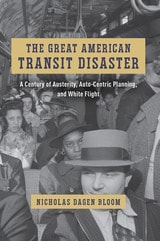
The Great American Transit Disaster
A Century of Austerity, Auto-Centric Planning, and White FlightNicholas Dagen Bloom
University of Chicago Press, 2023
Many a scholar and policy analyst has lamented American dependence on cars and the corresponding lack of federal investment in public transportation throughout the latter decades of the twentieth century. But as Nicholas Dagen Bloom shows in The Great American Transit Disaster, our transit networks are so bad for a very simple reason: we wanted it this way.
Focusing on Baltimore, Atlanta, Chicago, Detroit, Boston, and San Francisco, Bloom provides overwhelming evidence that transit disinvestment was a choice rather than destiny. He pinpoints three major factors that led to the decline of public transit in the United States: municipal austerity policies that denied most transit agencies the funding to sustain high-quality service; the encouragement of auto-centric planning; and white flight from dense city centers to far-flung suburbs. As Bloom makes clear, these local public policy decisions were not the product of a nefarious auto industry or any other grand conspiracy—all were widely supported by voters, who effectively shut out options for transit-friendly futures. With this book, Bloom seeks not only to dispel our accepted transit myths but hopefully to lay new tracks for today’s conversations about public transportation funding.
The Great American Transit Disaster
A Century of Austerity, Auto-Centric Planning, and White FlightNicholas Dagen Bloom
University of Chicago Press, 2023
A potent re-examination of America’s history of public disinvestment in mass transit.
Many a scholar and policy analyst has lamented American dependence on cars and the corresponding lack of federal investment in public transportation throughout the latter decades of the twentieth century. But as Nicholas Dagen Bloom shows in The Great American Transit Disaster, our transit networks are so bad for a very simple reason: we wanted it this way.
Focusing on Baltimore, Atlanta, Chicago, Detroit, Boston, and San Francisco, Bloom provides overwhelming evidence that transit disinvestment was a choice rather than destiny. He pinpoints three major factors that led to the decline of public transit in the United States: municipal austerity policies that denied most transit agencies the funding to sustain high-quality service; the encouragement of auto-centric planning; and white flight from dense city centers to far-flung suburbs. As Bloom makes clear, these local public policy decisions were not the product of a nefarious auto industry or any other grand conspiracy—all were widely supported by voters, who effectively shut out options for transit-friendly futures. With this book, Bloom seeks not only to dispel our accepted transit myths but hopefully to lay new tracks for today’s conversations about public transportation funding.
The Great Broadening
How the Vast Expansion of the Policymaking Agenda Transformed American PoliticsBryan D. Jones, Sean M. Theriault, and Michelle Whyman
University of Chicago Press, 2019
With The Great Broadening, Bryan D. Jones, Sean M. Theriault, and Michelle Whyman examine in detail the causes, internal dynamics, and consequences of this extended burst of activity. They argue that the broadening of government responsibilities into new policy areas such as health care, civil rights, and gender issues and the increasing depth of existing government programs explain many of the changes in America politics since the 1970s. Increasing government attention to particular issues was motivated by activist groups. In turn, the beneficiaries of the government policies that resulted became supporters of the government’s activity, leading to the broad acceptance of its role. This broadening and deepening of government, however, produced a reaction as groups critical of its activities organized to resist and roll back its growth.
The Great Deception
Anglo-American Power and World OrderMark Curtis
Pluto Press, 1998
The Great Derangement
Climate Change and the UnthinkableAmitav Ghosh
University of Chicago Press, 2016
The extreme nature of today’s climate events, Ghosh asserts, make them peculiarly resistant to contemporary modes of thinking and imagining. This is particularly true of serious literary fiction: hundred-year storms and freakish tornadoes simply feel too improbable for the novel; they are automatically consigned to other genres. In the writing of history, too, the climate crisis has sometimes led to gross simplifications; Ghosh shows that the history of the carbon economy is a tangled global story with many contradictory and counterintuitive elements.
Ghosh ends by suggesting that politics, much like literature, has become a matter of personal moral reckoning rather than an arena of collective action. But to limit fiction and politics to individual moral adventure comes at a great cost. The climate crisis asks us to imagine other forms of human existence—a task to which fiction, Ghosh argues, is the best suited of all cultural forms. His book serves as a great writer’s summons to confront the most urgent task of our time.
The Great Enterprise
Sovereignty and Historiography in Modern KoreaHenry H. Em
Duke University Press, 2013
Surveying historical works written over the course of the twentieth century, Em elucidates the influence of Christian missionaries, as well as the role that Japan's colonial policy played in determining the narrative framework for defining Korea's national past. Em goes on to analyze postcolonial works in which South Korean historians promoted national narratives appropriate for South Korea's place in the U.S.-led Cold War system. Throughout, Em highlights equal sovereignty's creative and productive potential to generate oppositional subjectivities and vital political alternatives.
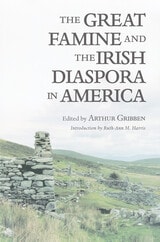
The Great Famine and the Irish Diaspora in America
Arthur Gribben
University of Massachusetts Press, 1999
The Great Global Transformation
The United States, China, and the Remaking of the World Economic OrderBranko Milanovic
University of Chicago Press, 2026
The world’s two great economic powers are on opposite trajectories. In the United States, decades of neoliberal policies produced a small class of rich elites and gutted the middle class. In China, the same global forces have created a massive new upper class. The result is the greatest reshuffling of global incomes since the Industrial Revolution—a dramatic shakeup of each country’s political order. As the two powers retreat from one another, the implications for their futures, and for the world economy, are uncertain.
In The Great Global Transformation, acclaimed economist Branko Milanovic draws on original research to chart how these seismic shifts will shape the next century of the global economy. As both the US and China retreat into protectionism, Milanovic shows how a new and multipolar world order will follow—and how rising nationalism will have dramatically different effects on the two countries. And he shows us the fight ahead: as plutocracy returns, global war threatens, and a new system silently shapes our nations, driving populist discontent to the breaking point.
A worthy successor to Capitalism, Alone and his other landmark works, Milanovic’s new book announces the arrival of a new era he terms “national market liberalism,” in which liberalism survives in domestic economies, but not necessarily in the social arena. The Great Global Transformation is Milanovic’s indispensable account of the new twenty-first century now underway.
The Great Global Transformation
The United States, China, and the Remaking of the World Economic OrderBranko Milanovic
University of Chicago Press, 2026
From the essential chronicler of the world economy, a portrait of the Great Powers in transition.
The world’s two great economic powers are on opposite trajectories. In the United States, decades of neoliberal policies produced a small class of rich elites and gutted the middle class. In China, the same global forces have created a massive new upper class. The result is the greatest reshuffling of global incomes since the Industrial Revolution—a dramatic shakeup of each country’s political order. As the two powers retreat from one another, the implications for their futures, and for the world economy, are uncertain.
In The Great Global Transformation, acclaimed economist Branko Milanovic draws on original research to chart how these seismic shifts will shape the next century of the global economy. As both the US and China retreat into protectionism, Milanovic shows how a new and multipolar world order will follow—and how rising nationalism will have dramatically different effects on the two countries. And he shows us the fight ahead: as plutocracy returns, global war threatens, and a new system silently shapes our nations, driving populist discontent to the breaking point.
A worthy successor to Capitalism, Alone and his other landmark works, Milanovic’s new book announces the arrival of a new era he terms “national market liberalism,” in which liberalism survives in domestic economies, but not necessarily in the social arena. The Great Global Transformation is Milanovic’s indispensable account of the new twenty-first century now underway.

The Great Gypsy Moth War
A History of the First Campaign in Massachusetts to Eradicate the Gypsy Moth, 1890-1901Robert J. Spear
University of Massachusetts Press, 2005
During the Civil War, when the supply of cotton from southern fields was disrupted, the owners of northern textile mills looked elsewhere for raw fiber. One source was silk. Among those experimenting with silkworm production was a Frenchman named Etienne Leopold Trouvelot, who had settled outside of Boston. It was Trouvelot who imported the gypsy moths and inadvertently allowed them to escape. Soon the invasion was on and a counteroffensive was required.
Spear reveals the turbulent undercurrents in the eradication campaign when the enthusiasm of the entomologists in charge turned into desperation upon the discovery that their alien adversary was much tougher than they thought. Fighting a war they could not win and dared not lose, the leaders of the campaign resorted to political maneuvering, cheap tricks, and outright misrepresentation to maintain a façade of success, urging the Commonwealth to continue funding the war long after any chance of victory had faded.
More than just reviewing the important events of this historic episode, Spear tells the story in an engaging way, often through the first-hand accounts of those who were directly involved. Much of what Spear has written is new, the recounting is lively, and the information he presents shows that almost all of the previous beliefs about the campaign to eradicate the gypsy moths are myths. In the process, he also traces the rise of modern economic entomology and the birth of the pesticide industry.
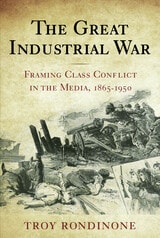
The Great Industrial War
Framing Class Conflict in the Media, 1865-1950Rondinone, Troy
Rutgers University Press, 2011
Examining how the mainstream press along with the writings of a select group of influential reformers and politicians framed strike news, Rondinone argues that the Civil War, coming on the cusp of a revolution in industrial productivity, offered a gruesome, indelible model for national conflict. He follows the heated discourse on class war through the nineteenth century until its general dissipation in the mid-twentieth century. Incorporating labor history, cultural studies, linguistic anthropology, and sociology, The Great Industrial War explores the influence of historical experience on popular perceptions of social order and class conflict and provides a reinterpretation of the origins and meaning of the Taft-Hartley Act and the industrial relations regime it supported.
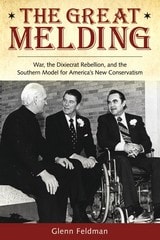
The Great Melding
War, the Dixiecrat Rebellion, and the Southern Model for America's New ConservatismGlenn Feldman
University of Alabama Press, 2015
CHOICE OUTSTANDING ACADEMIC TITLE
Tracing the Southern Origins of Modern American Conservatism.
Audacious in its scope, subtle in its analysis, and persuasive in its arguments, The Great Melding is the second book in Glenn Feldman’s magisterial recounting of the South’s transformation from a Reconstruction-era citadel of Democratic Party inertia to a cauldron of GOP agitation. In this pioneering study, Feldman shows how the transitional years after World War II, the Dixiecrat episode, and the early 1950s formed a pivotal sequence of events that altered America’s political landscape in profound, fundamental, and unexpected ways.
Feldman’s landmark work The Irony of the Solid South dismantled the myth of the New Deal consensus, proving it to be only a fleeting alliance of fissiparous factions; The Great Melding further examines how the South broke away from that consensus. Exploring issues of race and white supremacy, Feldman documents and explains the roles of economics, religion, and emotive appeals to patriotism in southern voting patterns. His probing and original analysis includes a discussion of the limits of southern liberalism and a fresh examination of the Dixiecrat Revolt of 1948.
Feldman convincingly argues that the Dixiecrats—often dismissed as a transitory footnote in American politics—served as a template for the modern conservative movement. Now a predictable Republican stronghold, Alabama at the time was viewed by national political strategists as a battleground and bellwether. Masterfully synthesizing a vast range of sources, Feldman shows that Alabama was then one of the few states where voters made unpredictable choices between the competing ideologies of the Democrats, Republicans, and Dixiecrats.
Writing in his lively and provocative style, Feldman demonstrates that the events he recounts in Alabama between 1942 and Dwight Eisenhower’s 1952 election encapsulate a rare moment of fluidity in American politics, one in which the New Deal consensus shattered and the Democratic and Republican parties fought off a third-party revolt only to find themselves irrevocably altered by their success. The Great Melding will fascinate historians, political scientists, political strategists, and readers of political nonfiction.
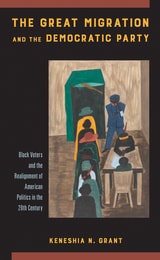
The Great Migration and the Democratic Party
Black Voters and the Realignment of American Politics in the 20th CenturyKeneshia N. Grant
Temple University Press, 2020
Where Black people live has long been an important determinant of their ability to participate in political processes. The Great Migration significantly changed the way Democratic Party elites interacted with Black communities in northern cities, Detroit, New York, and Chicago. Many white Democratic politicians came to believe the growing pool of Black voters could help them reach their electoral goals—and these politicians often changed their campaign strategies and positions to secure Black support. Furthermore, Black migrants were able to participate in politics because there were fewer barriers to Black political participations outside the South.
The Great Migration and the Democratic Party frames the Great Migration as an important economic and social event that also had serious political consequences. Keneshia Grant created one of the first listings of Black elected officials that classifies them based on their status as participants in the Great Migration. She also describes some of the policy/political concerns of the migrants. The Great Migration and the Democratic Party lays the groundwork for ways of thinking about the contemporary impact of Black migration on American politics.
The Great Recession
David B. Grusky
Russell Sage Foundation, 2012
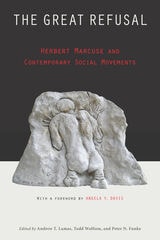
The Great Refusal
Herbert Marcuse and Contemporary Social MovementsAndrew Lamas
Temple University Press, 2016
Herbert Marcuse examined the subjective and material conditions of radical social change and developed the "Great Refusal," a radical concept of "the protest against that which is." The editors and contributors to the exciting new volume The Great Refusal provide an analysis of contemporary social movements around the world with particular reference to Marcuse's revolutionary concept. The book also engages-and puts Marcuse in critical dialogue with-major theorists including Slavoj Žižek and Michel Foucault, among others.
The chapters in this book analyze different elements and locations of the contemporary wave of struggle, drawing on the work and vision of Marcuse in order to reveal, with a historical perspective, the present moment of resistance. Essays seek to understand recent uprisings-such as the Zapatistas in Mexico, the Arab Spring, and the Occupy movement-in the context of Marcuse's powerful conceptual apparatus.
The Great Refusal also charts contemporary social movements against global warming, mass incarceration, police brutality, white supremacy, militarization, technological development, and more, to provide insights that advance our understanding of resistance today.
Contributors include: Kevin B. Anderson, Stanley Aronowitz, Joan Braune, Jenny Chan, Angela Y. Davis, Arnold L. Farr, Andrew Feenberg, Michael Forman, Christian Fuchs, Stefan Gandler, Christian Garland, Toorjo Ghose, Imaculada Kangussu, George Katsiaficas, Douglas Kellner, Sarah Lynn Kleeb, Filip Kovacevic, Lauren Langman, Heather Love, Peter Marcuse, Martin J. Beck Matuštík, Russell Rockwell, AK Thompson, Marcelo Vieta, and the editors.
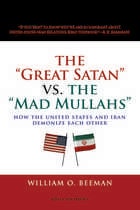
The Great Satan vs. the Mad Mullahs
How the United States and Iran Demonize Each OtherWilliam O. Beeman
University of Chicago Press, 2008
“William Beeman’s analysis of dissonant perceptions of Iran and the USA is compelling and important. . . . I am particularly grateful for this work.”—James Peacock, University of North Carolina at Chapel Hill
“[Beeman] is more interested in informing the reader than in impressing his peers. The other strength of the book lies in the author’s knowledge of Iranian history and culture. . . . It challenges the reader and forces him to question stereotypes about Iran and Washington’s perspective on the country.”—Abbas William Samii, Middle East Journal
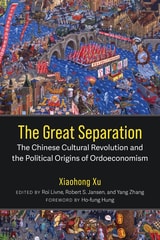
The Great Separation
The Chinese Cultural Revolution and the Political Origins of OrdoeconomismXiaohong Xu Edited by Roi Livne, Robert Jansen and Yang Zhang
University of Michigan Press, 2026
With a keen attention to how culture and elite conflict shape politics, The Great Separation upends deterministic understandings of the Chinese Cultural Revolution and the market reforms that followed. This ambitious posthumous volume by sociologist Xiaohong Xu turns the existing scholarship on China’s “neoliberalism” on its head by demonstrating that the effort to separate mass politics from economic policy had its origins well before the Reform and Opening-up era.
Over the course of the Cultural Revolution, unfolding factional dynamics and interpretive struggles enabled Chairman Mao and his radical colleagues to mobilize workers to advance their own political goals while neutralizing the masses’ economic demands, symbolically separating the political from the economic. This set the stage for a more thoroughgoing depoliticization of the economy after 1989, when China faced challenges from students and workers whose economic grievances had rapidly morphed into political demands for democracy. The result was what Xu calls ordoeconomism: an ideology that valorizes economic development, rejects mass politics, and views the state as the apolitical guardian of the economy. As Xu demonstrates, while ordoeconomism may share some affinities with neoliberalism, it is a distinctively Chinese approach that must be understood on its own terms.