Results by title
28167 books match the query 'History' and 6372 start with t
The Atlantic Slave Trade
Effects on Economies, Societies and Peoples in Africa, the Americas, and EuropeJoseph E. Inikori and Stanley L. Engerman
Duke University Press, 1992
Among the questions these essays address are: the social cost to Africa of this forced migration; the role of slavery in the economic development of Europe and the United States; the short-term and long-term effects of the slave trade on black mortality, health, and life in the New World; and the racial and cultural consequences of the abolition of slavery. Some of these essays originally appeared in recent issues of Social Science History; the editors have added new material, along with an introduction placing each essay in the context of current debates.
Based on extensive archival research and detailed historical examination, this collection constitutes an important contribution to the study of an issue of enduring significance. It is sure to become a standard reference on the Atlantic slave trade for years to come.
Contributors. Ralph A. Austen, Ronald Bailey, William Darity, Jr., Seymour Drescher, Stanley L. Engerman, David Barry Gaspar, Clarence Grim, Brian Higgins, Jan S. Hogendorn, Joseph E. Inikori, Kenneth Kiple, Martin A. Klein, Paul E. Lovejoy, Patrick Manning, Joseph C. Miller, Johannes Postma, Woodruff Smith, Thomas Wilson
The Atlas of Boston History
Edited by Nancy S. Seasholes
University of Chicago Press, 2019
Edited by historian Nancy S. Seasholes, this landmark volume captures all aspects of Boston’s past in a series of fifty-seven stunning full-color spreads. Each section features newly created thematic maps that focus on moments and topics in that history. These maps are accompanied by hundreds of historical and contemporary illustrations and explanatory text from historians and other expert contributors. They illuminate a wide range of topics including Boston’s physical and economic development, changing demography, and social and cultural life. In lavishly produced detail, The Atlas of Boston History offers a vivid, refreshing perspective on the development of this iconic American city.
Contributors
Robert J. Allison, Robert Charles Anderson, John Avault, Joseph Bagley, Charles Bahne, Laurie Baise, J. L. Bell, Rebekah Bryer, Aubrey Butts, Benjamin L. Carp, Amy D. Finstein, Gerald Gamm, Richard Garver, Katherine Grandjean, Michelle Granshaw, James Green, Dean Grodzins, Karl Haglund, Ruth-Ann M. Harris, Arthur Krim, Stephanie Kruel, Kerima M. Lewis, Noam Maggor, Dane A. Morrison, James C. O’Connell, Mark Peterson, Marshall Pontrelli, Gayle Sawtelle, Nancy S. Seasholes, Reed Ueda, Lawrence J. Vale, Jim Vrabel, Sam Bass Warner, Jay Wickersham, and Susan Wilson
The Attention of a Traveller
Essays on William Bartram's "Travels" and LegacyEdited by Kathryn H. Braund
University of Alabama Press, 2022
An interdisciplinary reevaluation of William Bartram’s Travels, illuminating the natural, cultural, and intellectual landscapes of the eighteenth‑century Southeast through diverse scholarly lenses.
William Bartram, author of Travels through North and South Carolina, Georgia, East and West Florida, the Cherokee Country, the Extensive Territories of the Muscogulees, or Creek Confederacy, and the Country of the Chactaws, was colonial America’s first native born naturalist and artist, and the first author in the modern genre of writers who portrayed nature through personal experience as well as scientific observation. His book, first published in 1791, was based on his journeys through southern Indian nations and Britain’s southern colonies in the years just prior to the American Revolution and provides descriptions of the natural and cultural environments of what would soon become the American South. Scholars and general readers alike have long appreciated Bartram’s lush, vivid prose, his clarity of observation and evident wonder at the landscapes he traversed, and his engagement with the native nations whose lands he traveled through.
The Attention of a Traveller: Essays on William Bartram’s “Travels” and Legacy offers an interdisciplinary assessment of Bartram’s influence and evolving legacy, opening new avenues of research concerning the flora, fauna, and people connected to Bartram and his writings. Featuring 13 essays divided into five sections, contributors to the volume weave together scholarly perspectives from geology, art history, literary criticism, geography, and philosophy, alongside the more traditional Bartram-affiliated disciplines of biology and history. The collection concludes with a comprehensive treatment of the book as a material historical artifact.
The Attractions of the Moving Image
Essays on History, Theory, and the Avant-GardeTom Gunning
University of Chicago Press, 2025
Tom Gunning is the author of multiple books and nearly two hundred essays that have defined the field of cinema and media studies. His works have transformed our understanding of early cinema and the American avant-garde and reset the terms of many central debates in film and media history and theory. His 1986 essay “The Cinema of Attractions” is among the most cited essays on film ever published. Gunning’s writings articulate a distinctive and powerful model for thinking about cinema’s history and likely future, addressing the full range of moving-image media, from film to still photography to digital media. His discussions draw on stage melodrama and magic lantern shows, as well as criminology, world’s fairs, and Spiritualism, surveying the medium as a cultural phenomenon informed by the industrial and information ages, psychiatry, urban experience, discourses on art and aesthetics, and more.
This collection brings together twenty-six essays that showcase the depth and range of Gunning’s scholarship, including four that have never before been published. Together, they solidify Gunning’s place as a scholar who has transformed the way generations of scholars, archivists, critics, and artists think about cinema.
The Audacious Ministry of Zilpha Elaw
Race, Religion, and RebellionKimberly D. Blockett
Duke University Press, 2026

The Audacity of a Kiss
Love, Art, and LiberationLeslie Cohen
Rutgers University Press, 2021
Rendered in bronze, covered in white lacquer, two women sit together on a park bench in Greenwich Village. One of the women touches the thigh of her partner as they gaze into each other’s eyes. The two women are part of George Segal’s iconic sculpture “Gay Liberation,” but these powerful symbols were modeled on real people: Leslie Cohen and her partner (now wife) Beth Suskin.
In this evocative memoir, Cohen tells the story of a love that has lasted for over fifty years. Transporting the reader to the pivotal time when brave gay women and men carved out spaces where they could live and love freely, she recounts both her personal struggles and the accomplishments she achieved as part of New York’s gay and feminist communities. Foremost among these was her 1976 cofounding of the groundbreaking women’s nightclub Sahara, which played host to such luminaries as Betty Friedan, Gloria Steinem, Pat Benatar, Ntozake Shange, Rita Mae Brown, Adrienne Rich, Patti Smith, Bella Abzug, and Jane Fonda. The Audacity of a Kiss is a moving and inspiring tale of how love, art, and solidarity can overcome oppression.
The Audible Past
Cultural Origins of Sound ReproductionJonathan Sterne
Duke University Press, 2003
Blending cultural studies and the history of communication technology, Sterne follows modern sound technologies back through a historical labyrinth. Along the way, he encounters capitalists and inventors, musicians and philosophers, embalmers and grave robbers, doctors and patients, deaf children and their teachers, professionals and hobbyists, folklorists and tribal singers. The Audible Past tracks the connections between the history of sound and the defining features of modernity: from developments in medicine, physics, and philosophy to the tumultuous shifts of industrial capitalism, colonialism, urbanization, modern technology, and the rise of a new middle class.
A provocative history of sound, The Audible Past challenges theoretical commonplaces such as the philosophical privilege of the speaking subject, the visual bias in theories of modernity, and static descriptions of nature. It will interest those in cultural studies, media and communication studies, the new musicology, and the history of technology.
The Author's Due
Printing and the Prehistory of CopyrightJoseph Loewenstein
University of Chicago Press, 2002
As Loewenstein shows, copyright is a form of monopoly that developed alongside a range of related protections such as commercial trusts, manufacturing patents, and censorship, and cannot be understood apart from them. The regulation of the press pitted competing interests and rival monopolistic structures against one another—guildmembers and nonprofessionals, printers and booksellers, authors and publishers. These struggles, in turn, crucially shaped the literary and intellectual practices of early modern authors, as well as early capitalist economic organization.
With its probing look at the origins of modern copyright, The Author's Due will prove to be a watershed for historians, literary critics, and legal scholars alike.
The Autobiography of Citizenship
Assimilation and Resistance in U.S. EducationCooper, Tova
Rutgers University Press, 0
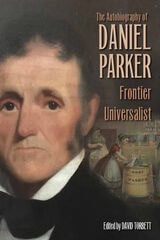
The Autobiography of Daniel Parker, Frontier Universalist
Daniel Parker
Ohio University Press, 2021
A vastly informative and rare early-American pioneer autobiography rescued from obscurity.
In this remarkable memoir, Daniel Parker (1781–1861) recorded both the details of everyday life and the extraordinary historical events he witnessed west of the Appalachian Mountains between 1790 and 1840. Once a humble traveling salesman for a line of newly invented clothes washing machines, he became an outspoken advocate for abolition and education. With his wife and son, he founded Clermont Academy, a racially integrated, coeducational secondary school—the first of its kind in Ohio.
However, Parker’s real vocation was as a self-ordained, itinerant preacher of his own brand of universal salvation. Raised by Presbyterian parents, he experienced a dramatic conversion to the Halcyon Church, an alternative, millenarian religious movement led by the enigmatic prophet Abel Sarjent, in 1803. After parting ways with the Halcyonists, he continued his own biblical and theological studies, arriving at the universalist conclusions that he would eventually preach throughout the Ohio River Valley.
David Torbett has transcribed Parker’s manuscript and publishes it here for the first time, together with an introduction, epilogue, bibliography, and extensive notes that enrich and contextualize this rare pioneer autobiography.
The Autocratic Academy
Reenvisioning Rule within America's UniversitiesTimothy V. Kaufman-Osborn
Duke University Press, 2023
The Autonomy of History
Truth and Method from Erasmus to GibbonJoseph M. Levine
University of Chicago Press, 1999
Levine's first three essays discuss Thomas More's preoccupation with the distinction between history and fiction; Erasmus's biblical criticism and the contribution of Renaissance philology to critical method; and the way in which Renaissance rhetoric, as in Thomas Elyot's Book of the Governor, continued to inhibit the autonomy of history. He then shows how these issues persisted into the eighteenth century, even as critical method developed. He concludes with a close description of the great controversy that culminated in Edward Gibbon's day over the authenticity of a biblical text that had been used for centuries to defend the Trinity but which turned out to be a forgery. Levine shows how by then all sides were ready to concede the autonomy of history.
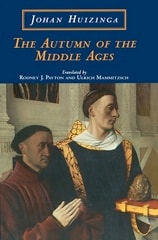
The Autumn of the Middle Ages
Johan Huizinga
University of Chicago Press, 1996
The Autumn of the Middle Ages is Johan Huizinga's classic portrait of life, thought, and art in fourteenth- and fifteenth-century France and the Netherlands. Few who have read this book in English realize that The Waning of the Middle Ages, the only previous translation, is vastly different from the original Dutch, and incompatible will all other European-language translations.
For Huizinga, the fourteenth- and fifteenth-century marked not the birth of a dramatically new era in history—the Renaissance—but the fullest, ripest phase of medieval life and thought. However, his work was criticized both at home and in Europe for being "old-fashioned" and "too literary" when The Waning of the Middle Ages was first published in 1919. In the 1924 translation, Fritz Hopman adapted, reduced and altered the Dutch edition—softening Huizinga's passionate arguments, dulling his nuances, and eliminating theoretical passages. He dropped many passages Huizinga had quoted in their original old French. Additionally, chapters were rearranged, all references were dropped, and mistranslations were introduced.
This translation corrects such errors, recreating the second Dutch edition which represents Huizinga's thinking at its most important stage. Everything that was dropped or rearranged has been restored. Prose quotations appear in French, with translations preprinted at the bottom of the page, mistranslations have been corrected.
"The advantages of the new translation are so many. . . . It is one of the greatest, as well as one of the most enthralling, historical classics of the twentieth century, and everyone will surely want to read it in the form that was obviously intended by the author." —Francis Haskell, New York Review of Books
"A once pathbreaking piece of historical interpretation. . . . This new translation will no doubt bring Huizinga and his pioneering work back into the discussion of historical interpretation." —Rosamond McKitterick, New York Times Book Review
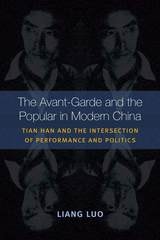
The Avant-Garde and the Popular in Modern China
Tian Han and the Intersection of Performance and PoliticsLiang Luo
University of Michigan Press, 2014

The Avenues of Salt Lake City
Cevan J. LeSieur
University of Utah Press, 2012
Salt Lake City’s oldest residential historic district is a neighborhood known as the Avenues. During the late nineteenth century this area was home to many of the most influential citizens of Salt Lake City. Built from 1860 until 1930, it contains a mix of middle and upper middle class homes of varying architectural styles. This architectural diversity makes the Avenues unique among Utah's historic districts. For the past thirty years, as citizens have rediscovered the value of living in historic properties near downtown and the University of Utah, preservation efforts have soared in the area.
In 1980, the Avenues was established as a historic district and the Utah Historical Society published The Avenues of Salt Lake City. That book’s authors, Karl T. Haglund and Philip F. Notarianni, gleaned much about the area’s history by using information found on the historic district applications. This newly revised edition of The Avenues of Salt Lake City by Cevan J. LeSieur updates the original with a greatly expanded section on the historic homes in the neighborhood, including more than 600 new photos, and additional material covering the history of the Avenues since 1980.
The book is designed so that readers can take it along as a guide when exploring the neighborhoods. All the pictures of Avenues homes are accompanied with architectural information and brief histories of the properties. This volume makes a valuable resource for those interested in the history of the Avenues and its diverse architecture, and for anyone interested in Utah history, Utah architecture, and historic preservation.
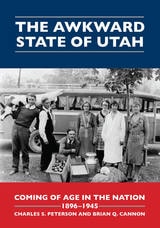
The Awkward State of Utah
Coming of Age in the Nation, 1896-1945Charles Peterson and Brian Cannon
University of Utah Press, 2015
The half century between statehood in 1896 and the end of World War II in 1945 was a period of transformation and transition for Utah. This book interprets those profound changes, revealing sweeping impacts on both institutions and ordinary people. Drawing upon expertise honed over decades of teaching, researching, and writing about Utah’s history, the authors incorporate fresh archival sources, new oral histories, and hundreds of scholarly articles and books as they narrate the little-known story of the crucial formative years when Utah came of age.
During its sometimes awkward years of adolescence and maturation, Utah was gradually incorporated into the American political, social, and economic mainstream. Urban and industrial influences supplanted agrarian traditions, displacing people socially, draining the countryside of population, and galvanizing a critical crisis in values and self-identification. National corporations and mass labor movements took root in the state as commerce expanded. Involvement in world events such as the Spanish-American War, two world wars, and the Great Depression further set the stage for entry into the modern, globalized world as Utahns immersed themselves in national politics and became part of the democratic, corporate culture of twentieth-century America.
The Aztec Kings
The Construction of Rulership in Mexican HistorySusan D. Gillespie
University of Arizona Press, 1989
The Aztec Kings is the first major study to take into account the Aztec cyclical conception of time—which required that history constantly be reinterpreted to achieve continuity between past and present—and to treat indigenous historical traditions as symbolic statements in narrative form. Susan Gillespie focuses on the dynastic history of the Mexica of Tenochtitlan, whose stories reveal how the Aztecs used "history" to construct, elaborate, and reify ideas about the nature of rulership and the cyclical nature of the cosmos, and how they projected the Spanish conquest deep into the Aztec past in order to make history accommodate that event.
By demonstrating that most of Aztec history is nonliteral, she sheds new light on Aztec culture and on the function of history in society. By relating the cyclical structure of Aztec dynastic history to similar traditions of African and Polynesian peoples, she introduces a broader perspective on the function of history in society and on how and why history must change.
The Aztec Palimpsest
Mexico in the Modern ImaginationDaniel Cooper Alarcón
University of Arizona Press, 1997
He shows how the Chicano myth of Aztlan was constructed upon earlier Mesoamerican myths, discusses representations of Mexico in texts by nineteenth- and twentieth-century writers, and analyzes the content of tourist literature, thereby revealing the economic, social, and political interests that drive the production of Mexicanness today. This original linking of seemingly incongruous discourses corrects the misconception that Mexicanness is produced only by hegemonic groups. Cooper shows how Mexico has been defined and represented, by both Mexicans and non-Mexicans, as more than a political or geographic entity, and he particularly reveals how Mexicanness has been exploited by Mexicans themselves through the promotion of tourism as a form of neocolonialism.
Cooper's work is valuable both for identifying attempts to revise and control Mexican myth, history, and culture and for defining the intricate relationship between history, historiography, and cultural nationalism. The Aztec Palimpsest extends existing analyses of Mexicanness into new theoretical realms and provides a fresh perspective on the relationship between the United States and Mexico at a time when these two nations are becoming more intimately linked.
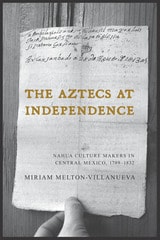
The Aztecs at Independence
Nahua Culture Makers in Central Mexico, 1799–1832Miriam Melton-Villanueva
University of Arizona Press, 2016
The Aztecs at Independence offers the first internal ethnographic view of these central Mexican indigenous communities in the critical transitional time of Independence. Miriam Melton-Villanueva uses previously unknown Nahuatl-language sources—primarily last wills and testaments—to provide a comprehensive understanding of indigenous societies during the transition from colonial to postcolonial times. The book describes the cultural life of people now called Nahuas or Mexicas in the nineteenth century—based on their own words, their own written records. The book uses previously unknown, unstudied, and untranslated indigenous texts to bring Nahua society into history, fleshing out glimpses of daily life in the early nineteenth century. Thus, The Aztecs at Independence describes life at the most local level: Nahua lineages of ritual and writing, guilds and societies, the people that take turns administering festivals and attending to the last wishes of the dying.
Interwoven with personal stories and memory, The Aztecs at Independence invites a general audience along on a scholarly journey, where readers are asked to imagine Nahua concepts and their contemporary meanings that give light to modern problems.
The BBC Talks of E.M. Forster, 1929-1960
A Selected EditionEdited by Mary Lago, Linda K. Hughes & Elizabeth MacLeod Walls
University of Missouri Press, 2008
Spanning three decades and a host of subjects, E. M. Forster’s radio broadcasts for the BBC were a major contribution to British cultural history, yet today they are rarely acknowledged by scholars of his life and work. But in their day they reached a larger audience than his fiction and established him as a household figure not only in Britain but also in the farthest reaches of its Empire.
As a frequent contributor to the BBC, Forster generally adhered to literary topics but did not shy away from social commentary. This book offers a new appreciation of his vitality and public importance through seventy annotated broadcasts that present him not only as a literary critic but also as a political activist, an advocate for India, and a wary yet cooperative ally of a colonialist government during World War II.
Gathering material either not in print or, if recast as essays, widely scattered, The BBC Talks of E. M. Forster reveals aspects of Forster’s intellect that have been given short shrift in previous studies. Nearly half the scripts date from 1941 to 1945 and provide an eyewitness account of war from a distinguished perspective. Forster comments on how the arts gallantly survived the blitz—even taking his listeners to the theater as bombing threats loom—and in other cases protests government interference in private life or the limits on free expression caused by the wartime paper shortage.
In these scripts, Forster casts a cosmopolitan eye on contemporary literature from James Joyce to John Steinbeck and provides early exposure for young writers and composers. He also enlarges the scope of European art by pairing Jane Austen or C. S. Lewis with Indian writers and offers pointed comments on contemporary literati such as Aldous Huxley and T. S. Eliot. Annotations to each piece identify Forster’s references and trace his revisions from script to broadcast, while the book’s introduction places his emergence as a distinctive radio voice within the historical, creative, and institutional contexts of broadcasting in his day.
This significant body of writing, too long overlooked, traces Forster’s evolution from novelist to adroit cultural critic and shows how a man who was never comfortable with machines played an important role in shaping a new medium. The BBC Talks of E. M. Forster situates Forster as one of the most poignant voices of the twentieth century as it offers new insight into a nation transfigured by war.
The Ba'thification of Iraq
Saddam Hussein's TotalitarianismBy Aaron M. Faust
University of Texas Press, 2015
Saddam Hussein ruled Iraq as a dictator for nearly a quarter century before the fall of his regime in 2003. Using the Ba’th party as his organ of meta-control, he built a broad base of support throughout Iraqi state and society. Why did millions participate in his government, parrot his propaganda, and otherwise support his regime when doing so often required betraying their families, communities, and beliefs? Why did the “Husseini Ba’thist” system prove so durable through uprisings, two wars, and United Nations sanctions?
Drawing from a wealth of documents discovered at the Ba’th party’s central headquarters in Baghdad following the US-led invasion in 2003, The Ba’thification of Iraq analyzes how Hussein and the party inculcated loyalty in the population. Through a grand strategy of “Ba’thification,” Faust argues that Hussein mixed classic totalitarian means with distinctly Iraqi methods to transform state, social, and cultural institutions into Ba’thist entities, and the public and private choices Iraqis made into tests of their political loyalty. Focusing not only on ways in which Iraqis obeyed, but also how they resisted, and using comparative examples from Hitler’s Germany and Stalin’s Russia, The Ba’thification of Iraq explores fundamental questions about the roles that ideology and culture, institutions and administrative practices, and rewards and punishments play in any political system.
The Babylonian Genesis
The Story of the CreationAlexander Heidel
University of Chicago Press, 1963
The Babylonian Genesis offers, in one compact, accessible volume, a complete translation of all the published cuneiform tablets of the various Babylonian creation stories, of both the Semitic Babylonian and the Sumerian material. Each creation account is preceded by a brief introduction from renowned scholar and translator Alexander Heidel dealing with the age and provenance of the tablets, the aim and purpose of the story, and everything else that a reader of any level of knowledge needs to understand these stories in their context. Also included is a translation and discussion of two Babylonian creation versions written in Greek. The final chapter presents a detailed examination of the Babylonian creation accounts in their relation to our Old Testament literature.

The Back Bench
Margaret Hope Bacon
QuakerPress, 2007
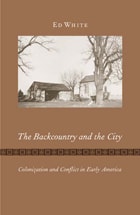
The Backcountry and the City
Colonization and Conflict in Early AmericaEd White
University of Minnesota Press, 2005
Ed White explores the backcountry-city divide as well as the dynamics of indigenous peoples, bringing together two distinct bodies of scholarship: one stressing the political culture of the Revolutionary era, the other taking an ethnohistorical view of white–Native American contact. White concentrates his study in Pennsylvania, a state in which the majority of the population was rural, and in Philadelphia, a city that was a center of publishing and politics and the national capital for a decade. Against this backdrop, White reads classic political texts such as Crèvecoeur’s Letters from an American Farmer, Franklin’s Autobiography, and Paine’s “Agrarian Justice,” alongside missionary and captivity narratives, farmers’ petitions, and Native American treaties. Using historical and ethnographic sources to enrich familiar texts, White demonstrates the importance of rural areas in the study of U.S. nation formation and finds unexpected continuities between the early colonial period and the federal ascendancy of the 1790s.
Ed White is associate professor of English at the University of Florida.
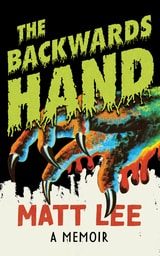
The Backwards Hand
A MemoirMatt Lee
Northwestern University Press, 2024
Told in lyric fragments, The Backwards Hand traces Matt Lee’s experience living in the United States for more than thirty years with a rare congenital defect. Weaving in historical research and pop culture references, Lee dissects how the disabled body has been conflated with impurity, worthlessness, and evil. His voice swirls amid those of artists, criminals, activists, and philosophers. With a particular focus on horror films, Lee juxtaposes portrayals of fictitious monsters with the real-life atrocities of the Nazi regime and the American eugenics movement. Through examining his struggles with physical and mental health, Lee confronts his own beliefs about monstrosity and searches for atonement as he awaits the birth of his son.
The Backwards Hand interrogates what it means to be a cripple in a predominantly ableist society, deconstructing how perceptions of disability are—and are not—reflected in art and media.

The Backyard Brawl
Stories from One of the Weirdest, Wildest, Longest Running, and Most Instense Rivalries in College Football HistoryJohn Antonik
West Virginia University Press, 2012
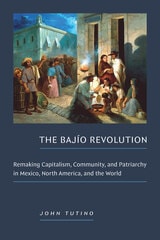
The Bajío Revolution
Remaking Capitalism, Community, and Patriarchy in Mexico, North America, and the WorldJohn Tutino
Duke University Press, 2025
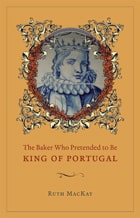
The Baker Who Pretended to Be King of Portugal
Ruth MacKay
University of Chicago Press, 2012
On August 4, 1578, in an ill-conceived attempt to wrest Morocco back from the hands of the infidel Moors, King Sebastian of Portugal led his troops to slaughter and was himself slain. Sixteen years later, King Sebastian rose again. In one of the most famous of European impostures, Gabriel de Espinosa, an ex-soldier and baker by trade—and most likely under the guidance of a distinguished Portuguese friar—appeared in a Spanish convent town passing himself off as the lost monarch. The principals, along with a large cast of nuns, monks, and servants, were confined and questioned for nearly a year as a crew of judges tried to unravel the story, but the culprits went to their deaths with many questions left unanswered.
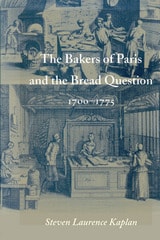
The Bakers of Paris and the Bread Question, 1700-1775
Steven Laurence Kaplan
Duke University Press, 1996
Despite the overpowering salience of bread in public and private life, Kaplan’s is the first inquiry into the ways bread exercised its vast and significant empire. Bread framed dreams as well as nightmares. It was the staff of life, the medium of communion, a topic of common discourse, and a mark of tradition as well as transcendence. In his exploration of bread’s materiality and cultural meaning, Kaplan looks at bread’s fashioning of identity and examines the conditions of supply and demand in the marketplace. He also sets forth a complete history of the bakers and their guild, and unmasks the methods used by the authorities in their efforts to regulate trade.
Because the bakers and their bread were central to Parisian daily life, Kaplan’s study is also a comprehensive meditation on an entire society, its government, and its capacity to endure. Long-awaited by French history scholars, The Bakers of Paris and the Bread Question, 1700–1775 is a landmark in eighteenth-century historiography, a book that deeply contextualizes, and thus enriches our understanding of one of the most important eras in European history.
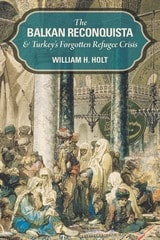
The Balkan Reconquista and Turkey's Forgotten Refugee Crisis
William H. Holt
University of Utah Press, 2019
In this book, William H. Holt tells the story of a people and moment in time that has largely been neglected in modern Turkish and Balkan memory. Holt uncovers the reasons for this mass forgetting, finding context both within the development of the modern Turkish state and the workings of collective memory. Bringing together a wide array of eyewitness accounts, the book provides unprecedented detail on the plight of the Muslim refugees in their flight from Bulgaria, in Istanbul, and in their resettlement in Anatolia. In crisp, clear, and engaging prose, Holt offers an insightful analysis of human suffering and social memory.
The Balkans
Mission PossibleMaria Todorova
Central European University Press, 2026
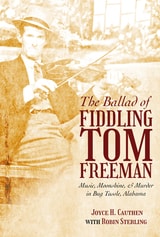
The Ballad of Fiddling Tom Freeman
Music, Moonshine, and Murder in Bug Tussle, AlabamaJoyce H. Cauthen with Robin Sterling
University of Alabama Press, 2026
A raw, firsthand account of feuds, fiddling, moonshining, and survival in a small Alabama town, told by its most colorful chronicler and shaped through careful historical insight.
The Ballad of Fiddling Tom Freeman is a riveting portrait of a forgotten America, drawn from the handwritten memoirs of a bootlegger, fiddler, and chronicler of life in Bug Tussle, Alabama, in the first half of the twentieth century. Today, rural voices are often drowned out by polished narratives, but this book resurrects the unfiltered perspective of a man who lived through—and candidly documented—the chaos and violence in his home place as he shared stories of the large close-knit families who lived there.
Freeman’s storytelling is as wild and tangled as the lives he describes, and author Joyce H. Cauthen, with the assistance of historical researcher Robin Sterling, brings clarity and context to his tales without sanding down their rough edges. The result is a vivid, bottom-up history of a place where lawlessness and loyalty often walked hand in hand.
The Ballad of Fiddling Tom Freeman stands out as a testament to the power of personal narrative. Not just a story about one man, it’s a window into a community shaped by hardship, music, and survival, told in a voice that refuses to be forgotten. This book is essential reading for historians, folklorists, musicians, and anyone drawn to the untamed stories of America’s backroads and backwoods.
The Baltimore Book
New Views of Local HistoryLinda Shopes
Temple University Press, 1993
Baltimore has a long, colorful history that traditionally has been focused on famous men, social elites, and patriotic events. The Baltimore Book is both a history of "the other Baltimore" and a tour guide to places in the city that are important to labor, African American, and women's history. The book grew out of a popular local bus tour conducted by public historians, the People's History Tour of Baltimore, that began in 1982. This book records and adds sites to that tour; provides maps, photographs, and contemporary documents; and includes interviews with some of the uncelebrated people whose experiences as Baltimoreans reflect more about the city than Francis Scott Key ever did.
The tour begins at the B&O Railroad Station at Camden Yards, site of the railroad strike of 1877, moves on to Hampden-Woodbury, the mid-19th century cotton textile industry's company town, and stops on the way to visit Evergreen House and to hear the narratives of ex-slaves. We travel to Old West Baltimore, the late 19th-century center of commerce and culture for the African American community; Fells Point; Sparrows Point; the suburbs; Federal Hill; and Baltimore's "renaissance" at Harborplace. Interviews with community activists, civil rights workers, Catholic Workers, and labor union organizers bring color and passion to this historical tour. Specific labor struggles, class and race relations, and the contributions of women to Baltimore's development are emphasized at each stop.
In the series Critical Perspectives on the Past, edited by Susan Porter Benson, Stephen Brier, and Roy Rosenzweig.

The Baltimore Orioles
The History of a Colorful Team in Baltimore and St. LouisFrederick G. Lieb Foreword by Bob Broeg
Southern Illinois University Press, 2005
With a legacy that spans two fiercely loyal baseball towns a half-nation apart, the Baltimore Orioles—originally the St. Louis Browns—rank among baseball’s most storied teams. One of the fifteen celebrated team histories commissioned by G. P. Putnam’s Sons in the 1940s and 1950s, The Baltimore Orioles: The History of a Colorful Team in Baltimore and St. Louis chronicles the club’s early history and is reissued on the fiftieth anniversary of their first season in Baltimore.
Hall of Fame sportswriter Frederick G. Lieb begins with the history of baseball in Baltimore from its pre-Civil War beginnings and its major-league debut as the Lord Baltimores in 1872 to the championship seasons of the National League Orioles in 1894, ’95, and ’96 when the roster included Willie Keeler, Joe Kelley, Kid Gleason, Roger Bresnahan, Joe McGinnity, and John McGraw. After the turn of the century, Baltimore was briefly home to the Orioles of the American League in 1901-02, then, after losing its franchise to New York, had to settle for the AAA International League Orioles until 1954. Under the leadership of Jack Dunn, the minor-league Orioles, while developing the talents of Babe Ruth, Lefty Grove, and other future major-league stars, won seven straight International League pennants from 1919 to 1926.
Here, too, is the colorful history of the precursors to the current Orioles, the lovable and luckless St. Louis Browns, augmented for this edition with a new foreword from St. Louis sportswriter Bob Broeg on the escapades of the Brownies. Though they lost more than a thousand games and captured only a single pennant in fifty-three seasons, the Browns remain a legendary part of national lore. Taking their lead in different eras from larger-than-life figures such as Branch Rickey, Rogers Hornsby, Urban Shocker, and the Barnum of Baseball, Bill Veeck, the Browns “boasted a one-armed outfielder, a hired hypnotist, the mighty midget [Eddie Gaedel] and—even the best ballplayer in the land—George Sisler,” as Broeg recalls in his foreword. In 1944, the Browns also played in the only all-St. Louis World Series, losing to the Cardinals.
Originally published in 1955 and featuring twenty-two photographs, The Baltimore Orioles history concludes with the new American League team’s first season in Baltimore, finishing seventh in the league but garnering the lasting adoration of their new hometown.
The Baltimore Plot
The First Conspiracy to Assassinate Abraham LincolnMichael J. Kline
Westholme Publishing, 2008
The Complete Story of the First Attempt to Assassinate President Abraham Lincoln
"In a thrilling detective story of conspiracy, treachery and assassination, Michael J. Kline suggests how close the Baltimore plotters came to achieving their goal, and reveals how Lincoln and a few guards outwitted them. Meticulously researched and written with verve, "The Baltimore Plot" takes readers aboard Lincoln's inaugural train for a perilous and unforgettable journey." —James L. Swanson, author of the Edgar Award-winning New York Times bestseller Manhunt: The 12-Day Chase for Lincoln's Killer
On February 11, 1861, the "Lincoln Special" - Abraham Lincoln's private train—began its journey from Springfield, Illinois, to the City of Washington, carrying the president-elect to his inauguration as the sixteenth president of the United States. Considered a "sectional candidate" by the South, and winning the election without the popular vote, Lincoln was so despised that seven states immediately seceded from the Union. Over the next twelve days, Lincoln would speak at numerous stops, including Indianapolis, Columbus, Cleveland, Pittsburgh, Buffalo, Albany, New York, and Philadelphia, expressing his desire to maintain the Union. But as Lincoln made his way east, America's first private detective, Allan Pinkerton, and a separate undercover operation by New York City detectives, uncovered startling evidence of a conspiracy to assassinate Lincoln during his next-to-last stop in Baltimore. Long a site of civil unrest—even Robert E. Lee's father, Henry "Light Horse Harry" Lee, was nearly beaten to death in its streets—Baltimore provided the perfect environment for a strike. The largest city of a border state with secessionist sympathies, Baltimore had been infiltrated by paramilitary groups bent on killing Lincoln, the "Black Republican." The death of the president-elect would, it was supposed, throw the nation into chaos and allow the South to establish a new nation and claim Washington as its capital. Warned in time, Lincoln outfoxed the alleged conspirators by slipping through Baltimore undetected, but at a steep price. Ridiculed by the press for "cowardice" and the fact that no conspirators were charged, Lincoln would never hide from the public again. Four years later, when he sat unprotected in the balcony of Ford's Theatre, the string of conspiracies against his life finally succeeded. One of the great presidential mysteries and long a source of fascination among Lincoln scholars, the Baltimore Plot has never been fully investigated until now. In The Baltimore Plot: The First Conspiracy to Assassinate Abraham Lincoln, Michael J. Kline turns his legal expertise to evaluating primary sources in order to discover the extent of the conspiracy and culpability of the many suspects surrounding the case. Full of memorable characters, including Kate Warne, the first female undercover agent, and intriguing plot twists, the story is written as an unfolding criminal proceeding in which the author allows the reader to determine whether there was a true plot to kill Lincoln and if the perpetrators could have been brought to trial.

The Baneberry Disaster
A Generation of Atomic FalloutLarry C. Johns
University of Nevada Press, 2017
The authors are attorneys from Las Vegas who spent 25 years pursuing a lawsuit for the victims at Baneberry. The story begins in 1971, just after the Baneberry test vented, and takes the reader through the years leading up to the trial, the 41-day trial in 1979, and the multiple appeals following the trial. It discusses the claims and lawsuits filed by others exposed to atomic testing, and the congressional investigations that led to the enactment of the Radiation Exposure Compensation Act in 1990.

The Bangladesh Reader
History, Culture, PoliticsMeghna Guhathakurta and Willem van Schendel, eds.
Duke University Press, 2013
Intended for travelers, students, and scholars, the Reader encompasses first-person accounts, short stories, historical documents, speeches, treaties, essays, poems, songs, photographs, cartoons, paintings, posters, advertisements, maps, and a recipe. Classic selections familiar to many Bangladeshis—and essential reading for those who want to know the country—are juxtaposed with less-known pieces. The selections are translated from a dozen languages; many have not been available in English until now. Featuring eighty-three images, including seventeen in color, The Bangladesh Reader is an unprecedented, comprehensive introduction to the South Asian country's turbulent past and dynamic present.
The Bank War
Andrew Jackson, Nicholas Biddle, and the Fight for American FinancePaul Kahan
Westholme Publishing, 2022
Late one night in July 1832,Martin Van Buren rushed to the White House where he found an ailing President Andrew Jackson weakened but resolute. Thundering against his political antagonists, Jackson bellowed: “The Bank, Mr. Van Buren, is trying to kill me, but I shall kill it!”With those famous words, Jackson formally declared “war” against the Second Bank of the United States and its president Nicholas Biddle. The Bank of the United States, which held the majority of Federal monies, had been established as a means of centralizing and stabilizing American currency and the economy, particularly during the country’s vulnerable early years. Jackson and his allies viewed the bank as both elitist and a threat to states’ rights. Throughout his first term, Jackson had attacked the bank viciously but failed to take action against the institution. Congress’ decision to recharter the bank forced Jackson to either make good on his rhetoric and veto the recharter or sign the recharter bill and be condemned as a hypocrite.
In The Bank War: Andrew Jackson, Nicholas Biddle, and the Fight for American Finance, historian Paul Kahan explores one of the most important and dramatic events in American political and economic history, from the idea of centralized banking and the First Bank of the United States to Jackson’s triumph, the era of “free banking,” and the creation of the Federal Reserve System. Relying on a range of primary and secondary source material, the book also shows how the Bank War was a manifestation of the debates that were sparked at the Constitutional Convention—the role of the executive branch and the role of the federal government in American society—debates that endure to this day as philosophical differences that often divide the United States.
The Banquet
Dining in the Great Courts of Late Renaissance EuropeKen Albala
University of Illinois Press, 2017
In The Banquet, Ken Albala covers the transitional period between the heavily spiced and colored cuisine of the Middle Ages and classical French haute cuisine. This development involved increasing use of dairy products, a move toward lighter meats such as veal and chicken, increasing identification of national food customs, more sweetness and aromatics, and a refined aesthetic sense, surprisingly in line with the late-Renaissance styles found in other arts.

The Banyamulenge Soldier
Genocide between Congo and RwandaChristopher P. Davey
University of Michigan Press, 2025
Challenging the preconceived perpetrator and victim categories with a forward-thinking approach using the concept of genocide narrative identity—meaning a narrative identity shaped by experiences of social destruction or uses of genocide as a concept—Christopher P. Davey reveals how the stories we tell about ourselves shapes who we are. He shows that Banyamulenge experiences of genocide between Congo and Rwanda are layered around agencies of victimhood and perpetration of genocide. Using soldier and other community narratives, Davey examines the subjective nature of genocide in perception of an event, strategic deployment of the label, and in the (re)shaping of social worlds inhabited by this community and therefore impacting others in Congo and Rwanda. The Banyamulenge Soldier offers an insider view of the historical dynamics of current conflicts in South Kivu while adding to our understanding of relational genocide theory.
The Barbara Johnson Collective
Edited by Devin M. Garofalo and Nathan K. Hensley
Northwestern University Press, 2027
Collaboratively reassesses Barbara Johnson’s legacy as a reader and thinker with an eye to contemporary conditions
Across an archive of essays on abortion and race, Mallarmé and Melville, feminist philosophy, rhetorical device, and pedagogical method, Barbara Johnson built a legacy of thought whose energies reverberate into the present. This collected volume gathers writers and critics from a range of North American higher educational settings to engage with this essential but still often underappreciated critic in a time of renewed and deepening crisis.
In Zoom meetings and shared essays, across a virtualized map of today’s academic and para-academic worlds, the group assessed how the rolling catastrophes of late neoliberalism continue to stage the sort of analogy Johnson herself would highlight between patriarchy, capitalism, ecocide, and other forms of structural violence. Emerging from that assemblage, this experimental collection tracks Johnson’s efforts to link literary reading with concrete matters of personhood and care at a moment when the very system of higher education that enabled Johnson’s work in the 1980s and 1990s faces existential threat. The frozen record of a live experience, the book is an impure procedure, tangled in the idiom of its own unfolding: a temporary culmination of an ongoing collaborative undertaking that will always remain unfinished.

The Bark River Chronicles
Stories from a Wisconsin WatershedMilton J. Bates
Wisconsin Historical Society Press, 2012
The Bark River valley in southeastern Wisconsin is a microcosm of the state's - indeed, of the Great Lakes region's - natural and human history. "The Bark River Chronicles" reports one couple's journey by canoe from the river's headwaters to its confluence with the Rock River and several miles farther downstream to Lake Koshkonong. Along the way, it tells the stories of Ice Age glaciation, the effigy mound builders, the Black Hawk War, early settlement and the development of waterpower sites, and recent efforts to remove old dams and mitigate the damage done by water pollution and invasive species.
Along with these big stories, the book recounts dozens of little stories associated with sites along the river. The winter ice harvest, grain milling technology, a key supreme court decision regarding toxic waste disposal, a small-town circus, a scheme to link the Great Lakes to the Mississippi River by canal, the murder of a Chicago mobster, controversies over race and social class in Waukesha County's lake country, community efforts to clean up the river and restore a marsh, visits to places associated with the work of important Wisconsin writers - these and many other stories belong to the Bark River chronicles.
For the two voyageurs who paddle the length of the Bark, it is a journey of rediscovery and exploration. As they glide through marshes, woods, farmland, and cities, they acquire not only historical and environmental knowledge but also a renewed sense of the place in which they live. Maps and historical photographs help the reader share their experience.
The Baron in the Grand Canyon
Friedrich Wilhelm von Egloffstein in the WestSteven Rowan
University of Missouri Press, 2012
This revealing account concentrates on Egloffstein’s activity in the American mountain West from 1853 to 1858. The early chapters cover his roots as a member of an imperial baronial family in Franconia, his service in the Prussian army, his arrival in the United States in 1846, and his links to his scandalous gothic-novelist cousin, Baron Ludwig von Reizenstein.
Egloffstein’s work as a cartographer in St. Louis in the 1840s led to his participation in John C. Frémont’s final expedition to the West in 1853 and 1854. He left Frémont for Salt Lake City where he joined the Gunnison Expedition under the leadership of Edward Beckwith. During this time, Egloffstein produced his most outstanding panoramas and views of the expedition, which were published in Pacific Railroad Reports.
Egloffstein also served along with Heinrich Balduin Möllhusen as one of the artists and as the chief cartographer of Joseph Christmas Ives’s expedition up the Colorado River. The two large maps produced by Egloffstein for the expedition report are regarded as classics of American art and cartography in the nineteenth century.
While with the Ives expedition, Egloffstein performed his revolutionary experiments in printing photographic images. He developed a procedure for working from photographs of plaster models of terrain, and that led him to invent “heliography,” a method of creating printing plates directly from photographs. He later went on to launch a company to exploit his photographic printing process, which closed after only a few years of operation.
Among the many images in this engaging narrative are photographs of the Egloffstein castle and of Egloffstein in 1865 and in his later years. Also include are illustrations that were published in the PRR, such as “View Showing the Formation of the Cañon of Grand River [today called the Gunnison River] / near the Mouth of Lake Fork with Indications of the Formidable Side Cañons” and Beckwith Map 1: “From the Valley of Green River to the Great Salt Lake.”
The Barren Sacrifice
An Essay on Political ViolencePaul Dumouchel
Michigan State University Press, 2015
The Bars Are Ours
Histories and Cultures of Gay Bars in America,1960 and AfterLucas Hilderbrand
Duke University Press, 2024

The Bartonellas and Peruvian Medicine
The Work of Alberto Leonardo BartonAlarcón, Graciela S
Rutgers University Press, 2019
The book is the result of intense bibliographic research and of original documents aimed not just at the examination of Barton’s life and work, but also the examination of today’s perspectives and future work in the field of infectious and “neglected” diseases. The authors address current scientific information on the relevant bacteria Bartonella bacilliformis, besides current research and clinical status of the other Bartonellas, making it a useful and practical text for those studying infectious diseases.

The Baseball Film
A Cultural and Transmedia HistoryAaron Baker
Rutgers University Press, 2022
This study offers an extensive look at nearly one hundred years of baseball-themed movies, documentaries, and TV shows. Film and sports scholar Aaron Baker examines works like A League of their Own (1992) and Sugar (2008), which dramatize the underrepresented contributions of female and immigrant players, alongside classic baseball movies like The Natural that are full of nostalgia for a time when native-born white men could use the game to achieve the American dream. He further explores how biopics have both mythologized and demystified such legendary figures as Ty Cobb, Babe Ruth, Lou Gehrig, Jackie Robinson and Fernando Valenzuela.
The Baseball Film charts the variety of ways that Hollywood presents the game as integral to American life, whether showing little league as a site of parent-child bonding or depicting fans’ lifelong love affairs with their home teams. Covering everything from Bull Durham (1988) to The Bad News Bears (1976), this book offers an essential look at one of the most cinematic of all sports.

The Bases of Empire
The Global Struggle Against U.S. Military PostsCatherine Lutz
Pluto Press, 2008
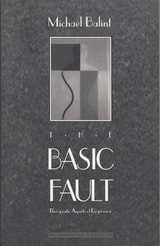
The Basic Fault
Therapeutic Aspects of RegressionMichael Balint
Northwestern University Press, 1968
The Basic Fault continues to illuminate the crucial current issues in psychoanalysis and psychotherapy in general: the nature of self, the role of developmental defects, the value of empathy, and the central importance of the relationship between therapist and patient. This paperback edition includes a foreword by Paul H. Ornstein discussing the impact of Balint's work at the time of its publication and its continued importance now.
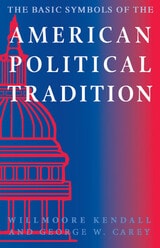
The Basic Symbols of the American Political Tradition
Willmoore Kendall
Catholic University of America Press, 1995