Results by title
8812 books match the query 'Political Science' and 1911 start with t
The Iwakura Embassy, 1871-1873, Volume IV
Continental Europe, 2Kunitake Kume
MHM Limited, 2002
The Iwakura Embassy, 1871-1873, Volume V
Continental Europe, 3; and the Voyage HomeKunitake Kume
MHM Limited, 2002
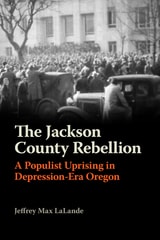
The Jackson County Rebellion
A Populist Uprising in Depression-Era OregonJeffrey Max LaLande
Oregon State University Press, 2023
The Jackson County Rebellion explores a dramatic if little-known populist insurgency in the American West. Author Jeff LaLande takes a deep dive into a tumultuous uprising that captured national attention as it played out in rural Oregon. First tracing its roots back to the area’s tradition of protest, including the Ku Klux Klan of the 1920s, he focuses on Jackson County’s politics of upheaval during the worst days of the Great Depression. The broad strokes of the episode may be familiar to contemporary readers: Demagogues fanning rage — relentlessly accusing an elite of corruption and conspiracy. The strife-torn episode featured nativist and anti-Semitic elements.
The local press played a key role in the events. Two inflammatory newspapers, one owned by wealthy orchardist Llewellyn Banks and the other by politician Earl Fehl, became the vehicles by which these men won the loyalty of rural and working-class residents. Partners in demagoguery, Banks and Fehl created a movement — dubbed the “Good Government Congress” that very nearly took over county government through direct action, ballot theft, and threats of violence. Among those opposing the two men was Harvard-educated Robert Ruhl, owner/editor of the Medford Mail-Tribune, who faced off against Banks and Fehl. Despite boycotts and threats of sabotage. Ruhl ran a resolute editorial campaign against the populist threat in his Mail-Tribune, which won a Pulitzer Prize for its reporting on the uprising.
The rebellion blazed hotly but not for long. Its end was marked by the arrest of its leaders after the fiercely contested 1932 election and by Banks’s murder of the police officer sent to arrest him. Placing the Jackson County Rebellion squarely within America’s long tradition of populist uprisings against the perceived sins of an allegedly corrupt, affluent local elite, LaLande argues that this little-remembered episode is part of a long history of violent conflict in the West that continues today.
The Jamesonian Unconscious
The Aesthetics of Marxist TheoryClint Burnham
Duke University Press, 1995
In an unusual biographical move, Burnham negotiates Jameson’s major works—including Marxism and Form, The Political Unconscious, and Postmodernism, or, The Cultural Logic of Late Capitalism—by way of his own working-class, queer-ish, Gen-X background and sensibility. Thus Burnham’s study draws upon an immense range of references familiar to the MTV generation, including Reservoir Dogs, theorists Slavoj Zizek and Pierre Bourdieu, The Satanic Verses, Language poetry, the collapse of state communism in Eastern Europe, and the indie band Killdozer. In the process, Burnham addresses such Jamesonian questions as how to imagine the future, the role of utopianism in capitalist culture, and the continuing relevance of Marxist theory.
Through its redefinition of Jameson’s work and compelling reading of the political present, The Jamesonian Unconscious defines the leading edge of Marxist theory. Written in a style by turns conversational, playful, and academic, this book will appeal to students and scholars of Marxism, critical theory, aesthetics, narratology, and cultural studies, as well as the wide circle of readers who have felt and understood Jameson’s influence.

The Japanese Experience in Indonesia
Selected Memoirs of 1942-1945Anthony Reid
Ohio University Press, 1986
Although the wartime Japanese military administration of Indonesia was critical to the making of modern Indonesia, it remains shrouded in mystery, in part because of the systematic destruction of records following the Japanese surrender. These excerpts from personal memoirs of individual Japanese soldiers and administrators provide unique glimpses of the occupation—from the Japanese landing on Java and the Dutch surrender, to the independence proclamation in Jakarta, to the violence in Surabaya following the Japanese surrender. Through the eyes of Japanese at all levels of responsibility, we see the internal Indonesian turmoil, the struggle toward an independence movement, and the efforts of some Japanese to promote independence, despite the policies of imperial headquarters.
Not only does this collection illuminate modern Indonesian history, it provides students of Japanese history with a feeling for the variety of Japanese responses to the war effort. The Japanese Experience in Indonesia will therefore be of interest to Southeast and East Asian historians and political scientists, as well as to those with a more general interest in World War II.
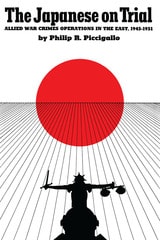
The Japanese On Trial
Allied War Crimes Operations in the East, 1945–1951By Philip R. Piccigallo
University of Texas Press, 1979
This comprehensive treatment of post–World War II Allied war crimes trials in the Far East is a significant contribution to a neglected subject. While the Nuremberg and, to a lesser degree, Tokyo tribunals have received considerable attention, this is the first full-length assessment of the entire Far East operation, which involved some 5,700 accused and 2,200 trials.
After discussing the Tokyo trial, Piccigallo systematically examines the operations of each Allied nation, documenting procedure and machinery as well as the details of actual trials (including hitherto unpublished photographs) and ending with a statistical summary of cases.
This study allows a completely new assessment of the Far East proceedings: with a few exceptions, the trials were carefully and fairly conducted, the efforts of defense counsel and the elaborate review procedures being especially noteworthy. Piccigallo’s approach to this emotion-filled subject is straightforward and evenhanded throughout. He concludes with a discussion of the broader implications of such war crimes trials, a matter of interest to the general reader as well as to specialists in history, law, and international affairs.
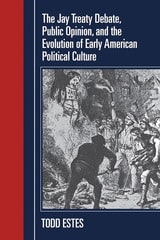
The Jay Treaty Debate, Public Opinion, and the Evolution of Early American Political Culture
Todd Estes
University of Massachusetts Press, 2006
Drawing evidence from a broad range of sources—petitions and newspaper polemics, crowd gatherings, as well as rhetorical exchanges on the floor of Congress—Estes shows how both sides in the Jay Treaty debate mounted extensive and unprecedented campaigns to marshal popular support for their positions. Although many Americans initially opposed the treaty, the Federalists proved particularly skillful at courting the public and eventually prevailed over their opponents, just as they had won earlier battles over neutrality, democratic societies, and the Whiskey Rebellion. But the Republicans, Estes points out, learned from the experience, and in the long run they would become even more adept than the Federalists at shaping public opinion.
Even at the time, amid the fierce political rhetoric and colorful street demonstrations that characterized the Jay Treaty debate, participants recognized that important changes were taking place. Not only did the dispute solidify party allegiances, it also legitimized and advanced popular involvement in the political process. While some welcomed the emergence of this new, more democratic political culture, Estes concludes, others were much more ambivalent.
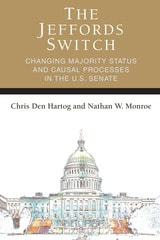
The Jeffords Switch
Changing Majority Status and Causal Processes in the U.S. SenateChris Den Hartog and Nathan W. Monroe
University of Michigan Press, 2019
Senator Jim Jeffords left the Republican Party in May 2001 and became an independent. Because he agreed to vote with the Democrats on organizational votes, this gave that party a 51–49 majority in the Senate.
Using the “Jeffords switch,” Chris Den Hartog and Nathan W. Monroe examine how power is shared and transferred in the Senate, as well as whether Democratic bills became more successful after the switch. They also use the data after the switch, when the Republican Party still held a majority on many Democratic Party-led committees, to examine the power of the committee chairs to influence decisions. While the authors find that the majority party does influence Senate decisions, Den Hartog and Monroe are more interested in exploring the method and limits of the majority party to achieve its goals.
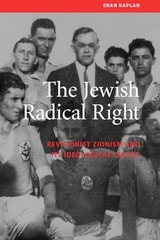
The Jewish Radical Right
Revisionist Zionism and Its Ideological LegacyEran Kaplan
University of Wisconsin Press, 2005
Published with support from the Koret Jewish Studies Program
The Journal of Politics, volume 82 number 1 (January 2020)
The University of Chicago Press
University of Chicago Press Journals, 2020
The Journal of Politics, volume 82 number 2 (April 2020)
The University of Chicago Press
University of Chicago Press Journals, 2020
The Journal of Politics, volume 82 number 3 (July 2020)
The University of Chicago Press
University of Chicago Press Journals, 2020
The Journal of Politics, volume 82 number 4 (October 2020)
The University of Chicago Press
University of Chicago Press Journals, 2020
The Journal of Politics, volume 83 number 1 (January 2021)
The University of Chicago Press
University of Chicago Press Journals, 2021
The Journal of Politics, volume 83 number 2 (April 2021)
The University of Chicago Press
University of Chicago Press Journals, 2021
The Journal of Politics, volume 83 number 3 (July 2021)
The University of Chicago Press
University of Chicago Press Journals, 2021
The Journal of Politics, volume 83 number 4 (October 2021)
The University of Chicago Press
University of Chicago Press Journals, 2021
The Journal of Politics, volume 84 number 1 (January 2022)
The University of Chicago Press
University of Chicago Press Journals, 2022
The Journal of Politics, volume 84 number 2 (April 2022)
The University of Chicago Press
University of Chicago Press Journals, 2022
The Journal of Politics, volume 84 number 3 (July 2022)
The University of Chicago Press
University of Chicago Press Journals, 2022
The Journal of Politics, volume 84 number 4 (October 2022)
The University of Chicago Press
University of Chicago Press Journals, 2022
The Journal of Politics, volume 85 number 1 (January 2023)
The University of Chicago Press
University of Chicago Press Journals, 2023
The Journal of Politics, volume 85 number 2 (April 2023)
The University of Chicago Press
University of Chicago Press Journals, 2023
The Journal of Politics, volume 85 number 3 (July 2023)
The University of Chicago Press
University of Chicago Press Journals, 2023
The Journal of Politics, volume 85 number 4 (October 2023)
The University of Chicago Press
University of Chicago Press Journals, 2023
The Journal of Politics, volume 86 number 1 (January 2024)
The University of Chicago Press
University of Chicago Press Journals, 2024
The Journal of Politics, volume 86 number 2 (April 2024)
The University of Chicago Press
University of Chicago Press Journals, 2024
The Journal of Politics, volume 86 number 3 (July 2024)
The University of Chicago Press
University of Chicago Press Journals, 2024
The Journal of Politics, volume 86 number 4 (October 2024)
The University of Chicago Press
University of Chicago Press Journals, 2024
The Journal of Politics, volume 87 number 1 (January 2025)
The University of Chicago Press
University of Chicago Press Journals, 2025
The Journal of Politics, volume 87 number 2 (April 2025)
The University of Chicago Press
University of Chicago Press Journals, 2025
The Journal of Politics, volume 87 number 3 (July 2025)
The University of Chicago Press
University of Chicago Press Journals, 2025
The Journal of Politics, volume 87 number 4 (October 2025)
The University of Chicago Press
University of Chicago Press Journals, 2025
The Journal of Politics, volume 88 number 1 (January 2026)
The University of Chicago Press
University of Chicago Press Journals, 2026
The Journal of Politics, volume 88 number 2 (April 2026)
The University of Chicago Press
University of Chicago Press Journals, 2026
The Journal of Politics, volume 88 number 3 (July 2026)
The University of Chicago Press
University of Chicago Press Journals, 2026
The Journal of Politics, volume 88 number 4 (October 2026)
The University of Chicago Press
University of Chicago Press Journals, 2026
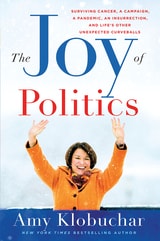
The Joy of Politics
Surviving Cancer, a Campaign, a Pandemic, an Insurrection, and Life’s Other Unexpected CurveballsAmy Klobuchar
University of Minnesota Press, 2023
An intimate and revelatory memoir on personal challenges, political turmoil, and the state of American democracy―now in paperback with a new preface
During the past few years, as our country has faced unprecedented challenges, Senator Amy Klobuchar has been in the room where it happens―on the Senate floor for critical votes during the pandemic, at the debate podium during one of the most crucial presidential primaries in U.S. history, and in the Capitol on January 6, 2021, when insurrectionists stormed the building, interrupting the certification of the Electoral College. It was well past midnight when Klobuchar stood beside then–Vice President Pence to officially certify President Biden's victory.
In her candid, honest, and at times bitingly funny memoir, the pragmatic senator shares insider stories from these historic moments, while also inviting readers into her personal life. An underdog in the 2020 Democratic presidential primary campaign, she built surprising early momentum, only to suspend her candidacy in order to support Joe Biden. Within weeks of returning to work in the Senate, the sudden onslaught of Covid-19 hit her family directly: her husband was hospitalized for a week and spent a month in isolation. Klobuchar shares her experience facing a cancer diagnosis while her beloved father succumbs to Alzheimer's. She recounts the dramatic narrative of January 6 and how close we came to losing our democracy. And, with her signature humor, she reveals what it's like to work with some of her more . . . well, interesting . . . colleagues.
At the crux of these stories is a narrative of resilience—of personal resilience and the resilience of a nation—and, improbably, joy.
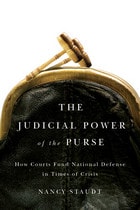
The Judicial Power of the Purse
How Courts Fund National Defense in Times of CrisisNancy Staudt
University of Chicago Press, 2011
Congress and the president are not the only branches that deal with fiscal issues in times of war. In this innovative book, Nancy Staudt focuses on the role of federal courts in fiscal matters during warfare and high-cost national defense emergencies. There is, she argues, a judicial power of the purse that becomes evident upon examining the budgetary effects of judicial decision making. The book provides substantial evidence that judges are willing—maybe even eager—to redirect private monies into government hands when the country is in peril, but when the judges receive convincing cues that ongoing wartime activities undermine the nation’s interests, they are more likely to withhold funds from the government by deciding cases in favor of private individuals and entities who show up in court.
In stark contrast with conventional legal, political, and institutional thought that privileges factors associated with individual preferences, The Judicial Power of the Purse sheds light on environmental factors in judicial decision making and will be an excellent read for students of judicial behavior in political science and law.
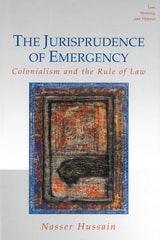
The Jurisprudence of Emergency
Colonialism and the Rule of LawNasser Hussain
University of Michigan Press, 2003
Ever-more-frequent calls for the establishment of a rule of law in the developing world have been oddly paralleled by the increasing use of "exceptional" measures to deal with political crises. To untangle this apparent contradiction, The Jurisprudence of Emergency analyzes the historical uses of a range of emergency powers, such as the suspension of habeas corpus and the use of military tribunals. Nasser Hussain focuses on the relationship between "emergency" and the law to develop a subtle new theory of those moments in which the normative rule of law is suspended.
The Jurisprudence of Emergency examines British colonial rule in India from the late eighteenth to the early twentieth century in order to trace tensions between the ideology of liberty and government by law, which was used to justify the British presence, and the colonizing power's concurrent insistence on a regime of conquest. Hussain argues that the interaction of these competing ideologies exemplifies a conflict central to all Western legal systems—between the universal, rational operation of law on the one hand and the absolute sovereignty of the state on the other. The author uses an impressive array of historical evidence to demonstrate how questions of law and emergency shaped colonial rule, which in turn affected the development of Western legality.
The pathbreaking insights developed in The Jurisprudence of Emergency reevaluate the place of colonialism in modern law by depicting the colonies as influential agents in the interpretation and delineation of Western ideas and practices. Hussain's interdisciplinary approach and subtly shaded revelations will be of interest to historians as well as scholars of legal and political theory.
The Jurisprudence of Emergency
Colonialism and the Rule of LawNasser Hussain
University of Michigan Press, 2019
The Jurisprudence of Emergency examines British rule in India from the late eighteenth to the early twentieth century, tracing tensions between the ideology of liberty and government by law used to justify the colonizing power's insistence on a regime of conquest. Nasser Hussain argues that the interaction of these competing ideologies exemplifies a conflict central to all Western legal systems—between the universal, rational operation of law on the one hand and the absolute sovereignty of the state on the other. The author uses an impressive array of historical evidence to demonstrate how questions of law and emergency shaped colonial rule, which in turn affected the development of Western legality.
The pathbreaking insights developed in The Jurisprudence of Emergency reevaluate the place of colonialism in modern law by depicting the colonies as influential agents in the interpretation of Western ideas and practices. Hussain's interdisciplinary approach and subtly shaded revelations will be of interest to historians as well as scholars of legal and political theory.
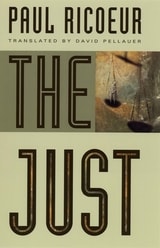
The Just
Paul Ricoeur
University of Chicago Press, 2000
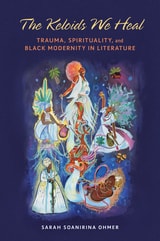
The Keloids We Heal
Trauma, Spirituality, and Black Modernity in LiteratureSarah Soanirina Ohmer
University of Illinois Press, 2025
Women of colors and a literature written in corporeal and spiritual scars
The corporeal and spiritual healing in literature by women of colors can be seen to redefine modern thought and printed text. Sarah Soanirina Ohmer traces the impact of colonization and enslavement on Black women and Black women’s contributions to colonial, nineteenth, and twentieth century literature in the US, Brazil, and the Caribbean.
Drawing on intersectional analysis, Ohmer focuses on portrayals of trauma and spirituality in works by Toni Morrison, Conceição Evaristo, Maryse Condé, Gloria Anzaldúa, the Quilombhoje poets, and María de los Reyes Castillo. Ohmer compares literature from different countries along four thematic pathways: ghosts, mirrors, naming, and motherhood. Her analysis unlocks the literature’s power to heal through gut-wrenching descriptions of wounds and thrilling passages of hope and liberation. Throughout, Ohmer weaves in her life story as a Black woman as she reflects on how colonialism, racism, sexism, and capitalism have impacted her work, traumas, and faith journey.
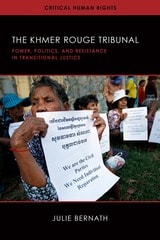
The Khmer Rouge Tribunal
Power, Politics, and Resistance in Transitional JusticeJulie Bernath
University of Wisconsin Press, 2023
Here, Julie Bernath takes a different tack, deliberately decentering the trials in an effort to understand the ECCC in its particular context—and, by extension, the degree to which notions of transitional justice generally must be understood in particular social, cultural, and political contexts. She focuses on “sites of resistance” to the ECCC, including not only members of the elite political class but also citizens who do not, for a variety of tangled reasons, participate in the tribunal—and even resistance from victims of the regime and participants in the trials. Bernath demonstrates that the ECCC both shapes and is shaped by long-term contestation over Cambodia’s social, economic, and political transformations, and thereby argues that transitional justice must be understood locally rather than as a homogenous good that can be implanted by international actors.
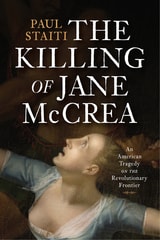
The Killing of Jane McCrea
An American Tragedy on the Revolutionary FrontierPaul Staiti
Westholme Publishing, 2027
FINALIST FOR THE 2026 GEORGE WASHINGTON PRIZE
Winner of the 2026 Book of the Year Award, George Washington American Revolution Round Table, Washington, DC
The killing of Jane McCrea on July 26, 1777, on the outskirts of a village in the northern Hudson Valley, would unexpectedly rupture the British advance from Canada that was meant to crush the American Revolution in one knockout blow. On that day, twenty-five-year-old McCrea, an unremarkable person preparing for an impending marriage, was assaulted, scalped, and killed by a group of Native Americans in the employ of British general John Burgoyne. Though the murder was but one of many civilian deaths in a fierce war zone, McCrea’s killing had far-reaching consequences for each of the three major parties involved in the Northern Campaign of 1777. In America, she became the great cause célèbre of the Revolution, the sympathetic female victim of the war symbolizing the righteousness of The Cause. In Britain, she was a human-rights tragedy that tarnished the polished surface of British honor and galvanized Whig politicians who shouted out her name in Parliament as an example of how low the nation had fallen. For Native peoples, recruited by both the British and the Americans, and caught in the middle of a war staged on ancestral grounds, McCrea’s killing was the opening salvo in a vicious chain of bloody retribution that led to the disintegration of the venerable Iroquois Confederacy and the obliteration of Native homelands. After the war, the nightmarish image of a young Jane McCrea slaughtered on the New York frontier would obsess white Americans who came to fear Native peoples as irredeemable savages. Her murder would help justify the expulsion of Indigenous tribes and open the doors for an expansionary United States that was fully intent on transforming the American continent into its own image.
The Killing of Jane McCrea: An American Tragedy on the Revolutionary Frontier by distinguished historian Paul Staiti undertakes for the first time a comprehensive investigation into McCrea’s life, death, and especially her long and strange afterlife. Using both visual arts and written records, the author reassembles the scattered fragments to illuminate a historical terrain long since shrouded in misinformation, mired in controversy, and relegated to mythology. Coming into view is a major portrait of the persons, cultures, actions, and motives that fatally converged on that hot July morning in 1777.
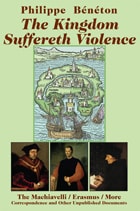
The Kingdom Suffereth Violence
The Machiavelli / Erasmus / More Correspondence and Other Unpublished DocumentsPhilippe Bénéton
St. Augustine's Press, 2012
The Kingdom to Come
Thoughts on the Union before and after the Scottish Independence ReferendumPeter Hennessy
Haus Publishing, 2015
Peter Hennessy discusses the run-up to the Scottish Independence Referendum and its immediate aftermath, as well as the constitutional issues the referendum opened for the entire United Kingdom. This book includes Hennessy’s personal impressions of recent questioning of the Acts of Union that created Great Britain and describes when he, as the top expert on Britain’s unwritten constitution, became an important voice in what might happen next. The Kingdom to Come also offers a valuable examination of the possible agenda for remaking the constitution in both the medium and long term.

The Kingfisher's Wings
Glimpsing the British Constitution in the 2020sPeter Hennessy and Andrew Blick
Haus Publishing, 2024
The Know-Nothing Campaign Against Higher Learning
James Chandler
Prickly Paradigm Press, 2026
Irony and satire in the contemporary American moment.
The second Trump administration has committed itself to upending the knowledge systems and deliberative institutions that have been essential to modern democracy, with the American university—site of scientific research and liberal education—a primary target. In The Know-Nothing Campaign Against Higher Learning, literary and film critic James Chandler spotlights an American tradition of such hostility to intellectual life, especially the nativist movement of the 1850s that persecuted Catholic immigrants from Ireland and Germany. Ironically, Steve Bannon, the self-proclaimed “Know-Nothing vulgarian” who long ago recruited candidate Trump to his anti-intellectual crusade, is himself the great-grandson of an Irish immigrant who would have faced Know-Nothing backlash in that era.
Such dark ironies define our moment, Chandler argues, and they call out not only for intellectual critique but also for satire. Yet in the midst of the MAGA campaign’s calamitous effects on American public discourse, even satire must confront the “kayfabe” practices imported by Trump from professional wrestling, which mix illusion and reality to turn political life into a “spectacle without thought.” Drawing widely on cultural critics from Jonathan Swift and Alexis de Tocqueville to Roland Barthes, Chandler’s pamphlet offers an elegant and bracing account of the MAGA campaign against higher learning and its transformative effects on criticism and democracy itself.
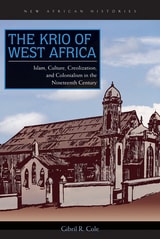
The Krio of West Africa
Islam, Culture, Creolization, and Colonialism in the Nineteenth CenturyGibril R. Cole
Ohio University Press, 2013
Sierra Leone’s unique history, especially in the development and consolidation of British colonialism in West Africa, has made it an important site of historical investigation since the 1950s. Much of the scholarship produced in subsequent decades has focused on the “Krio,” descendants of freed slaves from the West Indies, North America, England, and other areas of West Africa, who settled Freetown, beginning in the late eighteenth century. Two foundational and enduring assumptions have characterized this historiography: the concepts of “Creole” and “Krio” are virtually interchangeable; and the community to which these terms apply was and is largely self-contained, Christian, and English in worldview.
In a bold challenge to the long-standing historiography on Sierra Leone, Gibril Cole carefully disentangles “Krio” from “Creole,” revealing the diversity and permeability of a community that included many who, in fact, were not Christian. In Cole’s persuasive and engaging analysis, Muslim settlers take center stage as critical actors in the dynamic growth of Freetown’s Krio society.
The Krio of West Africa represents the results of some of the first sustained historical research to be undertaken since the end of Sierra Leone’s brutal civil war. It speaks clearly and powerfully not only to those with an interest in the specific history of Sierra Leone, but to histories of Islam in West Africa, the British empire, the Black Atlantic, the Yoruban diaspora, and the slave trade and its aftermath.