Results by title
5448 books match the query 'History and criticism' and 1116 start with t
The Subject of Modernism
Narrative Alterations in the Fiction of Eliot, Conrad, Woolf, and JoyceTony E. Jackson
University of Michigan Press, 1994
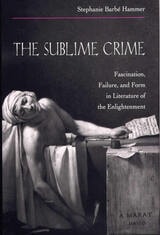
The Sublime Crime
Fascination, Failure, and Form in Literature of the EnlightenmentStephanie Barbe Hammer
Southern Illinois University Press, 1993
In this hermeneutic analysis of seven literary texts, Stephanie Barbé Hammer studies the roles of criminal protagonists in the dramas of George Lillo (The London Merchant) and Friedrich Schiller (The Robbers) and in the narratives of Abbé de Prévost (Manon Lescaut), Henry Fielding (Jonathan Wild), Marquis de Sade (Justine), William Godwin (Caleb Williams), and Heinrich von Kleist (Michael Kohlhaas).
Hammer reflects the current interest in cultural critique by utilizing the social theories of Michel Foucault and the feminist approaches of Hélène Cixous and Eve Sedgwick to redefine the Enlightenment as a movement of thought rather than as a strictly defined period synonymous with the eighteenth century. In addition, through the examination of the works of three post–World War II authors (Jean Genet, Anthony Burgess, and Peter Handke), Hammer suggests that the Enlightenment’s artistic representations of criminality are unparalleled by subsequent modern literature.
Hammer explains that the seven works she focuses on have been dismissed as failures by readers who have misunderstood the texts’ aesthetic elements. While claiming that the form of these works breaks down under the pressure of their criminal protagonists, she asserts that this formal failure actually contributes to the success of the works as art. The works "fail" because, like the criminal characters themselves, they break laws. The criminal protagonist effectively sabotages the official story that the text seeks to tell by deflecting the plot, style, and formal requirements in question, subverting its message—be it moral, sentimental, or libertine— through a kind of structural undermining, forcing the text beyond its own formal boundaries. For example, Hammer maintains that the presence of the criminal figure, Millwood, in Lillo’s bourgeois tragedy actually makes the play covertly antibourgeois.
Hammer insists that the criminal’s subversive presence in these seven works inaugurates new insight, and her analysis thereby challenges late twentieth-century readers to continue the investigation that the works themselves have begun.
This book will prove indispensable to scholars of comparative literature, especially eighteenth-century specialists, as well as to all individuals interested in cultural critique.
The Submerged Plot and the Mother's Pleasure from Jane Austen to Arundhati Roy
Kelly A. Marsh
The Ohio State University Press, 2016
Combining feminist and rhetorical narratological approaches, Marsh’s study offers fresh readings of Persuasion, Jane Eyre, Bleak House, The Woman in White, The House of Mirth, The Last September, The Color Purple, A Thousand Acres, Bastard Out of Carolina, Talking to the Dead, and The God of Small Things. Through these readings, The Submerged Plot and the Mother’s Pleasure explores how the unnarratable can be communicated in fiction and offers a significant contribution to our understanding of narrative progression.
The Substance of Shadow
A Darkening Trope in Poetic HistoryJohn Hollander
University of Chicago Press, 2016
Shadow shows itself here in myriad literary identities, revealing its force as a way of seeing and a form of knowing, as material for fable and parable. Taking up a vast range of texts—from the Bible, Dante, Shakespeare, and Milton to Poe, Dickinson, Eliot, and Stevens—Hollander describes how metaphors of shadow influence our ideas of dreaming, desire, doubt, and death. These shadows of poetry and prose fiction point to unknown, often fearful domains of human experience, showing us concealed shapes of truth and possibility. Crucially, Hollander explores how shadows in poetic history become things with a strange substance and life of their own: they acquire the power to console, haunt, stalk, wander, threaten, command, and destroy. Shadow speaks, even sings, revealing to us the lost as much as the hidden self.
An extraordinary blend of literary analysis and speculative thought, Hollander’s account of the substance of shadow lays bare the substance of poetry itself.
The Suburb of Dissent
Cultural Politics in the United States and Canada during the 1930sCaren Irr
Duke University Press, 1998
Irr highlights works by Richard Wright, John Dos Passos, Nathanael West, and others to uncover the complex relationship between American anti-communism and communist anti-Americanism. In an unprecedented move, she extends her inquiry to the work of Canadian intellectuals such as Dorothy Livesay and Hugh MacLennan to reveal the important yet overlooked fact that the territory at the border of the United States and Canada provided a vital contact zone and transnational “home” for leftist thinkers. Attending to intersections of race, ethnicity, and gender, Irr illustrates the ways dissenting writers made culture actively respond to the political crises of the Great Depression and questioned the nature of what it means to be “American.”
Drawing on insights from postcolonial and American studies and taking into account the intellectual and cultural dimensions of leftist politics, The Suburb of Dissent is the first study of the 1930s to bring together U.S. and Canadian writings. In doing so, it reveals how the unique culture of the left contributed to North American history at this critical juncture and beyond.
The Subversion of the Apocalypses in the Book of Jubilees
Todd R. Hanneken
SBL Press, 2012
The Superhero Symbol
Media, Culture, and PoliticsLiam Burke
Rutgers University Press, 2020
It is hard to imagine a time when superheroes have been more pervasive in our culture. Today, superheroes are intellectual property jealously guarded by media conglomerates, icons co-opted by grassroots groups as a four-color rebuttal to social inequities, masks people wear to more confidently walk convention floors and city streets, and bulletproof banners that embody regional and national identities. From activism to cosplay, this collection unmasks the symbolic function of superheroes.
Bringing together superhero scholars from a range of disciplines, alongside key industry figures such as Harley Quinn co-creator Paul Dini, The Superhero Symbol provides fresh perspectives on how characters like Captain America, Iron Man, and Wonder Woman have engaged with media, culture, and politics, to become the “everlasting” symbols to which a young Bruce Wayne once aspired.

The Surprising Effects of Sympathy
Marivaux, Diderot, Rousseau, and Mary ShelleyDavid Marshall
University of Chicago Press, 1988
Placing novels in the context of eighteenth-century writing about theater, fiction, and painting, Marshall argues that an unusual variety of authors and texts were concerned with the possibility of entering into someone else's thoughts and feelings. He shows how key eighteenth-century works reflect on the problem of how to move, touch, and secure the sympathy of readers and beholders in the realm of both "art" and "life." Marshall discusses the demands placed upon novels to achieve certain effects, the ambivalence of writers and readers about those effects, and the ways in which these texts can be read as philosophical meditations on the differences and analogies between the experiences of reading a novel, watching a play, beholding a painting, and witnessing the spectacle of someone suffering. The Surprising Effects of Sympathy traces the interaction of sympathy and theater and the artistic and philosophical problems that these terms represent in dialogues about aesthetics, moral philosophy, epistemology, psychology, autobiography, the novel, and society.

The TESTED WOMAN PLOT
Women’s Choices, Men’s Judgments, and the Shaping of StoriesLois E. Bueler
The Ohio State University Press, 2001
The Tamburitza Tradition
From the Balkans to the American MidwestRichard March
University of Wisconsin Press, 2013

The Tangled Roots of Feminism, Environmentalism, and Appalachian Literature
Elizabeth S. D. Engelhardt
Ohio University Press, 2003
Contemporaries were shocked when author Mary Noailles Murfree revealed she was a woman, but modern readers may be more surprised by her cogent discussion of community responses to unwanted development. Effie Waller Smith, an African American woman writing of her love for the Appalachian mountains, wove discussions of women's rights, racial tension, and cultural difference into her Appalachian poetry. Grace MacGowan Cooke participated in avant-garde writers' colonies with the era's literary lights and applied their progressive ideals to her fiction about the Appalachia of her youth. Emma Bell Miles, witness to poverty, industrialization, and violence against women, wrote poignant and insightful critiques of her Appalachian home.
In The Tangled Roots of Feminism, Environmentalism, and Appalachian Literature Elizabeth Engelhardt finds in all four women's writings the origins of what we recognize today as ecological feminism—a wide-reaching philosophy that values the connections between humans and nonhumans and works for social and environmental justice.
People and the land in Appalachia were also the subject of women authors with radically different approaches to mountains and their residents. Authors with progressive ideas about women's rights did not always respect the Appalachian places they were writing about or apply their ideas to all of the women in those places—but they did create hundreds of short stories, novels, letters, diaries, photographs, sketches, and poems about the mountains.
While The Tangled Roots of Feminism, Environmentalism, and Appalachian Literature ascribes much that is noble to the beginnings of the ecological feminism movement as it developed in Appalachia, it is also unyielding in its assessment of the literatures of the voyeur, tourist, and social crusader who supported status quo systems of oppression in Appalachia.
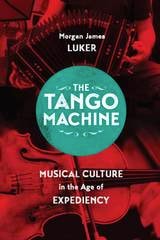
The Tango Machine
Musical Culture in the Age of ExpediencyMorgan James Luker
University of Chicago Press, 2016
Luker traces the diverse and often contradictory ways tango is used in Argentina in activities ranging from state cultural policy-making to its export abroad as a cultural emblem, from the expanding nonprofit arts sector to tango-themed urban renewal projects. He shows how projects such as these are not peripheral to an otherwise “real” tango—they are the absolutely central means by which the values of this musical culture are cultivated. By richly detailing the interdependence of aesthetic value and the regimes of cultural management, this book sheds light on core conceptual challenges facing critical music scholarship today.
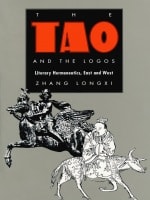
The Tao and the Logos
Literary Hermeneutics, East and WestLongxi Zhang
Duke University Press, 1992
Zhang's book brings together philosophy and literature, theory and practical criticism, the Western and the non-Western in defining common ground on which East and West may come to a mutual understanding. He provides commentary on the rich traditions of poetry and poetics in ancient China; equally illuminating are Zhang's astute analyses of Western poets such as Rilke, Shakespeare, and Mallarmé and his critical engagement with the work of Foucault, Derrida, and de Man, among others.
Wide-ranging and learned, this definitive work in East-West comparative poetics and the hermeneutic tradition will be of interest to specialists in comparative literature, philosophy, literary theory, poetry and poetics, and Chinese literature and history.
The Taste for Nothingness
A Study of Virtus and Related Themes in Lucan's Bellum CivileR. Sklenar
University of Michigan Press, 2003
The Taste for Nothingness traces Lucan's own analytical method by showing how virtus and related concepts operate--or rather, fail to operate--in Lucan's appropriations and distortions of the traditional epic-battle narrative; in the philosophical commitment of Cato the Younger; and in the personalities of the two antagonists, Pompey and Caesar. Much recent scholarship has reached a consensus that Lucan's literary method is mimetic, that his belief in a chaotic cosmos produces a poetics of chaos. While accepting many of the recent findings about Lucan's view of language and the universe, The Taste for Nothingness also allows an even bolder Lucan to emerge: a committed aesthete who regards art as the only realm in which order is possible.
Robert Sklenár is Visiting Assistant Professor of Classical Studies, Tulane University.
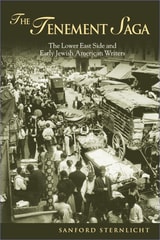
The Tenement Saga
The Lower East Side and Early Jewish American WritersSanford Sternlicht
University of Wisconsin Press, 2004
Sternlicht discusses the role of women, the Yiddish Theater, secular values, the struggle between generations, street crime, politics, labor unions, and the importance of newspapers and periodicals. He documents the decline of Yiddish culture as these immigrants blended into what they called "The Golden Land."

The Tenth Muse
Victorian Philology and the Genesis of the Poetic Language of Gerard Manley HopkinsBy Cary H. Plotkin
Southern Illinois University Press, 1989
With authority and sensitivity Plotkin traces the close relationship between Hopkins’s poetry and the theories of language suggested in his Journals and expounded by Victorian philologists such as Max Müller and George Marsh.
Plotkin seeks to determine what changed Hopkins’s perception of language between the writing of such early poems as "The Habit of Perfection" and "Nondum" (1866) and his creation of The Wreck of the Deutschland (1875–76). Did the language of the ode, and of Hopkins’s mature poetry generally, arise as spontaneously as it appears to have done, or does it have a traceable genesis in the ways in which language as a whole was conceived and studied in mid-century England? In answer, Plotkin fixes the development of Hopkins’s singular poetic language in the philological context of his time.
If one is to understand Hopkins’s writings and poetic language in the context in which they developed rather than in the terms of a present-day theory of history or textuality, then that movement in all of its complexity must be considered. Hopkins "translates" into the language of poetry patterns and categories common to Victorian language study.
The Terrible Fitzball
The Melodramatist of the MacabreLarry Stephen Clifton
University of Wisconsin Press, 1993
The Texas-Mexican Conjunto
History of a Working-class MusicBy Manuel H. Peña
University of Texas Press, 1985
Around 1930, a highly popular and distinctive type of accordion music, commonly known as conjunto, emerged among Texas-Mexicans. Manuel Peña's The Texas-Mexican Con;unto is the first comprehensive study of this unique folk style. The author's exhaustive fieldwork and personal interviews with performers, disc jockeys, dance promoters, recording company owners, and conjunto music lovers provide the crucial connection between an analysis of the music itself and the richness of the culture from which it sprang.
Using an approach that integrates musicological, historical, and sociological methods of analysis, Peña traces the development of the conjunto from its tentative beginnings to its preeminence as a full-blown style by the early 1960s. Biographical sketches of such major early performers as Narciso Martínez (El Huracán del Valle), Santiago Jiménez (El Flaco), Pedro Ayala, Valerio Longoria, Tony de la Rosa, and Paulino Bernal, along with detailed transcriptions of representative compositions, illustrate the various phases of conjunto evolution.
Peña also probes the vital connection between conjunto's emergence as a powerful symbolic expression and the transformation of Texas-Mexican society from a pre-industrial folk group to a community with increasingly divergent socioeconomic classes and ideologies. Of concern throughout the study is the interplay between ethnicity, class, and culture, and Peña's use of methods and theories from a variety of scholarly disciplines enables him to tell the story of conjunto in a manner both engaging and enlightening. This important study will be of interest to all students of Mexican American culture, ethnomusicology, and folklore.
The Text is Myself
Women's Life Writing and CatastropheMiriam Fuchs
University of Wisconsin Press, 2004
In The Text Is Myself, Miriam Fuchs analyzes the impact of catastrophe on the lives and writings of these five women. She shows that, however much the past may be shaped into a discernible storyline, it is the uncertain present that preoccupies these writers. Using a feminist and comparative approach to the texts, Fuchs links the women in creative and insightful ways and displays their many profound connections, despite the differences in their cultural and geographic backgrounds.
Fuchs argues convincingly for a new genre within life writing—the narrative of catastrophe, defined by the writing process that occurs during catastrophic events. Two narratives are being told, and two levels of representation, literal and figurative, are present.
The Theater Will Rock
A History of the Rock Musical, from Hair to HedwigElizabeth L. Wollman
University of Michigan Press, 2010
"A much-needed study of the impact of rock music on the musical theater and its resulting challenges, complexities, failures, and successes. Anyone interested in Broadway will learn a great deal from this book."
---William Everett, author of The Musical: A Research Guide to Musical Theatre
"As Wollman weaves her historical narrative, she compellingly returns to . . . the conflict between the aesthetics and ideologies of rock music and the disciplined and commercial practices of the musical stage."
---Theatre Research International
"This well-written account puts the highs and lows of producing staged rock musicals in New York City into perspective and is well worth reading for the depth of insight it provides."
---Studies in Musical Theatre
Despite the genre’s influence and fame, there are still some critics who claim that the term “rock musical” is an oxymoron. The relationship between rock and the musical theater has been stormy from the start, and even the comparatively recent success of Rent has done little to convince theater producers that rock musicals are anything but highly risky ventures. Elizabeth L. Wollman explores the reasons behind these problematic connections and looks at the socioeconomic forces that underlie aesthetic decisions. She weighs the influence on the rock musical by mass media, sound, and recording technology, and the economic pressures that have affected New York theater in general over the past three decades. Finally, Wollman offers a meditation on the state of the musical, its relation to rock, and, ultimately, its future.
Packed with candid commentary by members of New York's vibrant theater community, The Theater Will Rock traces the rock musical’s evolution over nearly fifty years, in popular productions such as Hair, The Who's Tommy, Jesus Christ Superstar, The Rocky Horror Picture Show, Little Shop of Horrors, Rent, and Mamma Mia!—and in notable flops such as The Capeman.
Elizabeth L. Wollman is Assistant Professor of Music at Baruch College of the City University of New York.
The Theater of Devotion
East Anglian Drama and Society in the Late Middle AgesGail McMurray Gibson
University of Chicago Press, 1989
The Theater of Narration
From the Peripheries of History to the Main Stages of ItalyJuliet Guzzetta
Northwestern University Press, 2021
This book examines the theater of narration, an Italian performance genre and aesthetic that revisits historical events of national importance from local perspectives, drawing on the rich relationship between personal experiences and historical accounts. Incorporating original research from the private archives of leading narrators—artists who write and perform their work—Juliet Guzzetta argues that the practice teaches audiences how ordinary people aren’t simply witnesses to history but participants in its creation.
The theater of narration emerged in Italy during the labor and student protests, domestic terrorism, and social progress of the 1970s. Developing Dario Fo and Franca Rame’s style of political theater, influenced by Jerzy Grotowski and Bertolt Brecht, and following in the freewheeling actor‑author traditions of the commedia dell’arte, narrators created a new form of popular theater that grew in prominence in the 1990s and continues to gain recognition. Guzzetta traces the history of the theater of narration, contextualizing its origins—both political and intellectual—and centers the contributions of Teatro Settimo, a performance group overlooked in previous studies. She also examines the genre’s experiments in television and media.
The first full-length book in English on the subject, The Theater of Narration leverages close readings and a wealth of primary sources to examine the techniques used by narrators to remake history—a process that reveals the ways in which history itself is a theater of narration.
The Theater of Plautus
Playing to the AudienceBy Timothy J. Moore
University of Texas Press, 1998
The relationship between actors and spectators has been of perennial interest to playwrights. The Roman playwright Plautus (ca. 200 BCE) was particularly adept at manipulating this relationship. Plautus allowed his actors to acknowledge freely the illusion in which they were taking part, to elicit laughter through humorous asides and monologues, and simultaneously to flatter and tease the spectators.
These metatheatrical techniques are the focus of Timothy J. Moore's innovative study of the comedies of Plautus. The first part of the book examines Plautus' techniques in detail, while the second part explores how he used them in the plays Pseudolus, Amphitruo, Curculio, Truculentus, Casina, and Captivi. Moore shows that Plautus employed these dramatic devices not only to entertain his audience but also to satirize aspects of Roman society, such as shady business practices and extravagant spending on prostitutes, and to challenge his spectators' preconceptions about such issues as marriage and slavery. These findings forge new links between Roman comedy and the social and historical context of its performance.
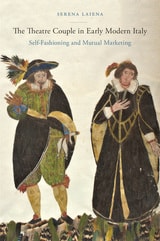
The Theatre Couple in Early Modern Italy
Self-Fashioning and Mutual MarketingSerena Laiena
University of Delaware Press, 2024
Who were the first celebrity couples? How was their success forged? Which forces influenced their self-fashioning and marketing strategies?
These questions are at the core of this study, which looks at the birth of a phenomenon, that of the couple in show business, with a focus on the promotional strategies devised by two professional performers: Giovan Battista Andreini (1576–1654) and Virginia Ramponi (1583–ca.1631). This book examines their artistic path – a deliberately crafted and mutually beneficial joint career – and links it to the historical, social, and cultural context of post-Tridentine Italy. Rooted in a broad research field, encompassing theatre history, Italian studies, celebrity studies, gender studies, and performance studies, The Theatre Couple in Early Modern Italy revises the conventional view of the Italian diva, investigates the deployment of Catholic devotion as a marketing tool, and argues for the importance of the couple system in the history of Commedia dell’Arte, a system that continues to shape celebrity today.
The Theatrical Event
Dynamics of Performance and PerceptionWillmar Sauter
University of Iowa Press, 2000
The Theatricality of Greek Tragedy
Playing Space and ChorusGraham Ley
University of Chicago Press, 2007
Drawing on evidence from the surviving texts of tragedies by Aeschylus, Sophocles, and Euripides, Ley explains how scenes with actors were played in the open ground of the orchestra, often considered as exclusively the dancing place of the chorus. In reviewing what is known of the music and dance of Greek antiquity, Ley goes on to show that in the original productions the experience of the chorus—expressed in song and dance and in interaction with the characters—remained a vital characteristic in the performance of tragedy.
Combining detailed analysis with broader reflections about the nature of ancient Greek tragedy as an art form, this volume—supplemented with a series of illustrative drawings and diagrams—will be a necessary addition to the bookshelf of anyone interested in literature, theater, or classical studies.
The Theoretical Dimensions of Henry James
John Carlos Rowe
University of Wisconsin Press, 1985
Rowe examines James from the perspectives of the psychology of literary influence, feminism, Marxism, psychoanalysis, literary phenomenology and impressionism, and reader-response criticism, transforming a literary monument into the telling point of intersection for modern critical theories.
The Things That Fly in the Night
Female Vampires in Literature of the Circum-Caribbean and African DiasporaGiselle Liza Anatol
Rutgers University Press, 2015
This book is available as an audio book (https://www.abantuaudio.com/books/1197052/The-Things-That-Fly-in-the-Night).
The Thinker As Artist
From Homer To Plato and AristotleGeorge Anastaplo
Ohio University Press, 1997
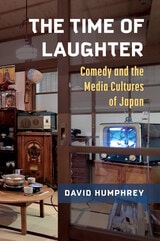
The Time of Laughter
Comedy and the Media Cultures of JapanDavid Humphrey
University of Michigan Press, 2023
The Trace of Judaism
Dostoevsky, Babel, Mandelstam, LevinasVal Vinokur
Northwestern University Press, 2009
The defining quality of Russian literature, for most critics, is its ethical seriousness expressed through formal originality. The Trace of Judaism addresses this characteristic through the thought of the Lithuanian-born Franco-Jewish philosopher Emmanuel Levinas. Steeped in the Russian classics from an early age, Levinas drew significantly from Dostoevsky in his ethical thought. One can profitably read Russian literature through Levinas, and vice versa.
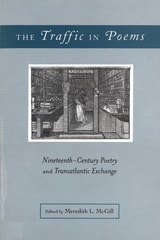
The Traffic In Poems
Nineteenth-Century Poetry and Transatlantic ExchangeMcGill, Meredith L
Rutgers University Press, 2008
Drawing on examples such as Felicia Hemans's elaboration of the foundational American myth of Plymouth Rock, Emma Lazarus's ambivalent welcome of Europe's cast-off populations, black abolitionist Mary Webb's European performances of Hiawatha, and American reprints of Robert Browning and George Meredith, the eleven essays in this book focus on poetic depictions of exile, slavery, immigration, and citizenship and explore the often asymmetrical traffic between British and American poetic cultures.
The Transformation of Authorship in America
Grantland S. Rice
University of Chicago Press, 1997
Rice shows that the rigorous censorship practiced by Puritan authorities conferred an implicit prestige on texts as civic interventions, helping to foster a vigorous and indigenous tradition of sociopolitical criticism. With special attention to the sudden emergence of the novel in post-revolutionary America, Rice reveals how the emergence of economic liberalism undermined the earlier tradition of political writing by transforming American authorship from an expression of individual civic conscience to a market-oriented profession.
Includes discussions of the writings of Benjamin Franklin, Michel-Guillaume-Jean de Crèvecoeur, and Hugh Henry Brackenridge.
The Translated Jew
German Jewish Culture outside the MarginsLeslie Morris
Northwestern University Press, 2018
The Translated Jew brings together an eclectic set of literary and visual texts to reimagine the transnational potential for German Jewish culture in the twenty-first century. Departing from scholarship that has located the German Jewish text as an object that can be defined geographically and historically, Leslie Morris challenges national literary historiography and redraws the maps by which transnational Jewish culture and identity must be read.
Morris explores the myriad acts of translation, actual and metaphorical, through which Jewishness leaves its traces, taking as a given the always provisional nature of Jewish text and Jewish language. Although the focus is on contemporary German Jewish literary cultures, The Translated Jew also turns its attention to a number of key visual and architectural projects by American, British, and French artists and writers, including W. G. Sebald, Anne Blonstein, Hélène Cixous, Ulrike Mohr, Daniel Blaufuks, Paul Celan, Raymond Federman, and Rose Ausländer.
In thus realigning German Jewish culture with European and American Jewish culture and post-Holocaust aesthetics, this book explores the circulation of Jewishness between the United States and Europe. The insistence on the polylingualism of any single language and the multidirectionality of Jewishness are at the very center of The Translated Jew.
The Translations of Nebrija
Language, Culture, and Circulation in the Early Modern WorldByron Ellsworth Hamann
University of Massachusetts Press, 2015
Tracing the global influence of Nebrija's dictionary, Byron Ellsworth Hamann, in this interdisciplinary, deeply researched book, connects pagan Rome, Muslim Spain, Aztec Tenochtitlan, Elizabethan England, the Spanish Philippines, and beyond, revealing new connections in world history. The Translations of Nebrija re-creates the travels of people, books, and ideas throughout the early modern world and reveals the adaptability of Nebrija's text, tracing the ways heirs and pirate printers altered the dictionary in the decades after its first publication. It reveals how entries in various editions were expanded to accommodate new concepts, such as for indigenous languages in the Americas—a process with profound implications for understanding pre-Hispanic art, architecture, and writing. It shows how words written in the margins of surviving dictionaries from the Americas shed light on the writing and researching of dictionaries across the early modern world.
Exploring words and the dictionaries that made sense of them, this book charts new global connections and challenges many assumptions about the early modern world.
The Translator in the Text
On Reading Russian Literature in EnglishRachel May
Northwestern University Press, 1994
The Transmutation of Love and Avant-Garde Poetics
Jeanne Heuving
University of Alabama Press, 2016
Reimagining love as a force of poetic innovation in modern and avant-garde literature.
The Transmutation of Love and Avant-Garde Poetics is a probing examination of how the writing of sexual love undergoes a radical revision by avant-garde poets in the twentieth and twenty-first centuries. Today, the exploration of love by poets—long a fixture of Western poetic tradition—is thought to be in decline, with love itself understood to be a mere ideological overlay for the more “real” entities of physical sex and desire.
In The Transmutation of Love and Avant-Garde Poetics, Jeanne Heuving claims that a key achievement of poetry by Ezra Pound, H.D., Robert Duncan, Kathleen Fraser, Nathaniel Mackey, and others lies significantly in their engagement with the synergistic relations between being in love and writing love. These poets, she argues, have traded the clichéd lover of yore for impersonal or posthuman poetic speakers that sustain the gloire and mystery of love poetry of prior centuries. As Robert Duncan writes, “There is a love in which we are outcast and vagabond from what we are that we call ‘falling in love.’”
Heuving claims that this writing of love is defining for avant-garde poetics, identifying how such important discoveries as Pound’s and H.D.’s Imagism, Pound’s Cantos, and Duncan’s “open field poetics” are derived through their changed writing of love. She draws attention to how the prevailing concept of language as material is inadequate to the ways these poets also engage language as a medium—as a conduit—enabling them to address love afresh in a time defined through preoccupations with sexuality. They engage love as immanent and change it through a writing that acts on itself.
The Transmutation of Love and Avant-Garde Poetics ascribes the waning of love poetry to its problematic form: a genre in which empowered poetic speakers constitute their speech through the objectification of comparatively disempowered subjects, or beloveds. Refusing this pervasive practice, the poets she highlights reject the delimiting, one-sided tradition of masculine lovers and passive feminine beloveds; instead, they create a more nuanced, dynamic poetics of ecstatic exploration, what Heuving calls “projective love” and “libidinized field poetics,” a formally innovative poetry, in which one perception leads directly to the next and all aspects of a poem are generative of meaning.
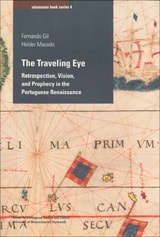
The Traveling Eye
Retrospection, Vision, and Prophecy in the Portuguese RenaissanceFernando Gil
Tagus Press, 2009
The idea for The Traveling Eye came as a new departure in an old dialogue between the two authors, one a literary scholar, the other a philosopher. Our focus was initially centered on a philosophical hypothesis concerning evidence, with specific reference to the prophetic writings of Father António Vieira, but it occurred to us that this perspective could be applied to literary works, particularly those of the Portuguese Renaissance. The studies that one of us had dedicated to the initiatory aspects of The Lusiads and to the codification of esoteric meanings in the work of Bernardim Ribeiro suggested a possible convergence of our two lines of research. But there are other issues raised by the Portuguese Renaissance: voyages, the new, the encounter with difference and how to understand it. The most obvious and direct expression of these issues is found in the chronicles of voyage and empire, whose importance is duly noted in the study by Luís de Sousa Rebelo included in Chapter III of this book. The literary treatment of this material seems to us no less revealing. Seeing ("seeing clearly seen" as Camões says in The Lusiads) poses the problem of simultaneously seeing "what is there" and of how what is there could be seen. This questioning from the outside by "the traveling eye" went hand in hand with new ways of relating to oneself and to others. Three key Renaissance authors, Luís de Camões (1525?-1580), Francisco de Sá de Miranda (1481?-1558?) and Bernardim Ribeiro (b.1480s?), address the human subject's relationship as a perplexing issue. Their works transform the feeling of love into a multifaceted investigation that questions the identity of the individual. A recurring theme in this book is the metamorphoses of the self brought about by love.
The Treacherous Imagination
Intimacy, Ethics, and Autobiographical FictionRobert McGill
The Ohio State University Press, 2013
The Tribe of John
Ashbery and Contemporary PoetrySusan M. Schultz
University of Alabama Press, 1995
This concentration on Ashbery's influence on contemporary American poetry provides new methods for interpreting and understanding his poetic achievement.
The Tribe of Pyn
Literary Generations in the Postmodern PeriodDavid Cowart
University of Michigan Press, 2015
The Triumph of Human Empire
Verne, Morris, and Stevenson at the End of the WorldRosalind Williams
University of Chicago Press, 2013
The Tropics Bite Back
Culinary Coups in Caribbean LiteratureValérie Loichot
University of Minnesota Press, 2013
The ubiquitous presence of food and hunger in Caribbean writing—from folktales, fiction, and poetry to political and historical treatises—signals the traumas that have marked the Caribbean from the Middle Passage to the present day. The Tropics Bite Back traces the evolution of the Caribbean response to the colonial gaze (or rather the colonial mouth) from the late nineteenth century to the twenty-first. Unlike previous scholars, Valérie Loichot does not read food simply as a cultural trope. Instead, she is interested in literary cannibalism, which she interprets in parallel with theories of relation and creolization.
For Loichot, “the culinary” is an abstract mode of resistance and cultural production. The Francophone and Anglophone authors whose works she interrogates—including Patrick Chamoiseau, Suzanne Césaire, Aimé Césaire, Maryse Condé, Edwidge Danticat, Édouard Glissant, Lafcadio Hearn, and Dany Laferrière—“bite back” at the controlling images of the cannibal, the starved and starving, the cunning cook, and the sexualized octoroon with the ultimate goal of constructing humanity through structural, literal, or allegorical acts of ingesting, cooking, and eating.
The Tropics Bite Back employs cross-disciplinary methods to rethink notions of race and literary influence by providing a fresh perspective on forms of consumption both metaphorical and material.
The Trouble with Sauling Around
Conversion in Ethnic American Autobiography, 1965-2002Madeline R. Walker
University of Iowa Press, 2011
The Troubled Union
Expansionist Imperatives in Post-Reconstruction American NovelsJohn Morán González
The Ohio State University Press, 2010
The True Story of Alice B. Toklas
A Study of Three AutobiographiesAnna Linzie
University of Iowa Press, 2006
The True Story of the Novel
Margaret Anne Doody
Rutgers University Press, 1997
Twentieth-century historians and critics defending the novel have emphasized its role as superseding something else, as a sort of legitimate usurper that deposed the Epic, a replacement of myth, or religious narrative. To say that the Age of Early Christianity was really also the Age of the Novel rumples such historical tidiness––but so it was. From the outset of her discussion, Doody rejects the conventional Anglo-Saxon distinction between Romance and Novel. This eighteenth-century distinction, she maintains, served both to keep the foreign––dark-skinned peoples, strange speakers, Muslims, and others––largely out of literature, and to obscure the diverse nature of the novel itself.
This deeply informed and truly comparative work is staggering in its breadth. Doody treats not only recognized classics, but also works of usually unacknowledged subgenres––new readings of novels like The Pickwick Papers, Puddn’head Wilson, L’Assommoir, Death in Venice, and Beloved are accompanied by insights into Death on the Nile or The Wind in the Willows. Non-Western writers like Chinua Achebe and Witi Ihimaera are also included. In her last section, Doody goes on to show that Chinese and Japanese novels, early and late, bear a strong and not incidental affinity to their Western counterparts. Collectively, these readings offer the basis for a serious reassessment of the history and the nature of the novel.
The True Story of the Novel marks the beginning of the twenty-first century’s understanding of fiction and of culture. It is essential reading for anyone with an interest in literature.

The Truth That Never Hurts 25th anniversary edition
Writings on Race, Gender, and FreedomBarbara Smith
Rutgers University Press, 2024
Barbara Smith has been doing groundbreaking work since the early 1970s, describing a Black feminism for Black women. Her work in Black women's literary traditions; in examining the sexual politics of the lives of women of color; in representing the lives of Black lesbians and gay men; and in making connections between race, class, sexuality and gender is gathered in The Truth That Never Hurts. This collection contains some of her major essays on Black women's literature, Black lesbian writing, racism in the women's movement, Black-Jewish relations, and homophobia in the Black community. Her forays into these areas ignited dialogue about topics that few other writers were addressing at the time, and which, sadly, remain pertinent to this day. This twenty-fifth anniversary edition, in a beautiful new package, also contains the essays from the original about the 1968 Chicago convention demonstrations; attacks on the NEA; the Anita Hill-Clarence Thomas Senate hearings; and police brutality against Rodney King and Abner Louima, which, after twenty-five years, still have the urgency they did when they were first written.
The Truth That Never Hurts
Writings on Race, Gender, and FreedomSmith, Barbara
Rutgers University Press, 2000
Smith’s essay “Toward a Black Feminist Criticism,” is often cited as a major catalyst in opening the field of black women’s literature. Pieces about racism in the women’s movement, black and Jewish relations, and homophobia in the Black community have ignited dialogue about topics that few other writers address. The collection also brings together topical political commentaries on the 1968 Chicago convention demonstrations; attacks on the NEA; the Anita Hill–Clarence Thomas Senate hearings; and police brutality against Rodney King and Abner Louima. It also includes a never-before-published personal essay on racial violence and the bonds between black women that make it possible to survive.

The Tutor'd Mind
Indian Missionary-Writers in Antebellum AmericaBernd C. Peyer
University of Massachusetts Press, 1997
In the view of the English colonists and their descendants, Indian converts to Christianity were expected to repudiate native traditions and affirm the superiority of European civilization, to serve as role models, and to spread the gospel far into the wilderness. Yet as Bernd C. Peyer shows, Indian missionaries did not always fulfill the expectations of those who trained them. Once the Indians recognized that conversion alone did not guarantee protection from discrimination, they devised a variety of strategies, theological as well as practical, to resist assimilation into the dominant white culture. Making effective use of their literacy and education, they called attention to the discrepancy between the Protestant ideals they had been taught and the Anglo-American practices to which native people were subjected.
By uncovering this subtext of dissent and resistance, Peyer at once alters and enriches our understanding of the evolution of the American Indian literary tradition.