Results by title
3785 books match the query 'Poetry' and 833 start with t
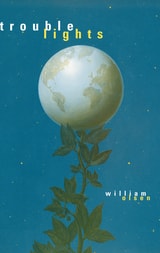
Trouble Lights
William Olsen
Northwestern University Press, 2001
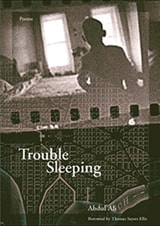
Trouble Sleeping
Abdul Ali
New Issues Poetry and Prose, 2015
— Publisher’s Weekly
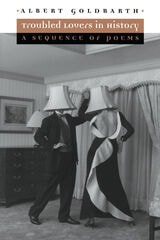
Troubled Lovers in History
A Sequence of PoemsAlbert Goldbarth
The Ohio State University Press, 1999
Troubled Lovers in History demonstrates an exhilarating range: from the briefest of lyrics to rich and multipartite narrative adventures in exotic realms; from a comic monologue spoken in immigrant “Yinglish” to a soulful elegy set in San Antonio’s Pearl Beer brewery plant; from Martian invaders, through polar explorers, to all of us busy inflicting “words with edges” on those we love.
Goldbarth sets his unflinching study of individual hope and grief against the backdrop of history: the travels of Marco Polo; Bertha and Wilhelm Rontgen’s discovery of X-rays; an 1800 battle “twixt Dragon Sam, the great Exhaler of Gouts of Amazing Flame . . . and Liquid Dan, the Living Geyser.”
From the night stars to the little starring parts we all play every day, Troubled Lovers in History takes us into the text of our dreams and despairs, as witnessed by the writer whom Joyce Carol Oates called “a poet of remarkable gifts—a dazzling virtuoso who can break your heart.”

Troubled Mirror
A Study Of Yeats's "The Tower"David Young
University of Iowa Press, 1987
Despite the extensive critical attention that has been paid to the work of W. B. Yeats, we are still very much in the process of understanding both the greatness and the modernity of this poet. The assessment of his poetry has rested primarily on the scope, intensity, and memorability of his lyrics, but his romantic beginnings have made it problematic to acknowledge him as a modernist, while his failure to produce a long poem has for some time raised questions about his greatness. Don’t major poets, the argument runs, produce major poems?
In this meticulous analysis of The Tower, David Young addresses both these issues, showing that this powerful volume represents Yeats at his best and most modern, and that its careful construction makes it the deliberate equivalent to the long poems of tradition.
By tracing the careful ordering of the poems in The Tower, Young demonstrates the volume’s overall vision, giving careful readings of each poem and illustrating the growing repetition of images that create a whole which is both emotionally and dramatically greater than the sum of its parts. Young contends that the best way to read Yeat’s lyrics is through attention to the context he created for them. Their interdependence, he asserts, is the true key to their modernity.
This eminently readable study appears at a time when most readers are in danger of losing touch with the particular achievement of Yeat’s individual volumes as he conceived them. Most students and readers now encounter Yeats in anthologies, in a volume of selected poems, or in a somewhat misleadingly presented complete Poems. Young convinces us that by persisting in this approach we will lose sight of a significant aspect of a foremost modern poet and the very elements that make him a true modern.
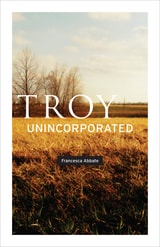
Troy, Unincorporated
Francesca Abbate
University of Chicago Press, 2012
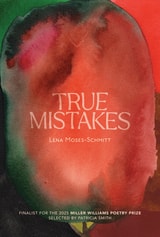
True Mistakes
Lena Moses-Schmitt
University of Arkansas Press, 2025
Finalist, 2025 Miller Williams Poetry Prize
In her debut collection True Mistakes, the poet Lena Moses-Schmitt unleashes her powers of scrutiny on herself and on works of art to interrogate the essential nature of consciousness, identity, and time.
As the poet goes about daily life—taking long walks, painting at her desk, going to work, grappling with the deaths of friends, struggling with anxiety and depression—she ruminates on the boundaries between art and reality, grief and joy, living and imagining. For Moses-Schmitt, thought, like painting, is relentlessly high-stakes: “I often think about things so hard / I kill them.” And: “Is it possible to paint myself so precisely / I disappear? Can I remember myself / so completely I’m erased?” In the context of such ruminations, the poet’s reflections on David Hockney’s seminal pool paintings shimmer with sublimity and insight.
Working to turn “mistakes”—misperceptions, errors in life and in art—into sites of possibility and imagination instead of failure or confusion, Moses-Schmitt offers “a truth for every reader,” writes series editor Patricia Smith.

True Names
Vergil and the Alexandrian Tradition of Etymological WordplayJames J. O'Hara
University of Michigan Press, 2016
In this new edition, O’Hara offers more than one hundred new examples, and more than 250 new bibliographical items on etymologizing in Vergil and other ancient authors, especially the other Augustan poets. A substantial new Introduction reflects on the wide scholarly response to the first edition, and it discusses issues in scholarship on etymologizing from the last two decades.
True-Love
Essays on Poetry and ValuingAllen Grossman
University of Chicago Press, 2009
True-Love is the fulfillment of revered poet-critic Allen Grossman’s long service to poetry in the interests of humanity. Poetry’s singular mission is to bind love and truth together—love that desires the beloved’s continued life, knotted with the truth of life’s contingency—to help make us more present to each other.
In the spirit of Blake’s vow of “mental fight,” Grossman contends with challenges to the validity of the poetic imagination, from Adorno’s maxim “No poetry after Auschwitz,” to the claims of religious authority upon truth, and the ultimate challenge posed by the fact of death itself. To these challenges he responds with eloquent and rigorous arguments, drawing on wide resources of learning and his experience as master-poet and teacher. Grossman’s readings of Wordsworth, Hart Crane, Paul Celan, and others focus on poems that interrogate the real or enact the hard bargains that literary representation demands. True-Love is destined to become an essential book wherever poetry and criticism sustain one another.
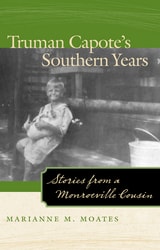
Truman Capote's Southern Years
Stories from a Monroeville CousinMarianne M. Moates
University of Alabama Press, 2008
Although much is known about the mature Truman Capote--his literary genius and flamboyant life-style--details of his childhood years spent in Monroeville, Alabama, have remained a mystery. Truman Capote's Southern Years explores Capote's formative years, the abandonment by his mother, and his early life in the care of elderly relatives. In Monroeville young Capote formed significant bonds and played childhood games with his cousin, Jennings Faulk Carter, and next door neighbor, Nelle Harper Lee. Through the tales told here by Carter, readers discover the lively imagination and the early tragedies of a brilliant child.
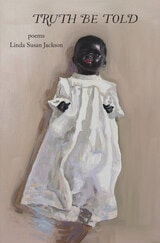
Truth Be Told
Linda Susan Jackson
Four Way Books, 2024
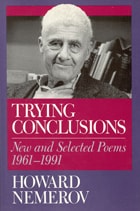
Trying Conclusions
New and Selected Poems, 1961-1991Howard Nemerov
University of Chicago Press, 1991
Trying to Say It
Outlooks and Insights on How Poems HappenPhilip Booth
University of Michigan Press, 1996
Gathering together selections from his notebooks, dreamlogs, memoirs, and essays of such poets as Frost, Robert Lowell and George Oppen, Trying to Say It particularly focuses on the ways that the tension between in-formed structures and lineation create poems which--in all senses--move.
Employing the Thoreauvian sense of place for which his poetry is known, Booth probes the nature of poetry itself, as well as the poetry of nature--yielding insights that are rooted in the acute observation that catalyzes imagination. Infused with a restless spirit in search of a moving language commensurate with the complexity of being fully alive, the essays collected in Trying to Say It reveal the pulses of a teacher's mind and a poet's heart.
Philip Booth is the author of nine books of poetry, and has been honored by Guggenheim, Rockefeller, and National Endowment for the Arts fellowships, the National Institute of Arts and Letters, and the Academy of American Poets.
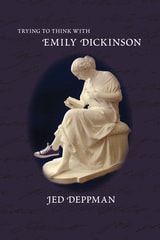
Trying to Think with Emily Dickinson
Jed Deppman
University of Massachusetts Press, 2008
This book presents Emily Dickinson as one of America's great thinkers and argues that she has even more to say to the twenty-first century than she did to the nineteenth. Jed Deppman weaves together many strands in Dickinson's intellectual culture—philosophy, lexicography, religion, experimental science, the female Bildungsroman—and shows how she developed a lyricized, conversational hermeneutics uniquely suited to rethinking the authoritative discourses of her time.
Through Deppman's original analysis, readers come to see how Dickinson's mind and poetry were informed by two strong but opposing philosophical vocabularies: on the one hand, the Lockean materialism and Scottish Common Sense that dominated her schoolbooks in logic and mental philosophy—Reid, Hedge, Watts, Stewart, Brown, and Upham—and on the other, the neo-Kantian modes of apprehending the supersensible that circulated throughout German idealism and Transcendentalism.
Blending close readings with philosophical and historical approaches, Deppman affirms Dickinson's place in the history of ideas and brings her to the center of postmodern conversations initiated by Jean-François Lyotard, Jean-Luc Nancy, Jacques Derrida, Richard Rorty, and Gianni Vattimo. Trying her out in various postmodern roles—the Nietzschean accomplished nihilist, the Nancian finite thinker, the Vattimian weak thinker, and the Rortian liberal ironist—Deppman adds to the traditional expressive functions of her poetry a valuable, timely, and interpretable layer of philosophical inquiry. Dickinson, it turns out, is an ideal companion for anybody trying to think in the contemporary conditions that Vattimo characterizes as the “weakened experience of truth.”
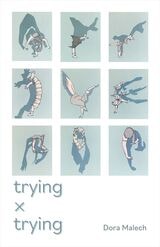
Trying x Trying
Dora Malech
Carnegie Mellon University Press, 2025
In Trying × Trying, Dora Malech dissects the language of our times; she turns over the familiar phrases of politics, parenthood, and pandemic to reveal what lies beneath. Through playing with the double meaning of “trying” as both perseverance and reproductive struggle, these poems navigate public and private spheres and interrogate the words we use to make sense of uncertainty and belief.
With sharp lyricism and restless energy, Malech transforms language into prayer and protest. Sound bends, meanings shift, and repetition becomes a revelation as she traces the tensions between individual and collective experience. Trying × Trying is an enlightening meditation on persistence, reminding us that even in fractured times, poetry finds a way forward.
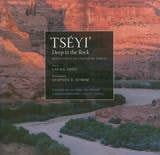
Tséyi' / Deep in the Rock
Reflections on Canyon de ChellyText by Laura Tohe; photographs by Stephen E. Strom
University of Arizona Press, 2005
Diné poet Laura Tohe draws deeply on her heritage to create lyrical writings that are rooted in the canyon but universal in spirit, while photographer Stephen Strom captures images that reveal the very soul of this ancient place. Tohe’s words take readers on a journey from the canyon rim down sheer sandstone walls to its rich bottomlands; from the memory of Kit Carson’s rifle shots and the forced march of the Navajo people to the longings of modern lovers. Her poems view the land through Diné eyes, blending history, tradition, and personal reflection while remaining grounded in Strom’s delicate yet striking images. These photographs are not typical of most southwestern landscapes. Strom’s eye for the subtleties and mysticism of the canyon creates powerful images that linger in the mind long after the pages are turned, compelling us to look at the earth in new ways.
Tséyi' / Deep in the Rock is a unique evocation of Canyon de Chelly and the people whose lives and spirits are connected to it. It is a collaboration that conjures the power of stories and images, inviting us to enter a world of harmony and be touched by its singularly haunting beauty.

Turn Thanks
POEMSLorna Goodison
University of Illinois Press, 1999
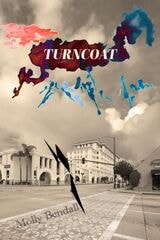
Turncoat
Molly Bendall
Omnidawn, 2025
Through the poems in Turncoat, Molly Bendall’s sixth collection, the speaker and other figures dwell under the ever-present eye of surveillance by unspecified authorities. Mistrust and dread become part of the fabric of their lives, as they never know who may be a turncoat—a person who disguises her allegiances and traffics in betrayal. These poems employ an invented paranoid syntax meant to evade oppressive surveillance. A series of intimate and darkly humorous incidents press the speaker to continually adapt to unseen—or even nonexistent—dangers. Haunted by a sense of disorientation and uncertainty about whether old friendships may have been compromised, or if spaces could disappear overnight, Bendall’s poems coax the reader to step across boundaries and snares, alternating between episodes of interrogation and flight.
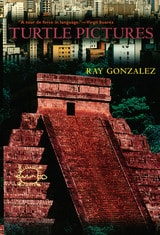
Turtle Pictures
Ray Gonzalez
University of Arizona Press, 2000
Gonzalez has forged a new Chicano manifesto, a cultural memoir that traces both his personal journey and the communal journey that Mexican Americans have traveled throughout this century, across this land. He interweaves lyrical poetry, prose poems, short fiction, and nonfiction commentary into a lush cacophony that traces the evolution of today's politically charged Chicano voices from the deafening silence of their ancestors. Adopting the turtle as a metaphor for the Native American origins of border culture, Gonzalez frames this multitextured individual vision until it becomes a universal portrait of American life: a slow, ancient creature morphing into one of voracious rapidity. In wild and challenging surrealistic images, he hammers out a political statement from language that takes on a special urgency. Walking a fine line between lyricism and polemic, and succeeding where others have stumbled, he calls on Mexican Americans to return to their roots in order to avoid being swept up in American material culture.
Turtle Pictures is a complex body of work by a poet totally in tune with the spirit and nuances of language, imbued with a deep sense of craft and literary tradition. It invites readers to revel in its richness and vitality, to be caught up in its chantlike spirit, to luxuriate in its hauntingly beautiful passages. It is a work to devour, to savor, to return to, for it speaks with all the rhythms of the soul.
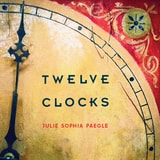
Twelve Clocks
Julie Sophia Paegle
University of Arizona Press, 2015
As the reader is transported from Las Vegas to Argentina to the landscapes of Ancient Greek epic poetry, Twelve Clocks explores the connections between song, ancestry, family, loss, and time. If the imagery of the collection hints Troy might be an image of the wrecked Argentine economy under neoliberal economics, the poems eschew the abstractions of politics in favor of a vivid and sensuous lyricism.
The interconnectivity of the poems in Twelve Clocks is mirrored by different elements’ transcendence throughout the collection. The clock that goes missing in one poem turns up in another, characters vanish and reappear, matter destroyed in one poem reoccurs as energy in another, and then matter and energy both go missing. Taken together, the poems confront the literary legacy of Western poetic tradition and our shared future.
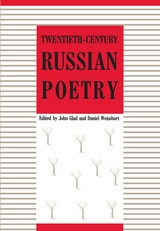
Twentieth-Century Russian Poetry
John Glad
University of Iowa Press, 1992
This celebrated anthology, first published in 1978 as Russian Poetry: The Modern Period, provides a much-needed panoramic overview of Russian poetry since the Bolshevik Revolution of 1917.
Major features of this collection include a new and expanded introduction, a substantial new section of glasnost-era poetry, a generous sampling of postrevolutionary poetry in Russia, full representation of poets of the first and second post-World War II generations, and poetry of the successive emigrations, flights, or expulsions from Russia.
Twentieth-Century Russian Poetry makes an important contribution to our continuing understanding of a changing world order. This anthology should be read by all those who wish to know more about the poetry of Russia, those interested in international cultural and literary history, and all Slavicists.
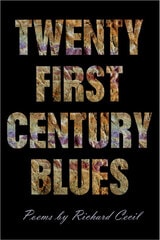
Twenty First Century Blues
Richard Cecil
Southern Illinois University Press, 2004
Death, fame, art, and religion become comic subjects in Twenty First Century Blues, the fourth collection from Richard Cecil.Whether elegizing his predecessors, predicting his own end, channeling Dickinson’s “corpse-eye-view of stony death,” or imagining Yeats living in Indiana and dealing with English department politics, Cecil tempers his morbidity with a straightforward, tender brand of humor and a refreshing honesty about the shelf life of contemporary poetry. Deadpan and dark, yet pulsing with the spirit of life, these poems speak of historic France, Italy, and Switzerland, where religious persecutions, ancient catastrophes, and other, less personal, failures overshadow the disappointments and shortcomings of the poet’s modern life in the Midwest. Grimly cheered by these revelations, Cecil shows that poets, like cicadas screaming in the summer air, “won’t shut up until we’re skeletons.”
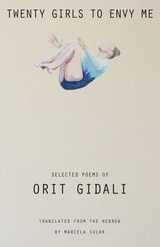
Twenty Girls to Envy Me
Selected Poems of Orit GidaliBy Orit Gidali. Edited and translated by Marcela Sulak
University of Texas Press, 2016
This English-Hebrew book features three dozen poems by the extraordinary Israeli writer Orit Gidali (b. 1974), a unique voice among her contemporaries. Gidali’s work appears to focus on the domestic, but for her, the domestic sphere is the stage on which the drama of the geopolitical is reworked on an individual scale. The domestic is always inhabited by the Other, who in these deeply personal poems appears in various guises: a Palestinian mother, biblical figures, the poet’s own deceased mother, and her husband’s first wife. Gidali creates a space in her world to imaginatively reconfigure the current political impasses of the region through a focus on relationship and openness.
Gidali’s poems, beautifully captured in English by Marcela Sulak, present a world beset by danger and uncertainty, yet they nonetheless cry out for community, connection, cooperation, and coexistence.
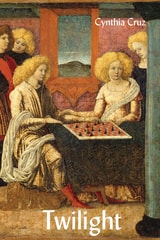
Twilight
Cynthia Cruz
Four Way Books, 2026
Twilight is the intermediary state of becoming, the suspension between, when one is no longer who one was and not yet who they will be. At the end of psychoanalysis, after one has worked through the symbolic investitures one has been relegated to, one is reduced to such a state. In this state of momentary suspension, one is, in a sense, nothing.
Twilight also names a historical moment, when one world is ending but the next has yet to appear. That we are existing in the suspension between the the end of the world as we have known it and the void of what has yet to come is a commonly repeated truth. Hegel describes twilight as “a flash” that in “a single stroke brings to view the structure of the new world,” suggesting that novelty arises out of darkness and obscurity. We are living, in other words, in a state of twilight.
Cruz’s tenth poetry collection takes the concept of twilight and presents, through a series of elliptical poems, a working through of the term. The speakers in these poems exist within this wavering. As she writes in one of several poems titled “Twilight,” “Twilight, its world between worlds / its miraculous suspension. / I belong to the school of Freud’s / hypothetical boarding school girls. / We wait and we wait / for the world to begin.”
Twilight of a Golden Age
Selected Poems of Abraham Ibn EzraWeinberger, Leon J.
University of Alabama Press, 1997
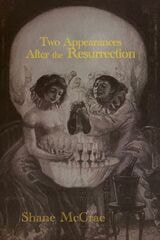
Two Appearances After the Resurrection
Shane McCrae
Omnidawn, 2025
This is a book about perceiving and being perceived. The various subjects of these poems are viewed by an artist, a devil, a soul floating out of a body it had inhabited, a god fed up with her husband’s infidelities, and a father whose young child has COVID-19. The poems of Two Appearances After the Resurrection are haunted by the question of what one ought to do with their perceivability.
After a decade of publishing poems almost exclusively utilizing no punctuation aside from the slash, Shane McCrae began including semi-regular punctuation in his 2023 book, The Many Hundreds of the Scent. He continues that project in Two Appearances After the Resurrection. Here, he further explores the consequences—especially the rhythmical consequences—of the change. Throughout these poems, McCrae perceives and implicitly considers his own shifting approaches to writing.
Two Menus
Rachel DeWoskin
University of Chicago Press, 2020
The poems in Two Menus offer insights into the layers of what it means to be human, to reconcile living as multiple selves. DeWoskin dives into the uncertain spaces, showing us how a life lived between walls is murky, strange, and immensely human. These poems ask us how to communicate across the boundaries that threaten to divide us, to measure and close the distance between who we are, were, and want to be.
Two Minds of a Western Poet
David Mason
University of Michigan Press, 2011
Praise for David Mason
“. . . richly evocative and rare . . .”
—Publishers Weekly
“David Mason has succeeded in restoring to poetry some of the territory lost over recent centuries to prose fiction.”
—Paul Lake, First Things
In this new collection of essays, award-winning poet David Mason further broadens his exploration of Western and frontier themes. Beginning with the subject of poetry in and about the American West, he then widens his canvas to examine poets as diverse as James Wright, Anthony Hecht, and B. H. Fairchild, as well as taking up the idea of “the West” in global terms.
The title essay builds on a product of Mason’s upbringing in the American West—his “two minds” about the life of poetry, one aware that he needs and loves the art, and one equally aware that he understands a world outside cultural definitions. These two minds coexist throughout each lively, evocative essay, while Mason delves into family history and his efforts to connect himself to place, narrative poets of the American West, and farther-flung topics such as literary movements, post-colonial studies, and favorite Greek writers. In each of these meditations, Mason pursues a personal voice, connecting what he reads to a life outside books and making poetry accessible to the common reader.

Two Signatures
Sara Ellen Fowler
University of Utah Press, 2024
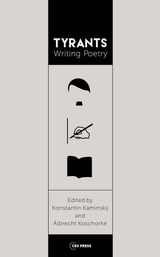
Tyrants Writing Poetry
Albrecht Koschorke
Central European University Press, 2018
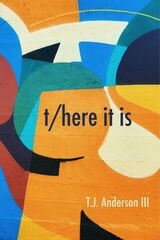
t/here it is
T.J. Anderson III
Omnidawn, 2022
The poems in t/here it is take multiple forms as each section reflects on variations of experience, engaging with the simultaneity of historic and present time while yearning for a future that is beyond what we can envision. In Section I, the poet grapples with ancestral legacy and connection to the natural world. Section II deals with the way one traverses the urban landscape and with various strategies of survival, and Section III recalls the observations and experiences of youth. Through nine linked poems, Section IV complicates the idea of witness under a capitalistic system bent on exploitation and devaluing the sacred human experience. Section V speaks to the lost opportunity of making profound human connections during the race to acquire more material goods. In Section VI, the poems take on the domestic and institutional places that govern our lives. A single poem forms Section VII, mapping the intersection between jazz and emotion. With Section VIII, Anderson pays homage to jazz greats and reflects on the ways that listening can carry one back to moments of growth and lamentation. The two poems that close out the book in Section IX bring the reader to a place of vulnerability, expressing the desire to be able to discern the multiple avenues of one’s journey with awareness.
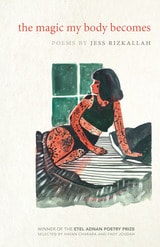
the magic my body becomes
Poems byJess Rizkallah
University of Arkansas Press, 2017
Winner, 2017 Etel Adnan Poetry Prize
In the magic my body becomes, Jess Rizkallah seeks a vernacular for the inescapable middle ground of being Arab American—a space that she finds, at times, to be too Arab for America and too American for her Lebanese elders.
These poems freely assert gender, sexuality, and religious beliefs while at the same time respecting a generational divide: the younger’s privilege gained by the sacrifice of the older, the impossibility of separating what is wholly hers from what is hers secondhand.
In exploring family history, civil war, trauma, and Lebanon itself, Rizkallah draws from the spirits of canonical Arab and Middle Eastern poets. As a result of her conjuring, the reader feels these spirits begin to exorcise the grief of those who are still alive. Throughout, there is the body, a reclamation and pushback against cultures that simultaneously sexualize and shame women. And there is a softness as inherent as rage, a resisting of stereotypes that too often speak louder than the complexities of a resilient cultural identity.
The magic my body becomes is an exciting new book from an exciting young poet, a love letter to a people as well as a fist in the air.
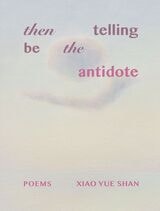
then telling be the antidote
Xiao Yue Shan
Tupelo Press, 2024
By illuminating what has been left untold, these writings present the vivid landscape of a mind layering itself over the world, thinking and speaking its way through a myriad of places, objects, and visions. From rooms overlooking Tokyo rivers to Shanghai streets in the thrall of nighttime, Shan throws light on a nation’s quieted crevices, on the distances between the carnal and the eternal, and most pivotally, on the ability of language to elucidate fact with imagination.
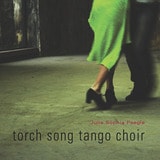
torch song tango choir
Julie Sophia Paegle
University of Arizona Press, 2010
The poems in the first section, torch songs, hover near a heartbreaking lyricism as they reckon with political histories, landscapes, and loss. As she writes in this section, there is truly “nothing in this life like being blind in Granada.” The sonnet crown that comprises the next section, tango liso, plots a history of cultural inheritance and renewal, weaving back and forth in time and spanning Argentina, Spain, and the United States. Here the reader encounters Eva Perón alongside Katharine of Aragon and Billie Holiday. The final section, choir, commemorates sites of pilgrimage in Latvia, West Germany, and Spain, among other places. In this extended contemplation of cathedral spaces, Paegle interrogates the boundary between the sacred and the secular, silence and song. What emerges from this diverse collection is a sensual and allusive space where music and memory coincide.