Results by title
22279 books match the query 'Social Science' and 4007 start with t
The Conscript
A Novel of Libya’s Anticolonial WarGebreyesus Hailu
Ohio University Press, 2013
The Consequences of Counterterrorism
Martha Crenshaw
Russell Sage Foundation, 2010
The Constitution of Society
Edward Shils
University of Chicago Press, 1982
Professor Shils has attempted to develop a theory that has a place for more than those parts of society that are generated from the biological nature of human beings and those parts that are engendered by the desires of individuals, acting for themselves or for groups and categories of individuals, to maintain and increase their power over other human beings and to secure material goods and services for themselves. He has argued that there are constituents of society in which human beings seek and cultivate connections with objects that transcend those needed to satisfy biological necessity and the desire for material objects and power over others. This third stratum of social existence, he concludes, cannot be reduced to the other two and cannot be disregarded in any serious attempt to understand the function of any society. Thus Edward Shils, without disregarding its many valuable achievements, has nevertheless parted ways with much of modern sociology.
For this collection of papers the author has written an introductory intellectual autobiography that places each essay in the setting of the development of his thought and that connects it with his other writings.
The Constitutional Underclass
Gays, Lesbians, and the Failure of Class-Based Equal ProtectionEvan Gerstmann
University of Chicago Press, 1999
The Court divides people into legal classes that receive varying levels of protection; gays and lesbians and other groups, such as the elderly and the poor, receive the least. Gerstmann reveals how these standards are used to favor certain groups over others, and also how Amendment 2 advocates used the Court's doctrine to convince voters that gays and lesbians were seeking "special rights" in Colorado.
Concluding with a call for wholesale reform of equal-protection jurisprudence, this book is essential reading for anyone interested in fair, coherent, and truly equal protection under the law.
The Construction of Homosexuality
David F. Greenberg
University of Chicago Press, 1990
The Construction of Minorities
Cases for Comparison Across Time and Around the WorldAndre Burguiere and Raymond Grew, Editors
University of Michigan Press, 2001

The Contemporary Arab Reader on Political Islam
Edited by Ibrahim M. Abu-Rabi' and Tere Vaden
Pluto Press, 2010
The Contemporary Arab Reader on Political Islam brings together the writings of highly influential figures in the field of Islamism in the contemporary Arab world, many of whose writings have never been available before in English.
Addressing the key issues such as human rights, civil society, secularism, globalisation and ummah, and the impact of the West on the modern Arab world, this is the perfect starting point for students and academics looking to understand 'Political Islam' in contemporary Arab and Muslim societies.
The contributors include such important Islamist thinkers and activists as Abdullah Azzam, central to the spread of Islamism in Afghanistan, Sayyid Muhammad Hussain Fadlallah, a major Shiite figure in contemporary Lebanon and Ahmad Bin Yousuf, a political advisor to Akram Haniyya in Gaza.
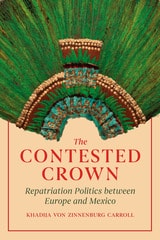
The Contested Crown
Repatriation Politics between Europe and MexicoKhadija von Zinnenburg Carroll
University of Chicago Press, 2022
In The Contested Crown, Khadija von Zinnenburg Carroll meditates on the case of a spectacular feather headdress believed to have belonged to Montezuma, emperor of the Aztecs. This crown has long been the center of political and cultural power struggles, and it is one of the most contested museum claims between Europe and the Americas. Taken to Europe during the conquest of Mexico, it was placed at Ambras Castle, the Habsburg residence of the author’s ancestors, and is now in Vienna’s Welt Museum. Mexico has long requested to have it back, but the Welt Museum uses science to insist it is too fragile to travel.
Both the biography of a cultural object and a history of collecting and colonizing, this book offers an artist’s perspective on the creative potentials of repatriation. Carroll compares Holocaust and colonial ethical claims, and she considers relationships between indigenous people, international law and the museums that amass global treasures, the significance of copies, and how conservation science shapes collections. Illustrated with diagrams and rare archival material, this book brings together global history, European history, and material culture around this fascinating object and the debates about repatriation.
The Context of Ancient Drama
Eric Csapo and William J. Slater
University of Michigan Press, 1995
The Continent of Everything and Practically Nothing
Sami Tchak
Seagull Books, 2026
A Togolese novel that delivers a rich, intimate portrait of a scholar whose life is inextricably bound to Africa.
For the French ethnologist Maurice Boyer, Africa isn't just a place; it’s a mirage, an enigma, a mirror reflecting his desires and doubts. The fieldwork he undertook in Tèdi, Togo, where he lived for years among the Tem people and tried to understand their customs and rituals, has left him with questions that have lingered: Who was a friend and who was a foe? Which stories were true and which were illusions? As decades pass and the roles of Aurélie, his wife, and Safi, his former student, begin to shift, Boyer finds himself wrestling not only with his own choices but with the legacy of knowledge itself.
Through the lens of this profound postcolonial quest, Sami Tchak explores Africa’s rich, complex reality through this intimate story of a scholar reconsidering his own understanding of culture, ethnology, and history. The Continent of Everything and Practically Nothing asks whether assembling more data can truly capture the complexity of a continent, and explores how academic ambition, history, and emotion shape how we understand the world, and how we live in it.
The Continuing Storm
Learning from KatrinaKai Erikson and Lori Peek
University of Texas Press, 2022
2023 Finalist, Colorado Book Awards, History/Biography Category
This final volume in the award-winning Katrina Bookshelf series reflects upon the lessons of Hurricane Katrina and what they reveal about our society and current cultural climate.
More than fifteen years later, Hurricane Katrina maintains a strong grip on the American imagination. The reason is not simply that Katrina was an event of enormous scale, although it certainly was by any measure one of the most damaging storms in American history. But, quite apart from its lethality and destructiveness, Katrina retains a place in living memory because it is one of the most telling disasters in our recent national experience, revealing important truths about our society and ourselves.
The final volume in the award-winning Katrina Bookshelf series The Continuing Storm reflects upon what we have learned about Katrina and about America. Kai Erikson and Lori Peek expand our view of the disaster by assessing its ongoing impact on individual lives and across the wide-ranging geographies where displaced New Orleanians landed after the storm. Such an expanded view, the authors argue, is critical for understanding the human costs of catastrophe across time and space. Concluding with a broader examination of disasters in the years since Katrina—including COVID-19—The Continuing Storm is a sobering meditation on the duration of a catastrophe that continues to exact steep costs in human suffering.
The Continuous Path
Pueblo Movement and the Archaeology of BecomingEdited by Samuel Duwe and Robert W. Preucel
University of Arizona Press, 2019
The Continuous Path challenges archaeologists to take Pueblo notions of movement seriously by privileging Pueblo concepts of being and becoming in the interpretation of anthropological data. In this volume, archaeologists, anthropologists, and Native community members weave multiple perspectives together to write histories of particular Pueblo peoples. Within these histories are stories of the movements of people, materials, and ideas, as well as the interconnectedness of all as the Pueblo people find, leave, and return to their middle places. What results is an emphasis on historical continuities and the understanding that the same concepts of movement that guided the actions of Pueblo people in the past continue to do so into the present and the future.
Movement is a never-ending and directed journey toward an ideal existence and a continuous path of becoming. This path began as the Pueblo people emerged from the underworld and sought their middle places, and it continues today at multiple levels, integrating the people, the village, and the individual.
The Contradictions of Neoliberal Agri-Food
Corporations, Resistance, and Disasters in JapanKae Sekine
West Virginia University Press, 2016
Sekine and Bonanno stress the incompatibility of the requirements of neoliberalism with the structural and cultural conditions of Japanese agri-food. Local farmers’ and fishermen’s emphasis on community collective management of natural resources, they argue, clashes with neoliberalism’s focus on individualism and competitiveness. The authors conclude by pointing out the resulting fundamental contradiction: The lack of recognition of this incompatibility allows the continuous implementation of market solutions to problems that originate in these very market mechanisms.

The Conundrum of Class
Public Discourse on the Social Order in AmericaMartin J. Burke
University of Chicago Press, 1995
Surveying American political, social, and intellectual life from the late 17th to the end of the 19th century, Burke examines in detail the contested discourse about equality—the way Americans thought and wrote about class, class relations, and their meaning in society.
Burke explores a remarkable range of thought to establish the boundaries of class and the language used to describe it in the works of leading political figures, social reformers, and moral philosophers. He traces a shift from class as a legal category of ranks and orders to socio-economic divisions based on occupations and income. Throughout the century, he finds no permanent consensus about the meaning of class in America and instead describes a culture of conflicting ideas and opinions.
The Cooking of History
How Not to Study Afro-Cuban ReligionStephan Palmié
University of Chicago Press, 2013
The Copy Generic
How the Nonspecific Makes Our Social WorldsScott MacLochlainn
University of Chicago Press, 2022
From off-brand products to elevator music, the “generic” is discarded as the copy, the knockoff, and the old. In The Copy Generic, anthropologist Scott MacLochlainn insists that more than the waste from the culture machine, the generic is a universal social tool, allowing us to move through the world with necessary blueprints, templates, and frames of reference. It is the baseline and background, a category that orders and values different types of specificity yet remains inherently nonspecific in itself. Across arenas as diverse as city planning, social media, ethnonationalism, and religion, the generic points to spaces in which knowledge is both overproduced and desperately lacking. Moving through ethnographic and historical settings in the Philippines, Europe, and the United States, MacLochlainn reveals how the concept of the generic is crucial to understanding how things repeat, circulate, and are classified in the world.
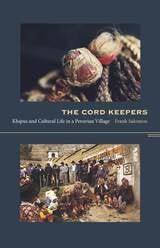
The Cord Keepers
Khipus and Cultural Life in a Peruvian VillageFrank Salomon
Duke University Press, 2004
In 1994, Salomon witnessed the use of khipus as civic regalia on the heights of Tupicocha, in Peru’s central Huarochirí region. By observing the rich ritual surrounding them, studying the village’s written records from past centuries, and analyzing the khipus themselves, Salomon opens a fresh chapter in the quest for khipu decipherment. He draws on a decade’s field research, early colonial records, and radiocarbon and fiber analysis. Challenging the prevailing idea that the use of khipus ended under early Spanish colonial rule, Salomon reveals that these beautiful objects served, apparently as late as the early twentieth century, to document households’ contribution to their kin groups and these kin groups’ contribution to their village. The Cord Keepers is a major contribution to Andean history and, more broadly, to understandings of writing and literacy.
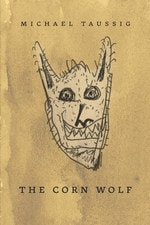
The Corn Wolf
Michael Taussig
University of Chicago Press, 2015
The leading figure of these projects is the corn wolf, whom Wittgenstein used in his fierce polemic on Frazer’s Golden Bough. For just as the corn wolf slips through the magic of language in fields of danger and disaster, so we are emboldened to take on the widespread culture of academic—or what he deems “agribusiness”—writing, which strips ethnography from its capacity to surprise and connect with other worlds, whether peasant farmers in Colombia, Palestinians in Israel, protestors in Zuccotti Park, or eccentric yet fundamental aspects of our condition such as animism, humming, or the acceleration of time.
A glance at the chapter titles—such as “The Stories Things Tell” or “Iconoclasm Dictionary”—along with his zany drawings, testifies to the resonant sensibility of these works, which lope like the corn wolf through the boundaries of writing and understanding.
The Corporate Social Audit
Raymond A. Bauer
Russell Sage Foundation, 1972
The Cosmic Zoom
Scale, Knowledge, and MediationZachary Horton
University of Chicago Press, 2021
Horton uses the cosmic zoom as a starting point to develop a cross-disciplinary theory of scale as mediated difference. He considers the origins of our notions of scale, how scalar mediation functions differently in analog and digital modes, and how cosmic zoom media has influenced scientific and popular views of the world. Analyzing literature, film, digital media, and database history, Horton establishes a much-needed framework for thinking about scale across multiple domains and disciplines.
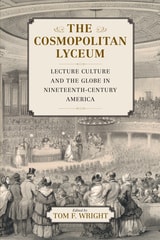
The Cosmopolitan Lyceum
Lecture Culture and the Globe in Nineteenth-Century AmericaTom F. Wright
University of Massachusetts Press, 2013
From the 1830s to the 1900s, a circuit of lecture halls known as the “lyceum movement” flourished across the United States. At its peak, up to a million people a week regularly attended talks in local venues, captivated by the words of visiting orators who spoke on an extensive range of topics. The movement was a major intellectual and cultural force of this nation-building period, forming the creative environment of writers and public figures such as Frederic Douglass, Ralph Waldo Emerson, Anna Dickinson, and Mark Twain.
The phenomenon of the lyceum has commonly been characterized as inward looking and nationalistic. Yet as this collection of essays reveals, nineteenth-century audiences were fascinated by information from around the globe, and lecturers frequently spoke to their fellow Americans of their connection to the world beyond the nation and helped them understand “exotic” ways of life. Never simple in its engagement with cosmopolitan ideas, the lyceum provided a powerful public encounter with international currents and crosscurrents, foreshadowing the problems and paradoxes that continue to resonate in our globalized world.
This book offers a major reassessment of this important cultural phenomenon, bringing together diverse scholars from history, rhetoric, and literary studies. The twelve essays use a range of approaches, cover a wide chronological timespan, and discuss a variety of performers both famous and obscure. In addition to the volume editor, contributors include Robert Arbour, Thomas Augst, Susan Branson, Virginia Garnett, Peter Gibian, Sara Lampert, Angela Ray, Evan Roberts, Paul Stob, Mary Zboray, and Ronald Zboray.
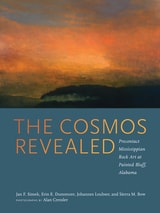
The Cosmos Revealed
Precontact Mississippian Rock Art at Painted Bluff, AlabamaBy Jan F. Simek, Erin E. Dunsmore, Johannes Loubser, and Sierra M. Bow
University of Alabama Press, 2021
The definitive rock art book on Painted Bluff, Alabama and the visual language of a Native American cosmos.
Boasting more than 130 paintings and engravings, Painted Bluff is perhaps the most elaborate prehistoric pictograph site east of the Mississippi River. Positioned at several levels on a dramatic sandstone cliff along the Tennessee River in northern Alabama, the spectacular paintings and engravings depict mythical creatures, dancing humans, and mystical portals. The Cosmos Revealed: Precontact Mississippian Rock Art at Painted Bluff, Alabama is the first complete documentation of one of the most important archaeological sites in eastern North America. Through art, the site materializes a model or “cosmogram” of the Mississippian Native American view of the universe, offering connections between the visible and invisible worlds for Native spiritual leaders and other visitors.
Discovered by Euro-Americans in the early 1800s, the site became known as “Painted Bluff” because of its pictographs, but inexplicably it has only recently been subjected to the intensive archaeological study it deserves. Under the auspices of the Tennessee Valley Authority (TVA), the authors of this volume have documented and assessed the site since 2005, and efforts have been made to reverse some of the vandalism that has occurred over many decades and to stabilize natural degradation of the cliff and its artwork.
Including more than one hundred remarkable prehistoric paintings on the cliff face that have been recorded, mapped, and photographed, this book synthesizes the research done on Painted Bluff to date and documents the entire site. Richly illustrated chapters cover the historical background, geology and archaeology, documentation methods, types of rock art, stratigraphy, paint recipes, TVA management, graffiti removal, and a summary that broadly synthesizes the meaning, timeframe, artistry, organization, conceptual boundaries, and the cosmos revealed. This groundbreaking study features 113 color photographs and a complete catalog of the pictographs and petroglyphs at the site.
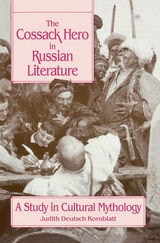
The Cossack Hero in Russian Literature
A Study in Cultural MythologyJudith Deutsch Kornblatt
University of Wisconsin Press, 1992
This is the first book to study the development of the Cossack hero and to identify him as part of Russian cultural mythology. Kornblatt explores the power of the myth as a literary image, providing new and challenging readings of Pushkin, Gogol, Tolstoi, and a host of other writers.
The Cost of Being a Girl
Working Teens and the Origins of the Gender Wage GapYasemin Besen-Cassino
Temple University Press, 2017
The gender wage gap is one of the most persistent problems of labor markets and women’s lives.
Most approaches to explaining the gap focus on adult employment despite the fact that many Americans begin working well before their education is completed. In her critical and compelling new book, The Cost of Being a Girl, Yasemin Besen-Cassino examines the origins of the gender wage gap by looking at the teenage labor force, where comparisons between boys and girls ought to show no difference, but do.
Besen-Cassino’s findings are disturbing. Because of discrimination in the market, most teenage girls who start part-time work as babysitters and in other freelance jobs fail to make the same wages as teenage boys who move into employee-type jobs. The “cost” of being a girl is also psychological; when teenage girls work retail jobs in the apparel industry, they have lower wages and body image issues in the long run.
Through in-depth interviews and surveys with workers and employees, The Cost of Being a Girl puts this alarming social problem—which extends to race and class inequality—in to bold relief. Besen-Cassino emphasizes that early inequalities in the workplace ultimately translate into greater inequalities in the overall labor force.
The Cost of Inclusion
How Student Conformity Leads to Inequality on College CampusesBlake R. Silver
University of Chicago Press, 2020
Blake R. Silver spent a year immersed in student life at a large public university. He trained with the Cardio Club, hung out with the Learning Community, and hosted service events with the Volunteer Collective. Through these day-to-day interactions, he witnessed how students sought belonging and built their social worlds on campus. Over time, Silver realized that these students only achieved inclusion at significant cost. To fit in among new peers, they clung to or were pushed into raced and gendered cultural assumptions about behavior, becoming “the cool guy,” “the nice girl,” “the funny one,” “the leader,” “the intellectual,” or “the mom of the group.” Instead of developing dynamic identities, they crafted and adhered to a cookie-cutter self, one that was rigid and two-dimensional. Silver found that these students were ill-prepared for the challenges of a diverse college campus, and that they had little guidance from their university on how to navigate the trials of social engagement or the pressures to conform. While colleges are focused on increasing the diversity of their enrolled student body, Silver’s findings show that they need to take a hard look at how they are failing to support inclusion once students arrive on campus.
The Cost of Inclusion
How Student Conformity Leads to Inequality on College CampusesBlake R. Silver
University of Chicago Press, 2020
Young people are told that college is a place where they will “find themselves” by engaging with diversity and making friendships that will last a lifetime. This vision of an inclusive, diverse social experience is a fundamental part of the image colleges sell potential students. But what really happens when students arrive on campus and enter this new social world? The Cost of Inclusion delves into this rich moment to explore the ways students seek out a sense of belonging and the sacrifices they make to fit in.
Blake R. Silver spent a year immersed in student life at a large public university. He trained with the Cardio Club, hung out with the Learning Community, and hosted service events with the Volunteer Collective. Through these day-to-day interactions, he witnessed how students sought belonging and built their social worlds on campus. Over time, Silver realized that these students only achieved inclusion at significant cost. To fit in among new peers, they clung to or were pushed into raced and gendered cultural assumptions about behavior, becoming “the cool guy,” “the nice girl,” “the funny one,” “the leader,” “the intellectual,” or “the mom of the group.” Instead of developing dynamic identities, they crafted and adhered to a cookie-cutter self, one that was rigid and two-dimensional. Silver found that these students were ill-prepared for the challenges of a diverse college campus, and that they had little guidance from their university on how to navigate the trials of social engagement or the pressures to conform. While colleges are focused on increasing the diversity of their enrolled student body, Silver’s findings show that they need to take a hard look at how they are failing to support inclusion once students arrive on campus.
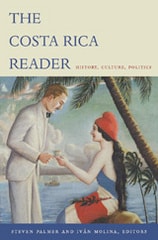
The Costa Rica Reader
History, Culture, PoliticsSteven Palmer and Iván Molina, editors
Duke University Press, 2004
This essential introduction to Costa Rica includes more than fifty texts related to the country’s history, culture, politics, and natural environment. Most of these newspaper accounts, histories, petitions, memoirs, poems, and essays are written by Costa Ricans. Many appear here in English for the first time. The authors are men and women, young and old, scholars, farmers, workers, and activists. The Costa Rica Reader presents a panoply of voices: eloquent working-class raconteurs from San José’s poorest barrios, English-speaking Afro-Antilleans of the Limón province, Nicaraguan immigrants, factory workers, dissident members of the intelligentsia, and indigenous people struggling to preserve their culture. With more than forty images, the collection showcases sculptures, photographs, maps, cartoons, and fliers. From the time before the arrival of the Spanish, through the rise of the coffee plantations and the Civil War of 1948, up to participation in today’s globalized world, Costa Rica’s remarkable history comes alive. The Costa Rica Reader is a necessary resource for scholars, students, and travelers alike.
The Costs of the Gig Economy
Musical Entrepreneurs and the Cultural Politics of Inequality in Northeastern BrazilFalina Enriquez
University of Illinois Press, 2022
Drawing on years of fieldwork, Enriquez shows how forcing artists to adopt “neutral” market solutions reinforces, and generates, overlapping racial and class-based inequalities. Lacking the social and financial resources of their middle-class peers, working-class musicians find it difficult to uphold institutional goals of connecting the city’s cultural roots to global markets and consumers. Enriquez also links the artists’ situation to that of cultural and creative workers around the world. As she shows, musical sponsorship in Recife and the contemporary gig economy elsewhere employ processes that, far from being neutral, uphold governmental and corporate ideologies that produce social stratification.
Rich and vibrant, The Costs of the Gig Economy offers a rare English-language portrait of the changing musical culture in Recife.
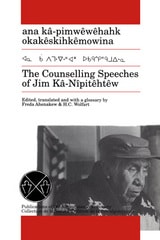
The Counselling Speeches of Jim Ka-Nipitehtew
Freda Ahenakew
University of Manitoba Press, 1998
The Counterfeit Coin
Videogames and Fantasies of EmpowermentChristopher Goetz
Rutgers University Press, 2023
The Courage to Connect
Sexuality, Citizenship, and Community in ProvincetownSandra L. Faiman-Silva
University of Illinois Press, 2003
Based on over six years of fieldwork, Sandra L. Faiman-Silva's The Courage to Connect traces the transformation of the Cape Cod community of Provincetown from its nineteenth-century origins as a fishing town where Portuguese immigrants settled to its present status as a welcoming, sexually diverse tourist enclave. Faiman-Silva examines the community’s history and economy as well as how gay and straight cultures intersect in areas such as public education, local government, and law enforcement. Using queer and critical culture theory to deconstruct day-to-day local encounters, Faiman-Silva describes the causes of social conflicts and how these conflicts can be resolved. Capturing the pathos and joy of a community that has struggled to accommodate radical social changes, The Courage to Connect yields understanding of the ways in which communities can construct themselves to overcome differences.
The Courage to Welcome
Between principles and pragmatism in international affairsCatherine Ashton and Filippo Grandi
Haus Publishing, 2026
A timeless call amid the challenging nature of public service to find the familiar in the foreign.
What does it mean to lead with compassion in a world riven by fear, at a time when the responses to forced displacement hold the power to reshape communities? How can institutions and individuals sustain solidarity amid rising division?
This moving reflection of Filippo Grandi’s ten years as United Nations High Commissioner for Refugees and four decades spent working in humanitarian crises across the world addresses the growing complexity of forced displacement, its repercussions for international relations, and the challenges it poses for governments. Grandi calls for greater cooperation between nations and considers measures—along displacement routes and in host countries—which would provide lifesaving assistance to refugees as well as preserve international cooperation and goodwill. He suggests a universal responsibility not to exacerbate division but to work diligently on the space between pragmatism and principle.
Taking up this challenge, Catherine Ashton’s response to Grandi draws on her own distinguished leadership during some of the most important moments that have shaped contemporary diplomacy and suggests how enduring principles can be retained within the realities of public life.
The Course of Gay and Lesbian Lives
Social and Psychoanalytic PerspectivesBertram J. Cohler and Robert M. Galatzer-Levy
University of Chicago Press, 2000
Drawing on their own work with gays, lesbians, and bisexuals as well as other pertinent studies, psychoanalysts Bertram J. Cohler and Robert Galatzer-Levy have written a groundbreaking work that examines how psychological development and clinical intervention as well as social and historical change across generations contribute to how we think about sexuality. The authors argue that there is little support for assuming that homosexuality has a biological basis. Recognizing the many pathways that lead to same-gender sexual orientation, the authors conclude that the cause is much less important than understanding the meaning of being homosexual. They consider the destructive nature of an intolerant society that fosters so-called conversion psychotherapy and stress the importance of helping to rebuild a sense of coherence and personal integrity among homosexuals.
The Courteous Power
Japan and Southeast Asia in the Indo-Pacific EraJohn D. Ciorciari and Kiyoteru Tsutsui, editors
University of Michigan Press, 2021
The Courteous Power seeks to provide a nuanced view of the current relationship between Japan and Southeast Asia. Much of the current scholarship on East–Southeast Asian engagement has focused on the multidimensional chess game playing out between China and Japan, as the dominant post-imperialist powers. Alternatively, there has been renewed attention on ASEAN and other Southeast Asian–centered initiatives, explicitly minimizing the influence of East Asia in the region. Given the urgency of understanding the careful balance in the Indo-Pacific region, this volume brings together scholars to examine the history and current engagement from a variety of perspectives, ranging from economic and political, to the cultural and technological, while also focusing more clearly on the specific relationship between the region and Japan.

The Courtesan's Memory, Voice, and Late Ming Drama
Peng Xu
University of Michigan Press, 2025
This study profoundly remaps the textbook narratives of gender bias, challenges modern prejudices prevalent in the literary history of Chinese drama, and reveals how theatrical conditions and writing styles shifted to accommodate courtesan performances. Utilizing a wide range of sources such as scripts, city guides, biographies, diaries, letters, wood-block illustrations, and paintings, this study distinguishes itself from earlier studies of Chinese courtesans by not thematizing courtesans for their allegorical values, but rather pinpointing their agency in shaping the features of Chinese theater and recognizing courtesans as a source of creativity and development in the medium. Xu’s focus on courtesan performance culture allows for fresh readings of canonical Chinese plays, opening up new ways of understanding the history of Chinese drama written by women, thus deviating from standard historiography based solely on the writings of men.
The Courthouse Square in Texas
By Robert E. Veselka
University of Texas Press, 2000
With its dignified courthouse set among shade trees and lawns dotted with monuments to prominent citizens and fallen veterans, the courthouse square remains the civic center in a majority of the county seats of Texas. Yet the squares themselves vary in form and layout, reflecting the different town-planning traditions that settlers brought from Europe, Mexico, and the United States. In fact, one way to trace settlement patterns and ethnic dispersion in Texas is by mapping the different types of courthouse squares.
This book offers the first complete inventory of Texas courthouse squares, drawn from extensive archival research and site visits to 139 of the 254 county seats. Robert Veselka classifies every existing plan by type and origin, including patterns and variants not previously identified. He also explores the social and symbolic functions of these plans as he discusses the historical and modern uses of the squares. He draws interesting new conclusions about why the courthouse square remains the hub of commercial and civic activity in the smaller county seats, when it has lost its prominence in others.
The Cow in the Elevator
An Anthropology of WonderTulasi Srinivas
Duke University Press, 2018

The Cowboy Hero & Its Audience
Popular Culture As Market Derived ArtAlf H. Walle
University of Wisconsin Press, 2000
Using the history of the cowboy story from 1820 to 1970 as an extended example, Alf H. Walle combines popular culture scholarship with marketing theory to provide a hybrid analysis. Wall examines major authors and genres of Western American literature and film; he also explores why certain respected authors were unable to significantly impact the cowboy story even though their innovations were embraced by later generations. Finally Wall provides a hybrid analysis combining business and popular culture theory in an overarching analysis.
The Crable Site, Fulton County, Illinois
A Late Prehistoric Site in the Central Illinois ValleyHale Gilliam Smith
University of Michigan Press, 1951
The Cramoisy Queen
A Life of Caresse CrosbyLinda Hamalian
Southern Illinois University Press, 2009
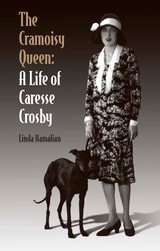
Caresse Crosby rejected the culturally prescribed roles for women of her era and background in search of an independent, creative, and socially responsible life. Poet, memoirist, advocate of women’s rights and the peace movement, Crosby published and promoted modern writers and artists such as Hart Crane, Dorothy Parker, Salvador Dalí, and Romare Bearden. She also earned a place in the world of fashion by patenting one of the earliest versions of the brassiere.
Behind her public success was a chaotic life: three marriages, two divorces, the suicide of her husband Harry Crosby, strained relationships with her children, and legal confrontations over efforts to establish a center for world peace. As the first biographer to consider both the literary and social contexts of Crosby’s life, Linda Hamalian details Crosby’s professional accomplishments and her personal struggles. The Cramoisy Queen: A Life of Caresse Crosby also measures the impact of small presses on modernist literature and draws connections between key writers and artists of the era.
In addition to securing a place for Crosby in modern literary and cultural history, The Cramoisy Queen: A Life of Caresse Crosby contributes to the field of textual studies, specifically the complexities of integrating autobiography and correspondence into biography. Enhanced by thirty-two illustrations, the volume appeals to a wide range of readers, including literary critics, cultural historians, biographers, and gender studies specialists.

The Creation of Dangerous Violent Criminals
Lonnie H. Athens
University of Illinois Press, 1992
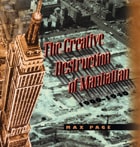
The Creative Destruction of Manhattan, 1900-1940
Max Page
University of Chicago Press, 1999
"It'll be a great place if they ever finish it," O. Henry wrote about New York City. This laconic remark captures the relentlessly transitory character of New York, and it points toward Max Page's synthetic perspective. Against the prevailing motif of a naturally expanding metropolis, Page argues that the early-twentieth-century city was dominated by the politics of destruction and rebuilding that became the hallmark of modern urbanism.
The oxymoron "creative destruction" suggests the tensions that are at the heart of urban life: between stability and change, between particular places and undifferentiated spaces, between market forces and planning controls, and between the "natural" and "unnatural" in city growth. Page investigates these cultural counterweights through case studies of Manhattan's development, with depictions ranging from private real estate development along Fifth Avenue to Jacob Riis's slum clearance efforts on the Lower East Side, from the elimination of street trees to the efforts to save City Hall from demolition.
In these examples some New Yorkers celebrate planning by destruction or marvel at the domestication of the natural environment, while others decry the devastation of their homes and lament the passing of the city's architectural heritage. A central question in each case is the role of the past in the shaping of collective memory—which buildings are preserved? which trees are cut down? which fragments are enshrined in museums? Contrary to the popular sense of New York as an ahistorical city, the past—as recalled by powerful citizens—was, in fact, at the heart of defining how the city would be built.
Beautifully illustrated and written in clear, engaging prose, The Creative Destruction of Manhattan offers a new way of viewing the development of the American city.
"An excellent, multifaceted analysis of the process of urban development-not the inevitability of development but the choices individuals, organizations, and developers made that transformed Manhattan. The politics of place was, Max Page convincingly argues, an ongoing battle to define and thereby control the evolving shape of the city."—David Schuyler, author of Apostle of Taste: Andrew Jackson Downing 1815-1852
"Max Page transcends the usual dichotomy between those who glorify destruction for the sake of change and those who would avoid both at all cost. The sizeable borderland between architecture and preservation reveals new dimensions about science and history, innovation and memory, the cities that have been, and those yet to come."—Gwendolyn Wright, author of The Politics of Design in French Colonial Urbanism
"A sober, humane explanation of how and why New York City became a place of continuous rebuilding. . . . For real or armchair New Yorkers, the whole package is a treat."—Kirkus Reviews
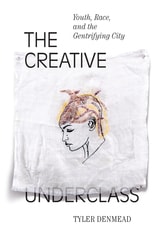
The Creative Underclass
Youth, Race, and the Gentrifying CityTyler Denmead
Duke University Press, 2019
The Creativity of Action
Hans Joas
University of Chicago Press, 1996
Joas argues for adding a third model of action to the two predominant models of rational and normative action—one that emphasizes the creative character of human action. This model encompasses the other two, allowing for a more comprehensive theory of action. Joas elaborates some implications of his model for theories of social movements and social change and for the status of action theory in sociology in the face of competition from theories advanced by Luhmann and Habermas.
The problem of action is of crucial importance in both sociology and philosophy, and this book—already widely debated in Germany—will add fresh impetus to the lively discussions current in the English-speaking world.
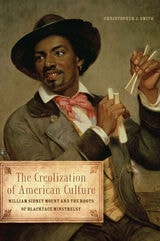
The Creolization of American Culture
William Sidney Mount and the Roots of Blackface MinstrelsyChristopher J. Smith
University of Illinois Press, 2014
The Crime of Galileo
Giorgio de Santillana
University of Chicago Press, 1955
The Crimes of Womanhood
Defining Femininity in a Court of LawA. Cheree Carlson
University of Illinois Press, 2014
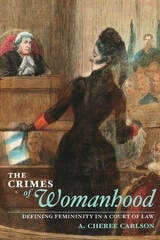
Carlson analyzes the situations of several women of varying historical stature, from the insanity trials of Mary Todd Lincoln and Lizzie Borden's trial for the brutal slaying of her father and stepmother, to lesser-known trials involving insanity, infidelity, murder, abortion, and interracial marriage. The insanity trial of Elizabeth Parsons Ware Packard, the wife of a minister, resulted from her attempts to change her own religion, while a jury acquitted Mary Harris for killing her married lover, suggesting that loss of virginity to an adulterous man was justifiable grounds for homicide. The popular conception of abortion as a "woman's crime" came to the fore in the case of Ann Loman (also known as Madame Restell), who performed abortions in New York both before and after it became a crime. Finally, Alice Rhinelander was sued for fraud by her new husband Leonard for "passing" as white, but the jury was more moved by the notion of Alice being betrayed as a woman by her litigious husband than by the supposed defrauding of Leonard as a white male. Alice won the case, but the image of womanhood as in need of sympathy and protection won out as well.
At the heart of these cases, Carlson reveals clearly just how narrow was the line that women had to walk, since the same womanly virtues that were expected of them--passivity, frailty, and purity--could be turned against them at any time. These trials of popular status are especially significant because they reflect the attitudes of the broad audience, indicate which forms of knowledge are easily manipulated, and allow us to analyze how the verdict is argued outside the courtroom in the public and press. With gripping retellings and incisive analysis of these scandalous criminal and civil cases, this book will appeal to historians, rhetoricians, feminist researchers, and anyone who enjoys courtroom drama.
The Criminally Insane
A Community Follow-up of Mentally Ill OffendersTerence Thornberry and Joseph E. Jacoby
University of Chicago Press, 1979
In 1971, 586 patients were released from a Pennsylvania maximum-security hospital for the criminally insane. They were not considered officially "cured," but a federal court held that their commitments had been unconstitutional. Through exhaustive examination of hospital and police records and interviews with hospital administrators and the subjects themselves, Thornberry and Jacoby assess the processes by which the patients had been retained in confinement, the impact of their release upon their communities, and their ability to adjust to the freedom of community life.
The authors demonstrate that the patients did not display a significant level of violent behavior during confinement, nor did they pose a major threat to society after release. In fact, their social and psychological adjustment to community life is shown to have been comparable to that of non-criminal mental patients. Yet despite these findings the subjects had been retained in maximum-security confinement for an average of fourteen years because they were predicted to be violent and "dangerous" to society. The authors explain this inaccuracy by a process called "political prediction," in which clinicians avoid any potential risks to the community, the reputation of their hospitals, and their careers by consistently overpredicting dangerous behavior.
The Criminally Insane will stimulate response from professionals in a wide variety of fields, including law, criminology, psychiatry, and sociology, and from anyone concerned with society's responsibility to the mentally ill offender.
The Criminals of Lima and Their Worlds
The Prison Experience, 1850-1935Carlos Aguirre
Duke University Press, 2005
Drawing on a large collection of prison and administrative records archived at Peru’s Ministry of Justice, Aguirre offers a detailed account of the daily lives of men incarcerated in Lima’s jails. In showing the extent to which the prisoners actively sought to influence prison life, he reveals the dynamic between prisoners and guards as a process of negotiation, accommodation, and resistance. He describes how police and the Peruvian state defined criminality and how their efforts to base a prison system on the latest scientific theories—imported from Europe and the United States—foundered on the shoals of financial constraints, administrative incompetence, corruption, and widespread public indifference. Locating his findings within the political and social mores of Lima society, Aguirre reflects on the connections between punishment, modernization, and authoritarian traditions in Peru.
The Crimson Cowboys
The Remarkable Odyssey of the 1931 Claflin-Emerson ExpeditionJerry D. Spangler and James M. Aton
University of Utah Press, 2018
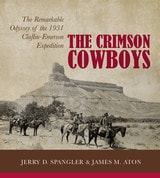
In 1931 a group from Harvard University’s Peabody Museum accomplished something that had never been attempted in the history of American archaeology: a six-week, four-hundred-mile horseback survey of Fremont prehistoric sites through some of the West’s most rugged terrain. The expedition was successful, but a report on the findings was never completed. What should have been one of the great archaeological stories in American history was relegated to boxes and files in the basement of the Peabody Museum at Harvard.
Now, based on over a thousand pages of documents (field journals, correspondence, and receipts) and over four hundred photographs, this book recounts the remarkable day-to-day adventures of this crew of one professor, five students, and three Utah guides who braved heat, fatigue, and the dangerous canyon wilderness to reveal vestiges of the Fremont culture in the Tavaputs Plateau and Uinta Basin areas. To better tell this story, authors Spangler and Aton undertook extensive fieldwork to confirm the sites; their recent photographs and those of the original expedition are shared on these pages. This engaging narrative situates the 1931 survey and its discoveries within the history of American archaeology.
Click here for a podcast with the APEX hour and Jim Aton about The Crimson Cowboys.