Results by title
4155 books match the query 'State & Local' and 925 start with t
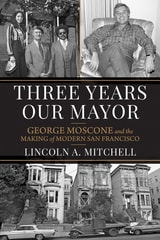
Three Years Our Mayor
George Moscone and the Making of Modern San FranciscoLincoln A. Mitchell
University of Nevada Press, 2025
Moscone was also a very colorful character who, in addition to being a successful politician, was a charming and charismatic bon vivant who was deeply embedded in the fabric and culture of San Francisco. He grew up the only son of a single mother in Cow Hollow when it was a working class, largely Italian American neighborhood, and he became the kind of politician who knew bartenders, playground attendants, small business owners, and neighborhood activists in every corner of the city. Moscone’s life and the history of San Francisco during the middle half of the twentieth century are deeply intertwined.
Through illustrating the life of Moscone, author Lincoln A. Mitchell explores how today’s San Francisco came into being. Moscone—through his work in the State Senate, victory in the very divisive 1975 mayor’s race, and brief tenure as mayor—was a key figure in the city’s evolution. The politics surrounding Moscone’s election as mayor, governance of the city, and tragic death are still relevant issues. Moscone was a groundbreaking politician whose life was cut short, but his influence on San Francisco can still be felt today.
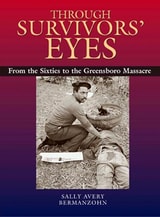
Through Survivors' Eyes
From the Sixties to the Greensboro MassacreSally Avery Bermanzohn
Vanderbilt University Press, 2003
In passionate first-person accounts, Through Survivors' Eyes tells the story of six remarkable people who set out to change the world. The survivors came of age as the "protest generation," joining the social movements of the 1960s and 1970s. They marched for civil rights, against war, for textile and healthcare workers, and for black power and women's liberation. As the mass mobilizations waned in the mid-1970s, they searched for a way to continue their activism, studied Marxism, and became communists.
Nelson Johnson, who grew up on a farm in eastern North Carolina in a family proud of its African American heritage, settled in Greensboro in the 1960s and became a leader of the Black Liberation Movement and a decade later the founder of the Faith Community Church. Willena Cannon, the daughter of black sharecroppers, witnessed a KKK murder as a child and was spurred to a life of activism. Her son, Kwame Cannon, was only ten when he saw the Greensboro killings. Marty Nathan, who grew up the daughter of a Midwestern union organizer and came to the South to attend medical school, lost her husband to the Klan/Nazi gunfire. Paul Bermanzohn, the son of Jewish Holocaust survivors, was permanently injured during the shootings. Sally Avery Bermanzohn, a child of the New York suburbs who came south to join the Civil Rights Movement, watched in horror as her friends were killed and her husband was wounded.
Through Survivors' Eyes is the story of people who abandoned conventional lives to become civil rights activists and then revolutionaries. It is about blacks and whites who united against Klan/Nazi terror, and then had to overcome unbearable hardship, and persist in seeking justice. It is also a story of one divided southern community, from the protests of black college students of the late 1960s to the convening this January of a Truth and Community Reconciliation Project (on the South African model) intended to reassess the Massacre.

Thunder Go North
The Hunt for Sir Francis Drake's Fair and Good BayMelissa Darby
University of Utah Press, 2019
Thunder Go North unravels the mysteries surrounding Drake’s famous voyage and summer sojourn in this bay. Comparing Drake’s observations of the Natives’ houses, dress, foods, language, and lifeways with ethnographic material collected by early anthropologists, Melissa Darby makes a compelling case that Drake and his crew landed not in California but on the Oregon coast. She also uncovers the details of how an early twentieth-century hoax succeeded in maintaining the California landing theory and silencing contrary evidence. Presented here in an engaging narrative, Darby’s research beckons for history to be rewritten.
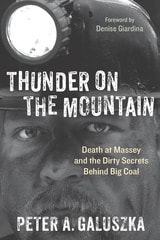
Thunder on the Mountain
Death at Massey and the Dirty Secrets behind Big CoalPeter A. Galuszka
West Virginia University Press, 2014
With a foreword by Denise Giardina
On April 5, 2010, an explosion ripped through Massey Energy’s Upper Big Branch Mine, killing twenty-nine coal miners. This tragedy was the deadliest mine disaster in the United States in forty years—a disaster that never should have happened. These deaths were rooted in the cynical corporate culture of Massey and its notorious former CEO Don Blankenship, and were part of an endless cycle of poverty, exploitation, and environmental abuse that has dominated the Appalachian coalfields since coal was first discovered there. And the cycle continues unabated as coal companies bury the most insidious dangers deep underground, all in search of higher profits, and hide the true costs from regulators, unions, and investors alike. But the disaster at Upper Big Branch goes beyond the coalfields of West Virginia. It casts a global shadow, calling into bitter question why coal miners in the United States are sacrificed to erect cities on the other side of the world, why the coal wars have been allowed to rage, polarizing the country, and how the world’s voracious appetite for energy is satisfied at such horrendous cost.
With Thunder on the Mountain, Peter A. Galuszka pieces together the true story of greed and negligence behind the tragedy at the Upper Big Branch Mine, and in doing so he has created a devastating portrait of an entire industry that exposes the coal-black motivations that led to the death of twenty-nine miners and fuel the ongoing war for the world’s energy future.
This paperback edition contains a foreword by Denise Giardinia that provides an update on Massey Energy and Donald Blankenship, Chairman and CEO of Massey Energy Company during the UBB disaster, and recounts her own experiences with Massey Energy and the United Mine Workers Association in the 1980s. This edition also includes a notes section and a bibliography.
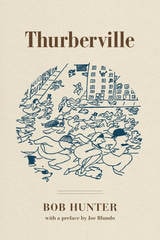
Thurberville
Bob Hunter
The Ohio State University Press, 2017
Thurber’s Columbus was a wild and crazy place, a city full of fascinating and sometimes peculiar characters, many in his own family. Because of the widespread popularity of his stories, that was also the Columbus that many of his readers around the world came to know.
Thurberville chronicles those characters and explores that world. But it also examines the real city where Thurber struggled and then blossomed as a college student, worked as a newspaper reporter and a press agent, and achieved international fame as a humorist and cartoonist after he left town, in part by writing about the subjects he left behind.
Much of Thurber’s best work was cultivated by experiences Thurber had in Columbus and in his dealings with family, friends, teachers, and acquaintances there. They are worth a revisit and, in some cases, an introduction.
Thursday Night Lights
The Story of Black High School Football in TexasBy Michael Hurd
University of Texas Press, 2019
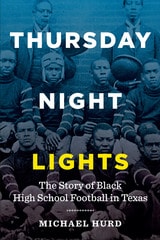
At a time when “Friday night lights” shone only on white high school football games, African American teams across Texas burned up the gridiron on Wednesday and Thursday nights. The segregated high schools in the Prairie View Interscholastic League (the African American counterpart of the University Interscholastic League, which excluded black schools from membership until 1967) created an exciting brand of football that produced hundreds of outstanding players, many of whom became college All-Americans, All-Pros, and Pro Football Hall of Famers, including NFL greats such as “Mean” Joe Green (Temple Dunbar), Otis Taylor (Houston Worthing), Dick “Night Train” Lane (Austin Anderson), Ken Houston (Lufkin Dunbar), and Bubba Smith (Beaumont Charlton-Pollard).
Thursday Night Lights tells the inspiring, largely unknown story of African American high school football in Texas. Drawing on interviews, newspaper stories, and memorabilia, Michael Hurd introduces the players, coaches, schools, and towns where African Americans built powerhouse football programs under the PVIL leadership. He covers fifty years (1920–1970) of high school football history, including championship seasons and legendary rivalries such as the annual Turkey Day Classic game between Houston schools Jack Yates and Phillis Wheatley, which drew standing-room-only crowds of up to 40,000, making it the largest prep sports event in postwar America. In telling this story, Hurd explains why the PVIL was necessary, traces its development, and shows how football offered a potent source of pride and ambition in the black community, helping black kids succeed both athletically and educationally in a racist society.
Timber!
A Northwoods Story of Lumberjacks, Logging, and the LandSusan Apps-Bodilly
Wisconsin Historical Society Press, 2024
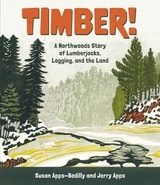
How did the logging boom begin? What was it like to work in the woods? What happened to the land after the trees were cut down? The latest book for young readers from father-daughter duo Jerry Apps and Susan Apps-Bodilly explores the origin story of Wisconsin’s logging boom, the devastation it caused to the land, and the extraordinary efforts to restore the cutover land and log sustainably.
Timber! helps young readers examine a complex and pivotal chapter in our state and nation’s history, covering a wide range of topics, including:
• how Native people used, shared, and relied on natural resources for thousands of years
• the forced removal of Native people from forested lands
• how the lumber industry made possible the westward expansion of the United States
• what it was like to work in a logging camp, on a log drive, and inside a sawmill
• the roles on a logging team, from sawyer to cook
• the destructive legacy of early logging practices and early efforts to restore the land
• the emergence of sustainable forestry practices
This comprehensive yet easy-to-read history includes letters, postcards, and other primary sources paired with discussion questions designed to engage young readers’ creativity and critical-thinking skills. Timber! also features more than 100 images, a glossary, suggested activities, and an extensive list of related resources, including books, websites, teaching materials, museums, and outdoor places to visit. Timber! will inspire readers of all ages to explore, protect, and learn about trees and forests in their own communities.

Timberline Tailings
Tales Of Colorado'S Ghost Towns And Mining CampsMuriel Sibell Wolle
Ohio University Press, 1993
Time and Change
150 Years of The Ohio State UniversityTamar Chute with a Letter by President Michael V. Drake and an Afterword by Provost Bruce A. McPheron
The Ohio State University Press, 2019
Gain a visually stunning new perspective on iconic landmarks such as Mirror Lake, the Oval, Ohio Stadium, and the neighborhoods surrounding the Columbus and regional campuses. From beloved teams, symbols, and traditions to scenes from academic and campus life, reflect on time and change and rediscover the extraordinary connection that unites generations of Buckeyes.
Time and the Town
A Provincetown ChronicleAdele Heller
Rutgers University Press, 1991
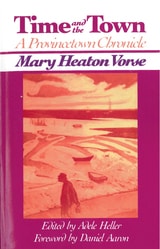
Time and the Town was the last of Mary Heaton Vorse's books. It is about many things —a town and its people, the author, a certain kind of idyllic life. As much as anything else, it is the biography of the house Vorse bought in 1907 and lived in, off and on, for the next thirty-six years. The moods of the house mirrored her own. "Our houses," she wrote, "are our biographies, the stories of our defeats and victories."
Tinged with nostalgia and disenchantment, the book describes a Provincetown that has changed, a place on the verge of modernity. It is no longer a major fishing port. It has become a place whose business is tourism. Contrasting the old and the new, Vorse celebrates the enduring character of the town itself. She tells stories that are engaging and charming, droll and fabulous. The wrinkled Mrs. Mary Mooncusser who, though drunk and stark naked, conducts herself with great decorum when Vorse pays her a call, might have stepped out of the pages of Sherwood Anderson or Eudora Welty. In another anecdote, the townspeople scour the beaches for cases of booze dumped into the sea by rumrunners and are briefly inflated with the spirit of ancestral smugglers and buccaneers.
Vorse herself remained something of an outsider in Provincetown, despite her evident affection for the place and its inhabitants. They surely regarded her as simply another of those artist-intellectuals--many of whom appear in the pages of this book. The "off-Cape" outsiders put the town in the national limelight but took no interest in local matters. Vorse here ponders local matters exclusively, almost, one suspects, as a way of forgetting the more complex matters that occupied her--her agonies of parental guilt, her resentment of domestic obligations, her third marriage, her depressions and breakdowns. The town is in that sense beyond time.
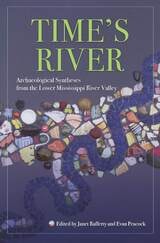
Time's River
Archaeological Syntheses from the Lower Mississippi ValleyEdited by Janet Rafferty and Evan Peacock
University of Alabama Press, 2008
An archaeologically rich region, in advance of impending disturbance
This volume stands as a key general resource for archaeologists working in the region extending from Louisiana through Mississippi north to Missouri and Kentucky, and it represents an opportunity to influence for decades a large part of the archaeological work to take place in the Southeast.
The book responds to a need for a comprehensive archaeological overview of the Lower Mississippi Valley that forms a portion of an interstate corridor spanning nine states that will run from southern Michigan to the Texas-Mexico border. The culturally sensitive Mississippi Delta is one of the richest archaeological areas in North America, and it is crucial that research designs be comprehensive, coordinated, and meet current preservation and future research needs. The authors are well-respected researchers from both within and outside the region with expertise in the full range of topics that comprise American archaeology. They examine matters of method and theory, the application of materials science, geophysics, and other high-tech tools in archaeology that provide for optimum data-recovery.
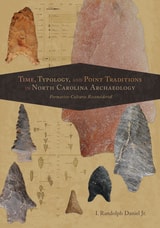
Time, Typology, and Point Traditions in North Carolina Archaeology
Formative Cultures ReconsideredI. Randolph Daniel Jr.
University of Alabama Press, 2021
Revisiting the stone tools that reshaped our understanding of North Carolina's prehistoric past.
In the 1964 landmark publication The Formative Cultures of the Carolina Piedmont, Joffre Coe established a projectile point typology and chronology that, for the first time, allowed archaeologists to identify the relative age of a site or site deposit based on the point types recovered there. Consistent with the cultural-historical paradigm of the day, the “Coe axiom” stipulated that only one point type was produced at one moment in time in a particular location. Moreover, Coe identified periods of “cultural continuity” and “discontinuity” in the chronology based on perceived similarities and differences in point styles through time.
In Time, Typology, and Point Traditions in North Carolina Archaeology: Formative Cultures Reconsidered, I. Randolph Daniel Jr. reevaluates the Coe typology and sequence, analyzing their strengths and weaknesses. Daniel reviews the history of the projectile point type concept in the Southeast and revisits both Coe’s axiom and his notions regarding cultural continuity and change based on point types. In addition, Daniel updates Coe’s typology by clarifying or revising existing types and including types unrecognized in Coe’s monograph. Daniel also adopts a practice-centered approach to interpreting types and organizes them into several technological traditions that trace ancestral-descendent communities of practice that relate to our current understanding of North Carolina prehistory.
Appealing to professional and avocational archaeologists, Daniel provides ample illustrations of points in the book as well as color versions on a dedicated website. Daniel dedicates a final chapter to a discussion of the ethical issues related to professional archaeologists using private artifact collections. He calls for greater collaboration between professional and avocational communities, noting the scientific value of some private collections.
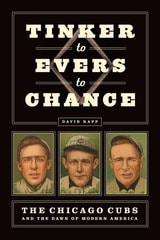
Tinker to Evers to Chance
The Chicago Cubs and the Dawn of Modern AmericaDavid Rapp
University of Chicago Press, 2018
Tinker to Evers to Chance examines this pivotal moment in American history, when baseball became the game we know today. Each man came from a different corner of the country and brought a distinctive local culture with him: Evers from the Irish-American hothouse of Troy, New York; Tinker from the urban parklands of Kansas City, Missouri; Chance from the verdant fields of California’s Central Valley. The stories of these early baseball stars shed unexpected light not only on the evolution of baseball and on the enthusiasm of its players and fans all across America, but also on the broader convulsions transforming the US into a confident new industrial society. With them emerged a truly national culture.
This iconic trio helped baseball reinvent itself, but their legend has largely been relegated to myths and barroom trivia. David Rapp’s engaging history resets the story and brings these men to life again, enabling us to marvel anew at their feats on the diamond. It’s a rare look at one of baseball’s first dynasties in action.

To Care for the Sick and Bury the Dead
African American Lodges and Cemeteries in TennesseeLeigh Ann Gardner
Vanderbilt University Press, 2022
These Black cemeteries dot the Tennessee landscape, but few know their history or the societies of care they represent. To Care for the Sick and Bury the Dead is the first book-length look at these cemeteries and the lodges that fostered them.
This book is a must-have for genealogists, historians, and family members of the people buried in these cemeteries.
To Do Justice
The Civil Rights Ministry of Reverend Robert E. HughesRandall C. Jimerson
University of Alabama Press, 2022
A minister’s call to justice in the struggle for civil rights.
A native Alabamian, Reverend Robert E. Hughes worked full-time in the civil rights movement as executive director of the Alabama Council of Human Relations, where he developed a close relationship with Dr. Martin Luther King Jr. After facing backlash from the Ku Klux Klan, spending four days in jail for refusing to disclose ACHR membership lists, and ultimately being forced to leave the state of Alabama, he served as a Methodist missionary in Southern Rhodesia (now part of Zimbabwe). After two years of organizing Black liberation groups, he was banned as a “prohibited immigrant” by the Ian Smith government. His lifelong commitment to social justice, racial equality, and peaceful resolution of conflicts marks a fascinating career richly documented in this comprehensive biography.
To Do Justice: The Civil Rights Ministry of Reverend Robert E. Hughes traces the life and career of an admirable and lesser-known civil rights figure who fought injustice on two continents. This account presents valuable new evidence about the civil rights movement in the United States as well as human rights and liberation issues in colonial Southern Rhodesia in the years leading up to independence and self-rule. It provides an intimate portrait of a courageous individual who worked outside of the public spotlight but provided essential support and informational resources to public activists and news reporters
Randall C. Jimerson explores the interwoven threads of race relations and religious beliefs on two continents, focusing on the dual themes of the American civil rights movement and the African struggles for decolonization and majority rule. The life and career of Robert Hughes provide insight into the international dimensions of racial prejudice and discrimination that can be viewed in comparative context to similar oppressions in other colonial lands.

To Foster the Spirit of Professionalism
Southern Scientists and State Academies of ScienceNancy Smith Midgette
University of Alabama Press, 1991
"A welcome contribution to the history of science in the South during the period since the Civil War. . . . By considering the academies in the larger context of scientific professionalism, South and North, Midgette has produced a surprisingly wide-ranging and informative study. This is overall a judicious and carefully researched work. The writing is straightforward and admirably clear, while the topic is effectively organized and presented. The book is a commendably original addition to local and regional history as well as history of American Science."
—Journal of American History
"Midgette’s study is thorough and well organized and should be consulted by anyone interested in American science and American higher education."
—Florida Historical Quarterly
"A very useful survey."
—Choice

To Possess The Land
A Biography Of Arthur Rochford ManbyFrank Waters
Ohio University Press, 1993
Ambitious and only twenty-four years old, Arthur Manby arrived from England to the Territory of New Mexico in 1883 and saw in its wilderness an empire that he believed himself destined to rule. For his kingdom, he chose a vast Spanish land grant near Taos, a wild 100,000 acres whose title was beyond question. Obsessed, he poured more than twenty years into his dream of glory, and schemed, stole, lied, cajoled, begged, and bribed to take the vast grant from its rightful owners. With great mastery, Waters draws us into this obsession, and the intense drama of these years is at once psychological and historical. In May 1913, Manby came at last to possess the grant, but within three years it had slipped again from his grasp.
The story does not end there, and perhaps only Frank Waters could have portrayed the strange disintegration of Manby’s personality as he aged, his frantic but ingenious efforts to regain “his” land. Among these was the creation of a secret society which terrorized whole towns and villages, becoming so powerful that even Manby no longer knew all its members and workings. At the same time he turned deeper inward, locked and bolted his gates against the outside world which hated and feared him more than ever. On July 3, 1929, a swollen, headless body was discovered in Manby’s Taos home. Some said it was murder; others swore the body was not Manby’s; still others reported seeing him alive afterward. The story blazed into national headlines and an official inquiry followed. Step by step, Waters takes us into the web of strange clues, evidence, more murders and complications—an investigation which the New Mexican government inexplicably called to a halt. The case remains one of the West’s greatest unsolved mysteries.

To Russia with Love
An Alaskan's JourneyVictor Fischer with Charles Wohlforth
University of Alaska Press, 2012
Son of the famous American journalist Louis Fischer, who corresponded from Germany and then Moscow, and the Russian writer Markoosha Fischer, Victor Fischer grew up in the shadow of Hitler and Stalin, watching his friends’ parents disappear after political arrests. Eleanor Roosevelt personally engineered the Fischer family’s escape from Russia, and soon after Victor was serving in the United States Army in World War II and fighting opposite his childhood friends in the Russian and German armies.
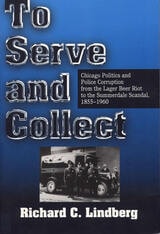
To Serve and Collect
Chicago Politics and Police Corruption from the Lager Beer Riot to the Summerdale Scandal, 1855-1960Richard C. Lindberg
Southern Illinois University Press, 1998
Crooked politicians, gangsters, madams, and cops on the take: To Serve and Collect tells the story of Chicago during its formative years through the history of its legendary police department.
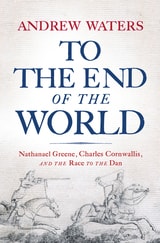
To the End of the World
Nathanael Greene, Charles Cornwallis, and the Race to the DanAndrew Waters
Westholme Publishing, 2023
“In the most barren inhospitable unhealthy part of North America, opposed by the most savage, inveterate perfidious cruel Enemy, with zeal and with Bayonets only, it was resolv’d to follow Green’s Army, to the end of the World.” So wrote British general Charles O’Hara about the epic confrontation between Nathanael Greene and Charles Cornwallis during the winter of 1780-81. Only Greene’s starving, threadbare Continentals stood between Cornwallis and control of the South—and a possible end to the American rebellion. Burning their baggage train so that they could travel more quickly, the British doggedly pursued Greene’s bedraggled soldiers, yet the rebels remained elusive. Daniel Morgan’s stunning victory at Cowpens over a superior British force set in motion the “Race to the Dan,” Greene’s month-long strategic retreat across the Carolinas. In constant rain and occasional snow, Greene’s soldiers—tracking the ground with their bloody feet—bound toward a secret stash of boats on the Dan River. Just before Cornwallis could close his trap, the Continentals crossed into Virginia and safety. Greene’s path featured three near-miss river escapes, the little-known Battle of Cowan’s Ford, and a final chase so close that the fate of the American South—and the American effort—rested on one wrong British move.
With a background section on the Southern theater in 1780, and a summary outlining the lives and careers of its important officers, To the End of the World: Nathanael Greene, Charles Cornwallis, and the Race to the Dan is a carefully documented and beautifully written account of this extraordinary chapter of American history. The book not only showcases the incredible dramatics of the American Revolution’s “Great Escape,” but also provides a compelling look at the psychological and intellectual distinctions between its two great generals, Greene and Cornwallis.
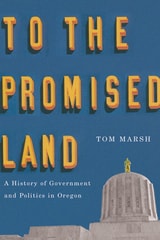
To the Promised Land
A History of Government and Politics in OregonTom Marsh
Oregon State University Press, 2012
From Jason Lee’s first letter urging Congress to take possession of the Oregon Country to John Kitzhaber’s precedent-setting third term as governor, from the land frauds of the early 20th century to the state’s land-use planning goals, from the Beach Bill to the Bottle Bill, this book tells Oregon’s story.
Featuring interesting trivia, historical photographs, and biographical sketches of key politicians, To the Promised Land is an essential volume for readers interested in Oregon’s history.
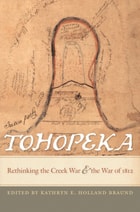
Tohopeka
Rethinking the Creek War and the War of 1812Edited by Kathryn E. Holland Braund
University of Alabama Press, 2012
Reexamining the Creek War, the War of 1812, and the Making of the American South.
Tohopeka contains a variety of perspectives and uses a wide array of evidence and approaches, from scrutiny of cultural and religious practices to literary and linguistic analysis, to illuminate this troubled period. Almost two hundred years ago, the territory that would become Alabama was both ancient homeland and new frontier where a complex network of allegiances and agendas was playing out. The fabric of that network stretched and frayed as the Creek Civil War of 1813-14 pitted a faction of the Creek nation known as Red Sticks against those Creeks who supported the Creek National Council. The war began in July 1813, when Red Stick rebels were attacked near Burnt Corn Creek by Mississippi militia and settlers from the Tensaw area in a vain attempt to keep the Red Sticks’ ammunition from reaching the main body of disaffected warriors. A retaliatory strike against a fortified settlement owned by Samuel Mims, now called Fort Mims, was a Red Stick victory. The brutality of the assault, in which 250 people were killed, outraged the American public and “Remember Fort Mims” became a national rallying cry.
During the American-British War of 1812, Americans quickly joined the war against the Red Sticks, turning the civil war into a military campaign designed to destroy Creek power. The battles of the Red Sticks have become part of Alabama and American legend and include the famous Canoe Fight, the Battle of Holy Ground, and most significantly, the Battle of Tohopeka (also known as Horseshoe Bend)—the final great battle of the war. There, an American army crushed Creek resistance and made a national hero of Andrew Jackson.
New attention to material culture and documentary and archaeological records fills in details, adds new information, and helps disabuse the reader of outdated interpretations.
Contributors
Susan M. Abram / Kathryn E. Holland Braund/Robert P. Collins / Gregory Evans Dowd / John E. Grenier / David S. Heidler / Jeanne T. Heidler / Ted Isham / Ove Jensen / Jay Lamar / Tom Kanon / Marianne Mills / James W. Parker / Craig T. Sheldon Jr. / Robert G. Thrower / Gregory A. Waselkov
Tom's Town
Kansas City and the Pendergast LegendWilliam M. Reddig
University of Missouri Press, 1986
The Pendergast machine rose to power riding the industrial and business boom of the 1920s, strengthened its grip during the chaos of the depression years, and grew fat and arrogant during the spending spree that followed. It fell apart in a fantastic series of crimes, including voting fraud and tax evasion, that shocked the nation and resulted in the incarceration of Tom Pendergast in a federal prison in 1939. Now available in paperback with a foreword by Charles Glaab, William M. Reddig's political and social history of Kansas City from the mid-1800s to 1945, focusing on the lives of Alderman Jim Pendergast and especially his younger sibling, Big Tom Pendergast, chronicles both the influence of the brothers on the growing metropolitan area and the national phenomenon of bossism.
"The story of the Pendergasts has been told ... in many places and in many ways. It has hardly been told anywhere, however, with more fascinating detail and healthy irony than in this volume of William M. Reddig." --New York Times
"Reddig has written his history of the Pendergast machine in a reportorial style which manages to combine plain city desk prose with a great deal of humor, irony, and insight. He has dwelt with obvious delight on the local characters, the factions, and feuds, and has given several brilliant personality sketches." --Saturday Review of Literature
Tommy Gun Winter
Jewish Gangsters, a Preacher's Daughter, and the Trial That Shocked 1930s BostonNathan Gorenstein
University Press of New England, 2015

Tommy
My Journey of a LifetimeTommy G. Thompson and Doug Moe
University of Wisconsin Press, 2018
Personal and revealing stories punctuate the biographical details and policy discussions. Here is Tommy as a young man, just happening to be on the National Mall in 1964 when Dr. Martin Luther King told the nation "I have a dream." Here is Tommy as Wisconsin governor, struggling to start a Harley-Davidson motorcycle before leading "a pack of Hell's Republicans" on a ride through the state. Here is Tommy in Washington after the 9/11 attacks, slipping out of a secure bunker (in defiance of orders) to aid the emergency medical response.
Thompson speaks candidly of his achievements and regrets, including his involvement with welfare reform, school choice, land conservancy, prisons, the financing of Miller Park, stem cell research, and health insurance.

Tony Oliva
The Life and Times of a Minnesota Twins LegendThom Henninger
University of Minnesota Press, 2019
If not for the botched Bay of Pigs invasion, Minnesota might never have known one of its most popular baseball players, Twins three-time batting champion and eight-time All-Star Tony Oliva. In April 1961, the twenty-two-year-old Cuban prospect failed to impress the Twins in a tryout, but the sudden rupture in U.S.–Cuba relations made a return visa all but impossible. The story of how Oliva’s unexpected stay led to a second chance and success with the Twins—as well as decades of personal and cultural isolation—is told for the first time in this full-scale biography of the man the fans affectionately call “Tony O.”
With unprecedented access to the very private Oliva, baseball writer Thom Henninger captures what life was like for the Cuban newcomer as he adjusted to major league play and American culture—and at the same time managed to earn Rookie of the Year honors and win the American League batting title in his first two seasons, all while playing with a knuckle injury. Packed with never-before-published photographs, the book follows Oliva through the 1965 season, all the way to the World Series, and then, with repaired knuckle and knee, into one of the most dramatic pennant races in baseball history in 1967. Through the voices of Oliva, his family, and his teammates—including the Cuban players who shared his cultural challenges and the future Hall of Famers he mentored, Rod Carew and Kirby Puckett—the personal and professional highs and lows of the years come alive: the Gold Glove Award in 1966, a third batting title in 1971, the devastating injury that curtailed his career, and, through it all, the struggle to build a family and recover the large and close-knit one he had left behind in Cuba.
Nearly forty years after Oliva’s retirement, the debate continues over whether his injury-shortened career was Hall of Fame caliber—a question that gets a measured and resounding answer here.

Too Much Sea for Their Decks
Shipwrecks of Minnesota's North Shore and Isle RoyaleMichael Schumacher
University of Minnesota Press, 2023
Shipwreck stories from along Minnesota’s north shore of Lake Superior and Isle Royale
Against the backdrop of the extraordinary history of Great Lakes shipping, Too Much Sea for Their Decks chronicles shipwrecked schooners, wooden freighters, early steel-hulled steamers, whalebacks, and bulk carriers—some well-known, some unknown or forgotten—all lost in the frigid waters of Lake Superior.
Included are compelling accounts of vessels destined for infamy, such as that of the Stranger, a slender wooden schooner swallowed by the lake in 1875, the sailors’ bodies never recovered nor the wreckage ever found; an account of the whaleback Wilson, rammed by a large commercial freighter in broad daylight and in calm seas, sinking before many on board could escape; and the mysterious loss of the Kamloops, a package freighter that went down in a storm and whose sailors were found on the Isle Royale the following spring, having escaped the wreck only to die of exposure on the island. Then there is the ill-fated Steinbrenner, plagued by bad luck from the time of her construction, when she was nearly destroyed by fire, to her eventual (and tragic) sinking in 1953. These tales and more represent loss of life and property—and are haunting stories of brave and heroic crews.
Arranged chronologically and presented in three sections covering Minnesota's North Shore, Isle Royale, and the three biggest storms in Minnesota’s Great Lakes history (the 1905 Mataafa storm, the 1913 hurricane on the lakes, and the 1940 Armistice Day storm), each shipwreck documented within these pages provides a piece to the history of shipping on Lake Superior.
Torn in Two
The Sinking of the Daniel J. Morrell and One Man's Survival on the Open SeaMichael Schumacher
University of Minnesota Press, 2018
Dennis Hale reached the dock just in time to see the Daniel J. Morrell heading out to open waters, a 600-foot freighter that had plied the waters for sixty years, carrying ore from Minnesota’s Iron Range to steel firms around the Great Lakes. The twenty-six-year-old watchman had, quite literally, missed the boat—which meant scrambling to rejoin the Morrell at its next stop or forfeiting a good chunk of his pay package. Seventy-two hours later, Hale would find himself clinging to a life raft alongside the frozen bodies of his crewmates in the violent waves of Lake Huron. The boat would not be reported missing for another twenty-seven hours and by the time the life raft was found, Dennis Hale would remain as the sole survivor of the wreck of the Daniel J. Morrell.
This is life-and-death drama on the inland sea as only Michael Schumacher can tell it. In Torn in Two the great Lakes historian recreates the circumstances surrounding the terrible storm of November 29, 1966, that broke the mighty freighter in half, sending twenty-five of the Morrell’s twenty-nine-man crew to their deaths and consigning the surviving four to the freezing raft where all but Hale would perish. At the heart of Torn in Two are the terrible hours spent by Hale on the life raft with his crewmen, clinging to life for thirty-eight hours in freezing temperatures and wearing only a peacoat, life jacket, and boxer shorts. The fight to save Hale and find the others, the Coast Guard hearings into what happened, the discovery of the wreckage—Schumacher’s vivid narrative captures every harrowing detail and curious fact of the Morrell’s demise, finally doing justice to this epic shipwreck fifty years past.
Toting the Lead Row
Ruby Pickens Tartt, Alabama FolkloristVirginia Pounds Brown
University of Alabama Press, 1981
Preserving voices from the back roads—Ruby Pickens Tartt and the folklore of Alabama’s Black Belt.
“You recall the expression ‘toting the lead row’, don’t you? In chopping cotton or corn there is always a leader, one who can chop the fastest of them all. When he finishes his row, he goes back and helps the other choppers finish theirs. The one who totes the lead row takes the lead place in the next row.”—Ruby Pickens Tartt
Toting the Lead Row is a powerful biographical and cultural tribute to Ruby Pickens Tartt, a white woman from Alabama’s Black Belt who devoted her life to preserving the oral traditions of rural Black communities. Born in 1880 in Livingston, Alabama, Tartt witnessed nearly a century of social transformation and made it her mission to document the songs, stories, and life histories of her African American neighbors. She believed that the soul of Sumter County resided not in its institutions, but in its cabins, fields, and voices.
During the Great Depression, Tartt worked with the Federal Writers’ Project, collaborating with renowned folklorists such as Carl Carmer and John Lomax. Her home became a hub for cultural preservation, attracting scholars and artists who recognized the depth of her fieldwork. The book’s title refers to a Southern agricultural phrase—“toting the lead row”—symbolizing leadership and support, a role Tartt embodied in her efforts to elevate the voices of those often overlooked.
This volume is divided into two parts: the first offers a detailed biography of Tartt and her work with the WPA, while the second presents a curated selection of her collected writings, including 18 life histories and 12 slave narratives. Through these stories, Tartt preserved a vital piece of Southern history and gave voice to generations whose experiences might otherwise have been lost.
Toting the Lead Row is both a celebration of a remarkable woman and a vital contribution to the study of folklore, race, and Southern identity.
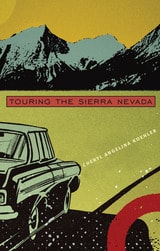
Touring The Sierra Nevada
Cheryl Angelina Koehler
University of Nevada Press, 2007
The complete guide to the entire Sierra Nevada
The Sierra Nevada is one of the most scenic, biologically diverse, and historically rich mountain ranges in North America. Touring the Sierra Nevada covers the entire range and its adjacent regions, exploring the Sierra Nevada from such world-famous sites as Lake Tahoe and Yosemite to picturesque mining towns, scenic alpine lakes, lush vineyards, and colorful hidden byways. Koehler offers suggestions for long tours and exciting daytrips, as well as detailed information about the history, geology, flora and fauna, economy, and unique features of places along the way. The book is illustrated with photographs and maps of the regions she describes. Koehler includes excursions for automobile travelers as well as backcountry adventures for hikers. She provides information about attractions in the Sierra’s two “jumping-off” cities, Sacramento and Reno, as well as in some of the major towns within the range. There is practical advice about contacting parks, museums, historical sites, visitors’ bureaus, U.S. Forest Service offices, and other agencies; finding lodging, campgrounds, and restaurants along the way; preparing for weather and altitude changes; and identifying further sources of information about the region in published guides and other books, as well as on websites. Koehler offers her readers the literary companionship of an experienced, charming, and vivacious guide through one of America’s most fascinating regions.

Toward a Healthier Garden State
Beyond Cancer Clusters and COVIDMichael R. Greenberg
Rutgers University Press, 2023
This book uses the past fifty years of New Jersey history as a case study to illustrate just how much public policy decisions and other upstream factors can affect the health of a state’s citizens. It reveals how economic and racial disparities in health care were exacerbated by bad policies regarding everything from zoning to education to environmental regulation. The study further chronicles how New Jersey struggled to deal with public health crises like the AIDS epidemic and the crack epidemic. Yet it also explores how the state has developed some of the nation’s most innovative responses to public health challenges, and then provides policy suggestions for how we might build an even healthier New Jersey.
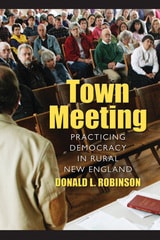
Town Meeting
Practicing Democracy in Rural New EnglandDonald L. Robinson
University of Massachusetts Press, 2011
At Gettysburg, Abraham Lincoln described government by the people as “the great task remaining before us.” Many citizens of modern America, frustrated and disheartened, are tempted to despair of realizing that ideal. Yet, it is a project still alive in parts of New England.
This book traces the origins of town-meeting democracy in Ashfield, a community of just under 2,000 people in the foothills of the Berkshires in western Massachusetts. Donald Robinson begins by recounting several crises at the town's founding in the eighteenth century that helped to shape its character. He shows how the town has changed since then and examines how democratic self-government functions in the modern context.
The picture is not pretty. Self-government carries no guarantees, and Ashfield is no utopia. Human failings are abundantly on display. Leaders mislead. Citizens don't pay attention and they forget hard-earned lessons.
But in this candid account of the operation of democracy in one New England town, Robinson demonstrates that for better and for worse, Ashfield governs itself democratically. Citizens control the actions of their government. Not everyone participates, but all may, and everyone who lives in the town must accept and obey what town meeting decides.
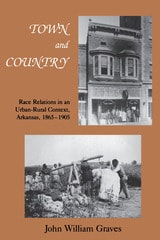
Town and Country
Race Relations in an Urban-Rural Context, Arkansas, 1865–1905John Graves
University of Arkansas Press, 1990
A thoroughly researched and extensively documented look at race relations in Arkansas druing the forty years after the Civil War, Town and Country focuses on the gradual adjustment of black and white Arkansans to the new status of the freedman, in both society and law, after generations of practicing the racial etiquette of slavery.
John Graves examines the influences of the established agrarian culture on the developing racial practices of the urban centers, where many blacks living in the towns were able to gain prominence as doctors, lawyers, successful entrepreneurs, and political leaders. Despite the tension, conflict, and disputes within and between the voice of the government and the voice of the people in an arduous journey toward compromise, Arkansas was one of the most progressive states during Reconstruction in desegregating its people.
Town and Country makes a significant contribution to the history of the postwar South and its complex engagement with the race issue.
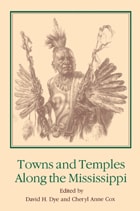
Towns and Temples Along the Mississippi
Edited by David H. Dye and Cheryl Anne Cox
University of Alabama Press, 1990
A Dan Josselyn Memorial Publication
Discover the stories, structures, and spirit that shaped life along America’s greatest river.
Specialists from archaeology, ethnohistory, physical anthropology, and cultural anthropology bring their varied points of view to this subject in an attempt to answer basic questions about the nature and extent of social change within the time period. The scholars' overriding concerns include presentation of a scientifically accurate depiction of the native cultures in the Central Mississippi Valley prior and immediately subsequent to European contact and the need to document the ensuing social and biological changes that eventually led to the widespread depopulation and cultural reorientation. Their findings lead to three basic hypotheses that will focus the scholarly research for decades to come.
Contributors include:
George J. Armelagos, Ian W. Brown, Chester B. DePratter, George F. Fielder, Jr., James B. Griffin, M. Cassandra Hill, Michael P. Hoffman, Charles Hudson, R. Barry Lewis, Dan F. Morse, Phyllis A. Morse, Mary Lucas Powell, Cynthia R. Price, James F. Price, Gerald P. Smith, Marvin T. Smith, and Stephen Williams
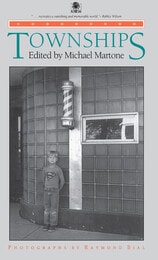
Townships
Michael Martone
University of Iowa Press, 1992
Townships establishes the Midwest as an important center of creativity, a region to be noted for more than corn and prairie and neat, square patches of land. The reverberations in sensibility that make their way through these essays speak to all midwesterners and to all those for whom a sense of place is a source of inspiration.
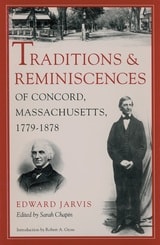
Traditions and Reminiscences of Concord, Massachusetts, 1779-1878
Edward Jarvis
University of Massachusetts Press, 1993
A statistician and pioneer in the treatment of the mentally ill, Edward Jarvis (1803–1884) decided late in life to record his recollections of Concord, Massachusetts, the town in which he was raised. Using Lemuel Shattuck's History of Concord as the springboard for his thoughts, Jarvis produced a remarkable document. Traditions and Reminiscences is encyclopedic in scope but intimate in style; it provides an astonishingly detailed account of life in early nineteenth-century Concord. Jarvis escorts us through the family home, making certain we understand the function and value of each item in the domestic scene. Then he is off to the neighbors' houses, to the schoolhouse, the church, the social clubs, the library, the post office, the town hall, and even the tavern, where he unabashedly counts patrons' drinks. Along the way we learn about neighborly cooperation—quiltings, husking bees, and barn raisings—about social manners and respectability, and about local vices. The result is a vast storehouse of information and a vivid portrait of life in an early nineteenth-century preindustrial community. The memoir also provides a first-hand witness to the crusade for moral reform that transformed mid-nineteenth-century New England.
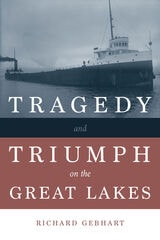
Tragedy and Triumph on the Great Lakes
Richard Gebhart
Michigan State University Press, 2024
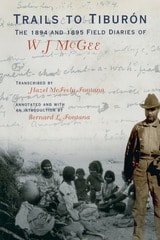
Trails to Tiburón
The 1894 and 1895 Field Diaries of W J McGeeW. J. McGee; Transcribed by Hazel McFeely Fontana; Annotated and with an Introduction by Bernard L. Fontana
University of Arizona Press, 2000
A self-taught scientist in the newly forming field of anthropology, McGee led two expeditions through southern Arizona and northern Sonora for the Bureau of American Ethnology. There he conducted ethnographic research among the Papagos (Tohono O'odham) and the Seris, and his subsequent publication The Seri Indians helped secure his place in the anthropological community.
McGee's complete journals of the expeditions, kept in small field notebooks and preserved in the Library of Congress, are published here for the first time. These journals contain detailed descriptions of the country and people McGee encountered and convey the adventure of traveling through wild and unfamiliar places—including a voyage to Isla Tiburón, or Shark Island, in the Gulf of California—and being plagued by foul weather, a shortage of supplies, and fear of attack from hostile Indians.
Trails to Tiburón features 57 historical photographs taken on the expedition, capturing the places McGee saw and the people he encountered. Fontana's notes to the diary provide useful botanical, geological, and ethnographic information, while his introduction places McGee and his field work in the context of late-nineteenth-century anthropology and science.
Trails to Tiburón reveals McGee's versatility as a field worker and shows his methods, often questioned today, to be the reasonable response of a man caught up in the intellectual fervor of his time. For anyone wanting to share in the spirit of adventure, these journals are a landmark in the annals of exploration.
Transcendental Heresies
Harvard and the Modern American Practice of UnbeliefDavid Faflik
University of Massachusetts Press, 2020
At a moment when the requirements of belief and unbelief were being negotiated in unexpected ways, transcendentalism allowed for a more creative approach to spiritual questions. Interrogating the movement's alleged atheistic underpinnings, David Faflik contends that transcendentalism reconstituted the religious sensibilities of 1830s and 1840s New England, producing a dynamic and complex array of beliefs and behaviors that cannot be categorized as either religious or nonreligious. Rather than “the latest form of infidelity,” as one contemporary described it, adherents viewed their unconventional and distinct spiritual practices as a modern religion.
Transcendental Heresies draws on an expansive antebellum archive of period commentary and writings by transcendentalism's practitioners, including Ralph Waldo Emerson, Henry David Thoreau, Theodore Parker, Margaret Fuller, and the women of transcendentalism's second and third waves. From Boston to Concord to the heady environs of Harvard, the species of unbelief they practiced multiplied the religious possibilities of the era, expressing misgivings about traditional notions of divinity, flouting religion's customary forms, and ultimately encouraging spiritual questioning.
Transformation of the Mormon Culture Region
Ethan R. Yorgason
University of Illinois Press, 2010
Transitions
Archaic and Early Woodland Research in the Ohio CountryMartha P. Otto
Ohio University Press, 2008
The late archaic and early woodland peoples lived in the Ohio region between 5,000 and 2,000 years ago. This was a time of transition, when hunters and gatherers began to grow native seed crops, establish more permanent settlements, and develop complex forms of ritual and ceremonialism, sometimes involving burial mound construction.
The focused archaeological studies described in Transitions: Archaic and Early Woodland Research in the Ohio Country shed light on this important episode in human cultural development. The authors describe important archaeological sites such as the rich Late Archaic settlements of southwestern Ohio and the early Adena Dominion Land Company enclosure in Franklin County. They present detailed accounts of Native American behavior, such as the use of smoking pipes by Adena societies and a reconstruction of mound use and ritual.
Transitions is the result of a comprehensive, long-term study focusing on particular areas of Ohio with the most up-to-date and detailed treatment of Ohio’s native cultures during this important time of change. This book will be of great value to students and other readers who wish to go beyond the general and often dated treatments of Ohio archaeology currently available.
Trask
Don Berry
Oregon State University Press, 2004
Trask is at once a gripping tale of adventure and a portrayal of one man's return to the naked simplicity of life. Inspired by his belief in the transcendent power of nature, his fascination with Eastern philosophy, and the lives of historical men and women, Don Berry created a story that is strongly imagined and powerfully rendered-a landmark work. This new edition of Berry's celebrated first novel includes an introduction by Jeff Baker, book critic for The Oregonian.
Travelers In Texas, 1761-1860
By Marilyn McAdams Sibley
University of Texas Press, 1967
History passed in review along the highways of Texas in the century 1761–1860. This was the century of exploration and settlement for the big new land, and many thousands of people traveled its trails: traders, revolutionaries, missionaries, warriors, government agents, adventurers, refugees, gold seekers, prospective settlers, land speculators, army wives, and filibusters. Their reasons for coming were many and varied, and the travelers viewed the land and its people with a wide variety of reactions. Political and industrial revolution, famine, and depression drove settlers from many of the countries of Europe and many of the states of the United States. Some were displeased with what they found in Texas, but for many it was a haven, a land of renewed hope. So large was the migration of people to Texas that the land that was virtually unoccupied in 1761 numbered its population at 600,000 a century later.
Several hundred of these travelers left published accounts of their impressions and adventures. Collectively the accounts tell a panoramic story of the land as its boundaries were drawn and its institutions formed. Spain gave way to Mexico, Mexico to the Republic of Texas, the Republic to statehood in the United States, and statehood in the Union was giving way to statehood in the Confederate states by 1860. The travelers’ accounts reflect these changes; but, more important, they tell the story of the receding frontier.
In Travelers in Texas, 1761–1860, the author examines the Texas seen by the traveler-writer. Opening with a chapter about travel conditions in general (roads or trails, accommodations, food), she also presents at some length the travelers’ impressions of the country and its people. She then proceeds to examine particular aspects of Texas life: the Indians, slavery, immigration, law enforcement, and the individualistic character of the people, all as seen through the eyes of the travelers. The discussion concludes with a “Critical Essay on Sources,” containing bibliographic discussions of over two hundred of the more important travel accounts.
Traveling Through Time
A Guide to Michigan's Historical MarkersLaura Rose Ashlee, Editor
University of Michigan Press, 2005
Since 1955 the state of Michigan has erected historical markers throughout the state. In this revised edition of Traveling Through Time, Laura Rose Ashlee collects the histories that appear on these markers together into one handy guidebook---a great desk reference for researchers and armchair historians alike.
Some of the book's special features include:
o Location and full text of each marker
o Arranged alphabetically within county chapters
o More than 85 historic and color photographs
o Special section on Michigan historical markers placed outside Michigan
Traveling the Old Ski Tracks of New England
E. John B. Allen
University of Massachusetts Press, 2022
For over a century New Englanders have taken to the slopes in search of ways to enjoy the coldest months, and skiing has deep roots in the region. In the late nineteenth century Scandinavian immigrants worked to educate snowbound locals on how to ski, make equipment, and prepare trails. Soon thereafter, colleges across the Northeast built world-class ski programs, massive jumps were constructed in Brattleboro and Berlin, and dozens of ski areas—big and small—cropped up from the 1930s through the 1960s.
Traveling the Old Ski Tracks of New England offers a fascinating history of downhill, cross-country, and backcountry skiing across the region and its leading personalities. Moving from popular destinations like Stowe, Cannon, Bromley, and Mount Washington to the less intimidating hills surrounding Boston, Rhode Island, and Connecticut, E. John B. Allen also recovers the forgotten stories of ski areas that have been abandoned in the face of changing tastes and a warming climate.
Treasure Tales of the Rockies
Perry Eberhart
Ohio University Press, 1990
Perry Eberhart gathered and researched almost 150 treasure tales and tells them with the same thoroughness, engaging style, and lively anecdotes that distinguish his other major contribution to Colorado lore and history: Guide to the Colorado Ghost Towns and Mining Camps.
Treasure Tales not only tells the original story of a lost mine or a buried treasure, but also fills in the pieces of the puzzle as they have come to light over the years. Many tales become more and more intriguing — but still remain a puzzle. In some cases the puzzle is solved, often accidentally. Eberhart also collects the fascinating tales of lost treasures found. This latest edition of Treasure Tales brings all of this information up to date.
Forty-three maps by Sandy Eberhart and forty-eight well-chosen photographs round out Treasure Tales. This is a book for both armchair excitement and for the adventurer who wants to search out what nature, time, and man's ingenuity have hidden from us — and what nature, time, and man's ingenuity also often help us find. Good luck!
Treasures of the Abraham Lincoln Presidential Library
Edited by Glenna R. Schroeder-Lein
Southern Illinois University Press, 2014
Illinois State Historical Society Superior Achievement Award 2015
The Abraham Lincoln Presidential Library in Springfield, Illinois, houses a trove of invaluable historical resources concerning all aspects of the Prairie State’s past. Treasures of the Abraham Lincoln Presidential Library commemorates the institution’s 125-year history, as well as its contributions to scholarship and education by highlighting a selection of eighty-five treasures from among more than twelve million items in the library’s collections.
After opening with a historical overview and extensive chronology of the Library, the volume organizes the treasures by various topics, including items that illustrate various locations and materials relating to business, the mid-nineteenth century and the Civil War, World Wars I and II, the oldest items, unusual treasures, ethnicity, and art. From the Gettysburg Address, Abraham and Mary Lincoln’s letters, and Governor Dan Walker’s boots to a Deering Harvester Company catalog, WPA publications, and an Adlai Stevenson I campaign hat, each entry includes a thorough description of the item, one or more images, and a discussion of its history and how the library acquired it, if known. Other treasures include the Thomas Yates General Store daybook, Dubin Pullman car materials, Civil War newspapers, a Lincoln coffin photograph, the Mary Lincoln insanity verdict, the Directory of Sangamon County’s Colored Citizens, andLincoln’s stovepipe hat.
To highlight the academic importance of the Library, nineteen researchers share how study in the Library’s collections proved essential to their projects. Although these treasures only scrape the surface of the vast holdings of the Abraham Lincoln Presidential Library, together they epitomize the rich, varied, and sometimes quirky resources available to both serious scholars and curious tourists alike at this valuable cultural institution.
Trespassing
An Inquiry into the Private Ownership of LandJohn Hanson Mitchell
University Press of New England, 2015
Tribune of the People
The Minnesota Legislature and Its LeadershipRoyce Hanson
University of Minnesota Press, 1990
Tripping on the Color Line
Black-White Multiracial Families in a Racially Divided WorldDalmage, Heather M
Rutgers University Press, 2000
At the turn of the twentieth century W.E.B. DuBois predicted that the central problem facing the United States in the new century would be that of the “color line.” Now, at the beginning of a new century, we find many people straddling the color line. These people come from the growing number of multiracial families in America, families who search for places of comfort and familiarity in a racially polarized society whose educational system, places of worship, and neighborhoods continue to suffer a de facto segregation. This group has provoked an ever-widening debate and an upheaval in traditional racial thinking in the United States.
Through in-depth interviews with individuals from black–white multiracial families, and insightful sociological analysis, Heather M. Dalmage examines the challenges faced by people living in such families and explores how their experiences demonstrate the need for rethinking race in America. She examines the lived reality of race in the ways multiracial family members construct and describe their own identities and sense of community and politics. She shows how people whose own very lives complicate the idea of the color line must continually negotiate and contest it in order not to reproduce it. Their lack of language to describe their multiracial existence, along with their experience of coping with racial ambiguity and with institutional demands to conform to a racially divided, racist system is the central theme of Tripping on the Color Line. By connecting the stories to specific issues, such as census categories, transracial adoption, intermarriage, as well as the many social responses to violations of the color line, Dalmage raises the debate to a broad discussion on racial essentialism and social justice.
Exploring the dynamic of race as it pervades the lives of those close to the color line, Dalmage argues that the struggle for racial justice must include an understanding that race is a complex construct that is constantly shifting, and is something we do rather than something we simply are.