Results by title
808 books match the query 'Civilization' and 200 start with t
The Culture of Western Europe
The Nineteenth and Twentieth CenturiesGeorge L. Mosse with a critical introduction by Anthony James Steinhoff
University of Wisconsin Press, 2023
The Cynical Society
The Culture of Politics and the Politics of Culture in American LifeJeffrey C. Goldfarb
University of Chicago Press, 1991
The Czech Reader
History, Culture, PoliticsJan Bazant, Nina Bazantová, and Frances Starn, eds.
Duke University Press, 2010
The Daily Lives of the Anglo-Saxons
Carole Biggam
Arizona Center for Medieval and Renaissance Studies, 2017
Insights into the lives of any group of historical people are provided by three main types of evidence: their language, their literature and their material culture. The contributors to this volume draw on all three types of evidence in order to present new research into the lives of the Anglo-Saxons. The particular focus is on daily life – the ordinary rather than the extraordinary, the normal rather than the exceptional. Rather than attempting an overview, the essays address individual scenarios in greater depth, but with an emphasis on shared experience.
The following scholars have contributed essays to this collection:
Martha Bayless
University of Oregon
Carole P. Biggam
University of Glasgow
Paul Cavill
University of Nottingham
Amy W. Clark
University of California, Berkeley
James Graham-Campbell
University College London
Antonina Harbus
Macquarie University, Sydney
Carole Hough
University of Glasgow
Daria Izdebska
Liverpool Hope University
Karen Louise Jolly
University of Hawai‘i at Mānoa
Alexandra Lester-Makin
University of Manchester
Elisabeth Okasha
University College, Cork
Phyllis Portnoy
University of Manitoba
Jane Roberts
University of London
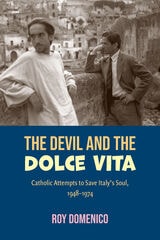
The Devil and the Dolce Vita
Catholic Attempts to Save Italy's Soul, 1948-1974Roy Domenico
Catholic University of America Press, 2021
The Divine Spark of Syracuse
Ingrid D. Rowland
Brandeis University Press, 2018
The Dominican Republic Reader
History, Culture, PoliticsEric Paul Roorda, Lauren Derby, and Raymundo González , eds.
Duke University Press, 2014
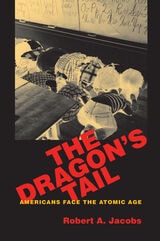
The Dragon's Tail
Americans Face the Atomic AgeRobert A. Jacobs
University of Massachusetts Press, 2010
When President Harry Truman introduced the atomic bomb to the world in 1945, he described it as a God-given harnessing of “the basic power of the universe.” Six days later a New York Times editorial framed the dilemma of the new Atomic Age for its readers: “Here the long pilgrimage of man on Earth turns towards darkness or towards light.” American nuclear scientists, aware of the dangers their work involved, referred to one of their most critical experiments as “tickling the dragon's tail.”
Even after Hiroshima and Nagasaki, most Americans may not have been sure what an atomic bomb was or how it worked. But they did sense that it had fundamentally changed the future of the human race. In this book, Robert Jacobs analyzes the early impact of nuclear weapons on American culture and society. He does so by examining a broad range of stories, or “nuclear narratives,” that sought to come to grips with the implications of the bomb's unprecedented and almost unimaginable power.
Beginning with what he calls the “primary nuclear narrative,” which depicted atomic power as a critical agent of social change that would either destroy the world or transform it for the better, Jacobs explores a variety of common themes and images related to the destructive power of the bomb, the effects of radiation, and ways of surviving nuclear war. He looks at civil defense pamphlets, magazines, novels, and films to recover the stories the U.S. government told its citizens and soldiers as well as those presented in popular culture.
According to Jacobs, this early period of Cold War nuclear culture—from 1945 to the banning of above-ground testing in 1963—was distinctive for two reasons: not only did atmospheric testing make Americans keenly aware of the presence of nuclear weapons in their lives, but radioactive fallout from the tests also made these weapons a serious threat to public health, separate from yet directly linked to the danger of nuclear war.
The Dynastic Imagination
Family and Modernity in Nineteenth-Century GermanyAdrian Daub
University of Chicago Press, 2021
Daub builds this conception of dynasty in a syncretic study of literature, sciences, and the history of ideas, engaging with remnants of dynastic ideology in the work of Richard Wagner, Émile Zola, and Stefan George, and in the work of early feminists and pioneering psychoanalysts. At every stage of cultural progression, Daub reveals how the relation of dynastic to nuclear families inflected modern intellectual history.
The Eagle and the Virgin
Nation and Cultural Revolution in Mexico, 1920–1940Mary Kay Vaughan and Stephen E. Lewis, eds.
Duke University Press, 2006
Contributors explore the nation-building efforts of the government, artists, entrepreneurs, and social movements; their contradictory, often conflicting intersection; and their inevitably transnational nature. Scholars of political and social history, communications, and art history describe the creation of national symbols, myths, histories, and heroes to inspire patriotism and transform workers and peasants into efficient, productive, gendered subjects. They analyze the aesthetics of nation building made visible in murals, music, and architecture; investigate state projects to promote health, anticlericalism, and education; and consider the role of mass communications, such as cinema and radio, and the impact of road building. They discuss how national identity was forged among social groups, specifically political Catholics, industrial workers, middle-class women, and indigenous communities. Most important, the volume weighs in on debates about the tension between the eagle (the modernizing secular state) and the Virgin of Guadalupe (the Catholic defense of faith and morality). It argues that despite bitter, violent conflict, the symbolic repertoire created to promote national identity and memory making eventually proved capacious enough to allow the eagle and the virgin to coexist peacefully.
Contributors. Adrian Bantjes, Katherine Bliss, María Teresa Fernández, Joy Elizabeth Hayes, Joanne Hershfield, Stephen E. Lewis, Claudio Lomnitz, Rick A. López, Sarah M. Lowe, Jean Meyer, James Oles, Patrice Olsen, Desmond Rochfort, Michael Snodgrass, Mary Kay Vaughan, Marco Velázquez, Wendy Waters, Adriana Zavala
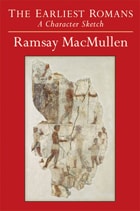
The Earliest Romans
A Character SketchRamsay MacMullen
University of Michigan Press, 2013
"A vibrant account that puts flesh on the bare bones of early Roman history."
---Celia Schultz, University of Michigan
The ancient Romans' story down to 264 B.C. can be made credible by stripping away their later myths and inventions to show how their national character shaped their destiny.
After many generations of scholarly study, consensus is clear: the account in writers like Livy is not to be trusted because their aims were different from ours in history-writing. They wanted their work to be both improving and diverting. It should grow out of the real past, yes, but if that reality couldn't be recovered, or was uncertain, their art did not forbid invention. It more than tolerated dramatic incidents, passions, heroes, heroines, and villains. If, however, all this resulting ancient fiction and adornment are pruned away, a national character can be seen in the remaining bits and pieces of credible information, to explain the familiar story at least in its outlines.
To doubt the written sources has long been acceptable, but this or that detail or narrative section must always be left for salvage by special pleading. To press home the logic of doubt is new. To reach beyond the written sources for a better support in excavated evidence is no novelty; but it is a novelty, to find in archeology the principal substance of the narrative---which is the choice in this book. To use this in turn for the discovery of an ethnic personality, a Roman national character, is key and also novel.
What is repeatedly illustrated and emphasized here is the distance traveled by the art or craft of understanding the past---"history" in that sense---over the course of the last couple of centuries. The art cannot be learned, because it cannot be found, through studying Livy and Company. Readers who care about either of the two disciplines contrasted, Classics and History, may find this argument of interest.
"Like Thucydides of the hyperactive Athenians and de Tocqueville of the nation-building Americans, MacMullen here draws a character sketch of the early Romans---the men who built Rome, conquered Italy, and created an empire. Based on profound familiarity with history, evidence, and their better-known descendants, attention to what they did and failed to do, remarkable insight, empathy, constructive imagination, and not without humor, he reconstructs the homo Romanus and thus helps us imagine what he was like, and understand why he achieved what he did. This little book is informative, full of important ideas, and delightful to read."
---Kurt Raaflaub, Brown University
Jacket image: Marcus Fabius and Quintus Tannius. Fresco. Musei Capitolini, Rome, Italy. Courtesy of Scala / Art Resource, NY..
The Eastern Establishment and the Western Experience
The West of Frederic Remington, Theodore Roosevelt, and Owen WisterBy G. Edward White
University of Texas Press, 1989
First published in 1968, The Eastern Establishment and the Western Experience has become a classic in the field of American studies.
G. Edward White traces the origins of “the West of the imagination” to the adolescent experiences of Frederic Remington, Theodore Roosevelt, and Owen Wister—three Easterners from upper-class backgrounds who went West in the 1880s in search of an alternative way of life.
Each of the three men came to identify with a somewhat idealized “Wild West” that embodied the virtues of individualism, self-reliance, and rugged masculinity. When they returned East, they popularized this image of the West through art, literature, politics, and even their public personae. Moreover, these Western virtues soon became and have remained American virtues—a patriotic ideal that links Easterners with Westerners.
With a multidisciplinary blend of history, biography, sociology, psychology, and literary criticism, The Eastern Establishment and the Western Experience will appeal to a wide audience. The author has written a new preface, offering additional perspectives on the mythology of the West and its effect on the American character.
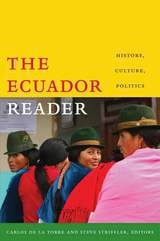
The Ecuador Reader
History, Culture, PoliticsCarlos de la Torre and Steve Striffler, eds.
Duke University Press, 2008
The voices and creations of Ecuadorian politicians, writers, artists, scholars, activists, and journalists fill the Reader, from José María Velasco Ibarra, the nation’s ultimate populist and five-time president, to Pancho Jaime, a political satirist; from Julio Jaramillo, a popular twentieth-century singer, to anonymous indigenous women artists who produced ceramics in the 1500s; and from the poems of Afro-Ecuadorians, to the fiction of the vanguardist Pablo Palacio, to a recipe for traditional Quiteño-style shrimp. The Reader includes an interview with Nina Pacari, the first indigenous woman elected to Ecuador’s national assembly, and a reflection on how to balance tourism with the protection of the Galápagos Islands’ magnificent ecosystem. Complementing selections by Ecuadorians, many never published in English, are samples of some of the best writing on Ecuador by outsiders, including an account of how an indigenous group with non-Inca origins came to see themselves as definitively Incan, an exploration of the fascination with the Andes from the 1700s to the present, chronicles of the less-than-exemplary behavior of U.S. corporations in Ecuador, an examination of Ecuadorians’ overseas migration, and a look at the controversy surrounding the selection of the first black Miss Ecuador.
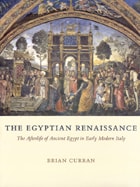
The Egyptian Renaissance
The Afterlife of Ancient Egypt in Early Modern ItalyBrian Curran
University of Chicago Press, 2007
Fascination with ancient Egypt is a recurring theme in Western culture, and here Brian Curran uncovers its deep roots in the Italian Renaissance, which embraced not only classical art and literature but also a variety of other cultures that modern readers don’t tend to associate with early modern Italy. Patrons, artists, and spectators of the period were particularly drawn, Curran shows, to Egyptian antiquity and its artifacts, many of which found their way to Italy in Roman times and exerted an influence every bit as powerful as that of their more familiar Greek and Roman counterparts.
Curran vividly recreates this first wave of European Egyptomania with insightful interpretations of the period’s artistic and literary works. In doing so, he paints a colorful picture of a time in which early moderns made the first efforts to decipher Egyptian hieroglyphs, and popes and princes erected pyramids and other Egyptianate marvels to commemorate their own authority. Demonstrating that the emergence of ancient Egypt as a distinct category of historical knowledge was one of Renaissance humanism’s great accomplishments, Curran’s peerless study will be required reading for Renaissance scholars and anyone interested in the treasures and legacy of ancient Egypt.
The Egyptians
Edited by Sergio Donadoni
University of Chicago Press, 1997
Read consecutively, the portraits merge to create a larger picture of Egyptian culture, state, and society. The framework of the Egyptian state, in particular, is touched upon in each essay, describing the meticulous administration and well-organized hierarchical system that fostered centuries of stability and prosperity.
The Elusive Promise of Indigenous Development
Rights, Culture, StrategyKaren Engle
Duke University Press, 2010
Conceiving indigenous rights as cultural rights, Engle argues, has largely displaced or deferred many of the economic and political issues that initially motivated much indigenous advocacy. She contends that by asserting static, essentialized notions of indigenous culture, indigenous rights advocates have often made concessions that threaten to exclude many claimants, force others into norms of cultural cohesion, and limit indigenous economic, political, and territorial autonomy.
Engle explores one use of the right to culture outside the context of indigenous rights, through a discussion of a 1993 Colombian law granting collective land title to certain Afro-descendant communities. Following the aspirations for and disappointments in this law, Engle cautions advocates for marginalized communities against learning the wrong lessons from the recent struggles of indigenous peoples at the international level.
The Emerson Effect
Individualism and Submission in AmericaChristopher Newfield
University of Chicago Press, 1995
Christopher Newfield analyzes the interplay of liberal and authoritarian impulses in Emerson's work in various domains: domestic life, the changing New England economy, theories of poetic language, homoerotic friendship, and racial hierarchy. Focusing on neglected later writings, Newfield shows how Emerson explored the tensions between autonomy and community—and consistently resolved these tensions by "abandoning crucial elements of both" and redefining autonomy as a kind of liberating subjection. He argues that in Emersonian individualism, self-determination is accompanied by submission to authority, and examines the influence of this submissive individualism on the history of American liberalism. In a provocative reading of Emerson's early and neglected later works, Newfield analyzes Emerson's emphasis on collective, or "corporate", world-building, rather than private possession. Tracing the development of this corporate individualism, he illuminates contradictions in Emerson's political outlook, and the conjunctions of liberal and authoritarian ideology they produced.
The Empire of Civilization
The Evolution of an Imperial IdeaBrett Bowden
University of Chicago Press, 2009
The term “civilization” comes with considerable baggage, dichotomizing people, cultures, and histories as “civilized”—or not. While the idea of civilization has been deployed throughout history to justify all manner of interventions and sociopolitical engineering, few scholars have stopped to consider what the concept actually means. Here, Brett Bowden examines how the idea of civilization has informed our thinking about international relations over the course of ten centuries.
From the Crusades to the colonial era to the global war on terror, this sweeping volume exposes “civilization” as a stage-managed account of history that legitimizes imperialism, uniformity, and conformity to Western standards, culminating in a liberal-democratic global order. Along the way, Bowden explores the variety of confrontations and conquests—as well as those peoples and places excluded or swept aside—undertaken in the name of civilization. Concluding that the “West and the rest” have more commonalities than differences,this provocative and engaging bookultimately points the way toward an authentic intercivilizational dialogue that emphasizes cooperation over clashes.
The End of Sacrifice
Religious Transformations in Late AntiquityGuy G. Stroumsa
University of Chicago Press, 2009
The religious transformations that marked late antiquity represent an enigma that has challenged some of the West’s greatest thinkers. But, according to Guy Stroumsa, the oppositions between paganism and Christianity that characterize prevailing theories have endured for too long. Instead of describing this epochal change as an evolution within the Greco-Roman world from polytheism to monotheism, he argues that the cause for this shift can be found not so much around the Mediterranean as in the Near East.
The End of Sacrifice points to the role of Judaism, particularly its inventions of new religious life following the destruction of the Second Temple in 70 CE. The end of animal sacrifice gave rise to new forms of worship, with a concern for personal salvation, scriptural study, rituals like praying and fasting, and the rise of religious communities and monasticism. It is what Christianity learned from Judaism about texts, death, and, above all, sacrifice that allowed it to supersede Greco-Roman religions and, Stroumsa argues, transform religion itself.
A concise and original approach to a much-studied moment in religious history, The End of Sacrifice will be heralded by all scholars of late antiquity.
The Enduring Legacy
Oil, Culture, and Society in VenezuelaMiguel Tinker Salas
Duke University Press, 2009
North American and British petroleum companies, seeking to maintain their stakes in Venezuela, promoted the idea that their interests were synonymous with national development. They set up oil camps—residential communities to house their workers—that brought Venezuelan employees together with workers from the United States and Britain, and eventually with Chinese, West Indian, and Mexican migrants as well. Through the camps, the companies offered not just housing but also schooling, leisure activities, and acculturation into a structured, corporate way of life. Tinker Salas contends that these practices shaped the heart and soul of generations of Venezuelans whom the industry provided with access to a middle-class lifestyle. His interest in how oil suffused the consciousness of Venezuela is personal: Tinker Salas was born and raised in one of its oil camps.
The Ethics of Oneness
Emerson, Whitman, and the Bhagavad GitaJeremy David Engels
University of Chicago Press, 2021
In The Ethics of Oneness, Jeremy David Engels reads the Bhagavad Gita alongside the works of American thinkers Ralph Waldo Emerson and Walt Whitman. Drawing on this rich combination of traditions, Engels presents the notion that individuals are fundamentally interconnected in their shared divinity. In other words, everything is one. If the lessons of oneness are taken to heart, particularly as they were expressed and celebrated by Whitman, and the ethical challenges of oneness considered seriously, Engels thinks it is possible to counter the pervasive and problematic American ideals of hierarchy, exclusion, violence, and domination.
The European Identity
Historical and Cultural Realities We Cannot DenyStephen Green
Haus Publishing, 2015
Green points out that Europeans can readily define the differences that separate them from others around the globe, but they have yet to clearly define their own similarities across member states. He argues that Europe has something distinctive and vitally important to offer: the experience of a unique journey through centuries of exploration and conflict, errors and lessons, soul-searching and rebuilding—an evolution of universal significance.
Coming at a time when the divisions in European culture have been laid bare by recent financial crises and calls for independence, The European Identity identifies one of the biggest challenges for all of the member states of the European Union.

The European Revolutions of 1848 and the Americas
Edited by Guy Thomson
University of London Press, 2002
The Ever-Present Origin
Part One: Foundations Of The Aperspectival WorldJean Gebser
Ohio University Press, 1986
This English translation of Gebser’s major work, Ursprung und Gegenwart (Stuttgart, Deutsche Verlag, 1966), offers certain fundamental insights which should be beneficial to any sensitive scientist and makes it available to the English-speaking world for the recognition it deserves.
“The path which led Gebser to his new and universal perception of the world is, briefly, as follows. In the wake of materialism and social change, man had been described in the early years of our century as the “dead end” of nature. Freud had redefined culture as illness—a result of drive sublimation; Klages had called the spirit (and he was surely speaking of the hypertrophied intellect) the “adversary of the soul,” propounding a return to a life like that of the Pelasgi, the aboriginal inhabitants of Greece; and Spengler had declared the “Demise of the West” during the years following World War I. The consequences of such pessimism continued to proliferate long after its foundations had been superseded.
It was with these foundations—the natural sciences—that Gebser began. As early as Planck it was known that matter was not at all what materialists had believed it to be, and since 1943 Gebser has repeatedly emphasized that the so-called crisis of Western culture was in fact an essential restructuration.…
Gebser has noted two results that are of particular significance: first, the abandonment of materialistic determinism, of a one-sided mechanistic-causal mode of thought; and second, a manifest “urgency of attempts to discover a universal way of observing things, and to overcome the inner division of contemporary man who, as a result of his one-sided rational orientation, thinks only in dualisms.”
Against this background of recent discoveries and conclusions in the natural sciences Gebser discerned the outlines of a potential human universality. He also sensed the necessity to go beyond the confines of this first treatise so as to include the humanities (such as political economics and sociology) as well as the arts in a discussion along similar lines. This was the point of departure of The Ever-Present Origin.
From In memoriam Jean Gebser by Jean Keckeis
The Exhaustion of Difference
The Politics of Latin American Cultural StudiesAlberto Moreiras
Duke University Press, 2001
What, asks Moreiras, is the function of critical reason in the present moment? What is regionalistic knowledge in the face of globalization? Can regionalistic knowledge be an effective tool for a critique of contemporary reason? What is the specificity of Latin Americanist reflection and how is it situated to deal with these questions? Through examinations of critical regionalism, restitutional excess, the historical genealogy of Latin American subalternism, testimonio literature, and the cultural politics of magical realism, Moreiras argues that while cultural studies is increasingly institutionalized and in danger of reproducing the dominant ideologies of late capitalism, it is also ripe for giving way to projects of theoretical reformulation. Ultimately, he claims, critical reason must abandon its allegiance to aesthetic-historicist projects and the destructive binaries upon which all cultural theories of modernity have been constructed.
The Exhaustion of Difference makes a significant contribution to the rethinking of Latin American cultural studies.

The Extractive Zone
Social Ecologies and Decolonial PerspectivesMacarena Gómez-Barris
Duke University Press, 2017

The Fear of Barbarians
Beyond the Clash of CivilizationsTzvetan Todorov
University of Chicago Press, 2010
The relationship between Western democracies and Islam, rarely entirely comfortable, has in recent years become increasingly tense. A growing immigrant population and worries about cultural and political assimilation—exacerbated by terrorist attacks in the United States, Europe, and around the world—have provoked reams of commentary from all parts of the political spectrum, a frustrating majority of it hyperbolic or even hysterical.
In The Fear of Barbarians, the celebrated intellectual Tzvetan Todorov offers a corrective: a reasoned and often highly personal analysis of the problem, rooted in Enlightenment values yet open to the claims of cultural difference. Drawing on history, anthropology, and politics, and bringing to bear examples ranging from the murder of Theo van Gogh to the French ban on headscarves, Todorov argues that the West must overcome its fear of Islam if it is to avoid betraying the values it claims to protect. True freedom, Todorov explains, requires us to strike a delicate balance between protecting and imposing cultural values, acknowledging the primacy of the law, and yet strenuously protecting minority views that do not interfere with its aims. Adding force to Todorov's arguments is his own experience as a native of communist Bulgaria: his admiration of French civic identity—and Western freedom—is vigorous but non-nativist, an inclusive vision whose very flexibility is its core strength.
The record of a penetrating mind grappling with a complicated, multifaceted problem, The Fear of Barbarians is a powerful, important book—a call, not to arms, but to thought.
The Feeling of History
Islam, Romanticism, and AndalusiaCharles Hirschkind
University of Chicago Press, 2021
Against this xenophobic tendency, The Feeling of History examines the idea of Andalucismo—a modern tradition founded on the principle that contemporary Andalusia is connected in vitally important ways with medieval Islamic Iberia. Charles Hirschkind explores the works and lives of writers, thinkers, poets, artists, and activists, and he shows how, taken together, they constitute an Andalusian sensorium. Hirschkind also carefully traces the various itineraries of Andalucismo, from colonial and anticolonial efforts to contemporary movements supporting immigrant rights. The Feeling of History offers a nuanced view into the way people experience their own past, while also bearing witness to a philosophy of engaging the Middle East that experiments with alternative futures.
The Floating University
Experience, Empire, and the Politics of KnowledgeTamson Pietsch
University of Chicago Press, 2023
In 1926, New York University professor James E. Lough—an educational reformer with big dreams—embarked on a bold experiment he called the Floating University. Lough believed that taking five hundred American college students around the globe by ship would not only make them better citizens of the world but would demonstrate a model for responsible and productive education amid the unprecedented dangers, new technologies, and social upheavals of the post–World War I world. But the Floating University’s maiden voyage was also its last: when the ship and its passengers returned home, the project was branded a failure—the antics of students in hotel bars and port city back alleys that received worldwide press coverage were judged incompatible with educational attainment, and Lough was fired and even put under investigation by the State Department.
In her new book, Tamson Pietsch excavates a rich and meaningful picture of Lough’s grand ambition, its origins, and how it reveals an early-twentieth-century America increasingly defined both by its imperialism and the professionalization of its higher education system. As Pietsch argues, this voyage—powered by an internationalist worldview—traced the expanding tentacles of US power, even as it tried to model a new kind of experiential education. She shows that this apparent educational failure actually exposes a much larger contest over what kind of knowledge should underpin university authority, one in which direct personal experience came into conflict with academic expertise. After a journey that included stops at nearly fifty international ports and visits with figures ranging from Mussolini to Gandhi, what the students aboard the Floating University brought home was not so much knowledge of the greater world as a demonstration of their nation’s rapidly growing imperial power.
The Forbidden Modern
Civilization and VeilingNilufer Gole
University of Michigan Press, 1997
The Fortunes of Permanence
Culture and Anarchy in an Age of AmnesiaRoger Kimball
St. Augustine's Press, 2022
“Cultural instructions.” Everyone who has handled a package of seedlings has encountered that enigmatic advisory. This much water and that much sun, certain tips about fertilizer, soil, and drainage. Planting one sort of flower nearby keeps the bugs away but proximity to another sort makes bad things happen. Young shoots might need stakes, and watch out for beetles, weeds, and unseasonable frosts. It’s a complicated business.
But at least since Cicero introduced the term cultura animi (“cultivation of the mind or spirit”), such “cultural instructions” have applied as much to the realm of civilization as to horticulture. In this wide-ranging investigation into the vicissitudes of culture in the twenty-first century, the distinguished critic Roger Kimball traces the deep filiations between cultivation as a spiritual enterprise and the prerequisites of political freedom. Drawing on figures as various as James Burnham, Richard Weaver, G. K. Chesterton, Rudyard Kipling, John Buchan, Friedrich von Hayek, and Leszek Kolakowski, Kimball traces the interconnections between what he calls the fortunes of permanence and such ambassadors of anarchy as relativism, multiculturalism, and the socialist-utopian imperative.
With his signature blend of wit and erudition, Kimball deftly draws on the resources of art, literature, and political philosophy to illuminate some of the wrong turns and dead ends our culture has recently pursued, while also outlining some of the simple if overlooked alternatives to the various tyrannies masquerading as liberation we have again and again fallen prey to. This rich, rewarding, and intelligent volume bristles with insights into what the nineteenth-century novelist Anthony Trollope called “The Way We Live Now.”
Partly an exercise in cultural pathology, The Fortunes of Permanence is also a forward-looking effort of cultural recuperation. It promises to be essential reading for anyone concerned about the direction of Western culture in an age of anti-Western animus and destructive multicultural fantasy.
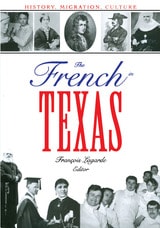
The French in Texas
History, Migration, CultureEdited by François Lagarde
University of Texas Press, 2003
2005 — San Antonio Conservation Society Citation
Original articles that explore the French presence and influence on Texas history, arts, education, religion, and business.
The flag of France is one of the six flags that have flown over Texas, but all that many people know about the French presence in Texas is the ill-fated explorer Cavelier de La Salle, fabled pirate Jean Laffite, or Cajun music and food. Yet the French have made lasting contributions to Texas history and culture that deserve to be widely known and appreciated. In this book, François Lagarde and thirteen other experts present original articles that explore the French presence and influence on Texas history, arts, education, religion, and business from the arrival of La Salle in 1685 to 2002.
Each article covers an important figure or event in the France-Texas story. The historical articles thoroughly investigate early French colonists and explorers, the French pirates and privateers, the Bonapartists of Champ-d'Asile, the French at the Alamo, Dubois de Saligny and French recognition of the Republic of Texas, the nineteenth-century utopists of Icaria and Reunion, and the French Catholic missions. Other articles deal with French immigration in Texas, including the founding of Castroville, Cajuns in Texas, and the French economic presence in Texas today (the first such study ever published). The remaining articles look at painters Théodore and Marie Gentilz, sculptor Raoul Josset, French architecture in Texas, French travelers from Théodore Pavie to Simone de Beauvoir who have written on Texas, and the French heritage in Texas education. More than seventy color and black-and-white illustrations complement the text.
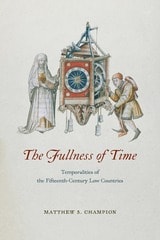
The Fullness of Time
Temporalities of the Fifteenth-Century Low CountriesMatthew S. Champion
University of Chicago Press, 2017
The Fullness of Time asks how the passage of time in the Low Countries was ordered by the rhythms of human action, from the musical life of a cathedral to the measurement of time by clocks and calendars, the work habits of a guildsman to the devotional practices of the laity and religious orders. Through a series of transdisciplinary case studies, it explores the multiple ways that objects, texts and music might themselves be said to engage with, imply, and unsettle time, shaping and forming the lives of the inhabitants of the fifteenth-century Low Countries. Champion reframes the ways historians have traditionally told the history of time, allowing us for the first time to understand the rich and varied interplay of temporalities in the period.

The Future of Humanity (Third edition)
From Global Civilization to Great CivilizationZhouying Jin
Intellect Books, 2026
This study, now in its third edition and with an expanded chapter, explores the future trajectories of industrial civilization—and of futures studies itself.
From the perspective of sublating Eastern and Western cultures and civilizations, this book argues for the urgency of industrial civilization's transformation. Zhouying Jin explores the future trajectories of humanity, the world, and human civilization; puts forward for the first time the concepts of “global civilization” and “great civilization” as two forms of advanced future civilizations for humanity, elucidating their core significance and practical approaches; and advocates for integrating the values of global civilization into the practice of sustainable development.
This revised edition of Future of Humanity includes a substantially expanded chapter that addresses seven major contemporary topics in artificial intelligence, including setting red lines for AI development as well as the advantages and misconceptions of AI in education. A new appendix outlines major trends and methodologies in futures studies, bringing together contributions from one hundred thinkers, futurists, and thirty-five pioneering institutions.

The Genius of Place
The Geographic Imagination in the Early RepublicChristopher C. Apap
University of New Hampshire Press, 2019
The Genius of Place examines how, after the War of 1812, concerns about the scale of the nation resulted in a fundamental reorientation of American identity away from the Atlantic or global ties that held sway in the early republic and toward more localized forms of identification. Instead of addressing the sweep of the nation, American authors, artists, geographers, and politicians shifted from the larger reach of the globe to the more manageable scope of the local and sectional. Paradoxically, that local representation became the primary mode through which early Americans construed their emerging national identity. This newfound cultural obsession with locality impacted the literary consolidation and representation of key American imagined places—New England, the plantation, the West—in the decades between 1816 and 1836.
Apap's examination of the intersections between local and national representations and exploration of the myths of space and place that shaped U.S. identity through the nineteenth century will appeal to a broad, interdisciplinary readership.
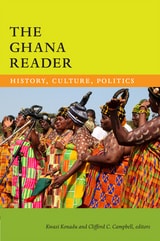
The Ghana Reader
History, Culture, PoliticsKwasi Konadu and Clifford C. Campbell, editors
Duke University Press, 2016
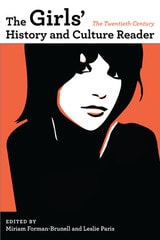
The Girls' History and Culture Reader
The Twentieth CenturyEdited by Miriam Forman-Brunell and Leslie Paris
University of Illinois Press, 2011
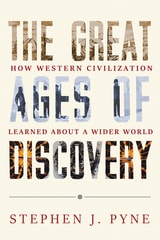
The Great Ages of Discovery
How Western Civilization Learned About a Wider WorldStephen J. Pyne
University of Arizona Press, 2021
Historian and MacArthur Fellow Stephen J. Pyne identifies three great ages of discovery in his fascinating new book. The first age of discovery ranged from the early 15th to the early 18th century, sketched out the contours of the globe, aligned with the Renaissance, and had for its grandest expression the circumnavigation of the world ocean. The second age launched in the latter half of the 18th century, spanning into the early 20th century, carrying the Enlightenment along with it, pairing especially with settler societies, and had as its prize achievement the crossing of a continent. The third age began after World War II, and, pivoting from Antarctica, pushed into the deep oceans and interplanetary space. Its grand gesture is Voyager’s passage across the solar system. Each age had in common a galvanic rivalry: Spain and Portugal in the first age, Britain and France—followed by others—in the second, and the USSR and USA in the third.
With a deep and passionate knowledge of the history of Western exploration, Pyne takes us on a journey across hundreds of years of geographic trekking. The Great Ages of Discovery is an interpretive companion to what became Western civilization’s quest narrative, with the triumphs and tragedies that grand journey brought, the legacies of which are still very much with us.
The Great Brain Suck
And Other American EpiphaniesEugene Halton
University of Chicago Press, 2008
Luckily Halton, with scalpel-sharp wit in one hand and the balm of wisdom in the other, is here to operate on the declining body politic. His initial diagnosis is bleak: fast food and too much time spent sitting, whether in our cars or on our couches, are ruining our bodies, while our minds are weakened by the proliferation of electronic devices—TVs, computers, cell phones, iPods, video games—and their alienating effects. If we are losing the battle between autonomy and automation, he asks, how can our culture regain self-sufficiency? Halton finds the answer in the inspiring visions—deeply rooted in American culture—of an organic and more spontaneous life at the heart of the work of master craftsman Wharton Esherick, legendary blues singer Muddy Waters, urban critic Lewis Mumford, and artist Maya Lin, among others.
A scathing and original jeremiad against modern materialism, The Great Brain Suck is also a series of epiphanies of a simpler but more profound life.
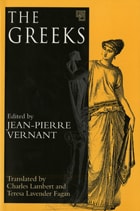
The Greeks
Edited by Jean-Pierre Vernant
University of Chicago Press, 1995
The Greeks offers the most complete portraits available of typical Greek personages from Athens to Sparta, Arcadia, Thessaly and Epirus to the city-states of Asia Minor, to the colonies of the Black Sea, southern Italy, and Sicily. Looking at the citizen, the religious believer, the soldier, the servant, the peasant, and others, they show what—in the Greek relationships with the divine, with nature, with others, and with the self—made him "different" in his ways of acting, thinking, and feeling.
The contributors to this volume are Jean-Pierre Vernant, Claude Mosse, Yvon Garlan, Giuseppe Cambiano, Luciano Canfora, James Redfield, Charles Segal, Oswyn Murray, Mario Vegetti, and Philippe Borgeaud.
The Greeks and Us
Essays in Honor of Arthur W. H. AdkinsEdited by Robert B. Louden and Paul Schollmeier
University of Chicago Press, 1996
The timely subjects addressed by the contributors include the relation between literature and moral understanding, moral and nonmoral values, and the contemporary meaning of ancient Greek ethics. The volume also includes an essay from the late Adkins himself illustrating his methodology in an analysis of the "Speech of Lysias" in Plato's Phaedrus.
The Greeks and Us will interest all those concerned with how ancient moral values do or do not differ from our own.
Contributors include Arthur W. H. Adkins, Stephanie Nelson, Martha C. Nussbaum, Paul Schollmeier, James Boyd White, Bernard Williams, and Lee Yearley.
Commentaries by Wendy Doniger, Charles M. Gray, David Grene, Robert B. Louden, Richard Posner, and Candace Vogler.

The Green Bloc
Neo-avant-garde Art and Ecology under SocialismMaja Fowkes
Central European University Press, 2015
The Guatemala Reader
History, Culture, PoliticsGreg Grandin, Deborah T. Levenson, and Elizabeth Oglesby, eds.
Duke University Press, 2011
The Haiti Reader
History, Culture, PoliticsLaurent Dubois, Kaiama L. Glover, Nadève Ménard, Millery Polyné, and Chantalle F. Verna, editors
Duke University Press, 2020
The Harbour of all this Sea and Realm
Crusader to Venetian FamagustaMichael J.K. Walsh
Central European University Press, 2014
The Haunted West
Memory and Commemoration at the Buffalo Bill Center of the WestGreg Dickinson, Eric Aoki, and Brian L. Ott
University of Alabama Press, 2024
Through incisive analysis of the museum’s five institutions, Greg Dickinson and his coauthors reveal how narratives of Native American heritage, violent colonial settlement, Western art, natural history, and ever‑present gun culture collide to shape a haunted sense of American identity. By tracing the tensions between what is memorialized, what is mythologized, and what is suppressed, the authors expose the ghosts that linger in contemporary understandings of the West and offer a compelling rethinking of how memory and commemoration continue to influence the nation’s cultural imagination.
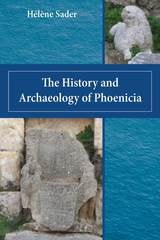
The History and Archaeology of Phoenicia
Hélène Sader
SBL Press, 2019
An insightful historical account of Phoenicia that illustrates its cities, culture, and daily life
Hélène Sader presents the history and archaeology of Phoenicia based on the available contemporary written sources and the results of archaeological excavations in Phoenicia proper. Sader explores the origin of the term Phoenicia; the political and geographical history of the city-states Arwad, Byblos, Sidon, and Tyre; and topography, climate, and natural resources of the Phoenician homeland. Her limited focus on Phoenicia proper, in contrast to previous studies that included information from Phoenician colonies, presents the bare realities of the opportunities and difficulties shaping Phoenician life. Sader’s evaluation and synthesis of the evidence offers a corrective to the common assumption of a unified Phoenician kingdom.
Features
- Historical as well as modern maps with the locations of all relevant archaeological sites
- Faunal and floral analyses that shed light on the Phoenician diet
- Petrographic analysis of pottery that sheds light on trading patterns and developments
The Illusion of Cultural Identity
Jean-François Bayart
University of Chicago Press, 2005
In this highly sophisticated book, Bayart shows that the very idea of cultural identity prevents us from grasping the cultural dimensions of political action and economic development. Identities, he argues, are fluid, never homogeneous, and sometimes invented. Political repertoires are instead created through imagined, highly ambiguous aspects of culture—what he calls "imaginaires." For instance, the long beards worn by men in some fundamentalist groups are thought to be key to their core identities and thus assumed to be in conflict with modern values. These beards, however, do not stand in the way of the men's use of technology or their embrace of capitalism—an example Bayart uses to demonstrate the equivocality of cultural identity. The theoretical implications of Bayart's analysis emerge from a fascinating collection of historical examples that often surprise and always instruct.
The Imperial Style of Inquiry in Twentieth-Century China
The Emergence of New ApproachesDonald J. Munro
University of Michigan Press, 1996
The Impure Imagination
Toward A Critical Hybridity In Latin American WritingJoshua Lund
University of Minnesota Press, 2006
In this pathbreaking work, Joshua Lund offers a thoughtful critique of hybridity by reading contemporary theories of cultural mixing against their historical precursors. The Impure Imagination is the first book to systematically analyze today’s dominant theories in relation to earlier, narrative manifestations of hybridity in Latin American writing, with a particular focus on Mexico and Brazil.
Generally understood as the impurification of standard or canonized forms, hybridity has historically been embraced as a basic marker of Latin American regional identity and as a strategy of resistance to cultural imperialism. Lund contends that Latin American theories and narratives of hybridity have been, and continue to be, underwritten by a structure of colonial power. Here he provides an informed critique and cogent investigation of this connection, its cultural effects, and its political implications. Using the emergence of hybridity as an analytical frame for thinking about culture in the Americas, Lund examines the contributions of influential thinkers, including Néstor García Canclini, Homi Bhabha, Jacques Derrida, Giorgio Agamben, Jorge Luis Borges, Antonio Candido, and many others.
Distinguished by its philosophical grounding and underpinned with case studies, The Impure Imagination employs postcolonial theory and theories of race as it explores Latin American history and culture. The result is an original and interrogative study of hybridity that exposes surprising—and unsettling—similarities with nationalistic discourses.
Joshua Lund is assistant professor of Spanish at the University of Pittsburgh. His essays have appeared in A Contracorriente, Race & Class, Cultural Critique, and the Journal of Latin American Cultural Studies.