Results by title
434 books match the query 'Ethics & Moral Philosophy' and 102 start with t
The Moral Conflict of Law and Neuroscience
Peter A. Alces
University of Chicago Press, 2018
Peter A. Alces considers where and how the law currently fails to appreciate the neuroscientific revelation that humans may in key ways lack normative free will—and therefore moral responsibility. The most accessible setting in which to consider the potential impact of neuroscience is criminal law, as certain aspects of criminal law already reveal the naiveté of most normative reasoning, such as the inconsistent treatment of people with equally disadvantageous cognitive deficits, whether congenital or acquired. But tort and contract law also assume a flawed conception of human agency and responsibility. Alces reveals the internal contradictions of extant legal doctrine and concludes by considering what would be involved in constructing novel legal regimes based on emerging neuroscientific insights.
The Morality of Everyday Life
Rediscovering an Ancient Alternative to the Liberal TraditionThomas Fleming
University of Missouri Press, 2007
In TheMorality of Everyday Life, Thomas Fleming offers an alternative to the enlightened liberalism espoused by thinkers as different as Kant, Mill, Rand, and Rawls. Philosophers in the liberal tradition, although they disagree on many important questions, agree that moral and political problems should be looked at from an objective point of view and a decision made from a rational perspective that is universally applied to all comparable cases.
Fleming instead places importance on the particular, the local, and moral complexity. He advocates a return to premodern traditions, such as those exemplified in the texts of Aristotle, the Talmud, and the folk wisdom in ancient Greek literature, for a solution to ethical predicaments. In his view, liberalism and postmodernism ignore the fact that human beings by their very nature refuse to live in a world of universal abstractions.
While such modern philosophers as Kant and Kohlberg have regarded a mother’s self-sacrificing love for her children as beneath their level of morality, folk wisdom tells us it is nearly the highest morality, taking precedence over the duties of citizenship or the claims of humanity. Fleming believes that a modern type of “casuistry” should be applied to these moral conflicts in which the line between right and wrong is rarely clear.
This volume will appeal to students of ethics and classics, as well as the general educated reader, who will appreciate Fleming’s jargon-free prose. Teachers will find this text useful because each chapter is a self-contained essay that could be used as the basis for classroom discussion.
The Mythology in Our Language
Remarks on Frazer's Golden BoughLudwig Wittgenstein
HAU, 2018
In 1931 Ludwig Wittgenstein wrote his famous Remarks on Frazer’s “Golden Bough,” published posthumously in 1967. At that time, anthropology and philosophy were in close contact—continental thinkers drew heavily on anthropology’s theoretical terms, like mana, taboo, and potlatch, in order to help them explore the limits of human belief and imagination. Now the book receives its first translation by an anthropologist, in the hope that it can kick-start a new era of interdisciplinary fertilization.
Wittgenstein’s remarks on ritual, magic, religion, belief, ceremony, and Frazer’s own logical presuppositions are as lucid and thought-provoking now as they were in Wittgenstein’s day. Anthropologists find themselves asking many of the same questions as Wittgenstein—and in a reflection of that, this volume is fleshed out with a series of engagements with Wittgenstein’s ideas by some of the world’s leading anthropologists, including Veena Das, David Graeber, Wendy James, Heonik Kwon, Michael Lambek, Michael Puett, and Carlo Severi.
The Natural Law
A Beginner's Thomistic GuideSteven J. Jensen
Catholic University of America Press, 2025

The Nature of Love
Dietrich von Hildebrand
St. Augustine's Press, 2009
The Ontology of Becoming and the Ethics of Particularity
M. C. Dillon
Ohio University Press, 2012
M. C. Dillon (1938–2005) was widely regarded as a world-leading Merleau-Ponty scholar. His book Merleau-Ponty’s Ontology (1988) is recognized as a classic text that revolutionized the philosophical conversation about the great French phenomenologist. Dillon followed that book with two others: Semiological Reductionism, a critique of early-1990s linguistic reductionism, and Beyond Romance, a richly developed theory of love. At the time of his death, Dillon had nearly completed two further books to which he was passionately committed. The first one offers a highly original interpretation of Nietzsche’s ontology of becoming. The second offers a detailed ethical theory based on Merleau-Ponty’s account of carnal intersubjectivity. The Ontology of Becoming and the Ethics of Particularity collects these two manuscripts written by a distinguished philosopher at the peak of his powers—manuscripts that, taken together, offer a distinctive and powerful view of human life and ethical relations.
The Perspective of Morality
Philosophical Foundations of Thomistic Virtue EthicsMartin Rhonheimer
Catholic University of America Press, 2011
The Perspective of the Acting Person
Essays in the Renewal of Thomistic Moral PhilosophyMartin Rhonheimer
Catholic University of America Press, 2008
The Philosophy of Alain Locke
Harlem Renaissance and Beyondedited by Leonard Harris
Temple University Press, 1991
This collection of essays by American philosopher Alain Locke (1885-1954) makes readily available for the first time his important writings on cultural pluralism, value relativism, and critical relativism. As a black philosopher early in this century, Locke was a pioneer: having earned both undergraduate and doctoral degrees at Harvard, he was a Rhodes scholar at Oxford, studied at the University of Berlin, and chaired the Philosophy Department at Howard University for almost four decades. He was perhaps best known as a leading figure in the Harlem Renaissance.
Locke’s works in philosophy—many previously unpublished—conceptually frame the Harlem Renaissance and New Negro movement and provide an Afro-American critique of pragmatism and value absolutism, and also offer a view of identity, communicative competency, and contextualism. In addition, his major works on the nature of race, race relations, and the role of race-conscious literature are presented to demonstrate the application of his philosophy. Locke’s commentaries on the major philosophers of his day, including James, Royce, Santayana, Perry, and Ehrenfels help tell the story of his relationship to his former teachers and his theoretical affinities.
In his substantial Introduction and interpretive concluding chapter, Leonard Harris describes Locke’s life, evaluates his role as an American philosopher and theoretician of the Harlem Renaissance, situates him in the pragmatist tradition, and outlines his affinities with modern deconstructionist ideas. A chronology of the philosopher’s life and bibliography of his works are also provided. Although much has been written about Alain Locke, this is the first book to focus on his philosophical contributions.
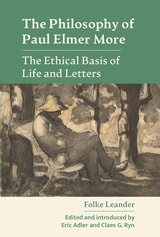
The Philosophy of Paul Elmer More
The Ethical Basis of Life and LettersFolke Leander
University of Missouri Press, 2026
Folke Leander (1910-1981) was a prolific and internationally known Swedish philosopher. He is best known in the United States as an explicator of the New Humanism, an informal movement of literary and cultural criticism founded by Paul Elmer More (1864-1937) and Irving Babbitt (1865-1933).
Leander’s manuscript for The Philosophy of Paul Elmer More was completed in the early 1970s, but because of the academic environment at the time and the book’s special philosophical focus, Leander was unable to find a publisher. Since then, the work existed only as a typescript, a copy of which he left with Claes G. Ryn, his former student and collaborator, in the hope that one day in more favorable intellectual circumstances it might be published.
Leander is rare among the scholars of the New Humanism for his first-rate philosophical training, depth of insight, and clarity of expression. In The Philosophy of Paul Elmer More he grapples carefully and precisely with the most fundamental tenets of the New Humanism. Although very supportive of the movement, Leander provides essential critiques of its contentions—and even improves upon some of them in crucial respects. In a series of concise, limpid chapters, he explains and assesses such fundamental—but often hazily understood—Humanist concepts as the “inner check,” “naturalism,” and “the higher will.” The result is a book essential for anyone who wants to understand the New Humanism.
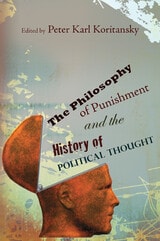
The Philosophy of Punishment and the History of Political Thought
Edited by Peter Karl Koritansky
University of Missouri Press, 2011
For the last half century, the philosophical debates over punishment have been deadlocked at two schools of thought: Utilitarianism and Retributivism. In his introduction, Koritansky provides an overview of the stymied debate by analyzing H. L. A. Hart’s argument for a philosophy unifying the theories of Utilitarianism and Retributivism. While Koritansky allows that both theories have contributed substantially to the contemporary understanding of punishment, he points out that Hart’s lack of success in combining these theories proves that both are less than ideal. From this starting point, Koritansky urges transcendence from these two theories in order to respond to new developments and circumstances surrounding the enactment of punishment today.
Conveniently divided into three sections, the book explores pagan and Christian premodern thought; early modern thought, culminating in chapters on Kant and classic Utilitarianism; and postmodern thought as exemplified in the theories of Nietzsche and Foucault. In all, the essays probe the work of Plato, Saint Augustine, Saint Thomas Aquinas, Thomas Hobbes, Immanuel Kant, Cesere Beccaria, Jeremy Bentham, John Stuart Mill, Friedrich Nietzsche, and Michel Foucault.
These essays devoted to the philosophy of punishment from the perspective of political thought delve deep into key contributions from thinkers of all eras to help further debates on punishment, provide the history of political thought in order to trace changes and effects on future theories, as well as expose the roots of the two prevailing schools of thought. This collection will engage all social scientists interested in the issue of punishment and energize the ongoing debate surrounding this complex issue.
The Political Sublime
Michael J. Shapiro
Duke University Press, 2018
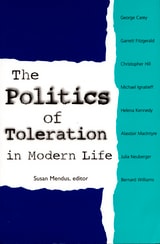
The Politics of Toleration in Modern Life
Susan Mendus, ed.
Duke University Press, 1999
How can toleration be fostered in a contentious and tightly populated world? What situations and fears have historically fed attitudes of intolerance? When and how should states intervene? The authors of these essays seek answers to such questions and examine topics such as why certain national groups are especially vulnerable to intolerance and narcissistic fantasies and how the colonial view of intolerant exploitation as an acceptable norm of behavior has been replaced by a drive toward international solidarity. The essays address religious tolerance, the role of toleration in legal contexts, the philosophical justification of tolerance, and the concept of solidarity. Ethnic identity, nationalism, the “goods of conflict,” and the treatment of refugees seeking asylum are discussed as well. While one contributor argues that a moment of genuine tolerance is achieved only when there is a cost involved in the act of tolerating another person’s way of living, another stresses that rational, communal dialogue can only take place if the state is excluded from the discussion, if conflict is recognized as valuable, and if local communities come to consensus about what behavior and discourse is intolerable.
Offering an accessible and engaging commentary on the concept of tolerance, The Politics of Toleration in Modern Life will interest a wide range of readers of philosophy, political science, religion, sociology, and history.
Contributors. George Carey, Christopher Hill, Michael Ignatieff, Helena Kennedy, Alasdair MacIntyre, Susan Mendus, Julia Neuberger, Bernard Williams
The Possibility of Practical Reason
J. David Velleman
Michigan Publishing Services, 2015
The Postgenomic Condition
Ethics, Justice, and Knowledge after the GenomeJenny Reardon
University of Chicago Press, 2017
Drawing on more than a decade of research—in molecular biology labs, commercial startups, governmental agencies, and civic spaces—Reardon demonstrates how the extensive efforts to transform genomics from high tech informatics practiced by a few to meaningful knowledge beneficial to all exposed the limits of long-cherished liberal modes of knowing and governing life. Those in the American South challenged the value of being included in genomics when no hospital served their community. Ethicists and lawyers charged with overseeing Scottish DNA and data questioned how to develop a system of ownership for these resources when their capacity to create things of value—new personalized treatments—remained largely unrealized. Molecular biologists who pioneered genomics asked whether their practices of thinking could survive the deluge of data produced by the growing power of sequencing machines. While the media is filled with grand visions of precision medicine, The Postgenomic Condition shares these actual challenges of the scientists, entrepreneurs, policy makers, bioethicists, lawyers, and patient advocates who sought to leverage liberal democratic practices to render genomic data a new source of meaning and value for interpreting and caring for life. It brings into rich empirical focus the resulting hard on-the-ground questions about how to know and live on a depleted but data-rich, interconnected yet fractured planet, where technoscience garners significant resources, but deeper questions of knowledge and justice urgently demand attention.
The Practices of the Self
Charles Larmore
University of Chicago Press, 2010
What is the nature of the fundamental relation we have to ourselves that makes each of us a self? To answer this question, Charles Larmore develops a systematic theory of the self, challenging the widespread view that the self’s defining relation to itself is to have an immediate knowledge of its own thoughts. On the contrary, Larmore maintains, our essential relation to ourselves is practical, as is clear when we consider the nature of belief and desire. For to believe or desire something consists in committing ourselves to thinking and acting in accord with the presumed truth of our belief or the presumed value of what we desire.
Larmore develops this conception with frequent reference to such classic authors as Montaigne, Stendhal, and Proust and by comparing it to other views of the self in contemporary philosophy. He also discusses the important ethical consequences of his theory of the self, arguing that it allows us to better grasp what it means to be ourselves and why self-understanding often involves self-creation.
Winner of the Académie Française’s Grand Prix de Philosophie, The Practices of the Self is that rare kind of lucid yet rigorous work that transcends disciplinary boundaries.
The Price of Our Values
The Economic Limits of Moral LifeAugustin Landier and David Thesmar
University of Chicago Press, 2025
The economic case for self-interest at the outer limits of being morally good.
Modern life is an exercise in discomfort. In the face of endless injustice, how much selfishness is permissible? How do we square suffering elsewhere with our hope to thrive at home? How does one strive for the greater good while guarding one's personal interests? The Price of Our Values argues that the answers to these questions are economic: by weighing our sense of the personal costs associated with the outer limits of our moral beliefs.
These tradeoffs—the want to be good, the personal costs of being good, and the points at which people abandon goodness due to its costs—are somewhat unsettling. But as economists Augustin Landier and David Thesmar show, they are highly predictable, even justified. Our values guide us, but we are also forced to consider economic costs to settle decisions.
The Price of Our Values is an economic reckoning with the universal unease of contemporary moral life. Wielding insights from the philosophical founders of the field, Landier and Thesmar provide frameworks for thinking about the place of values—justice, freedom, beauty— in the decisions of modern life. They do so in terms that seek to be consistent with both our good intentions and their limits.
The Right To Privacy
Gays, Lesbians, and the ConstitutionVincent J. Samar
Temple University Press, 1992
Where did the right to privacy come from and what does it mean? Grappling with the critical issues involving women and gays that relate to the recent Supreme Court appointment, Vincent J. Samar develops a definition of legal privacy, discusses the reasons why and the degree to which privacy should be protected, and shows the relationship between privacy and personal autonomy. He answers former Supreme Court nominee Robert Bork’s questions about scope, content, and legal justification for a general right to privacy and emphasizes issues involving gays and lesbians, Samar maintains that these privacy issues share a common constitutional-ethical underpinning with issues such as abortion, surrogate motherhood, drug testing, and the right to die.
The Roots Of Thinking
Maxine Sheets-Johnstone
Temple University Press, 1990

The Scope of Morality
Peter A. French
University of Minnesota Press, 1980
The Scope of Morality was first published in 1980. Minnesota Archive Editions uses digital technology to make long-unavailable books once again accessible, and are published unaltered from the original University of Minnesota Press editions.
The scope of morality, Peter A. French contends, is much narrower than many traditional and contemporary works in ethical theory suggest. We trivialize morality if we think it has something to say about everything we do; it touches us all, but not at all times.
This essay in philosophical ethics focuses upon the origin, purpose, and function of the various concepts to be found in a more or less mature morality. The author draws a distinction between moral concepts that arise from an individual's wish to live a worthwhile life and those directed towards the development of virtue in the moral community. Moral concepts, in his view, are subjective creations of human beings rather than laws with an objective basis in nature. The ethics of sociobiology, of the lifeboat and spaceship models, and of game theory all come under his critical eye in this useful and progressive work. The Scope of Morality, says Hector-Neri Castaneda, "represents a serious effort at discussing the nature of morality, taking into account the most important contributions of recent writers."
The Selected Writings of John Witherspoon
Edited by Thomas P. Miller
Southern Illinois University Press, 1990
The Social Contract in the Ruins
Natural Law and Government by ConsentPaul R. DeHart
University of Missouri Press, 2024
Most scholars who write on social contract and classical natural law perceive an irreconcilable tension between them. Social contract theory is widely considered the political-theoretic concomitant of modern philosophy. Against the regnant view, The Social Contract in the Ruins, argues that all attempts to ground political authority and obligation in agreement alone are logically self-defeating. Political authority and obligation require an antecedent moral ground. But this moral ground cannot be constructed by human agreement or created by sheer will—human or divine. All accounts of morality as constructed or made collapse into self-referential incoherence. Only an uncreated, real good can coherently ground political authority and obligation or the proposition that rightful government depends on the consent of the governed. Government by consent requires classical natural law for its very coherence.

The Study of Religion in an Age of Global Dialogue
Leonard Swidler
Temple University Press, 2000
What is religion? As this comprehensive work shows, religion is an explanation of the ultimate meaning of life and how to live accordingly, based on a notion of the Transcendent. Normally it contains the four "C's": Creed, Code, Cult, Community-structure.
This volume looks at the ways we humans have developed to study religion. It also examines the new age in human consciousness that is now drawing. It also examines the new age in human consciousness that is now dawning: The Age of Global Dialogue, a radically new consciousness that shifts the ways we understand everything in life, including religion. This global dialogical way of understanding life does not lead to one global religion, but it does lead toward a consciously acknowledged common set of ethical principles, a Global Ethic. The book looks at these two movements -- the Age of Global Dialogue and inchoative Global Ethic -- in order to help readers understand what is going on around them, so they may make informed, intelligent decisions about the meaning of life and how to live it.
The Tanner Lectures Vol 25
Grethe B Peterson
University of Utah Press, 2005
The Tanner Lectures Vol 26
Peterson, Grethe B
University of Utah Press, 2006
The Tanner Lectures Vol 27
Grethe B Peterson
University of Utah Press, 2007
The Tanner Lectures on Human Values
Volume 32Mark Matheson
University of Utah Press, 2013
John Broome, “The Public and Private Morality of Climate Change”
John Broome is the Whites Professor of Moral Philosophy at the University of Oxford and a fellow of Corpus Christi College in Oxford. He has written six books.
John M. Cooper, “Ancient Philosophies as Ways of Life”
John Cooper is the Henry Putnam University Professor of Philosophy at Princeton University. His books include Pursuits of Wisdom: Six Ways of Ancient Philosophy from Socrates to Plotinus and Panentheism: The Other God of the Philosophers.
Stephen Greenblatt, “Shakespeare and the End of Life History”
Stephen Greenblatt is the John Cogan University Professor of the Humanities at Harvard University. He is the author of several books, including the 2012 Pulitzer Prize–winning The Swerve: How the World Became Modern and Will in the World: How Shakespeare Became Shakespeare.
Lisa Jardine, “The Sorcerer’s Apprentice: C. P. Snow and J. Bronowski” and “Science and Government: C. P. Snow and the Corridors of Power”
Lisa Jardine is a professor of Renaissance studies at University College London, where she is the director of the Interdisciplinary Centre for Research in the Humanities and the Centre for Editing Lives and Letters. She has published more than fifty scholarly articles and seventeen books, including Going Dutch: How England Plundered Holland’s Glory.
Samuel Scheffler, “The Afterlife”
Samuel Scheffler is University Professor and a professor of philosophy and law at New York University. He has published four books in the areas of moral and political philosophy, including Equality and Tradition.
Abraham Verghese, “Two Souls Intertwined”
Abraham Verghese is a professor of medicine and senior associate chair for the Theory and Practice of Medicine at Stanford University. He has published widely across disciplines, including My Own Country: A Doctor’s Story and the novel Cutting for Stone. He is perhaps best known for his deep interest in bedside medicine and work in the medical humanities.
The Tanner Lectures on Human Values
Volume 34Mark Matheson
University of Utah Press, 2016
The Tanner Lectures on Human Values, founded July 1, 1978, at Clare Hall, Cambridge University, was established by the American scholar, industrialist, and philanthropist Obert Clark Tanner. Lectureships are awarded to outstanding scholars or leaders in broadly defined fields of human values and transcend ethnic, national, religious, or ideological distinctions. Volume 34 features lectures given during the academic year 2013 to 2014 at the University of Oxford; Stanford University; the University of Utah; and Yale University.
Shami Chakrabarti, Liberty Organization (formerly National Council for Civil Liberties)
“Human Rights as Human Values”
Paul Gilroy, King’s College London
“The Black Atlantic and Re-enchantment of Humanism”
Bruno Latour, Institut d’etudes politiques (Sciences Po) Paris “How Better to Register the Agency of Things”
Nicholas Lemann, Columbia University School of Journalism “The Turn Against Institutions” and “What Transactions Can’t Do”
Andrew Solomon, Author
“Love, Acceptance, Celebration: How Parents Make Their Children”
The Theory of Morality
Alan Donagan
University of Chicago Press, 1977
"The man value of this book seems to me to be that it shows the force of the Hebrew-Christian moral tradition in the hands of a creative philosopher. Throughout the book, one cannot but feel that a serious philosopher is trying to come to terms with his religious-moral background and to defend it against the prevailing secular utilitarian position which seems to dominate academic philosophy."—Bernard Gert, Journal of Medicine and Philosophy
The Three Ethologies
A Positive Vision for Rebuilding Human-Animal RelationshipsMatthew Calarco
University of Chicago Press, 2024
The Three Ethologies offers a fresh, affirmative vision for rebuilding human-animal relations. Venturing beyond the usual scholarly and activist emphasis on restricting harm, Matthew Calarco develops a new philosophy for understanding animal behavior—a practice known as ethology—through three distinct but interrelated lenses: mental ethology, which rebuilds individual subjectivity; social ethology, which rethinks our communal relations; and environmental ethology, which reconfigures our relationship to the land we co-inhabit with our animal kin. Drawing on developments in philosophy, (eco)feminist theory, critical geography, Indigenous studies, and the environmental humanities, Calarco casts an inspiring vision of how ethological living can help us to reimagine our ideas about goodness, truth, and beauty.
The Ties That Bind
Julius M. Moravcsik
Central European University Press, 2004
The Tragedy and Comedy of Life
Plato's PhilebusPlato
University of Chicago Press, 1993
In The Tragedy and Comedy of Life, Seth Benardete focuses on the idea of the good in what is widely regarded as one of Plato's most challenging and complex dialogues, the Philebus. Traditionally the Philebus is interpreted as affirming the doctrine that the good resides in thought and mind rather than in pleasure or the body. Benardete challenges this view, arguing that Socrates vindicates the life of the mind over the life of pleasure not by separating the two and advocating a strict asceticism, but by mixing pleasure and pain with mind in such a way that the philosophic life emerges as the only possible human life.
Benardete combines a probing and challenging commentary that subtly mirrors and illuminates the complexities of this dialogue with the finest English translation of the Philebus yet available. The result is a work that will be of great value to classicists, philosophers, and political theorists alike.
The Underclass Question
Bill Lawson
Temple University Press, 1992
The Unheeded Cry
Animal Consciousness, Animal Pain, and ScienceBernard Rollin
University of Missouri Press, 2017
Bernard Rollin offers welcome insight into questions like this in his ground-breaking account of the difficult and controversial issues surrounding the use of animals. He demonstrates that the denial of animal consciousness and animal suffering is not an essential feature of a scientific approach, but rather a contingent, historical aberration that can and must be changed if science is to be both coherent and morally responsible. Widely hailed by advocates of animal welfare and scientists alike on its first appearance, the book now includes an epilogue by the author describing what has changed, and what hasn’t, in this use of animals in scientific research and food production.
The Unnatural Lottery
Character and Moral LuckClaudia Card
Temple University Press, 1996
The opportunities to become a good person are not the same for everyone. Modern European ethical theory, especially Kantian ethics, assumes the same virtues are accessible to all who are capable of rational choice. Character development, however, is affected by circumstances, such as those of wealth and socially constructed categories of gender, race, and sexual orientation, which introduce factors beyond the control of individuals. Implications of these influences for morality have, since the work of Williams and Nagel in the seventies, raised questions in philosophy about the concept of moral luck. In The Unnatural Lottery, Claudia Card examines how luck enters into moral character and considers how some of those who are oppressed can develop responsibility.
Luck is often best appreciated by those who have known relatively bad luck and have been unable to escape steady comparison of their lot with those of others. The author takes as her paradigms the luck of middle and lower classes of women who face violence and exploitation, of lesbians who face continuing pressure to hide or self-destruct, of culturally Christian whites who have ethnic privilege, and of adult survivors of child abuse. How have such people been affected by luck in who they are and can become, the good lives available to them, the evils they may be liable to embody? Other philosophers have explored the luck of those who begin from privileged positions and then suffer reversals of fortune. Claudia Card focuses on the more common cases of those who begin from socially disadvantaged positions, and she considers some who find their good luck troubling when its source is the unnatural lottery of social injustice.
The Urgings of Conscience
A Theory of PunishmentJacob Adler
Temple University Press, 1992
While most philosophers who write about punishment ask, "Why may we punish the guilty?" Jacob Adler asks, "To what extent does a guilty person have a duty to submit to punishment?" He maintains that if we are to justify any system of punishment by the state, we must explain why persons guilty of an offense are morally bound to submit to punitive treatment, or to undertake it on their own. Using Rawls's theory of social contract as a framework, the author presents what he calls the rectification theory of punishment.
After examining punishment from two points of view—that of the punisher and that of the offender who is to be punished—Adler proposes the Paradigm of the Conscientious Punishee: a repentant wrongdoer who views punishment as not necessarily unpleasant, but as something it is morally incumbent upon one to undertake. The author argues that this paradigm must play a central role in the theory of punishment. Citing community service projects and penances for sin (as required by some religions), Adler argues that punishment need not involve pain or any other disvalue. Instead he defines it in terms of its justificatiory connection with wrongdoing: punishment is that which is justified by the prior commission of an offense and generally not justified without the prior commission of an offense.
The rectification theory applies particularly to offenses involving basic liberties. It is based on the assumption that each person is guaranteed the right to an inviolable sphere of liberty. Someone who commits an offense has expanded his or her sphere by arrogating excess liberties. In order to maintain the equality on which this theory rests, an equivalent body of liberties must be given up. In discussing applications of the theory, Adler demonstrates that active service (as punishment) is more effective in safeguarding important rights and interests and maintaining the social contract than is afflictive punishment.
The Way to Hell
Machiavelli for Catastrophic TimesNathan Crick
University of Alabama Press, 2024
An incisive and erudite survey of Machiavelli, the catastrophes of his times and ours, and his counsel for responding to an era of constant crises.
Catastrophe looms. Political, environmental, epidemic, and military crises arrive with increasing frequency. In The Way to Hell, Nathan Crick argues that our perilous times call for the strongest medicine in the Western canon: Machiavelli. Crick reminds contemporary readers about the Florentine master’s advice—that one must learn the road to Hell precisely to avoid taking it.
Like a knowledgeable friend, Crick offers contemporary readers a guide to Machiavelli’s world, work, and warnings. He takes in the sweep of Western history, comparing Machiavelli’s work with ancient sources such as Cicero and Thucydides. And as Machiavelli has never stopped provoking comment, Crick treats readers to a feast of responses to Machiavelli’s work—caustic, learned, and humorous—in the five centuries since he lived.
Including both Machiavelli’s best-known works, The Prince and Discourses on Livy, as well as his personal correspondence and comic plays, Crick asks anew the questions that bedeviled Machiavelli’s beloved Florentine republic: When is force necessary? When are lies justified? Is cruelty defensible? When does social protest slip into violent revolution? What is the correct response to catastrophe?
Like Machiavelli himself, The Way to Hell is witty, stimulating, and challenging. In a world seemingly on the road to Hell, Machiavelli offers an alternative route. His bracing vision exhorts readers to see the dangers in their path and to take action with vigor and determination. Far from a vision of cynicism, Machiavelli offers a beacon of hope for a world that seems on the brink.
The modeling of nature
philosophy of science and philosophy of nature in synthesisWilliam A Wallace
Catholic University of America Press, 1996

Theory as Practice
Ethical Inquiry in the RenaissanceNancy S. Struever
University of Chicago Press, 1992
Struever argues that the accomplishment of five major Renaissance figures—Petrarch, Nicolaus Cusanus, Lorenzo Valla, Machiavelli, and Montaigne—was to consider theory as practice and thus engage the ethics of inquiry. She notes three stages of investigation, the first represented by Petrarch, who "relocated" ethical inquiry from a theoretical realm to a familiar practice responsive to daily experience.
Thinking Plant Animal Human
Encounters with Communities of DifferenceDavid Wood
University of Minnesota Press, 2020
Collected essays by a leading philosopher situating the question of the animal in the broader context of a relational ontology
There is a revolution under way in our thinking about animals and, indeed, life in general, particularly in the West. The very words man, animal, and life have turned into flimsy conceptual husks—impediments to thinking about the issues in which they are embroiled. David Wood was a founding member of the early 1970s Oxford Group of philosophers promoting animal rights; he also directed Ecology Action (UK). Thinking Plant Animal Human is the first collection of this major philosopher’s influential essays on “animals,” bringing together his many discussions of nonhuman life, including the classic “Thinking with Cats.”
Exploring our connections with cats, goats, and sand crabs, Thinking Plant Animal Human introduces the idea of “kinnibalism” (the eating of mammals is eating our own kin), reflects on the idea of homo sapiens, and explores the place of animals both in art and in children’s stories. Finally, and with a special focus on trees, the book delves into remarkable contemporary efforts to rescue plants from philosophical neglect and to rethink and reevaluate their status. Repeatedly bubbling to the surface is the remarkable strangeness of other forms of life, a strangeness that extends to the human.
Wood shows that the best way of resisting simplistic classification is to attend to our manifold relationships with other living beings. It is not anthropocentric to focus on such relationships; they cast light in complex ways on the living communities of which we are part, and exploring them recoils profoundly on our understanding of ourselves.

Thomas Aquinas on Faith, Hope, and Love
A Summa of the Summa on the Theological VirtuesChristopher Kaczor
Catholic University of America Press, 2020

Thomas Aquinas on the Cardinal Virtues
A Summa of the Summa on Prudence, Justice, Temperance, and CourageChristopher Kaczor
Catholic University of America Press, 2020
Thoughts and Things
Leo Bersani
University of Chicago Press, 2014
Thoughts and Things posits what would appear to be an irreducible gap between our thoughts (the human subject) and things (the world). Bersani departs from his psychoanalytic convictions to speculate on the oneness of being—of our intrinsic connectedness to the other that is at once external and internal to us. He addresses the problem of formulating ways to consider the undivided mind, drawing on various sources, from Descartes to cosmology, Freud, and Genet and succeeds brilliantly in diagramming new forms as well as radical failures of connectedness. Ambitious, original, and eloquent, Thoughts and Things will be of interest to scholars in philosophy, film, literature, and beyond.
Through a Vegan Studies Lens
Textual Ethics and Lived ActivismLaura Wright
University of Nevada Press, 2019
Veganism is a practice that allows for environmentally responsible consumer choices that are viewed, particularly in the West, as oppositional to an economy that is largely dependent upon big agriculture. This groundbreaking collection exposes this disruption, critiques it, and offers a new roadmap for navigating and reimaging popular culture representations on veganism. These essays engage a wide variety of political, historical, and cultural issues, including contemporary political and social circumstances, emergent veganism in Eastern Europe, climate change, and the Syrian refugee crisis, among other topics.
Through a Vegan Studies Lens significantly furthers the conversation of what a vegan studies perspective can be and illustrates why it should be an integral part of cultural studies and critical theory. Vegan studies is inclusive, refusing to ignore the displacement, abuse, and mistreatment of nonhuman animals. It also looks to ignite conversations about cultural oppression.
To Flourish or Destruct
A Personalist Theory of Human Goods, Motivations, Failure, and EvilChristian Smith
University of Chicago Press, 2015
In his 2010 book What Is a Person?, Christian Smith argued that sociology had for too long neglected this fundamental question. Prevailing social theories, he wrote, do not adequately “capture our deep subjective experience as persons, crucial dimensions of the richness of our own lived lives, what thinkers in previous ages might have called our ‘souls’ or ‘hearts.’” Building on Smith’s previous work, To Flourish or Destruct examines the motivations intrinsic to this subjective experience: Why do people do what they do? How can we explain the activity that gives rise to all human social life and social structures?
Smith argues that our actions stem from a motivation to realize what he calls natural human goods: ends that are, by nature, constitutionally good for all human beings. He goes on to explore the ways we can and do fail to realize these ends—a failure that can result in varying gradations of evil. Rooted in critical realism and informed by work in philosophy, psychology, and other fields, Smith’s ambitious book situates the idea of personhood at the center of our attempts to understand how we might shape good human lives and societies.
Toleration
Nicholas G. Fotion
University of Alabama Press, 1992
A compelling exploration of the idea that enables diverse people to live together with respect, dignity, and understanding.
Most regard toleration as an unattractive fallback position of compromise and so tend to overlook it in favor of such active concepts as freedom, equality, and justice. Fotion and Elfstrom argue that toleration offers us the useful possibility of responding to a difficult situation with a degree of flexibility not possible with the dichotomous concepts of good-bad, right-wrong, ethical-unethical, Right-Left.
Tolerating saturates ordinary human life and infuses public discussions of religion, morality, and politics. It forms a major strand in the history of Western European thought. Yet the word “toleration” and similar terms are rarely used. Unnoticed and unremarked, they are like the air that surrounds us, vitally important yet invisible.The authors seek to address this oversight in several ways. They begin with a thorough conceptual analysis of toleration and its kindred concepts. They are convinced that an appreciation of the importance of the family of toleration concepts must be founded on an understanding of the various ways in which they function in our language and our lives. In addition, they examine the historical development of the concept of toleration and canvass the major arguments people have employed either to urge toleration or to disparage it. They examine the role of toleration in liberal political philosophy and respond to the major critics of liberal toleration.
The authors also discuss a number of factors that cause toleration to be overlooked in political debate and personal reflection and offer evidence to support the view that this omission is unfortunate. In particular, they argue that toleration has the crucial role of helping people live with one another with respect and dignity in the fractious and contentious world we inhabit. With the rise of racism and other forms of religious, political, and social intolerance, people on all sides of the present debates concerning multi-culturalism and diversity will benefit from this timely and lucidly argued philosophical discussion of the concepts of toleration and its possible application in a less-than-perfect world.
Torture and Dignity
An Essay on Moral InjuryJ. M. Bernstein
University of Chicago Press, 2015
Beginning with the attempts to abolish torture in the eighteenth century, and then sensitively examining what is suffered in torture and related transgressions, such as rape, Bernstein elaborates a powerful new conception of moral injury. Crucially, he shows, moral injury always involves an injury to the status of an individual as a person—it is a violent assault against his or her dignity. Elaborating on this critical element of moral injury, he demonstrates that the mutual recognitions of trust form the invisible substance of our moral lives, that dignity is a fragile social possession, and that the perspective of ourselves as potential victims is an ineliminable feature of everyday moral experience.

Torture and the War on Terror
Tzvetan Todorov
Seagull Books, 2009
One of the world's leading intellectuals dismantles the political and ethical justifications for institutional torture.
In the aftermath of 9/11, the US government approved interrogation tactics for enemy combatant detainees that could be defined as torture, which was outlawed in Europe in the eighteenth century and forbidden by the Geneva Conventions and the United Nations Convention Against Torture. In conjunction with these policies, the Bush administration vocally defended torture as a necessary tool in its Global War on Terror. Though the election of Barack Obama and his signing of the executive order to close the prison at Guantanamo Bay signaled a considerable shift away from the policies of the Bush era, the lessons to be learned from the Global War on Terror will remain relevant and necessary for many years to come.
In Torture and the War on Terror, Tzvetan Todorov argues that the use of the terms “war” and “terror” dehumanizes the enemy and permits treatment that would otherwise be impermissible. He examines the implications and corrupting impact of the attempt to impose “good” through violence and spread democratic values by unethical means. Todorov asks: Can violence overcome violence? Does the need to protect one’s own country justify violating human rights? Challenging one by one the political and ethical arguments in favor of torture, Todorov likens institutional torture to a cancer that is eroding our society and undermining the very fundamental democratic ideas of justice and right.
Toward Better Problems
New Perspectives on Abortion, Animal Rights, the Environment, and JusticeAnthony Weston
Temple University Press, 1992
Tracking the Meaning of Life
A Philosophical JourneyYuval Lurie
University of Missouri Press, 2006