Results by title
715 books match the query 'Higher' and 168 start with t

The Chicago Handbook for Teachers
A Practical Guide to the College ClassroomAlan Brinkley, Betty Dessants, Michael Flamm, Cynthia Fleming, Charles Forcey, and Eric Rothschild
University of Chicago Press, 1999
The Chicago Handbook for Teachers is an extraordinarily helpful guide for all those who face the challenge of putting together material for a course and then making it work. Representing teachers at all stages of their careers, the authors, including distinguished historian Alan Brinkley, offer practical advice for almost any situation a new teacher might face, from preparing a syllabus to managing classroom dynamics. Beginning with a nuts and bolts plan for designing a course, the handbook also explains how to lead a discussion, evaluate your own teaching, deliver an effective lecture, supervise students' writing and research, create and grade exams, and more. Other sections address the less straightforward aspects of teaching, such as dealing with "diversity issues" and knowing where to draw the line in relationships with students. Particularly timely is an up-to-date discussion of when and how best to incorporate the Internet and other electronic resources into your teaching.
Indispensable for graduate students and new teachers, The Chicago Handbook for Teachers is also a useful refresher for the experienced professionals.
The Chicago Handbook of University Technology Transfer and Academic Entrepreneurship
Edited by Albert N. Link, Donald S. Siegel, and Mike Wright
University of Chicago Press, 2015
The Chicago Handbook of University Technology Transfer and Academic Entrepreneurship is the first definitive source to synthesize state-of-the-art research in this arena. Edited by three of the foremost experts in the field, the handbook presents evidence from entrepreneurs, administrators, regulators, and professors in numerous disciplines. Together they address the key managerial and policy implications through chapters on how to sustain successful research ventures, ways to stimulate academic entrepreneurship, maintain effective open innovation strategies, and improve the performance of university technology transfer offices.
A broad and ambitious work, the handbook offers comprehensive coverage for universities of all types, allowing them to confidently handle technology commercialization and further cultivate innovation.
The Community-Based PhD
Complexities and Triumphs of Conducting CBPREdited by Sonya Atalay and Alexandra McCleary
University of Arizona Press, 2022
The Community-Based PhD brings together the experiences of PhD students from a range of disciplines discussing CBPR in the arts, humanities, social sciences, public health, and STEM fields. They write honestly about what worked, what didn’t, and what they learned. Essays address the impacts of extended research time frames, why specialized skill sets may be needed to develop community-driven research priorities, the value of effective relationship building with community partners, and how to understand and navigate inter- and intra-community politics.
This volume provides frameworks for approaching dilemmas that graduate student CBPR researchers face. They discuss their mistakes, document their successes, and also share painful failures and missteps, viewing them as valuable opportunities for learning and pushing the field forward. Several chapters are co-authored by community partners and provide insights from diverse community perspectives. The Community-Based PhD is essential reading for graduate students, scholars, and the faculty who mentor them in a way that truly crosses disciplinary boundaries.
Contributors: Anna S. Antoniou, Amy Argenal, Sonya Atalay, Stacey Michelle Chimimba Ault, Victoria Bochniak, Megan Butler, Elias Capello, Ashley Collier-Oxandale, Samantha Cornelius, Annie Danis, Earl Davis, John Doyle, Margaret J. Eggers, Cyndy Margarita García-Weyandt, R. Neil Greene, D. Kalani Heinz, Nicole Kaechele, Myra J. Lefthand, Emily Jean Leischner, Christopher B. Lowman, Geraldine Low-Sabado, Alexandra G. Martin, Christine Martin, Alexandra McCleary, Chelsea Meloche, Bonnie Newsom, Katherine L. Nichols, Claire Novotny, Nunanta (Iris Siwallace), Reidunn H. Nygård, Francesco Ripanti, Elena Sesma, Eric Simons, Cassie Lynn Smith, Tanupreet Suri, Emery Three Irons, Arianna Trott, Cecilia I. Vasquez, Kelly D. Wiltshire, Julie Woods, Sara L. Young
The Concept of Academic Freedom
Edited by Edmund L. Pincoffs
University of Texas Press, 1975
Most professors and administrators are aware that academic freedom is in danger of being brushed aside by a public that has little understanding of what is at stake. They may be only marginally aware that the defense of academic freedom is endangered by certain confusions concerning the nature of academic freedom, the criteria for its violation, and the structure of an adequate justification for claims to it. These confusions were enshrined in some of the central documents on the subject, including the 1940 Statement on Academic Freedom and Tenure, agreed upon by the American Association of University Professors and the Association of American Colleges and endorsed by many professional organizations. Careful analysis of them will not do away with debate; it will bring the debate into focus, so that attacks on academic freedom can be appraised as near or far away from the center of the target and can then be appropriately answered.
Nearly all the contemporary writing on academic freedom consists of attack or defense. The Concept of Academic Freedom is the first book to deal exclusively with fundamental conceptual issues underlying the battle. In the discussion of these issues, certain philosophical positions crystallize: radical versus liberal conceptions of the status and function of university teachers, specific versus general theories of academic freedom, consequential versus nonconsequential theories of justification. Partisans (and enemies) of academic freedom would do well to decide on which side of these divisions they stand, or how they would mediate between sides. Otherwise many questions will remain unclear: What is under discussion—a special right peculiar to academics or a general right that is especially important to academics? Is justification of that right possible? Can the right be derived from other rights, or from the theory of justice or of democratic society? Or is the argument for academic freedom one that more properly turns on the consequences for society as a whole if that freedom is not protected?
The essays in this book explore these and other problems concerning the defense of academic freedom by radicals, the justification for disruption on campus, and the control of research.
Contributors to the volume include Hugo Adam Bedau, Bertram H. Davis, Milton Fisk, Graham Hughes, Alan Pasch, Hardy E. Jones, Alexander Ritchie, Amelie Oksenberg Rorty, Rolf Sartorius, T. M. Scanlon, Richard Schmitt, John R. Searle, Judith Jarvis Thomson, and William Van Alstyne. All are outstanding in their fields. Many have had practical experience in the legal profession or with the American Association of University Professors on the issue of academic freedom.
The Conscience of the University, and Other Essays
By Harry Huntt Ransom
University of Texas Press, 1982
In 1982, a century after the laying of the cornerstone of its first building, the University of Texas was ranked by the New York Times among the best in the nation. No one had more to do with that extraordinary achievement than Harry Huntt Ransom. From 1935 to his death in 1976, he served the University in positions ranging from instructor in English to chancellor of The University of Texas System. In the fifties, sixties, and seventies, he held a succession of administrative posts requiring him to face a myriad of perplexing problems. Among the critical issues calling for analysis and decision in those years were the post-Sputnik pressure for greater emphasis on science and technology, the student revolts during the 1960s, and the defection of growing numbers of university faculty to industry and government.
Harry Huntt Ransom did not merely respond to the problems of the times. He had his own large ambitions for the University of Texas, in particular the improvement of student programs, the development of a vigorous faculty, and—the achievement for which he is best remembered—the building of a world-renowned library.
He was concerned with the role of the university in society, what the university should do and do well, and what it should not do. Always he viewed these matters in broad perspective, and his approach to them was far-sighted and deeply philosophical.
As dean, vice-president, president, and chancellor, Ransom wrote and spoke often on these and other important subjects. Aside from the books that he wrote and edited, he left a prodigious amount of material, some of which had been published in various journals and some of which had been delivered as lectures and addresses and never made available in printed form.
For the last twenty-five years of Ransom's life his wife, Hazel, was his closest companion and confidant. At the urging of Harry's friends, colleagues, and admirers, she undertook the task of sifting through her late husband's papers in an effort to organize and preserve some of the important contributions he had made to the thought and planning that were so instrumental in shaping the University of Texas and higher education in general. In these essays we see the force of reasoning and grace of style for which Ransom was so widely admired. It was he who reminded us that books last longer than buildings. This is a book of lasting importance that Harry Ransom himself might have given us had he lived longer.
The Cost of Inclusion
How Student Conformity Leads to Inequality on College CampusesBlake R. Silver
University of Chicago Press, 2020
Blake R. Silver spent a year immersed in student life at a large public university. He trained with the Cardio Club, hung out with the Learning Community, and hosted service events with the Volunteer Collective. Through these day-to-day interactions, he witnessed how students sought belonging and built their social worlds on campus. Over time, Silver realized that these students only achieved inclusion at significant cost. To fit in among new peers, they clung to or were pushed into raced and gendered cultural assumptions about behavior, becoming “the cool guy,” “the nice girl,” “the funny one,” “the leader,” “the intellectual,” or “the mom of the group.” Instead of developing dynamic identities, they crafted and adhered to a cookie-cutter self, one that was rigid and two-dimensional. Silver found that these students were ill-prepared for the challenges of a diverse college campus, and that they had little guidance from their university on how to navigate the trials of social engagement or the pressures to conform. While colleges are focused on increasing the diversity of their enrolled student body, Silver’s findings show that they need to take a hard look at how they are failing to support inclusion once students arrive on campus.
The Cost of Inclusion
How Student Conformity Leads to Inequality on College CampusesBlake R. Silver
University of Chicago Press, 2020
Young people are told that college is a place where they will “find themselves” by engaging with diversity and making friendships that will last a lifetime. This vision of an inclusive, diverse social experience is a fundamental part of the image colleges sell potential students. But what really happens when students arrive on campus and enter this new social world? The Cost of Inclusion delves into this rich moment to explore the ways students seek out a sense of belonging and the sacrifices they make to fit in.
Blake R. Silver spent a year immersed in student life at a large public university. He trained with the Cardio Club, hung out with the Learning Community, and hosted service events with the Volunteer Collective. Through these day-to-day interactions, he witnessed how students sought belonging and built their social worlds on campus. Over time, Silver realized that these students only achieved inclusion at significant cost. To fit in among new peers, they clung to or were pushed into raced and gendered cultural assumptions about behavior, becoming “the cool guy,” “the nice girl,” “the funny one,” “the leader,” “the intellectual,” or “the mom of the group.” Instead of developing dynamic identities, they crafted and adhered to a cookie-cutter self, one that was rigid and two-dimensional. Silver found that these students were ill-prepared for the challenges of a diverse college campus, and that they had little guidance from their university on how to navigate the trials of social engagement or the pressures to conform. While colleges are focused on increasing the diversity of their enrolled student body, Silver’s findings show that they need to take a hard look at how they are failing to support inclusion once students arrive on campus.
The Dean's List
Leading a Modern Business SchoolMatthew A. Waller
University of Arkansas Press, 2021
The role of a dean has changed dramatically in the last few decades. In addition to managing up, down, and sideways while dealing with students, staff, and faculty, there’s a growing demand for deans to work with parents, alumni, and donors as well as business and community leaders. The Dean’s List highlights examples from Waller’s career to illustrate practical advice for dealing with the specific challenges deans regularly face. The result is a handbook for shortening the learning curve for anyone who is, or aspires to be, the dean of a business college.
The Diversity Bargain
And Other Dilemmas of Race, Admissions, and Meritocracy at Elite UniversitiesNatasha Warikoo
University of Chicago Press, 2016
What Warikoo uncovers—talking with both white students and students of color at Harvard, Brown, and Oxford—is absolutely illuminating; and some of it is positively shocking. As she shows, many elite white students understand the value of diversity abstractly, but they ignore the real problems that racial inequality causes and that diversity programs are meant to solve. They stand in fear of being labeled a racist, but they are quick to call foul should a diversity program appear at all to hamper their own chances for advancement. The most troubling result of this ambivalence is what she calls the “diversity bargain,” in which white students reluctantly agree with affirmative action as long as it benefits them by providing a diverse learning environment—racial diversity, in this way, is a commodity, a selling point on a brochure. And as Warikoo shows, universities play a big part in creating these situations. The way they talk about race on campus and the kinds of diversity programs they offer have a huge impact on student attitudes, shaping them either toward ambivalence or, in better cases, toward more productive and considerate understandings of racial difference.
Ultimately, this book demonstrates just how slippery the notions of race, merit, and privilege can be. In doing so, it asks important questions not just about college admissions but what the elite students who have succeeded at it—who will be the world’s future leaders—will do with the social inequalities of the wider world.
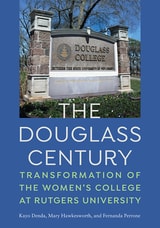
The Douglass Century
Transformation of the Women’s College at Rutgers UniversityDenda, Kayo
Rutgers University Press, 2018
The Douglass Century celebrates the college’s longevity and diversity as distinctive accomplishments, and analyzes the contributions of Douglass administrators, alumnae, and students to its survival, while also investigating multiple challenges that threatened its existence. This book demonstrates how changing historical circumstances altered the possibilities for women and the content of higher education, comparing the Jazz Age, American the Great Depression, the Second World War, the post-war Civil Rights era, and the resurgence of feminism in the 1970s and 1980s. Concluding in the present day, the authors highlight the college’s ongoing commitment to Mabel Smith Douglass’ founding vision, “to bring about an intellectual quickening, a cultural broadening in connection with specific training so that women may go out into the world fitted…for leadership…in the economic, political, and intellectual life of this nation.” In addition to providing a comprehensive history of the college, the book brings its subjects to life with eighty full-color images from the Special Collections and University Archives, Rutgers University Libraries.
The Education of Historians for Twenty-first Century
Thomas Bender, Philip M. Katz, Colin Palmer, and the Committee on Graduate Education (AHA)
University of Illinois Press, 2004
An examination and analysis of history education in American colleges and universities
In 1958, the American Historical Association began a study to determine the status and condition of history education in U.S. colleges and universities. Published in 1962 and addressing such issues as the supply and demand for teachers, student recruitment, and training for advanced degrees, that report set a lasting benchmark against which to judge the study of history thereafter. Now, more than forty years later, the AHA has commissioned a new report. The Education of Historians for the Twenty-first Century documents this important new study's remarkable conclusions.
Both the American academy and the study of history have been dramatically transformed since the original study, but doctoral programs in history have barely changed. This report from the AHA explains why and offers concrete, practical recommendations for improving the state of graduate education. The Education of Historians for the
Twenty-first Century stands as the first investigation of graduate training for historians in more than four decades and the best available study of doctoral education in any major academic discipline.
Prepared for the AHA by the Committee on Graduate Education, the report represents the combined efforts of a cross-section of the entire historical profession. It draws upon a detailed review of the existing studies and data on graduate education and builds upon this foundation with an exhaustive survey of history doctoral programs. This included actual visits to history departments across the country and consultations with scores of individual historians, graduate students, deans, academic and non-academic employers of historians, as well as other stakeholders in graduate education.
As the ethnic and gender composition of both graduate students and faculty has changed, methodologies have been refined and the domains of historical inquiry expanded. By addressing these revolutionary intellectual and demographic changes in the historical profession, The Education of Historians for the Twenty-first Century breaks important new ground. Combining a detailed historical snapshot of the profession with a rigorous analysis of these intellectual changes, this volume is ideally positioned as the definitive guide to strategic planning for history departments. It includes practical recommendations for handling institutional challenges as well as advice for everyone involved in the advanced training of historians, from department chairs to their students, and from university administrators to the AHA itself.
Although focused on history, there are lessons here for any department. The Education of Historians for the Twenty-first Century is a model for in-depth analysis of doctoral education, with recommendations and analyses that have implications for the entire academy. This volume is required reading for historians, graduate students, university administrators, or anyone interested in the future of higher education.
The Electronic Word
Democracy, Technology, and the ArtsRichard A. Lanham
University of Chicago Press, 1993
This highly acclaimed collection of Richard Lanham's witty, provocative, and engaging essays surveys the effects of electronic text on the arts and letters. Lanham explores how electronic text fulfills the expressive agenda of twentieth-century visual art and music, revolutionizes the curriculum, democratizes the instruments of art, and poses anew the cultural accountability of humanism itself.
Persuading us with uncommon grace and power that the move from book to screen gives cause for optimism, not despair, Lanham proclaims that "electronic expression has come not to destroy the Western arts but to fulfill them."
The Electronic Word is also available as a Chicago Expanded Book for your Macintosh®. This hypertext edition allows readers to move freely through the text, marking "pages," annotating passages, searching words and phrases, and immediately accessing annotations, which have been enhanced for this edition. In a special prefatory essay, Lanham introduces the features of this electronic edition and gives a vividly applied critique of this dynamic new edition.
The Elements of Construction
N. Clifford Ricker, Architecture, and the University of IllinoisN. Clifford Ricker. Edited by Marci S. Uihlein
University of Illinois Press, 2025
In addition to providing the full text, Uihlein and the contributors trace Ricker’s career and delve into his practice of teaching. Subject experts explore specific topics. Thomas Leslie surveys contemporary construction practices in Chicago. Tom F. Peters considers Ricker’s writings in the context of the time while Rachel Will looks at masonry know-how and testing. Donald Friedman examines the teaching of iron and steel construction.
An illuminating look at a field and a legacy, The Elements of Construction rediscovers a figure that shaped the teaching of architecture and trained a generation that forever changed Chicago.
The Emergence of the American University
Laurence R. Veysey
University of Chicago Press, 1965
What did the men living in this formative period want the American university to become? How did they differ in defining the ideal university? And why did the institution acquire a form that only partially corresponded with these definitions? These are the questions Mr. Veysey seeks to answer.
The End of Concern
Maoist China, Activism, and Asian StudiesFabio Lanza
Duke University Press, 2017
The English Department
A Personal and Institutional HistoryW. Ross Winterowd
Southern Illinois University Press, 1998
Tounderstand the history of "English," Ross Winterowd insists, one must understand how literary studies, composition-rhetoric studies, and influential textbooks interrelate. Stressing the interrelationship among these three forces, Winterowd presents a history of English studies in the university since the Enlightenment.
Winterowd’s history is unique in three ways. First, it tells the whole story of English studies: it does not separate the history of literary studies from that of composition-rhetoric studies, nor can it if it is going to be an authentic history. Second, it traces the massive influence on English studies exerted by textbooks such as Adventures in Literature, Understanding Poetry, English in Action, and the Harbrace College Handbook. Finally, Winterowd himself is very much a part of the story, a partisan with more than forty years of service to the discipline, not simply a disinterested scholar searching for the truth.
After demonstrating that literary studies and literary scholars are products of Romantic epistemology and values, Winterowd further invites controversy by reinterpreting the Romantic legacy inherited by English departments. His reinterpretation of major literary figures and theory, too, invites discussion, possibly argument. And by directly contradicting current histories of composition-rhetoric that allow for no points of contact with literature, Winterowd intensifies the argument by explaining the development of composition-rhetoric from the standpoint of literature and literary theory.
The Equity/Excellence Imperative
A 2030 Blueprint for Undergraduate Education at U.S. Research UniversitiesThe Boyer 2030 Commission
University Press of Colorado, 2022
In 2021, The Association for Undergraduate Education at Research Universities (UERU)—with over 100 research university members and hosted at Colorado State University since 2013—recruited The Boyer 2030 Commission. This group was co-chaired by AAU’s Barbara R. Snyder and APLU’s Peter McPherson and included 14 additional distinguished higher ed leaders. The Boyer 2030 Commission sought to update the1998 Boyer Report, the landmark publication that inspired UERU’s founding in 2000 and helped spur nearly a quarter century of progress. Upon a year of research and reflection, the Boyer 2030 Commission issued The Equity/Excellence Imperative: A Blueprint for Undergraduate Education at U.S. Research Universities, reiterating the vital importance of undergraduate education at research universities and the need to invest in meeting what they name as the equity/excellence imperative.
From the Report:
"Research university presidents/chancellors, provosts, and their senior colleagues are today called upon to lead in a challenging world of deeply entrenched inequities laid bare by a deadly pandemic; a long-overdue racial reckoning; fractured democratic institutions and frayed democratic norms; an existential planetary climate emergency; a mental health crisis affecting all ages, including and especially traditional-aged undergraduate students; and growing public disaffection with and distrust of higher education. College-going and the prestige of a college degree are in decline, and, despite efforts to recruit and retain low-income undergraduate students, new data show that research universities were serving even fewer of them prior to the pandemic, let alone as a result. The Boyer 2030 Commission Report is organized around what the Commission has termed the ‘equity/excellence imperative,’ a belief that excellence and equity are inextricably entwined, such that excellence without equity (privilege reproducing privilege) is not true excellence, and equity (mere access) without excellence is unfulfilled promise. At this pivotal moment, the Boyer 2030 Commission poses these fundamental questions:
- How can US research universities embrace the equity/excellence imperative?
- Can we commit to equity as a necessary and defining precondition of excellence?
- Can we conceive, prioritize, and invest in equitable undergraduate achievement?
- Can we educate and support undergraduates for 21st-century world readiness?
Meeting the equity/excellence imperative offers a leadership opportunity. Recognizing that diversity of mission, identity, organization, and culture is a long-standing strength of U.S. higher education, the Boyer 2030 Commission offers 11 provocations to catalyze the multiple actions needed for a research university to realize the equity/excellence imperative. This report will aid leaders as they work to meet this imperative, and millions of undergraduate students, their alma maters and broader human society will meaningfully and measurably benefit as a result."
This book is also available as an open access ebook through the UERU.
Co-Chairs: Barbara R. Snyder, President, AAU and Peter McPherson, President Emeritus, APLU Commission
Members: Michael Crow, President, Arizona State University; Andrew Delbanco, President, Teagle Foundation; Roger Ferguson, former President, TIAA-CREF; Kathleen Fitzpatrick, Director of Digital Humanities, Michigan State University; Kevin Kruger, President and CEO, NASPA–Student Affairs Administrators in Higher Education; Gary May, Chancellor, University of California, Davis; Sarah Newman, Director of Art and Education at metaLAB, Harvard University; Lynn Pasquerella, President, American Association of Colleges & Universities; Deborah Santiago, Co-Founder and CEO, Excelencia in Education; Claude Steele, Lucie Stern Professor in the Social Sciences, Emeritus, Stanford University; Holden Thorp, Editor-in-Chief, Science; Eric Waldo, Founding Executive Director of Michelle Obama’s Reach Higher; Mary Wright, Associate Provost for Teaching and Learning, Brown University; Ex officio: Elizabeth Loizeaux, Boston University; Former President, UERU
Staff: Liz Bennett, Associate Director, UERU; Steven Dandaneau, Executive Director, UERU; Howard Gobstein, Senior Vice President, APLU; Ken Goldstein, Senior Vice President, AAU; Tara King, Education Program and Evaluation Manager, AAU; Emily Miller, Deputy Vice President, AAU; Mariah Pursley, Senior Coordinator, UERU; Kacy Redd, Associate Vice President, APLU; Liz Wasden, Research Assistant, University of Maryland, College Park
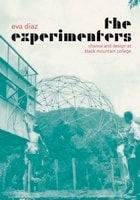
The Experimenters
Chance and Design at Black Mountain CollegeEva Díaz
University of Chicago Press, 2014
Díaz’s focus is on experimentation. Albers, Cage, and Fuller, she shows, taught new models of art making that favored testing procedures rather than personal expression. These methodologies represented incipient directions for postwar art practice, elements of which would be sampled, and often wholly adopted, by Black Mountain students and subsequent practitioners. The resulting works, which interrelate art and life in a way that imbues these projects with crucial relevance, not only reconfigured the relationships among chance, order, and design—they helped redefine what artistic practice was, and could be, for future generations.
Offering a bold, compelling new angle on some of the most widely studied creative figures of modern times, The Experimenters does nothing less than rewrite the story of art in the mid-twentieth century.
The Floating University
Experience, Empire, and the Politics of KnowledgeTamson Pietsch
University of Chicago Press, 2023
In 1926, New York University professor James E. Lough—an educational reformer with big dreams—embarked on a bold experiment he called the Floating University. Lough believed that taking five hundred American college students around the globe by ship would not only make them better citizens of the world but would demonstrate a model for responsible and productive education amid the unprecedented dangers, new technologies, and social upheavals of the post–World War I world. But the Floating University’s maiden voyage was also its last: when the ship and its passengers returned home, the project was branded a failure—the antics of students in hotel bars and port city back alleys that received worldwide press coverage were judged incompatible with educational attainment, and Lough was fired and even put under investigation by the State Department.
In her new book, Tamson Pietsch excavates a rich and meaningful picture of Lough’s grand ambition, its origins, and how it reveals an early-twentieth-century America increasingly defined both by its imperialism and the professionalization of its higher education system. As Pietsch argues, this voyage—powered by an internationalist worldview—traced the expanding tentacles of US power, even as it tried to model a new kind of experiential education. She shows that this apparent educational failure actually exposes a much larger contest over what kind of knowledge should underpin university authority, one in which direct personal experience came into conflict with academic expertise. After a journey that included stops at nearly fifty international ports and visits with figures ranging from Mussolini to Gandhi, what the students aboard the Floating University brought home was not so much knowledge of the greater world as a demonstration of their nation’s rapidly growing imperial power.
The Floating University
Experience, Empire, and the Politics of KnowledgeTamson Pietsch
University of Chicago Press, 2023
This is an auto-narrated audiobook edition of this book.
The Floating University sheds light on a story of optimism and imperialist ambition in the 1920s.In 1926, New York University professor James E. Lough—an educational reformer with big dreams—embarked on a bold experiment he called the Floating University. Lough believed that taking five hundred American college students around the globe by ship would not only make them better citizens of the world but would demonstrate a model for responsible and productive education amid the unprecedented dangers, new technologies, and social upheavals of the post–World War I world. But the Floating University’s maiden voyage was also its last: when the ship and its passengers returned home, the project was branded a failure—the antics of students in hotel bars and port city back alleys that received worldwide press coverage were judged incompatible with educational attainment, and Lough was fired and even put under investigation by the State Department.
In her new book, Tamson Pietsch excavates a rich and meaningful picture of Lough’s grand ambition, its origins, and how it reveals an early-twentieth-century America increasingly defined both by its imperialism and the professionalization of its higher education system. As Pietsch argues, this voyage—powered by an internationalist worldview—traced the expanding tentacles of US power, even as it tried to model a new kind of experiential education. She shows that this apparent educational failure actually exposes a much larger contest over what kind of knowledge should underpin university authority, one in which direct personal experience came into conflict with academic expertise. After a journey that included stops at nearly fifty international ports and visits with figures ranging from Mussolini to Gandhi, what the students aboard the Floating University brought home was not so much knowledge of the greater world as a demonstration of their nation’s rapidly growing imperial power.
The Future of Academic Freedom
Edited by Louis Menand
University of Chicago Press, 1996
"Louis Menand has assembled The Future of Academic Freedom to better define and delineate what should and should not happen within our colleges and universities. . . . The whole extremely learned yet accessible debate exploits the freedoms it extols, tackling sensitive subjects such as ethnicity and ethics head-on."—Publishers Weekly
"The essays are not only sharp, elegant and lucid, but extremely well-informed about the history of American battles over academic freedom."—Alan Ryan, Times Higher Education Supplement
"[A] superb inquiry into some of the most vexing and significant issues in higher education today."—Zachary Karabell, Boston Book Review
The Gee Years, 1990-1997
HISTORY OF THE OHIO STATE UNIVERSITYMalcolm S. Baroway
The Ohio State University Press, 2003
When Gee lost his beloved wife, Elizabeth, to cancer in 1991 and became a single parent, he not only carried on, he carried the university through some of its most exhilarating but contentious times. By 1996, he was so popular, private polls said he could run for Ohio governor—and win—on either ticket. When he, and his new bride Constance Bumgarner Gee, left instead for Brown University in January 1998, they left behind a stronger Ohio State and a string of stories about power brokers, politicians, and just plain Buckeyes. Populated by such figures as Les Wexner and George Voinovich, Andy Geiger and John Cooper, Bernadine Healy and John Glenn, The Gee Years is “inside baseball,” written by a member of Gee’s inner circle, his communications director. From the board room to the press box, from fundraisers to sit-ins, this is the story of a singular academic leader and more than seven years in the history of the complex university he headed.
The Gee Years, 2007–2013
Herbert B. Asher
The Ohio State University Press, 2022
The Graduate Advisor Handbook
A Student-Centered ApproachBruce M. Shore
University of Chicago Press, 2014
One of the first books to approach advising from the advisor’s point of view, the handbook highlights the importance of a partnership in which both parties need to be invested. Shore emphasizes the interpersonal relationships at the heart of advising and reveals how advisors can draw on their own strengths to create a rewarding rapport.
The Graduate Advisor Handbook moves chronologically through the advising process, from the first knock on the door to the last reference letter. Along the way it covers transparent communication, effective motivation, and cooperative troubleshooting. Its clear-eyed approach also tackles touchy subjects, including what to do when personal boundaries are crossed and how to deliver difficult news. Sample scripts help advisors find the right words for even the toughest situations.
With resources dwindling and student and advising loads increasing, graduate advisors need all the resources they can find to give their students the help they need. The Graduate Advisor Handbook has the cool-headed advice and comprehensive coverage that advisors need to make the advising relationship not just effective but also enjoyable.
The Handbook of Broader Impacts
Strategies for Enhancing the Societal Impacts of ResearchLaurie A. Van Egeren
Michigan State University Press, 2026
The Handbook of Broader Impacts is an essential resource for researchers, administrators, policymakers, and anyone interested in the societal benefits of research. The volume brings together experts who trace the history of broader impacts as a U.S. National Science Foundation policy, explore its relationship to engaged scholarship, and provide models for institutional infrastructure and support. The book equips readers with tools to build the institutional capacity to advance the societal impacts of research, from developing researcher identities and competencies to navigating promotion and tenure. The Handbook of Broader Impacts explores a wide range of initiatives—open science, science communication, citizen science, informal STEM learning, K–12 partnerships, undergraduate research, teacher development, international collaborations, and more. By blending policy context, practical strategies, and real-world examples, the handbook spells out the value of broader impacts and demonstrates how research can contribute to direct and meaningful change.
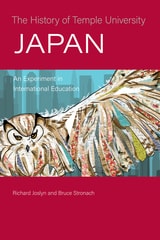
The History of Temple University Japan
An Experiment in International EducationRichard Joslyn and Bruce Stronach
Temple University Press, 2023
The authors recount the development of the academic program, the recruitment of students, and the support from Temple that enabled curricular and pedagogical improvement.
They also address the university’s relationships with three Japanese partners, and the financial threats and crises TUJ faced over the decades.
The History of Temple University Japan is not only an important documentation of TUJ, but also a history of U.S.-Japanese relations. What emerges is the significant impact TUJ has had on the thousands of students, faculty, and staff who have been a part of this international academic institution.
The Holbrook Years
2002–2007Christian Zacher
The Ohio State University Press, 2012
The OSU Board of Trustees and its presidential search committee found in Holbrook’s experience many reasons to invite her to lead Ohio’s flagship institution of higher education. Foremost among them was her familiarity with academic medicine, which they thought would give her a special understanding of OSU’s growing medical center. She was particularly interested in fostering multi-disciplinary programs and emphasizing outreach via pre-collegiate programs to broaden the pipeline for students who saw The Ohio State University as a goal.
The Humanities in the Age of Information and Post-Truth
Edited by Ignacio López-Calvo and Christina Lux
Northwestern University Press, 2019
While the reader may suspect that these types of lucubration are a desperate reaction to decreased public funding for the humanities worldwide, a decreased enrollment of students, or anxiety over the future of our profession, there is in this volume a coherent argument for the continued need, perhaps more now than ever, to invest in humanities education if we are to have informed and socially conscious citizens rather than just willing consumers and obedient workers. Furthermore, the essays prove that the humanities and the arts are, after all, not a luxury but an integral part of a complete scholarly education.
The Idea and Practice of General Education
An Account of the College of the University of ChicagoThe College of the University of Chicago
University of Chicago Press, 1992
The Idea of a Catholic University
George Dennis O'Brien
University of Chicago Press, 2002
Truth is a central concept for both university and church, and O'Brien's book is built on the idea that there are different areas of truth—scientific, artistic, and religious—each with its own proper warrant and "method." In this light, he argues that one can reverse Shaw's comparison and uncover academic dogma and Christian freedom, university "infallibility" and dogmatic "fallibility."
Drawing on theology and the history of philosophy, O'Brien shows how religious truth relates to the work of a Catholic university. He then turns to the current controversies over Pope John Paul II's recent statement, Ex Corde Ecclesiae, which seeks to make Catholic universities conform to the church's official teaching office. O'Brien rejects the conventional "institutional-juridical" model used by the Vatican as improper both to faith and academic freedom. He argues for a "sacramental" model, one that respects the different kinds of "truth"—thus preserving the integrity of both church and university while making their combination in a Catholic university not only possible but desirable. O'Brien concludes with a practical consideration of how the ideal Catholic university might be expressed in the actual life of the contemporary curriculum and extracurriculum.
For anyone concerned about the place of religion in higher education, The Idea of a Catholic University will be essential reading.
The Idea of a Writing Laboratory
Neal Lerner
Southern Illinois University Press, 2009
The Idea of a Writing Laboratory is a book about possibilities, about teaching and learning to write in ways that can transform both teachers and students.
Author Neal Lerner explores higher education’s rich history of writing instruction in classrooms, writing centers and science laboratories. By tracing the roots of writing and science educators’ recognition that the method of the lab––hands-on student activity—is essential to learning, Lerner offers the hope that the idea of a writing laboratory will be fully realized more than a century after both fields began the experiment.
Beginning in the late nineteenth century, writing instructors and science teachers recognized that mass instruction was inadequate for a burgeoning, “non-traditional” student population, and that experimental or laboratory methods could prove to be more effective. Lerner traces the history of writing instruction via laboratory methods and examines its successes and failures through case studies of individual programs and larger reform initatives. Contrasting the University of Minnesota General College Writing Laboratory with the Dartmouth College Writing Clinic, for example, Lerner offers a cautionary tale of the fine line between experimenting with teaching students to write and “curing” the students of the disease of bad writing.
The history of writing within science education also wends its way through Lerner’s engaging work, presenting the pedagogical origins of laboratory methods to offer educators in science in addition to those in writing studies possibilities for long-sought after reform. The Idea of a Writing Laboratory compels readers and writers to “don those white coats and safety glasses and discover what works” and asserts that “teaching writing as an experiment in what is possible, as a way of offering meaning-making opportunities for students no matter the subject matter, is an endeavor worth the struggle.”
The Impact of College Diversity
Struggles and Successes at Age 30Elizabeth Aries
Temple University Press, 2023
The Impact of College Diversity details how exposure to diversity in college helped shape Black and white graduates process issues of economic and racial privilege and inequality at age 30. She investigates how college diversity experiences also facilitate the attainment of upward social mobility in lower-income students and the role that mobility played in their relationships with family and friends in their home communities. Aries further examines how interactions with peers of another race and class influenced development of citizenship skills and civic engagement, as well as Black students’ ability to cope with the challenges they faced in the professional world.
Aries concludes her study with a discussion of why elite colleges have been beneficial in promoting upward mobility in lower-income students, and the importance of achieving equity and inclusion in making diversity initiatives successful.
The Instruction Myth
Why Higher Education is Hard to Change, and How to Change ItJohn Tagg
Rutgers University Press, 2019
The Instruction Myth argues that yes, higher education can be reformed and reinvigorated, but it will not be an easy process. In fact, it will require universities to abandon their central operating principle, the belief that education revolves around instruction, easily measurable in course syllabi, credits, and enrollments. Acclaimed education scholar John Tagg presents a powerful case that instruction alone is worthless and that universities should instead be centered upon student learning, which is far harder to quantify and standardize. Yet, as he shows, decades of research have indicated how to best promote student learning, but few universities have systematically implemented these suggestions.
This book demonstrates why higher education must undergo radical change if it hopes to survive. More importantly, it offers specific policy suggestions for how universities can break their harmful dependence on the instruction myth. In this extensively researched book, Tagg offers a compelling diagnosis of what’s ailing American higher education and a prescription for how it might still heal itself.
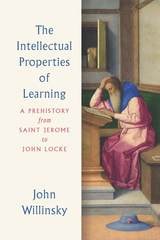
The Intellectual Properties of Learning
A Prehistory from Saint Jerome to John LockeJohn Willinsky
University of Chicago Press, 2017
Willinsky begins with Saint Jerome in the fifth century, then traces the evolution of reading, writing, and editing practices in monasteries, schools, universities, and among independent scholars through the medieval period and into the Renaissance. He delves into the influx of Islamic learning and the rediscovery of classical texts, the dissolution of the monasteries, and the founding of the Bodleian Library before finally arriving at John Locke, whose influential lobbying helped bring about the first copyright law, the Statute of Anne of 1710. Willinsky’s bravura tour through this history shows that learning gave rise to our idea of intellectual property while remaining distinct from, if not wholly uncompromised by, the commercial economy that this concept inspired, making it clear that today’s push for marketable intellectual property threatens the very nature of the quest for learning on which it rests.
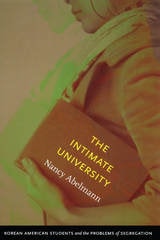
The Intimate University
Korean American Students and the Problems of SegregationNancy Abelmann
Duke University Press, 2009
Drawing on ten years of ethnographic research with Korean American students at the University of Illinois and closely following multiple generations of a single extended Korean American family in the Chicago metropolitan area, Abelmann investigates the complexity of racial politics at the American university today. Racially hyper-visible and invisible, Korean American students face particular challenges as they try to realize their college dreams against the subtle, day-to-day workings of race. They frequently encounter the accusation of racial self-segregation—a charge accentuated by the fact that many attend the same Evangelical Protestant church—even as they express the desire to distinguish themselves from their families and other Korean Americans. Abelmann concludes by examining the current state of the university, reflecting on how better to achieve the university’s liberal ideals despite its paradoxical celebration of diversity and relative silence on race.
The Journey Before Us
First-Generation Pathways from Middle School to CollegeLaura Nichols
Rutgers University Press, 2020
The Knowledge Most Worth Having
Edited by Wayne C. Booth
University of Chicago Press, 1967
The Landscape of Rural Service Learning, and What It Teaches Us All
Randy Stoecker
Michigan State University Press, 2016
The Latinx Guide to Graduate School
Genevieve Negrón-Gonzales and Magdalena L. Barrera
Duke University Press, 2023
The Launching of Duke University, 1924–1949
Robert F. Durden
Duke University Press, 1993
Made possible by a gift from James B. Duke, the wealthiest member of the family that had underwritten Trinity College since 1890, Duke University was organized with Few as president. Few's goal was to turn Duke into a world-class institution of higher education and these early years saw the development of much of what we know as Duke University today. Drawing on extensive archival material culled over a ten-year period, Durden discusses the building of the Medical Center, the rebuilding of the School of Law, the acquisition of the Duke Forest and development of the School of Forestry, the nurturing of the Divinity School, and the enrichment of the Graduate School of Arts and Sciences.
It was also during this period, as Durden details, that such treasures as the Sarah P. Duke Gardens were created, as well as some near treasures, as seen by the failed attempt to start an art museum. Although the story of the birth of this University belongs largely to William Preston Few, other people figure prominently and are discussed at length. Alice Baldwin, who led in the establishment of the Woman's College, emerges as a fascinating figure, as do William H. Wannamaker, James B. Duke, William Hanes Ackland, Robert L. Flowers, Justin Miller, and Wilburt Cornell Davision, among others.
Although impressive growth occurred in Duke's formative years, tensions also arose. The need to strike an institutional balance between the twin demands of teaching and research, of regional versus national status, combined with continual shortages of funds, created occasional obstacles. The problem of two sets of trustees, one for the university and another for the Duke Endowment, loomed largest of all. As Few himself said, during these early years Duke successfully embarked on a long journey, for it was not until after World War II that Duke University consolidated the growth begun in the inter-war years.
An important contribution to the history of Southern higher education as well as to Duke University, this book will be of great interest to historians, alumni, and friends of Duke University alike.
The Liberal Arts Advantage
Measuring the Deeper Value of a College EducationEdited by Richard Arum, Paul Courant, and Allyson Flaster
University of Chicago Press, 2026
Showcases new measurement strategies for assessing the impact of a liberal arts education on students and society.
More than ever before, our society is questioning the meaning and value of higher education, and liberal arts education, in particular, has come under substantial scrutiny. Economic detractors characterize liberal arts education as impractical, claiming that college should prepare students for the workforce. Others object to the curriculum, portraying it as broken or misdirected. According to these critics, the liberal arts education being offered in the United States is marked by its rejection of core intellectual and ideological commitments.
In The Liberal Arts Advantage, a wide range of scholars argue for how and why a liberal arts education uniquely develops skill sets and expertise needed for individuals and society to thrive in the twenty-first century. The contributors address foundational questions about what liberal arts education is, how it has been conceptualized in the past, and what we can learn from its societal and professional impacts. They present compelling, unique research and new methodological tools for assessing the outcomes of liberal arts graduates. Offering grounded and well-founded arguments in favor of our education system, The Liberal Arts Advantage persuasively explains why educational leaders should reinvest in liberal arts education.
The Life and Work of Francis Willey Kelsey
Archaeology, Antiquity, and the ArtsJohn Griffiths Pedley
University of Michigan Press, 2011
President of the Archaeological Institute of America, professor at the University of Michigan from 1889 to 1927, and president of the American Philological Association, Francis Kelsey was crucially involved in the founding or growth of major educational institutions. He came to maturity in a period of great technological change in communications, transportation, and manufacturing. Kelsey took full advantage of such innovations in his ceaseless drive to promote education for all, to further the expansion of knowledge, and to champion the benefits of the study of antiquity.
A vigorous traveler around the United States, Europe, and the Mediterranean, Kelsey strongly believed in the value of personally viewing sites ancient and modern and collecting artifacts that could be used by the new museums and universities that were springing up in the United States. This collecting habit put him in touch with major financiers of the day, including Charles Freer, Andrew Carnegie, and J. P. Morgan, as he sought their help for important projects.
Drawing heavily on Kelsey's daily diaries now held at the University of Michigan's Bentley Historical Library, John Griffiths Pedley gives us a biography that records the wide-ranging activities of a gifted and energetic scholar whose achievements mirrored the creative and contributive innovations of his contemporary Americans.
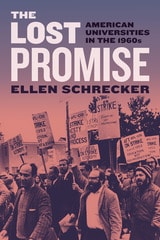
The Lost Promise
American Universities in the 1960sEllen Schrecker
University of Chicago Press, 2021
The 1950s through the early 1970s are widely seen as American academia’s golden age, when universities—well-funded and viewed as essential for national security, economic growth, and social mobility—embraced an egalitarian mission. Swelling in size, schools attracted new types of students and professors, including radicals who challenged their institutions’ calcified traditions. But that halcyon moment soon came to a painful and confusing end, with consequences that still afflict the halls of ivy. In The Lost Promise, Ellen Schrecker—our foremost historian of both the McCarthy era and the modern American university—delivers a far-reaching examination of how and why it happened.
Schrecker illuminates how US universities’ explosive growth intersected with the turmoil of the 1960s, fomenting an unprecedented crisis where dissent over racial inequality and the Vietnam War erupted into direct action. Torn by internal power struggles and demonized by conservative voices, higher education never fully recovered, resulting in decades of underfunding and today’s woefully inequitable system. As Schrecker’s magisterial history makes blazingly clear, the complex blend of troubles that disrupted the university in that pivotal period haunts the ivory tower to this day.
The Making of Chicana/o Studies
In the Trenches of AcademeAcuña, Rodolfo F
Rutgers University Press, 2011
The Making of Chicana/o Studies traces the philosophy and historical development of the field of Chicana/o studies from precursor movements to the Civil Rights era to today, focusing its lens on the political machinations in higher education that sought to destroy the discipline. As a renowned leader, activist, scholar, and founding member of the movement to establish this curriculum in the California State University system, which serves as a model for the rest of the country, Rodolfo F. Acuña has, for more than forty years, battled the trend in academia to deprive this group of its academic presence.
The book assesses the development of Chicana/o studies (an area of studies that has even more value today than at its inception)--myths about its epistemological foundations have remained uncontested. Acuña sets the record straight, challenging those in the academy who would fold the discipline into Latino studies, shadow it under the dubious umbrella of ethnic studies, or eliminate it altogether.
Building the largest Chicana/o studies program in the nation was no easy feat, especially in an atmosphere of academic contention. In this remarkable account, Acuña reveals how California State University, Northridge, was instrumental in developing an area of study that offers more than 166 sections per semester, taught by 26 tenured and 45 part-time instructors. He provides vignettes of successful programs across the country and offers contemporary educators and students a game plan--the mechanics for creating a successful Chicana/o studies discipline--and a comprehensive index of current Chicana/o studies programs nationwide.
Latinas/os, of which Mexican Americans are nearly seventy percent, comprise a complex sector of society projected to be just shy of thirty percent of the nation's population by 2050. The Making of Chicana/o Studies identifies what went wrong in the history of Chicana/o studies and offers tangible solutions for the future.

The Making of The University of Michigan 1817-1992
Howard H. Peckham
University of Michigan Press, 1994
The Making of the Modern University
Intellectual Transformation and the Marginalization of MoralityJulie A. Reuben
University of Chicago Press, 1996
Based on extensive research at eight universities—Harvard, Yale, Columbia, Johns Hopkins, Chicago, Stanford, Michigan, and California at Berkeley—Reuben examines the aims of university reformers in the context of nineteenth-century ideas about truth. She argues that these educators tried to apply new scientific standards to moral education, but that their modernization efforts ultimately failed. By exploring the complex interaction between institutional and intellectual change, Reuben enhances our understanding of the modern university, the secularization of intellectual life, and the association of scientific objectivity with value-neutrality.
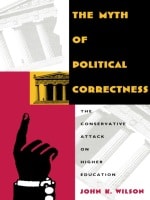
The Myth of Political Correctness
The Conservative Attack on Higher EducationJohn K. Wilson
Duke University Press, 1995
The phrase "political correctness" is on everyone’s lips, on radio and television, and in newspapers and magazines. The phenomenon itself, however, has been deceptively described. Wilson steps into the nation’s favorite cultural fray to reveal that many of the most widely publicized anecdotes about PC are in fact more myth than reality. Based on his own experience as a student and in-depth research, he shows what’s really going on beneath the hysteria and alarmism about political correctness and finds that the most disturbing examples of thought policing on campus have come from the right. The image of the college campus as a gulag of left-wing totalitarianism is false, argues Wilson, created largely through the exaggeration of deceptive stories by conservatives who hypocritically seek to silence their political opponents.
Many of today’s most controversial topics are here: multiculturalism, reverse discrimination, speech codes, date rape, and sexual harassment. So are the well-recognized protagonists in the debate: Dinesh D’Souza, William Bennett, and Lynne Cheney, among others. In lively fashion and in meticulous detail, Wilson compares fact to fiction and lays one myth after another to rest, revealing the double standard that allows "conservative correctness" on college campuses to go unchallenged.
The Next Twenty-five Years
Affirmative Action in Higher Education in the United States and South AfricaDavid L. Featherman, Martin Hall, and Marvin Krislov, editors
University of Michigan Press, 2009
"Ambitious, provocative, and wide-ranging, this rich collection of essays from U.S. and South African perspectives reflects the thinking of thoughtful advocates of affirmative action."
---William G. Bowen, President Emeritus, The Andrew W. Mellon Foundation, and President Emeritus, Princeton University
"Thoughtful commentary from outstanding experts on affirmative action’s future in two countries struggling to overcome a legacy of racial injustice."
---Derek Bok, 300th Anniversary University Research Professor, and President Emeritus, Harvard University
"An enormously important comparative study and reflection on affirmative (U.S.) and corrective (South Africa) action with exhaustive and sensitive treatment of a vital topic."
---Kader Asmal, Professor of Law, University of the Western Cape, Cape Town, and former Minister of Education, South Africa
A penetrating exploration of affirmative action's continued place in 21st-century higher education, The Next Twenty-five Years assembles the viewpoints of some of the most influential scholars, educators, university leaders, and public officials. Its comparative essays span the political spectrum and dissect debates in two nations to elucidate the legal, political, social, economic, and moral dimensions of affirmative action in higher education and its role in contributing to a just, equitable, and vital society.
David L. Featherman is Professor of Sociology and Psychology and Founding Director of the Center for Advancing Research and Solutions for Society at the University of Michigan.
Martin Hall is Vice-Chancellor of the University of Salford, Greater Manchester, and previously was Deputy Vice-Chancellor at the University of Cape Town.
Marvin Krislov is President of Oberlin College and previously was Vice President and General Counsel at the University of Michigan.
The Non-Modern Crisis of the Modern University
D. Bret Leraul and Willy Thayer
Northwestern University Press, 2025
A landmark work of critical theory about the Western university from the Southern Cone
Renowned Chilean philosopher Willy Thayer’s La crisis no moderna de la universidad moderna, first published in 1996 and in an updated edition in 2019, is a landmark work of critical theory from the Southern Cone. Presented in English for the first time, The Non-Modern Crisis of the Modern University rewrites the idea of the Western university while also diagnosing the ills of postdictatorship Chile through a philosophically informed dismantling of its neoliberal institutionalization of higher education. Bret Leraul’s translation advances the vital work of globalizing critical university studies by disseminating theory from the Global South. If the university helped to construct Chile’s neoliberal society, Thayer’s polemical deconstruction of both will help readers reconstruct the cultural politics of the era to better understand the global hegemony of neoliberalism today.
The Ocean in the School
Pacific Islander Students Transforming Their UniversityRick Bonus
Duke University Press, 2020