Results by title
767 books match the query 'Hispanic & Latino Studies' and 95 start with t
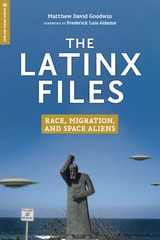
The Latinx Files
Race, Migration, and Space AliensMatthew David Goodwin
Rutgers University Press, 2021
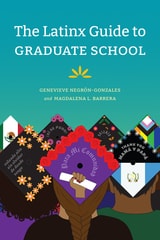
The Latinx Guide to Graduate School
Genevieve Negrón-Gonzales and Magdalena L. Barrera
Duke University Press, 2023
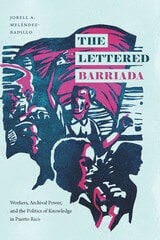
The Lettered Barriada
Workers, Archival Power, and the Politics of Knowledge in Puerto RicoJorell A. Meléndez-Badillo
Duke University Press, 2021
Duke University Press Scholars of Color First Book Award recipient
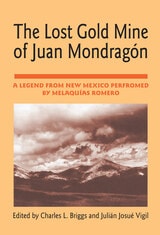
The Lost Gold Mine of Juan Mondragón
A Legend from New Mexico performed by Melaquías RomeroEdited by Charles L. Briggs and Julián Josué Vigil
University of Arizona Press, 1990
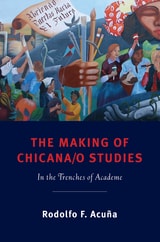
The Making of Chicana/o Studies
In the Trenches of AcademeAcuña, Rodolfo F
Rutgers University Press, 2011
The Making of Chicana/o Studies traces the philosophy and historical development of the field of Chicana/o studies from precursor movements to the Civil Rights era to today, focusing its lens on the political machinations in higher education that sought to destroy the discipline. As a renowned leader, activist, scholar, and founding member of the movement to establish this curriculum in the California State University system, which serves as a model for the rest of the country, Rodolfo F. Acuña has, for more than forty years, battled the trend in academia to deprive this group of its academic presence.
The book assesses the development of Chicana/o studies (an area of studies that has even more value today than at its inception)--myths about its epistemological foundations have remained uncontested. Acuña sets the record straight, challenging those in the academy who would fold the discipline into Latino studies, shadow it under the dubious umbrella of ethnic studies, or eliminate it altogether.
Building the largest Chicana/o studies program in the nation was no easy feat, especially in an atmosphere of academic contention. In this remarkable account, Acuña reveals how California State University, Northridge, was instrumental in developing an area of study that offers more than 166 sections per semester, taught by 26 tenured and 45 part-time instructors. He provides vignettes of successful programs across the country and offers contemporary educators and students a game plan--the mechanics for creating a successful Chicana/o studies discipline--and a comprehensive index of current Chicana/o studies programs nationwide.
Latinas/os, of which Mexican Americans are nearly seventy percent, comprise a complex sector of society projected to be just shy of thirty percent of the nation's population by 2050. The Making of Chicana/o Studies identifies what went wrong in the history of Chicana/o studies and offers tangible solutions for the future.
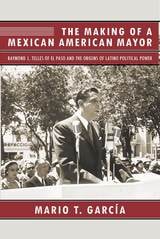
The Making of a Mexican American Mayor
Raymond L. Telles of El Paso and the Origins of Latino Political PowerMario T. García
University of Arizona Press, 2018
In the border metropolis of El Paso, more than half the population is Mexican American, yet this group had been denied effective political representation. Mexican Americans broke this barrier and achieved the “politics of status” through Telles’s stunning 1957 victory. This book captures the excitement of that long-awaited election.
The Making of a Mexican American Mayor also examines Telles’s story as a microcosm of the history of Mexican Americans before and after World War II—the Mexican American Generation. As mayor and ambassador, Telles symbolized this generation’s striving for political participation, and his legacy is evident in the growing number of Latinas/os holding office today.
The Mexican American Experience in Texas
Citizenship, Segregation, and the Struggle for EqualityBy Martha Menchaca
University of Texas Press, 2022
A historical overview of Mexican Americans' social and economic experiences in Texas
For hundreds of years, Mexican Americans in Texas have fought against political oppression and exclusion—in courtrooms, in schools, at the ballot box, and beyond. Through a detailed exploration of this long battle for equality, this book illuminates critical moments of both struggle and triumph in the Mexican American experience.
Martha Menchaca begins with the Spanish settlement of Texas, exploring how Mexican Americans’ racial heritage limited their incorporation into society after the territory’s annexation. She then illustrates their political struggles in the nineteenth century as they tried to assert their legal rights of citizenship and retain possession of their land, and goes on to explore their fight, in the twentieth century, against educational segregation, jury exclusion, and housing covenants. It was only in 1967, she shows, that the collective pressure placed on the state government by Mexican American and African American activists led to the beginning of desegregation. Menchaca concludes with a look at the crucial roles that Mexican Americans have played in national politics, education, philanthropy, and culture, while acknowledging the important work remaining to be done in the struggle for equality.
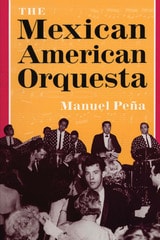
The Mexican American Orquesta
Music, Culture, and the Dialectic of ConflictBy Manuel Peña
University of Texas Press, 1999
The Mexican American orquesta is neither a Mexican nor an American music. Relying on both the Mexican orquesta and the American dance band for repertorial and stylistic cues, it forges a synthesis of the two. The ensemble emerges historically as a powerful artistic vehicle for the expression of what Manuel Peña calls the "dialectic of conflict." Grounded in ethnic and class conflict, this dialectic compels the orquesta and its upwardly mobile advocates to waver between acculturation and ethnic resistance. The musical result: a complex mesh of cultural elements—Mexican and American, working- and middle-class, traditional and contemporary.
In this book, Manuel Peña traces the evolution of the orquesta in the Southwest from its beginnings in the nineteenth century through its pinnacle in the 1970s and its decline since the 1980s. Drawing on fifteen years of field research, he embeds the development of the orquesta within a historical-materialist matrix to achieve the optimal balance between description and interpretation. Rich in ethnographic detail and boldly analytical, his book is the first in-depth study of this important but neglected field of artistic culture.
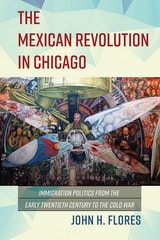
The Mexican Revolution in Chicago
Immigration Politics from the Early Twentieth Century to the Cold WarJohn H Flores
University of Illinois Press, 2018
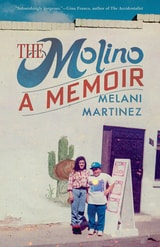
The Molino
A MemoirMelani Martinez
University of Arizona Press, 2024
Set in one of Tucson’s first tamal and tortilla factories, The Molino is a hybrid memoir that reckons with one family’s loss of home, food, and faith.
Weaving together history, culture, and Mexican food traditions, Melani Martinez shares the story of her family’s life and work in the heart of their downtown eatery, El Rapido. Opened by Martinez’s great-grandfather, Aurelio Perez, in 1933, El Rapido served tamales and burritos to residents and visitors to Tucson’s historic Barrio Presidio for nearly seventy years. For the family, the factory that bound them together was known for the giant corn grinder churning behind the scenes—the molino. With clear eyes and warm humor, Martinez documents the work required to prepare food for others, and explores the heartbreaking aftermath of gentrification that forces the multigenerational family business to close its doors.
The Molino is also Martinez’s personal story—that of a young Tucsonense coming of age in the 1980s and ’90s. As a young woman she rejects the work in her father’s popular kitchen, but when the business closes, her world shifts and the family disbands. When she finds her way back home, the tortillería’s iconic mural provides a gateway into history and ruin, ancestry and sacrifice, industrial myth and artistic incarnation—revealing a sacred presence still alive in Tucson.
A must-read for foodies, history lovers, and anyone searching for spiritual truth in the desert, this is a story of belonging and transformation in the borderlands.
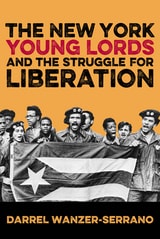
The New York Young Lords and the Struggle for Liberation
Darrel Wanzer-Serrano
Temple University Press, 2015
In The New York Young Lords and the Struggle for Liberation, Darrel Wanzer-Serrano details the numerous community initiatives that advanced decolonial sensibilities in El Barrio and beyond. Using archival research and interviews, he crafts an engaging account of the Young Lords’ discourse and activism. He rescues the organization from historical obscurity and makes an argument for its continued relevance, enriching and informing contemporary discussions about Latino/a politics.
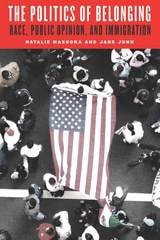
The Politics of Belonging
Race, Public Opinion, and ImmigrationNatalie Masuoka and Jane Junn
University of Chicago Press, 2013
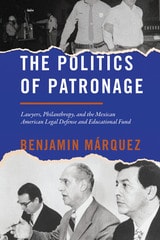
The Politics of Patronage
Lawyers, Philanthropy, and the Mexican American Legal Defense and Educational FundBy Benjamin Márquez
University of Texas Press, 2021
Co-winner, Latino Politics Best Book Award, American Political Science Association
The first book about the Mexican American Legal Defense and Educational Fund, the influential work it has done for the Latina/o community, and the issues stemming from its dependence on large philanthropic organizations.
Founded in 1968, the Mexican American Legal Defense and Educational Fund (MALDEF) is the Latino equivalent to the NAACP: a source of legal defense for the Latina/o community in cases centered on education, state immigration laws, redistricting, employment discrimination, and immigrant rights. Unlike the NAACP, however, MALDEF was founded by Mexican American activists in conjunction with the larger philanthropic structure of the Ford Foundation—a relationship that has opened it up to controversy and criticism.
In the first book to examine this little-known but highly influential organization, Benjamin Márquez explores MALDEF’s history and shows how it has thrived and served as a voice for the Latina/o community throughout its six decades of operation. But he also looks closely at large-scale investments of the Ford Foundation, Rockefeller Foundation, and others, considering how their ties to MALDEF have influenced Mexican American and Latinx politics. Its story crafted from copious research into MALDEF and its benefactors, this book brings to light the influence of outside funding on the articulation of minority identities and the problems that come with creating change through institutional means.

The Puerto Rican Movement
Voices from the DiasporaAndres Torres
Temple University Press, 1998
To combat these two problems, and drawing n a tradition of patriotism and social responsibility, a number of organizations grew up, including the Young Lords Party (YLP), which later evolved into the Puerto Rican Revolutionary Workers Organization; the Pro Independence Movement (MPI), which evolved into the U.S> branch of the Puerto Rican Socialist Party; El Comite; the Puerto Rican Student Union (PRSU); the Movement for National Liberation (MLN); and the Armed Forces of National Liberation (FALN). THe Puerto Rican Movement looks at all these groups as specific organizations of real people in such places as Boston, Chicago, Hartford, New York, and Philadelphia.
The contributors, almost all of whom were involved with the organizations they describe, provide detailed descriptions and historical analyses of the Puerto Rican Left. Interviews with such key figures as Elizam Escobar, Piri Thomas, and Luis Fuentes, as well as accounts by people active in the gay/lesbian, African American, and white Left movements add a vivid picture of why and how people became radicalized and how their ideals intersected with their group's own dynamics.
These critical assessments highlight each organization's accomplishments and failures and illuminate how different sets of people, in different circumstances, respond to social problems -- in this case, the "national question" and the issues of social justice and movement politics.
The Returned
Former U.S. Migrants’ Lives in Mexico CityClaudia Masferrer
Russell Sage Foundation, 2025
Masferrer, Hamilton, and Denier draw on interviews with former U.S. migrants living in Mexico City to better understand the experience of return migration to urban areas. Each of the migrants they spoke with lived in the United States for long periods with noncitizen status during the last four decades. During this time, U.S. immigration policy became increasingly focused on restriction and enforcement, which made it difficult for migrants to safely move back and forth across the border for work or to visit family without documentation. The authors find that upon their return, migrants in Mexico City felt disoriented and lost and had difficulty adapting to a massive urban environment where there is little support for returnees. They struggled to translate their work experience from their time in the U.S. to find quality jobs. Additionally, many found their family lives upended as they reunited with or formed families in the U.S.. Some found themselves separated from family members still in the U.S. with no ability to legally visit them. Others brought their families back to Mexico, some of whom were U.S. citizens and had never been to Mexico before. They, too, struggled to adapt and integrate to life in Mexico City.
The authors use the experiences of return migrants to discuss policies and practices that would improve their lives and ease their reintegration. To help with the disorientation they experience, returnees proposed ongoing psychological support with mental health professionals who have knowledge and training in the social and legal issues that return migrants face. Return migrants also advocated for policies to enhance skill matching, job creation, and entrepreneurship, as many felt the occupational skills they developed in the U.S. were undervalued in Mexico. To address family separation, returnees argued for legal and policy reform to accommodate family reunification.
The Returned is an illuminating account of the difficulties faced by return migrants and their families in Mexico City.
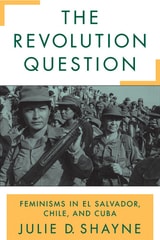
The Revolution Question
Feminisms in El Salvador, Chile, and CubaShayne, Julie D.
Rutgers University Press, 2004
The Revolutionary Imaginations of Greater Mexico
Chicana/o Radicalism, Solidarity Politics, and Latin American Social MovementsBy Alan Eladio Gómez
University of Texas Press, 2016
Bringing to life the stories of political teatristas, feminists, gunrunners, labor organizers, poets, journalists, ex-prisoners, and other revolutionaries, The Revolutionary Imaginations of Greater Mexico examines the inspiration Chicanas/os found in social movements in Mexico and Latin America from 1971 to 1979. Drawing on fifteen years of interviews and archival research, including examinations of declassified government documents from Mexico, this study uncovers encounters between activists and artists across borders while sharing a socialist-oriented, anticapitalist vision. In discussions ranging from the Nuevo Teatro Popular movement across Latin America to the Revolutionary Proletariat Party of America in Mexico and the Peronista Youth organizers in Argentina, Alan Eladio Gómez brings to light the transnational nature of leftist organizing by people of Mexican descent in the United States, tracing an array of festivals, assemblies, labor strikes, clandestine organizations, and public protests linked to an international movement of solidarity against imperialism.
Taking its title from the “greater Mexico” designation used by Américo Paredes to describe the present and historical movement of Mexicans, Mexican Americans, and Chicanas/os back and forth across the US-Mexico border, this book analyzes the radical creativity and global justice that animated “Greater Mexico” leftists during a pivotal decade. While not all the participants were of one mind politically or personally, they nonetheless shared an international solidarity that was enacted in local arenas, giving voice to a political and cultural imaginary that circulated throughout a broad geographic terrain while forging multifaceted identities. The epilogue considers the politics of going beyond solidarity.
The Right to Remain Violets
poemasAntonio De Jesús López
University of Arizona Press, 2027
The Right to Remain Violets is an electrifying poetry collection that reimagines the language of policing, public education, and state surveillance to illuminate the lived realities of Black and Brown youth in East Palo Alto—a city shaped by redlining, freeway expansion, and decades of over-policing. Blending documentary poetics with hip-hop cadence and Catholic liturgy, Antonio De Jesús López transforms transcripts, municipal documents, and legal language into a powerful form of witness. These poems trace how children are drafted into systems of surveillance and criminalization, even as they search for joy and solidarity amid Silicon Valley’s contrasts of wealth and dispossession.
Inventive and emotionally resonant, the collection spans sonnets, sestinas, hip-hop, and prayer, insisting that language can both indict and heal. López brings his experiences as an award-winning poet, scholar, and former mayor of East Palo Alto to each poem. At once elegy and refusal, The Right to Remain Violets speaks to readers of documentary poetics, social justice literature, and those who believe in the radical importance of protecting childhood in an America reckoning with itself.
The Shadow of the Wall
Violence and Migration on the U.S.-Mexico BorderEdited by Jeremy Slack, Daniel E. Martínez, and Scott Whiteford; Foreword by Josiah Heyman; Photographs by Murphy Woodhouse
University of Arizona Press, 2018
The authors analyze data from the Migrant Border Crossing Study (MBCS), a mixed-methods, binational research project that offers socially relevant, rigorous social science about migration, immigration enforcement, and violence on the border. Using information gathered from more than 1,600 post-deportation surveys, this volume examines the different faces of violence and migration along the Arizona-Sonora border and shows that deportees are highly connected to the United States and will stop at nothing to return to their families. The Shadow of the Wall underscores the unintended social consequences of increased border enforcement, immigrant criminalization, and deportation along the U.S.-Mexico border.
Contributors
Howard Campbell
Josiah Heyman
Alison Elizabeth Lee
Daniel E. Martínez
Ricardo Martínez-Schuldt
Emily Peiffer
Jeremy Slack
Prescott L. Vandervoet
Matthew Ward
Scott Whiteford
Murphy Woodhouse
The Silver Cradle
Las Posadas, Los Pastores, and Other Mexican American TraditionsBy Julia Nott Waugh
University of Texas Press, 1955
Originally published in 1955, The Silver Cradle is the story of a year in the life of the Mexican American people of San Antonio, Texas. During the 1950s, Julia Nott Waugh recorded the performances of such seasonal and religious traditions as Las Posadas, Los Pastores, Las Calaveras, the Blessing of the Animals, the liturgical observances of Holy Week, and festivities of el diez y seis de septiembre (Mexican Independence Day), among others.
Although years have passed and many of the details of observances have changed, the festival calendar and the joy and sincerity of the Mexican American people in honoring its customs and obligations have not disappeared. Now, in fact, a much wider population shares and appreciates the pageantry preserved for us by people like Graciana Reyes, in whose prized silver cradle the Christ Child slept every year at Christmas, and like Doroteo Domínguez, whose annual devotion to presenting a thousand-year-old pastoral epic in his back yard was legendary.
Waugh has done much more than just open a window onto a charming past. She has captured for us one of the true gifts of our Mexican American heritage—the willingness to ritually celebrate the passage of time and to embellish the occasions with sensitivity and fervor. This book will appeal to the general reader as well as to those interested in folk traditions and Mexican American culture.
The Sound of Exclusion
NPR and the Latinx PublicChristopher Chávez
University of Arizona Press, 2021
Chávez analyzes NPR as a historical product that has evolved alongside significant changes in technology, industry practice, and demography. In The Sound of Exclusion, Chávez asks these pressing questions: What kind of news organization was NPR intended to be? What has it become over time? In what ways is it evolving to meet the needs of a nation, in which U.S. Latinxs are becoming an increasingly larger portion of the American public that NPR serves? Informed by more than fifty in-depth interviews conducted with public radio practitioners from all aspects of the business, Chávez addresses how power is enacted in everyday broadcast practices. By interrogating industry practices, we might begin to reimagine NPR as a public good that serves the broad and diverse spectrum of the American public.

The Sound of Thinking
A Listener's Companion to Conceptual MusicCraig Dworkin
University of Chicago Press, 2026
An artist draws two octaves of pitches randomly from a hat, just enough to set each syllable of the dictionary definition of imprimer (to score, to print). Trawling the internet for cute videos of cats “playing” piano, an artist splices together a complete, note-perfect performance of Arnold Schoenberg’s Opus 11. Half a century after the release of Miles Davis’s album Kind of Blue, a jazz quintet spends months of focused practice to reproduce the original exactly. These performances share a common denominator: absolute fidelity to the outcome of a system. From Marcel Duchamp to Yoko Ono, Steve Reich to Sun Ra, The Sound of Thinking brings together a diverse array of musical or sonic works that are algorithmic, automatic, permutational, procedural, or otherwise structured in contrast to the creative expressivity typically associated with artistic production.
In twenty-six short essays, each keyed to a term that begins with a different letter of the alphabet, Dworkin discusses work composed or performed according to a predetermined rule, transforming artistic creation into a system running its course. The pieces detailed here, drawn from more than a century of musical experimentation, offer a fresh perspective on the history of innovative music by decoupling music from expression and by shunting creativity from the level of organizing sounds to the level of devising a system that can do the organizing. Not only does this book spotlight the critical role of music in twentieth-century conceptual art, but it also identifies previously overlooked links among diverse artists and movements.
The Starting Line
Latina/o Children, Texas Schools, and National Debates on Early EducationBy Robert Crosnoe
University of Texas Press, 2020
How can we create high-quality learning environments for children from socially, politically, and economically marginalized groups? How do early childhood programs help to overcome the challenges created by poverty? Seeking to answer these questions, The Starting Line delves into the ups and downs of early education programs serving Latinas/os in Texas, using the state as a window into broader debates about academic opportunity and the changing demographics of the United States.
Immersing readers in the day-to-day activities of Texas's early childhood education programs, Robert Crosnoe illuminates how significant obstacles can stymie the best intentions. Crosnoe pays particular attention to the complex connections among classrooms, schools, families, and communities, as well as the frequently unfolding interplay of educational philosophies. The result is a story highlighting the promises of early childhood education, the perils faced in attempting to fulfill them, and the degree to which Texas stands at the forefront of some larger movements and lags behind in others.
Giving voice to bilingual educators and low-income Latina/o families, this book is a timely exploration of the strengths and needs of what will soon be the largest share of the US child population.
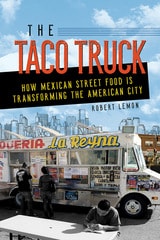
The Taco Truck
How Mexican Street Food Is Transforming the American CityRobert Lemon
University of Illinois Press, 2019
Drawing on interviews with taco truck workers and his own skills as a geographer, Robert Lemon illuminates new truths about foodways, community, and the unexpected places where ethnicity, class, and culture meet. Lemon focuses on the San Francisco Bay Area, Sacramento, and Columbus, Ohio, to show how the arrival of taco trucks challenge preconceived ideas of urban planning even as cities use them to reinvent whole neighborhoods. As Lemon charts the relationships between food practices and city spaces, he uncovers the many ways residents and politicians alike contest, celebrate, and influence not only where your favorite truck parks, but what's on the menu.

The Team That Changed Baseball
Roberto Clemente and the 1971 Pittsburgh PiratesBruce Markusen
Westholme Publishing, 2006
The Inspiring Story of Roberto Clemente's Greatest Season and One of the Most Important Teams in Sport History
In 1947, major league baseball experienced its first measure of integration when the Brooklyn Dodgers brought Jackie Robinson to the National League. While Robinson's breakthrough opened the gates of opportunity for African Americans and other minority players, the process of integration proved slow and uneven. It was not until the 1960s that a handful of major league teams began to boast more than a few Black and Latino players. But the 1971 World Championship team enjoyed a full and complete level of integration, with half of its twenty-five-man roster comprised of players of African American and Latino descent. That team was the Pittsburgh Pirates, managed by an old-time Irishman.
In The Team That Changed Baseball: Roberto Clemente and the 1971 Pittsburgh Pirates, veteran baseball writer Bruce Markusen tells the story of one of the most likable and significant teams in the history of professional sports. In addition to the fact that they fielded the first all-minority lineup in major league history, the 1971 Pirates are noteworthy for the team's inspiring individual performances, including those of future Hall of Famers Roberto Clemente, Willie Stargell, and Bill Mazeroski, and their remarkable World Series victory over the heavily favored Baltimore Orioles. But perhaps their greatest legacy is the team's influence on the future of baseball, inspiring later championship teams such as the New York Yankees and Oakland Athletics to open their doors fully to all talented players, regardless of race, particularly in the new era of free agency.
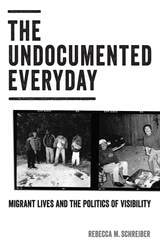
The Undocumented Everyday
Migrant Lives and the Politics of VisibilityRebecca M. Schreiber
University of Minnesota Press, 2018
Examining how undocumented migrants are using film, video, and other documentary media to challenge surveillance, detention, and deportation
As debates over immigration increasingly become flashpoints of political contention in the United States, a variety of advocacy groups, social service organizations, filmmakers, and artists have provided undocumented migrants with the tools and training to document their experiences.
In The Undocumented Everyday, Rebecca M. Schreiber examines the significance of self-representation by undocumented Mexican and Central American migrants, arguing that by centering their own subjectivity and presence through their use of documentary media, these migrants are effectively challenging intensified regimes of state surveillance and liberal strategies that emphasize visibility as a form of empowerment and inclusion. Schreiber explores documentation as both an aesthetic practice based on the visual conventions of social realism and a state-administered means of identification and control.
As Schreiber shows, by visualizing new ways of belonging not necessarily defined by citizenship, these migrants are remaking documentary media, combining formal visual strategies with those of amateur photography and performative elements to create a mixed-genre aesthetic. In doing so, they make political claims and create new forms of protection for migrant communities experiencing increased surveillance, detention, and deportation.
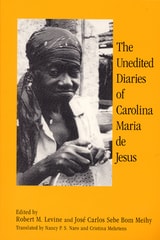
The Unedited Diaries of Carolina Maria De Jesus
Levine, Robert M
Rutgers University Press, 1998
Carolina Maria de Jesus' book, Quarto de Despejo (The Trash Room), depicted the harsh life of the slums, but it also spoke of the author's pride in her blackness, her high moral standards, and her patriotism. More than a million copies of her diary are believed to have been sold worldwide. Yet many Brazilians refused to believe that someone like de Jesus could have written such a diary, with its complicated words (some of them misused) and often lyrical phrasing as she discussed world events. Doubters prefer to believe the book was either written by Audáulio Dantas, the enterprising newspaper reporter who discovered her, or that Dantas rewrote it so substantially that her book is a fraud. With the cooperation of de Jesus' daughter, recent research shows that although Dantas deleted considerable portions of the diary (as well as a second one), every word was de Jesus'.
But Dantas did "create" a different Carolina from the woman who coped with her harsh life by putting things down on paper. This book sets the record straight by providing detailed translations of de Jesus' unedited diaries and explains why Brazilian elites were motivated to obscure her true personality and present her as something she was not. It is not only about the writer but about Brazil as recorded by her sarcastic pen. The diary entries in this book span from 1958 to 1966, five years beyond text previously known to exist. They show de Jesus as she was, preserving her Joycean stream-of-consciousness language and her pithy characterizations.
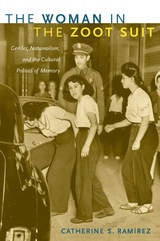
The Woman in the Zoot Suit
Gender, Nationalism, and the Cultural Politics of MemoryCatherine S. Ramírez
Duke University Press, 2009
Two events in wartime Los Angeles thrust young Mexican American zoot suiters into the media spotlight. In the Sleepy Lagoon incident, a man was murdered during a mass brawl in August 1942. Twenty-two young men, all but one of Mexican descent, were tried and convicted of the crime. In the Zoot Suit Riots of June 1943, white servicemen attacked young zoot suiters, particularly Mexican Americans, throughout Los Angeles. The Chicano movement of the 1960s–1980s cast these events as key moments in the political awakening of Mexican Americans and pachucos as exemplars of Chicano identity, resistance, and style. While pachucas and other Mexican American women figured in the two incidents, they were barely acknowledged in later Chicano movement narratives. Catherine S. Ramírez draws on interviews she conducted with Mexican American women who came of age in Los Angeles in the late 1930s, 1940s, and 1950s as she recovers the neglected stories of pachucas. Investigating their relative absence in scholarly and artistic works, she argues that both wartime U.S. culture and the Chicano movement rejected pachucas because they threatened traditional gender roles. Ramírez reveals how pachucas challenged dominant notions of Mexican American and Chicano identity, how feminists have reinterpreted la pachuca, and how attention to an overlooked figure can disclose much about history making, nationalism, and resistant identities.
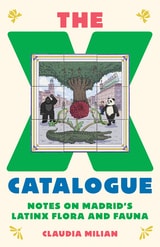
The X Catalogue
Notes on Madrid's LatinX Flora and FaunaClaudia Milian
University of Minnesota Press, 2026
A transatlantic, more-than-human exploration of LatinX presence, memory, and empire in the heart of Madrid
How does LatinXness begin in the Kingdom of Spain? In The X Catalogue, Claudia Milian offers a vade mecum of Madrid, exploring it as an ecological archive and former imperial metropolis. Approaching the “X” as metaphor, method, and philosophical practice, she extends inquiry beyond the human. Milian traces the “X” through transplanted life from the Americas: the roots of the ahuehuete tree (the Montezuma cypress), the engineering and renaming of the acocoxochitl (the dahlia), the “invasion” of the cotorras argentinas (Monk parakeets), and the exhibition of the caimán (the alligator) as a conquered object.
Critical theory and historical cultural studies meet to remap the Atlantic world through the “Xs” of arrival, circulation, and transformation. By examining how LatinXness inhabits the Spanish capital, Milian breaks open LatinX Spain and global LatinX studies. The X Catalogue resists containment, mirroring its objects of study and challenging categories such as native, foreign, or authentic. It advances a more-than-human, transatlantic understanding of LatinXness within empire studies, environmental humanities, and the critical study of tourism.
Retail e-book files for this title are screen-reader friendly with images accompanied by short alt text and/or extended descriptions.

They Call You Back
A Lost History, A Search, A MemoirTim Z. Hernandez
University of Arizona Press, 2024
A haunting, an obsession, a calling: Tim Z. Hernandez has been searching for people his whole life. Now, in this highly anticipated memoir, he takes us along on an investigative odyssey through personal and collective history to uncover the surprising conjunctions that bind our stories together.
Hernandez’s mission to find the families of the twenty-eight Mexicans who were killed in the 1948 plane wreck at Los Gatos Canyon formed the basis for his acclaimed documentary novel All They Will Call You, which the San Francisco Chronicle dubbed “a stunning piece of investigative journalism,” and the New York Times hailed as “painstaking detective work by a writer who is the descendant of farmworkers.”
In this riveting new work, Hernandez continues his search for the plane crash victims while also turning the lens on himself and his ancestral past, revealing the tumultuous and deeply intimate experiences that have fueled his investigations—a lifelong journey haunted by memory, addiction, generational trauma, and the spirit world.
They Call You Back is the true chronicle of one man’s obsession to restore dignity to an undignified chapter in America’s past, while at the same time making a case for why we must heal our personal wounds if we are ever to heal our political ones.
They Came to Toil
Newspaper Representations of Mexicans and Immigrants in the Great DepressionBy Melita M. Garza
University of Texas Press, 2018
As the Great Depression gripped the United States in the early 1930s, the Hoover administration sought to preserve jobs for Anglo-Americans by targeting Mexicans, including long-time residents and even US citizens, for deportation. Mexicans comprised more than 46 percent of all people deported between 1930 and 1939, despite being only 1 percent of the US population. In all, about half a million people of Mexican descent were deported to Mexico, a “homeland” many of them had never seen, or returned voluntarily in fear of deportation.
They Came to Toil investigates how the news reporting of this episode in immigration history created frames for representing Mexicans and immigrants that persist to the present. Melita M. Garza sets the story in San Antonio, a city central to the formation of Mexican American identity, and contrasts how the city’s three daily newspapers covered the forced deportations of Mexicans. She shows that the Spanish-language La Prensa not surprisingly provided the fullest and most sympathetic coverage of immigration issues, while the locally owned San Antonio Express and the Hearst chain-owned San Antonio Light varied between supporting Mexican labor and demonizing it. Garza analyzes how these media narratives, particularly in the English-language press, contributed to the racial “othering” of Mexicans and Mexican Americans. Adding an important new chapter to the history of the Long Civil Rights Movement, They Came to Toil brings needed historical context to immigration issues that dominate today’s headlines.
Thirteen Ways of Looking at Latino Art
Ilan Stavans, Jorge J. E. Gracia
Duke University Press, 2014
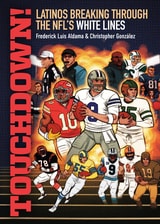
Touchdown!
Latinos Breaking Through the NFL's White LinesFrederick Luis Aldama and Christopher González
The Ohio State University Press, 2026
An accessible, lively, and concise study of Latino participation in the NFL that is part sports history, part cultural analysis, and part love letter to those who break through color lines.
The NFL doesn’t want you to know: Latinos have been playing in the league since 1927. In Touchdown!, Frederick Luis Aldama and Christopher González tap interviews, archival research, and statistics to tell the story that generations of sports journalists have missed. They celebrate Cuban-born Lou Molinet’s leather-helmet debut, Steve Van Buren’s Hall of Fame rise, Tom Flores’s Lombardi trophies, and Jim Plunkett threading impossible passes. And they address those convergences of race, class, and athletic opportunity—such as pay-to-play youth leagues, housing segregation, legal exclusions to early citizenship, and racist stereotypes pushing Latino players away from “thinking” positions—that keep brown players on the sidelines. Part sports history, part cultural analysis, and part love letter to those who break through color lines, Touchdown! fills a critical gap in sports literature and Latino studies and makes clear what the scoreboard has tried to erase: La cultura has been on the field the whole time.
Toward Camden
Mercy Romero
Duke University Press, 2021
Duke University Press Scholars of Color First Book Award recipient
Toxic Ivory Towers
The Consequences of Work Stress on Underrepresented Minority FacultyRuth Enid Zambrana
Rutgers University Press, 2018
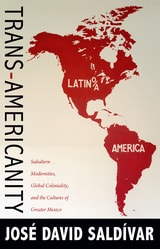
Trans-Americanity
Subaltern Modernities, Global Coloniality, and the Cultures of Greater MexicoJosé David Saldívar
Duke University Press, 2012
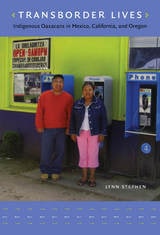
Transborder Lives
Indigenous Oaxacans in Mexico, California, and OregonLynn Stephen
Duke University Press, 2007
Stephen weaves the personal histories and narratives of indigenous transborder migrants together with explorations of the larger structures that affect their lives. Taking into account U.S. immigration policies and the demands of both commercial agriculture and the service sectors, she chronicles how migrants experience and remember low-wage work in agriculture, landscaping, and childcare and how gender relations in Oaxaca and the United States are reconfigured by migration. She looks at the ways that racial and ethnic hierarchies inherited from the colonial era—hierarchies that debase Mexico’s indigenous groups—are reproduced within heterogeneous Mexican populations in the United States. Stephen provides case studies of four grass-roots organizations in which Mixtec migrants are involved, and she considers specific uses of digital technology by transborder communities. Ultimately Stephen demonstrates that transborder migrants are reshaping notions of territory and politics by developing creative models of governance, education, and economic development as well as ways of maintaining their cultures and languages across geographic distances.
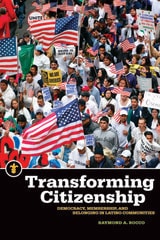
Transforming Citizenship
Democracy, Membership, and Belonging in Latino CommunitiesRaymond A. Rocco
Michigan State University Press, 2014
Translating Blackness
Latinx Colonialities in Global PerspectiveLorgia García Peña
Duke University Press, 2022
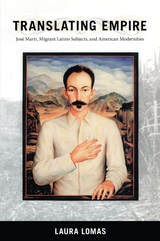
Translating Empire
Jose Marti, Migrant Latino Subjects, and American ModernitiesLaura Lomas
Duke University Press, 2008
Lomas challenges longstanding conceptions about Martí through readings of neglected texts and reinterpretations of his major essays. Against the customary view that emphasizes his strong identification with Ralph Waldo Emerson and Walt Whitman, the author demonstrates that over several years, Martí actually distanced himself from Emerson’s ideas and conveyed alarm at Whitman’s expansionist politics. She questions the association of Martí with pan-Americanism, pointing out that in the 1880s, the Cuban journalist warned against foreign geopolitical influence imposed through ostensibly friendly meetings and the promotion of hemispheric peace and “free” trade. Lomas finds Martí undermining racialized and sexualized representations of America in his interpretations of Buffalo Bill and other rituals of westward expansion, in his self-published translation of Helen Hunt Jackson’s popular romance novel Ramona, and in his comments on writing that stereotyped Latino/a Americans as inherently unfit for self-government. With Translating Empire, Lomas recasts the contemporary practice of American studies in light of Martí’s late-nineteenth-century radical decolonizing project.
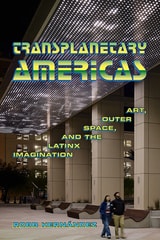
Transplanetary Americas
Art, Outer Space, and the Latinx ImaginationRobb Hernández
Duke University Press, 2026
Trees Dream of Water
Selected and New PoemsLeo Romero; Foreword by Joy Harjo
University of Arizona Press, 2025
Leo Romero stands as a foundational figure in Latino letters. With six books of poetry and a book of short fiction to his name, Romero’s contribution to the literary canon is profound and enduring.
Bringing together for the first time his new and selected poems, Trees Dream of Water reflects Romero’s journey from youth to maturity as a person and a poet, and his deep connection to New Mexico and its culture. Traversed by memory, myth, and observation of the natural world, these poems explore family, community belonging and conflict, life as an artist, and the cycles of life and death. This lyrical anthology includes accompanying essays to illuminate Romero’s life and work for longtime admirers and new readers alike.

Triangulations
Narrative Strategies for Navigating Latino IdentityDavid J. Vázquez
University of Minnesota Press, 2011
Just as mariners use triangulation, mapping an imaginary triangle between two known positions and an unknown location, so, David J. Vázquez contends, Latino authors in late twentieth-century America employ the coordinates of familiar ideas of self to find their way to new, complex identities. Through this metaphor, Vázquez reveals how Latino autobiographical texts, written after the rise of cultural nationalism in the 1960s, challenge mainstream notions of individual identity and national belonging in the United States.
In a traditional autobiographical work, the protagonist frequently opts out of his or her community. In the works that Vázquez analyzes in Triangulations, protagonists instead opt in to collective groups—often for the express political purpose of redefining that collective. Reading texts by authors such as Ernesto Galarza, Jesús Colón, Piri Thomas, Oscar “Zeta” Acosta, Judith Ortiz Cofer, John Rechy, Julia Alvarez, and Sandra Cisneros, Vázquez engages debates about the relationship between literature and social movements, the role of cultural nationalism in projects for social justice, the gender and sexual problematics of 1960s cultural nationalist groups, the possibilities for interethnic coalitions, and the interpretation of autobiography. In the process, Triangulations considers the potential for cultural nationalism as a productive force for aggrieved communities of color in their struggles for equality.
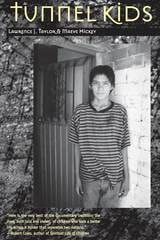
Tunnel Kids
Lawrence J. Taylor and Maeve Hickey
University of Arizona Press, 2001
Beneath the streets of the U.S.-Mexico border, children are coming of age. They have come from all over Mexico to find shelter and adventure in the drainage tunnels that connect the twin cities of Nogales, Sonora, and Nogales, Arizona. This book opens up the world of the tunnel kids and tells how in this murky underworld of struggling immigrants, drug dealers, and thieves, these kids have carved out a place of their own. Two parallel tunnels— each fourteen feet wide and several miles long— drain the summer rains from Mexico to the United States. Here and in the crumbling colonias you'll meet the tunnel kids: streetwise El Boston, a six-year veteran of the tunnels; his little pal Jesús; Jesús' girlfriend, La Flor, and her six-month-old baby; wild Negra; poetic Guanatos; moody Romel and his beautiful girlfriend, La Fanta. They form an extended family of some two dozen young people who live hard-edged lives and answer to no one in El Barrio Libre— the free barrio.
Lawrence Taylor and Maeve Hickey met these kids at Mi Nueva Casa, the safe house built to draw the youths out of the tunnels and into a more normal life. The authors spent two summers with tunnel kids as they roamed all over Nogales and beyond in their struggle to survive. In the course of their adventures the kids described their lives, talking about what might tempt them to leave the tunnels— and what kept them there. Hickey's stunning portraits provide a heart-stopping counterpoint to Taylor's incisive prose. Story and photos together open a window into the life of the tunnel kids—a world like that of many homeless children, precarious and adaptive, albeit unique to the border. Where most people might see just another gang of doped-up, violent children, Taylor and Hickey discover displaced and sometimes heroic young people whose stories add a human dimension to the world of the U.S.-Mexico border.
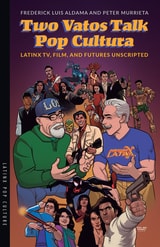
Two Vatos Talk Pop Cultura
Latinx TV, Film, and Futures UnscriptedFrederick Luis Aldama and Peter Murrieta
University of Arizona Press, 2026
Two Vatos Talk Pop Cultura brings a leading Latinx media studies scholar, Frederick Luis Aldama, together with an award-winning television writer and producer, Peter Murrieta, to examine how Latinx representation has evolved—and stagnated—across seven decades of American TV, film, and pop culture.