Results by title
668 books match the query 'History & Surveys' and 161 start with t
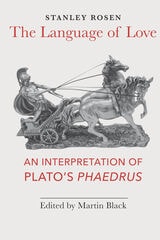
The Language of Love
An Interpretation of Plato's PhaedrusStanley Rosen
St. Augustine's Press, 2016
Here Rosen’s argue for the possibility of philosophy or the retrieval of human self-knowledge on the basis of a renewed argument for the partial intelligibility of ordinary experience or, in other words, for the Platonic Ideas. His book on the Symposium was an important contribution to the subsequent sea change in Plato scholarship that returned attention to the dialogue form and to the poetic side of philosophy even in its quarrel with philosophy. That change allowed us search for understanding in the light of the whole, a whole which is otherwise, as Rosen has shown elsewhere, fragmented by the scientism of analytical philosophy or the historicism of “Continental” philosophy.
The Language of Love represents a missing key to Stanley Rosen’s work and, much more significantly, to the rediscovery of philosophy in our time. The title of the book is not merely a play on words. It points to the incommensurability between the constructed or historical nature of language or culture and the pre-discursive apprehension of things that is necessary if speech is to make sense and be understood, as opposed to being mere nonsense.
Among many valuable insights along the way, Rosen unites the dialogue in two parts, treating both eros and rhetoric, showing the linkage between eros and writing, as between myth and analysis. He connects the comic attempt to subject eros to diaeresis in the Phaedrus with the attempt to understand non-being as an eidos in the Sophist. In both cases, the inadequacy of a technical understanding of philosophy returns us to the pre-technical world of ordinary experience.
Rosen’s interpretation is an expression of the Socratic claim that we can’t speak beautifully without knowing the truth and that whatever truth we speak or write is a reflection of the silent invisibility of beauty as the unity of form. However, “Like every good teacher, it does not simply state that link for us to memorize. Instead, we must recollect it.”
The Later Works of John Dewey, Volume 1, 1925 - 1953
1925, Experience and NatureJohn Dewey. Edited by Jo Ann Boydston
Southern Illinois University Press, 2008
John Dewey’s Experience and Nature has been considered the fullest expression of his mature philosophy since its eagerly awaited publication in 1925.Irwin Edman wrote at that time that “with monumental care, detail and completeness, Professor Dewey has in this volume revealed the metaphysical heart that beats its unvarying alert tempo through all his writings, whatever their explicit themes.” In his introduction to this volume, Sidney Hook points out that “Dewey’s Experience and Nature is both the most suggestive and most difficult of his writings.”
The meticulously edited text published here as the first volume in the series The Later Works of John Dewey, 1925–1953spans that entire period in Dewey’s thought by including two important and previously unpublished documents from the book’s history: Dewey’s unfinished new introduction written between 1947and 1949,edited by the late Joseph Ratner, and Dewey’s unedited final draft of that introduction written the year before his death. In the intervening years Dewey realized the impossibility of making his use of the word “experience” understood. He wrote in his 1951draft for a new introduction: “Were I to write (or rewrite) Experience and Nature today I would entitle the book Culture and Nature and the treatment of specific subject-matters would be correspondingly modified. I would abandon the term ‘experience’ because of my growing realization that the historical obstacles which prevented understanding of my use of ‘experience’ are, for all practical purposes, insurmountable. I would substitute the term ‘culture’ because with its meanings as now firmly established it can fully and freely carry my philosophy of experience.”
The Later Works of John Dewey, Volume 10, 1925 - 1953
1934, Art as ExperienceJohn Dewey. Edited by Jo Ann Boydston
Southern Illinois University Press, 2008
Art as Experience evolved from John Dewey’s Willam James Lectures, delivered at Harvard University from February to May 1931.
In his Introduction, Abraham Kaplan places Dewey’s philosophy of art within the context of his pragmatism. Kaplan demonstrates in Dewey’s esthetic theory his traditional “movement from a dualism to a monism” and discusses whether Dewey’s viewpoint is that of the artist, the respondent, or the critic.
The Later Works of John Dewey, Volume 11, 1925 - 1953
Essays, Reviews, Trotsky Inquiry, Miscellany, and Liberalism and Social ActionJohn Dewey. Edited by Jo Ann Boydston
Southern Illinois University Press, 2008
This volume includes ninety-two items from 1935, 1936, and 1937, including Dewey’s 1935 Page-Barbour Lectures at the University of Virginia, published as Liberalism and Social Action.
In essay after essay Dewey analyzed, criticized, and reevaluated liberalism. When his controversial Liberalism and Social Action appeared, asking whether it was still possible to be a liberal, Horace M. Kallen wrote that Dewey “restates in the language and under the conditions of his times what Jefferson’s Declaration of Independence affirmed in the language and under the conditions of his.”
The diverse nature of the writings belies their underlying unity: some are technical philosophy; other philosophical articles shade into social and political themes; social and political issues permeate the educational articles, which in turn involve Dewey’s philosophical ideas.
The Later Works of John Dewey, Volume 12, 1925 - 1953
1938, Logic: The Theory of InquiryJohn Dewey. Edited by Jo Ann Boydston
Southern Illinois University Press, 2008
Heralded as “the crowning work of a great career,” Logic: The Theory of Inquiry was widely reviewed. To Evander Bradley McGilvary, the work assured Dewey “a place among the world’s great logicians.”
William Gruen thought “No treatise on logic ever written has had as direct and vital an impact on social life as Dewey’s will have.”
Paul Weiss called it “the source and inspiration of a new and powerful movement.”
Irwin Edman said of it, “Most philosophers write postscripts; Dewey has made a program. His Logic is a new charter for liberal intelligence.”
Ernest Nagel called the Logic an impressive work. Its unique virtue is to bring fresh illumination to its subject by stressing the roles logical principles and concepts have in achieving the objectives of scientific inquiry.”
The Later Works of John Dewey, Volume 13, 1925 - 1953
1938-1939, Experience and Education, Freedom and Culture, Theory of Valuation, and EssaysJohn Dewey. Edited by Jo Ann Boydston
Southern Illinois University Press, 2008
This volume includes all Dewey’s writings for 1938 except for Logic: The Theory of Inquiry (Volume 12 of The Later Works), as well as his 1939 Freedom and Culture, Theory of Valuation, and two items from Intelligence in the Modern World.
Freedom and Culture presents, as Steven M. Cahn points out, “the essence of his philosophical position: a commitment to a free society, critical intelligence, and the education required for their advance.”
The Later Works of John Dewey, Volume 14, 1925 - 1953
1939 - 1941, Essays, Reviews, and MiscellanyJohn Dewey. Edited by Jo Ann Boydston
Southern Illinois University Press, 2008
This volume republishes forty-four essays, reviews, and miscellaneous pieces from 1939, 1940, and 1941.
In his Introduction, R. W. Sleeper characterizes the contents of this volume as “vintage Dewey. Ranging widely over problems of theory and practice, they reveal him commencing his ninth decade at the peak of his intellectual powers.”
“Nature in Experience,” Dewey’s reply to Morris R. Cohen and William Ernest Hocking, “is a model of clarity and responsiveness,” writes Sleeper, “perhaps his clearest statement of why it is that metaphysics does not play the fundamental role for him that it had regularly played for his predecessors.”
The Later Works of John Dewey, Volume 15, 1925 - 1953
1942 - 1948, Essays, Reviews, and MiscellanyJohn Dewey. Edited by Jo Ann Boydston
Southern Illinois University Press, 2008
This volume republishes sixty-two of Dewey’s writings from the years 1942 to 1948; four other items are published here for the first time.
A focal point of this volume is Dewey’s introduction to his collective volume Problems of Men. Exchanges in the Journal of Philosophy with Donald C. Mackay, Philip Blair Rice, and with Alexander Meiklejohn in Fortune appear here, along with Dewey’s letters to editors of various publications and his forewords to colleagues’ books. Because 1942 was the centenary of the birth of William James, four articles about James are also included in this volume.
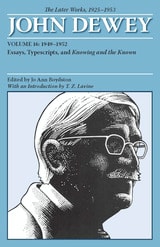
The Later Works of John Dewey, Volume 16, 1925 - 1953
1949 - 1952, Essays, Typescripts, and Knowing and the KnownJohn Dewey. Edited by Jo Ann Boydston
Southern Illinois University Press, 2008
Typescripts, essays, and an authoritative edition of Knowing and the Known, Dewey’s collaborative work with Arthur F. Bentley.
In an illuminating Introduction T. Z. Lavine defines the collaboration's three goals—the "construction of a new language for behavioral inquiry," "a critique of formal logicians, in defense of Dewey’s Logic," and "a critique of logical positivism." In Dewey’s words: "Largely due to Bentley, I’ve finally got the nerve inside of me to do what I should have done years ago."
"What Is It to Be a Linguistic Sign or Name?" and "Values, Valuations, and Social Facts,’ both written in 1945, are published here for the first time.
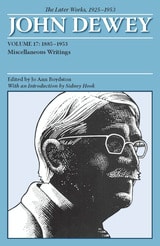
The Later Works of John Dewey, Volume 17, 1925 - 1953
1885 - 1953, Miscellaneous WritingsJohn Dewey. Edited by Jo Ann Boydston
Southern Illinois University Press, 2008
This is the final textual volume in The Collected Works of John Dewey, 1882–1953, published in 3 series comprising 37 volumes: The Early Works, 1882–1898 (5 vols.); The Middle Works, 1899–1924 (15 vols.); The Later Works, 1925–1953 (17 vols.).
Volume 17 contains Dewey’s writings discovered after publication of the appropriate volume of The Collected Works and spans most of Dewey’s publishing life. There are 83 items in this volume, 24 of which have not been previously published.
Among works highlighted in this volume are 10 “Educational Lectures before Brigham Young Academy,” early essays “War’s Social Results” and “The Problem of Secondary Education after the War,” and the previously unpublished “The Russian School System.”
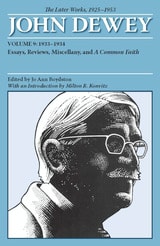
The Later Works of John Dewey, Volume 9, 1925 - 1953
1933-1934, Essays, Reviews, Miscellany, and A Common FaithJohn Dewey. Edited by Jo Ann Boydston
Southern Illinois University Press, 2008
This ninth volume in The Later Works of John Dewey, 1925—1953, brings together sixty items from 1933 and 1934, including Dewey’s Terry Lectures at Yale University, published as A Common Faith.
In his introduction, Milton R. Konvitz concludes that A Common Faith remains a provocative book, an intellectual ‘teaser,’ an essay at religious philosophy which no philosopher can wholly bypass.”
Dewey concentrated much of his writing in 1933 and 1934 on issues arising from the economic crises of the Great Depression. In the early 1930s Communist activity in the New York Teachers Union increased. The Report of the Special Grievance Committee of the Teachers Union is published in this volume, as is Dewey’s impromptu address, “On the Grievance Committee’s Report,” made when he presented that report. Rounding out the volume are eighteen articles from the People’s Lobby Bulletin.
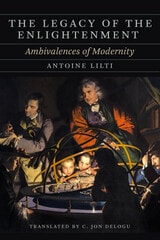
The Legacy of the Enlightenment
Ambivalences of ModernityAntoine Lilti
University of Chicago Press, 2025
The Enlightenment has come under substantial attack over the past several years, with some going so far as to recommend leaving behind its thinkers and their Eurocentric prejudices. In response, the most orthodox defenders of the Enlightenment have insisted that its values are not just foundational but indispensable and that abandoning them would mean opening the door to nihilism and relativism. For Antoine Lilti, one of the leading scholars of the French Enlightenment, both sides are wrong.
In this tactfully argued series of essays, Lilti emphasizes a non-dogmatic, non-ideological view of the Enlightenment—one that sees its legacy as a critical, attentive approach that can and should serve as its own best critic. Along the way, he engages with everyone from Rousseau and Kant to Foucault and Habermas, as well as prominent contemporary voices, such as Jonathan Israel. The result is a remarkable new reading of the Enlightenment that redraws the stakes of old debates and offers an alternative way to engage with both canonical thinkers and later scholarship that is both honest about the past and useful for the future.
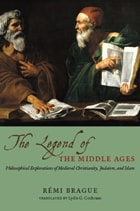
The Legend of the Middle Ages
Philosophical Explorations of Medieval Christianity, Judaism, and IslamRémi Brague
University of Chicago Press, 2009
This volume presents a penetrating interview and sixteen essays that explore key intersections of medieval religion and philosophy. With characteristic erudition and insight, RémiBrague focuses less on individual Christian, Jewish, and Muslim thinkers than on their relationships with one another. Their disparate philosophical worlds, Brague shows, were grounded in different models of revelation that engendered divergent interpretations of the ancient Greek sources they held in common. So, despite striking similarities in their solutions for the philosophical problems they all faced, intellectuals in each theological tradition often viewed the others’ ideas with skepticism, if not disdain. Brague’s portrayal of this misunderstood age brings to life not only its philosophical and theological nuances, but also lessons for our own time.
The Legitimacy of the Middle Ages
On the Unwritten History of TheoryAndrew Cole and D. Vance Smith, eds.
Duke University Press, 2010
In The Legitimacy of the Middle Ages, modernists and medievalists, as well as scholars specializing in eighteenth-, nineteenth-, and twentieth-century comparative literature, offer a new history of theory and philosophy through essays on secularization and periodization, Marx’s (medieval) theory of commodity fetishism, Heidegger’s scholasticism, and Adorno’s nominalist aesthetics. One essay illustrates the workings of medieval mysticism in the writing of Freud’s most famous patient, Daniel Paul Schreber, author of Memoirs of My Nervous Illness (1903). Another looks at Michael Hardt and Antonio Negri’s Empire, a theoretical synthesis whose conscientious medievalism was the subject of much polemic in the post-9/11 era, a time in which premodernity itself was perceived as a threat to western values. The collection concludes with an afterword by Fredric Jameson, a theorist of postmodernism who has engaged with the medieval throughout his career.
Contributors: Charles D. Blanton, Andrew Cole, Kathleen Davis, Michael Hardt, Bruce Holsinger, Fredric Jameson, Ethan Knapp, Erin Labbie, Jed Rasula, D. Vance Smith, Michael Uebel
The Linguistic Turn
Essays in Philosophical MethodEdited by Richard M. Rorty
University of Chicago Press, 1992
"All too rarely an anthology is put together that reflects imagination, command, and comprehensiveness. Rorty's collection is just such a book."—Review of Metaphysics
The Logic of Desire
Aquinas on EmotionNicholas E. Lombardo, O.P.
Catholic University of America Press, 2011
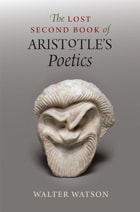
The Lost Second Book of Aristotle's "Poetics"
Walter Watson
University of Chicago Press, 2012
Of all the writings on theory and aesthetics—ancient, medieval, or modern—the most important is indisputably Aristotle’s Poetics, the first philosophical treatise to propound a theory of literature. In the Poetics, Aristotle writes that he will speak of comedy—but there is no further mention of comedy. Aristotle writes also that he will address catharsis and an analysis of what is funny. But he does not actually address any of those ideas. The surviving Poetics is incomplete.
Until today. Here, Walter Watson offers a new interpretation of the lost second book of Aristotle's Poetics. Based on Richard Janko’s philological reconstruction of the epitome, a summary first recovered in 1839 and hotly contested thereafter, Watson mounts a compelling philosophical argument that places the statements of this summary of the Aristotelian text in their true context. Watson renders lucid and complete explanations of Aristotle’s ideas about catharsis, comedy, and a summary account of the different types of poetry, ideas that influenced not only Cicero’s theory of the ridiculous, but also Freud’s theory of jokes, humor, and the comic.
Finally, more than two millennia after it was first written, and after five hundred years of scrutiny, Aristotle’s Poetics is more complete than ever before. Here, at last, Aristotle’s lost second book is found again.
The Lost World of Thomas Jefferson
Daniel J. Boorstin
University of Chicago Press, 1993
"The volume is too subtle, too rich in ideas for anyone to do justice to it in brief summary, too heavily documented and too carefully wrought for anyone to dismiss its thesis. . . . It is a major contribution not only to Jefferson studies but to American intellectual history. . . . All who work in the history of ideas will find themselves in Mr. Boorstin's debt."—Richard Hofstadter, South Atlantic Monthly
The Metamorphoses of the City of God
Etienne Gilson
Catholic University of America Press, 2021
The Middle Included
Logos in AristotleAygün, Ömer
Northwestern University Press, 2016
The Middle Included also explores human language in Aristotelian philosophy. After an account of acoustic phenomena and animal communication, Aygün argues that human language for Aristotle is the ability to understand and relay both first-hand experiences and non-first-hand experiences. This definition is key to understanding many core human experiences such as science, history, news media, education, sophistry, and indeed philosophy itself. Logos is thus never associated with any other animal nor with anything divine—it remains strictly and rigorously secular, humane, and yet full of the wonder.
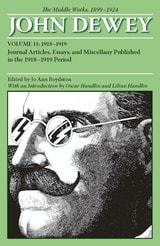
The Middle Works of John Dewey, Volume 11, 1899 - 1924
Journal Articles, Essays, and Miscellany Published in the 1918-1919 PeriodJohn Dewey. Edited by Jo Ann Boydston
Southern Illinois University Press, 2008
Volume 11 brings together all of Dewey’s writings for 1918 and 1919. A Modern Language Association Committee on Scholarly Editions textual edition.
Dewey’s dominant theme in these pages is war and its aftermath. In the Introduction, Oscar and Lilian Handlin discuss his philosophy within the historical context: “The First World War slowly ground to its costly conclusion; and the immensely more difficult task of making peace got painfully under way. The armistice that some expected would permit a return to normalcy opened instead upon a period of turbulence that agitated further a society already unsettled by preparations for battle and by debilitating conflict overseas.”
After spending the first half of 1918–19 on sabbatical from Columbia at the University of California, Dewey traveled to Japan and China, where he lectured, toured, and assessed in his essays the relationship between the two nations. From Peking he reported the student revolt known as the May Fourth Movement. The forty items in this volume also include an analysis of Thomas Hobbe’s philosophy; an affectionate commemorative tribute to Theodore Roosevelt, “our Teddy”; the syllabus for Dewey’s lectures at the Imperial University in Tokyo, which were later revised and published as Reconstruction in Philosophy; an exchange with former disciple Randolph Bourne about F. Matthias Alexander’s Man’sSupreme Inheritance; and, central to Dewey’s creed, “Philosophy and Democracy.” His involvement in a study of the Polish-American community in Philadelphia—resulting in an article, two memoranda, and a lengthy report—is discussed in detail in the Introduction and in the Note on the “Confidential Report of Conditions among the Poles in the United States.”
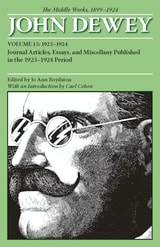
The Middle Works of John Dewey, Volume 15, 1899 - 1924
Journal Articles, Essays, and Miscellany Published in the 1923-1924 PeriodJohn Dewey. Edited by Jo Ann Boydston
Southern Illinois University Press, 2008
Volume 15 in The Middle Works of John Dewey, 1899–1924, series brings together Dewey’s writings for the period 1923–1924. A Modern Language Association Committee on Scholarly Editions textual edition.
Volume 15 completes the republication of Dewey’s extensive writings for the 25-year period included in the Middle Works series. Many facets of Dewey’s interests—politics, philosophy, education, and social concerns—are illuminated by the 40 items from 1923 and 1924.
Inspired by his own convictions and those of his friend Salmon O. Levinson, founder of the American Committee for the Outlawry of War, Dewey’s articles became the keystone of the committee’s campaign to outlaw war. His essay, “Logical Method and Law,” is perhaps the most enduring of Dewey’s writings in this volume. Dewey’s philosophical discussions with Daniel Sommer Robinson, David Wight Prall, Arthur Oncken Lovejoy, and Sterling Power Lamprecht are represented here, as is Dewey’s assessment of the Turkish educational system.
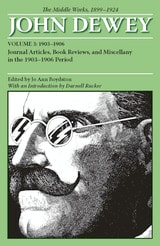
The Middle Works of John Dewey, Volume 3, 1899 - 1924
Journal Articles, Book Reviews, and Miscellany in the 1903-1906 PeriodJohn Dewey. Edited by Jo Ann Boydston
Southern Illinois University Press, 2008
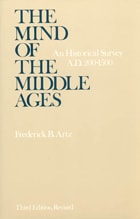
The Mind of the Middle Ages
An Historical SurveyFrederick B. Artz
University of Chicago Press, 1980
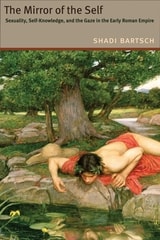
The Mirror of the Self
Sexuality, Self-Knowledge, and the Gaze in the Early Roman EmpireShadi Bartsch
University of Chicago Press, 2006
Weaving together literary theory, philosophy, and social history, Bartsch traces this complex notion of self from Plato’s Greece to Seneca’s Rome. She starts by showing how ancient authors envisioned the mirror as both a tool for ethical self-improvement and, paradoxically, a sign of erotic self-indulgence. Her reading of the Phaedrus, for example, demonstrates that the mirroring gaze in Plato, because of its sexual possibilities, could not be adopted by Roman philosophers and their students. Bartsch goes on to examine the Roman treatment of the ethical and sexual gaze, and she traces how self-knowledge, the philosopher’s body, and the performance of virtue all played a role in shaping the Roman understanding of the nature of selfhood. Culminating in a profoundly original reading of Medea, The Mirror of the Self illustrates how Seneca, in his Stoic quest for self-knowledge, embodies the Roman view, marking a new point in human thought about self-perception.
Bartsch leads readers on a journey that unveils divided selves, moral hypocrisy, and lustful Stoics—and offers fresh insights about seminal works. At once sexy and philosophical, The Mirror of the Self will be required reading for classicists, philosophers, and anthropologists alike.
The Modern Turn
Michael Rohlf
Catholic University of America Press, 2017
This volume approaches the modern turn not as an event that occurred all at once, but rather as a series of shifts in different areas of philosophy at different times. The essays are arranged broadly in chronological order of the topics they treat. Among the themes that recur most often in these essays are, first, that modern philosophy is characteristically preoccupied with questions about foundations and, second, that it ultimately prioritizes practice over theory. But the virtues of this text is in presenting a wide range or perspectives on modern philosophy – what constitutes it as modern, when it arose, and what its shortcomings may be.
The Moral Authority of Nature
Edited by Lorraine Daston and Fernando Vidal
University of Chicago Press, 2003
The Moral Authority of Nature offers a wide-ranging account of how people have used nature to think about what counts as good, beautiful, just, or valuable. The eighteen essays cover a diverse array of topics, including the connection of cosmic and human orders in ancient Greece, medieval notions of sexual disorder, early modern contexts for categorizing individuals and judging acts as "against nature," race and the origin of humans, ecological economics, and radical feminism. The essays also range widely in time and place, from archaic Greece to early twentieth-century China, medieval Europe to contemporary America.
Scholars from a wide variety of fields will welcome The Moral Authority of Nature, which provides the first sustained historical survey of its topic.
Contributors:
Danielle Allen, Joan Cadden, Lorraine Daston, Fa-ti Fan, Eckhardt Fuchs, Valentin Groebner, Abigail J. Lustig, Gregg Mitman, Michelle Murphy, Katharine Park, Matt Price, Robert N. Proctor, Helmut Puff, Robert J. Richards, Londa Schiebinger, Laura Slatkin, Julia Adeney Thomas, Fernando Vidal
The Moral Meaning of Nature
Nietzsche’s Darwinian Religion and Its CriticsPeter J. Woodford
University of Chicago Press, 2018
We start with Friedrich Nietzsche, whose writings staged one of the first confrontations with the Christian tradition using the resources of Darwinian thought. The lebensphilosophie, or “life-philosophy,” that arose from his engagement with evolutionary ideas drew responses from other influential thinkers, including Franz Overbeck, Georg Simmel, and Heinrich Rickert. These critics all offered cogent challenges to Nietzsche’s appropriation of the newly transforming biological sciences, his negotiation between science and religion, and his interpretation of the implications of Darwinian thought. They also each proposed alternative ways of making sense of Nietzsche’s unique question concerning the meaning of biological evolution “for life.” At the heart of the discussion were debates about the relation of facts and values, the place of divine purpose in the understanding of nonhuman and human agency, the concept of life, and the question of whether the sciences could offer resources to satisfy the human urge to discover sources of value in biological processes. The Moral Meaning of Nature focuses on the historical background of these questions, exposing the complex ways in which they recur in contemporary philosophical debate.
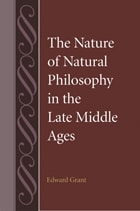
The Nature of Natural Philosophy in the Late Middle Ages (Studies in Philosophy and the History of Philosophy, Volume 52)
Edward Grant
Catholic University of America Press, 2010

The New Century
Bergsonism, Phenomenology, and Responses to Modern ScienceEdited by Keith Ansell-Pearson and Alan D. Schrift
University of Chicago Press, 2010
From Kant to Kierkegaard, from Hegel to Heidegger, continental philosophers have indelibly shaped the trajectory of Western thought since the eighteenth century. Although much has been written about these monumental thinkers, students and scholars lack a definitive guide to the entire scope of the continental tradition. The most comprehensive reference work to date, this eight-volume History of Continental Philosophy will both encapsulate the subject and reorient our understanding of it. Beginning with an overview of Kant’s philosophy and its initial reception, the History traces the evolution of continental philosophy through major figures as well as movements such as existentialism, phenomenology, hermeneutics, and poststructuralism. The final volume outlines the current state of the field, bringing the work of both historical and modern thinkers to bear on such contemporary topics as feminism, globalization, and the environment. Throughout, the volumes examine important philosophical figures and developments in their historical, political, and cultural contexts.
The first reference of its kind, A History of Continental Philosophy has been written and edited by internationally recognized experts with a commitment to explaining complex thinkers, texts, and movements in rigorous yet jargon-free essays suitable for both undergraduates and seasoned specialists. These volumes also elucidate ongoing debates about the nature of continental and analytic philosophy, surveying the distinctive, sometimes overlapping characteristics and approaches of each tradition. Featuring helpful overviews of major topics and plotting road maps to their underlying contexts, A History of Continental Philosophy is destined to be the resource of first and last resort for students and scholars alike.
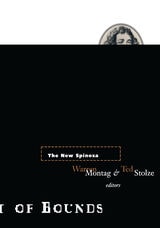
The New Spinoza
Warren Montag
University of Minnesota Press, 1998
The Nietzsche Canon
A Publication History and BibliographyWilliam H. Schaberg
University of Chicago Press, 1996
Included for the first time in any language is an extensive account of Nietzsche's finances and his relationships with his publishers. Schaberg reveals a man who was obsessed with money, fought bitterly with his publishers, complained about his readers, and all the while continued to produce more and more books that went unread. He also reveals the influential role of Nietzsche's sister Elizabeth, who provoked disputes between Nietzsche and his publisher during her brother's lifetime and deliberately falsified information after his death.
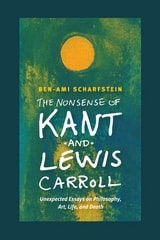
The Nonsense of Kant and Lewis Carroll
Unexpected Essays on Philosophy, Art, Life, and DeathBen-Ami Scharfstein
University of Chicago Press, 2014
Scharfstein begins with essays on the nature of philosophy itself, moving from an autobiographical account of the trials of being a comparativist to philosophy’s function in the outside world to the fear of death in Kant and Hume. From there he explores an impressive array of art: from China and Japan to India and the West; from an essay on sadistic and masochistic body art to one on the epistemology of the deaf and the blind. He then returns to philosophy, writing on Machiavelli and political ruthlessness, then on the ineffable, and closes with a review of Walter Kaufmann’s multivolume look at the essence of humanity, Discovering the Mind. Altogether, these essays are a testament to adventurous thought, the kind that leaps to the furthest reaches of the possible.
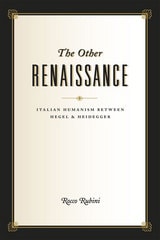
The Other Renaissance
Italian Humanism between Hegel and HeideggerRocco Rubini
University of Chicago Press, 2014
Bookended by Giambattista Vico and Antonio Gramsci, this strand of Renaissance-influenced philosophy rose in reaction to the major revolutions of the time in Italy, such as national unity, fascism, and democracy. Exploring the ways its thinkers critically assimilated the thought of their northern counterparts, Rubini uncovers new possibilities in our intellectual history: that antihumanism could have been forestalled, and that our postmodern condition could have been entirely different. In doing so, he offers an important new way of thinking about the origins of modernity, one that renews a trust in human dignity and the Western legacy as a whole.
The Pedagogy of Wisdom
An Interpretation of Plato's TheaetetusGregory Kirk
Northwestern University Press, 2015
In this interpretive commentary on Theaetetus, Gregory Kirk makes a major contribution to scholarship on Plato by emphasizing the relevance of the interpersonal dynamics between the interlocutors for the interpretation of the dialogue’s central arguments about knowledge. Kirk attends closely to the personalities of the participants in the dialogue, focusing especially on the unique demands faced by a student—in this case, Theaetetus—and the ways in which one can embrace or deflect the responsibilities of learning. Kirk’s approach gives equal consideration to the dual demands of dramatic interpretation and philosophical argument that constitute the unique character of the Platonic text, and he develops an original interpretation of the Theaetetus, concluding that the uncertainty that characterizes wisdom supersedes the certainty of knowledge.
The Phaedo
A Platonic Labyrinth and On Plato’s Euthyphro: New EditionRonna Burger
St. Augustine's Press, 2023
This revised and expanded edition includes a new Preface, “The Death of Socrates and the Post-Socratic Schools,” and an essay, “On Plato's Euthyphro.”
“This is a comprehensive study of the Phaedo, thoroughly researched, and sparkling with insights into the text.” – Paul Woodruff, University of Texas
“Burger has a wonderfully fertile mind and supports her imaginative thesis with a close reading, extremely sensitive to nuance.” – Jerome Schiller, The Journal of the History of Philosophy 1986
"On Plato's Euthyphro" presents a more thoughtful and careful analysis of the dialogue than any previous full-length commentary. -- Lewis Fallis, Interpretation 2016
The Phenomenological Study of Religion
Key Texts and SourcesChristina M. Gschwandtner
Northwestern University Press, 2026
Presenting a wide-ranging selection of works and commentary in religious phenomenology
Phenomenology is a central method employed to study religious phenomena within religious studies, philosophy of religion, and philosophical theology. This expertly edited collection brings together historical sources and newly commissioned essays from various ways of investigating religion phenomenologically both to diversify the field and to make available important works that have not been previously translated into English. The Phenomenological Study of Religion includes not only representative texts from well-known phenomenological philosophers and scholars of religion but also selections from significant thinkers that have not been studied as widely, along with contributions from leading contemporary voices. This volume offers scholars and students at all levels of expertise broad exposure to the various configurations of the phenomenological study of religion.
The Philosopher in Plato's Statesman
Mitchell Miller
Parmenides Publishing, 2004
"This study demonstrates how the Statesman is the culminating expression of Plato''s lifelong effort, both in Athens and in the Academy, to bring metaphysical insight to the unending political crisis of his times."The Philosopher in Plato's Statesman a trail-blazing work. While not every reader will agree with the lessons Miller himself draws from this approach, none should fail to be impressed by its interpretive power. All this is exciting stuff. The interpretive pathway on which Miller has embarked has the potential for changing the face of scholarship on the late Platonic dialogues. Parmenides [Publishing] is to be commended for making these two important contributions available under a single cover." --Kenneth Sayre, Professor of Philosophy, University of Notre Dame
"Miller casts considerable light on virtually every aspect of the dialogue. . . . All in all, this book is an outstanding contribution to our understanding of the Statesman." --Stanley Rosen, Borden Parker Bowne Professor of Philosophy, Boston University
MITCHELL MILLER is Professor of Philosophy at Vassar College. He is the author of Plato's Parmenides.
The Philosophical Papers of Alan Donagan, Volume 1
Historical Understanding and the History of PhilosophyAlan Donagan
University of Chicago Press, 1994
Volume 1 includes essays on Spinoza, Descartes, Bradley, Collingwood, Russell, Moore, and Popper, as well as two previously unpublished papers on the history of philosophy as a discipline, and on Ryle and Wittgenstein's nature of philosophy. Linked by Donagan's commitment to the central importance of history for philosophy and his interest in problems of historical understanding, these essays represent the remarkable scope of Donagan's thought.
The Philosophical Papers of Alan Donagan, Volume 2
Action, Reason, and ValueAlan Donagan
University of Chicago Press, 1994
Volume 2 addresses issues in the philosophy of action and moral theory. With papers on Kant, von Wright, Sellars, and Chisholm, this volume also covers a range of questions in applied ethics—from the morality of Truman's decision to drop atomic bombs on Hiroshima and Nagasaki to ethical questions in medicine and law.
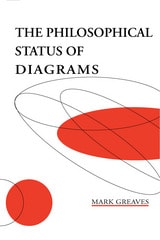
The Philosophical Status of Diagrams
Mark Greaves
CSLI, 2001
This book explores the reasons why structured graphics have been largely ignored in contemporary formal theories of axiomatic systems. In particular, it elucidates the systematic forces in the intellectual history of mathematics which have driven the adoption of sentential representational styles over diagrammatic ones. In this book, the effects of historical forces on the evolution of diagrammatically-based systems of inference in logic and geometry are traced from antiquity to the early twentieth-century work of David Hilbert. From this exploration emerges an understanding that the present negative attitudes towards the use of diagrams in logic and geometry owe more to implicit appeals to their history and philosophical background than to any technical incompatibility with modern theories of logical systems.
The Philosophical Vision of John Duns Scotus
An IntroductionMary Beth Ingham
Catholic University of America Press, 2004
The Philosophy Scare
The Politics of Reason in the Early Cold WarJohn McCumber
University of Chicago Press, 2016
McCumber begins with the story of Max Otto, whose appointment to the UCLA Philosophy Department in 1947 was met with widespread protest charging him as an atheist. Drawing on Otto’s case, McCumber details the hugely successful conservative efforts that, by 1960, had all but banished the existentialist and pragmatist paradigms—not to mention Marxism—from philosophy departments all across the country, replacing them with an approach that valorized scientific objectivity and free markets and which downplayed the anti-theistic implications of modern thought. As he shows, while there have since been many instances of definitive and even explosive rejection of this conservative trend, its effects can still be seen at American universities today.

The Philosophy of Baruch Spinoza
Richard Kennington
Catholic University of America Press, 2018
The Philosophy of Epicurus
Letters, Doctrines, and Parallel Passages from LucretiusEpicurus, translated with commentary and introduction by George K. Strodach
Northwestern University Press, 1963
The Philosophy of Immanuel Kant
Richard Kennington
Catholic University of America Press, 2018
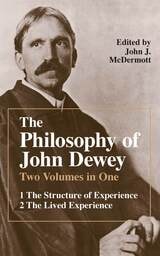
The Philosophy of John Dewey
Volume 1. The Structure of Experience. Volume 2: The Lived ExperienceJohn Dewey
University of Chicago Press, 1981
John J. McDermott's anthology, The Philosophy of John Dewey, provides the best general selection available of the writings of America's most distinguished philosopher and social critic. This comprehensive collection, ideal for use in the classroom and indispensable for anyone interested in the wide scope of Dewey's thought and works, affords great insight into his role in the history of ideas and the basic integrity of his philosophy.
This edition combines in one book the two volumes previously published separately. Volume 1, "The Structure of Experience," contains essays on metaphysics, the logic of inquiry, the problem of knowledge, and value theory. In volume 2, "The Lived Experience," Dewey's writings on pedagogy, ethics, the aesthetics of the "live creature," politics, and the philosophy of culture are presented. McDermott has prefaced each essay with a helpful explanatory note and has written an excellent general introduction to the anthology.

The Philosophy of Nature
Ivor Leclerc
Catholic University of America Press, 2018
The Pocket Epicurean
John Sellars
University of Chicago Press, 2021
As long as there has been human life, we’ve searched for what it means to be happy. More than two thousand years ago, the Greek philosopher Epicurus came to his own conclusion: all we really want in life is pleasure. Though today we tend to associate the word “Epicurean” with indulgence in the form of food and wine, the philosophy of Epicurus was about a life well lived even in the hardest of times. As John Sellars shows in this concise, approachable guide, the ideal life envisioned by Epicurus and his followers was a life much more concerned with mental pleasures and the avoidance of pain. Their goal, in short, was a life of tranquility or contentment.
In The Pocket Epicurean Sellars walks us through the history of Epicureanism, starting with the private garden on the edge of ancient Athens where Epicurus and his students lived in the fourth century BC, and where women were as welcome as men. Sellars then moves on to ancient Rome, where Epicurean influence flourished thanks to the poet Lucretius and his cohort. Throughout the book, Sellars draws on the ideas of Epicurus to offer a constructive way of thinking about the pleasures of friendship and our place in the world.
The Pocket Stoic
John Sellars
University of Chicago Press, 2020
As John Sellars shows in The Pocket Stoic, the popular image of the isolated and unfeeling Stoic hardly does justice to the rich vein of thought that we find in the work of Seneca, Epictetus, and Marcus Aurelius, the three great Roman Stoics. Their works are recognized classics, and for good reason—they speak to some of the perennial issues that face anyone trying to navigate their way through life. These writings, fundamentally, are about how to live—how to understand your place in the world, how to cope when things don’t go well, how to manage your emotions, how to behave toward others, and finally, how to live a good life. To be a Stoic is to recognize that much of the suffering in your life is due to the way you think about things, and that you have the ability to train your mind to look at the world in a new way—to recognize what you can and cannot control and to turn adversity into opportunity.
Concise and accessible, The Pocket Stoic provides a welcome introduction to the lives and thought of the key Stoics. It is also a perfect guide to help you start incorporating the practice of Stoicism into your everyday approach to life.