Results by title
1031 books match the query 'Intellectual life' and 216 start with t
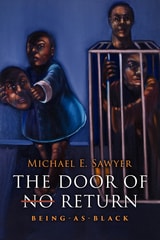
The Door of No Return
Being-As-BlackMichael E. Sawyer
Temple University Press, 2026
Using critical theory and philosophy, Sawyer decouples Black identity and Black philosophy from White and Western frames by building on Toni Morrison’s ideas of Black Thought and encouraging an understanding of Black Self-Consciousness and Black Self-Identity on Black terms. The Door of No Return uses music, literature, visual art, and a variety of physical disciplines to imagine a world that differs from one that confounds the positive formation of Black Self-Consciousness under the coercive regime of white supremacy and Anti-Black racism.
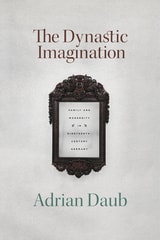
The Dynastic Imagination
Family and Modernity in Nineteenth-Century GermanyAdrian Daub
University of Chicago Press, 2021
Daub builds this conception of dynasty in a syncretic study of literature, sciences, and the history of ideas, engaging with remnants of dynastic ideology in the work of Richard Wagner, Émile Zola, and Stefan George, and in the work of early feminists and pioneering psychoanalysts. At every stage of cultural progression, Daub reveals how the relation of dynastic to nuclear families inflected modern intellectual history.
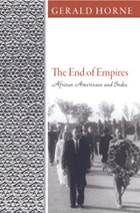
The End of Empires
African Americans and IndiaGerald Horne
Temple University Press, 2009
In the past fifty years, according to Christine So, the narratives of many popular Asian American books have been dominated by economic questions-what money can buy, how money is lost, how money is circulated, and what labor or objects are worth. Focusing on books that have achieved mainstream popularity, Economic Citizens unveils the logic of economic exchange that determined Asian Americans’ transnational migrations and national belonging.
With penetrating insight, So examines literary works that have been successful in the U.S. marketplace but have been read previously by critics largely as narratives of alienation or assimilation, including Fifth Chinese Daughter, Flower Drum Song, Falling Leaves and Turning Japanese. In contrast to other studies that have focused on the marginalization of Asian Americans, Economic Citizens examines how Asian Americans have entered into the public sphere.
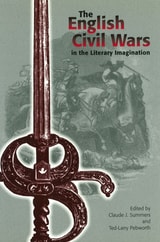
The English Civil Wars in the Literary Imagination
Edited by Claude J. Summers & Ted-Larry Pebworth
University of Missouri Press, 1999
The English civil wars loom large in seventeenth-century history and literature. This period, which culminated in the execution of a king, the dismantling of the Established Church, the inauguration of a commonwealth, and the assumption of rule by a lord protector, was one of profound change and disequilibrium. Focusing on writers as major as Milton, Marvell, Herrick, and Vaughan, and as misunderstood as Fane, Overton, and the poet Eliza, the fifteen essays in this collection discuss not only the representation of the civil wars but also the ways in which the civil wars were anticipated, refigured, and refracted in the century's literary imagination.
Although all of the essays are historically grounded and critically based, they vary widely in their historical perspectives and critical techniques, as well as in their scope and area of concentration. Six of the essays are on Royalist literary figures, six are on figures traditionally associated with the Parliamentarian side of the civil wars, two consider both, and the remaining essay examines how Royalist writers refashioned a puritan literary trope.
Unified through the contributors' concentration on "moderate" voices and their recurrent concerns with the ambiguities of literary response, The English Civil Wars in the Literary Imagination provides an important understanding of the English civil wars' manifold and sometimes indirect presence in the literature of the period.
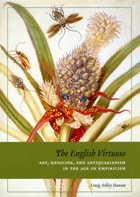
The English Virtuoso
Art, Medicine, and Antiquarianism in the Age of EmpiricismCraig Ashley Hanson
University of Chicago Press, 2009
At the heart of this profoundly interdisciplinary study lies the Royal Society of London for the Improvement of Natural Knowledge, which from its founding in 1660 served as the major professional organization for London’s leading physicians, many of them prominent virtuosi. Craig Ashley Hanson reveals that a vital art audience emerged from the Royal Society—whose members assembled many of the period’s most important nonaristocratic collections—a century before most accounts date the establishment of an institutional base for the arts in England. Unearthing the fascinating stories of an impressive cast of characters, Hanson establishes a new foundation for understanding both the relationship between British art and science and the artistic accomplishments of the late eighteenth and nineteenth centuries.
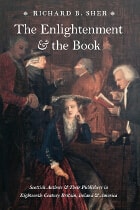
The Enlightenment and the Book
Scottish Authors and Their Publishers in Eighteenth-Century Britain, Ireland, and AmericaRichard B. Sher
University of Chicago Press, 2007
The late eighteenth century witnessed an explosion of intellectual activity in Scotland by such luminaries as David Hume, Adam Smith, Hugh Blair, William Robertson, Adam Ferguson, James Boswell, and Robert Burns. And the books written by these seminal thinkers made a significant mark during their time in almost every field of polite literature and higher learning throughout Britain, Europe, and the Americas.
In this magisterial history, Richard B. Sher breaks new ground for our understanding of the Enlightenment and the forgotten role of publishing during that period. The Enlightenment and the Book seeks to remedy the common misperception that such classics as The Wealth of Nations and The Life of Samuel Johnson were written by authors who eyed their publishers as minor functionaries in their profession. To the contrary, Sher shows how the process of bookmaking during the late eighteenth-century involved a deeply complex partnership between authors and their publishers, one in which writers saw the book industry not only as pivotal in the dissemination of their ideas, but also as crucial to their dreams of fame and monetary gain. Similarly, Sher demonstrates that publishers were involved in the project of bookmaking in order to advance human knowledge as well as to accumulate profits.
The Enlightenment and the Book explores this tension between creativity and commerce that still exists in scholarly publishing today. Lavishly illustrated and elegantly conceived, it will be must reading for anyone interested in the history of the book or the production and diffusion of Enlightenment thought.
The Enlightenment
A GenealogyDan Edelstein
University of Chicago Press, 2010
What was the Enlightenment? Though many scholars have attempted to solve this riddle, none has made as much use of contemporary answers as Dan Edelstein does here. In seeking to recover where, when, and how the concept of “the Enlightenment” first emerged, Edelstein departs from genealogies that trace it back to political and philosophical developments in England and the Dutch Republic. According to Edelstein, by the 1720s scholars and authors in France were already employing a constellation of terms—such as l’esprit philosophique—to describe what we would today call the Enlightenment. But Edelstein argues that it was within the French Academies, and in the context of the Quarrel of the Ancients and the Moderns, that the key definition, concepts, and historical narratives of the Enlightenment were crafted.
A necessary corrective to many of our contemporary ideas about the Enlightenment, Edelstein’s book turns conventional thinking about the period on its head. Concise, clear, and contrarian, The Enlightenment will be welcomed by all teachers and students of the period.
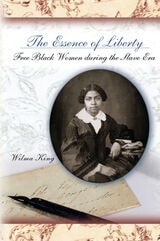
The Essence of Liberty
Free Black Women During the Slave EraWilma King
University of Missouri Press, 2006
The Essence of Liberty blends social, political, and economic history to analyze black women’s experience in both the North and the South, from the colonial period through emancipation. Focusing on class and familial relationships, King examines the myriad sources of freedom for black women to show the many factors that, along with time spent in slavery before emancipation, shaped the meaning of freedom. Her book also raises questions about whether free women were bound to or liberated from gender conventions of their day.
Drawing on a wealth of untapped primary sources—not only legal documents and newspapers but also the diaries, letters, and autobiographical writings of free women—King opens a new window on the world of black women. She examines how they became free, educated themselves, found jobs, maintained self-esteem, and developed social consciousness—even participating in the abolitionist movement. She considers the stance of southern free women toward their enslaved contemporaries and the interactions between previously free and newly freed women after slavery ended. She also looks closely at women’s spirituality, disclosing the dilemma some women faced when they took a stand against men—even black men—in order to follow their spiritual callings.
Throughout this engaging history, King underscores the pernicious constraints that racism placed on the lives of free blacks in spite of the fact that they were not enslaved. The Essence of Liberty shows the importance of studying these women on their own terms, revealing that the essence of freedom is more complex than the mere absence of shackles.
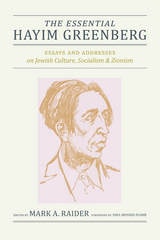
The Essential Hayim Greenberg
Essays and Addresses on Jewish Culture, Socialism, and ZionismHayim Greenberg, Edited and introduced by Mark Raider, Foreword by Paul Mendes-Flohr
University of Alabama Press, 2016
This collection of thoroughly annotated essays, spanning the 1920s to the early 1950s, includes Greenberg’s meditations on socialism and ethics, profiles of polarizing twentieth-century figures (among them Trotsky, Lenin, and Gandhi), and several essays investigating the compatibility of socialism and communism. Greenberg always circles back, however, to the recurring question of how Jews might situate themselves in modernity, both before and after the Holocaust, and how Labor Zionist ideology might reshape the imbalances of Jewish economic life.
Alongside his role as an American Zionist leader, Greenberg maintained a lifelong commitment to the vitality of the Jewish diaspora. Rather than promoting Jewish autonomy and statehood, he argued for fidelity to the Jewish spirit. This volume not only seeks to restore Greenberg to his previous stature in the field of Judaic studies but also to return a vital and authentic voice, long quieted, to the continuing debate over what it means to be Jewish.
The Essential Hayim Greenberg provides an accessible text for scholars, historians, and students of Jewish studies, religion, and theology.
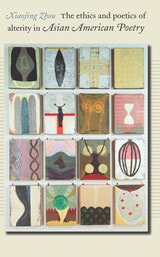
The Ethics and Poetics of Alterity in Asian American Poetry
Xiaojing Zhou
University of Iowa Press, 2006
Poetry by Asian American writers has had a significant impact on the landscape of contemporary American poetry, and a book-length critical treatment of Asian American poetry is long overdue. In this groundbreaking book, Xiaojing Zhou demonstrates how many Asian American poets transform the conventional “I” of lyric poetry—based on the traditional Western concept of the self and the Cartesian “I”—to enact a more ethical relationship between the “I” and its others.
Drawing on Emmanuel Levinas’s idea of the ethics of alterity—which argues that an ethical relation to the other is one that acknowledges the irreducibility of otherness—Zhou offers a reconceptualization of both self and other. Taking difference as a source of creativity and turning it into a form of resistance and a critical intervention, Asian American poets engage with broader issues than the merely poetic. They confront social injustice against the other and call critical attention to a concept of otherness which differs fundamentally from that underlying racism, sexism, and colonialism. By locating the ethical and political questions of otherness in language, discourse, aesthetics, and everyday encounters, Asian American poets help advance critical studies in race, gender, and popular culture as well as in poetry.
The Ethics and Poetics of Alterity is not limited, however, to literary studies: it is an invaluable response to the questions raised by increasingly globalized encounters across many kinds of boundaries.
The Poets
Marilyn Chin, Kimiko Hahn, Myung Mi Kim, Li Young Lee, Timothy Liu, David Mura, and John Yau
The Ethics of Witnessing
The Holocaust in Polish Writers' Diaries from Warsaw, 1939-1945Rachel Feldhay Brenner
Northwestern University Press, 2014
Winner, 2015 USC Book Award in Literary and Cultural Studies, for outstanding monograph published on Russia, Eastern Europe or Eurasia in the fields of literary and cultural studies
The Ethics of Witnessing investigates the reactions of five important Polish diaristswriters—Jaroslaw Iwaszkiewicz, Maria Dabrowska, Aurelia Wylezynska, Zofia Nalkowska, and Stanislaw Rembek—during the period when the Nazis persecuted and murdered Warsaw’s Jewish population. The responses to the Holocaust of these prominent prewar authors extended from insistence on empathic interaction with victims to resentful detachment from Jewish suffering. Whereas some defied the dehumanization of the Jews and endeavored to maintain intersubjective relationships with the victims they attempted to rescue, others selfdeceptively evaded the Jewish plight. The Ethics of Witnessing examines the extent to which ideologies of humanism and nationalism informed the diarists’ perceptions, proposing that the reality of the Final Solution exposed the limits of both orientations and ultimately destroyed the ethical landscape shaped by the Enlightenment tradition, which promised the equality and fellowship of all human beings.
The Ever-Present Origin
Part One: Foundations Of The Aperspectival WorldJean Gebser
Ohio University Press, 1986
This English translation of Gebser’s major work, Ursprung und Gegenwart (Stuttgart, Deutsche Verlag, 1966), offers certain fundamental insights which should be beneficial to any sensitive scientist and makes it available to the English-speaking world for the recognition it deserves.
“The path which led Gebser to his new and universal perception of the world is, briefly, as follows. In the wake of materialism and social change, man had been described in the early years of our century as the “dead end” of nature. Freud had redefined culture as illness—a result of drive sublimation; Klages had called the spirit (and he was surely speaking of the hypertrophied intellect) the “adversary of the soul,” propounding a return to a life like that of the Pelasgi, the aboriginal inhabitants of Greece; and Spengler had declared the “Demise of the West” during the years following World War I. The consequences of such pessimism continued to proliferate long after its foundations had been superseded.
It was with these foundations—the natural sciences—that Gebser began. As early as Planck it was known that matter was not at all what materialists had believed it to be, and since 1943 Gebser has repeatedly emphasized that the so-called crisis of Western culture was in fact an essential restructuration.…
Gebser has noted two results that are of particular significance: first, the abandonment of materialistic determinism, of a one-sided mechanistic-causal mode of thought; and second, a manifest “urgency of attempts to discover a universal way of observing things, and to overcome the inner division of contemporary man who, as a result of his one-sided rational orientation, thinks only in dualisms.”
Against this background of recent discoveries and conclusions in the natural sciences Gebser discerned the outlines of a potential human universality. He also sensed the necessity to go beyond the confines of this first treatise so as to include the humanities (such as political economics and sociology) as well as the arts in a discussion along similar lines. This was the point of departure of The Ever-Present Origin.
From In memoriam Jean Gebser by Jean Keckeis
The Fascist Revolution
Toward a General Theory of FascismGeorge L. Mosse, with a critical introduction by Roger Griffin
University of Wisconsin Press, 2021
The Fin-de-Siècle Poem
English Literary Culture and the 1890sJoseph Bristow
Ohio University Press, 2005
The First Fifty Years
A Jubilee in Prose and Poetry Honoring Women RabbisRabbi Sue Levi Elwell, Jessica Greenbaum, Rabbi Hara E. Person
Central Conference of American Rabbis, 2023
The ordination of Rabbi Sally J. Priesand in 1972 was a watershed moment in Jewish history. In The First Fifty Years, contributors from across the Jewish and gender spectrums reflect on the meaning of this moment and the ensuing decades, both personally and for the Jewish community. In short pieces of new prose, authors—many of them pioneering rabbis—share stories, insights, analysis, and celebrations of women in the rabbinate. These are intertwined with a wealth of poetry that poignantly captures the spirit of this anniversary. The volume is a deep, heartfelt tribute to women rabbis and their indelible impact on all of us.
The First Moderns
Profiles in the Origins of Twentieth-Century ThoughtWilliam R. Everdell
University of Chicago Press, 1997
"This exceptionally wide-ranging history is chock-a-block with anecdotes, factoids, odd juxtapositions, and useful insights. Most impressive. . . . For anyone interested in learning about late 19th- and early 20th- century imaginative thought, this engagingly written book is a good place to start."—Washington Post Book World
"The First Moderns brilliantly maps the beginning of a path at whose end loom as many diasporas as there are men."—Frederic Morton, The Los Angeles Times Book Review
"In this truly exciting study of the origins of modernist thought, poet and teacher Everdell roams freely across disciplinary lines. . . . A brilliant book that will prove useful to scholars and generalists for years to come; enthusiastically recommended."—Library Journal, starred review
"Everdell has performed a rare service for his readers. Dispelling much of the current nonsense about 'postmodernism,' this book belongs on the very short list of profound works of cultural analysis."—Booklist
"Innovative and impressive . . . [Everdell] has written a marvelous, erudite, and readable study."-Mark Bevir, Spectator
"A richly eclectic history of the dawn of a new era in painting, music, literature, mathematics, physics, genetics, neuroscience, psychiatry and philosophy."—Margaret Wertheim, New Scientist
"[Everdell] has himself recombined the parts of our era's intellectual history in new and startling ways, shedding light for which the reader of The First Moderns will be eternally grateful."—Hugh Kenner, The New York Times Book Review
"Everdell shows how the idea of "modernity" arose before the First World War by telling the stories of heroes such as T. S. Eliot, Max Planck, and Georges Serault with such a lively eye for detail, irony, and ambiance that you feel as if you're reliving those miraculous years."—Jon Spayde, Utne Reader

The Florida Room
Alexandra T. Vazquez
Duke University Press, 2022
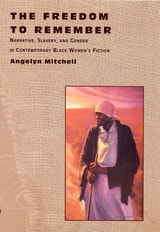
The Freedom to Remember
Narrative, Slavery, and Gender in Contemporary Black Women's FictionMitchell, Angelyn
Rutgers University Press, 2002
The Freedom to Remember examines contemporary literary revisions of slavery in the United States by black women writers. The narratives at the center of this book include: Octavia E. Butler’s Kindred, Sherley Anne Williams’s Dessa Rose, Toni Morrison’s Beloved, J. California Cooper’s Family, and Lorene Cary’s The Price of a Child.
Recent studies have investigated these works only from the standpoint of victimization. Angelyn Mitchell changes the conceptualization of these narratives, focusing on the theme of freedom, not slavery, defining these works as “liberatory narratives.” These works create a space to problematize the slavery/freedom dichotomy from which contemporary black women writers have the “safe” vantage point to reveal aspects of enslavement that their ancestors could not examine. The nineteenth-century female emancipatory narrative, by contrast, was written to aid the cause of abolition by revealing the unspeakable realitiesof slavery. Mitchell shows how the liberatory narrative functions to emancipate its readers from the legacies of slavery in American society: by facilitating a deeper discussion of the issues and by making them new through illumination and interrogation.
The French Writers' War, 1940-1953
Gisèle Sapiro
Duke University Press, 2014
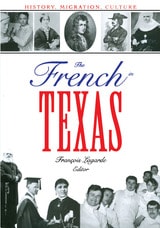
The French in Texas
History, Migration, CultureEdited by François Lagarde
University of Texas Press, 2003
2005 — San Antonio Conservation Society Citation
Original articles that explore the French presence and influence on Texas history, arts, education, religion, and business.
The flag of France is one of the six flags that have flown over Texas, but all that many people know about the French presence in Texas is the ill-fated explorer Cavelier de La Salle, fabled pirate Jean Laffite, or Cajun music and food. Yet the French have made lasting contributions to Texas history and culture that deserve to be widely known and appreciated. In this book, François Lagarde and thirteen other experts present original articles that explore the French presence and influence on Texas history, arts, education, religion, and business from the arrival of La Salle in 1685 to 2002.
Each article covers an important figure or event in the France-Texas story. The historical articles thoroughly investigate early French colonists and explorers, the French pirates and privateers, the Bonapartists of Champ-d'Asile, the French at the Alamo, Dubois de Saligny and French recognition of the Republic of Texas, the nineteenth-century utopists of Icaria and Reunion, and the French Catholic missions. Other articles deal with French immigration in Texas, including the founding of Castroville, Cajuns in Texas, and the French economic presence in Texas today (the first such study ever published). The remaining articles look at painters Théodore and Marie Gentilz, sculptor Raoul Josset, French architecture in Texas, French travelers from Théodore Pavie to Simone de Beauvoir who have written on Texas, and the French heritage in Texas education. More than seventy color and black-and-white illustrations complement the text.
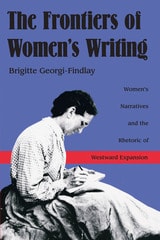
The Frontiers of Women's Writing
Women's Narratives and the Rhetoric of Westward ExpansionBrigitte Georgi-Findlay
University of Arizona Press, 1996
Brigitte Georgi-Findlay presents a range of writings that reflects the diversity of the western experience. Beginning with the narratives of Caroline Kirkland and other women of the early frontier, she reviews the diaries of the overland trails; letters and journals of the wives of army officers during the Indian wars; professional writings, focusing largely on travel, by women such as Caroline Leighton from the regional publishing cultures that emerged in the Far West during the last quarter of the century; and late-nineteenth- and early-twentieth-century accounts of missionaries and teachers on Indian reservations. Most of the writers were white, literate women who asserted their own kind of cultural authority over the lands and people they encountered. Their accounts are not only set in relation to a masculine frontier myth but also investigated for clues about their own involvement with territorial expansion. By exploring the various ways in which women writers actively contributed to and at times rejected the development of a national narrative of territorial expansion based on empire building and colonization, the author shows how their accounts are implicated in expansionist processes at the same time that they formulate positions of innocence and detachment.
Georgi-Findlay has drawn on American studies scholarship, feminist criticism, and studies of colonial discourse to examine the strategies of women's representation in writing about the West in ways that most theorists have not. She critiques generally accepted stereotypes and assumptions--both about women's writing and its difference of view in particular, and about frontier discourse and the rhetoric of westward expansion in general--as she offers a significant contribution to literary studies of the West that will challenge scholars across a wide range of disciplines.
The Genuine Article
Race, Mass Culture, and American Literary ManhoodPaul Gilmore
Duke University Press, 2001
From characters in Indian melodramas and minstrel shows to exhibits in popular museums and daguerrotype galleries, primitive racialized figures circulated as “the genuine article” of manliness in the antebellum United States. Gilmore argues that these figures were manipulated, translated, and adopted not only by canonical authors such as Hawthorne, Thoreau, Cooper, and Melville but also by African American and Native American writers like William Wells Brown and Okah Tubbee. By examining how these cultural notions of race played out in literary texts and helped to construct authorship as a masculine profession, Gilmore makes a unique contribution to theories of class formation in nineteenth-century America.
The Genuine Article will enrich students and scholars of American studies, gender studies, literature, history, sociology, anthropology, popular culture, and race.
The Great Brain Suck
And Other American EpiphaniesEugene Halton
University of Chicago Press, 2008
Luckily Halton, with scalpel-sharp wit in one hand and the balm of wisdom in the other, is here to operate on the declining body politic. His initial diagnosis is bleak: fast food and too much time spent sitting, whether in our cars or on our couches, are ruining our bodies, while our minds are weakened by the proliferation of electronic devices—TVs, computers, cell phones, iPods, video games—and their alienating effects. If we are losing the battle between autonomy and automation, he asks, how can our culture regain self-sufficiency? Halton finds the answer in the inspiring visions—deeply rooted in American culture—of an organic and more spontaneous life at the heart of the work of master craftsman Wharton Esherick, legendary blues singer Muddy Waters, urban critic Lewis Mumford, and artist Maya Lin, among others.
A scathing and original jeremiad against modern materialism, The Great Brain Suck is also a series of epiphanies of a simpler but more profound life.

The Great Transformation
The Contribution of German-Jewish Exiles to British CultureJeremy Adler
University of London Press, 2019
The Harlem Renaissance and the Idea of a New Negro Reader
Shawn Anthony Christian
University of Massachusetts Press, 2016
Many scholars have written about the white readers and patrons of the Harlem Renaissance, but during the period many black writers, publishers, and editors worked to foster a cadre of African American readers, or in the poet Sterling Brown's words, a “reading folk.” Black newspapers featured columns that reviewed the latest African American fiction. Magazines held writing contests to urge black readers to participate in the literary culture. Through newspapers, journals, and anthologies, writers such as James Weldon Johnson, Jessie Fauset, and Gwendolyn Bennett spoke directly to their fellow African Americans to cultivate interest in literature and the intellectual tools for reading it.
In The Harlem Renaissance and the Idea of a New Negro Reader, Shawn Anthony Christian argues that print-based addresses to African Americans are a defining but understudied component of the Harlem Renaissance. Especially between 1919 and 1930, these writers promoted diverse racial representation as a characteristic of “good literature” both to exhibit black literacy and to foster black readership. Drawing on research from print culture studies, histories of racial uplift, and studies of modernism, Christian demonstrates the importance of this focus on the African American reader in influential periodicals such as The Crisis and celebrated anthologies such as The New Negro. Christian illustrates that the drive to develop and support black readers was central in the poetry, fiction, and drama of the era.
The Heart as a Drum
Continuance and Resistance in American Indian PoetryRobin Riley Fast
University of Michigan Press, 2000
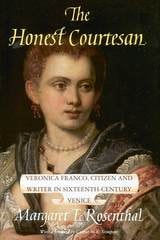
The Honest Courtesan
Veronica Franco, Citizen and Writer in Sixteenth-Century VeniceMargaret F. Rosenthal
University of Chicago Press, 1992
Margaret F. Rosenthal draws a compelling portrait of Veronica Franco in her cultural social, and economic world. Rosenthal reveals in Franco's writing a passionate support of defenseless women, strong convictions about inequality, and, in the eroticized language of her epistolary verses, the seductive political nature of all poetic contests. It is Veronica Franco's insight into the power conflicts between men and women—and her awareness of the threat she posed to her male contemporaries—that makes her literary works and her dealings with Venetian intellectuals so pertinent today.
Combining the resources of biography, history, literary theory, and cultural criticism, this sophisticated interdisciplinary work presents an eloquent and often moving account of one woman's life as an act of self-creation and as a complex response to social forces and cultural conditions.
"A book . . . pleasurably redolent of Venice in the 16th-century. Rosenthal gives a vivid sense of a world of salons and coteries, of intricate networks of family and patronage, and of literary exchanges both intellectual and erotic."—Helen Hackett, Times Higher Education Supplement
The Honest Courtesan is the basis for the film Dangerous Beauty (1998) directed by Marshall Herskovitz. (The film was re-titled The Honest Courtesan for release in the UK and Europe in 1999.)
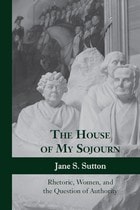
The House of My Sojourn
Rhetoric, Women, and the Question of AuthorityJane S. Sutton
University of Alabama Press, 2010
Employing the trope of architecture, Jane Sutton envisions the relationship between women and rhetoric as a house: a structure erected in ancient Greece by men that, historically, has made room for women but has also denied them the authority and agency to speak from within. Sutton’s central argument is that all attempts to include women in rhetoric exclude them from meaningful authority in due course, and this exclusion has been built into the foundations of rhetoric.
Drawing on personal experience, the spatial tropes of ancient Greek architecture, and the study of women who attained significant places in the house of rhetoric, Sutton highlights a number of decisive turns where women were able to increase their rhetorical access but were not able to achieve full authority, among them the work of Frances Wright, Lucy Stone, and suffragists Mott, Anthony, and Stanton; a visit to the 1893 World’s Columbian Exposition in Chicago, where the busts that became the Portrait Monument were displayed in the Woman’s Building (a sideshow, in essence); and a study of working-class women employed as telephone operators in New York in 1919.
With all the undeniable successes—socially, politically, and financially— of modern women, it appears that women are now populating the house of rhetoric as never before. But getting in the house and having public authority once inside are not the same thing. Sutton argues that women “can only act as far as the house permits.” Sojourn calls for a fundamental change in the very foundations of rhetoric.
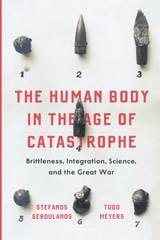
The Human Body in the Age of Catastrophe
Brittleness, Integration, Science, and the Great WarStefanos Geroulanos and Todd Meyers
University of Chicago Press, 2018
In The Human Body in the Age of Catastrophe, Stefanos Geroulanos and Todd Meyers uncover a fascinating story of how medical scientists came to conceptualize the body as an integrated yet brittle whole. Responding to the harrowing experience of the Great War, the medical community sought conceptual frameworks to understand bodily shock, brain injury, and the vast differences in patient responses they occasioned. Geroulanos and Meyers carefully trace how this emerging constellation of ideas became essential for thinking about integration, individuality, fragility, and collapse far beyond medicine: in fields as diverse as anthropology, political economy, psychoanalysis, and cybernetics.
Moving effortlessly between the history of medicine and intellectual history, The Human Body in the Age of Catastrophe is an intriguing look into the conceptual underpinnings of the world the Great War ushered in.
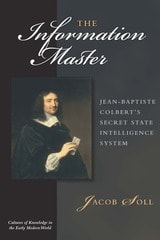
The Information Master
Jean-Baptiste Colbert's Secret State Intelligence SystemJacob Soll
University of Michigan Press, 2011
"Colbert has long been celebrated as Louis XIV's minister of finance, trade, and industry. More recently, he has been viewed as his minister of culture and propaganda. In this lively and persuasive book, Jake Soll has given us a third Colbert, the information manager."
---Peter Burke, University of Cambridge
"Jacob Soll gives us a road map drawn from the French state under Colbert. With a stunning attention to detail Colbert used knowledge in the service of enhancing
royal power. Jacob Soll's scholarship is impeccable and his story long
overdue and compelling."
---Margaret Jacob, University of California, Los Angeles
"Nowadays we all know that information is the key to power, and that the masters of information rule the world. Jacob Soll teaches us that Jean-Baptiste Colbert had grasped this principle three and a half centuries ago, and used it to construct a new kind of state. This imaginative, erudite, and powerfully written book re-creates the history of libraries and archives in early modern Europe, and ties them in a novel and convincing way to the new statecraft of Europe's absolute monarchs."
---Anthony Grafton, Princeton University
"Brilliantly researched, superbly told, and timely, Soll's story is crucial for the history of the modern state."
---Keith Baker, Stanford University
When Louis XIV asked his minister Jean-Baptiste Colbert---the man who was to oversee the building of Versailles and the Royal Academy of Sciences, as well as the navy, the Paris police force, and French industry---to build a large-scale administrative government, Colbert created an unprecedented information system for political power. In The Information Master, Jacob Soll shows how the legacy of Colbert's encyclopedic tradition lies at the very center of the rise of the modern state and was a precursor to industrial intelligence and Internet search engines.
Soll's innovative look at Colbert's rise to power argues that his practice of collecting knowledge originated from techniques of church scholarship and from Renaissance Italy, where merchants recognized the power to be gained from merging scholarship, finance, and library science. With his connection of interdisciplinary approaches---regarding accounting, state administration, archives, libraries, merchant techniques, ecclesiastical culture, policing, and humanist pedagogy---Soll has written an innovative book that will redefine not only the history of the reign of Louis XIV and information science but also the study of political and economic history.
Jacob Soll is Associate Professor of History at Rutgers University and the author of Publishing The Prince: History, Reading, and the Birth of Political Criticism (University of Michigan Press, 2005), and winner of the 2005 Jacques Barzun Prize from the American Philosophical Society and a 2009 Guggenheim Fellowship. Soll edited a special issue of Journal of the History of Ideas titled "The Uses of Historical Evidence in Early Modern Europe"; has cofounded the online journal Republics of Letters; and is editor, along with Anthony Grafton and Ann Blair, of the series Cultures of Knowledge in the Early Modern World.
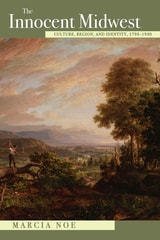
The Innocent Midwest
Culture, Region, and Identity, 1793–1930Marcia Noe
Ohio University Press, 0
The Innocent Midwest delves into one of the most enduring stereotypes in American cultural history: the image of the Midwest as a bastion of innocence. Despite its share of social, political, and economic complexities, the region has long been portrayed as wholesome, virtuous, and peace loving—a perception that has persisted from its pastoral beginnings through industrialization and into the digital age.
This book traces the roots and evolution of that myth, arguing that the Midwest’s innocent image has been carefully cultivated through American popular and high culture. From literature and film to music and visual art, the trope of the innocent Midwesterner has shaped national perceptions of the region for over a century. Focusing on literature from 1793 to the 1920s, the book explores how this character type emerged, evolved, and eventually confronted the disillusionment of the machine age.
Organized thematically, the book examines early frontier narratives, stories of Midwesterners abroad, Progressive Era ideals of neighborliness, immigrant and migrant experiences, and the eventual unraveling of the pastoral dream. It reveals how the myth of innocence was underpinned by a constellation of values—agrarianism, Christian morality, and a belief in education—that supported the Jeffersonian vision of a democratic, virtuous citizenry.
Rather than offering a sweeping theory of regional identity, The Innocent Midwest focuses on the recurring literary figure of the innocent Midwesterner—an individual shaped by the land and striving for self-actualization. The book draws both on canonical authors like Mark Twain, William Dean Howells, Booth Tarkington, Sinclair Lewis, Theodore Dreiser, and Willa Cather and on lesser-known voices such as Maria Susanna Cummins, David Graham Phillips, Elia W. Peattie, William Webb, Chief Luther Standing Bear, and Oscar Micheaux, whose works contributed to the cultural construction of the Midwest.
Through its nuanced exploration of literature and culture, this book offers a compelling account of how the Midwest came to symbolize innocence—and why that image continues to resonate in the American imagination.
The Intellectual Life
A. G. Sertillanges
Catholic University of America Press, 1992
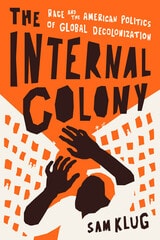
The Internal Colony
Race and the American Politics of Global DecolonizationSam Klug
University of Chicago Press, 2025
In The Internal Colony, Sam Klug reveals the central but underappreciated importance of global decolonization to the divergence between mainstream liberalism and the Black freedom movement in postwar America. Klug reconsiders what has long been seen as a matter of primarily domestic policy in light of a series of debates concerning self-determination, postcolonial economic development, and the meanings of colonialism and decolonization. These debates deeply influenced the discord between Black activists and state policymakers and formed a crucial dividing line in national politics in the 1960s and 1970s.
The result is a history that broadens our understanding of ideological formation—particularly how Americans conceptualized racial power and political economy—by revealing a much wider and more dynamic network of influences. Linking intellectual, political, and social movement history, The Internal Colony illuminates how global decolonization transformed the terms of debate over race and social class in the twentieth-century United States.
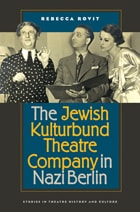
The Jewish Kulturbund Theatre Company in Nazi Berlin
Rebecca Rovit
University of Iowa Press, 2012
The Kulturbund’s directors were repeatedly caught between escalating demands from their Nazi overseers and from their own Jewish constituents. By examining why and how an all-Jewish repertory theatre could coexist with the Nazi regime, Rovit raises broader questions about the nature of art in an environment of coercion and isolation, artistic integrity and adaptability, and community and identity.
The Jewish Response to German Culture
From the Enlightenment to the Second World WarJehuda Reinharz
Brandeis University Press, 1991

The Journey Back
Houston A. Baker Jr.
University of Chicago Press, 1984
The Learned Ones
Nahua Intellectuals in Postconquest MexicoKelly S. McDonough
University of Arizona Press, 2014
Not so, according to author Kelly S. McDonough, at least not for native speakers of Nahuatl, one of the most widely spoken and best-documented indigenous languages of the Americas. This book focuses on how Nahuas have been deeply engaged with the written word ever since the introduction of the Roman alphabet in the early sixteenth century. Dipping into distinct time periods of the past five hundred years, this broad perspective allows McDonough to show the heterogeneity of Nahua knowledge and writing as Nahuas took up the pen as agents of their own discourses and agendas.
McDonough worked collaboratively with contemporary Nahua researchers and students, reconnecting the theorization of a population with the population itself. The Learned Ones describes the experience of reading historic text with native speakers today, some encountering Nahua intellectuals and their writing for the very first time. It intertwines the written word with oral traditions and embodied knowledge, aiming to retie the strand of alphabetic writing to the dynamic trajectory of Nahua intellectual work.
The Left Bank
Writers, Artists, and Politics from the Popular Front to the Cold WarHerbert Lottman
University of Chicago Press, 1998
"Surprisingly fresh and intense. . . . A retrospective travelogue of the Left Bank in the days when it was the setting for almost all French intellectual activity. . . . Absorbing."—Naomi Bliven, New Yorker
"As an introduction to a period in French history already legendary, The Left Bank is superb."—Michael Dirda, Washington Post Book World
"An intellectual history. A history of the interaction between politics and letters. And a rumination on the limitless credulity of intellectuals."—Christopher Hitchens, New Statesman
The Lettered City
Angel Rama
Duke University Press, 1996
Starting with the colonial period, Rama undertakes a historical analysis of the hegemonic influences of the written word. He explores the place of writing and urbanization in the imperial designs of the Iberian colonialists and views the city both as a rational order of signs representative of Enlightenment progress and as the site where the Old World is transformed—according to detailed written instructions—in the New. His analysis continues by recounting the social and political challenges faced by the letrados as their roles in society widened to include those of journalist, fiction writer, essayist, and political leader, and how those roles changed through the independence movements of the nineteenth century. The coming of the twentieth century, and especially the gradual emergence of a mass reading public, brought further challenges. Through a discussion of the currents and countercurrents in turn-of-the-century literary life, Rama shows how the city of letters was finally “revolutionized.”
Already crucial in setting the terms for debate concerning the complex relationships among intellectuals, national formations, and the state, this elegantly written and translated work will be read by Latin American scholars in a wide range of disciplines, and by students and scholars in the fields of anthropology, cultural geography, and postcolonial studies.

The Literary Guide and Companion to Southern England
Revised EditionRobert M. Cooper
Ohio University Press, 1998
In a series of intriguing routes through the English countryside, Professor Robert Cooper notes those attractions that the casual tourist might unknowingly pass by, such as the house where Dickens wrote A Tale of Two Cities, or the windswept quay where John Fowles’s French Lieutenant’s woman walked. Maps and information about restaurants and accommodations give the traveler the opportunity of having pints of “half and half” where Jane Austen dined or visiting the pub where Blake’s scuffle led to his trial for treason.
This newly revised and updated edition of Robert Cooper’s acclaimed handbook combines the utility of current travel information with the appeal of literary history, biography, and anecdote in a leisurely and flavorful guide to the broad sweep of southern England outside of London. A rich and reliable guide to the landscape that fostered one of our most cherished cultures, The Literary Guide and Companion to Southern England is an indispensable resource for those who wish to experience literature firsthand.
The Long Night of the Watchman
Essays by Vaclav Benda, 1977-1989F. Flagg Taylor
St. Augustine's Press, 2017
The Long War
The Intellectual People’s Front and Anti-Stalinism, 1930–1940Judy Kutulas
Duke University Press, 1994
Judy Kutulas takes us into the debates and outright fights between and within the ranks of organizations such as the League of American Writers, the John Reed Clubs, the Committee for Cultural Freedom, the American Civil Liberties Union, and the National Committee for the Defense of Political Prisoners. Showing how extremist views about the nature and value of communism triumphed over more moderate ones, she traces the transfer of the left’s leadership from one generation to the next. She describes how supporters of the People’s Front were discredited by the time of the Nazi-Soviet Pact and how this opened the way for a new generation of leaders better known as the New York intellectuals. In this shift, Kutulas identifies the beginnings of the liberal anti-communism that would follow World War II.
A book for students and scholars of the intersection of politics and culture, The Long War offers a new, informed perspective on the intellectual maneuvers of the American left of the 1930s and leads to a reinterpretation of the time and its complex legacy.
The Longing for Myth in Germany
Religion and Aesthetic Culture from Romanticism to NietzscheGeorge S. Williamson
University of Chicago Press, 2004
Through readings of key intellectuals ranging from Herder and Schelling to Wagner and Nietzsche, Williamson highlights three crucial factors in the emergence of the German engagement with myth: the tradition of Philhellenist neohumanism, a critique of contemporary aesthetic and public life as dominated by private interests, and a rejection of the Bible by many Protestant scholars as the product of a foreign, "Oriental" culture. According to Williamson, the discourse on myth in Germany remained bound up with problems of Protestant theology and confessional conflict through the nineteenth century and beyond.
A compelling adventure in intellectual history, this study uncovers the foundations of Germany's fascination with myth and its enduring cultural legacy.
The Lost Promise of Patriotism
Debating American Identity, 1890-1920Jonathan M. Hansen
University of Chicago Press, 2003
Intellectuals such as William James, John Dewey, Jane Addams, Eugene V. Debs, and W. E. B. Du Bois repudiated liberalism's association with acquisitive individualism and laissez-faire economics, advocating a model of liberal citizenship whose virtues and commitments amount to what Hansen calls cosmopolitan patriotism. Rooted not in war but in dedication to social equity, cosmopolitan patriotism favored the fight against sexism, racism, and political corruption in the United States over battles against foreign foes. Its adherents held the domestic and foreign policy of the United States to its own democratic ideals and maintained that promoting democracy universally constituted the ultimate form of self-defense. Perhaps most important, the cosmopolitan patriots regarded critical engagement with one's country as the essence of patriotism, thereby justifying scrutiny of American militarism in wartime.
The Lost Roads Project
A Walk-in Book of ArkansasC.D. Wright
University of Arkansas Press, 1994
The Lost World of Thomas Jefferson
Daniel J. Boorstin
University of Chicago Press, 1993
"The volume is too subtle, too rich in ideas for anyone to do justice to it in brief summary, too heavily documented and too carefully wrought for anyone to dismiss its thesis. . . . It is a major contribution not only to Jefferson studies but to American intellectual history. . . . All who work in the history of ideas will find themselves in Mr. Boorstin's debt."—Richard Hofstadter, South Atlantic Monthly
The Man Who Would Marry Susan Sontag
And Other Intimate Literary Portraits of the Bohemian EraEdward Field
University of Wisconsin Press, 2007
Long before Stonewall, young Air Force veteran Edward Field, fresh from combat in WWII, threw himself into New York’s literary bohemia, searching for fulfillment as a gay man and poet. In this vivid account of his avant-garde years in Greenwich Village and the bohemian outposts of Paris’s Left Bank and Tangier—where you could write poetry, be radical, and be openly gay—Field opens the closet door to reveal, as never been seen before, some of the most important writers of his time.
Here are young, beautiful Susan Sontag sitting at the feet of her idol Alfred Chester, who shrewdly plotted to marry her; May Swenson and her two loves; Paul and Jane Bowles in their ambiguous marriage; Frank O’Hara in and out of bed; Fritz Peters, the anointed son of Gurdjieff; and James Baldwin, Isabel Miller (Patience and Sarah), Tobias Schneebaum, Robert Friend, and many others. With its intimate portraits, Field’s memoir brings back a forgotten era—postwar bohemia—bawdy, comical, romantic, sad, and heroic.
The Mexican Transpacific
Nikkei Writing, Visual Arts, and PerformanceIgnacio López-Calvo
Vanderbilt University Press, 2022
This book, a continuation of author Ignacio López-Calvo’s previous research on cultural production by Latin American authors of Asian ancestry, focuses mostly on literature, theater, and visual arts produced by Japanese immigrants in Mexico and their descendants, rather than on the Japanese community as a mere object of study. With this interdisciplinary project, López-Calvo aims to bring to the fore this silenced community’s voice and agency to historicize its own experience.
The Midwestern Pastoral
Place and Landscape in Literature of the American HeartlandWilliam Barillas
Ohio University Press, 2006
The Mind of the Middle Ages
An Historical SurveyFrederick B. Artz
University of Chicago Press, 1980