Results by title
645 books match the query 'Judaism' and 172 start with t
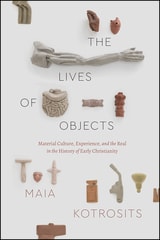
The Lives of Objects
Material Culture, Experience, and the Real in the History of Early ChristianityMaia Kotrosits
University of Chicago Press, 2020
Maia Kotrosits offers a fresh perspective on objects, looking beyond physical material to consider how collective imagination shapes the formation of objects and the experience of reality. Bringing a psychoanalytic approach to the analysis of material culture, she examines objects of attachment—relationships, ideas, and beliefs that live on in the psyche—and illustrates how people across time have anchored value systems to the materiality of life. Engaging with classical studies, history, anthropology, and literary, gender, and queer studies, Kotrosits shows how these disciplines address historical knowledge and how an expanded definition of materiality can help us make connections between antiquity and the contemporary world.
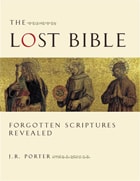
The Lost Bible
Forgotten Scriptures RevealedJ. R. Porter
University of Chicago Press, 2001
J. R. Porter introduces the reader to a wide selection of these extraordinary and beautiful "lost" works-from words considered to be those of prophets, kings, and patriarchs (even Adam himself) to legends and stories that supply "missing" parts of the Gospels. For each work, commentary is followed by a translated extract in clear and up-to-date language. The commentary places writings in their religious, social, and political context; explains the crucial importance of these works to the development of Jewish and Christian thought; and highlights the many legends and artistic traditions that sprang from them. It also examines the reasons-both religious and political-why these writings did not become part of the Jewish and Christian Bibles.
Lavishly illustrated with beautiful artwork, and amplified by maps, timelines, and data boxes, this text is a rich resource for anyone interested in exploring the origins of Judaism and Christianity.
Part I: Works related to the Old Testament
*Apocalypses
*Testaments
*Comments on Scripture
*Wisdom and Philosophy
*Hymns and Prayers
*Sibylline Oracles
*Apocrypha and Deuterocanonical works
*Recent Discoveries, including the Dead Sea Scrolls
Part II: Works related to the New Testament
*Apocryphal Gospels
*Apocryphal Acts
*Apocryphal Letters
*Apocryphal Apocalypses
*Recent Discoveries, including the Gnostic Library
The Lowercase Jew
Rodger Kamenetz
Northwestern University Press, 2003
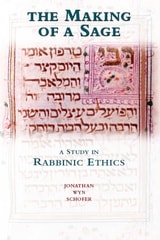
The Making of a Sage
A Study in Rabbinic EthicsJonathan Wyn Schofer
University of Wisconsin Press, 2005
Jonathan Schofer offers the first theoretically framed examination of rabbinic ethics in several decades. Centering on one large and influential anthology, The Fathers According to Rabbi Nathan, Jonathan Schofer situates that text within a broader spectrum of rabbinic thought, while at the same time bringing rabbinic thought into dialogue with current scholarship on the self, ethics, theology, and the history of religions.
Notable Selection, Jordan Schnitzer Book Award for Philosophy and Jewish Thought, Association for Jewish Studies
The Medieval Postcolonial Jew, In and Out of Time
Miriamne Ara Krummel
University of Michigan Press, 2022
The Mellah Society
Jewish Community Life in Sherifian MoroccoShlomo Deshen
University of Chicago Press, 1989
Shlomo Deshen, author of several books on North African Jewish immigrants to Israel, here turns his attention to the past. Taking as his focus the tension between individualism and communal authority—symbolized by the walls of the mellahs, the Jewish quarters—he applies to traditional Moroccan Jewish society questions of concern to sociologists everywhere regarding political organization, economic activity, religion, and the family.
From such documents as private correspondence, archival photographs, and the legal commentaries of rabbis who served in the Jewish community courts, Deshen draws out details of daily life: disputes between spouses, businessmen, craftsmen, and inheritors; the ramifications of marriage contracts; and claims involving community taxes and extortions by Muslim potentates. Linking this material with recent historical and anthropological studies of the Maghreb, Deshen reconstructs a community about which little has been known and places it squarely within the context of traditional Moroccan society.
Individual chapters deal with relations between Muslims and Jews, the material conditions of Jewish life, and the nature of politics within the mellah. Deshen devotes particular attention to the nature of the Moroccan rabbinate, the sociology of the mellah synagogue, lay community leadership, and the historic role of the Sephardic heritage in Morocco after the expulsion from medieval Spain. His close study of the nature of the extended family in traditional Morocco corrects popular misconceptions.
Originally published in Israel in 1983, now translated and expanded by its author, The Mellah Society draws upon Middle Eastern and Jewish history, textual Judaic studies, and social anthropology to make an original contribution that will interest scholars of the Middle East and North Africa as well as anyone concerned with Jewish history and ethnicity.
The Men's Section
Orthodox Jewish Men in an Egalitarian WorldElana Maryles Sztokman
Brandeis University Press, 2011
The Middle Maccabees
Archaeology, History, and the Rise of the Hasmonean KingdomAndrea M. Berlin
SBL Press, 2021
A focused, interdisciplinary examination of a tumultuous, history-making era
The Middle Maccabees lays out the charged, complicated beginnings of the independent Jewish state founded in the second century BCE. Contributors offer focused analyses of the archaeological, epigraphic, numismatic, and textual evidence, framed within a wider world of conflicts between the Ptolemies of Egypt, the Seleucids of Syria, and the Romans. The result is a holistic view of the Hasmonean rise to power that acknowledges broader political developments, evolving social responses, and the particularities of local history. Contributors include Uzi ‘Ad, Donald T. Ariel, Andrea M. Berlin, Efrat Bocher, Altay Coşkun, Benedikt Eckhardt, Gerald Finkielsztejn, Christelle Fischer-Bovet, Yuval Gadot, Erich Gruen, Sylvie Honigman, Jutta Jokiranta, Paul J. Kosmin, Uzi Leibner, Catharine Lorber, Duncan E. MacRae, Dvir Raviv, Helena Roth, Débora Sandhaus, Yiftah Shalev, Nitsan Shalom, Danny Syon, Yehiel Zelinger, and Ayala Zilberstein.
Features
- Up-to-date, generously illustrated essays analyzing the relevant archaeological remains
- A revised understanding of how local and imperial histories overlapped and intersected
- New analysis of the book of 1 Maccabees as a tool of Hasmonean strategic interest
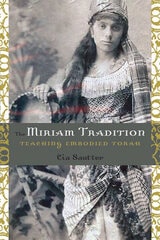
The Miriam Tradition
Teaching Embodied TorahCia Sautter
University of Illinois Press, 2010
The Mishnah in Contemporary Perspective, Volume 1
Alan J. Avery-Peck
SBL Press, 2016
Now in Paperback!
In the past thirty years, the Mishnah has taken its place as a principal focus in the academic study of religion and of Judaism. Many university scholars have participated in the contemporary revolution in the description, analysis, and interpretation of the Mishnah. Nearly all the publishing scholars of the academy who are now at work are represented in this project. Both essential volumes present a broad selection of approaches to the study of the Mishnah. What they prove in diverse ways is that the Mishnah defines the critical focus of the study of Judaism. It is a document that rewards study in the academic humanities.
Features:
- The best of contemporary scholarship on the Mishnah
- The most representative selection of contemporary Mishnah-study contributions available in any collection in a Western language
- Paperback format of an essential Brill reference work
The Mishnah in Contemporary Perspective, Volume 2
Alan J. Avery-Peck
SBL Press, 2016
Now in Paperback!
This second volume of a two-part project on the Mishnah displays a broad selection of approaches to the study of the Mishnah in the contemporary academy. The work derives from Israel, North America, and Europe and shows the intellectual vitality of scholarship in all three centers of learning. What these articles show in diverse ways is that the Mishnah forms a critical focus of the study of Judaism.
Features:
- The best of contemporary scholarship on the Mishnah
- The most representative selection of contemporary Mishnah-study contributions available in any collection in a Western language
- Paperback format of an essential Brill reference work
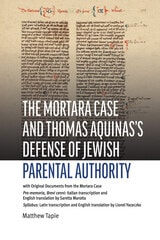
The Mortara Case and St. Thomas Aquinas's Defense of Jewish Parental Authority
with Original Documents from the Mortara Case: <i>Pro-memoria, Syllabus, Brevi cenni</i>Matthew Tapie
Catholic University of America Press, 2024
The Mussar Torah Commentary
A Spiritual Path to Living a Meaningful and Ethical LifeRabbi Barry H. Block
Central Conference of American Rabbis, 2020
This Mussar-based commentary is a vital resource for Torah study, offering a thoughtful analysis of each of the 54 weekly parashot. Each essay in this anthology brings a parashah into juxtaposition with one of the Mussar middot (character traits as described within the Jewish school of ethics called Mussar), thereby providing an applied lens of Mussar teachings that helps us to delve deeper into our tradition with increased mindfulness and intention.

The Myths of Zionism
John Rose
Pluto Press, 2004
Ancient, medieval and modern, this book is a critical account of the historical, political and cultural roots of Zionism.
Scrutinising the roots of the myths of Zionism and mobilising recent scholarship, John Rose shows how many of these stories, as with other mythologies, have no basis in fact. However, because Zionism is a living political force and these myths have been used to justify very real and political ends - namely, the expulsion and continuing persecution of the Palestinians. John Rose separates fact from fiction presenting a detailed analysis of their origins and development. This includes a challenge to Zionism's biblical claims using very recent and very startling Israeli archaeological conclusions.
This book shows clearly how Zionism makes many false claims on Jewish religion and history.
The Nakedness of the Fathers
Biblical Visions and RevisionsOstriker, Alicia Suskin
Rutgers University Press, 1997
In her introduction, "Entering the Tents, " Ostriker defines the need to struggle against a tradition in which women have been silenced and disempowered - and to recover the female power buried beneath the surface of the biblical texts. In "The Garden, " she reinterprets the mythically complex stories of Creation. Then she considers the stories of "The Fathers, " from Abraham and Isaac to Moses, David, and Solomon - and their wives, mothers, and sisters. In "The Return of the Mothers, " she begins with a radical new interpretation of the book of Esther, includes a meditation on the silenced wife of Job and the idea of justice, and concludes with a fable on the death of God and a prayer to the Shekhinah, the feminine aspect of God. Ostriker refuses to dismiss the Bible as meaningless to women. Instead, in this angry, eloquent, visionary book, she attempts to recover what is genuinely sacred in these sacred texts.
The New Jew in Film
Exploring Jewishness and Judaism in Contemporary CinemaAbrams, Nathan
Rutgers University Press, 2012
The New Jew in Film is grounded in the study of over three hundred films from Hollywood and beyond. Nathan Abrams explores these new and changing depictions of Jews, Jewishness, and Judaism, providing a wider, more representative picture of this transformation. In this compelling, surprising, and provocative book, chapters explore masculinity, femininity, passivity, agency, and religion in addition to a departure into new territory—including bathrooms and food. Abrams’s concern is to reveal how the representation of the Jew is used to convey confidence or anxieties about Jewish identity and history as well as questions of racial, sexual, and gender politics. In doing so, he provides a welcome overview of important Jewish films produced globally over the past twenty years.
The New Jewish Diaspora
Russian-Speaking Immigrants in the United States, Israel, and GermanyGitelman, Zvi
Rutgers University Press, 2016
The New Jewish Leaders
Reshaping the American Jewish LandscapeEdited by Jack Wertheimer
Brandeis University Press, 2011
The Old Testament Pseudepigrapha
Fifty Years of the Pseudepigrapha Section at the SBLMatthias Henze
SBL Press, 2019
A history of research that changed scholarly perceptions of early Judaism
This collection of essays by some of the most important scholars in the fields of early Judaism and Christianity celebrates fifty years of the study of the Old Testament Pseudepigrapha at the Society of Biblical Literature and the pioneering scholars who introduced the Pseudepigrapha to the Society. Since its early days as a breakfast meeting in 1969, the Pseudepigrapha Section has provided a forum for a rigorous discussion of these understudied texts and their relevance for Judaism and Christianity. Contributors recount the history of the section's beginnings, critically examine the vivid debates that shaped the discipline, and challenge future generations to expand the field in new interdisciplinary directions.
Features:
- Reflections from early members of the Pseudepigrapha Group
- Essays that examine a methodological shift from capturing and preserving traditions to exploring the intellectual and social world of Jewish antiquity
- Evaluations of past interactions with adjacent fields and the larger academic world
The Only True God
Early Christian Monotheism in Its Jewish ContextJames F. McGrath
University of Illinois Press, 2012
The Open Door
A Passover HaggadahRabbi Sue Levi Elwell
Central Conference of American Rabbis, 2002
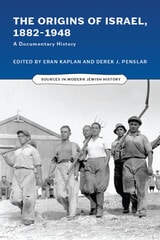
The Origins of Israel, 1882–1948
A Documentary HistoryEran Kaplan
University of Wisconsin Press, 2011
In 1880 the Jewish community in Palestine encompassed some 20,000 Orthodox Jews; within sixty-five years it was transformed into a secular proto-state with well-developed political, military, and economic institutions, a vigorous Hebrew-language culture, and some 600,000 inhabitants. The Origins of Israel, 1882–1948: A Documentary History chronicles the making of modern Israel before statehood, providing in English the texts of original sources (many translated from Hebrew and other languages) accompanied by extensive introductions and commentaries from the volume editors.
This sourcebook assembles a diverse array of 62 documents, many of them unabridged, to convey the ferment, dissent, energy, and anxiety that permeated the Zionist project from its inception to the creation of the modern nation of Israel. Focusing primarily on social, economic, and cultural history rather than Zionist thought and diplomacy, the texts are organized in themed chapters. They present the views of Zionists from many political and religious camps, factory workers, farm women, militants, intellectuals promoting the Hebrew language and arts—as well as views of ultra-Orthodox anti-Zionists. The volume includes important unabridged documents from the origins of the Arab-Israeli conflict that are often cited but are rarely read in full. The editors, Eran Kaplan and Derek J. Penslar, provide both primary texts and informative notes and commentary, giving readers the opportunity to encounter voices from history and make judgments for themselves about matters of world-historical significance.
Best Special Interest Books, selected by the Public Library Reviewers
Best Books for General Audiences, selected by the American Association of School Librarians
The Papacy, the Jews, and the Holocaust
Frank J. Coppa
Catholic University of America Press, 2006
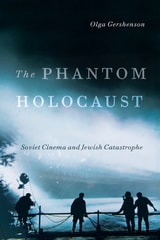
The Phantom Holocaust
Soviet Cinema and Jewish CatastropheGershenson, Olga
Rutgers University Press, 2013
Focusing on work by both celebrated and unknown Soviet directors and screenwriters, Olga Gershenson has written the first book about all Soviet narrative films dealing with the Holocaust from 1938 to 1991. In addition to studying the completed films, Gershenson analyzes the projects that were banned at various stages of production.
The book draws on archival research and in-depth interviews to tell the sometimes tragic and sometimes triumphant stories of filmmakers who found authentic ways to represent the Holocaust in the face of official silencing. By uncovering little known works, Gershenson makes a significant contribution to the international Holocaust filmography.
The Philo of Alexandria Scripture Index
Sean A. Adams
SBL Press, 2023
The Philo of Alexandria Scripture Index identifies and lists every instance in which Philo of Alexandria cites or alludes to passages from Jewish Scripture. With 7,831 references, this book is the most comprehensive study of its kind to date. Unlike other volumes with a single index of Philo’s citations and allusions organized by biblical book, this volume includes a second index that follows Philo’s treatise order. This second format allows students and scholars easily to examine Philo’s engagement with Scripture in individual treatises and to interrogate how Philo collected and grouped intertexts. In addition to the indices, Sean A. Adams and Zanne Domoney-Lyttle provide an introduction to their methodology and their selection of texts, including Philo’s fragmentary works and those that survive only in the Armenian tradition.
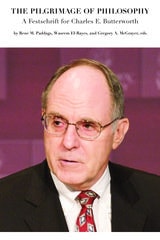
The Pilgrimage of Philosophy
A Festschrift for Charles E. Butterworthel-rayes
St. Augustine's Press, 2019
This book intends to introduce readers to the work of Charles E. Butterworth, and thereby to introduce students to Medieval islamic political philosophy, of which Butterworth is one of the world’s most prominent scholars. In a wider sense, the Festschrift introduces its readers to the current debates on Medieval islamic political philosophy, related as they are to the questions of the relationship between islam and Christianity, the Medieval to the Modern world, and reason and revelation. Butterworth’s scholarship spans six decades, primarily translating, editing, and interpreting the works of the Muslim political philosopher Alfarabi (d. 950) and Averroes (Ibn Rushd, d. 1198). He began his studies of Muslim political philosophy at a time when the Middle East and islam did not have the political salience they have acquired in more recent years. instead, Butterworth’s reason for engaging with islam was rooted in the question of the relationship between reason and revelation.
While one possible answer was pursued in the Christian, latin West, the islamic borderlands of Greek, Roman, and Muslim civilization offered another. By exploring Averroes, who provides the possibility of an Aristotelian-Islamic political philosophy, and Alfarabi, who pursues a Platonic-islamic political philosophy, Butterworth showed how islamic civilization provided a viable alternative to the theologico-political question reason v revelation, as well as serving as an inspiration to the latin West.
The Postcolonial Jewish Question
Colonialism and the Politics of Difference in Postwar FranceMendel Kranz
University of Chicago Press, 2026
A history of how decolonization shaped Jewish political identity in late-twentieth-century France.
In The Postcolonial Jewish Question, Mendel Kranz shows how France’s colonial history fundamentally shaped contemporary debates among Jews in France about racism, discrimination, and minority politics during the late twentieth century. As the wider country confronted the legacies of the Holocaust and the decline of its colonial empire, Jewish thinkers questioned the boundaries of their own political identity and challenged prevailing paradigms of Western universalism. This book traces how prominent and lesser-known thinkers—including Albert Memmi, Emmanuel Levinas, Alain Finkielkraut, and Wladimir Rabi—as well as organizations like the Colloque des intellectuels juifs de langue française engaged with issues of oppression, nationhood, and communal identity, and the ways that colonialism and its afterlives shaped those discussions. Kranz reveals how the Jewish question itself changed shape through confrontations with postcolonial politics. In doing so, he calls for a reassessment of the parameters of the Jewish question amid colonialism’s enduring legacies in the present.
The Power of Dialogue between Israelis and Palestinians
Stories of Change from the School for PeaceSonnenschein, Nava
Rutgers University Press, 2019
The Prophetic Law
Essays in Judaism, Girardianism, Literary Studies, and the EthicalSandor Goodhart
Michigan State University Press, 2014
The Psalms of Solomon
Language, History, TheologyEberhard Bons
SBL Press, 2015
A fresh analysis of that sheds new light on the Psalms of Solomon
Researchers whose work focuses on the Psalms of Solomon, experts on the Septuagint, and scholars of Jewish Hellenistic literature take a fresh look at debates surrounding the text. Authors engage linguistic, historical, and theological issues including the original language of the psalms, their historical setting, and their theological intentions with the goal of expanding our understanding of first-century BCE Jewish theology.
Features:
- New methods applied to open questions of authorship and historical context
- Focusd scholarly attention on a work of theological and literary importance
- Revised essays originally presented at the First International Meeting on the Psalms of Solomon
The Quest for Jewish Belief and Identity in the Graphic Novel
Stephen E. Tabachnick
University of Alabama Press, 2014
The creators of Superman (Jerry Siegel and Joe Shuster), Batman (Bob Kane and Bill Finger), and the Marvel superheroes (Stan Lee and Jack Kirby), were Jewish, as was the founding editor of Mad magazine (Harvey Kurtzman). They often adapted Jewish folktales (like the Golem) or religious stories (such as the origin of Moses) for their comics, depicting characters wrestling with supernatural people and events. Likewise, some of the most significant graphic novels by Jews or about Jewish subject matter deal with questions of religious belief and Jewish identity. Their characters wrestle with belief—or nonbelief—in God, as well as with their own relationship to the Jews, the historical role of the Jewish people, the politics of Israel, and other issues related to Jewish identity.
In The Quest for Jewish Belief and Identity in the Graphic Novel, Stephen E. Tabachnick delves into the vivid kaleidoscope of Jewish beliefs and identities, ranging from Orthodox belief to complete atheism, and a spectrum of feelings about identification with other Jews. He explores graphic novels at the highest echelon of the genre by more than thirty artists and writers, among them Harvey Pekar (American Splendor), Will Eisner (A Contract with God), Joann Sfar (The Rabbi’s Cat), Miriam Katin (We Are On Our Own), Art Spiegelman (Maus), J. T. Waldman (Megillat Esther), Aline Kominsky Crumb (Need More Love), James Sturm (The Golem’s Mighty Swing), Leela Corman (Unterzakhn), Ari Folman and David Polonsky (Waltz with Bashir), David Mairowitz and Robert Crumb’s biography of Kafka, and many more. He also examines the work of a select few non-Jewish artists, such as Robert Crumb and Basil Wolverton, both of whom have created graphic adaptations of parts of the Hebrew Bible.
Among the topics he discusses are graphic novel adaptations of the Bible; the Holocaust graphic novel; graphic novels about the Jews in Eastern and Western Europe and Africa, and the American Jewish immigrant experience; graphic novels about the lives of Jewish women; the Israel-centered graphic novel; and the Orthodox graphic novel. The book concludes with an extensive bibliography.
No study of Jewish literature and art today can be complete without a survey of the graphic novel, and scholars, students, and graphic novel fans alike will delight in Tabachnick’s guide to this world of thought, sensibility, and artfulness.
The Quiet Voices
Southern Rabbis and Black Civil Rights, 1880s to 1990sMark K. Bauman
University of Alabama Press, 1997
These wide-ranging essays reveal the various roles played by southern rabbis in the struggle for black civil rights since Reconstruction
The study of black-Jewish relations has become a hotbed of controversy, especially with regard to the role played by Jewish leaders during the Civil Rights movement. Did these leaders play a pivotal role, or did many of them, especially in the South, succumb to societal pressure and strive to be accepted rather than risk being persecuted? If some of these leaders did choose a quieter path, were their reasons valid? And were their methods successful?
Individually, each essay offers a glimpse into both the private and public difficulties these rabbis faced in their struggle to achieve good. Collectively, the essays provide an unparalleled picture of Jewish leadership during the civil rights era.
The Qumran Paradigm
Critical Evaluation of Some Foundational Hypotheses in the Construction of the QGwynned de Looijer
SBL Press, 2015
A fundamentally revisionist approach that leaves behind the constructed social reality of a “sectarian” paradigm
Gwynned de Looijer reexamines the key hypotheses that have driven scholars’ understandings of the Dead Sea Scrolls, the archaeological site of Khirbet Qumran, and the textual descriptions of the Essenes. She demonstrates that foundational hypotheses regarding a sect at Qumran have heavily influenced the way the texts found in the surrounding caves are interpreted. De Looijer’s approach abandon’s those assumptions to illustrate that the Dead Sea Scrolls reflect a wider range of backgrounds reflecting the many diverse forms of Judaism that existed in the Second Temple period.
Features:
- In depth analysis of 4QMMT
- Reevaluation of the concept of dualism as it has been applied to Qumran texts
- Charts and tables illustrate complex theories, concepts, and connections
The Rediscovery of Jewish Christianity
From Toland to BaurF. Stanley Jones
SBL Press, 2012
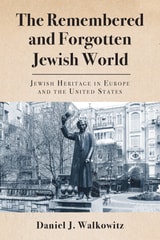
The Remembered and Forgotten Jewish World
Jewish Heritage in Europe and the United StatesDaniel J. Walkowitz
Rutgers University Press, 2018
The Remembered and Forgotten Jewish World investigates the politics of heritage tourism and collective memory. In an account that is part travelogue, part social history, and part family saga, acclaimed historian Daniel J. Walkowitz visits key Jewish museums and heritage sites from Berlin to Belgrade, from Krakow to Kiev, and from Warsaw to New York, to discover which stories of the Jewish experience are told and which are silenced. As he travels to thirteen different locations, participates in tours, displays, and public programs, and gleans insight from local historians, he juxtaposes the historical record with the stories presented in heritage tourism. What he finds raises provocative questions about the heritage tourism industry and its role in determining how we perceive Jewish history and identity. This book offers a unique perspective on the importance of collective memory and the dangers of collective forgetting.
The Renewal of the Kibbutz
From Reform to TransformationRussell, Raymond
Rutgers University Press, 2015
This book explores the waves of reforms since 1990. Looking through the lens of organizational theories that predict how open or closed a group will be to change, the authors find that less successful kibbutzim were most receptive to reform, and reforms then spread through imitation from the economically weaker kibbutzim to the strong.
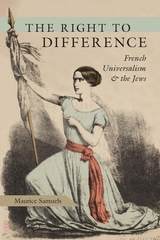
The Right to Difference
French Universalism and the JewsMaurice Samuels
University of Chicago Press, 2016
Samuels demonstrates that Jewish difference has always been essential to the elaboration of French universalism, whether as its foil or as proof of its reach. He traces the development of this discourse through key moments in French history, from debates over granting Jews civil rights during the Revolution, through the Dreyfus Affair and Vichy, and up to the rise of a “new antisemitism” in recent years. By recovering the forgotten history of a more open, pluralistic form of French universalism, Samuels points toward new ways of moving beyond current ethnic and religious dilemmas and argues for a more inclusive view of what constitutes political discourse in France.
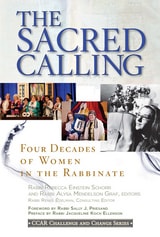
The Sacred Calling
Four Decades of Women in the RabbinateRabbi Rebecca Einstein Schorr and Rabbi Alysa Mendelson Graf
Central Conference of American Rabbis, 2016
Winner of the 2016 National Jewish Book Award in Women's Studies, this pioneering anthology paints an illuminating and necessary picture of the past while laying the groundwork for important work yet to be done.
Women have been rabbis for over forty years. No longer are women rabbis a unique phenomenon, rather they are part of the fabric of Jewish life. In this anthology, rabbis and scholars from across the Jewish world reflect back on the historic significance of women in the rabbinate and explore issues related to both the professional and personal lives of female rabbis. This collection examines the ways in which the reality of women in the rabbinate has impacted all aspects of Jewish life, including congregational culture, liturgical development, life cycle ritual, the Jewish healing movement, spirituality, theology, and more.
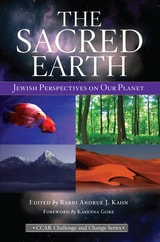
The Sacred Earth
Jewish Perspectives on Our PlanetRabbi Andrue J. Kahn
Central Conference of American Rabbis, 2023
The Torah begins by setting forth the heavens and the Earth as God’s creation, impelling humanity to steward our planet for its own sake and for its ability to nurture our lives. Yet the human-Divine-environment relationship seems to be in perpetual crisis. The Sacred Earth is a contemporary Jewish response to the looming threat of climate change, the widespread desire for experiential spirituality rooted in nature, and the continually changing relationship between humanity, nature, technology, and the Divine. The leading thinkers in this collection reflect on human vulnerability in the face of forces of nature, examine conceptions of our place in cosmology, and grapple with environmental destruction. Ultimately, with hope, they creatively explore ways to redeem this sacred Earth.
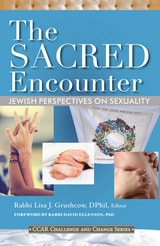
The Sacred Encounter
Jewish Perspectives on SexualityRabbi Lisa Grushcow, Dphil
Central Conference of American Rabbis, 2014
This wide-ranging anthology takes a close look at the breadth of human sexuality from a Jewish perspective. The essays begin with a look at biblical and rabbinic views on sexuality and then proceed to explorations of sexuality at different moments in the life cycle, sexuality and the marital model, diverse expressions of sexuality, examples of sexuality education, the nexus of sexuality and theology, and the challenges of contemporary sexual ethics. The Sacred Encounter is a thought-provoking and important Jewish resource. Perfect for personal study or for high school or adult classes.
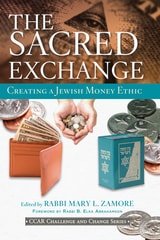
The Sacred Exchange
Creating a Jewish Money EthicRabbi Mary L. Zamore
Central Conference of American Rabbis, 2019
Part of the CCAR Press Challenge and Change series, this anthology creates a rich and varied discussion about the ethics of money. Our use of and relationship with money must reflect our religious values--this book aims to start a comprehensive conversation about how Judaism can guide us in this multi-faceted relationship.
The Sacred Struggle
Jewish Responses to TraumaRabbi Lindsey Danziger and Rabbi Benjamin David
Central Conference of American Rabbis, 2025
much more.
The Sacred Table
Creating a Jewish Food EthicRabbi Mary L. Zamore
Central Conference of American Rabbis, 2011
The Sacred Table: Creating a Jewish Food Ethic is an anthology of diverse essays on Jewish dietary practices. This volume presents the challenge of navigating through choices about eating, while seeking to create a rich dialogue about the intersection of Judaism and food. The definition of Kashrut, the historic Jewish approach to eating, is explored, broadened and, in some cases, argued with, in these essays. Kashrut is viewed not only as a ritual practice, but also as a multifaceted Jewish relationship with food and its production, integrating values such as ethics, community, and spirituality into our dietary practice.
The questions considered in The Sacred Table are broad reaching. Does Kashrut represent a facade of religiosity, hiding immorality and abuse, or is it, in its purest form, a summons to raise the ethical standards of food production? How does Kashrut enrich spiritual practice by teaching intentionality and gratitude? Can paying attention to our own eating practices raise our awareness of the hungry? Can Kashrut inspire us to eat healthfully? Can these laws draw us around the same table, thus creating community? In exploring the complexities of these questions, this book includes topics such as agricultural workers' rights, animal rights, food production, the environment, personal health, the spirituality of eating and fasting, and the challenges of eating together.
The Sacred Table celebrates the ideology of educated choice. The essays present a diverse range of voices, opinions, and options, highlighting the Jewish values that shape our food ethics. Whether for the individual, family, or community, this book supplies the basic how-tos of creating a meaningful Jewish food ethic and incorporating these choices into our personal and communal religious practices. These resources will be helpful if we are new to these ideas or if we are teaching or counseling others. Picture a beautiful buffet of choices from which you can shape your personal Kashrut. Read, educate yourself, build on those practices that you already follow, and eat well.
The Scribes of the Torah
The Formation of the Pentateuch in Its Literary and Historical ContextsKonrad Schmid
SBL Press, 2023
A revised view of the Pentateuch with consequences for the broader literary history of the Bible
This collection of thirty-one studies on the Pentateuch represents more than twenty years of Konrad Schmid’s research and publications advocating for a new view of the Pentateuch’s formation. Schmid’s essays present the case for a Persian period Priestly document that provided a basic narrative thread to the Torah, which included separate, pre-Priestly components of narratives in Genesis and the Moses story. Schmid’s open discussion includes evidence from various fields, such as literary history, comparative cultural history, historical linguistics, epigraphy, and archaeology. The essays are divided into eight sections usefully structured around the themes of the Pentateuch in the Enneateuch, the history of scholarship, the formation of the Torah, Genesis, the Moses story, the Priestly document, legal texts, and the Pentateuch in the history of ancient Israel’s religion.
The Song of Songs and the Ancient Egyptian Love Songs
Michael V. Fox
University of Wisconsin Press, 1985
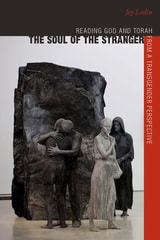
The Soul of the Stranger
Reading God and Torah from a Transgender PerspectiveJoy Ladin
Brandeis University Press, 2018
The Spectral Jew
Conversion and Embodiment in Medieval EuropeSteven F. Kruger
University of Minnesota Press, 2006
Looking closely at how medieval Jewish and Christian identities are distinguished from each other, yet intimately intertwined, Kruger demonstrates how Jews were often corporealized in ways that posited them as inferior to Christians—archaic and incapable of change—even as the two mutually shaped each other. But such attempts to differentiate Jews and Christians were inevitably haunted by the knowledge that Christianity had emerged out of Judaism and was, in its own self-understanding, a community of converts.
Examining the points of contact between Christian and Jewish communities, Kruger discloses the profound paradox of the Jew as different in all ways, yet capable of converting to fully Christian status. He draws from central medieval authors and texts such as Peter Damian, Guibert of Nogent, the Barcelona Disputation, and the Hebrew chronicles of the First Crusade, as well as lesser known writings such as the disputations of Ceuta, Majorca, and Tortosa and the immensely popular Dialogues of Peter Alfonsi.
By putting the conversion narrative at the center of this analysis, Kruger exposes it as a disruption of categories rather than a smooth passage and reveals the prominent role Judaism played in the medieval Christian imagination.
Steven F. Kruger is professor of English and medieval studies at Queens College and the Graduate Center, CUNY. He is author of several books and editor with Glenn Burger of Queering the Middle Ages (Minnesota, 2001).
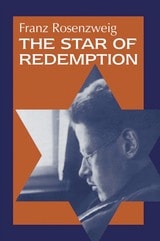
The Star of Redemption
Franz Rosenzweig; Translated by Barbara E. Galli; Foreword by Michael Oppenheim, introduction by Elliot R. Wolfson
University of Wisconsin Press, 2005
The Star of Redemption is essential reading for anyone interested in understanding religion and philosophy in the twentieth century. Fusing philosophy and theology, the book assigns both Judaism and Christianity distinct but equally important roles in the spiritual structure of the world. Franz Rosenzweig finds in both biblical religions approaches to a comprehension of reality.
The major themes and motifs of The Star—the birth, life, death, and the immortality of the soul; Eastern philosophies and Jewish mysticism; the relationship between God, world and humanity over time; and revelation as the real biblical miracle of faith and path to redemption—resonate meaningfully.
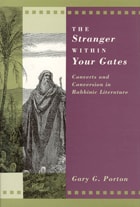
The Stranger within Your Gates
Converts and Conversion in Rabbinic LiteratureGary G. Porton
University of Chicago Press, 1994
The Stranger within Your Gates analyzes virtually every reference to converts in the full corpus of rabbinic literature. The intellectual dilemma that converts posed for classical Judaism played itself out in discussions of marriage, religious practice, inheritance of property, and much else. Reviewing the rabbinic literature text by text, Porton exposes the rabbis' frequently ambivalent and ambiguous views.
The Stranger within Your Gates is the only examination of conversion in rabbinic literature to draw upon the full scope of contemporary anthropological and sociological studies of conversion. It is also unique in its focus on the opinions of the community into which the convert enters, rather than on the testimony of the convert. By approaching data with new methods, Porton heightens our understanding of conversion and the nature of the People of Israel in rabbinic literature.
The Studia Philonica Annual XXIX, 2017
Studies in Hellenistic JudaismDavid T. Runia
SBL Press, 2017
The best current research on Philo and Hellenistic Judaism
The Studia Philonica Annual is a scholarly journal devoted to the study of Hellenistic Judaism, particularly the writings and thought of the Hellenistic-Jewish writer Philo of Alexandria (circa 15 BCE to circa 50 CE). This volume includes a soecial section on Philo's De plantatione.
Features:
- Articles on aspects of Hellenistic Judaism written by experts in the field
- Bibliography
- Book reviews