Results by title
622 books match the query 'Language Study' and 93 start with t
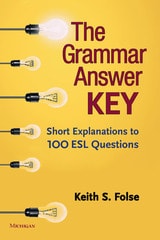
The Grammar Answer Key
Short Explanations to 100 ESL QuestionsKeith S. Folse
University of Michigan Press, 2018
The 100 questions are organized into 12 chapters on topics that teachers and students can relate to well: adjectives, articles, clauses, connectors, gerunds and infinitives, prepositions, pronouns, pronunciation, subject-verb agreement, suffixes, verbs, and vocabulary-grammar connections. The number of questions in each chapter ranges from 3 to 13 and is based on the questions submitted. Each chapter begins with a short overview of the topic that features key terminology and a chart explaining three common ESL errors.
Each question is presented in a box and is followed by an "answer" that can inform instruction, often in chart format. Examples of questions are:
- How do you know if a word is an adjective?
- Can I say the Monday or the January?
- Do you say on July or in July?
- I received an email from someone that said “Greetings from my wife and I.” Is this right? Why?
- How do I know which way to pronounce the -ed at the end of a word?
- Which verb tenses are the most common in English? Which ones should I study?
- Why do you say turn on the light instead of turn the light?
- In my language, we have one word for make and do. In English, when should I use make and when should I use do?
The book is the ideal teacher resource and professional development tool.
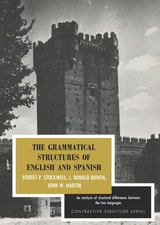
The Grammatical Structures of English and Spanish
Robert P. Stockwell, J. Donald Bowen, and John W. Martin
University of Chicago Press, 1965
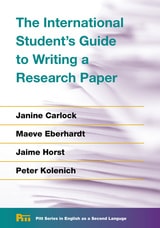
The International Student's Guide to Writing a Research Paper
Janine Carlock, Maeve Eberhardt, Jaime Horst, Peter Kolenich
University of Michigan Press, 2017
Each section of the book includes a discrete task called a Building Block, which requires students to apply the skills learned toward the development of their own paper. This step-by-step approach allows students to construct knowledge as they become more familiar with the process, making writing a research paper a less intimidating task.
Special features:
- This guide uses simple direct language for those for whom writing a research paper is new.
- Most example writing is from international students in an ESL program or first-year writing class, including two sample papers—one in APA and one in MLA.
- A section on responding to instructor feedback to provide students with the tools to read and understand comments and use them to improve the first draft.
- A subsection dedicated to constructing clear and cohesive paragraphs and sentences.
- The guide includes citation and style examples in MLA 8th edition.
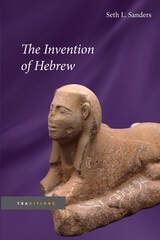
The Invention of Hebrew
Seth L. Sanders
University of Illinois Press, 2011
Seth L. Sanders connects the Bible's distinctive linguistic form--writing down a local spoken language--to a cultural desire to speak directly to people, summoning them to join a new community that the text itself helped call into being. Addressing the people of Israel through a vernacular literature, Hebrew texts reimagined their audience as a public. By comparing Biblical documents with related ancient texts in Hebrew, Ugaritic, and Babylonian, this book shows Hebrew's distinctiveness as a self-conscious political language. Illuminating the enduring stakes of Biblical writing, Sanders demonstrates how Hebrew assumed and promoted a source of power previously unknown in written literature: "the people" as the protagonist of religion and politics.
The Life of Adam and Eve in Greek
A Critical EditionJohannes Tromp
SBL Press, 2016
A Brill classic now in paperback from SBL Press
This critical edition of the Life of Adam and Eve in Greek is based on all available manuscripts. In the introduction the history of previous research is summarized, and the extant manuscripts are presented. Next comes a description of the grammatical characteristics of the manuscripts’ texts, followed by a detailed study of the genealogical relationships between them, resulting in a reconstruction of the writing’s history of transmission in Greek. On the basis of all this information, the Greek text of the Life of Adam and Eve in its earliest attainable stage, is established.
Features:
- Illustrations of textual relationships and variants
- Indices for subjects, passages, words in the text, variants, and additions and revisions Full critical apparatus with relevant evidence from the manuscripts
The Many Faces of Agreement
Morphology, Syntax, Semantics, and Discourse Factors in Serbo-Croatian AgreementStephen Wechsler and Larisa Zlatic
CSLI, 2003
With this framework in place, the authors explore a number of factors that affect agreement processes. The theory even explains the striking cross-linguistic generalizations expressed in Corbett's Agreement Hierarchy. Agreement is shown to be a distributed phenomenon, manifesting its many faces among the various components of grammar.
The Myths of Fiction
Studies in the Canonical Greek NovelsEdmund P. Cueva
University of Michigan Press, 2004
The tradition of historical literature begun by Herodotus and Thucydides molded the early Greek novel. As the genre evolved, however, Greek novels moved away from their historical roots to become more heavily influenced by mythological traditions. Edmund Cueva's new book examines the literary uses to which the ancient novelists put their mythological material. His work offers a stimulating discussion of myths and their rise to prominence as the key feature of the fully developed Greek novel. He also takes into account the impact of the Roman conquest on the development of the Greek novel, the last true literary creation of the Greek world. The Myths of Fiction will interest scholars of Greek literarure, imperial history, literary myth, intertextuality, and comparative literature.
Edmund Cueva is Associate Professor and Chair of Classics at Xavier University.
The Official MET Go! Practice Test Book
Michigan Language Assessment
University of Michigan Press, 2019
The MET Go! is intended for early adolescents at the middle school to lower-secondary school level who want to measure their general English language proficiency in a variety of linguistic contexts. The test results can be used for educational purposes, such as when finishing an English language course, as a motivational tool to encourage students as they progress in their English study, or as a supporting credential for youth opportunities requiring English skills. It may also be used as a bridge to a higher-level exam such as the MET.
The Official MET Go! Practice Test Book is first book to provide actual practice tests for students preparing to take the MET Go!
The Official MET Go! Practice Test Book includes:
- 4 complete practice tests (Listening, Reading, Writing)
- 4 sets of practice Speaking Test prompts
- tips for practicing the different sections of the tests
- a progress tracking log for recording practice test cores
- actual test form instructions and a sample answer sheet
More information about the MET Go! is available at www.michiganassessment.org.
The Official MET Practice Test Book with Answers
Michigan Language Assessment
University of Michigan Press, 2019
The MET is intended for adults and adolescents at or above a secondary level of education who want to measure their general English language proficiency in a variety of linguistic contexts. The test results can be used for educational purposes, such as when finishing an English language course, or for employment purposes, like when applying for a job or pursuing a promotion that requires an English language qualification.
The Official MET Practice Test Book is the first book to provide actual practice tests for students preparing to take the MET.
The Official MET Practice Test Book with Answers, designed for self-study (information about the Classroom Edition can be found at https://www.press.umich.edu/11390089/official_met_practice_test_book_classroom_edition), includes:
- 4 complete practice tests (Listening, Reading and Grammar, Writing)
- 4 sets of Speaking test prompts
- tips for practicing the different sections of the tests
- a progress tracking log for recording practice test scores
- selected practice test vocabulary lists
- answer keys
- audio transcripts for the Listening section
- Writing test responses with commentary for two of the tests
- Examiner scripts for the Speaking test
- actual test form instructions and a sample answer sheet
The audio for the Listening section can be accessed at www.press.umich.edu/elt/compsite/met
For more information about the MET, go to www.michiganassessment.org
The Official MET Practice Test Book, Classroom Edition
Michigan Language Assessment
University of Michigan Press, 2019
The MET is intended for adults and adolescents at or above a secondary level of education who want to measure their general English language proficiency in a variety of linguistic contexts. The test results can be used for educational purposes, such as when finishing an English language course, or for employment purposes, like when applying for a job or pursuing a promotion that requires an English language qualification.
The Official MET Practice Test Book is the first book to provide specific test-preparation materials for the MET.
The Classroom Edition, designed for school use (the self-study version can be found at https://www.press.umich.edu/11390380/official_met_practice_test_book_with_answers), includes:
- 4 complete practice tests (Listening, Reading and Grammar, Writing)
- 4 sets of Speaking test prompts
- tips for preparing for the different sections of the tests
- a progress tracking log for recording practice test scores
- selected practice test vocabulary lists
- actual test form instructions and a sample answer sheet
For more information about the MET, go to www.michiganassessment.org
The Old Greek of Isaiah
An Analysis of Its Pluses and MinusesMirjam van der Vorm-Croughs
SBL Press, 2014
A concise study of a large number of examples of pluses and minus providing insight into translation from Hebrew to Greek
Van der Vorm-Croughs focuses this translation study on the processes leading to pluses and minuses including linguistic and stylistic aspects (i.e., cases in which elements have been added or omitted for the sake of a proper use of the Greek language), literary aspects (additions and omissions meant to embellish the Greek text), translation technical aspects (e.g., the avoidance of redundancy), and contextual and intertextual exegesis and harmonization. This work also covers the relation between the Greek Isaiah and its possible Hebrew Vorlage to try to determine which pluses and minuses may have been the result of the translator’s use of a different Hebrew text.
Features:
- Eleven categories for the pluses and minuses of the Greek Isaiah
- Examination of translation techniques and translator errors
- Use of Joseph Ziegler’s critical edition

The Other Tongue
English Across CulturesEdited by Braj B. Kachru
University of Illinois Press, 1992
When The Other Tongue appeared in 1982, it was called "required reading for all those concerned with English teaching in non-native situations, from the classroom teacher to the policy planner", Jowhn Platt, English World-Wide) and "an extremely useful and stimulating collection" (William C. Ritchie, Language). It introduced refreshingly new perspectives for understanding the spread and functions of English around the world.
This dramatically revised volume contains eight new chapters, replacing or updating more than half of the first edition. The Other Tongue is the first attempt to integrate and address provocative issues relevant to a deeper understanding of the forms and functions of English within different sociolinguistic, cross-cultural, and cross-linguistic contexts. The volume discusses linguistic, literary, pedagogical, and attitudinal issues related to world Englishes.
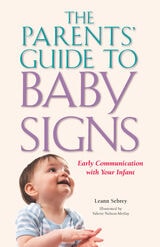
The Parents’ Guide to Baby Signs
Early Communication with Your InfantLeann Sebrey
Gallaudet University Press, 2009
Experienced ASL instructor Leann Sebrey champions two-way sign communication between parents and their infants who are just months old as a way to bond more closely and reduce frustration, while also maximizing the children’s intelligence and emotional quotients.
Sebrey’s book The Parents’ Guide to Baby Signs: Early Communication with Your Infant lays out an easy, step-by-step process that will instill confidence in parents who have never signed before. She begins by explaining why ASL is best for all children, both deaf and hearing. Sebrey also recognizes the different ways young children learn, encouraging parents and caregivers to sign with infants at all times as a natural part of their interaction. She reveals the first indications of when a baby is ready to communicate, and includes a list of signs to provide parents with a good starting point. Sebrey discusses the moments when infants are most receptive to learn signs and outlines numerous practical techniques with plenty of helpful hints to speed the process. She describes the pleasure of seeing a baby’s first sign, and tells parents how to interpret baby signs, including what to do when a baby uses the wrong signs. Full of easy-to-grasp illustrations of child and family-oriented signs, The Parents’ Guide to Baby Signs is the best how-to book for parents, caregivers, and educators to teach early communication to infants.
The Phonology of Arizona Yaqui with Texts
Lynne S. Crumrine
University of Arizona Press, 1961
The Preposition Book
Practice toward Mastering English PrepositionsTom Cole
University of Michigan Press, 2006
The Preposition Book is organized by level of difficulty but was written for
intermediate-level students. Many exercises are included within each chapter, and Putting It Together and Expansion Exercises are designed to give students even more opportunity to practice. A Comprehensive Test appears at the end of each chapter.
The SBL Commentary on the Septuagint
An IntroductionDirk Büchner
SBL Press, 2017
Explore the groundwork for a new commentary series from SBL Press
This book contains verse by verse commentary on selections from the Greek text of the Hebrew Bible known as the Septuagint. Each chapter is from a different bible book, for which there will eventually be a full commentary published in the Society of Biblical Literature Commentary on the Septuagint. The commentary series focuses on the actual process of translation, so its authors try to describe and explain the kinds of decisions the ancient Alexandrian translators made about how to render Hebrew into Greek.
Features
- Translations from and commentary on Genesis, Exodus, Leviticus, Numbers, Esther, Job, and Psalms Contributions from eight experts on the Septuagint
- Guidelines and procedures used in the production of the translations in the series
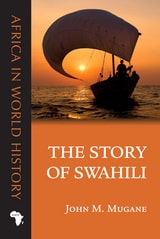
The Story of Swahili
John M. Mugane
Ohio University Press, 2015
Swahili was once an obscure dialect of an East African Bantu language. Today more than one hundred million people use it: Swahili is to eastern and central Africa what English is to the world. From its embrace in the 1960s by the black freedom movement in the United States to its adoption in 2004 as the African Union’s official language, Swahili has become a truly international language. How this came about and why, of all African languages, it happened only to Swahili is the story that John M. Mugane sets out to explore.
The remarkable adaptability of Swahili has allowed Africans and others to tailor the language to their needs, extending its influence far beyond its place of origin. Its symbolic as well as its practical power has evolved from its status as a language of contact among diverse cultures, even as it embodies the history of communities in eastern and central Africa and throughout the Indian Ocean world.
The Story of Swahili calls for a reevaluation of the widespread assumption that cultural superiority, military conquest, and economic dominance determine a language’s prosperity. This sweeping history gives a vibrant, living language its due, highlighting its nimbleness from its beginnings to its place today in the fast-changing world of global communication.
The Structure of English
Studies in Form and Function for Language TeachingJeanette S. DeCarrico
University of Michigan Press, 2000
With an emphasis on discourse function throughout, students are never expected to rely on lists of unrelated, constructed example sentences. Rather, when major points of grammar are presented, the structures are illustrated with rich, "real world" contexts excerpted from literature (mostly American), including novels, short stories, poems, essays, and drama. Exercises in the companion workbook are likewise based on naturally occurring stretches of discourse.
The Teaching Guide for English for Dispute Resolution
Mastering Negotiation, Mediation, and Alternative Dispute ResolutionBarrie J. Roberts
University of Michigan Press, 2025
Each chapter of the textbook provides a ready-made lesson plan with a sample dispute, warm-up questions, background readings, follow-up questions, activities, and reflections, and The Teaching Guide supplements each chapter with:
- Support in the form of teaching tips, lesson plans, additional activities or role-plays, assessment suggestions, and resources for further exploration.
- Separate guidance for ESL and Legal English/Business English instructors that helps them select the material and activities best suited to their students’ interests and needs.
- Resources such as sample syllabi and activities with step-by-step instructions that make it easy to start teaching the textbook.
- An online companion site where instructors can download and send activities and role-plays directly to their students.
The Theoretical Aspects of Bantu Tone
Edited by Larry M. Hyman and Charles Kisseberth
CSLI, 1998

The Theory of German Word Order from the Renaissance to the Present
Aldo Scaglione
University of Minnesota Press, 1981
The Theory of German Word Order from the Renaissance to the Present was first published in 1981. Minnesota Archive Editions uses digital technology to make long unavailable books once again accessible, and are published unaltered from the original University of Minnesota Press editions.
The uniquely systematic character of German word order and sentence structure has long been recognized as an important feature of the language and of its literary uses. This book is the first comprehensive survey of the way theorists and stylists have interpreted these features through the centuries. Aldo Scaglione contends that the story of this theoretical awareness is part of the emerging cultural and literary consciousness of the German nation, as well as a testing ground for contemporary linguistic typology.
German speculation on the nature of a national language is, to Scaglione, best understood as a dialogue with the prevailing models of Latin, Italian, French, and English. His account of the debates over German word order is thus grounded in the complex historical circumstances from which they emerge: Renaissance grammarians took stock of German divergencies from the Latin cultural model, and those in the seventeenth century faced the challenges of French rationalism, nineteenth-century Romanticism and the many linguistic movements of the twentieth century have all cast new light upon the peculiarities of German sentence structure. Readers interested in historical syntax, rhetorical traditions, and the history of the German language will value both Scaglione's wide-ranging knowledge and his lively style.
The Three Minute Thesis in the Classroom
What Every ESL Teacher Needs to KnowHeather Boldt
University of Michigan Press, 2019
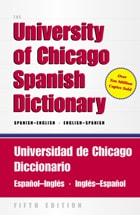
The University of Chicago Spanish Dictionary, Fifth Edition, Spanish-English, English-Spanish
Universidad de Chicago Diccionario Español-Inglés, Inglés-EspañolEdited by David A. Pharies
University of Chicago Press, 2002
With thousands of added entries, the Dictionary builds on the features that have made it the leader in its field for more than fifty years: authority, scope, clarity, and conciseness. And with this edition, the Dictionary brilliantly captures the current core vocabularies of two rapidly changing—and increasingly connected—languages and cultures.
Entirely bilingual, the fifth edition focuses on two contemporary international languages—American English and a basic, worldwide Spanish that draws from both Latin American and Iberian sources.
Designed for a wide range of users, including travelers, businesspeople, students, teachers, and professionals, the new Dictionary is the essential first resource for speakers of both languages—from beginners to those at all other stages. Up to date, just comprehensive enough, and extraordinarily clear and easy to use, the new edition of The University of Chicago Spanish Dictionary stands alone. No other dictionary offers so many users so much help—or so much value.
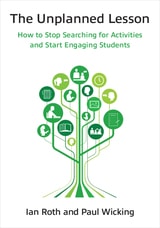
The Unplanned Lesson
How to Stop Searching for Activities and Start Engaging StudentsIan Roth and Paul Wicking
University of Michigan Press, 2023
The Use and Development of the Xinkan Languages
By Chris Rogers
University of Texas Press, 2016
Once spoken only in Santa Rosa Department, Guatemala, the Xinkan language family is unique within Mesoamerica, comprising four closely related languages that are unrelated to any of the other language groups used within the region. Descriptions of Xinkan date to 1770 but are typically only sketches or partial word lists. Not even the community of indigenous people who identify as Xinka today—the last speakers—have had access to a reliable descriptive source on their ancestral tongue. Preserving this endangered communication system in accurate, thorough detail, The Use and Development of the Xinkan Languages presents a historical framework, internal classifications, and both synchronic and diachronic descriptions, incorporating all elements of grammar based on extensive unpublished data collected in the 1970s by Lyle Campbell and Terrence Kaufman.
This valuable contribution is enhanced by author Chris Rogers’s emphasis on contextualizing the findings. Introducing the languages, Rogers presents important information regarding the social and cultural milieu of the speakers. He also traces a phonological reconstruction of Proto-Xinkan and reconstructs historical morphology and syntax. These revelations are of particular interest because the development of Xinka and the many aspects of Xinka morphosyntax have not been well understood. A sample text, “Na Mulha Uy,” is included as well. Solving numerous complex, centuries-old linguistic puzzles, The Use and Development of the Xinkan Languages unlocks new potential for the rediscovery of a rich cultural history.
This book is a part of the Recovering Languages and Literacies of the Americas publication initiative, funded by a grant from the Andrew W. Mellon Foundation.
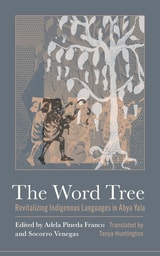
The Word Tree
Revitalizing Indigenous Languages in Abya YalaEdited by Adela Pineda Franco and Socorro VenegasTranslated by Tanya Huntington
University of Texas Press, 2025
A collaborative effort to address some of the chronic issues affecting the preservation and revitalization of indigenous languages.
What does it mean to "revitalize" an indigenous language when approximately 6,700 of the nearly 7,000 left in the world need protection? Where to begin? Each language offers a sense of history, identity, and belonging within society to the people actively using it. The Word Tree begins by hearing directly from those still communicating in some of these less dominant languages, from Achi'es to Zapotec, and offers the metaphor of a tree whose political roots sustain the trunk of education that will bear the fruit of learning languages anew. Whether describing the tension between indigenous and state-recognized languages; the process of linguistics displacement resulting from migration; or the value of locally focused efforts in a cultural cooperative, these nine essays offer fresh and useful perspectives.
The Word Tree is the result of a collaboration between the National Autonomous University of Mexico and the University of Texas at Austin. Gathering diverse concerns, experiences, explorations, proposals, and perspectives on the revitalization of some of the continent's most imperiled indigenous languages, the contributors aim to introduce their struggle for existence to a modern world. From south to north, the Quecha or Runasimi, Maya, Zapotec or Diidxazá, Chatino, Mè'pháá or Tlapaneco, Mixteco, Mixe or Auukj, and Nahuatl languages exist in all their vast complexities and contexts. At its most fundamental level, this book is a call to develop alternative paths for human existence in which caring for one another is the consensus.
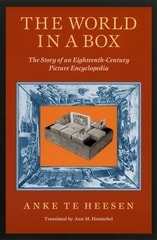
The World in a Box
The Story of an Eighteenth-Century Picture EncyclopediaAnke te Heesen
University of Chicago Press, 2002
As Anke te Heesen demonstrates, Stoy and his world in a box epitomized the Enlightenment concern with the creation and maintenance of an appropriate moral, intellectual, and social order. The box, and its images from nature, myth, and biblical history, were intended to teach children how to collect, store, and order knowledge. te Heesen compares the Academy with other aspects of Enlightenment material culture, such as commercial warehouses and natural history cabinets, to show how the kinds of collecting and ordering practices taught by the Academy shaped both the developing middle class in Germany and Enlightenment thought. The World in a Box, illustrated with a multitude of images of and from Stoy's Academy, offers a glimpse into a time when it was believed that knowledge could be contained and controlled.
The Writer's Reference Guide to Spanish
By David William Foster, Daniel Altamiranda, and Carmen de Urioste
University of Texas Press, 2000
Writers and editors of Spanish have long needed an authoritative guide to written language usage, similar to The MLA Style Manual and The Chicago Manual of Style. And here it is! This reference guide provides comprehensive information on how the Spanish language is copyedited for publication.
The book covers these major areas:
- Language basics: capitalization, word division, spelling, and punctuation.
- Language conventions: abbreviations, professional and personal titles, names of organizations, and nationalities.
- Bibliographic format, particularly how Spanish differs from English.
- Spanish language forms of classical authors' names.
- Literary and grammatical terminology.
- Linguistic terminology.
- Biblical names and allusions.
- A dictionary of grammatical doubts, including usage, grammatical constructions of particular words and phrases, verbal irregularities, and gender variations.
Theoretical Aspects of Bantu Grammar 1
Edited by Sam Mchombo
CSLI, 1993
Theoretical Perspectives on Word Order in South Asian Languages
Edited by Miriam Butt, Tracy Holloway King, and Gillian Ramchand
CSLI, 1994
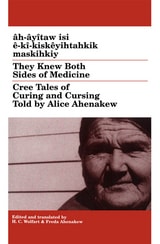
They Knew Both Sides of Medicine
Cree Tales of Curing and Cursing Told by Alice AhenakewH.C. Wolfart
University of Manitoba Press, 2000
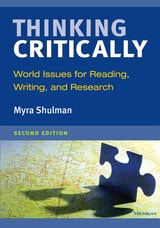
Thinking Critically, Second Edition
World Issues for Reading, Writing, and ResearchMyra Shulman
University of Michigan Press, 2014
Just like its predecessor, Thinking Critically helps students improve reading, writing, and research skills while exploring and analyzing major global issues. Although many of the same topics are explored in this second edition—world hunger, global health, gender equality, regional conflict, cultural heritage, and immigration policies—all 31 authentic readings in the second edition are new. New topics included in this edition are cybersecurity, climate change, education reform, leadership, and human rights.
Each chapter contains two or three readings (from print and online news sources, journals, and blogs) designed to raise rather than provide answers; a vocabulary review and discussion questions for each reading; a reaction writing task; a question on the topic to research; a writing assignment for a specific academic or business genre (with models in an appendix); speaking activities (oral presentation, debate, or role-play); and a Thinking about It task. The Thinking about It task calls on students’ ability to evaluate a complex issue with objectivity and to propose a realistic approach, making this textbook good preparation for academic courses that require critical-thinking skills to express opinions both orally and in writing.
Several new academic/business written genres (abstract, fact sheet, briefing paper, report on a survey) have also been added.
Thriving as a Graduate Writer
Principles, Strategies, and Habits for Effective Academic WritingRachael Cayley
University of Michigan Press, 2023
Readers of Thriving as a Graduate Writer will:
- Learn how to establish an effective writing practice
- Discover how to position themselves as competent and engaged writers
- Learn how to structure their writing, craft effective sentences, and create movement with a text
- Develop processes for draft revisions
- Create individual writing strategies that will last throughout their careers
Tohono O'odham/Pima to English, English to Tohono O'odham/Pima Dictionary
Dean Saxton, Lucille Saxton, and Susie Enos
University of Arizona Press, 1983
Tools and Tips for Using ELT Materials
A Guide for TeachersRuth Epstein and Mary Ormiston
University of Michigan Press, 2007
The book begins by addressing basic considerations in selecting and designing materials for classroom use. Textbooks themselves are covered in depth, which is very helpful for teachers choosing or assessing a textbook. An abundance of information is provided on how to use written texts from different genres (including teacher- and student-created texts), teacher-created resources, audio-visual aids, computers and the Internet, and how to provide community and service learning.
This resource aims to help instructors choose the most effective, appropriate, and flexible materials for their students and their programs. Teachers and teachers-in-training will find this to be a practical and comprehensive guide to integrating ELT materials and resources into a curriculum.
Transformations in Translation
Comparing Qumran Aramaic Job and Old Greek JobAlun Morton Thomas
SBL Press, 2026

Translanguaging
What Every Teacher Needs to KnowJacob Huckle
University of Michigan Press, 2027
Multilingual learners bring a wealth of resources to the classroom in the form of their various languages. How can teachers tap into these resources as part of the learning process? How can we intentionally embrace linguistic diversity in our classrooms through the way we design learning? Despite the proliferation of research and writing about pedagogical translanguaging, many teachers do not feel equipped to effectively implement translanguaging approaches in their teaching.
Translanguaging provides a comprehensive introduction to the what, why, and how of translanguaging. The book synthesizes the research literature for a non-specialist audience, and builds on these insights by providing practical guidance for how students can be empowered to use all their linguistic resources—not just English or the language of instruction—to learn and thrive in school or college. Whether teachers of ESL or other subjects, all teachers will benefit from the practical guidance about translanguaging in this book and will be equipped to begin rethinking and redesigning their teaching to make more space for students’ multilingualism.

Translating from the Portuguese
A Life TranslatedElizabeth Lowe
Tagus Press, 2025
Elizabeth Lowe charts her journey to becoming a translator through a series of vignettes relating her life as a “third-culture kid” and living and working abroad in a kaleidoscope of cultures and languages. She lived in Germany as a young child immediately after the Second World War while her father worked in the Nuremberg trials and as a newly married military spouse during the Vietnam War; she lived in Haiti just prior to Papa Doc's consolidation of power, in Brazil when the military dictatorship seized the country in its two-decade vise, at the University of Coimbra, Portugal during Salazar, and Colombia at the height of the guerrilla conflicts, and in Miami during the heyday of the cartels. The book is a reflection on translation as an art, on five decades teaching languages, literatures, and translation, and on her close relationship with writers from the Lusophone world. It explores theoretical aspects of translation as well as practical challenges faced by translators, especially those working in Portuguese literature. Lowe offers intimate insights into the creative process of the writers she translates and her own philosophy of literary translation.
Translation as Resistance
Czech and Ukrainian Historical PerspectivesEdited by Zuzana Štastná, Iryna Odrekhivska, and Stanislav Rubáš
Karolinum Press, 2026
In cultures and communities under pressure, whether from a powerful neighbor or a hegemonic ideology, translation becomes a political act. Shaped by the constraints of the moment, both translations and their paratexts are subject to forces that compromise quality or restrict freedom of expression, even as translators seek to bring home the quality and expressive freedom of their originals. In Translation as Resistance, the role translation has played and continues to play in reframing language and power in Czech and Ukrainian cultures is presented and interrogated by Czech and Ukrainian translators.
Trauma-Sensitive Practices in English Language Teaching
Janine J. Darragh and Luis Javier Pentón Herrera
University of Michigan Press, 2026
Treatment of Error in Second Language Student Writing
Dana R. Ferris
University of Michigan Press, 2002
Unlike a teachers' manual or a handbook that purports to give all the answers needed, Ferris's research-based volume offers a solid scholarly foundation for the practical ideas presented together with an abundance of illustrative sample texts. This book will be a rich resource in language teaching methodology courses, but experienced teachers too will no doubt benefit from the depth and breadth of Ferris's coverage of various error response techniques as well as of the research that motivates those techniques.
Ferris offers a realistic, well-reasoned account of what second language (L2) writing teacher--or teachers with L2 students in their classes--need to know about error and how to put what they know to use. She persuasively addresses the fundamental error treatment questions that plague novice and expert writing specialists alike: What types of errors should teachers respond to? When should we respond to them? What are the most efficacious ways of responding to them? And ultimately, what role should error treatment play in the teaching of the process of writing?
Treatment of Error in Second Language Student Writing, Second Edition
Dana R. Ferris
University of Michigan Press, 2011
Treatment of Error offers a realistic, well-reasoned account of what teachers of multilingual writers need to know about error and how to put what they know to use. As in the first edition, Ferris again persuasively addresses the fundamental error treatment questions that plague novice and expert writing specialists alike: What types of errors should teachers respond to? When should we respond to them? What are the most efficacious ways of responding to them? And ultimately, what role should error treatment play in the teaching of the process of writing?
The second edition improves upon the first by exploring changes in the field since 2002, such as the growing diversity in what is called “L2 writers,” the blurring boundaries between “native” and “non-native” speakers of English, the influence of genre studies and corpus linguistics on the teaching of writing, and the need the move beyond “error” to “second language development” in terms of approaching students and their texts. It also explores what teacher preparation programs need to do to train teachers to treat student error.
The second edition features
* an updating of the literature in all chapters
* a new chapter on academic language development
* a postscript on how to integrate error treatment/language development suggestions in Chapters 4-6 into a writing class syllabus
* the addition of discussion/analysis questions at the end of each chapter, plus suggested readings, to make the book more useful in pedagogy or teacher development workshops
Treatment of Error in Second Language Student Writing, Third Edition
Dana R. Ferris and Sabina Simon
University of Michigan Press, 2027
Treatment of Error in Second Language Student Writing is a practical book for teachers to help students writing in a second/other language develop greater precision (accuracy and style) in the language they use. While it does focus on language errors made by student writers, it goes beyond error to helping them develop strategies to become independent self-editors. It also discusses ongoing second language development—how students can increase and deploy their linguistic resources (grammar and vocabulary) to become more effective communicators of their written ideas.
This new edition retains the accessible design that helps teachers prepare themselves to treat error effectively. It contains guidance on how to organize course syllabi and lessons to provide authentically integrated error treatment and language development that is complementary to the overall goals of a writing course. In addition, the authors have incorporated new research and theory on written corrective feedback, discussion of philosophical questions raised by the translingual and Critical Language Awareness (CLA) movements, and analysis of how AI tools can help (or hinder) the students working to gain greater linguistic control of their writing.