Results by title
905 books match the query 'Literary' and 299 start with t
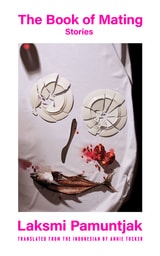
The Book of Mating
StoriesLaksmi Pamuntjak, Annie Tucker
Northwestern University Press, 2027
Winner of the Humanities in Translation Prize
The Book of Mating is a masterfully translated collection of stories in which Indonesian women explore the full spectrum of mating: marital, sexual, and spiritual; forced and free; transcendent, ruinous, and mundane. Laksmi Pamuntjak portrays both the constraints and opportunities facing women caught between the enduring restrictions of local norms and hierarchies and the tantalizing promises of globalized modern life, between internalized myths and social realities.
An experimental melding of Pamuntjak’s creative, journalistic, and activist work, these stories read as urgent dispatches from the Indonesian archipelago and diaspora—and as universal narratives of women’s lived experiences. Annie Tucker’s nuanced translation takes us from the prison island of Buru and the Bogor Botanical Gardens to Paris’s Left Bank, offering a polyphonic testament to the universal fight for women’s autonomy over their bodies and their lives.
The Book of the Dead
Orikuchi Shinobu
University of Minnesota Press, 2017
First published in 1939 and extensively revised in 1943, The Book of the Dead, loosely inspired by the tale of Isis and Osiris from ancient Egypt, is a sweeping historical romance that tells a gothic tale of love between a noblewoman and a ghost in eighth-century Japan. Its author, Orikuchi Shinobu, was a well-received novelist, distinguished poet, and an esteemed scholar. He is often considered one of the fathers of Japanese folklore studies, and The Book of the Dead is without a doubt the most important novel of Orikuchi’s career—and it is a book like no other.
Here, for the first time, is the complete English translation of Orikuchi’s masterwork, whose vast influence is evidenced by multiple critical studies dedicated to it and by its many adaptations, which include an animated film and a popular manga. This translation features an introduction by award-winning translator Jeffrey Angles discussing the historical background of the work as well as its major themes: the ancient origins of the Japanese nation, the development of religion in a modernizing society, and the devotion necessary to create a masterpiece. Also included are three chapters from The Mandala of Light by Japanese intellectual historian Andō Reiji, who places the novel and Orikuchi’s thought in the broader intellectual context of early twentieth-century Japan.
The Book of the Dead focuses on the power of faith and religious devotion, and can be read as a parable illustrating the suffering an artist must experience to create great art. Readers will soon discover that a great deal lies hidden beneath the surface of the story; the entire text is a modernist mystery waiting to be decoded.

The Box in Which We Live
Barber, Samuel Rafael
University of Iowa Press, 2026
Encompassing a wide range of formal approaches and genres, Samuel Rafael Barber captures the disparate manifestations of power and powerlessness in this era of global neoliberalism. The stories in The Box in Which We Live investigate the existential torment inflicted upon marginalized people by individuals, institutions, and states complicit in oppression. Across these experiments, a comic absurdity emerges and a distance grows between the individual and the collective in a media-oversaturated world.

The Bread of Those Early Years
Heinrich Boll
Northwestern University Press, 1994
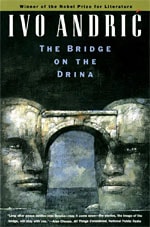
The Bridge on the Drina
Ivo Andric
University of Chicago Press, 1977
Internationally acclaimed since its original publication just after World War II, The Bridge on the Drina is a vivid historical novel that uses the Mehmed Paša Sokolović Bridge as the centerpiece of the story of Bosnia and its people from the late sixteenth century to the beginning of World War I. As we seek to make sense of the current nightmare in this region, this remarkable, timely book serves as a reliable guide to its people and history. Through powerful stories of the people who make history—and the people suffer under those who do—Ivo Andric traces the story of the Bosnian people from the Ottoman Empire through the domination of Austria-Hungary and into the rising tide of competing nationalist ideologies that set the stage for the tragedy of World War I.
Written while Andric was under house arrest during the Nazi occupation, The Bridge on the Drina is as gripping as a soap opera, bringing history down to the level of compelling individual lives and experiences. It is one of the landmark works of twentieth-century literature, as powerful today as it ever was.
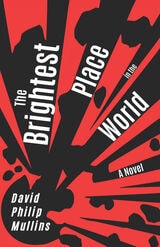
The Brightest Place in the World
A NovelDavid Philip Mullins
University of Nevada Press, 2020
Inspired by true events, The Brightest Place in the World traces the lives of four characters haunted by an industrial disaster. On an ordinary sunny morning in 2012, a series of explosions level a chemical plant on the outskirts of Las Vegas. The shock waves are felt as far away as Fremont Street. Homes and businesses suffer broken windows and caved-in roofs. Hundreds are injured, and eight employees of the plant are unaccounted for, presumed dead.
One of the missing is maintenance technician Andrew Huntley, a husband and father who is an orbital force in the novel as those who loved him grapple with his loss. Andrew’s best friend, Russell Martin—an anxiety-plagued bartender who calms his nerves with a steady inflow of weed—misses him more than he might a brother. Meanwhile Emma, Russell’s wife—a blackjack dealer at a downtown casino—tries to keep her years-long affair with Andrew hidden. Simon Addison, a manager at the plant who could have saved Andrew’s life, is afflicted by daily remorse, combined with a debilitating knowledge of his own cowardice. And then there’s Maddie, Andrew’s only child, a model high-school student whose response to the tragedy is to experiment with shoplifting and other deviant behavior.
Against the sordid backdrop of Las Vegas—and inspired by the PEPCON disaster of May 4, 1988—this engaging novel is a story of grief and regret, disloyalty and atonement, infatuation and love.
The Bruise
Magdalena Zurawski
University of Alabama Press, 2008
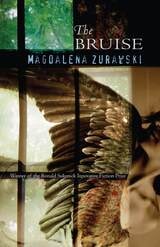
The Bruise is a prize-winning novel of imperative voice and raw sensation. In the sterile dormitories and on the quiet winter greens of an American university, a young woman named M— deals with the repercussions of a strange encounter with an angel, one that has left a large bruise on her forehead. Was the event real or imagined? The bruise does not disappear, forcing M— to confront her own existential fears and her wavering desire to tell the story of her imagination. As a writer, M— is breathless, desperate, and obsessive, questioning the mutations and directions of her words while writing with fevered immediacy. Using rhythmic language, suffused with allusions to literature and art, Magdalena Zurawski recasts the bildungsroman as a vibrant and moving form.
The Cape Cod Bicycle War
and Other StoriesBilly Kahora
Ohio University Press, 2020
The Caravaggio Syndrome
A NovelAlessandro Giardino
Rutgers University Press, 2024
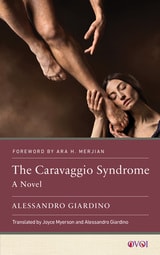
Leyla is a headstrong Brooklyn-born art historian at a prestigious upstate New York college. When she meets feckless young computer technician Pablo at a party, she quickly becomes pregnant with his child. There’s only one problem: she can’t stand him. And one more problem: her student Michael wants Pablo for himself.
Amid this love triangle, the objects of Leyla and Michael’s study take on a life of their own. Trying to learn more about Caravaggio’s masterpiece The Seven Works of Mercy, they pore over the journal and prison writings of maverick 17th-century utopian philosopher Tommaso Campanella, which, as if by enchantment, transport them back four centuries to Naples. And while the past and present miraculously converge, Leyla, Michael, and Tommaso embark on a voyage of self-discovery in search of a new life.
In this fusion of historical, queer, and speculative fiction, Alessandro Giardino combines the intellectual playfulness of Umberto Eco with the psychological finesse of Michael Cunningham.
The Castle
A NovelSeth Rogoff
University of Alabama Press, 2024
A fictional return to the unsettling world of Franz Kafka’s iconic unfinished novel, The Castle.
Seth Rogoff's masterful and mesmerizing novel, The Castle, draws inspiration from the enigmatic and incomplete final sentence of Franz Kafka's influential work of the same title. Follow renowned translator Sy Kirschbaum as he finds his way into the deserted landscape of Kafka’s world where the village of Z. lies eerily silent. The inhabitants vanished like phantoms leaving only remnants of their lives.
From these fragments, Kirschbaum pieces together a vision of a world in crisis triggered by the arrival of a stranger named K. To unravel this mystery, not just for the sake of the vanished village of Z. but for the world beyond, Kirschbaum is compelled to venture where K. could not—the deepest core of the castle.
The Castle is built upon lost documents, forgotten stories, and imagined histories. Unbound by the constraints of an authoritarian and doomed reality, Kirschbaum embarks on an extraordinary journey, seeking meaning through the fertile ground of imagination and embracing the inherent paradox of existence.

The Chimeras
A NovelJoe Fletcher
University of Alabama Press, 2026
Blending literary fiction, speculative fiction, and lyric prose, The Chimeras explores how communities create meaning in the wake of radical uncertainty. At its core, the novel is concerned with enduring human questions of belonging, family, memory, and faith in language itself. The book will appeal to readers of contemporary literary fiction, speculative literature, and works that push the boundaries of narrative form.
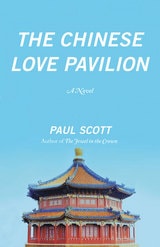
The Chinese Love Pavilion
A NovelPaul Scott
University of Chicago Press, 2013
The Chinese Love Pavilion follows a young British clerk, Tom Brent, who must track down a former friend—now suspected of murder—in Malaya. Tom faces great danger, both from the mysterious Malayan jungles and the political tensions between British officers, but the novel is perhaps most memorable for the strange, beautiful romance between Tom and a protean Eurasian beauty whom he meets in the eponymous Chinese Love Pavilion.
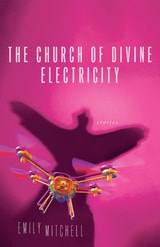
The Church of Divine Electricity
Emily Mitchell
University of Wisconsin Press, 2025
Whether being held by a giant and comforting machine, allowing micro-drones to record one’s every moment for a year to win prize money, or choosing self-mutilation in exchange for a bionic hand, these characters navigate technological and social change. The familiar can turn unrecognizable and disorienting—sometimes in a flash, sometimes gradually. Lyrical, haunting, and often funny, these stories ask us to consider what—and who—gets left out of a seemingly utopian future of technological advancements. Finely observed, thoughtful, and vivid, Mitchell’s stories get under your skin. It’s not that the best-laid plans could lead us astray—it’s that they may already have.
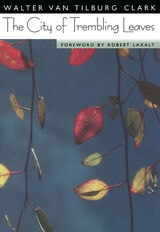
The City Of Trembling Leaves
Walter Van Tilburg Clark
University of Nevada Press, 2012
The City of Trembling Leaves by Walter Van Tilburg Clark was first published in 1945 by Random House and reprinted by the University of Nevada Press in paperback in 1991 with a new foreword by Robert Laxalt.
Clark’s novel broke new ground in his telling of the story of the rites of passage of a boy, Tim Hazard, into adulthood in the setting of the Western town of Reno, Nevada. The descriptions of Reno’s landscape and the realistic characters depict the role of nature during the tumultuous stages of adolescence and the potential risk of obstruction and loss in the attainment of maturity.
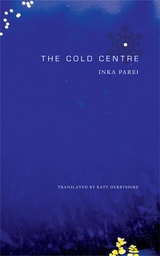
The Cold Centre
Inka Parei
Seagull Books, 2014
Written in Parei’s characteristically precise prose, The Cold Centre is a timely reminder of how we react to accidents—nuclear and otherwise— and a bleakly realistic description of East Berlin before the Wall fell. Its tight and dizzying structure keeps readers on the edge of their seats as the narrator tries to solve his mystery.
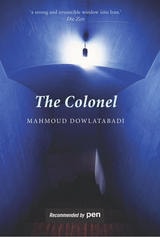
The Colonel
Mahmoud Dowlatabadi
Haus Publishing, 2011
The Islamic Revolution, like so many revolutions before it, is devouring its own children. The colonel must bury his daughter before sunrise, alone, without ceremony. So who is to blame? What follows is a shocking diatribe against the failures of the Iranian Left over the last sixty years.
Confrontational, angry, sad and lyrical, Mahmoud Dowlatabadi leaves no taboo unbroken as he asks three generations who have suffered under oppressive and brutal regimes, how has it come to this.
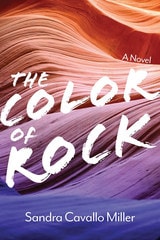
The Color of Rock
A NovelSandra Cavallo Miller
University of Nevada Press, 2019
A young physician, Dr. Abby Wilmore, attempts to escape her past by starting over at the Grand Canyon Clinic. Silently battling her own health issues, Abby struggles with adjusting to the demands of this unique rural location. She encounters everything from squirrel bites to suicides to an office plagued by strong personalities. While tending to unprepared tourists, underserved locals, and her own mental trials, Abby finds herself entangled in an unexpected romance and trapped amidst a danger even more treacherous than the foreboding desert landscape.
Sandra Cavallo Miller’s debut novel transports readers to the beautiful depths of Arizona and weaves an adventurous and heartwarming tale of the courage and strength it takes to overcome personal demons and to find love.
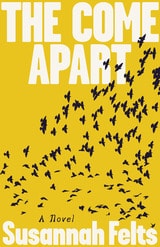
The Come Apart
A NovelSusannah Felts
Northwestern University Press, 2026
An authentic rock band story from Chicago to Nashville and, just maybe, back again
On the cusp of turning thirty, Chicago indie musician Maggie Corbin has hustled for a decade, set on making her rock and roll dreams come true. Her band, Spinning Birds, fronted by Maggie and her romantic partner Matt Turkish, releases a debut record to critical acclaim, hits the road, and begins working on a follow-up. From the outside, her path looks like success—but as streaming deconstructs the industry and Maggie’s relationships shift and slip, the question remains: Can you live for art alone?
When a sudden move back to the South forces Maggie to reframe her dreams and reckon with familial rifts and her past—while still fighting to reimagine what her future could be—a natural disaster in Nashville and a surprise encounter with a character from her childhood shift her perspective on healing, community, and the ties that bind. Drifting in and out of songwriting sessions, cozy kitchens, and moments of bearing witness to the curious power of the natural world, The Come Apart celebrates the times when we must come fully undone in order to put ourselves back together.
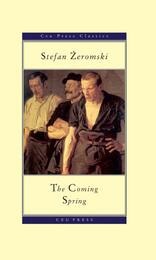
The Coming Spring
Stefan Zeromski
Central European University Press, 2007
The Complete Tales of Nikolai Gogol, Volume 1
Nikolai Gogol
University of Chicago Press, 1985
The Conjure Woman and Other Conjure Tales
Charles W. Chesnutt
Duke University Press, 1993
In the tradition of Uncle Remus, the conjure tale listens in on a poor black southerner, speaking strong dialect, as he recounts a local incident to a transplanted northerner for the northerner's enlightenment and edification. But in Chesnutt's hands the tradition is transformed. No longer a reactionary flight of nostalgia for the antebellum South, the stories in this book celebrate and at the same time question the folk culture they so pungently portray, and ultimately convey the pleasures and anxieties of a world in transition. Written in the late nineteenth century, a time of enormous growth and change for a country only recently reunited in peace, these stories act as the uneasy meeting ground for the culture of northern capitalism, professionalism, and Christianity and the underdeveloped southern economy, a kind of colonial Third World whose power is manifest in life charms, magic spells, and ha'nts, all embodied by the ruling figure of the conjure woman.
Humorous, heart-breaking, lyrical, and wise, these stories make clear why the fiction of Charles W. Chesnutt has continued to captivate audiences for a century.

The Country of the Pointed Firs and Other Stories
Sarah Orne Jewett
University of New Hampshire Press, 1997
The Country of the Pointed Firs (1896) is Sarah Orne Jewett's most popular book. In its elegantly constructed sketches, a worldly, anonymous writer spends the summer in a tiny Maine fishing village where she hopes to find peace and solitude. As she gains the acceptance and trust of her hosts, the community's power and complexity are slowly revealed. While its episodes portray the difficulty and loneliness of rural life, they also display its dignity and strength, particularly as expressed in the bonds between women: mothers, daughters, and friends.
This centennial edition contains a facsimile of the original text, thereby restoring the novel to Jewett's own version, which had been considerably altered in other published versions, plus four related stories. Further enhancing the importance of this volume is editor Sarah Way Sherman's introduction, which includes a sketch of Jewett's life and professional development, a commentary on textual accuracy, and a discussion of the book's themes and techniques as well as its historical context.
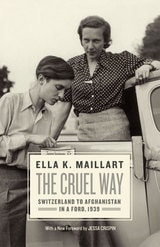
The Cruel Way
Switzerland to Afghanistan in a Ford, 1939Ella K. Maillart
University of Chicago Press, 2013
While the core of the book is the journey itself and their interactions with people oppressed by political conflict and poverty, towards the end of the trip the women’s increasingly troubled relationship takes center stage. By then the glamorous, androgynous Schwarzenbach, whose own account of the trip can be found in All the Roads Are Open, is fighting a losing battle with her own drug addiction, and Maillart’s frustrated attempts to cure her show the profound depth of their relationship.
Complete with thirteen of Maillart’s own photographs from the journey, The Cruel Way is a classic of travel writing, and its protagonists are as gripping and fearless as any in literature.
The Daughters
A NovelBen Rogers
University of Nevada Press, 2025
IndieReader Approved!
Renowned—albeit washed-up—author Peter Zemeckis (“Z”) is relishing the sunset of a life spent single when Dr. Nancy Chu crash-lands in the bungalow next door. As Nancy’s family drags him into deeper water, Z must rethink the ending to his own story.
Spanning from Amarillo, Texas, in 1977 to La Jolla, California, in 2012, The Daughters is a kaleidoscopic meditation on family, memory, and the invisible forces that bind us. Z’s narrative interweaves small-town rodeos with amateur radios, teen angst with parental love. Shard by shard, he pieces together the story of a fractured family struggling to reassemble itself.
Like particles, Z’s characters (and neighbors) are both small and singular, but their stories ripple like waves—colliding, refracting, and reshaping one another across generations. Elegant, intricate, and deeply moving, The Daughters reverberates long after its final page is turned.
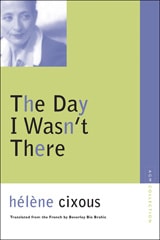
The Day I Wasn't There
Helene Cixous
Northwestern University Press, 2006
Cixous's elusive writing bears all the trademarks of her poetic, provocative style, vivid with word play, intense feeling and a stream-of-consciousness that moves freely over time and place. The narrator's mother claims not to remember what happened, and the brother tries to fill in some gaps in the story. By the end of the book we understand the significance of the title: one day Cixous's mother returned to the clinic to find the baby on the brink of death. Rather than attempt to save him she chose to end his suffering.
By closing the door to the imaginary clinic at the end, the narrator at last resolves the feelings of guilt and realizes that each human being has a fate they must endure. Informed by psychoanalytical theory, and always brutally honest, The Day I Wasn't There is above all an intimate study of a woman's inner landscape.
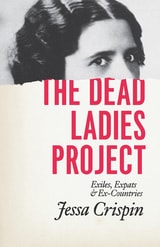
The Dead Ladies Project
Exiles, Expats, and Ex-CountriesJessa Crispin
University of Chicago Press, 2015
The Dead Ladies Project is an account of that journey—but it’s also much, much more. Fascinated by exile, Crispin travels an itinerary of key locations in its literary map, of places that have drawn writers who needed to break free from their origins and start afresh. As she reflects on William James struggling through despair in Berlin, Nora Barnacle dependant on and dependable for James Joyce in Trieste, Maud Gonne fomenting revolution and fostering myth in Dublin, or Igor Stravinsky starting over from nothing in Switzerland, Crispin interweaves biography, incisive literary analysis, and personal experience into a rich meditation on the complicated interactions of place, personality, and society that can make escape and reinvention such an attractive, even intoxicating proposition.
Personal and profane, funny and fervent, The Dead Ladies Project ranges from the nineteenth century to the present, from historical figures to brand-new hangovers, in search, ultimately, of an answer to a bedrock question: How does a person decide how to live their life?
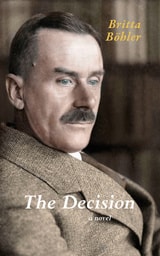
The Decision
Britta Böhler
Haus Publishing, 2015
Britta Böhler shows us one of the twentieth century’s greatest writers as a family man, a father, a writer, and a man with moral doubts. We see a human soul trapped in a historical setting that forces him to make a seemingly impossible choice. A convincing depiction of a dilemma addressed only sparsely in Mann’s own writings, The Decision eloquently explores the all-too-human price of confronting totalitarianism.
The Deep Blue Memory
Monique Laxalt Urza
University of Nevada Press, 1993
The Deposition
Pete Duval
University of Massachusetts Press, 2021
The Desert Between Us
A NovelPhyllis Barber
University of Nevada Press, 2020
2020 Reading the West Book Awards, Longlist for Fiction
2020 Association for Morman Letters Finalist, Fiction
The Desert Between Us is a sweeping, multi-layered novel based on the U.S. government’s decision to open more routes to California during the Gold Rush. To help navigate this waterless, largely unexplored territory, the War Department imported seventy-five camels from the Middle East to help traverse the brutal terrain that was murderous on other livestock.
Geoffrey Scott, one of the roadbuilders, decides to venture north to discover new opportunities in the opening of the American West when he—and the camels—are no longer needed. Geoffrey arrives in St. Thomas, Nevada, a polygamous settlement caught up in territorial fights over boundaries and new taxation. There, he falls in love with Sophia Hughes, a hatmaker obsessed with beauty and the third wife of a polygamist. Geoffrey believes Sophia wants to be free of polygamy and go away with him to a better life, but Sophia’s motivations are not so easily understood. She had become committed to Mormon beliefs in England and had moved to Utah Territory to assuage her spiritual needs.
The death of Sophia’s child and her illicit relationship with Geoffrey generate a complex nexus where her new love for Geoffrey competes with societal expectations and a rugged West seeking domesticity. When faced with the opportunity to move away from her polygamist husband and her tumultuous life in St. Thomas, Sophia becomes tormented by a life-changing decision she must face alone.
The Desert Between Us
A NovelPhyllis Barber
University of Nevada Press, 2020
2020 Reading the West Book Awards, Longlist for Fiction
2020 Association for Morman Letters Finalist, Fiction
The Desert Between Us is a sweeping, multi-layered novel based on the U.S. government’s decision to open more routes to California during the Gold Rush. To help navigate this waterless, largely unexplored territory, the War Department imported seventy-five camels from the Middle East to help traverse the brutal terrain that was murderous on other livestock.
Geoffrey Scott, one of the roadbuilders, decides to venture north to discover new opportunities in the opening of the American West when he—and the camels—are no longer needed. Geoffrey arrives in St. Thomas, Nevada, a polygamous settlement caught up in territorial fights over boundaries and new taxation. There, he falls in love with Sophia Hughes, a hatmaker obsessed with beauty and the third wife of a polygamist. Geoffrey believes Sophia wants to be free of polygamy and go away with him to a better life, but Sophia’s motivations are not so easily understood. She had become committed to Mormon beliefs in England and had moved to Utah Territory to assuage her spiritual needs.
The death of Sophia’s child and her illicit relationship with Geoffrey generate a complex nexus where her new love for Geoffrey competes with societal expectations and a rugged West seeking domesticity. When faced with the opportunity to move away from her polygamist husband and her tumultuous life in St. Thomas, Sophia becomes tormented by a life-changing decision she must face alone.

The Doll
Boleslaw Prus
Central European University Press, 1997
The city of Warsaw, under Russian rule in the late 1870s, is the setting for this story. The middle-aged hero, Wokulski, bold and successful in business, is being destroyed by his obsessive love for the frigid, aristocratic society ‘doll’ Izabela. The embattled aristocracy, the new men of finance, Dickensian tradesmen and the urban poor all come vividly to life on the vast, superbly detailed canvas.
The Doomscroller's Companion
Wendy Wimmer
University of Wisconsin Press, 2026
Jane, aka @erejane, a thirtysomething professional web influencer, lives in her aunt’s spare bedroom in Green Bay, Wisconsin. Her only confidant is Brian, a potter who is thrilled that the internet allows him to connect without having to leave his nearby home and studio. With limited options and a dwindling bank account, Jane lands a high-paying gig that requires her to travel to a wildlife refuge on a remote island near San Francisco to publicize a marine biologist’s shark study.
However, when a global pandemic strikes with astonishing speed, the scientists surrounding Jane succumb one by one; meanwhile, Brian grapples with neighbors living out their apocalyptic movie fantasies. When real-world events force them to set aside their online personas, Jane and Brian are forced to decide what—or whom—they care for the most.
Told through traditional narrative and imagined social media posts—which often appear, as they do in life, out of chronological order—The Doomscroller’s Companion is as engaging as it is unexpected.
The Dry Wood
Caryll Houselander
Catholic University of America Press, 2021

The Dust Within the Rock
A NovelFrank Waters
Ohio University Press, 2002
Based on one of the most significant periods in Frank Waters’s own life, Pike’s Peak is perhaps the most complete expression of all the archetypal themes he explored in both fiction and nonfiction.
In The Dust within the Rock, the third book in the Pike’s Peak saga, an aging Joseph Rogier clings to his vision of finding gold in the great mountain and his grandson Marsh comes of age in the Rogier household. It is the early part of the twentieth century, in Colorado Springs, and the schoolhouse, the newsstand, the railroad, the mines, all become part of the younger man’s emergence into adulthood and self-discovery.
Waters’s powerful and intuitive style transforms the tale into a mythic journey, a search for meaning played out in the drama of everyday living on the vast American frontier.
Pike’s Peak (1971) is composed of three condensed novels: The Wild Earth’s Nobility, Below Grass Roots, and The Dust within the Rock. Some years after its publication, an interviewer asked Frank Waters whether it was autobiographical. “Yes,” he replied, “and no.”
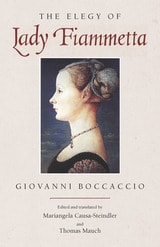
The Elegy of Lady Fiammetta
Giovanni Boccaccio
University of Chicago Press, 1990
Lady Fiammetta, the first-person narrator and protagonist, recounts how, although a married woman, she falls in love with a handsome young foreigner named Panfilo and, driven by irresistible passion, becomes his lover. Panfilo subsequently abandons Fiammetta and returns to his native land, where his elderly father is said to be dying. When he fails to keep his promise to return, Fiammetta, in what is the heart of the narrative, describes her longings, her anguish, and her despair. A host of contradictory sentiments drive her to desperation and to an unsuccessful suicide attempt. After a time, Fiammetta resumes her futile wait for Panfilo. She finally resolves to seek him out in his native land. Disguising her true intent from her husband, she secures his promise to help her in this undertaking. Addressing an exclusively female audience, Fiammetta warns them about the vicious ways of men. Her whole narrative, in fact, adds up to an indictment of men as both readers and lovers. Eliciting a remarkably wide range of responses from readers and critics, Fiammetta has been variously described as a pathetic victim of male cruelty; an irresponsible fool of a girl; a sophisticated, cunning, and wholly disingenuous female; and, finally, a genuinely modern woman. Whatever judgment we make of her, Fiammetta stands out among medieval women as an ardent and outspoken feminist.

The End and the End
Holly Goddard Jones
University of Iowa Press, 2027
The End of the House of Alard
Sheila Kaye-Smith
Catholic University of America Press, 2022
The End of the World Book
A NovelAlistair McCartney
University of Wisconsin Press, 2008
This is no ordinary novel. An encyclopedia of memory—from A to Z—The End of the World Book deftly intertwines fiction, memoir, and cultural history, reimagining the story of the world and one man’s life as they both hurtle toward a frightening future. Alistair McCartney’s alphabetical guide to the apocalypse layers images like a prose poem, building from Aristotle to da Vinci, hip-hop to lederhosen, plagues to zippers, while barreling from antiquity to the present.
In this profound book about mortality, McCartney composes an irreverent archive of philosophical obsessions and homoerotic fixations, demonstrating the difficulty of separating what is real from what is imagined.
Finalist, Edmund White Award for Debut Fiction, The Publishing Triangle
Finalist, PEN USA Literary Award for Fiction
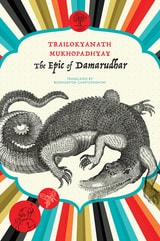
The Epic of Damarudhar
Trailokyanath Mukhopadhyay
Seagull Books, 2020
With its generic fusion of tall tales, science, myth, politics, and the absurd, the work also announces the emergence of the genre of modern fantasy in Bengal. A detailed introduction, bibliography, and extensive annotation bring to life the context for these stories, highlighting key intertexts, political nuances, and important mythological references. This volume also contains the first translation of a rare biographical piece on the author, which includes long autobiographical parts written by Trailokyanath himself. Carefully translated and thoroughly researched, this volume will introduce a trenchant Indian voice to the English-language readership.
The Extremities!
Samantha Kimmey
University of Iowa Press, 2025
The Faithful River
Stefan Zeromski
Northwestern University Press, 1999
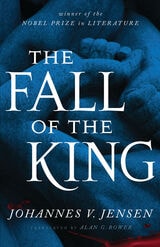
The Fall of the King
Johannes V. Jensen
University of Minnesota Press, 2011
Taking place during the first half of the sixteenth century, The Fall of the King tells the story of dreamy, slacking student Mikkel Thøgersen and the entanglements that ultimately bring him into service as a mercenary under King Christian II of Denmark. Moving from the Danish countryside to Stockholm during the execution of Swedish nobility and finally to the imprisonment of Mikkel and Christian, the narrative is a lyrical encapsulation of “the fall”—the fall of country, history, individuals, and nature.
Twice voted as the most important Danish novel of the twentieth century, The Fall of the King is both an epic depiction of real events and a complex psychological novel. Half pure narration, half prose poem, its scenes of brute realism mixed with rhapsodical passages make it a work of artistic genius.
The Farther Adventures of Robinson Crusoe
The Stoke Newington EditionMaximillian E. Novak
Bucknell University Press, 2022
Published by Bucknell University Press. Distributed worldwide by Rutgers University Press.
The Fast Red Road
A PlainsongStephen Graham Jones
University of Alabama Press, 2000
A road trip through myth, memory, and madness.
The Fast Red Road—A Plainsong is a novel which plunders, in a gleeful, two-fisted fashion, the myth and pop-culture surrounding the American Indian. It is a story fueled on pot fumes and blues, borrowing and distorting the rigid conventions of the traditional western. Indians, cowboys, and outlaws are as interchangeable as their outfits; men strike poses from Gunsmoke, and horses are traded for Trans-Ams. Pidgin, the half-blood protagonist, inhabits a world of illusion—of aliens, ghosts, telekinesis, and water-pistol violence—where television offers redemption, and “the Indian always gets it up the ass.”
Having escaped the porn factories of Utah, Pidgin heads for Clovis, NM to bury his father, Cline. But the body is stolen at the funeral, and Pidgin must recover it. With the aid of car thief Charlie Ward, he criscrosses a wasted New Mexico, straying through bars, junkyards, and rodeos, evading the cops, and tearing through barriers "Dukestyle." "Charlie Ward slid his thin leather belt from his jeans and held it out the window, whipping the cutlass faster, faster, his dyed black hair unbraiding in the fifty mile per hour wind, and they never stopped for gas." Along the way, Pidgin escapes a giant coyote, survives a showdown with Custer, and encounters the remnants of the Goliard Tribe—a group of radicals to which Cline belonged.
Pidgin's search allows him to reconcile the death of his father with five hundred years of colonial myth-making, and will eventually place him in a position to rewrite history. Jones tells his tale in lean, poetic prose. He paints a bleak, fever-burnt west—a land of strip-joints, strip-malls, and all you can eat beef-fed-beef stalls, where the inhabitants speak a raw, disposable lingo. His vision is dark yet frighteningly recognizable. In the tradition of Gerald Vizenor's Griever, The Fast Red Road—A Plainsong blazes a trail through the puppets and mirrors of myth, meeting the unexpected at every turn, and proving that the past—the texture of the road—can and must be changed.
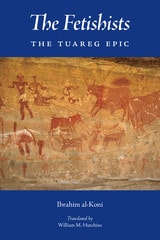
The Fetishists
By Ibrahim al-Koni, Translated by William M. Hutchins
University of Texas Press, 2018
The Fetishists, originally published in Arabic as Al Majus, is considered the masterpiece of Ibrahim al-Koni, one of the most prolific and important writers in Arabic today. In The Fetishists, Al-Koni explores what happens when a writer asks the novel to speak of and for the Sahara, when rival cultures clash, and when communities seek to build a utopia on Earth as individuals struggle between a desire for material well-being (represented by gold dust) and a need for spiritual meaning. As the story opens, Sultan Oragh of Timbuktu, who has already lost most of his power to Fetishist Bambara leaders of the forestlands, fears he will lose his only daughter, Tenere, as a human sacrifice to their god Amnay. The sultan sends Tenere to seek refuge with fellow Tuareg nomads in the plain. But even in their traditional, nomadic community, a competition rages between jihadi militant Islam; moderate Anhi Islam, which is the ancient Tuareg Law; and the cults of gold dust and of traditional African folk religions.
In this epic novel, Al-Koni blends Tuareg folklore and history with intense, fond descriptions of daily life in the desert, creating a mirror for life anywhere. Through its tragic rendering of a clash between the Tuareg and traditional African civilizations, the novel profoundly probes the contradictions of the human soul as it takes the reader on a unique spiritual adventure inside the Tuareg world.
The Financier
The Critical EditionTheodore Dreiser. Edited by Roark Mulligan
University of Illinois Press, 2010
First published in 1912, Theodore Dreiser's third novel, The Financier, captures the ruthlessness and sparkle of the Gilded Age alongside the charismatic amorality of the power brokers and bankers of the mid-nineteenth century. This volume is the first modern edition of The Financier to draw on the uncorrected page proofs of the original 1912 version, which established Dreiser as a master of the American business novel. The novel was the first volume of Dreiser’s Trilogy of Desire, also known as the Cowperwood Trilogy, which includes The Titan (1914) and The Stoic (1947).
Dreiser laboriously researched the business practices and personal exploits of real-life robber baron Charles Yerkes to narrate Frank Algernon Cowperwood's early career in The Financier, which explores the unscrupulous world of finance from the Civil War through the panic incited by the 1871 Chicago fire. In 1927, the monumental novel reappeared in a radically revised version for which Dreiser, notorious for lengthy novels, agreed to cut more than two hundred and seventy pages. This revised version became the most familiar, reprinted by publishers and studied by scholars for decades.
For this new edition, Roark Mulligan meticulously reviewed earlier versions of the novel and its publication history, including the last-minute removal of paragraphs, pages, and even whole chapters from the 1912 edition, cuts based mainly on the advice of H. L. Mencken. The restored text better matches Dreiser's original vision for the work. More than three hundred additional pages not available to modern readers--including those cut from the 1927 edition and more than seventy hastily removed from the manuscript just days before publication in 1912--more effectively establish characterization and motivation. Restored passages dedicated to the internal thoughts of major and minor characters bring a softer dimension to a novel primarily celebrated for its realistic attention to the cold external world of finance.
Mulligan's historical commentary reveals new insights into Dreiser's creative practices and how his business knowledge shaped The Financier. This supplemental material considers the novel's place within the tradition of American business novels and its reflections on the scandalous business practices of the robber baron era.
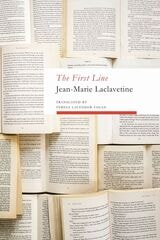
The First Line
Jean-Marie Laclavetine
Seagull Books, 2025
A sharp, witty send-up of the literary world, set in the world of book publishing—a must-read for anyone who’s ever dreamt of (or dreaded) getting published.
Cyril Cordouan is the beleaguered editor at Fulmen, a distinguished publishing house known for its solid but not particularly popular literary titles. Every day, Cyril faces an avalanche of subpar manuscripts, struggling to find a glimmer of quality amid the piles of drivel. Rejections are a routine part of his job, but aspiring authors don’t take kindly to their works being dismissed, and one distraught writer tragically ends his life after his manuscript is declined.
Devastated, Cyril decides to create an outlet for these rejected writers. Can group therapy for the hopelessly hopeful cure Cyril’s woes? Not quite. Between vengeful widows, surprise bestsellers, and a crippling crisis of conscience, Cyril’s life is a hilarious disaster.
With sharp wit and keen insight, Laclavetine, himself an industry insider, offers a satirical look at the literary world along with thought-provoking commentary on the nature of literary ambition, rejection, and the often ridiculous realities of the publishing industry.
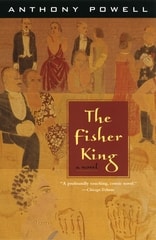
The Fisher King
A NovelAnthony Powell
University of Chicago Press, 2004
Ostensibly a novel about gossip on a cruise ship, The Fisher King is much more: a highly stylized narrative infused with Greek mythology, legend, and satire.
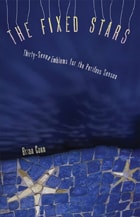
The Fixed Stars
Thirty-Seven Emblems for the Perilous SeasonBrian Conn
University of Alabama Press, 2010