Results by title
2817 books match the query 'Nature' and 595 start with t
The Atlas of Coasts and Oceans
Ecosystems, Threatened Resources, Marine ConservationDon Hinrichsen
University of Chicago Press, 2011
Oceans drive the world’s climate, nurture marine ecosystems full of aquatic life, and provide shipping lanes that have defined the global economy for centuries. And few realize that half of the world’s population lives in a coastal region within easy reach of one. Yet human activities such as commercial fishing, coastal real estate development, and industrial pollution have taken their toll on the seas. The first book of its kind, The Atlas of Coasts and Oceans documents the fraught relationship between humans and the earth’s largest bodies of water—and outlines the conservation steps needed to protect the marine environment for generations to come.
The Atlas offers a fascinating and often sobering account of how urbanization, climate change, offshore oil drilling, shipping routes, global tourism, and maritime conflict have had a profound impact on the world’s oceans and coasts. Combining text and images in visually engaging, thematically organized map spreads, this volume addresses the ecological, environmental, and economic importance of marine phenomena such as coral reefs, eroding shorelines, hurricanes, and fish populations—and how development threatens to destroy the ultimate source of all life on the “blue planet.” Lavishly illustrated with global and regional maps, from the Arabian Gulf to the Great Barrier Reef, from the Black Sea to the Mediterranean, and all the other major global waterways, The Atlas of Coasts and Oceans will be the definitive companion to any study of its subject for years to come.
The Attention of a Traveller
Essays on William Bartram's "Travels" and LegacyEdited by Kathryn H. Braund
University of Alabama Press, 2022
An interdisciplinary reevaluation of William Bartram’s Travels, illuminating the natural, cultural, and intellectual landscapes of the eighteenth‑century Southeast through diverse scholarly lenses.
William Bartram, author of Travels through North and South Carolina, Georgia, East and West Florida, the Cherokee Country, the Extensive Territories of the Muscogulees, or Creek Confederacy, and the Country of the Chactaws, was colonial America’s first native born naturalist and artist, and the first author in the modern genre of writers who portrayed nature through personal experience as well as scientific observation. His book, first published in 1791, was based on his journeys through southern Indian nations and Britain’s southern colonies in the years just prior to the American Revolution and provides descriptions of the natural and cultural environments of what would soon become the American South. Scholars and general readers alike have long appreciated Bartram’s lush, vivid prose, his clarity of observation and evident wonder at the landscapes he traversed, and his engagement with the native nations whose lands he traveled through.
The Attention of a Traveller: Essays on William Bartram’s “Travels” and Legacy offers an interdisciplinary assessment of Bartram’s influence and evolving legacy, opening new avenues of research concerning the flora, fauna, and people connected to Bartram and his writings. Featuring 13 essays divided into five sections, contributors to the volume weave together scholarly perspectives from geology, art history, literary criticism, geography, and philosophy, alongside the more traditional Bartram-affiliated disciplines of biology and history. The collection concludes with a comprehensive treatment of the book as a material historical artifact.
The Balance of Nature?
Ecological Issues in the Conservation of Species and CommunitiesStuart L. Pimm
University of Chicago Press, 1991
Ecologists describing phenomena on larger scales often use terms like "stability," "balance of nature," and "fragility," and Pimm begins by considering the various specific meanings of these terms. He addresses five kinds of ecological stability—stability in the strict sense, resilience, variability, persistence, and resistance—and shows how they provide ways of comparing natural populations and communities as well as theories about them. Each type of stability depends on characteristics of the species studied and also on the structure of the food web in which the species is embedded and the physical features of the environment.
The Balance of Nature? provides theoretical ecology with a rich array of questions—questions that also underpin pressing problems in practical conservation biology. Pimm calls for nothing less than new approaches to ecology and a new alliance between theoretical and empirical studies.
The Bark River Chronicles
Stories from a Wisconsin WatershedMilton J. Bates
Wisconsin Historical Society Press, 2012
The Bark River valley in southeastern Wisconsin is a microcosm of the state's - indeed, of the Great Lakes region's - natural and human history. "The Bark River Chronicles" reports one couple's journey by canoe from the river's headwaters to its confluence with the Rock River and several miles farther downstream to Lake Koshkonong. Along the way, it tells the stories of Ice Age glaciation, the effigy mound builders, the Black Hawk War, early settlement and the development of waterpower sites, and recent efforts to remove old dams and mitigate the damage done by water pollution and invasive species.
Along with these big stories, the book recounts dozens of little stories associated with sites along the river. The winter ice harvest, grain milling technology, a key supreme court decision regarding toxic waste disposal, a small-town circus, a scheme to link the Great Lakes to the Mississippi River by canal, the murder of a Chicago mobster, controversies over race and social class in Waukesha County's lake country, community efforts to clean up the river and restore a marsh, visits to places associated with the work of important Wisconsin writers - these and many other stories belong to the Bark River chronicles.
For the two voyageurs who paddle the length of the Bark, it is a journey of rediscovery and exploration. As they glide through marshes, woods, farmland, and cities, they acquire not only historical and environmental knowledge but also a renewed sense of the place in which they live. Maps and historical photographs help the reader share their experience.
The Battle for Alabama's Wilderness
Saving the Great Gymnasiums of NatureJohn N. Randolph
University of Alabama Press, 2005
Traces the development of Alabama's environmental movement from its beginnings with the establishment of The Alabama Conservancy in the late 1960s and early '70s to the preservation efforts of present-day activist groups
The grassroots effort to preserve Alabama's Wilderness Areas spanned thirty years, from 1967 to 1997. The first battle, to establish the Sipsey Wilderness in the Bankhead National Forest, was the catalyst for reform of national policy regarding public land preserves in the eastern United States. It, and the later campaigns—to establish the Cheaha Wilderness, to enlarge the Sipsey, and to create the Dugger Mountain Wilderness—are classic tales of citizen activists overcoming the quagmire of federal bureaucracy and the intransigence of hostile politicians. Early political opposition to proposed designation or expansion of wilderness areas in Alabama was based on the belief that limiting development of these lands would negatively impact the state's powerful timber industry. In response to such opposition, serious environmental activism was born in Alabama.
Using newspaper reports, Congressional testimony, interviews, and his own recollections, John Randolph traces the development of Alabama's environmental movement from its beginnings with the establishment of The Alabama Conservancy in the late 1960s and early '70s to the preservation efforts of present-day activist groups, such as the Alabama Environmental Council, the Cahaba River Society, and the Alabama Wilderness Alliance.
The Battle for Alabama's Wilderness permits all of the players—pro and con—to speak for themselves, but the heroes—people like Mary Burks, Blanche Dean, Joab Thomas, and Pete Conroy—embody the vision, hope, and persistence required of those who succeed in their preservation efforts. Randolph's account is a testament to the power of grassroots citizen groups who are committed to a common cause and inspired by a shared ideal.
The Battle for the Buffalo River
The Story of America's First National RiverNeil Compton
University of Arkansas Press, 2010
The Beaches Are Moving
The Drowning of America's ShorelineWallace Kaufman and Orrin H. Pilkey Jr.
Duke University Press, 1983
Our beaches are eroding, sinking, washing out right under our houses, hotels, bridges; vacation dreamlands become nightmare scenes of futile revetments, fills, groins, what have you—all thrown up in a frantic defense against the natural system. The romantic desire to live on the seashore is in doomed conflict with an age-old pattern of beach migration. Yet it need not be so. Conservationist Wallace Kaufman teams up with marine geologist Orrin H. Pilkey Jr., in an evaluation of America's beaches from coast to coast, giving sound advice on how to judge a safe beach development from a dangerous one and how to live at the shore sensibly and safely.

The Behavior of Texas Birds
By Kent Rylander
University of Texas Press, 2002
Whether it's the sudden, plunging dives of Brown Pelicans, the singing and aerial displays of Northern Mockingbirds, or the communal nesting of Purple Martins, innate and learned behaviors are some of the most fascinating things to observe in Texas birds. Even casual birdwatchers eventually ask, "why do they do that?" while serious birders and ornithologists seek to understand all the behaviors involved in feeding, flying, mating, and rearing young. But until now, it has been hard to find this information in one handy source.
In this comprehensive, yet easy-to-use book, Kent Rylander distills data from many sources to provide an authoritative guide to the behavior of Texas birds. He begins by explaining the principles of animal behavior and illustrating how they can be applied to interpreting bird behaviors in the field. The majority of the book is devoted to accounts of more than 400 species of birds that are most likely to be encountered by Texas birdwatchers. Each account describes such behaviors as feeding, courtship, parenting, and other behaviors that are significant for that species. References to interesting and important articles from scientific journals are incorporated in the species accounts where appropriate, and line drawings illustrate some of the behaviors described.

The Better to Eat You With
Fear in the Animal WorldJoel Berger
University of Chicago Press, 2008
Berger’s fieldwork that frigid day raised important questions that would require years of travel and research to answer: Can naive animals avoid extinction when they encounter reintroduced carnivores? To what extent is fear culturally transmitted? And how can a better understanding of current predator-prey behavior help demystify past extinctions and inform future conservation?
The Better to Eat You With is the chronicle of Berger’s search for answers. From Yellowstone’s elk and wolves to rhinos living with African lions and moose coexisting with tigers and bears in Asia, Berger tracks cultures of fear in animals across continents and climates, engaging readers with a stimulating combination of natural history, personal experience, and conservation. Whether battling bureaucracy in the statehouse or fighting subzero wind chills in the field, Berger puts himself in the middle of the action. The Better to Eat You With invites readers to join him there. The thrilling tales he tells reveal a great deal not only about survival in the animal kingdom but also the process of doing science in foreboding conditions and hostile environments.

The Big Bang Symphony
A Novel of AntarcticaLucy Jane Bledsoe
University of Wisconsin Press, 2010
At least that’s how thirty-year-old Rosie Moore views it as she flies in for her third season on the Ice. She plans to avoid all entanglements, romantic and otherwise, and do her work as a galley cook. But when her flight crash-lands, so do all her plans.
Mikala Wilbo, a brilliant young composer whose heart—and music—have been frozen since the death of her partner, is also on that flight. She has come to the Ice as an artist-in-residence, to write music, but also to secretly check out the astrophysicist father she has never met.
Arriving a few weeks later, Alice Neilson, a graduate student in geology who thinks in charts and equations, is thrilled to leave her dependent mother and begin her career at last. But from the start she is aware that her post-doc advisor, with whom she will work in Antarctica, expects much more from their relationship.
As the three women become increasingly involved in each other’s lives, they find themselves deeply transformed by their time on the Ice. Each falls in love. Each faces challenges she never thought she would meet. And ultimately, each finds redemption in a depth and quality of friendship that only the harsh beauty of Antarctica can engender.
The Biology of Sharks and Rays
A. Peter Klimley
University of Chicago Press, 2013
The book will be a useful textbook for advanced ichthyology students as well as an encyclopedic source for those seeking a greater understanding of these fascinating creatures.
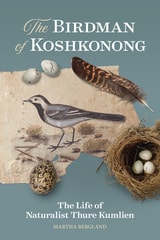
The Birdman of Koshkonong
The Life of Naturalist Thure KumlienMartha Bergland
Wisconsin Historical Society Press, 2021
For all of his achievements, Kumlien never gained the widespread notoriety of Wisconsin naturalists John Muir, Increase Lapham, or Aldo Leopold. Kumlien did his work behind the scenes, content to spend his days in the marshes and swamps rather than in the public eye. He once wrote that he was not “cut out for pretensions and show in the world.” Yet, his detailed observations of Wisconsin’s natural world—including the impact of early agriculture on the environment—were hugely important to the fields of ornithology and botany. As this carefully researched and lovingly rendered biography proves, Thure Kumlien deserves to be remembered as one of Wisconsin’s most influential naturalists.
The Birds of Michigan
Norman A. Wood
University of Michigan Press, 1951
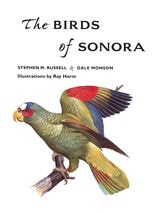
The Birds of Sonora
Stephen M. Russell
University of Arizona Press, 1998
The Birds of Sonora describes all the species known from that state and includes information on distribution, seasonal patterns of occurrence, abundance, and habitats. The first book of its kind in more than half a century to treat birds of this Mexican state immediately south of Arizona, it also contains details of nesting activity for breeding species, provides insight into factors influencing distribution, and notes historical changes in status. Each account is accompanied by a range map depicting the bird's range in Sonora—valuable information not available from any other source and useful to anyone interested in the distribution and ecology of North American birds. Drawings by internationally known wildlife artist Ray Harm enhance many of the entries.
Because other books on Mexican birds don't treat Sonora in detail, The Birds of Sonora is an indispensable resource for birders, and its background descriptions of Sonoran geography, climate, and habitats also make it a key reference for conservation and land use planning. A useful companion to field guides, it is a narrative account that puts readers in touch with birds of this important biogeographic area.
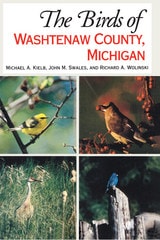
The Birds of Washtenaw County, Michigan
Michael A. Kielb, John M. Swales, and Richard A. Wolinski
University of Michigan Press, 1993
The Birds of Washtenaw County, Michigan provides a comprehensive account of the birdlife in Washtenaw County. Situated to the west of Detroit in southeast Michigan, the county has an exceptionally rich history of ornithological study, fueled by the activists of numerous amateur birdwatchers and by the interests of two major universities.
Frequency accounts of the 267 species recorded in the county during the last 15 years are framed by a discussion of the topographical history of the county. In addition, the authors present notes on another 30 species not seen in the county since 1976. A comprehensive site guide offers suggestions of the optimal locals and times to try to find the birds.
Michael A. Kielb has studied birds in Michigan for over 15 years and teaches classes on birds at the Matthaei Botanical Gardens in Ann Arbor and the College of Du Page in Illinois. He also leads bird-watching tours throughout the Americas and is currently a Research Associate in the Reproductive Sciences Program at the University of Michigan.
John M. Swales first became interested in birds while teaching in the Sudan and has been exploring the birdlife of Washtenaw County since arriving at the University of Michigan in 1985. He is Professor of Linguistics and Director of the English Language Institute, University of Michigan.
Richard A. Wolinski has been studying birds of Washtenaw County for nearly two decades. He is a staff biologist with an engineering firm in southeast Michigan.
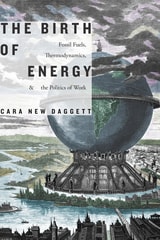
The Birth of Energy
Fossil Fuels, Thermodynamics, and the Politics of WorkCara New Daggett
Duke University Press, 2019
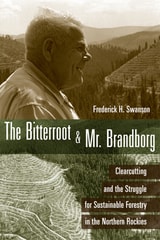
The Bitterroot and Mr. Brandborg
Clearcutting and the Struggle for Sustainable Forestry in the Northern RockiesFrederick H. Swanson
University of Utah Press, 2011
Winner of the Wallace Stegner Prize in American Environmental or Western History
Fredrick Swanson tells the story of Guy M. Brandborg and his impact on the practices of the U.S. Forest Service. As supervisor of Montana’s Bitterroot National Forest from 1935 to 1955, Brandborg engaged in a management style that promoted not only the well-being of the forest community but also the social and economic welfare of the local people. By relying on selective cutting, his goal was to protect the watersheds and wildlife habitats that are devastated by clear-cutting, and to prevent the job losses that follow such practices. Following his retirement, he became concerned that his agency was deviating from the practice of sustained-yield management of the forest’s timber lands, and led a highly visible public outcry that became known as the Bitterroot controversy. Brandborg’s behind-the-scenes lobbying contributed materially to the passage of the National Forest Management Act of 1976, the single most important law affecting public forestry since the creation of the Forest Service.
Winner of the Western Writers of America Spur Award for Best Western Nonfiction-Contemporary.
The Black Rock Desert
Text by William L. Fox; Photographs by Mark Klett
University of Arizona Press, 2002

The Black-Tailed Prairie Dog
Social Life of a Burrowing MammalJohn L. Hoogland
University of Chicago Press, 1995
Hoogland documents interactions within and among families of prairie dogs to examine the advantages and disadvantages of coloniality. By addressing such topics as male and female reproductive success, inbreeding, kin recognition, and infanticide, Hoogland offers a broad view of conflict and cooperation. Among his surprising findings is that prairie dog females sometimes suckle, and at other times kill, the offspring of close kin.
Enhanced by more than 100 photographs, this book illuminates the social organization of a burrowing mammal and raises fundamental questions about current theory. As the most detailed long-term study of any social rodent, The Black-Tailed Prairie Dog will interest not only mammalogists and other vertebrate biologists, but also students of behavioral and evolutionary ecology.

The Blind
Edited by Alfredo Cramerotti
Intellect Books, 2015
The Blind might be the answer. Developed for naturalists by the Institute of Critical Zoologists, the Blind is a camouflage cloak that works on the principle that an object vanishes from sight if light rays striking it are not reflected, but are instead forced to flow around as if it were not there. In fifty stunning color photographs, this volumeshows the cloak tested in nature reserves, grasslands, and urban environments. By taking the human out of the picture, The Blind offers an opportunity to explore how we see animals in photography.
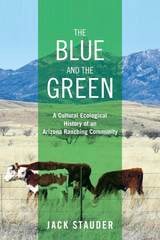
The Blue and the Green
A Cultural Ecological History of an Arizona Ranching CommunityJack Stauder
University of Nevada Press, 2016
In The Blue and the Green, anthropologist Jack Stauder analyzes how large-scale political, social, and environmental processes have transformed ranching and rural life in the West. Focusing on the community of Blue, Arizona, Stauder details how the problems of overgrazing, erosion, and environmental stresses on the open range in the early twentieth century coincided with a push by the newly created US Forest Service to develop fenced grazing allotments on federal lands. Later in the twentieth century, with the enactment of the Endangered Species Act and other laws, the growing power of urban-based environmental groups resulted in the reduction of federal grazing leases throughout the West.
The author combines historical research with oral interviews to explore the impact of these transformations on the ranchers residing in the Blue River Valley of eastern Arizona. Stauder gives voice to these ranchers, along with Forest Service personnel, environmental activists, scientists, and others involved with issues on “the Blue,” shedding light on how the ranchers’ rural way of life has changed dramatically over the course of the past century. This is a fascinating case study of the effects of increasing government regulations and the influence of outsiders on ranching communities in the American West.
The Book of Barely Imagined Beings
A 21st Century BestiaryCaspar Henderson
University of Chicago Press, 2013
With The Book of Barely Imagined Beings, Caspar Henderson offers readers a fascinating, beautifully produced modern-day menagerie. But whereas medieval bestiaries were often based on folklore and myth, the creatures that abound in Henderson’s book—from the axolotl to the zebrafish—are, with one exception, very much with us, albeit sometimes in depleted numbers. The Book of Barely Imagined Beings transports readers to a world of real creatures that seem as if they should be made up—that are somehow more astonishing than anything we might have imagined. The yeti crab, for example, uses its furry claws to farm the bacteria on which it feeds. The waterbear, meanwhile, is among nature’s “extreme survivors,” able to withstand a week unprotected in outer space. These and other strange and surprising species invite readers to reflect on what we value—or fail to value—and what we might change.
A powerful combination of wit, cutting-edge natural history, and philosophical meditation, The Book of Barely Imagined Beings is an infectious and inspiring celebration of the sheer ingenuity and variety of life in a time of crisis and change.
The Book of Bees
A Life-Size Guide to Bees WorldwideEdited by Robert Minckley
University of Chicago Press, 2026
Including more than four hundred species from all seven recognized biological families, a beautiful visual celebration of bee species the world over.
The honeycombs, hives, dancing, and royalty of bee colonies have long captured the public’s imagination, but there’s far more to these insects. There are over 20,000 bee species, but only a handful have colonies approaching the organization of the familiar western honeybee. The typical bee, if there is one, is solitary. It nests in the ground or a stem and has seven to fifteen offspring that develop and emerge the following year, long after their mother has died. These solitary species vary tremendously in the flowers they visit, how they collect pollen and nectar, the architecture of their nests, and how males strategize to find mates. Furthermore, another 17% of all bee species are well-armored parasites, often with striking colors and an array of tactics for attacking other bees.
Bees’ keystone contribution, as pollinators, to the human food supply and to the proper function of ecosystems far exceeds their numbers. From the emerald-green dilemma orchid bee to the spined leafcutter cuckoo, The Book of Bees celebrates bee species worldwide, highlighting a broad range of their diversity to illustrate how different they are in behavior, life history, and interactions with flowers and humans. Each entry includes a distribution map, a table of essential information, a section on related species, and a description of the species’ importance in terms of taxonomy, rarity, behavior, and scientific significance. Striking photos show the bees at their actual size and are also enlarged to showcase intricate details.
This wide-ranging exploration of social, solitary, and parasitic bees offers fascinating insights into their remarkable lives, fostering greater appreciation of their ecological importance and the need for their conservation.

The Book of Beetles, Second Edition
A Life-Size Guide to Six Hundred of Nature’s GemsEdited by Patrice Bouchard and Arthur V. Evans
University of Chicago Press, 2026
An up-to-date, exquisitely illustrated guide to six hundred of the world’s beguiling beetles.
When renowned British geneticist J. B. S. Haldane was asked what could be inferred about God from a study of his works, Haldane replied, “An inordinate fondness for beetles.” With more than 440,000 known species, and scientific estimates that millions more have yet to be identified, their abundance is indisputable, as is their variety. They range from the delightful summer firefly to the one-hundred-gram Goliath beetle. Beetles offer a dazzling array of shapes, sizes, and colors that entice scientists and collectors across the globe.
In a new updated edition, The Book of Beetles celebrates the beauty and diversity of this marvelous group of insects. The book includes six hundred significant beetle species, and each entry features a distribution map, basic biology, feeding habits, and information on cultural and economic significance. The beetles appear both at their actual size and enlarged to show details, such as the sextet of spots that distinguish the six-spotted tiger beetle or the jagged ridges of the mandibles on the giant jawed sawyer beetle. With updates to the common names, distribution, classification, or photographs for nearly five hundred entries, this edition offers the latest science and accessibly written, descriptive text that will appeal to researchers and armchair coleopterists alike.
The humble beetle continues to grow in popularity, taking center stage in biodiversity studies, sustainable agriculture programs, and even the dining rooms of adventurous and eco-conscious chefs. The Book of Beetles is the authoritative reference on these remarkably adaptable and beautiful creatures.
The Book of Beetles
A Life-Size Guide to Six Hundred of Nature's GemsPatrice Bouchard
University of Chicago Press, 2014
The Book of Beetles celebrates the beauty and diversity of this marvelous insect. Six hundred significant beetle species are covered, with each entry featuring a distribution map, basic biology, conservation status, and information on cultural and economic significance. Full-color photos show the beetles both at their actual size and enlarged to show details, such as the sextet of spots that distinguish the six-spotted tiger beetle or the jagged ridges of the giant-jawed sawyer beetle. Based in the most up-to-date science and accessibly written, the descriptive text will appeal to researchers and armchair coleopterists alike.
The humble beetle continues to grow in popularity, taking center stage in biodiversity studies, sustainable agriculture programs, and even the dining rooms of adventurous and eco-conscious chefs. The Book of Beetles is certain to become the authoritative reference on these remarkably adaptable and beautiful creatures.
The Book of Caterpillars
A Life-Size Guide to Six Hundred Species from around the WorldEdited by David G. James
University of Chicago Press, 2017
The Book of Caterpillars unveils the mysteries of six hundred species from around the world, introducing readers to the complexity and beauty of these underappreciated insects. With the advent of high-quality digital macrophotography, the world of caterpillars is finally opening up. The book presents a wealth of stunning imagery that showcases the astonishing diversity of caterpillar design, structure, coloration, and patterning. Each entry also features a two-tone engraving of the adult specimen, emphasizing the wing patterns and shades, as well as a population distribution map and table of essential information that includes their habitat, typical host plants, and conservation status. Throughout the book are fascinating facts that will enthrall expert entomologists and curious collectors alike.
A visually rich and scientifically accurate guide to six hundred of the world’s most peculiar caterpillars, this volume presents readers with a rare, detailed look at these intriguing forms of insect life.
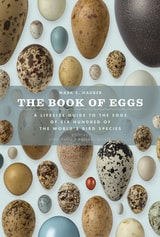
The Book of Eggs
A Life-Size Guide to the Eggs of Six Hundred of the World's Bird SpeciesMark E. Hauber
University of Chicago Press, 2014
The Book of Eggs introduces readers to eggs from six hundred species—some endangered or extinct—from around the world and housed mostly at Chicago’s Field Museum of Natural History. Organized by habitat and taxonomy, the entries include newly commissioned photographs that reproduce each egg in full color and at actual size, as well as distribution maps and drawings and descriptions of the birds and their nests where the eggs are kept warm. Birds’ eggs are some of the most colorful and variable natural products in the wild, and each entry is also accompanied by a brief description that includes evolutionary explanations for the wide variety of colors and patterns, from camouflage designed to protect against predation, to thermoregulatory adaptations, to adjustments for the circumstances of a particular habitat or season. Throughout the book are fascinating facts to pique the curiosity of binocular-toting birdwatchers and budding amateurs alike. Female mallards, for instance, invest more energy to produce larger eggs when faced with the genetic windfall of an attractive mate. Some seabirds, like the cliff-dwelling guillemot, have adapted to produce long, pointed eggs, whose uneven weight distribution prevents them from rolling off rocky ledges into the sea.
A visually stunning and scientifically engaging guide to six hundred of the most intriguing eggs, from the pea-sized progeny of the smallest of hummingbirds to the eggs of the largest living bird, the ostrich, which can weigh up to five pounds, The Book of Eggs offers readers a rare, up-close look at these remarkable forms of animal life.
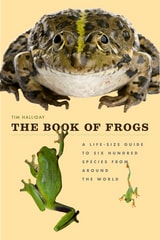
The Book of Frogs
A Life-Size Guide to Six Hundred Species from around the WorldTim Halliday
University of Chicago Press, 2015
The Book of Frogs commemorates the diversity and magnificence of all of these creatures, and many more. Six hundred of nature’s most fascinating frog species are displayed, with each entry including a distribution map, sketches of the frogs, species identification, natural history, and conservation status. Life-size color photos show the frogs at their actual size—including the colossal seven-pound Goliath Frog. Accessibly written by expert Tim Halliday and containing the most up-to-date information, The Book of Frogs will captivate both veteran researchers and amateur herpetologists.
As frogs increasingly make headlines for their troubling worldwide decline, the importance of these fascinating creatures to their ecosystems remains underappreciated. The Book of Frogs brings readers face to face with six hundred astonishingly unique and irreplaceable species that display a diverse array of adaptations to habitats that are under threat of destruction throughout the world.
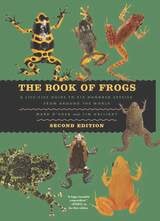
The Book of Frogs
A Life-Size Guide to Six Hundred Species from around the World, Second EditionMark O'Shea and Tim Halliday
University of Chicago Press, 2025
With almost nine thousand known species, frogs display a stunning array of forms and behaviors. A single gram of the toxin produced by the skin of the Golden Poison Frog can kill one hundred thousand people. Male Darwin’s Frogs carry their tadpoles in their vocal sacs for sixty days before coughing them out into the world. And the Wood Frogs of North America freeze every winter, reanimating in the spring.
The Book of Frogs documents the diversity and magnificence of all these anurans and many more. Readers meet six hundred of nature’s most fascinating frogs, with each entry including a distribution map, illustrations, species identification, natural history, and conservation status. Color photos show the frogs at their actual size—from Papua New Guinea’s diminutive Paedophryne amauensis, smaller than a coin, to Cameroon’s colossal Goliath Frog, heavier than some dogs. Written by experts Mark O’Shea and Tim Halliday and containing updated information on one hundred species and nearly twenty new entries, this revised edition will enthrall both veteran researchers and amateur herpetologists.
As frogs increasingly make headlines for their troubling worldwide decline, The Book of Frogs brings readers face to face with six hundred astonishingly unique and irreplaceable species that display a diverse array of adaptations to habitats that are ever changing.
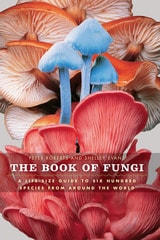
The Book of Fungi
A Life-Size Guide to Six Hundred Species from around the WorldPeter Roberts and Shelley Evans
University of Chicago Press, 2011
Colorful, mysterious, and often fantastically shaped, fungi have been a source of wonder and fascination since the earliest hunter-gatherers first foraged for them. Today there are few, if any, places on Earth where fungi have not found themselves a home. And these highly specialized organisms are an indispensable part of the great chain of life. They not only partner in symbiotic relationships with over ninety percent of the world’s trees and flowering plant species, they also recycle and create humus, the fertile soil from which such flora receive their nutrition. Some fungi are parasites or saprotrophs; many are poisonous and, yes, hallucinogenic; others possess life-enhancing properties that can be tapped for pharmaceutical products; while a delicious few are prized by epicureans and gourmands worldwide.
In this lavishly illustrated volume, six hundred fungi from around the globe get their full due. Each species here is reproduced at its actual size, in full color, and is accompanied by a scientific explanation of its distribution, habitat, association, abundance, growth form, spore color, and edibility. Location maps give at-a-glance indications of each species’ known global distribution, and specially commissioned engravings show different fruitbody forms and provide the vital statistics of height and diameter. With information on the characteristics, distinguishing features, and occasionally bizarre habits of these fungi, readers will find in this book the common and the conspicuous, the unfamiliar and the odd. There is a fungal predator, for instance, that hunts its prey with lassos, and several that set traps, including one that entices sows by releasing the pheromones of a wild boar.
Mushrooms, morels, puffballs, toadstools, truffles, chanterelles—fungi from habitats spanning the poles and the tropics, from the highest mountains to our own backyards—are all on display in this definitive work.
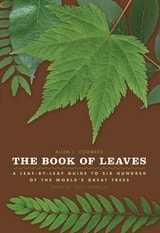
The Book of Leaves
A Leaf-by-Leaf Guide to Six Hundred of the World's Great TreesAllen J. Coombes
University of Chicago Press, 2010
Of all our childhood memories, few are quite as thrilling, or as tactile, as those of climbing trees. Scampering up the rough trunk, spying on the world from the cool green shelter of the canopy, lying on a limb and looking up through the leaves at the summer sun almost made it seem as if we were made for trees, and trees for us.Even in adulthood, trees retain their power, from the refreshing way their waves of green break the monotony of a cityscape to the way their autumn transformations take our breath away.
In this lavishly illustrated volume, the trees that have enriched our lives finally get their full due, through a focus on the humble leaves that serve, in a sense, as their public face. The Book of Leaves offers a visually stunning and scientifically engaging guide to six hundred of the most impressive and beautiful leaves from around the world. Each leaf is reproduced here at its actual size, in full color, and is accompanied by an explanation of the range, distribution, abundance, and habitat of the tree on which it’s found. Brief scientific and historical accounts of each tree and related species include fun-filled facts and anecdotes that broaden its portrait.
The Henry’s Maple, for instance, found in China and named for an Irish doctor who collected leaves there, bears little initial resemblance to the statuesque maples of North America, from its diminutive stature to its unusual trifoliolate leaves. Or the Mediterranean Olive, which has been known to live for more than 1,500 years and whose short, narrow leaves only fall after two or three years, pushed out in stages by the emergence of younger leaves.
From the familiar friends of our backyards to the giants of deep woods, The Book of Leaves brings the forest to life—and to our living rooms—as never before.
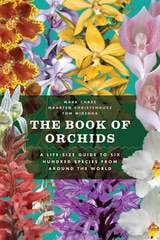
The Book of Orchids
A Life-Size Guide to Six Hundred Species from around the WorldMark W. Chase, Maarten J. M. Christenhusz, and Tom Mirenda
University of Chicago Press, 2017
The Book of Orchids revels in the diversity and oddity of these beguiling plants. Six hundred of the world’s most intriguing orchids are displayed, along with life-size photographs that capture botanical detail, as well as information about distribution, peak flowering period, and each species’ unique attributes, both natural and cultural. With over 28,000 known species—and more being discovered each year—the orchid family is arguably the largest and most geographically widespread of the flowering plant families. Including the most up-to-date science and accessibly written by botanists Mark Chase, Maarten Christenhusz, and Tom Mirenda, each entry in The Book of Orchids will entice researchers and orchid enthusiasts alike.
With stunning full-color images, The Book of Orchids is sure to become the go-to reference for these complex, alluring, and extraordinarily adaptable plants.
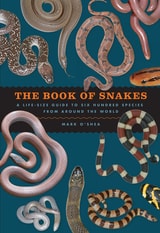
The Book of Snakes
A Life-Size Guide to Six Hundred Species from around the WorldMark O'Shea
University of Chicago Press, 2018
The Book of Snakes presents 600 species of snakes from around the world, covering nearly one in six of all snake species. It will bring greater understanding of a group of reptiles that have existed for more than 160 million years, and that now inhabit every continent except Antarctica, as well as two of the great oceans.
This volume pairs spectacular photos with easy-to-digest text. It is the first book on these creatures that combines a broad, worldwide sample with full-color, life-size accounts. Entries include close-ups of the snake’s head and a section of the snake at actual size. The detailed images allow readers to examine the intricate scale patterns and rainbow of colors as well as special features like a cobra’s hood or a rattlesnake’s rattle. The text is written for laypeople and includes a glossary of frequently used terms. Herpetologists and herpetoculturists alike will delight in this collection, and even those with a more cautious stance on snakes will find themselves drawn in by the wild diversity of the suborder Serpentes.
The Book of Snakes
A Life-Size Guide to Six Hundred Species from around the WorldMark O'Shea
University of Chicago Press, 2023
For millennia, humans have regarded snakes with an exceptional combination of fascination and revulsion. Some people recoil in fear at the very suggestion of these creatures, while others happily keep them as pets. Snakes can convey both beauty and menace in a single tongue flick, and so these creatures have held a special place in our cultures. Yet, for as many meanings as we attribute to snakes—from fertility and birth to sin and death—the real-life species represent an even wider array of wonders.
Now in a new edition, reflecting the most recent species classifications, The Book of Snakes presents 600 species of snakes from around the world, covering roughly one in seven of all snake species. It will bring greater understanding of a group of reptiles that have existed for more than 160 million years and that now inhabit every continent except Antarctica, as well as two of the great oceans.
This volume pairs spectacular photos with easy-to-digest text. It is the first book on these creatures that combines a broad, worldwide sample with full-color, life-size accounts. Entries include close-ups of the snake’s head and a section of the snake at actual size. The detailed images allow readers to examine the intricate scale patterns and rainbow of colors as well as special features like a cobra’s hood or a rattlesnake’s rattle. The text is written for laypeople and includes a glossary of frequently used terms. Herpetologists and herpetoculturists alike will delight in this collection, and even those with a more cautious stance on snakes will find themselves drawn in by the wild diversity of the suborder Serpentes.
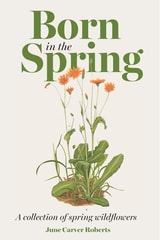
The Born in the Spring
A Collection of Spring WildflowersJune Carver Roberts
Ohio University Press, 2024
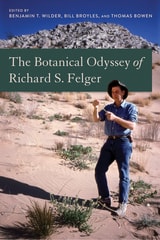
The Botanical Odyssey of Richard S. Felger
Edited by Benjamin T. Wilder, Bill Broyles, and Thomas Bowen
University of Arizona Press, 2026
This work is a vibrant tribute to Richard Stephen Felger, who was one of the most influential scientists of the American Southwest and northwestern Mexico. Known as a desert botanist, Felger’s work transcended regional boundaries, blending rigorous fieldwork with global ecological vision. This work offers an intimate and multifaceted portrait of a man whose tireless advocacy for biodiversity and biocultural conservation shaped generations of desert scientists..
Edited by Benjamin T. Wilder, Bill Broyles, and Thomas Bowen, this book is both a celebration and a resource. The work is separated into four parts. With humor, insight, and deep empathy, Felger’s own voice leads the journey in part 1, recounting his most memorable field experiences with masterful prose and sly wit. Part 2 brings together heartfelt reflections from colleagues who worked alongside Felger in the field, revealing the eccentric brilliance and relentless curiosity that defined his career. Part 3 explores his family history and the unconventional path that shaped his life’s work, while part 4 presents a comprehensive bibliography of his most important publications. The book contains four maps that help take you around the world on Felger’s journeys, and fifty images selected from the thousands of slides from his archive that further transport and anchor you in the adventure.
Felger’s own voice, paired with reflections from twenty colleagues, creates a rich, multifaceted narrative, offering readers a rare glimpse into the life of a scientific icon whose legacy continues to inspire desert researchers and conservationists across the globe.
Contributors
James Aronson
Thomas Bowen
Bill Broyles
Alberto Búrquez
Susan Davis Carnahan
Mark Alan Dimmitt
Exequiel Ezcurra
Gil Gillenwater
Russ Kleinman
Angelina Martínez-Yrízar
Gregory McNamee
Cathy Moser Marlett
Gary Paul Nabhan
Wallace J. Nichols
William R. Norris
Humberto Romero Morales
Sue Rutman
Silke Schneider
Jeffrey Seminoff
Jane Spinti
Benjamin T. Wilder
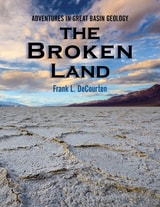
The Broken Land
Adventures in Great Basin GeologyFrank DeCourten
University of Utah Press, 2003
"The desert may seem timeless from within the Yellow Circle tonight, but the permanence of the surrounding landscape is only an illusion. Even the land is alive here, constantly changing and evolving as do all living things. Nothing here is 'finished.' Everything around us—the plants, the animals, the rocks, and the terrain itself—is in the process of becoming something else. And, of course, so are we. None of us around the campfire tonight are the same people we were yesterday, or will be tomorrow."—from the book
The Broken Land surveys the geological phenomena of the magnificent Great Basin landscape of western Utah, Nevada, eastern California, and adjacent regions. Each chapter focuses on a locality or area that provides insight into the deep history of one of North America's most remote regions—one of its continental margins. It is the only book available covering the geology of the entire Great Basin. Written for anyone with a casual to serious interest in natural history, The Broken Land conveys Frank DeCourten's awe at the story written in the rock of the basin.
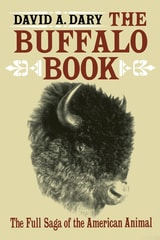
The Buffalo Book
The Full Saga Of The American AnimalDavid A. Dary
Ohio University Press, 1989
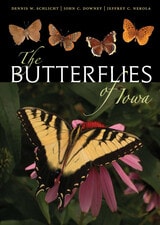
The Butterflies of Iowa
Dennis W. Schlicht
University of Iowa Press, 2007
The Cacti of Arizona
Lyman Benson
University of Arizona Press, 1969
"Of tremendous value to the professional botanist and ecologist, and with layman English and careful instructions, the work provides the amateur botanist insight into a fascinating family."—Garden Journal
"For the general desert lover as well as the botanist."—Books of the Southwest
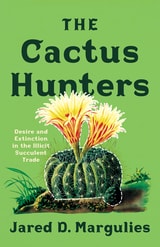
The Cactus Hunters
Desire and Extinction in the Illicit Succulent TradeJared D. Margulies
University of Minnesota Press, 2023
An exploration of the explosive illegal trade in succulents and the passion that drives it
Cacti and succulents are phenomenally popular worldwide among plant enthusiasts, despite being among the world’s most threatened species. The fervor driving the illegal trade in succulents might also be driving some species to extinction. Delving into the strange world of succulent collecting, The Cactus Hunters takes us to the heart of this conundrum: the mystery of how and why ardent lovers of these plants engage in their illicit trade. This is a world of alluring desires, where collectors and conservationists alike are animated by passions that at times exceed the limits of law.
What inspires the desire for a plant? What kind of satisfaction does it promise? The answer, Jared D. Margulies suspects, might be traced through the roots and workings of the illegal succulent trade—an exploration that traverses the fields of botany and criminology, political ecology and human geography, and psychoanalysis. His globe-spanning inquiry leads Margulies from a spectacular series of succulent heists on a small island off the coast of Mexico to California law enforcement agents infiltrating a smuggling ring in South Korea, from scientists racing to discover new and rare species before poachers find them to a notorious Czech “cacto-explorer” who helped turn a landlocked European country into the epicenter of the illegal succulent trade.
A heady blend of international intrigue, social theory, botanical lore, and ecological study, The Cactus Hunters offers complex insight into species extinction, conservation, and more-than-human care.
Retail e-book files for this title are screen-reader friendly with images accompanied by short alt text and/or extended descriptions.
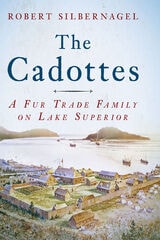
The Cadottes
A Fur Trade Family on Lake SuperiorRobert Silbernagel
Wisconsin Historical Society Press, 2023
The Cadottes
A Fur Trade Family on Lake SuperiorRobert Silbernagel
Wisconsin Historical Society Press, 2026
The Capitol Reef Reader
Stephen Trimble
University of Utah Press, 2019
The volume features nearly fifty writers who have anchored their attention and imagination in Utah’s least-known national park. The bedrock elders of Colorado Plateau literature are here (Clarence Dutton, Wallace Stegner, Edward Abbey), as are generations of writers who love this land (including Ellen Meloy, Craig Childs, Charles Bowden, Renny Russell, Ann Zwinger, Gary Ferguson, and Rose Houk). Their pieces are a pleasure to read and each reveals a facet of Capitol Reef’s story, creating a gem of a volume. Editor Stephen Trimble guides and orients with commentary and context.
A visual survey of the park in almost 100 photographs adds another layer to our understanding of this place. Historic photos, pictures from Trimble’s forty-five years of hiking the park, as well as images from master visual artists who have worked in Capitol Reef are included. No other book captures the essence of Capitol Reef like this one.
Part of the National Park Reader series, edited by Lance Newman and David Stanley
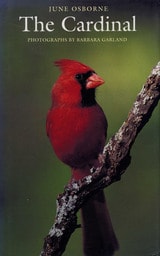
The Cardinal
Text by June Osborne, Photos by Barbara Garland
University of Texas Press, 1992
In this inviting guide, June Osborne and Barbara Garland follow a year in the life of the Northern Cardinal with a fact-filled text and glowing color photographs. They describe how cardinals stake out territory and choose mates, find a nesting site and incubate their eggs, feed the young and prepare them for full-fledged independence. The Cardinal also explores the special relationship that humans have with their favorite redbirds. Osborne traces the symbolic use of cardinals as state birds (Illinois, Indiana, Kentucky, North Carolina, Ohio, Virginia, and West Virginia) and athletic mascots and shows how they appear on everything from postage stamps to Christmas cards, as well as in fine art, literature, and Native American folklore.
The Cell
A Visual Tour of the Building Block of LifeJack Challoner
University of Chicago Press, 2015
With The Cell: A Visual Tour of the Building Block of Life, Jack Challoner treats readers to a visually stunning tour of these remarkable molecular machines. Most of the living things we’re familiar with—the plants in our gardens, the animals we eat—are composed of billions or trillions of cells. Most multicellular organisms consist of many different types of cells, each highly specialized to play a particular role—from building bones or producing the pigment in flower petals to fighting disease or sensing environmental cues. But the great majority of living things on our planet exist as single cell. These cellular singletons are every bit as successful and diverse as multicellular organisms, and our very existence relies on them.
The book is an authoritative yet accessible account of what goes on inside every living cell—from building proteins and producing energy to making identical copies of themselves—and the importance of these chemical reactions both on the familiar everyday scale and on the global scale. Along the way, Challoner sheds light on many of the most intriguing questions guiding current scientific research: What special properties make stem cells so promising in the treatment of injury and disease? How and when did single-celled organisms first come together to form multicellular ones? And how might scientists soon be prepared to build on the basic principles of cell biology to build similar living cells from scratch.
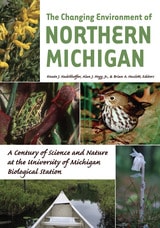
The Changing Environment of Northern Michigan
A Century of Science and Nature at the University of Michigan Biological StationKnute J. Nadelhoffer, Alan J. Hogg, Jr., Brian A. Hazlett, editors
University of Michigan Press, 2009
Northern Michigan is undergoing unprecedented changes in land use, climate, resource extraction, and species distributions. For the last hundred years, the University of Michigan Biological Station has monitored these environmental transformations. Stretching 10,000 acres along Burt and Douglas Lakes in the northern Lower Peninsula and 3,200 acres on Sugar Island near Sault Ste. Marie, Michigan, the station has played host to nearly 10,000 students and a steady stream of top scientists in the fields of biology, ecology, geology, archeology, and climatology.
The Changing Environment of Northern Michigan collects essays by some of these scientists, who lead readers on virtual field trips exploring the history of people and science at the station itself, the relations of indigenous people to the land, the geophysical history of the region, characteristics of terrestrial and aquatic ecosystems, key groups of organisms and their relations to local habitats, and perspectives on critical environmental challenges of today and their effects on the region. Accompanying the chapters are color illustrations and photographs that bring the station's pristine setting to life.
Like the station itself, the book provides a solid background for better appreciating the relationships among living and nonliving parts of northern Michigan, for anyone interested in exploring the region's forests, fields, and wetlands; wading or paddling down its rivers; or swimming or floating across its lakes.
Knute J. Nadelhoffer is Director of the University of Michigan Biological Station and Professor of Ecology and Evolutionary Biology at the University of Michigan.
Alan J. Hogg, Jr., teaches science writing at the University of Michigan as a faculty member of the Sweetland Writing Center. His Ph.D. research explored the effects of ozone and nitrogen oxides on University of Michigan Biological Station forests.
Brian A. Hazlett is Professor Emeritus of Zoology at the University of Michigan.
The Changing Mile
James Rodney Hastings, Raymond M. Turner
University of Arizona Press, 1965
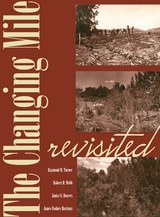
The Changing Mile Revisited
An Ecological Study of Vegetation Change with Time in the Lower Mile of an Arid and Semiarid RegionRaymond M. Turner, Robert H. Webb, Janice E. Bowers, and James Rodney Hastings
University of Arizona Press, 2003
Using nearly two hundred additional triplicate sets of unpublished photographs, The Changing Mile Revisited utilizes repeat photographs selected from almost three hundred stations located in southern Arizona, in the Pinacate region of Mexico, and along the coast of the Gulf of California. Coarse photogrammetric analysis of this enlarged photographic set shows the varied response of the region's major plant species to the forces of change. The images show vegetation across the entire region at sites ranging in elevation from sea level to a mile above sea level. Some sites are truly arid, while others are located above the desert in grassland and woodland. Common names are used for most plants and animals (with Latin equivalents in endnotes) to make the book more accessible to non-technical readers.
The original Changing Mile was based upon a unique set of data that allowed the authors to evaluate the extent and magnitude of vegetation change in a large geographic region. By extending the original landmark study, The Changing Mile Revisited will remain an indispensable reference for all concerned with the fragile desert environment.
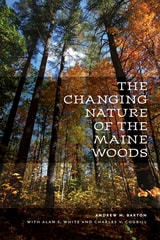
The Changing Nature of the Maine Woods
Andrew M. Barton
University of New Hampshire Press, 2012
The Changing Nature of the Maine Woods is both a fascinating introduction to the forests of Maine and a detailed but accessible narrative of the dynamism of these ecosystems. This is natural history with a long view, starting with an overview of the state's geological history, the reemergence of the forest after glacial retreat, and the surprising changes right up to European arrival. The authors create a vivid picture of Maine forests just before the impact of Euro-Americans and trace the profound transformations since settlement.
Ambitious in its geographic range, this book explores how and why Maine forests differ across the state, from the top of Mount Katahdin to the coast. Through groundbreaking research and engaging narratives, the authors assess key ecological forces such as climate change, insects and disease, nonnative organisms, natural disturbance, and changing land use to create a dramatic portrait of Maine forests—past, present, and future.
This book both synthesizes the latest scientific discoveries regarding the changing forest and relates the findings to an educated lay and academic audience.