Results by title
644 books match the query 'Wars & Conflicts' and 155 start with t
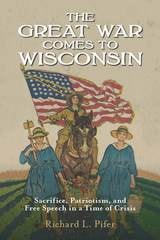
The Great War Comes to Wisconsin
Sacrifice, Patriotism, and Free Speech in a Time of CrisisRichard L. Pifer
Wisconsin Historical Society Press, 2017
Instead of a comprehensive history of the battlefield, this book captures the homefront experience: the political debates over war policy, the worry over loved ones fighting overseas, the countless everyday sacrifices, and the impact of a wartime hysteria that drove dissent underground. It also includes the voices of soldiers from Wisconsin’s famed 32nd Division, through extensively quoted letters and newspaper accounts. Immerse yourself in the Wisconsin experience during World War I—a conflict that demonstrated America’s great capacity for sacrifice and generosity, but also for prejudice, intolerance, and injustice.
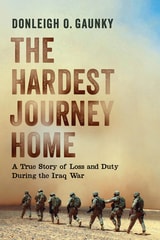
The Hardest Journey Home
A True Story of Loss and Duty during the Iraq WarDonleigh O. Gaunky
Westholme Publishing, 2017
“Sergeant Donleigh Gaunky’s moving memoir speaks to everyone who has lost a loved one in defense of our great nation. It serves as a reminder that freedom is not free, and it is our responsibility to continue to care for our service members, veterans, and their families. I am touched that Fisher House provided a refuge for Sergeant Gaunky during such a difficult journey.”—Ken Fisher, Chairman and CEO, Fisher House Foundation
“Fewer and fewer Americans have any close association with anyone serving in the Armed Forces. Donleigh Gaunky offers a heart-rending glimpse into his family as he, and they, grapple with the loss of Donleigh’s brother on a battlefield in Iraq. Every American should read this and, in so doing, learn what “Thank You for Your Service” really means.”
—Gen. Carter F. Ham, USA, Ret., President and CEO, Association of the United States Army
In November 2005, while analyzing live action reports at his base in Baghdad, Iraq, Donleigh O. Gaunky froze. His younger brother Alex’s unit had been hit by the enemy. Almost immediately, arrangements were made for Donleigh to meet his wounded brother in Germany, but Alex succumbed to his injuries before he arrived. Instead, Donleigh was asked to assume the role of remains escort. Most of the time a remains escort is picked at random from the appropriate branch of service or is someone with a relationship to the deceased, most often from the soldier’s own unit. Rarely—if ever in modern times—is the escort a family member. In The Hardest Journey Home: A True Story of Loss and Duty During the Iraq War, Donleigh O. Gaunky describes the events that unfolded over the course of a few days, from the front line in Iraq to the Landstuhl military hospital in Germany to their small town in Wisconsin, where he arrived with his brother’s body on Thanksgiving Day. In an effort to keep his mind off the tragedy and remain focused on his task, the author describes the protocol for escorting a body home—paperwork, appropriate attire, the proper use of the flag, when and where to salute—as well as how his divorced parents coped with the loss of one of their four sons serving in the military. Relying on commercial flights to bring Alex home, there was no military reception when they first landed in the United States and the author learned how little his brother’s sacrifice meant on a national level. But he was uplifted by his town’s response to his family’s loss when they unexpectedly lined the streets to pay their respects to one of their own. An important and moving story, The Hardest Journey Home reveals the human cost of a long, seemingly invisible war.
The Hashemites
The Dream of ArabiaRobert McNamara
Haus Publishing, 2010
The Hero and the Victim
Narratives of Criminality in Iraq War FictionGregory Brazeal
Lever Press, 2024
The emphasis on soldier criminality in Iraq War fiction can be partly explained by the rise of moral cosmopolitanism and its blurring of the traditional conceptual lines between war and crime. The anti-war literature of the twentieth century often presented fallen soldiers on both sides equally as victims and viewed the distinction between heroes and villains as part of the illusion that battlefield experience strips away. Written in the long shadow of Nuremberg, Iraq War fiction grapples with the possibility that the soldiers on one’s own side may not be the heroes in the story, or even the victims, but participants in a wrong, and perhaps even complicit in crimes. The Hero and the Victim contributes to the ongoing, public reexamination of American traditions by confronting a topic that has, up to now, been largely untouched: the moral celebration of military service.
The Hero and the Victim explores the theme of soldier criminality through close readings of several works by American authors, including Kevin Powers’s The Yellow Birds, Phil Klay’s Redeployment, Helen Benedict’s Sand Queen, Chris Kyle’s American Sniper, and Roy Scranton’s War Porn. This volume will be an essential text for students of American literature, historians of war culture, and any scholar interested in representations of the Iraq War.
The Hidden Perspective
The Military Conversations 1906-1914David Owen
Haus Publishing, 2014
Using contemporary historical documents, David Owen, himself a former foreign secretary, shows how the foreign office’s underlying belief in Britain’s moral obligation to send troops to the Continent influenced political decision-making and helped create the impression that war was inevitable. Had Britain’s diplomatic and naval strategy been handled more skillfully during these years, Owen contends, the carnage of World War I might have been prevented altogether.
The History of Wisconsin, Volume VI
Continuity and Change, 1940-1965William F. Thompson
Wisconsin Historical Society Press, 1988
The sixth and final volume in the History of Wisconsin series examines the period from 1940-1965, in which state and nation struggled to maintain balance and traditions. Some of the major developments analyzed in this volume include: coping with three wars, racial and societal conflict, technological innovation, population shifts to and from cities and suburbs, and accompanying stress in politics, government, and society as a whole. Using dozens of photographs to visually illustrate this period in the state's history, this volume upholds the high standards set forth in the previous volumes.
The Holocaust Averted
An Alternate History of American Jewry, 1938-1967Gurock, Jeffrey S
Rutgers University Press, 2015
This alternate history—where, among many scenarios, Hitler is assassinated, Japan does not bomb Pearl Harbor, and Franklin Delano Roosevelt is succeeded after two terms by Robert A. Taft—does cause us to review and better appreciate history. As Gurock tells his tale, he concludes every chapter with a short section that describes what actually happened and, thus, further educates the reader.
The Holocaust in Hungary
Seventy Years LaterRandolph L. Braham
Central European University Press, 2016
The Home Fronts of Iowa, 1939-1945
Lisa L. Ossian
University of Missouri Press, 2018
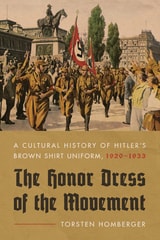
The Honor Dress of the Movement
A Cultural History of Hitler’s Brown Shirt Uniform, 1920–1933Torsten Homberger
University of Massachusetts Press, 2021
In The Honor Dress of the Movement, Torsten Homberger contends that the brown-shirted Stormtrooper uniform was central to Hitler's rise to power. By analyzing its design and marketing, he investigates how Nazi leaders used it to project a distinct political and military persona that was simultaneously violent and orderly, retrograde and modern—a dual image that proved popular with the German people and was key to the Nazis' political success. Based on a wealth of sources that includes literature, films, and newspapers of the era, Homberger exhibits how the Nazis shaped and used material culture to destroy democracy.
The Horrible Peace
British Veterans and the End of the Napoleonic WarsEvan Wilson
University of Massachusetts Press, 2023
Few battles in world history provide a cleaner dividing line than Waterloo: before, there was Napoleon; after, there was the Pax Britannica. While Waterloo marked France’s defeat and Britain’s ascendance as an imperial power, the war was far from over for many soldiers and sailors, who were forced to contend with the lasting effects of battlefield trauma, the realities of an impossibly tight labor market, and growing social unrest. The Horrible Peace details a story of distress and discontent, of victory complicated by volcanism, and of the challenges facing Britain at the beginning of its victorious century.
Examining the process of demobilization and its consequences for British society, Evan Wilson draws on archival research and veterans’ memoirs to tell the story of this period through the experiences of veterans who struggled to reintegrate and soldiers and sailors who remained in service as Britain attempted to defend and expand the empire. Veterans were indeed central to Britain’s experience of peace, as they took to the streets to protest the government’s indifference to widespread unemployment and misery. The fighting did not stop at Waterloo.
The Human Body in the Age of Catastrophe
Brittleness, Integration, Science, and the Great WarStefanos Geroulanos and Todd Meyers
University of Chicago Press, 2018
In The Human Body in the Age of Catastrophe, Stefanos Geroulanos and Todd Meyers uncover a fascinating story of how medical scientists came to conceptualize the body as an integrated yet brittle whole. Responding to the harrowing experience of the Great War, the medical community sought conceptual frameworks to understand bodily shock, brain injury, and the vast differences in patient responses they occasioned. Geroulanos and Meyers carefully trace how this emerging constellation of ideas became essential for thinking about integration, individuality, fragility, and collapse far beyond medicine: in fields as diverse as anthropology, political economy, psychoanalysis, and cybernetics.
Moving effortlessly between the history of medicine and intellectual history, The Human Body in the Age of Catastrophe is an intriguing look into the conceptual underpinnings of the world the Great War ushered in.
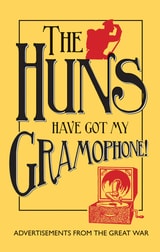
The Huns Have Got my Gramophone!
Advertisements from the Great WarAmanda Jane Doran and Andrew McCarthy
Bodleian Library Publishing, 2014
Ladies! Learn to Drive! Your Country Needs Women Drivers!
Do you drink German water?
When Britain declared war on Germany in 1914, industrious companies wasted no time in seizing the commercial opportunities presented by the conflict. Without TV or radio, newspapers provided one of the few ways in which the British public could get reliable news of the war. To cater to their rising readerships, advertising emerged as the new science of sales, growing increasingly sophisticated throughout the war years in both visual presentation and psychological appeal.
The Huns Have Got my Gramophone! collects some of the most compelling and cleverly worded original advertisements created between 1914 and 1918. Many of the advertisements are aimed at women, from fearless guard dogs promising protection while husbands are away to soaps and skin creams for “beauty on duty.” Others use the power of patriotism to push new products for men, including “officers’ waterproof trench coats,” and one young officer writing in the Times attests to the coats’ superior weather resistance by boldly asserting that he’d leave his sword behind before he left his Burberry. Together, the advertisements collected in the book reveal how advertisers sought to create new markets for products that took into account social change throughout the course of the conflict.
Featuring a range of products, from clothing, cigarettes, and invalid carriages to motorcycles and portable Decca phonographs—the “ideal gramophone for active service”—the book offers a new and unexpected source of historical information and an intimate glimpse of a nation at war.
The Hunt for Nazi Spies
Fighting Espionage in Vichy FranceSimon Kitson
University of Chicago Press, 2007
Simon Kitson informs this remarkable story with findings from his investigation—the first by any historian—of thousands of Vichy documents seized in turn by the Nazis and the Soviets and returned to France only in the 1990s. His pioneering detective work uncovers a puzzling paradox: a French government that was hunting down left-wing activists and supporters of Charles de Gaulle’s Free French forces was also working to undermine the influence of German spies who were pursuing the same Gaullists and resisters. In light of this apparent contradiction, Kitson does not deny that Vichy France was committed to assisting the Nazi cause, but illuminates the complex agendas that characterized the collaboration and shows how it was possible to be both anti-German and anti-Gaullist.
Combining nuanced conclusions with dramatic accounts of the lives of spies on both sides, The Hunt for Nazi Spies adds an important new dimension to our understanding of the French predicament under German occupation and the shadowy world of World War II espionage.
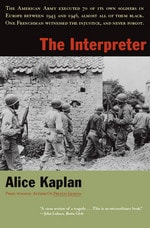
The Interpreter
Alice Kaplan
University of Chicago Press, 2007
No story of World War II is more triumphant than the liberation of France, made famous in countless photos of Parisians waving American flags and kissing GIs as columns of troops paraded down the Champs Élysées. But one of the least-known stories from that era is also one of the ugliest chapters in the history of Jim Crow. In The Interpreter, celebrated author Alice Kaplan recovers this story both as eyewitnesses first saw it, and as it still haunts us today.
The American Army executed 70 of its own soldiers between 1943 and 1946—almost all of them black, in an army that was overwhelmingly white. Through the French interpreter Louis Guilloux’s eyes, Kaplan narrates two different trials: one of a white officer, one of a black soldier, both accused of murder. Both were court-martialed in the same room, yet the outcomes could not have been more different.
Kaplan’s insight into character and setting creates an indelible portrait of war, race relations, and the dangers of capital punishment.
“A nuanced historical account that resonates with today’s controversies over race and capital punishment.” Publishers Weekly
“American racism could become deadly for black soldiers on the front. The Interpreter reminds us of this sad component of a heroic chapter in American military history.” Los Angeles Times
“With elegance and lucidity, Kaplan revisits these two trials and reveals an appallingly separate and unequal wartime U.S. military justice system.” Minneapolis Star Tribune
“Kaplan has produced a compelling look at the racial disparities as they were played out…She explores both cases in considerable and vivid detail.” Sacramento Bee
The Island
A History of the First Marine Division on GuadalcanalHerbert Laing Merillat
Westholme Publishing, 2010
A First Hand Contemporary Account of the Guadalcanal Campaign
“This is the real story, soberly, honestly, authoritatively told.”—New York Times
“This is a tale of dogged resistance, courage and sacrifice that will remain imperishable in our history.” —Weekly Book Review
In August 1942, U.S. Marines landed on the island of Guadalcanal in the South Pacific and defeated Japanese forces for the first time, turning the tide of World War II against Japan. Written by a historian who fought alongside his fellow Marines for the entire four-month campaign, The Island is an indispensable story of this hard-fought victory.

The Japanese Experience in Indonesia
Selected Memoirs of 1942-1945Anthony Reid
Ohio University Press, 1986
Although the wartime Japanese military administration of Indonesia was critical to the making of modern Indonesia, it remains shrouded in mystery, in part because of the systematic destruction of records following the Japanese surrender. These excerpts from personal memoirs of individual Japanese soldiers and administrators provide unique glimpses of the occupation—from the Japanese landing on Java and the Dutch surrender, to the independence proclamation in Jakarta, to the violence in Surabaya following the Japanese surrender. Through the eyes of Japanese at all levels of responsibility, we see the internal Indonesian turmoil, the struggle toward an independence movement, and the efforts of some Japanese to promote independence, despite the policies of imperial headquarters.
Not only does this collection illuminate modern Indonesian history, it provides students of Japanese history with a feeling for the variety of Japanese responses to the war effort. The Japanese Experience in Indonesia will therefore be of interest to Southeast and East Asian historians and political scientists, as well as to those with a more general interest in World War II.
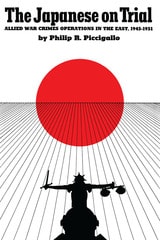
The Japanese On Trial
Allied War Crimes Operations in the East, 1945–1951By Philip R. Piccigallo
University of Texas Press, 1979
This comprehensive treatment of post–World War II Allied war crimes trials in the Far East is a significant contribution to a neglected subject. While the Nuremberg and, to a lesser degree, Tokyo tribunals have received considerable attention, this is the first full-length assessment of the entire Far East operation, which involved some 5,700 accused and 2,200 trials.
After discussing the Tokyo trial, Piccigallo systematically examines the operations of each Allied nation, documenting procedure and machinery as well as the details of actual trials (including hitherto unpublished photographs) and ending with a statistical summary of cases.
This study allows a completely new assessment of the Far East proceedings: with a few exceptions, the trials were carefully and fairly conducted, the efforts of defense counsel and the elaborate review procedures being especially noteworthy. Piccigallo’s approach to this emotion-filled subject is straightforward and evenhanded throughout. He concludes with a discussion of the broader implications of such war crimes trials, a matter of interest to the general reader as well as to specialists in history, law, and international affairs.
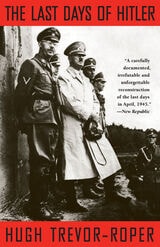
The Last Days of Hitler
Hugh Trevor-Roper
University of Chicago Press, 1992
"From exhaustive research [Trevor-Roper] has put together a carefully documented, irrefutable, and unforgettable reconstruction of the last days in April, 1945."—New Republic
"A book sound in its scholarship, brilliant in its presentation, a delight for historians and laymen alike."—A. J. P. Taylor, New Statesman
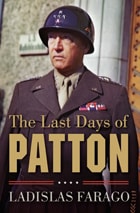
The Last Days of Patton
Ladislas Farago
Westholme Publishing, 2011
A Classic Account of America’s Greatest Field General at the End of World War II—and the Mystery Surrounding His Death
“It would be as hard to give up all thought [of being a soldier] as it would be to stop breathing,” wrote George S. Patton in October 1945; “The great tragedy of my life was that I survived the last battle.” But Patton would not see the year out: in December he would die as a result of injuries sustained in an automobile accident in Germany. His unexpected death sent shock waves through the American and Russian commands. It seemed plausible that America’s greatest general may have been a victim of foul play. In the seven months following the German surrender, Patton had openly and provocatively criticized the Soviet Union and appeared to have transformed from a staunch anti-Nazi to a Nazi sympathizer. The Last Days of Patton by Ladislas Farago, a follow-up to his bestselling Patton: Ordeal and Triumph, attempts to reconstruct the last months of Patton’s life in order to determine if the general did indeed try to provoke a war with the Soviet Union and whether he failed to sufficiently de-Nazify the area of Germany under his jurisdiction. Farago also investigates the possibility of a conspiracy to murder Patton and reveals the role other prominent men, including Eisenhower, Montgomery, Marshall, and MacArthur, had in censuring and ultimately removing Patton from active service. The Last Days of Patton, originally published in 1981, is the story of the general’s final battle—a professional soldier caught up in the changing politics of the emerging Cold War and new reality of the atomic age.
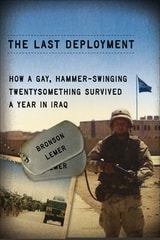
The Last Deployment
How a Gay, Hammer-Swinging Twentysomething Survived a Year in IraqBronson Lemer
University of Wisconsin Press, 2011
In 2003, after serving five and a half years as a carpenter in a North Dakota National Guard engineer unit, Bronson Lemer was ready to leave the military behind. But six months short of completing his commitment to the army, Lemer was deployed on a yearlong tour of duty to Iraq. Leaving college life behind in the Midwest, he yearns for a lost love and quietly dreams of a future as an openly gay man outside the military. He discovers that his father’s lifelong example of silent strength has taught him much about being a man, and these lessons help him survive in a war zone and to conceal his sexuality, as he is required to do by the U.S. military.
Finalist, Minnesota Book Awards
Finalist, Over the Rainbow Selection, American Library Association
Amazon Top Ten 10 Gay & Lesbian Books of 2011

The Lausanne Moment
Reckoning with the 1923 Treaty of Peace and Its LegaciesEdited by Ozan Ozavci, Julia Secklehner, and Georgios Giannakopoulos
Gingko, 2027
The 1923 Treaty of Lausanne remains one of the few interwar peace settlements that has endured into the twenty-first century. Yet, the memory of Lausanne has proved deeply contested. Celebrated by some as a triumph of state sovereignty and peacemaking, it has also come to symbolize forced displacement, the erasure of minority rights, and the codification of population transfers as instruments of international order.
Just over one hundred years after the signing of the Treaty of Lausanne, The Lausanne Moment revisits this diplomatic, legal, economic, and financial juncture that helped reshape the world and defined new norms of sovereignty, displacement, and identity. Building on a growing body of interdisciplinary scholarship and serving as a sequel to They All Made Peace—What is Peace?, also published by Gingko, this edited volume foregrounds the lived realities and long-term legacies of the treaty, critically re-examining the political, cultural, and social consequences of its provisions and aftershocks.
Rather than focusing solely on high diplomacy or legal text, The Lausanne Moment brings into view the human dimension of the Lausanne moment. Through case studies ranging from the refugee experience in Nikaia and Asia Minor orphans in Greece, to the enduring memory of loss in Pontic singing, the symbolic ethnicity of Cretan descendants, and the Kurdish experience in Turkey, the book documents the deeply personal and community-level consequences of forced migration and political rupture. These experiences are not confined to the immediate postwar period; they linger across time, informing the present-day politics of memory, migration, and identity.
This volume also interrogates the geopolitics of Lausanne through new thematic lenses. Essays explore how the treaty facilitated the continuation of imperial practices under new nationalist forms, shaped debates over public debt and cultural heritage, and affected actors and regions often overlooked in Lausanne historiography, such as Albania, Cyprus, and the Kurdish nationalist movements. Lausanne’s cultural afterlives, from its role in shaping archaeology, music, and education policy, are also covered in the book. Through its interdisciplinary and transregional approach, The Lausanne Moment breaks new ground in Lausanne studies, bringing together historians, anthropologists, archaeologists, political scientists, and cultural theorists, and introduces voices and perspectives—Kurdish, Cypriot, Pontic, Albanian, and Cretan—that have been marginal to mainstream narratives. By weaving together policy analysis, oral history, cultural production, and historical research, the volume offers an expansive and textured account of one of the twentieth century’s most consequential, yet paradoxical, peace settlements.
The Lausanne Moment situates the treaty within broader histories of state-led population engineering, colonial eugenic practices, and the moral politics of international humanitarianism. The “peace” of Lausanne, the volume suggests, was neither absolute nor apolitical—it was crafted, contested, and constantly renegotiated. The book’s contributors collectively ask not only what peace meant in 1923, but also what it means today for those still living with its consequences.
The League of Nations
Ruth Henig
Haus Publishing, 2010
The Legacy of the Great War
Ninety Years OnEdited by Jay Winter
University of Missouri Press, 2009
In late 2007 and early 2008, world-renowned historians gathered in Kansas City for a series of public forums on World War I. Each of the five events focused on a particular topic and featured spirited dialogue between its prominent participants.
The Little Lead Soldier
Hugh D. Wise III
Westholme Publishing, 2017
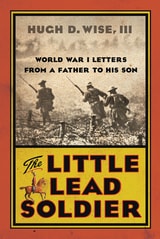
Arriving in France in April 1918, Col. Hugh D. Wise, commander of the U.S. 61st Infantry Division, held a precious object. It was a toy soldier given to him by his six-year-old son, Hugh, Jr. The boy had asked the little lead soldier to write him with news of his father. The colonel saw action in two of the most important campaigns the Americans fought, St. Mihiel and Meuse-Argonne, and the little lead soldier dutifully assured a boy thousands of miles away that his father was safe: “The men had been shelled, gassed, and raked by machine guns constantly: and undergone several intense bombardments; and made a difficult though successful attack; and had resisted a fierce counter-attack. They had dug trenches, moved, and dug again. All this time they had been without shelter, exposed to a cold driving rain and without warm food—They were wet, chilled, and tired when called upon for even greater efforts but they responded with the energy and spirit of fresh troops.” A treasured family heirloom, these wartime letters are presented for the first time along with letter from Colonel Wise to his wife, and engrossing historical context provided by his grandson, Hugh D. Wise, III. The Little Lead Soldier: World War I Letters from a Father to His Son is a remarkable story of how a father performed his dangerous duty while keeping a promise to his boy.
The Lonely Veteran's Guide to Companionship
Bronson Lemer
University of Wisconsin Press, 2025
Lemer’s distinct take on the veteran’s story boldly engages the intersection of military narratives and queer culture, including examinations into the role of thirst traps in contemporary dating culture, the fears of long-term health damage caused by military service, and the ways in which intimate relationships can lead to a loss of self. Taken together, his essays illustrate how one queer veteran managed to carve out a path that led him, however awkwardly at times, closer to the person he wanted to be.
The Long Shadows
A Global Environmental History of the Second World WarSimo Laakkonen
Oregon State University Press, 2017
The Long Shadows is the first book-length work to offer global perspectives on the environmental history of World War II. Based on long-term research, the selected articles represent the best available studies in different fields and countries. With contributions touching on Europe, America, Asia, and Africa, the book has a truly global approach.
While other edited volumes on the environmental history of warfare discuss multiple wars and various time periods, The Long Shadows is devoted exclusively to World War II and its profound and lasting impact on global environments, encompassing polar, temperate and tropical ecological zones. Divided into three main sections, the first offers an introduction to and holistic overview of the War. The second section of the book examines the social and environmental impacts of the conflict, while the third focuses on the history and legacy of resource extraction. A fourth and final section offers conclusions and hypotheses. Numerous themes and topics are explored in these previously unpublished essays, including the new and innovative field of acoustic ecology, the environmental policies of the Third Reich, Japanese imperialism and marine resources, and the control of Typhus fever.
Aimed at researchers and students in the fields of environmental history, military history, and global history, The Long Shadows will also appeal to a general audience interested in the environmental impact of the greatest military conflict in the history of the world.
CONTRIBUTORS
Outi Ampuja
Alla Bolotova
Chris Boyer
Matthew Evenden
Paul Josephson
Simo Laakkonen
Helene Laurent
Carol MacLennan
Gregory Maddox
Ilmo Massa
Evan Mawdsley
Micah Muscolino
William Tsutsui
Richard Tucker
Timo Vuorisalo
Anna-Katharina Wöbse
The Lost Cause and the Great War
Progressive Reform and Patriotism in the American SouthRobert E. Hunt
University of Alabama Press, 2025
How Tennessee reformers reconciled Southern heritage with rising nationalism, weaving the Lost Cause into the fabric of American progress and identity.
The Lost Cause and the Great War tells the stories of central Tennessee Progressive-era reformers to illustrate the fascinating broader issue of how Southerners steeped in Lost Cause Civil War mythologies simultaneously developed patriotic American fervor. Focusing on Luke Lea, a prominent politician and American army officer who attempted to capture Kaiser Wilhelm II during World War I, the book reveals the intricate interplay between three competing ideas: attachment to the memory of the Confederacy, intense American nationalism, and advocacy for progressive reforms.
Hunt shows that Lea and his contemporaries sought either to harmonize these competing loyalties or to compartmentalize them to use when needed. Through insightful accounts of Tennessee’s 1928 presidential campaign, the American Legion’s response to cuts to veteran benefits in 1933, and the redefinition of America’s global role post–World War II, Hunt shows how these reformers achieved a balance that held until the Civil Rights movement disrupted this delicate consensus.
Hunt’s rich account reveals how Lea and others like him wove national patriotism and Southern collective memory into a cohesive narrative that supported their broader Progressive goals. The book offers much to readers interested in Southern history, the Gilded Age, Prohibition, World War I, World War II, and the beginnings of the Civil Rights movement. It provides vivid examples of how collective memory and narratives shape social and political movements. General readers will discover how white Southerners who remained devoted to vindicating the Confederacy nonetheless became fervent supporters of America's growing nationalism in the early twentieth century.
The Missouri Home Guard
Protecting the Home Front during the Great WarPetra DeWitt
University of Missouri Press, 2022
The Home Guard also functioned to preserve patriotism and reduce opposition to the war. Service in the Guard was a way to show loyalty to one’s country, particularly for German Americans, who were frequently under suspicion as untrustworthy. Many German Americans in Missouri enthusiastically signed up to dispel any whispers of treason, while others found themselves torn between the motherland and their new homeland. Men too old or exempt from the draft for other reasons found meaning in helping with the war effort through the Home Guard while also garnering respect from the community. For similar reasons, women attempted to join the organization as did African Americans, some of whom formed units of a “Negro Home Guard.” Informed by the dynamics of race, gender, and ethnicity, DeWitt’s consideration of this understudied but important organization examines the fluctuating definition of patriotism and the very real question of who did and who did not have the privilege of citizenship and acceptance in society.
The Myth of the Addicted Army
Vietnam and the Modern War on DrugsJeremy Kuzmarov
University of Massachusetts Press, 2009
The image of the drug-addicted American soldier—disheveled, glassy-eyed, his uniform adorned with slogans of antiwar dissent—has long been associated with the Vietnam War. More specifically, it has persisted as an explanation for the U.S. defeat, the symbol of a demoralized army incapable of carrying out its military mission.
Yet as Jeremy Kuzmarov documents in this deeply researched book, popular assumptions about drug use in Vietnam are based more on myth than fact. Not only was alcohol the intoxicant of choice for most GIs, but the prevalence of other drugs varied enormously. Although marijuana use among troops increased over the course of the war, for the most part it remained confined to rear areas, and the use of highly addictive drugs like heroin was never as widespread as many imagined.
Like other cultural myths that emerged from the war, the concept of an addicted army was first advanced by war hawks seeking a scapegoat for the failure of U.S. policies in Vietnam, in this case one that could be linked to “permissive” liberal social policies and the excesses of the counterculture. But conservatives were not alone. Ironically, Kuzmarov shows, elements of the antiwar movement also promoted the myth, largely because of a presumed alliance between Asian drug traffickers and the Central Intelligence Agency. While this claim was not without foundation, as new archival evidence confirms, the left exaggerated the scope of addiction for its own political purposes.
Exploiting bipartisan concern over the perceived “drug crisis,” the Nixon administration in the early 1970s launched a bold new program of federal antidrug measures, especially in the international realm. Initially, the “War on Drugs” helped divert attention away from the failed quest for “peace with honor” in Southeast Asia. But once institutionalized, it continued to influence political discourse as well as U.S. drug policy in the decades that followed.
The Naval Air War in Korea
Richard P. Hallion
University of Alabama Press, 2011
How carrier-based air power helped define victory in the first hot war of the Cold War.
In The Naval Air War in Korea, Richard P. Hallion offers a compelling and authoritative account of the U.S. Navy and Marine Corps air campaign during the Korean War, a conflict that marked a pivotal transition in the history of military aviation. Through meticulous research and engaging narrative, Hallion examines how carrier-based air power became a decisive factor in supporting United Nations forces across the Korean Peninsula.
From the desperate defense of the Pusan Perimeter and the dramatic Inchon landing to interdiction strikes, close air support missions, and air superiority operations, naval aviators demonstrated extraordinary adaptability in a rapidly changing battlefield environment. The conflict also witnessed the evolution of aviation technology as propeller-driven aircraft served alongside emerging jet fighters, foreshadowing the future of modern air warfare.
Hallion highlights the courage, innovation, and operational effectiveness of Navy and Marine pilots who flew from aircraft carriers positioned off Korea's coasts, projecting combat power far beyond the reach of ground forces. Beyond recounting key battles and campaigns, he explores the strategic lessons learned from the war and their lasting influence on American naval doctrine and Cold War military planning.
A valuable resource for historians, aviation enthusiasts, and students of military strategy, this volume illuminates the crucial role of naval air power in shaping the outcome and legacy of the Korean War.
The Nazi Olympics
Sport, Politics, and Appeasement in the 1930sEdited by Arnd Krüger and William Murray
University of Illinois Press, 2003
The 1936 Olympic Games played a key role in the development of both Hitler’s Third Reich and international sporting competition. The Nazi Olympics gathers essays by modern scholars from prominent participating countries and lays out the issues--sporting as well as political--surrounding the involvement of individual nations.
The volume opens with an analysis of Germany’s preparations for the Games and the attempts by the Nazi regime to allay the international concerns about Hitler’s racist ideals and expansionist ambitions. Essays follow on the United States, Great Britain, and France--top-tier Olympian nations with misgivings about participation--as well as Germany's future Axis partners Italy and Japan. Other contributions examine the issues involved for Finland, Sweden, Norway, Denmark, and the Netherlands. Throughout, the authors reveal the high political stakes surrounding the Games and how the Nazi Olympics distilled critical geopolitical issues of the time into a spectacle of sport.

The Nazi Symbiosis
Human Genetics and Politics in the Third ReichSheila Faith Weiss
University of Chicago Press, 2010
The Faustian bargain—in which an individual or group collaborates with an evil entity in order to obtain knowledge, power, or material gain—is perhaps best exemplified by the alliance between world-renowned human geneticists and the Nazi state. Under the swastika, German scientists descended into the moral abyss, perpetrating heinous medical crimes at Auschwitz and at euthanasia hospitals. But why did biomedical researchers accept such a bargain?
The Nazi Symbiosis offers a nuanced account of the myriad ways human heredity and Nazi politics reinforced each other before and during the Third Reich. Exploring the ethical and professional consequences for the scientists involved as well as the political ramifications for Nazi racial policies, Sheila Faith Weiss places genetics and eugenics in their larger international context. In questioning whether the motives that propelled German geneticists were different from the compromises that researchers from other countries and eras face, Weiss extends her argument into our modern moment, as we confront the promises and perils of genomic medicine today.
The New Winter Soldiers
GI and Veteran Dissent During the Vietnam EraMoser, Richard
Rutgers University Press, 1996
Richard Moser uses interviews and personal stories of Vietnam veterans to offer a fundamentally new interpretation of the Vietnam War and the antiwar movement. Although the Vietnam War was the most important conflict of recent American history, its decisive battle was not fought in the jungles of Vietnam, or even in the streets of the United States, but rather in the hearts and minds of American soldiers. To a degree unprecedented in American history, soldiers and veterans acted to oppose the very war they waged. Tens of thousands of soldiers and veterans engaged in desperate conflicts with their superiors and opposed the war through peaceful protest, creating a mass movement of dissident organizations and underground newspapers.
Moser shows how the antiwar soldiers lived out the long tradition of the citizen soldier first created in the American Revolution and Civil War. Unlike those great upheavals of the past, the Vietnam War offered no way to fulfill the citizen-soldier's struggle for freedom and justice. Rather than abandoning such ideals, however, tens of thousands abandoned the war effort and instead fulfilled their heroic expectations in the movements for peace and justice. According to Moser, this transformation of warriors into peacemakers is the most important recent development of our military culture.
The struggle for peace took these new winter soldiers into America rather than away from it. Collectively these men and women discovered the continuing potential of American culture to advance the values of freedom, equality, and justice on which the nation was founded.
The Night of the Physicists
Operation Epsilon: Heisenberg, Hahn, Weizsäcker and the German BombRichard von Schirach
Haus Publishing, 2015
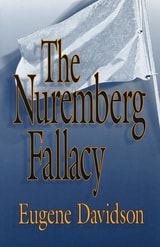
The Nuremberg Fallacy
Eugene Davidson
University of Missouri Press, 1998
Available for the first time in paperback, The Nuremberg Fallacy examines the inherent shortcomings of the Nuremberg "rules of war" and the War Crimes Tribunal's impossible expectations. In 1946, the Tribunal declared all aggressive war, war crimes, and crimes against humanity illegal. Yet the period since World War II has witnessed an unprecedented number of armed conflicts. In light of recent crises, including those in Rwanda, Bosnia and Serbia, and the Middle East, it is clear that the issues explored in The Nuremberg Fallacy are as relevant today as they were at the time of the book's first publication a quarter century ago.
In this volume, Eugene Davidson continues his investigations begun in The Trial of the Germans (University of Missouri Press), which studied the Nuremberg trials themselves, by focusing on five major conflicts since the end of World War II: the Suez crisis of 1956; Algeria's war of independence; Israel's recurring (and ongoing) battles with its Arab neighbors, complicated and worsened by intervention of the superpowers; the wars in Southeast Asia; and the Soviet Union's suppression of Czechoslovakia and other border states of Eastern Europe.
By exploring the roots and ramifications of these five conflicts, Davidson is able to chart the crosscurrents between large and small states, between individual nations and the United Nations, between the rules of Nuremberg and the significantly older rules of self- interest. The result is a thoughtful and thought-provoking study of the dynamics of war and peace in the post-Nuremberg world.
The rules of war proclaimed at Nuremberg—observing the flag of truce, prohibiting attacks on surrendered enemies, treating prisoners of war and civilian populations humanely—have become virtually irrelevant in modern guerrilla warfare. If anything, Davidson suggests, conditions have actually become worse than they were before the Nuremberg War Crimes Tribunal.
The continuing importance and relevance of The Nuremberg Fallacy is best summarized in the final sentences of Davidson's text: "The survival of a nation cannot be successfully entrusted to simplistic formulae or to principles that reflect unworkable doctrines. No computers have been programmed for the wisdom that remains essential for survival. People still have to provide that from their own inner and outer resources, no matter how far the weapons may seem to have outdistanced them."
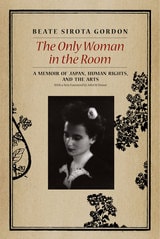
The Only Woman in the Room
A Memoir of Japan, Human Rights, and the ArtsBeate Sirota Gordon
University of Chicago Press, 2014
Sirota was born in Vienna, but in 1929 her family moved to Japan so that her father, a noted pianist, could teach, and she grew up speaking German, English, and Japanese. Russian, French, Italian, Latin, and Hebrew followed, and at fifteen Sirota was sent to complete her education at Mills College in California. The formal declaration of World War II cut Gordon off from her parents, and she supported herself by working for a CBS listening post in San Francisco that would eventually become part of the FCC. Translating was one of Sirota’s many talents, and when the war ended, she was sent to Japan as a language expert to help the American occupation forces. When General MacArthur suddenly created a team that included Sirota to draft the new Japanese Constitution, he gave them just eight days to accomplish the task. Colonel Roest said to Beate Sirota, “You’re a woman, why don’t you write the women’s rights section?”; and she seized the opportunity to write into law guarantees of equality unparalleled in the US Constitution to this day.
But this was only one episode in an extraordinary life, and when Gordon died in December 2012, words of grief and praise poured from artists, humanitarians, and thinkers the world over. Illustrated with forty-seven photographs, The Only Woman in the Room captures two cultures at a critical moment in history and recounts, after a fifty-year silence, a life lived with purpose and courage. This edition contains a new afterword by Nicole A. Gordon and an elegy by Geoffrey Paul Gordon.
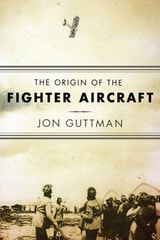
The Origin of the Fighter Aircraft
Jon Guttman
Westholme Publishing, 2009
From Scouts to Balloon-busters, the Emergence of Air-to-Air Combat in World War I
When World War I began in August 1914, the airplane had already proven its worth as an intelligence gathering “eye-in-the-sky.” These scouting aircraft soon became indispensable to armies on both sides, and the attempt to drive enemy planes away began in earnest. Local air superiority was incorporated into battlefield strategy, and the use of aircraft to conduct offensive operations would change warfare as dramatically as the first firearms 300 years before. By the end of 1915, the basic formula of the armed scout settled on a single-seater with a machine gun synchronized to fire through its propeller blades. This heavily armed aircraft became the first true fighter plane whose primary function was to destroy enemy aircraft, whether scouts, balloons, bombers, or other fighters. A new glamorized “knight of the air” was born: the ace, a fighter pilot who brought down five or more opponents. From 1916 on, as the combatants relied on airplanes more, flying tactics and strategy—including mass formations—were developed for what would become a deadly struggle for complete air superiority. By 1918, the final year of the war, air battles could be as sprawling as those on the ground.
In The Origin of the Fighter Aircraft, historian Jon Guttman tells the engrossing story of how one of the most amazing inventions became a integral component of warfare. Balancing technical description, personalities, and battle accounts, the author demonstrates that by the end of World War I most of the fundamentals for modern aerial combat had been established.
The Other Air Force
U.S. Efforts to Reshape Middle Eastern Media Since 9/11Sienkiewicz, Matt
Rutgers University Press, 2016
As it seeks to win the hearts and minds of citizens in the Muslim world, the United States has poured millions of dollars into local television and radio programming, hoping to generate pro-American currents on Middle Eastern airwaves. However, as this fascinating new book shows, the Middle Eastern media producers who rely on these funds are hardly puppets on an American string, but instead contribute their own political and creative agendas while working within U.S. restrictions.
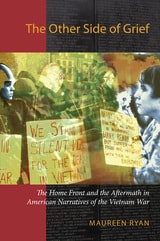
The Other Side of Grief
The Home Front and the Aftermath in American Narratives of the Vietnam WarMaureen Ryan
University of Massachusetts Press, 2008
The lingering aftereffects of the Vietnam War resonate to this day throughout American society: in foreign policy, in attitudes about the military and war generally, and in the contemporary lives of members of the so-called baby boom generation who came of age during the 1960s and early 1970s. While the best-known personal accounts of the war tend to center on the experience of combat, Maureen Ryan's The Other Side of Grief examines the often overlooked narratives—novels, short stories, memoirs, and films—that document the war's impact on the home front.
In analyzing the accounts of Vietnam veterans, women as well as men, Ryan focuses on the process of readjustment, on how the war continued to insinuate itself into their lives, their families, and their communities long after they returned home. She looks at the writings of women whose husbands, lovers, brothers, and sons served in Vietnam and whose own lives were transformed as a result. She also appraises the experiences of the POWs who came to be embraced as the war's only heroes; the ordeal of Vietnamese refugees who fled their “American War” to new lives in the United States; and the influential movement created by those who committed themselves to protesting the war.
The end result of Ryan's investigations is a cogent synthesis of the vast narrative literature generated by the Vietnam War and its aftermath. Together those stories powerfully demonstrate how deeply the legacies of the war penetrated American culture and continue to reverberate still.
The Peace That Never Was
A History of the League of NationsRuth Henig
Haus Publishing, 2010
The Political Orchestra
The Vienna and Berlin Philharmonics during the Third ReichFritz Trümpi
University of Chicago Press, 2016
Trümpi looks first at the decades preceding National Socialist rule, when the competing orchestras, whose rivalry mirrored a larger rivalry between Berlin and Vienna, were called on to represent “superior” Austro-German music and were integrated into the administrative and social structures of their respective cities—becoming vulnerable to political manipulation in the process. He then turns to the Nazi period, when the orchestras came to play a major role in cultural policies. As he shows, the philharmonics, in their own unique ways, strengthened National Socialist dominance through their showcasing of Germanic culture in the mass media, performances for troops and the general public, and fictional representations in literature and film. Accompanying these propaganda efforts was an increasing politicization of the orchestras, which ranged from the dismissal of Jewish members to the programming of ideologically appropriate repertory—all in the name of racial and cultural purity.
Richly documented and refreshingly nuanced, The Political Orchestra is a bold exploration of the ties between music and politics under fascism.
The Politics of Memory in Postwar Europe
Richard Ned Lebow, Wulf Kansteiner and Claudio Fogu, eds.
Duke University Press, 2006
An extensive introduction contains reflections on the significance of Europeans’ memories of World War II and a conclusion provides an analysis of the implications of the contributors’ findings for memory studies. These two pieces tease out some of the findings common to all seven countries: for instance, in each nation, the decade and a half between the late 1960s and the mid-1980s was the period of most profound change in the politics of memory. At the same time, the contributors demonstrate that Europeans understand World War II primarily through national frames of reference, which are surprisingly varied. Memories of the war have important ramifications for the democratization of Central and Eastern Europe and the consolidation of the European Union. This volume clarifies how those memories are formed and institutionalized.
Contributors. Claudio Fogu, Richard J. Golsan, Wulf Kansteiner, Richard Ned Lebow, Regula Ludi, Annamaria Orla-Bukowska, Heidemarie Uhl, Thomas C. Wolfe
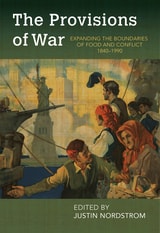
The Provisions of War
Expanding the Boundaries of Food and Conflict, 1840-1990Justin Nordstrom
University of Arkansas Press, 2021
The Provisions of War examines how soldiers, civilians, communities, and institutions have used food and its absence as both a destructive weapon and a unifying force in establishing governmental control and cultural cohesion during times of conflict. Historians as well as scholars of literature, regional studies, and religious studies problematize traditional geographic boundaries and periodization in this essay collection, analyzing various conflicts of the nineteenth and twentieth centuries through a foodways lens to reveal new insights about the parameters of armed interactions.
The subjects covered are as varied and inclusive as the perspectives offered—ranging from topics like military logistics and animal disease in colonial Africa, Indian vegetarian identity, and food in the counterinsurgency of the Malayan Emergency, to investigations of hunger in Egypt after World War I and American soldiers’ role in the making of US–Mexico borderlands. Taken together, the essays here demonstrate the role of food in shaping prewar political debates and postwar realities, revealing how dietary adjustments brought on by military campaigns reshape national and individual foodways and identities long after the cessation of hostilities
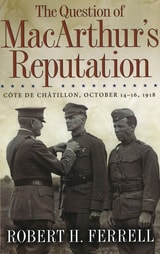
The Question of MacArthur's Reputation
Côte De Châtillon, October 14-16, 1918Robert H. Ferrell
University of Missouri Press, 2008
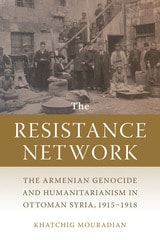
The Resistance Network
The Armenian Genocide and Humanitarianism in Ottoman Syria, 1915–1918Khatchig Mouradian
Michigan State University Press, 2021
The River of Angry Dogs
A MemoirMira Hamermesh
Pluto Press, 2004
As a young Jewish teenager Hamermesh escaped the horrors of German-occupied Poland and was spared the experience of the ghetto and the concentration camp that claimed most of her family. Mira shows how her status as a refugee has continued to influence her throughout her life. The journey led her across Europe and eventually to Palestine in 1941; her account of that region, before the establishment of Israel, provides a fascinating insight into the historical setting for today's conflict.
Having settled in London where she studied art and married, she eventually won a place at the celebrated Polish Film School in Lodz. At the height of the Cold War Mira Hamermesh commuted across the Iron Curtain – her experience of a divided Europe offers many insights into the political factors that affected people's everyday lives. Mira's theme of political conflict, so often explored in her films, is brought to life here in an intimate account that will live long in the memory.
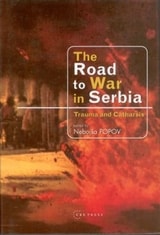
The Road to War in Serbia
Trauma and CatharsisNebojša Popov
Central European University Press, 2000
The Yugoslav crisis, with its armed conflict, ethnic cleansing and the reverberating ideas and mindsets, has been going on for more than ten years. The Road to War in Serbia is the first serious assessment to explore the roots of the conflict in the former Yugoslavia. Based on years of research, the authors - all eminent scholars in the field who have lived through these social conflicts - highlight key issues which have to date remained unknown or which have been previously neglected.
The issues dealt with include the institutional frameworks of ethnicity and nationalism; the input of the church, science, literature and sports; specific catalysts of the conflict and the role of the political actors, students, the ruling party and the media.
The Road to War in Serbia will be of great interest to all readers who want to understand why and how the violent option of settling disputes and conflicts on the territory of Yugoslavia is being accepted.
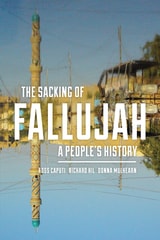
The Sacking of Fallujah
A People's HistoryRoss Caputi
University of Massachusetts Press, 2019
The Iraqi city of Fallujah has become an epicenter of geopolitical conflict, where foreign powers and non-state actors have repeatedly waged war in residential neighborhoods with staggering humanitarian consequences. The Sacking of Fallujah is the first comprehensive study of the three recent sieges of this city, including those by the United States in 2004 and the Iraqi-led operation to defeat ISIS in 2016.
Unlike dominant military accounts that focus on American soldiers and U.S. leaders and perpetuate the myth that the United States “liberated” the city, this book argues that Fallujah was destroyed by coalition forces, leaving public health crises, political destabilization, and mass civilian casualties in their wake. This meticulously researched account cuts through the propaganda to uncover the lived experiences of Fallujans under siege and occupation, and contextualizes these events within a broader history of U.S. policy in the Middle East. Relying on testimony from Iraqi civilians, the work of independent journalists, and documentation from human rights organizations, Ross Caputi, Richard Hil, and Donna Mulhearn place the experiences of Fallujah's residents at the center of this city's recent history.
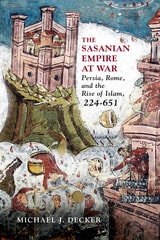
The Sasanian Empire at War
Persia, Rome, and the Rise of Islam, 224–651Michael J. Decker
Westholme Publishing, 2025
A comprehensive military history of one of the most important empires of Late Antiquity
The Sasanian Empire at War: Persia, Rome, and the Rise of Islam, 224–651 is the first comprehensive study in English examining war and society in one of the most important empires in world history: the Persian Empire of 224-651 AD, ruled by the Sasanian clan. At its height the Sasanians governed lands from the Indus River in the east to Egypt and the Mediterranean in the west. Adversaries of Rome, they also faced grave challenges from nomadic powers from Central Asia, notably the Huns and Turks. The Sasanians were able to maintain their empire for hundreds of years through nearly constant warfare, but when their expansion was checked in the north by the Byzantines at Constantinople in 626, and with the Muslim invasions to their south and west beginning in the 630s, the empire could no longer be sustained, and it finally collapsed.
In this book, Michael J. Decker examines Sasanian warfare, including military capabilities, major confrontations, organization and weapons of the Persian army. In addition to providing a comprehensive overview of the conflicts that marked this vital period in the history of Eurasia, The Sasanian Empire at War challenges long cherished notions of the inferiority of Sasanian military capabilities and renders a new image of a sophisticated, confident culture astride the heart of Eurasia at the end of the ancient world and birth of the Silk Road. Persian arms were among the many features of their culture that drew widespread admiration and was one of the keys to the survival of Iranian culture beyond the Arab Conquest and into the present day.