Results by title
3390 books match the query 'Fiction' and 1041 start with t
Towards the Ethics of Form in Fiction
Narratives of Cultural RemissionLeona Toker
The Ohio State University Press, 2010
Toker is especially interested in cultural remissions such as the carnivalesque—that is, the inverting of standard cultural hierarchies or the blurring of boundaries between normally separated social groups, actors and audiences, self and other. She argues that cultural remissions have the potential not simply to provide a break from the determinacies of our quotidian existence but also to return us to that existence with some alteration of our perceptions, beliefs, and values. Toker contends that the ethical consequences of reading fiction result from features of its aesthetics, particularly what she calls, following the semiotician Louis Hjemslev, “the form of the content”—the patterns arising from the artistic deployment of narrative details. In addition to addressing the carnivalesque discourse of Bakhtin as well as the theory of oppositionality developed by de Certeau and Chambers, she puts theory into practice through detailed analyses of canonical texts by Fielding, Sterne, Austen, Hawthorne, Dickens, Conrad, Joyce, and other writers.
Town College City Road
Patrick McGinty
University of Wisconsin Press, 2025
Through his struggles to pass multiple masculine initiations, both real and metaphorical, Kurt ultimately discovers that the only thing tougher than running away from rural mythology is constructing a new one.
Traces of Boots on Tongue
and Other StoriesRajkamal Chaudhary
Seagull Books, 2023
Drawing influences from Indian folktales, French existentialism, and the Bengali Hungryalist movement, Rajkamal Chaudhary’s œuvre is like a secret back alley in an old city—not completely forgotten but existing only for the few. Even though Chaudhary also wrote in Maithili and Bengali, it was his writings in Hindi that established him as the bold new experimentalist of Indian literature. His India of the 1950 and 60s is populated with hopeless literature professors, scattered alcohol bottles, prostitutes, hysteria patients, and sell-out painters. His unconventional life and writing place him outside the mainstream, and so he remains as uncategorizable as the characters and lives he wrote about. Bringing together twelve of his most representative short stories, translated for the first time in English, Traces of Boots on Tongue and Other Stories allows a glimpse into the early decades of independent India and its weariness, which many readers will find in today’s India as well.
Training for Catastrophe
Fictions of National Security after 9/11Lindsay Thomas
University of Minnesota Press, 2021
A timely, politically savvy examination of how impossible disasters shape the very real possibilities of our world
Why would the normally buttoned-down national security state imagine lurid future scenarios like a zombie apocalypse? In Training for Catastrophe, author Lindsay Thomas shows how our security regime reimagines plausibility to focus on unlikely and even unreal events rather than probable ones. With an in-depth focus on preparedness (a pivotal, emergent national security paradigm since 9/11) she explores how fiction shapes national security.
Thomas finds fiction at work in unexpected settings, from policy documents and workplace training manuals to comics and video games. Through these texts—as well as plenty of science fiction—she examines the philosophy of preparedness, interrogating the roots of why it asks us to treat explicitly fictional events as real. Thomas connects this philosophical underpinning to how preparedness plays out in contemporary politics, emphasizing how it uses aesthetic elements like realism, genre, character, and plot to train people both to regard some disasters as normal and to ignore others.
Training for Catastrophe makes an important case for how these documents elicit consent and compliance. Thomas draws from a huge archive of texts—including a Centers for Disease Control comic about a zombie apocalypse, the work of Audre Lorde, and the political thrillers of former national security advisor Richard Clarke—to ask difficult questions about the uses and values of fiction. A major statement on how national security intrudes into questions of art and life, Training for Catastrophe is a timely intervention into how we confront disasters.
Trampoline
An Illustrated NovelRobert Gipe
Ohio University Press, 2015
Trampoline
An Illustrated NovelRobert Gipe
Ohio University Press, 0
First published in 2015, Trampoline introduced readers to Dawn Jewell, a fierce, funny, and unforgettable fifteen year old navigating the complexities of family, activism, and identity in eastern Kentucky. With a voice as raw and real as the Appalachian landscape she inhabits, Dawn becomes an unlikely fighter in her grandmother’s crusade against mountaintop removal mining—while wrestling with her own need for escape and self-discovery.
This tenth anniversary edition celebrates the enduring power of Robert Gipe’s illustrated debut novel, the first in the acclaimed Canard County Trilogy, rounded out by his later novels Weedeater (2018) and Pop (2021). Gipe’s storytelling—rooted in oral tradition and punctuated by his signature hand-drawn illustrations—captures the grit, humor, and heart of a region too often misunderstood. His portrayal of Appalachia is both unflinching and deeply loving.
The new edition features an afterword by bestselling author Beth Macy (Dopesick, Raising Lazarus). It also includes an collective introduction by Darnell Arnoult, Sandra L. Ballard, Marianne Worthington, and Gillian Berchowitz, offering insight into the novel’s place in Appalachian literature and its influence on a generation of readers and writers.
Limited to 1,000 copies, this commemorative edition is a tribute to a beloved book and its visionary author. Whether you're discovering Dawn Jewell for the first time or returning to Canard County, Trampoline remains a vital, vibrant portrait of a young woman—and a region—fighting to be heard.
Trance-Migrations
Stories of India, Tales of HypnosisLee Siegel
University of Chicago Press, 2014
Even if you can’t read this with a partner—and I stress that you certainly ought to—you will still be in rich company. There is Shambaraswami, an itinerant magician, hypnotist, and storyteller to whom villagers turn for spells that will bring them wealth or love; José-Custodio de Faria, a Goan priest hypnotizing young and beautiful women in nineteenth-century Parisian salons; James Esdaile, a Scottish physician for the East India Company in Calcutta, experimenting on abject Bengalis with mesmerism as a surgical anesthetic; and Lee Siegel, a writer traveling in India to learn all that he can about hypnosis, yoga, past life regressions, colonialism, orientalism, magic spells, and, above all, the power of story. And then there is you: descending through these histories—these tales within tales, trances within trances, dreams within dreams—toward a place where the distinctions between reverie and reality dissolve.
Here the world within the book and that in which the book is read come startlingly together. It’s one of the most creative works we have ever published, a dazzling combination of literary prowess, scholarly erudition, and psychological exploration—all tempered by warm humor and a sharp wit. It is informing, entertaining, and, above all, mesmerizing.
Transfigured Night
Libuše Moníková
Karolinum Press, 2023
In late 1992, three years after the Velvet Revolution and as Czechoslovakia is about to dissolve into the Czech Republic and Slovakia, choreographer and dancer Leonora Marty, who fled the Communist state decades earlier, has returned to Prague. Having wrapped up her ballet of The Makropulos Affair, the famous dancer meets old classmates, wanders the city through crowds of tourists, and visits the most obscure and unvisited museums. When she is approached by Thomas Asperger, a descendant of ethnic Germans driven from Czechoslovakia after World War II, she must confront three relationships—her relationship with the city of her youth, her homeland’s relationship with its past, and her new romance with this German admirer.
Written in German and published in 1995, by an author whose life mirrored her protagonist’s, the novel provides a cultural tour of Prague. Employing a style as influenced by the operas of Leoš Janácek as the novels of Thomas Pynchon, Transfigured Night is a masterpiece of Czech literature, showing that the culture of this nation comes in a variety of tongues.
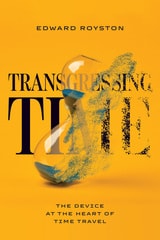
Transgressing Time
The Device at the Heart of Time TravelEdward Royston
The Ohio State University Press, 2026
Royston bolsters this concept through readings of classics such as Back to the Future and Octavia E. Butler’s Kindred, contemporary works such as the video game Outer Wilds and Scott Alexander Howard’s The Other Valley, and lesser-known works such as the nineteenth-century Spanish novel El Anacronópete. These readings demonstrate how time travel functions across different mediums and genres and spotlights the ways authors and creators have used anachronic metalepsis to contend with themes of exile, freedom and consequences, the powers and pitfalls of nostalgia, the nature of history and our relationship to it, and the nature of time itself.
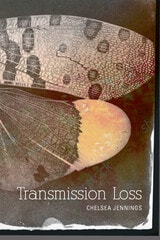
Transmission Loss
Chelsea Jennings
University of Massachusetts Press, 2018
In the study of sound waves and optics, the term transmission loss refers to how a signal grows weaker as it travels across distance and between objects. In this book, Chelsea Jennings reimagines the term in poems that register attenuated signals, mark presence and loss, and treat the body as an instrument sensitive to the weather of immediate experience. Threading together landscapes, abstract paintings, family heirlooms, maps, manuscripts, and photographs, these poems follow the seasons and traverse the spectrum of visible light. Vivid and precise, Transmission Loss brings us to the boundary between inside and outside, “As if what the hand knows / could be held in the hand.”

Traps
Sondra Spatt Olsen
University of Iowa Press, 1991
Heroines in Sondra Spatt Olsen's compelling stories often find themselves in bad situations: a wife with an irresponsible husband, an older woman who wants to leave her younger lover, a suburban housewife who wants sex with her doctor, a teacher who falls in love with her student, a young girl haunted by her mother's judgments, a demanding career woman unsettled by her boyfriend's success, a young woman who finds that her friends, when drunk, are potential murderers. But just as Chekhov gives us pleasure from moments of pain, Olsen illuminates the universal humor and pathos of bad situations.
Olsen brings bright wit, fresh empathy, and a generous dose of psychological insight to themes of abandonment and humiliation—her fiction offers a sort of transcendence from pain. These haunting, unsparing stories are not afraid to confront life's traps and pitfalls, but they do so with a celebration of the courage that rises amid the confusion all of us face.
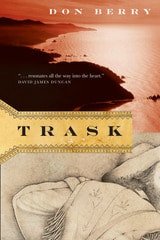
Trask
Don Berry
Oregon State University Press, 2004
Trask is at once a gripping tale of adventure and a portrayal of one man's return to the naked simplicity of life. Inspired by his belief in the transcendent power of nature, his fascination with Eastern philosophy, and the lives of historical men and women, Don Berry created a story that is strongly imagined and powerfully rendered-a landmark work. This new edition of Berry's celebrated first novel includes an introduction by Jeff Baker, book critic for The Oregonian.
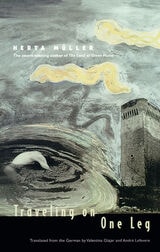
Traveling on One Leg
Herta Muller
Northwestern University Press, 2010
Winner, 2009 Nobel Prize in Literature
Irene is a fragile woman born to a German family in Romania, who has recently emigrated from her native country to West Germany. Politically and socially isolated, Irene moves within the orbit of three troubled men, while simultaneously embarking on an inner exploration of exile, homeland, and identity.
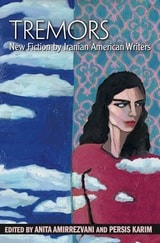
Tremors
New Fiction by Iranian American WritersAnita Amirrezvani
University of Arkansas Press, 2013
Tretjak
Max Landorff
Haus Publishing, 2014

Trigger Dance
Diane Glancy
University of Alabama Press, 1991
1990 Winner of the Mildren P. Nilon Award for Minority Fiction
In Trigger Dance, her first collection of stories, Diane Glancy takes us to uneasy places where both the environment and the characters are at risk, where even the animals grieve. Sometimes the author's voice, sometimes the voices of the characters, tell us about their migrations, symbolic or literal. Diane Glancy's characters walk in two worlds and try to build a middle ground between white and native cultures. They are the offspring of those who survived the Trail of Tears. Some of the young men dance at powwows in tune with the dead. Filo and Parnetta buy a fridge at the Hardware Store on Muskogee Street, in Tahleqah, Oklahoma. Farther west, near Chickasha, Keyo can't read, while Joseph Sink, an Indian hermit, learns a word a day. Anna America remembers her shortcomings as a mother and her hard life as she waits in the Northeastern Cherokee County Shelter for her wings to unfold so she can leave this earth. In the title story, Roan mourns the fact that human beings have the power to destroy the earth. He's astonished that creation and cremation could be so closely linked. Even his father, when he feels death approach, demands to be cremated because "it's autumn in outer space." Roan's final vision in the sweat lodge is of the air red as leaves. He admonishes his people to be strong and responsible, to acknowledge that life is a sizeable endeavor. it.

Trigger Man
More Tales of the Motor CityJim Ray Daniels
Michigan State University Press, 2011
Trigger Man is a superb collection of stories capturing the gritty spirit of Detroit and the sometimes grim circumstances of the characters shaped by its industry and economics. Grounded on the bleak streets of the Motor City, these stories also explore the mythical “Up North,” the idealized country of many Detroit workers’ fantasy—an escape from the concrete and metal reality of their daily lives. Daniels’ characters are resilient and defiant, inhabiting a world that has often placed them on the margins of society, scouring a declining region for spiritual providence. Building on Daniels’ earlier collections of stories, Trigger Man brings vivid life to individuals struggling both to remain in and to flee the city that once sustained them.
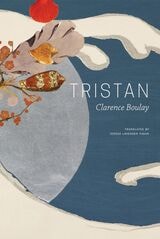
Tristan
Clarence Boulay
Seagull Books, 2021
After a seven-day journey on the South Atlantic Ocean aboard a lobster boat servicing Cape Town, Ida arrives on the island of Tristan. In the little island community, a village nestled on the slopes of a volcano whose only limits are the immense sky and the ocean, her bearings are gradually shifted as time slowly begins to expand.
When a cargo ship runs aground near a neighboring island, spilling massive amounts of oil, there is suddenly frantic activity in the town. Ida eagerly joins a team of three men who go to the small island to rescue oil-drenched penguins. One night, one of the men walks her back to the cabin where she is staying. They experience a night of love that continues to grow on the secluded island. For two weeks away from the world—the sea is rough, no boat can come to pick them up—the dance of their bodies and their all-consuming love is their only horizon.
Following the rhythm of the ocean and the untamed wind, Clarence Boulay brilliantly gives flesh to a dizzying sensation of sensual abandonment. Tristan raises emotional sails and upends all certainty.

Trixy
A NovelElizabeth Stuart Phelps, Edited and with an introduction by Emily E. VanDette
Northwestern University Press, 2019
Trixy is a 1904 novel by the best-selling but largely forgotten American author and women’s rights activist Elizabeth Stuart Phelps. The book decries the then common practice of vivisection, or scientific experiments on live animals. In Trixy, contemporary readers can trace the roots of the early animal rights movement in Phelps’s influential campaign to introduce legislation to regulate or end this practice. Phelps not only presents a narrative polemic against the cruelty of vivisection but argues that training young doctors in it makes them bad physicians. Emily E. VanDette’s introduction demonstrates that Phelps’s protest writing, which included fiction, pamphlets, essays, and speeches, was well ahead of its time.
Though not well known today, Phelps’s 1868 spiritualist novel, The Gates Ajar, which offered a comforting view of the afterlife to readers traumatized by the Civil War, was the century’s second best-selling American novel, surpassed only by Uncle Tom’s Cabin. Recently scholars and readers have begun to reexamine Phelps’s significance. As contemporary authors, including Peter Singer, Jonathan Safran Foer, Donna J. Haraway, Gary L. Francione, and Carol J. Adams, have extended her vision, they have also created new audiences for her work.
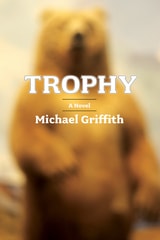
Trophy
A NovelMichael Griffith
Northwestern University Press, 2011
Vada Prickett is a 29-year-old Hose Associate at a car wash in South Carolina, and Darla, the woman he loves, is about to marry his friend, rival, and life-long neighbor, Wyatt Yancey. Vada has “spent his life waiting for the thing to get a proper start.” But it will never get that start, for Vada, as this wildly original novel opens, is being crushed to death by Wyatt’s latest animal trophy, a stuffed grizzly bear Vada has been helping him to smuggle—against Darla’s wishes—into Wyatt’s house.
It turns out that the cliché is true—at the moment of death, your life does flash before your eyes. Trophy, the account of a man’s final, fleeting instant on earth, joins Vada as he attempts to make that flash last as long as possible. As he lies dying, too soon and too absurdly, Vada tries to unravel the mysteries of his life. He first bargains with God, then rages against the dying of the light. Exhausted, Vada proceeds to prolong, in every way available to a man in his dire circumstances, the time he has remaining.
Just beneath Griffith’s dark humor and witty take on our present-day culture lies a meditation on memory and identity and the power of language over both.
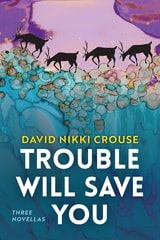
Trouble Will Save You
Three NovellasDavid Nikki Crouse
University of Alaska Press, 2023
While Crouse’s prize-winning collection of short fiction The Man Back There offered up insights into a kind of self-destructive masculinity, these novellas now sensitively and persuasively capture the inner landscapes of women struggling with grief and isolation. Trouble Will Save You is a unique and fully realized work from a keenly empathetic writer.
Praise for The Man Back There:
“In this virtuoso collection of stories, David Crouse guides us directly to where the shadow lies—the disorienting loss, the surprising heartache, the forgotten wound—those inevitable areas of the psyche we all share and through which only truth, illuminated with a such a light touch here, can deliver us; The Man Back There is the work of the real thing.”
—Andre Dubus III, author of House of Sand and Fog
“I chose these stories because they made me feel. I felt the characters like I would feel a stranger in a room or on a bus with me, with an irrational sympathy more animal than moral in its nature.”
—Mary Gaitskill, 2007 Mary McCarthy Prize judge
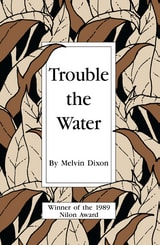
Trouble the Water
Melvin Dixon
University of Alabama Press, 1989
A haunting and poetic journey of memory, identity, and reconciliation in the heart of the Black South.
Winner of the Excellence in Minority Fiction Award
Trouble the Water moves among finely woven layers of time and place as it takes on a new and controversial theme in contemporary black writing, the search for family reconciliation. Twenty years after running away from home in Pee Dee, North Carolina, Jordan Henry believed he had found success, as a young college professor of history, a married man, and a resident of New England, whose colonial past he knew so well. When Jordan finds his career stymied by local prejudices, his world crumbles. Word of his grandmother's death reaches him, and he returns home to claim the ambiguous legacy of her farmland and face the consequences of his long absence.
Jordan's estranged father also returns to Pee Dee on a quest of his own restoring his good name in a community which blames him for Chloe Henry's death in childbirth. Chloe was Jordan's mother and his grandmother's only child. Unresolved hostility in the family and in the community breaks out, making Jordan the unsuspecting pawn in a plot of revenge against his father. Jordan may be the only one who can free his family from the past and the equally troubled present.
Trouble the Water gains resonance from its unflinching confrontation with dualities common in the Afro-American experience: reality and myth, folklore and sophistication, North and South, rural and cosmopolitan. While sacrificing none of its complexities for the sake of simplicity, it has the relentless movement of a fairy tale that reaches deep into the unconscious roots of behavior. It is intensely lyrical and dense in realism. Trouble the Water is magical in the way it reveals the Afro-American psyche and symbolizes fundamental truths about American life.
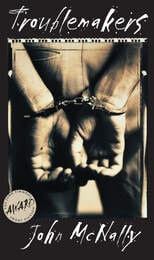
Troublemakers
John McNally
University of Iowa Press, 2000
Troublemakers is an often hilarious, sometimes frightening, occasionally off-the-wall collection of stories about men living on the edge. From the streets of Chicago's southwest side to the rural roads of Nebraska to the small towns of southern Illinois, these men tread a very fine line between right and wrong, love and hate, humor and horror.
Each story is a Pandora's box waiting to be opened: a high school boy with a new driver's license picks his brother up from jail; a UPS driver suspects his wife of having an affair but cannot find any tangible evidence of her indiscretion; an unemployed man's life begins to unravel after he discovers a dead man in a tree in his own backyard; two boys spend Halloween with an older thug; a young college teacher's patience is tested by both his annoying colleagues and the criminals who haunt his neighborhood. In story after story, McNally's troublemakers lead readers to a place no less thrilling or dangerous than the human heart itself.
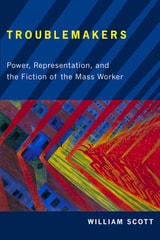
Troublemakers
Power, Representation, and the Fiction of the Mass WorkerScott, William
Rutgers University Press, 2012
William Scott’s Troublemakers explores how a major change in the nature and forms of working-class power affected novels about U.S. industrial workers in the first half of the twentieth century. With the rise of mechanization and assembly-line labor from the 1890s to the 1930s, these laborers found that they had been transformed into a class of “mass” workers who, since that time, have been seen alternately as powerless, degraded victims or heroic, empowered icons who could rise above their oppression only through the help of representative organizations located outside the workplace.
Analyzing portrayals of workers in such novels as Upton Sinclair’s The Jungle, Ruth McKenney's Industrial Valley, and Jack London’s The Iron Heel, William Scott moves beyond narrow depictions of these laborers to show their ability to resist exploitation through their direct actions—sit-down strikes, sabotage, and other spontaneous acts of rank-and-file “troublemaking” on the job—often carried out independently of union leadership. The novel of the mass industrial worker invites us to rethink our understanding of modern forms of representation through its attempts to imagine and depict workers’ agency in an environment where it appears to be completely suppressed.
True Country
Themes in the Fiction of Flannery O'ConnorCarter W. Martin
Vanderbilt University Press, 1969
Truth/Untruth
Mahasweta Devi
Seagull Books, 2023
Set in Calcutta in the mid-1980s, Truth/Untruth is a fast-paced thriller built around the death of the pregnant Jamuna—a maid in a newly affluent residential apartment complex—and Arjun, the upwardly mobile businessman who seduced her. Packed with a cast of colorful characters, this novel is a trenchant, darkly humorous, and unsentimental look at the different segments of Calcutta society: from the middle-class culture vultures to the unscrupulous “promoter” class and the domestic helpers and slum goons who form an intrinsic part of the city’s life. All are implicated in a complex web of guilt and bizarre twists and turns. Sex, lies, death—the great modernist themes—run like a thread through this book, exposing societal greed, lust, corruption, and moral hypocrisy with a sardonic tone that spares none. An unusual novel by an author who is otherwise known for her hard-hitting activist-feminist stories, Truth/Untruth underlines the exploitative vicious cycle that defines urban relations between the haves and have-nots.
Trying to Be
A CollectionJohn Haskell
University of Alabama Press, 2025
With lyrical precision and aching intimacy, Trying to Be moves through history, memory, and the performance of ephemeral identity, as John Haskell assembles a quiet manifesto for how to think, how to live, and how to feel ourselves in our bodies.
Trying to Be is a book about presence, absence, and the intricate art of inhabiting one’s own life. John Haskell—known for his genre-defying literary voice—moves through a series of intimate, sharply observed portraits: Francis Bacon and his doomed lover; Danny Kaye and his split personality; Sophia Loren; Diego Velázquez; Ulrike Meinhof; and Yvonne Rainer’s radical reinvention of what dance can be.
But this isn’t cultural commentary as ornament. These figures mirror Haskell’s own attempts to grapple with grief, estrangement, memory, and the failures of language. The result is a book that blurs the line between criticism and confession, art history and personal inventory. Whether recalling a botched friendship, a beloved mentor, or the carefully choreographed movement in a dance workshop, Haskell searches for new ways of becoming—through art, through awareness, through stories that have the quality of song. In prose that’s quiet but unflinching, Trying to Be asks: What do we do with our bodies, our memories, and our regrets when even language feels exhausted? And what happens when, against the odds, we keep going?

Tsing
David Albahari
Northwestern University Press, 1997
Twilight at the Equator
A NovelJaime Manrique
University of Wisconsin Press, 2003
Colombian-born Santiago Martinez starts his adult life as a young gay writer living in Spain. Years later, as a university professor in New York City, Santiago is called back to his native Colombia upon the suicide of his sister. There he learns some shocking secrets about his childhood and adolescence and comes to the realization that cherished memories of the past are only illusion.
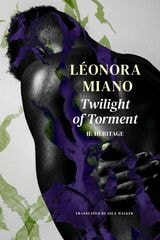
Twilight of Torment
II. HeritageLéonora Miano
Seagull Books, 2023
After beating his girlfriend and leaving her for dead on the street, Amok retraces his steps. Frightened by his act, which reproduces the violence of his father, he hopes to save the woman. But it is too late when he arrives at the scene; two women are already carrying the injured woman. Overwhelmed and not daring to reveal himself, he decides to find his father in order to learn how to rid himself of the dark force that he believes runs through the men of his lineage. He embarks on a journey that will be, more than anything, an inner one, forcing him to understand his story and choose a healthier way of being in the world. This second volume of Twilight of Torment is both intimate and political. Through the story of a man and his family, we discover an African bourgeoisie and its many social wanderings in a contemporary Africa whose future seems nebulous.
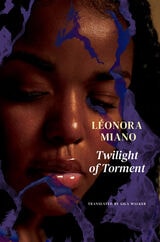
Twilight of Torment
MelancholyLéonora Miano
Seagull Books, 2022
Four women speak. They speak to the same man, who is not there. He is the son of the first, the great-yet-impossible love of the second, the platonic companion of the third, the older brother of the last. Speaking to him in his absence, it is to themselves that these women turn, examining their own stories to make sense of their journey, from twilight to twilight, through a mysterious stormy night in the middle of the dry season.
Together, the voices in Twilight of Torment: Melancholy, the first volume of a two-volume novel, perform a powerful and sometimes discordant jazz-inspired chorus about issues such as femininity, sexuality, self-love, and the intrusion of history into the intimate lives of people of African descent. Blackness confronts African-ness, love is sometimes discovered in the arms of another woman, the African renaissance tries to establish itself on the rubble of self-esteem damaged by history. Each of these women, with her own language and rhythm, ultimately represents a specific aspect of the tormented history of Africans in today’s world, and at the end of the night, they will each arrive at a dawn of hope.
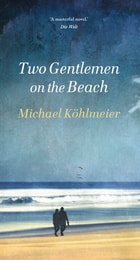
Two Gentlemen on the Beach
Michael Köhlmeier
Haus Publishing, 2016
When a chance encounter reveals what they share, an unusual and unlikely friendship ensues. A series of therapeutic meetings across the world, in Germany, England, and America, sees each become the other’s confidant as they talk of their “black dog days.” With the eye of a masterfully subtle narrator, Michael Köhlmeier imagines a startling friendship of unique understanding between this extraordinary pair: a friendship of the twentieth century between art and politics, humor and seriousness, but which at heart remains an understanding between two men—the poor tramp and the grand statesman—who bring together the history of the century.
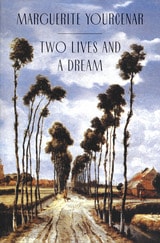
Two Lives and a Dream
Marguerite Yourcenar
University of Chicago Press, 1994
"An Obscure Man swarms with life. This intricately researched, imaginative, beautifully written tale of a young man's brief life in the mid-17th century is entirely engrossing."—Leona Weiss, San Francisco Chronicle
"In these three stories, [Yourcenar] succeeds in making the essences of these past lives a part of the reader's future through the sheer intensity of their portrayal."—Margaret Ezell, Houston Chronicle
Two Stories of Prague
King Bohush The SiblingsRainer Maria Rilke
Brandeis University Press, 1996
Two Women
A NovelBarbara F. Ichiishi
Bucknell University Press, 2022
This first English translation of the novel captures the lyrical romanticism of its prose and includes a scholarly introduction to the work and its author, Gertrudis Gómez de Avellaneda, a pioneering feminist and anti-slavery activist who based the character of Catalina on her own experience. Two Women is a searing indictment of the stern laws and customs governing marriage in the Hispanic world, brought to life in a spellbinding, tragic love story.
Two-Moon Journey
The Potawatomi Trail of DeathPeggy King Anderson
Indiana Historical Society Press, 2018
Tworki
Marek Bienczyk
Northwestern University Press, 2008
In Tworki, a village just southwest of Warsaw, there is a psychiatric hospital and in that hospital, the patients and their caretakers are hidden from the war just outside their iron gates. Our hero, Jurek, answers an ad in the paper for a job there and finds himself keeping the books alongside a knockout strawberry blonde named Sonia. They and their group of friends—vital young people like Marcel, an initial rival for Jurek; Olek, Sonia’s chosen love; and Janka, with whom Jurek becomes involved—do their jobs, picnic on the weekends, and dance in the gardens on the grounds of the hospital. Jurek speaks often of, and even in, verse, whether he is talking to his friends or in letters to a distant and admiring cousin. He and his friends live lives that defy the discord and destruction of the war in Europe, striving to rediscover or save whatever beauty they can. Much of this beauty is embodied by Sonia, who is beloved of all the friends and patients at the asylum. But the revitalizing spring they all hope will come for Poland is not to arrive this year. Despite the relative safety of their odd surroundings, the world and the war soon come for the friends. Olek’s absences are longer and unexplained. Marcel is not what he seems, and he and his wife mysteriously disappear, she says, to the gas. And the perfection that Sonia embodies cannot ultimately be kept, by the friends, by the nation, or even by Sonia herself.

Tycho Brahe's Path to God
A NovelMax Brod
Northwestern University Press, 2007
Typee
A Peep at Polynesian LifeHerman Melville
Northwestern University Press, 2003
This scholarly edition is based on collations of all editions published during his lifetime, incorporating many authorial readings that have often been omitted and some that have been misprinted in all previous editions. This edition is an Approved Text of the Center for Editions of American Authors (Modern Language Association of America).
Typee
Volume One, Scholarly EditionHerman Melville
Northwestern University Press, 1968
This scholarly edition is based on collations of all editions published during his lifetime, incorporating many authorial readings that have often been omitted and some that have been misprinted in all previous editions. This edition is an Approved Text of the Center for Editions of American Authors (Modern Language Association of America).
the book of webs
Jesse Kohn
University of Massachusetts Press, 2023
Honorable Mention, 2023 Big Other Readers’ Choice Award
Word spreads from one recovering self-inflicted eye surgery patient to the next of a mystical book capable of overturning the Burlingtonian empire.
Captivating and devious, the book of webs is constructed out of misremembered fragments, conflicting histories, and secrets whispered in the darkness. The insurgents tell of an enemy so powerful it owns the air, dictates reality, and has even managed to co-opt their thoughts. Their only hope is to conspire with the uprisings of their bodies: slips of the tongue, excretions, tics, bad hair days, and, most importantly, their dreams.
In this darkly comic and inventive debut novel, Jesse Kohn introduces a network of shape-shifters and misfits. A militant priestess broods over orphaned angel eggs. A post-punk band animates a messianic homunculus made of belly button lint. A failed dream journalist goes on a terrible first date to heaven. Each misadventure is a chapter in a book devised to oppose the despotic order of their enemy—the book of webs.