Results by title
4917 books match the query 'Philosophy' and 1267 start with t
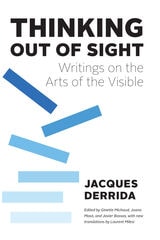
Thinking Out of Sight
Writings on the Arts of the VisibleJacques Derrida
University of Chicago Press, 2021
The book is divided into three sections. The first demonstrates Derrida’s preoccupation with visibility, image, and space. The second contains interviews and collaborations with artists on topics ranging from the politics of color to the components of painting. Finally, the book delves into Derrida’s writings on photography, video, cinema, and theater, ending with a text published just before his death about his complex relationship to his own image. With many texts appearing for the first time in English, Thinking out of Sight helps us better understand the critique of representation and visibility throughout Derrida’s work, and, most importantly, to assess the significance of his insights about art and its commentary.
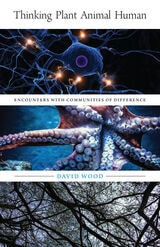
Thinking Plant Animal Human
Encounters with Communities of DifferenceDavid Wood
University of Minnesota Press, 2020
Collected essays by a leading philosopher situating the question of the animal in the broader context of a relational ontology
There is a revolution under way in our thinking about animals and, indeed, life in general, particularly in the West. The very words man, animal, and life have turned into flimsy conceptual husks—impediments to thinking about the issues in which they are embroiled. David Wood was a founding member of the early 1970s Oxford Group of philosophers promoting animal rights; he also directed Ecology Action (UK). Thinking Plant Animal Human is the first collection of this major philosopher’s influential essays on “animals,” bringing together his many discussions of nonhuman life, including the classic “Thinking with Cats.”
Exploring our connections with cats, goats, and sand crabs, Thinking Plant Animal Human introduces the idea of “kinnibalism” (the eating of mammals is eating our own kin), reflects on the idea of homo sapiens, and explores the place of animals both in art and in children’s stories. Finally, and with a special focus on trees, the book delves into remarkable contemporary efforts to rescue plants from philosophical neglect and to rethink and reevaluate their status. Repeatedly bubbling to the surface is the remarkable strangeness of other forms of life, a strangeness that extends to the human.
Wood shows that the best way of resisting simplistic classification is to attend to our manifold relationships with other living beings. It is not anthropocentric to focus on such relationships; they cast light in complex ways on the living communities of which we are part, and exploring them recoils profoundly on our understanding of ourselves.
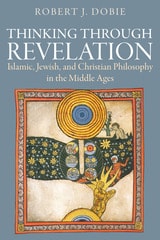
Thinking Through Revelation
Robert J. Dobie
Catholic University of America Press, 2019
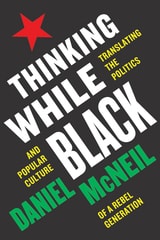
Thinking While Black
Translating the Politics and Popular Culture of a Rebel GenerationDaniel McNeil
Rutgers University Press, 2023
Listen along with this Spotify playlist inspired by the book!
For copyright reasons, this book is available in the U.S.A only.
Thinking With—Jean-Luc Nancy
Edited by Susanna Lindberg, Artemy Magun, and Marita Tatari
Diaphanes, 2023
This book continues passionate conversation that Jean-Luc Nancy (1940–2021) was engaged in throughout his life with philosophers and artists from all over the world. The contributors take up Nancy’s philosophical question of truth as a praxis of a “with”—understanding truth without any given measure or comparison as an articulation of a with. It is a thinking responsible for the world from within the world, a language that seeks to respond to the ongoing mutation of our civilization. Contributors include Jean-Christophe Bailly, Rodolphe Burger, Marcia Sá Calvacante Schuback, Marcus Coelen, Alexander García Düttmann, Juan-Manuel Garrido, Martta Heikkilä, Erich Hörl, Valentin Husson, Sandrine Israel-Jost, Ian James, Apostolos Lampropoulos, Nidesh Lawtoo, Jérôme Lèbre, Susanna Lindberg, Michael Marder, Artemy Magun, Boyan Manchev, Dieter Mersch, Hélène Nancy, Jean-Luc Nancy, Aïcha Liviana Messina, Ginette Michaud, Helen Petrovsky, Jacob Rogozinski, Philipp Stoellger, Peter Szendy, Georgios Tsagdis, Marita Tatari, Gert-Jan van der Heiden, and Aukje van Rooden.
Thinking Your Way to Freedom
A Guide to Owning Your Own Practical ReasoningSusan T. Gardner
Temple University Press, 2009
Thinking Your Way to Freedom is a critical-thinking textbook with a difference. Rather than focusing exclusively on improving college students’ academic achievement, Susan Gardner seeks to dramatically change how students think through issues that are important in their lives beyond school. Gardner created 66 original and entertaining comic strips—featuring her dogs, Diva and Ben—that add a light touch as they encourage intellectual and personal autonomy. Through a clear step-by-step method of practical reasoning, students are taught how to think impartially and how to neutralize invisible biases that limit their freedom of thought and action. With the help of Diva and Ben, readers learn to evaluate the strengths of arguments and to recognize fallacies, all the while avoiding the paralyzing effects of relativism.
Thinking Your Way to Freedom includes the writing of short essays so that students can improve their critical thinking and writing at the same time. A Teacher’s Manual for this book will be available online.
Thinking about Music
An Introduction to the Philosophy of MusicLewis E. Rowell
University of Massachusetts Press, 1983
Examines the nature of music and traces the history of music philosophy from ancient Greece to the twentieth century. Lewis Rowell's Thinking about Music is more than an introduction to the connections between music and other arts, and the philosophical underpinnings of aesthetics.
Thinking about Ordinary Things
A Short Invitation to PhilosophyJan Sokol
Karolinum Press, 2013
Thinking and the I
Hegel and the Critique of KantAlfredo Ferrarin
Northwestern University Press, 2019
What is the relation between thinking and the I that thinks? And what is the relation between thought and reality? The ordinary view shared by modern philosophers from Descartes to Kant, as well as by common sense, is that there is only thought when someone thinks something, and thoughts and concepts are mental acts that refer to objects outside us.
In Thinking and the I: Hegel and the Critique of Kant, Alfredo Ferrarin shows that Hegel’s philosophy entails a radical criticism of this ordinary conception of thinking. Breaking with the habitual presuppositions of both modern philosophy and common sense, Ferrarin explains that thought, negation, truth, reflection, and dialectic for Hegel are not properties of an I and cannot be reduced to the subjective activity of a self-conscious subject. Rather, he elucidates, thought is objective for Hegel in different senses. Reality as a whole is animated by a movement of thought and an unconscious logic as a spontaneity that reifies itself in determinate forms. Ferrarin concludes the book with a comprehensive comparison of Hegel’s and Kant’s concepts of reason.
While it mainly focuses on Hegel’s Phenomenology, Science of Logic, and Encyclopaedia, this ambitious book covers all aspects of Hegel’s philosophy. Its originality and strength lie in its recovery of the original core of Hegel’s dialectic over and above its currently predominant transcendental, neopragmatist, or realist appropriations. It will be essential reading for all students of Hegel, Kant, and German idealism in general for years to come.
Thinking between Deleuze and Merleau-Ponty
Judith Wambacq
Ohio University Press, 2017
Thinking between Deleuze and Merleau-Ponty is the first book-length examination of the relation between these two major thinkers of the twentieth century. Questioning the dominant view that the two have little of substance in common, Judith Wambacq brings them into a compelling dialogue to reveal a shared, historically grounded concern with the transcendental conditions of thought. Both Merleau-Ponty and Deleuze propose an immanent ontology, differing more in style than in substance. Wambacq’s synthetic treatment is nevertheless critical; she identifies the limitations of each thinker’s approach to immanent transcendental philosophy and traces its implications—through their respective relationships with Bergson, Proust, Cézanne, and Saussure—for ontology, language, artistic expression, and the thinking of difference. Drawing on primary texts alongside current scholarship in both French and English, Thinking between Deleuze and Merleau-Ponty is comprehensive and rigorous while remaining clear, accessible, and lively. It is certain to become the standard text for future scholarly discussion of these two major influences on contemporary thought.
Thinking in the Dark
Cinema, Theory, PracticePomerance, Murray
Rutgers University Press, 2015
Thinking in the Dark introduces readers to twenty-one key theorists whose work has made a great impact on film scholarship today, including Rudolf Arnheim, Sergei Eisenstein, Michel Foucault, Siegfried Kracauer, and Judith Butler. Rather than just discussing each theorist’s ideas in the abstract, the book shows how those concepts might be applied when interpreting specific films by including an analysis of both a classic film and a contemporary one. It thus demonstrates how theory can help us better appreciate films from all eras and genres: from Hugo to Vertigo, from City Lights to Sunset Blvd., and from Young Mr. Lincoln to A.I. and Wall-E.
The volume’s contributors are all experts on their chosen theorist’s work and, furthermore, are skilled at explaining that thinker’s key ideas and terms to readers who are not yet familiar with them. Thinking in the Dark is not only a valuable resource for teachers and students of film, it’s also a fun read, one that teaches us all how to view familiar films through new eyes.
Theorists examined in this volume are: Rudolf Arnheim, Béla Balázs, Roland Barthes, André Bazin, Walter Benjamin, Judith Butler, Stanley Cavell, Michel Chion, Gilles Deleuze, Jean Douchet, Sergei Eisenstein, Jean Epstein, Michel Foucault, Siegfried Kracauer, Jacques Lacan, Vachel Lindsay, Christian Metz, Hugo Münsterberg, V. F. Perkins, Jacques Rancière, and Jean Rouch.
Thinking in the Past Tense
Eight ConversationsAlexander Bevilacqua and Frederic Clark
University of Chicago Press, 2019
Thinking in the Ruins
Wittgenstein and Santayana on ContingencyMichael P. Hodges
Vanderbilt University Press, 2000
Santayana is often regarded as an aesthetician and metaphysician, but Wittgenstein's work is usually seen as antithetical to the philosophical approaches favored by Santayana. In this insightful new study, Michael Hodges and John Lachs argue that behind the striking differences in philosophical style and vocabulary there is a surprising agreement in position. The similarities have largely gone unnoticed because of their divergent styles, different metaphilosophies, and separate spheres of influence. Hodges and Lachs show that Santayana's and Wittgenstein's works express their philosophical responses to contingency. Surprisingly, both thinkers turn to the integrity of human practices to establish a viable philosophical understanding of the human condition.
Both of these important twentieth-century philosophers formed their mature views at a time when the comfortable certainties of Western civilization were crumbling all around them. What they say is similar at least in part because they wished to resist the spread of ruin by relying on the calm sanity of our linguistic and other practices. According to both, it is not living human knowledge but a mistaken philosophical tradition that demands foundations and thus creates intellectual homelessness and displacement. Both thought that, to get our house in order, we have to rethink our social, religious, philosophical, and moral practices outside the context of the search for certainty. This insight and the projects that flowed from it define their philosophical kinship.
Thinking in the Ruins will enhance our understanding of these monumental thinkers' intellectual accomplishments and show how each influenced subsequent American philosophers. The book also serves as a call to philosophers to look beyond traditional classifications to the substance of philosophical thought.
Thinking the US South
Contemporary Philosophy from Southern PerspectivesEdited by Shannon Sullivan
Northwestern University Press, 2021
Knowledge emerges from contexts, which are shaped by people’s experiences. The varied essays in Thinking the US South: Contemporary Philosophy from Southern Perspectives demonstrate that Southern identities, borders, and practices play an important but unacknowledged role in ethical, political, emotional, and global issues connected to knowledge production. Not merely one geographical region among others, the US South is sometimes a fantasy and other times a nightmare, but it is always a prominent component of the American national imaginary. In connection with the Global North and Global South, the US South provides a valuable perspective from which to explore race, class, gender, and other inter- and intra-American differences. The result is a fresh look at how identity is constituted; the role of place, ancestors, and belonging in identity formation; the impact of regional differences on what counts as political resistance; the ways that affect and emotional labor circulate; practices of boundary policing, deportation, and mourning; issues of disability and slowness; racial and other forms of suffering; and above all, the question of whether and how doing philosophy changes when done from Southern standpoints. Examining racist tropes, Indigenous land claims, Black Southern philosophical perspectives, migrant labor, and more, this incisive anthology makes clear that roots matter.

Thinking through Art
Aesthetic Agency and Global Modernity, Volume 25Daniel T. O’Hara and Alan Singer, eds.
Duke University Press, 0
Included in this volume are considerations of the relation between theories of art and the avant-garde; art’s relation to cognition; the aesthetic as history; the aesthetic as a unique access to modernity; and its impact on problems of identity formation, ideology, and resistances to the institutional powers inherent in dominant social formations.
Contributors. Charles Altieri, Peter Burger, David Carroll, Anthony J. Cascardi, Howard Caygill, Allen Dunn, Eric Gans, Agnes Heller, Ronald A. T. Judy, Marie-Rose Logan, Daniel T. O’Hara, Donald E. Pease, Alan Singer
Thinking through Kierkegaard
Existential Identity in a Pluralistic WorldPeter J. Mehl
University of Illinois Press, 2010
Contrary to Kierkegaard's ideal of moral personhood and orthodox Christian identity, Mehl aims to acknowledge the possibility of pluralism in existential identities. By demanding sensitivity to the deep ways social and cultural context influences human perception, interpretation and self?representation, Mehl argues that Kierkegaard is not simply discovering but also participating in a cultural construction of the human being.
Drawing on accounts of what it is to be a person by prominent philosophers outside of Kierkegaard scholarship, including Charles Taylor, Owen Flanagan, Alasdair MacIntyre, and Thomas Nagel, Mehl also works to bridge the analytic and continental traditions and reestablishes Kierkegaard as a rich resource for situating moral and spiritual identity. This reexamination of Kierkegaard is recommended for anyone interested in what it means to be a person.
Thinking through Technology
The Path between Engineering and PhilosophyCarl Mitcham
University of Chicago Press, 1994
Tracing the changing meaning of "technology" from ancient times to our own, Mitcham identifies the most important traditions of critical analysis of technology: the engineering approach, which assumes the centrality of technology in human life; and the humanities approach, which is concerned with its moral and cultural boundaries.
Mitcham bridges these two traditions through an analysis of discussions of engineering design, of the distinction between tools and machines, and of engineering science itself. He looks at technology as it is experienced in everyday life—as material objects (from kitchenware to computers), as knowledge ( including recipes, rules, theories, and intuitive "know-how"), as activity (design, construction, and use), and as volition (knowing how to use technology and understanding its consequences). By elucidating these multiple aspects, Mitcham establishes criteria for a more comprehensive analysis of ethical issues in applications of science and technology.
This book will guide anyone wanting to reflect on technology and its moral implications.
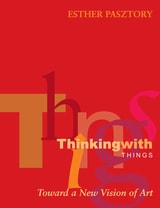
Thinking with Things
Toward a New Vision of ArtBy Esther Pasztory
University of Texas Press, 2005
What is "art"? Why have human societies through all time and around the globe created those objects we call works of art? Is there any way of defining art that can encompass everything from Paleolithic objects to the virtual images created by the latest computer technology? Questions such as these have preoccupied Esther Pasztory since the beginning of her scholarly career. In this authoritative volume, she distills four decades of research and reflection to propose a pathbreaking new way of understanding what art is and why human beings create it that can be applied to all cultures throughout time.
At its heart, Pasztory's thesis is simple and yet profound. She asserts that humans create things (some of which modern Western society chooses to call "art") in order to work out our ideas—that is, we literally think with things. Pasztory draws on examples from many societies to argue that the art-making impulse is primarily cognitive and only secondarily aesthetic. She demonstrates that "art" always reflects the specific social context in which it is created, and that as societies become more complex, their art becomes more rarefied.
Pasztory presents her thesis in a two-part approach. The first section of the book is an original essay entitled "Thinking with Things" that develops Pasztory's unified theory of what art is and why we create it. The second section is a collection of eight previously published essays that explore the art-making process in both Pre-Columbian and Western societies. Pasztory's work combines the insights of art history and anthropology in the light of poststructuralist ideas. Her book will be indispensable reading for everyone who creates or thinks about works of art.
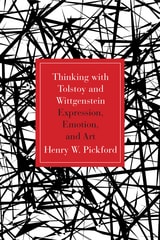
Thinking with Tolstoy and Wittgenstein
Expression, Emotion, and ArtHenry W. Pickford
Northwestern University Press, 2015
In this highly original interdisciplinary study incorporating close readings of literary texts and philosophical argumentation, Henry W. Pickford develops a theory of meaning and expression in art intended to counter the meaning skepticism most commonly associated with the theories of Jacques Derrida.
Pickford arrives at his theory by drawing on the writings of Wittgenstein to develop and modify the insights of Tolstoy’s philosophy of art. Pickford shows how Tolstoy’s encounter with Schopenhauer’s thought on the one hand provided support for his ethical views but on the other hand presented a problem, exemplified in the case of music, for his aesthetic theory, a problem that Tolstoy did not successfully resolve. Wittgenstein’s critical appreciation of Tolstoy’s thinking, however, not only recovers its viability but also constructs a formidable position within contemporary debates concerning theories of emotion, ethics, and aesthetic expression.
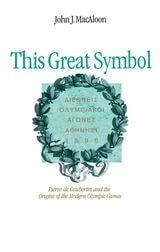
This Great Symbol
Pierre de Coubertin and the Origins of the Modern Olympic GamesJohn J. MacAloon
University of Chicago Press, 1981
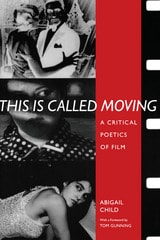
This Is Called Moving
A Critical Poetics of FilmAbigail Child, with a foreword by Tom Gunning
University of Alabama Press, 2005
A pioneering exploration of how poetry and experimental cinema intersect to reconstruct meaning across visual and linguistic forms.
As the writer, director, producer, and cinematographer of almost all her 30 films, videos, and shorts, Abigail Child has been recognized as a major and influential practitioner of experimental cinema since the early 1970s. Hallmarks of her style are the appropriation and reassembly of found footage and fragments from disparate visual sources, ranging from industrial films and documentaries to home movies, vacation photography, and snippets of old B movies.
The resulting collages and montages are cinematic narratives that have been consistently praised for their beauty and sense of wonder and delight in the purely visual. At the same time, Child's films are noted for their incisive political commentary on issues such as gender and sexuality, class, voyeurism, poverty, and the subversive nature of propaganda.
In the essays of This Is Called Moving, Child draws on her long career as a practicing poet as well as a filmmaker to explore how these two language systems inform and cross-fertilize her work. For Child, poetry and film are both potent means of representation, and by examining the parallels between them—words and frames, lines and shots, stanzas and scenes—she discovers how the two art forms re-construct and re-present social meaning, both private and collective.
This New Yet Unapproachable America
Lectures after Emerson after WittgensteinStanley Cavell
University of Chicago Press, 2013
This Strange Idea of the Beautiful
François Jullien
Seagull Books, 2016
An exploration of what it means when we say something is beautiful.
Bringing together ideas of beauty from both Eastern and Western philosophy, François Jullien challenges the assumptions underlying our commonly agreed-upon definition of what is beautiful and offers a new way of beholding art. Jullien argues that the Western concept of beauty was established by Greek philosophy and became consequently embedded within the very structure of European languages. And due to its relationship to language, this concept has determined ways of thinking about beauty that often go unnoticed or unchecked in discussions of Western aesthetics. Moreover, through globalization, Western ideals of beauty have even spread to cultures whose ancient traditions are based upon radically different aesthetic foundations; yet, these cultures have adopted such views without question and without recognizing the cultural assumptions they contain.
Thomas Aquinas
Pasquale Porro
Catholic University of America Press, 2016

Thomas Aquinas Today
Still the Common Doctor?Andrew Hofer
Catholic University of America Press, 2026
Thomas Aquinas and His Legacy
David M. Gallagher
Catholic University of America Press, 2018
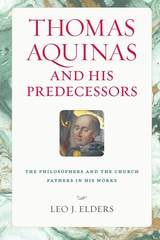
Thomas Aquinas and His Predecessors
The Philosophers and the Church FathersLeo J. Elders
Catholic University of America Press, 2018
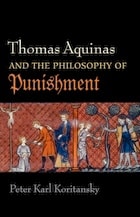
Thomas Aquinas and the Philosophy of Punishment
Peter Karl Koritansky
Catholic University of America Press, 2012
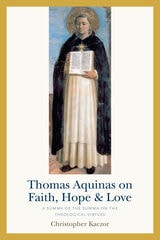
Thomas Aquinas on Faith, Hope, and Love
A Summa of the Summa on the Theological VirtuesChristopher Kaczor
Catholic University of America Press, 2020
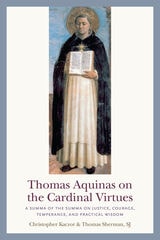
Thomas Aquinas on the Cardinal Virtues
A Summa of the Summa on Prudence, Justice, Temperance, and CourageChristopher Kaczor
Catholic University of America Press, 2020
Thomas Aquinas on the Immateriality of the Human Intellect
Adam Wood
Catholic University of America Press, 2020
Thomas Hobbes and the Natural Law Tradition
Norberto Bobbio
University of Chicago Press, 1993
Tracing Hobbes's work through De Cive and Leviathan, Bobbio identifies the philosopher's relation to the tradition of natural law. That Hobbes must now be understood in both this tradition as well as in the seemingly contradictory positivist tradition becomes clear for the first time in Bobbio's account. Bobbio also demonstrates that Hobbes cannot be easily labelled "liberal" or "totalitarian"; in Bobbio's provocative analysis of Hobbes's justification of the state, Hobbes emerges as a true conservative.
Though his primary concern is to reconstruct the inner logic of Hobbes's thought, Bobbio is also attentive to the philosopher's biography and weaves into his analysis details of Hobbes's life and world—his exile in France, his relation with the Mersenne circle, his disputes with Anglican bishops, and accusations of heresy leveled against him. The result is a revealing, thoroughly new portrait of the first theorist of the modern state.
Thomas Holcroft’s Revolutionary Drama
Reception and AfterlivesAmy Garnai
Bucknell University Press, 2023
Thomas Kuhn
A Philosophical History for Our TimesSteve Fuller
University of Chicago Press, 2000
Steve Fuller argues that Kuhn actually held a profoundly conservative view of science and how one ought to study its history. Early on, Kuhn came under the influence of Harvard President James Bryant Conant (to whom Structure is dedicated), who had developed an educational program intended to help deflect Cold War unease over science's uncertain future by focusing on its illustrious past. Fuller argues that this rhetoric made its way into Structure, which Fuller sees as preserving and reinforcing the old view that science really is just a steady accumulation of truths about the world (once "paradigm shifts" are resolved).
Fuller suggests that Kuhn, deliberately or not, shared the tendency in Western culture to conceal possible negative effects of new knowledge from the general public. Because it insists on a difference between a history of science for scientists and one suited to historians, Fuller charges that Structure created the awkward divide that has led directly to the "Science Wars" and has stifled much innovative research. In conclusion, Fuller offers a way forward that rejects Kuhn's fixation on paradigms in favor of a conception of science as a social movement designed to empower society's traditionally disenfranchised elements.
Certain to be controversial, Thomas Kuhn must be read by anyone who has adopted, challenged, or otherwise engaged with The Structure of Scientific Revolutions.
"Structure will never look quite the same again after Fuller. In that sense, he has achieved one of the main aims of his ambitious and impressively executed project."—Jon Turney, Times Higher Education Supplement
"Philosophies like Kuhn's narrow the possible futures of inquiry by politically methodizing and taming them. More republican philosophies will leave the future open. Mr. Fuller has amply succeeded in his program of distinguishing the one from the other."—William R. Everdell, Washington Times
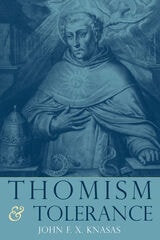
Thomism and Tolerance
John F. X. Knasas
University of Scranton Press, 2010
In this incisive study, John F. X. Knasas grounds the ideal of tolerance in Aquinas’s natural law ethics and connects the virtue of civic tolerance to the concept of being. If God is the source of being, argues Knasas, then we are the articulation of being, and it is in this capacity that we recognize our bond with other people and thus acknowledge our duty to be tolerant of one another. An important contribution to practical metaphysics and the philosophical foundations of political theory, Thomism and Tolerance will appeal to philosophy scholars and students at the undergraduate and graduate level.
Thomistic Considerations
Themes in Aquinas, Aristotle, Augustine, Dante and EliotKevin White
Catholic University of America Press, 2026
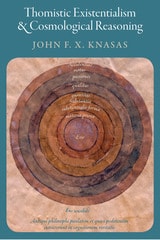
Thomistic Existentialism and Cosmological Reasoning
John F. X. Knasas
Catholic University of America Press, 2019
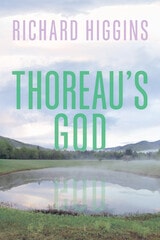
Thoreau's God
Richard Higgins
University of Chicago Press, 2024
Henry David Thoreau’s spiritual life is a riddle. Thoreau’s passionate critique of formal religion is matched only by his rapturous descriptions of encounters with the divine in nature. He fled the church only to pursue a deeper communion with a presence he felt at the heart of the universe. He called this illimitable presence many names, but he often called it God.
In Thoreau’s God, Richard Higgins invites seekers—religious or otherwise—to walk with the great Transcendentalist through a series of meditations on his spiritual life. Thoreau offers us no creed, but his writings encourage reflection on how to live, what to notice, and what to love. Though his quest was deeply personal, Thoreau devoted his life to communicating his experience of an infinite, wild, life-giving God. By recovering this vital thread in Thoreau’s life and work, Thoreau’s God opens the door to a new understanding of an original voice in American religion that speaks to spiritual seekers today.
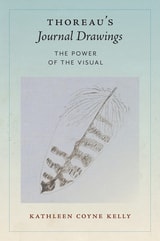
Thoreau's Journal Drawings
The Power of the VisualKathleen Coyne Kelly
University of Massachusetts Press, 2026
Examining journal drawings as an integral—and often delightful—feature of Thoreau’s work
In 1850, Henry David Thoreau began to draw in his Journal—a hedgehog’s quill, a locust’s wing, a goldenrod leaf. The sketches reflect his efforts to train his eye to observe more carefully, to look closely enough that he could see what was in front of him—with intention and attention. As Thoreau worked to combine the vivid language of a writer with the precision of a scientist, his drawings became more vital to the process. For him, writing and drawing were not separate activities; they were part of the same active, hands-on process of learning about the natural world.
Thoreau’s Journal Drawings offers a sustained examination of an understudied aspect of the Journal, emphasizing visual as well as textual analysis. It places Thoreau’s illustrated entries in the broader context of nineteenth-century scientific illustration, nature writing, and visual culture, while also offering close readings of key passages in which text and image work in tandem. The book opens up new possibilities for interpretation—both within the Journal and in the larger project of Thoreau’s thinking.
Ultimately, Thoreau’s illustrated Journal offers a case study in the complexities of representing the natural world through both language and image. His practice raises enduring questions about how we document, interpret, and mediate the more-than-human world across different forms of expression. To read the later volumes of Henry David Thoreau’s Journal without attending to his drawings is to overlook a vital dimension of his practice as both writer and observer.
Thoreau’s Democratic Withdrawal
Alienation, Participation, and ModernityShannon L. Mariotti
University of Wisconsin Press, 2009
Separated by time, space, and context, Thoreau and Adorno share a common belief that critical inquiry is essential to democracy but threatened by modern society. While walking, huckleberrying, and picking wild apples, Thoreau tries to recover the capacities for independent perception and thought that are blunted by “Main Street,” conventional society, and the rapidly industrializing world that surrounded him. Adorno’s thoughts on particularity and the microscopic gaze he employs to work against the alienated experience of modernity help us better understand the value of Thoreau’s excursions into nature. Reading Thoreau with Adorno, we see how periodic withdrawals from public spaces are not necessarily apolitical or apathetic but can revitalize our capacity for the critical thought that truly defines democracy.
In graceful, readable prose, Mariotti reintroduces us to a celebrated American thinker, offers new insights on Adorno, and highlights the striking common ground they share. Their provocative and challenging ideas, she shows, still hold lessons on how we can be responsible citizens in a society that often discourages original, critical analysis of public issues.
Thorstein Veblen and the Enrichment of Evolutionary Naturalism
Rick Tilman
University of Missouri Press, 2007
One of America’s most influential social critics, Thorstein Veblen authored works deeply rooted in evolutionary biology and American philosophical naturalism—both of which help explain his institutional economics and radical sociology. Now, one of today’s preeminent Veblen scholars ranges widely over the man’s writings to show how evolutionary naturalism underlies his social theory and criticism, shapes his satire, and binds his work together.
Rick Tilman’s study focuses on the intersections of social theory and social psychology, political economy and political theory, and modern philosophy and intellectual history in Veblen’s thinking. It links evolutionary naturalism for the first time to Veblen’s aesthetics, secular humanism, sociology of control, sociobiology, and sociology of knowledge, and it makes groundbreaking observations regarding the relationship of Veblen’s own life to his thinking; his place as a cultural lag theorist; and his analysis of sports, gambling, and religion.
Drawing on textual exegesis of Veblen’s work, unpublished correspondence, and selected archives, Tilman argues that only evolutionary naturalism could provide the philosophical foundations of Veblen’s thought. He also emphasizes Veblen’s role in the enhancement and embellishment of the social sciences and cultural studies, as well as his insights into the processes of change in the sociopolitical order.
Veblen’s evolutionary naturalism, with its unflattering evaluation of America’s self-selected special place in the international arena, casts doubt on today’s foreign interventions, and it also provides a much-needed antidote to the resurgence of creationist thought in American culture. Tilman shows that Veblen’s ideas are still valuable to contemporary social scientists—indeed, that his method of analysis and values are sorely needed to help us avoid wasteful consumption, predation, and the persistence of religious superstition. This work offers readers a new appreciation of Veblen and the many issues he addressed, and of Tilman’s own masterful facility in bringing them to light.

Thou Shall Not Die
Gabriel Marcel
St. Augustine's Press, 2009
Thought in the Act
Passages in the Ecology of ExperienceErin Manning
University of Minnesota Press, 2014
“Every practice is a mode of thought, already in the act. To dance: a thinking in movement. To paint: a thinking through color. To perceive in the everyday: a thinking of the world’s varied ways of affording itself.” —from Thought in the Act
Combining philosophy and aesthetics, Thought in the Act is a unique exploration of creative practice as a form of thinking. Challenging the common opposition between the conceptual and the aesthetic, Erin Manning and Brian Massumi “think through” a wide range of creative practices in the process of their making, revealing how thinking and artfulness are intimately, creatively, and inseparably intertwined. They rediscover this intertwining at the heart of everyday perception and investigate its potential for new forms of activism at the crossroads of politics and art.
Emerging from active collaborations, the book analyzes the experiential work of the architects and conceptual artists Arakawa and Gins, the improvisational choreographic techniques of William Forsythe, the recent painting practice of Bracha Ettinger, as well as autistic writers’ self-descriptions of their perceptual world and the experimental event making of the SenseLab collective. Drawing from the idiosyncratic vocabularies of each creative practice, and building on the vocabulary of process philosophy, the book reactivates rather than merely describes the artistic processes it examines. The result is a thinking-with and a writing-in-collaboration-with these processes and a demonstration of how philosophy co-composes with the act in the making. Thought in the Act enacts a collaborative mode of thinking in the act at the intersection of art, philosophy, and politics.
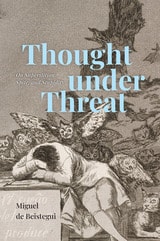
Thought under Threat
On Superstition, Spite, and StupidityMiguel de Beistegui
University of Chicago Press, 2022
Thought under Threat is an attempt to understand the tendencies that threaten thinking from within. These tendencies have always existed. But today they are on the rise and frequently encouraged, even in our democracies. People “disagree” with science and distrust experts. Political leaders appeal to the hearts and guts of “the people,” rather than their critical faculties. Stupidity has become a right, if not a badge of honor; superstition is on the rise; and spite is a major political force. Thinking is considered “elitist.”
To see those obstacles as vices of thought, Miguel de Beistegui argues, we need to understand stupidity not as a lack of intelligence or judgment, but as the tendency to raise false problems and trivial questions. Similarly, we need to see spite not as a moral vice, but as a poison that blurs and distorts our critical faculties. Finally, superstition is best described not as a set of false beliefs, but as a system that neutralizes one’s ability to think for oneself.
For de Beistegui, thinking is intrinsically democratic and a necessary condition for the exercise of freedom. Thought under Threat shows how a training of thought itself can be used to ward off those vices, lead to productive deliberation, and, ultimately, create a thinking community.
Thought, Fact, and Reference
The Origins and Ontology of Logical AtomismHerbert Hochberg
University of Minnesota Press, 1978
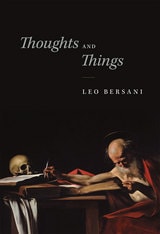
Thoughts and Things
Leo Bersani
University of Chicago Press, 2014
Thoughts and Things posits what would appear to be an irreducible gap between our thoughts (the human subject) and things (the world). Bersani departs from his psychoanalytic convictions to speculate on the oneness of being—of our intrinsic connectedness to the other that is at once external and internal to us. He addresses the problem of formulating ways to consider the undivided mind, drawing on various sources, from Descartes to cosmology, Freud, and Genet and succeeds brilliantly in diagramming new forms as well as radical failures of connectedness. Ambitious, original, and eloquent, Thoughts and Things will be of interest to scholars in philosophy, film, literature, and beyond.
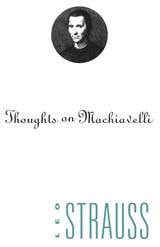
Thoughts on Machiavelli
Leo Strauss
University of Chicago Press, 1958
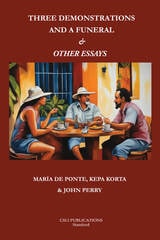
Three Demonstrations and a Funeral and Other Essays
Maria de Ponte, Kepa Korta, and John Perry
CSLI, 2024
The result of the collaboration between three distinguished philosophers, this book comprises the best sample of one of the most original theories in contemporary philosophy of language and communication—Critical Pragmatics. They present the development of the theory from its initial sprout, with “Three Demonstrations and a Funeral” (2006) as its first visible result, to a critical clarification of its tenets in “Critical Pragmatics: Nine Misconceptions” (2023). After Korta and Perry’s Critical Pragmatics (2011), this is the most important book on Critical Pragmatics, as it was conceived, developed and applied by its creators. Having de Ponte, Korta and Perry’s most important papers together on one place will be of great value to both philosophers and linguists.
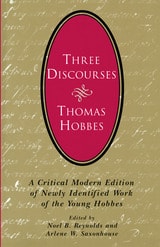
Three Discourses
A Critical Modern Edition of Newly Identified Work of the Young HobbesThomas Hobbes
University of Chicago Press, 1995
Saxonhouse and Reynolds present the complete texts of the discourse with full annotations and modernized spellings. These are followed by a lengthy essay analyzing the pieces' significance for Hobbes's intellectual development and modern political thought more generally. The discourses provide the strongest evidence to date for the profound influences of Bacon and Machiavelli on the young Hobbes, and they add a new dimension to the much-debated impact of the scientific method on his thought. The book also contains both introductory and in-depth explanations of statistical "wordprinting."
Three Economies of Transcendence
Andrea Righi
University of Minnesota Press, 2025
Exploring climate change through the interconnections between sociality, theory of money, and a different concept of time
Three Economies of Transcendence offers a sharp critique of how transcendence underpins the symbolic, economic, and environmental crises of the modern world. Andrea Righi identifies three distinct “economies of transcendence” that sustain neoliberal systems of power. Termed the economy of rank, the economy of infinite valorization, and the phallic economy of time, these economies perpetuate hierarchies, sacrifices, and ecological destruction. Through this framework, Righi not only diagnoses the crisis but also proposes an immanent model of economy that fosters solidarity and is expressly pro-social and ecologically responsible.
This thought-provoking book links climate change to Western cultural and symbolic mechanisms, showing that transformative action must address these deep-seated structures. Righi envisions a future rooted in our shared spatio-temporal existence, challenging the atomizing rivalries and endless growth of neoliberalism.