Results by title
28167 books match the query 'History' and 6372 start with t
The Complexity of Evil
Perpetration and GenocideTimothy Williams
Rutgers University Press, 2021
Download the open access ebook here.
The Composer Embalmed
Relic Culture from Piety to KitschAbigail Fine
University of Chicago Press, 2025
During the nineteenth century, music institutions promoted artworks they deemed timeless and made composers into figureheads of a lasting Western canon. Alongside this institutional face of the canon was a more intimate impulse to preserve, touch, and embrace the residues of the dead. In Germany and Austria between 1870 and 1930, music lovers venerated the bodies, houses, and belongings of composers as relics, shrines, and talismans. In The Composer Embalmed, Abigail Fine documents the vernacular and eccentric ways that composers have been remembered.
Fine navigates a wealth of unknown archival material to recover the stories of devotees: from pilgrims who felt time stop in historic houses to music-loving doctors who made skulls into sacred specimens, dilettantes who displayed Beethoven’s mask as a relic of the “beautiful death,” and interwar critics of those dilettantes who disparaged piety as a false religion, a kitsch replica. In isolation, these practices may look like simple acts of affection. But in the aggregate, Fine asserts, acts of devotion constituted what we might broadly understand as relic culture—a culture that sought to possess the body of the departed genius, and that superimposed habits of anthropological collecting onto artifacts of Austro-German heritage. By excavating objects, ephemera, amateur lyric, visitors’ books, letters, and travelogues, The Composer Embalmed reveals the underbelly of the canon, where guilty pleasures blur the boundary between sanctity and desecration.

The Computer's Voice
From Star Trek to SiriLiz W. Faber
University of Minnesota Press, 2020
A deconstruction of gender through the voices of Siri, HAL 9000, and other computers that talk
Although computer-based personal assistants like Siri are increasingly ubiquitous, few users stop to ask what it means that some assistants are gendered female, others male. Why is Star Trek’s computer coded as female, while HAL 9000 in 2001: A Space Odyssey is heard as male? By examining how gender is built into these devices, author Liz W. Faber explores contentious questions around gender: its fundamental constructedness, the rigidity of the gender binary, and culturally situated attitudes on male and female embodiment.
Faber begins by considering talking spaceships like those in Star Trek, the film Dark Star, and the TV series Quark, revealing the ideologies that underlie space-age progress. She then moves on to an intrepid decade-by-decade investigation of computer voices, tracing the evolution from the masculine voices of the ’70s and ’80s to the feminine ones of the ’90s and ’00s. Faber ends her account in the present, with incisive looks at the film Her and Siri herself.
Going beyond current scholarship on robots and AI to focus on voice-interactive computers, The Computer’s Voice breaks new ground in questions surrounding media, technology, and gender. It makes important contributions to conversations around the gender gap and the increasing acceptance of transgender people.
The Concept of Liberty in the Age of the American Revolution
John Phillip Reid
University of Chicago Press, 1988
As John Philip Reid goes on to make clear, "liberty" did not mean to the eighteenth-century mind what it means today. In the twentieth century, we take for granted certain rights—such as freedom of speech and freedom of the press—with which the state is forbidden to interfere. To the revolutionary generation, liberty was preserved by curbing its excesses. The concept of liberty taught not what the individual was free to do but what the rule of law permitted. Ultimately, liberty was law—the rule of law and the legalism of custom. The British constitution was the charter of liberty because it provided for the rule of law.
Drawing on an impressive command of the original materials, Reid traces the eighteenth-century notion of liberty to its source in the English common law. He goes on to show how previously problematic arguments involving the related concepts of licentiousness, slavery, arbitrary power, and property can also be fit into the common-law tradition. Throughout, he focuses on what liberty meant to the people who commented on and attempted to influence public affairs on both sides of the Atlantic. He shows the depth of pride in liberty—English liberty—that pervaded the age, and he also shows the extent—unmatched in any other era or among any other people—to which liberty both guided and motivated political and constitutional action.

The Concept of Representation in the Age of the American Revolution
John Phillip Reid
University of Chicago Press, 1989
John Phillip Reid goes on to argue that it was generally the application, not the definition, of these rights that was disputed. The sole—and critical—exception concerned the right of representation. American perceptions of the responsibility of representatives to their constituents, the necessity of equal representation, and the constitutional function of consent had diverged gradually, but significantly, from British tradition. Drawing on his mastery of eighteenth-century legal thought, Reid explores the origins and shifting meanings of representation, consent, arbitrary rule, and constitution. He demonstrates that the controversy which led to the American Revolution had more to do with jurisprudential and constitutional principles than with democracy and equality. This book will interest legal historians, Constitutional scholars, and political theorists.
The Concise History of Woman Suffrage
Selections from History of Woman Suffrage, by Elizabeth Cady Stanton, Susan B. Anthony, Matilda Joslyn Gage, and the National American Woman Suffrage AssociationEdited and with an Introduction by Mari Jo Buhle and Paul Buhle
University of Illinois Press, 2005
In their Concise History of Woman Suffrage, Mari Jo Buhle and Paul Buhle have revitalized this classic text by carefully selecting from among its best material. The eighty-two chosen documents, now including interpretative introductory material by the editors, give researchers easy access to material that the original work's arrangement often caused readers to ignore or to overlook.
The volume contains the work of many reform agitators, among them Angelina Grimké, Lucy Stone, Carrie Chapman Catt, Charlotte Perkins Gilman, Anna Howard Shaw, Jane Addams, Sojourner Truth, and Victoria Woodhull, as well as Elizabeth Cady Stanton, Susan B. Anthony, Matilda Joslyn Gage, and Ida Husted Harper.
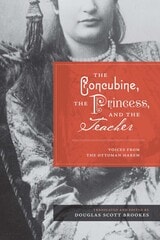
The Concubine, the Princess, and the Teacher
Voices from the Ottoman HaremTranslated and edited by Douglas Scott Brookes
University of Texas Press, 2008
In the Western imagination, the Middle Eastern harem was a place of sex, debauchery, slavery, miscegenation, power, riches, and sheer abandon. But for the women and children who actually inhabited this realm of the imperial palace, the reality was vastly different. In this collection of translated memoirs, three women who lived in the Ottoman imperial harem in Istanbul between 1876 and 1924 offer a fascinating glimpse "behind the veil" into the lives of Muslim palace women of the late nineteenth and early twentieth centuries.
The memoirists are Filizten, concubine to Sultan Murad V; Princess Ayse, daughter of Sultan Abdulhamid II; and Safiye, a schoolteacher who instructed the grandchildren and harem ladies of Sultan Mehmed V. Their recollections of the Ottoman harem reveal the rigid protocol and hierarchy that governed the lives of the imperial family and concubines, as well as the hundreds of slave women and black eunuchs in service to them. The memoirists show that, far from being a place of debauchery, the harem was a family home in which polite and refined behavior prevailed. Douglas Brookes explains the social structure of the nineteenth-century Ottoman palace harem in his introduction.
These three memoirs, written across a half century and by women of differing social classes, offer a fuller and richer portrait of the Ottoman imperial harem than has ever before been available in English.
The Confederacy
Charles P. Roland
University of Chicago Press, 1962
In The Confederacy Charles P. Roland is faithful to both the larger career and the internal complexity. Paying careful attention to President Davis' struggle against dividing forces within, the author skillfully narrates the attempt of the Confederacy to wage total war against superior forces. All the poignant events and conditions are here: the formation of the government, the upper South's final commitment to the cause, the doomed attempts to combat the Northern blockade at home and Northern diplomacy overseas, an agrarian economy's heroic defiance of an industrial enemy, the desperate measures by which the Davis government tried to sustain the Confederacy, and, at last, the dissolution and flight of the administration in 1865.
With accuracy, sensitivity, and balance, Mr. Roland develops the epic themes of his story against a background of vivid historical detail and re-creates the Confederacy with a tragic splendor—the prime quality of its surviving image among Southerners.
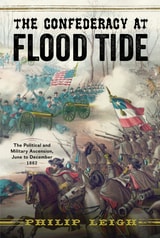
The Confederacy at Flood Tide
The Political and Military Ascension, June to December 1862Philip Leigh
Westholme Publishing, 2016
The first six months of 1862 provided a string of Federal victories in the West at Mill Springs, Fort Donelson, Pea Ridge, Island Number 10, and Shiloh. In May, New Orleans fell, and Union General George McClellan’s army was so close to the Confederate capital of Richmond, Virginia, that the troops could set their watches by the city’s church bells. But then the unexpected happened. In June, Robert E. Lee’s Army of Northern Virginia pushed McClellan’s much larger army back to the James River. In Europe, Confederate diplomats sought international recognition for the Confederate States of America, which was made even more attractive now that a shortage of cotton made the powerful textile interests anxious to end the war. Further tipping the balance, in July, the Confederacy secretly ordered two of the latest ironclad ships from England’s famous Laird Shipyard—the same yard that built the commerce raider Alabama. These steam-powered ironclads would be far superior to anything in the Federal navy.
While the “high tide” of the Confederacy is often identifed as Pickett’s Charge during the Battle of Gettysburg in July 1863, the most opportune time for the Confederacy vanished seven months earlier, coinciding with President Abraham Lincoln’s Emancipation Proclamation on January 1, 1863 and the failure of the secessionist states to be recognized as a sovereign nation. As Philip Leigh explains in his engrossing new book, The Confederacy at Flood Tide: The Political and Military Ascension, June to December 1862, on every battlefront and in the governmental halls of Europe, the Confederate effort reached its furthest extent during the second half of 1862. But with the president’s proclamation, battlefield reverses, Europe's decision to reject Confederate diplomatic overtures, and Britian's decision to halt the sale of the ironclads, the opportunity for Confederate success ended. The Confederacy would recede, and the great battles of 1863 and 1864 only marked the Southerners’ tenacity and stubborn belief in a lost cause.
The Confederacy's Fighting Chaplain
Father John B. BannonPhillip Thomas Tucker
University of Alabama Press, 1992
The Confederacy’s Fighting Chaplain is the remarkable story of the Irishman who brought the Bible and his own resourcefulness and daring to both the battlefield and the diplomatic field—a story that has been largely ignored for more than 130 years. The biography of John B. Bannon also chronicles the forgotten Southerners—the Irish immigrants of the Confederacy—whose colorful and crucial role in the Civil War has been seriously neglected.

The Confederados
Old South Immigrants in BrazilCyrus B. Dawsey
University of Alabama Press, 1998
The story of exiles from the Confederate South who fled to Brazil after the US Civil War. The collection includes a previously unpublished narrative by an original settler
In the wake of the American Civil War, thousands of disillusioned Southerners sought refuge far from Reconstruction’s reach—many found it in Brazil. The Confederados is a compelling exploration of this little-known migration, tracing the journey of Confederate exiles who forged new lives in the sugarcane fields of São Paulo. Through vivid personal narratives, scholarly essays, and rare archival insights, this volume uncovers the cultural, agricultural, and religious legacy these settlers left behind.
From the harrowing voyage of Sarah Bellona Smith Ferguson to the enduring traditions of the Campo chapel, the book reveals how these Americans shaped—and were shaped by—their Brazilian surroundings. It examines their impact on education, Protestantism, and farming, and how their descendants maintain a distinct identity more than a century later.
Richly illustrated and deeply researched, The Confederados is essential reading for anyone interested in Southern history, diaspora studies, or the global echoes of the Civil War. This is not just a story of exile—it’s a testament to resilience, adaptation, and the enduring ties between two nations.
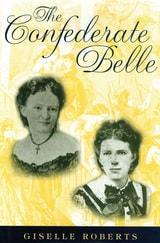
The Confederate Belle
Giselle Roberts
University of Missouri Press, 2003

The Confederate Navy in Europe
Warren F. Spencer
University of Alabama Press, 1983
“A major contribution to Civil War and naval history.” —Journal of Southern History
The Civil War was fought not only on American battlefields but also in the shipyards, diplomatic salons, and ports of Europe. In this sweeping history of the Confederate navy’s operations overseas, Warren Spencer traces the South’s ambitious efforts to build, equip, and deploy a naval force across the Atlantic. Drawing on extensive archival research in the United States, Great Britain, and France, the book reveals how Confederate agents, diplomats, and naval officers pursued international support while attempting to challenge Union power on the seas.
More than a military narrative, this study offers a richly detailed examination of the intersection of naval warfare, diplomacy, and international politics. The author synthesizes scattered research and original documentary evidence to provide a comprehensive account of Confederate naval activity in Europe, illuminating the roles of shipbuilders, foreign governments, intelligence networks, and naval leaders. By engaging both published sources and archival records, the book presents fresh interpretations of controversial episodes and demonstrates how events far from American shores shaped the course of the Civil War.
This volume will appeal to readers of Civil War history, naval history, diplomatic history, and international relations. Scholars, students, and history enthusiasts alike will appreciate its careful research, engaging narrative, and global perspective on a conflict too often viewed solely through a domestic lens. Anyone interested in the maritime dimensions of the Civil War or the Confederacy’s quest for recognition abroad will find this book both enlightening and compelling.
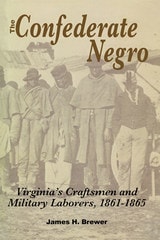
The Confederate Negro
Virginia's Craftsmen and Military Laborers, 1861-1865James H. Brewer
University of Alabama Press, 2007
A superb work in the social history of American industry
A Gettysburg College "Top 200 Civil War Books" selection
Mayflower Award Winner for 1970

The Confessions of Señora Francesca Navarro and Other Stories
Natalie L. M. Petesch
Ohio University Press, 2005
“Memory, of course, is sometimes like a bucking horse, sometimes a runaway one, and one must control the reins until finally it stops, snorting with exhausted relief,” writes Natalie L. M. Petesch in her haunting new collection, The Confessions of Señora Francesca Navarro and Other Stories.
Petesch immerses readers in the lives of people caught up in the 1936–39 Spanish Civil War, which left more than five hundred thousand dead. She captures the hand-to-mouth existence on the streets of Madrid of two war orphans; an old soldier’s memories of a fallen militiawoman; the dilemma of Franco’s laundress as she seeks to duplicate a stolen religious icon she finds in his home; and a man’s struggle to find his bride among thousands of Republican refugees waiting for ships to evacuate them before Franco’s Fascists arrive to kill them.
In the title novella, an elderly woman describes to her granddaughter how the families of Franco’s officers fighting against Republican militiamen endured hunger, filth, and danger in an underground fortress. Petesch conveys the humiliating details of war through the sensibility of a cultured woman who recalls only too vividly latrines made of laundry tubs, the smell of unwashed humans, and the stench of death.
Brilliant in its imaginative power and heartbreaking in its access to the bottomless well of human tears, The Confessions of Señora Francesca Navarro and Other Stories is the work of a mature artist able to convey a particular world so vividly that we know these people as our own.
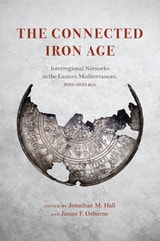
The Connected Iron Age
Interregional Networks in the Eastern Mediterranean, 900-600 BCEEdited by Jonathan M. Hall and James F. Osborne
University of Chicago Press, 2022
The early first millennium BCE marks one of the most culturally diverse periods in the history of the eastern Mediterranean. Surveying the region from Greece to Iraq, one finds a host of cultures and political formations, all distinct, yet all visibly connected in meaningful ways. These include the early polities of Geometric period Greece, the Phrygian kingdom of central Anatolia, the Syro-Anatolian city-states, the seafaring Phoenicians and the biblical Israelites of the southern Levant, Egypt’s Twenty-first through Twenty-fifth Dynasties, the Urartian kingdom of the eastern Anatolian highlands, and the expansionary Neo-Assyrian Empire of northern Mesopotamia. This volume adopts an interdisciplinary approach to understanding the social and political significance of how interregional networks operated within and between Mediterranean cultures during that era.
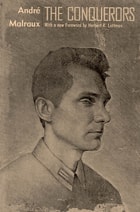
The Conquerors
André Malraux
University of Chicago Press, 1991
In a new Foreword, Herbert R. Lottman discusses the political background of the book, and the extent to which Malraux invented the history he wrote about.
"[The Conquerors] is a valuable introduction to Malraux himself, who would, like his fictional counterpart, become an analgam of talents as novelist, essayist, Leftist and Gaullist, Resistance hero and art critic. He was among the most 'universal' of French men of letters."—Choice
"The novel can be enjoyed as a remarkable work of modernism. With images derived from the silent cinema and prose from the telegraph, it moves at a tremendous pace. Canton all comes to violent life, seen as though from a speeding car."—Kirkus
"No other writer of the 20th century had the same capacity to translate his personal adventure into a meeting with history and a dialogue of civilization."—Carlos Fuentes, New York Times Book Review

The Conquest of Cool
Business Culture, Counterculture, and the Rise of Hip ConsumerismThomas Frank
University of Chicago Press, 1997
"[Thomas Frank is] perhaps the most provocative young cultural critic of the moment."—Gerald Marzorati, New York Times Book Review
"An indispensable survival guide for any modern consumer."—Publishers Weekly, starred review
"Frank makes an ironclad case not only that the advertising industry cunningly turned the countercultural rhetoric of revolution into a rallying cry to buy more stuff, but that the process itself actually predated any actual counterculture to exploit."—Geoff Pevere, Toronto Globe and Mail
"The Conquest of Cool helps us understand why, throughout the last third of the twentieth century, Americans have increasingly confused gentility with conformity, irony with protest, and an extended middle finger with a populist manifesto. . . . His voice is an exciting addition to the soporific public discourse of the late twentieth century."—T. J. Jackson Lears, In These Times
"An invaluable argument for anyone who has ever scoffed at hand-me-down counterculture from the '60s. A spirited and exhaustive analysis of the era's advertising."—Brad Wieners, Wired Magazine
"Tom Frank is . . . not only old-fashioned, he's anti-fashion, with a place in his heart for that ultimate social faux pas, leftist politics."—Roger Trilling, Details
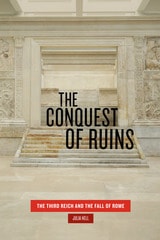
The Conquest of Ruins
The Third Reich and the Fall of RomeJulia Hell
University of Chicago Press, 2019
Hell examines centuries of European empire-building—from Charles V in the sixteenth century and Napoleon’s campaigns of the late seventeenth and early eighteenth centuries to the atrocities of Mussolini and the Third Reich in the 1930s and ’40s—and sees a similar fascination with recreating the Roman past in the contemporary image. In every case—particularly that of the Nazi regime—the ruins of Rome seem to represent a mystery to be solved: how could an empire so powerful be brought so low? Hell argues that this fascination with the ruins of greatness expresses a need on the part of would-be conquerors to find something to ward off a similar demise for their particular empire.
The Conquest of The Illinois
George Rogers Clark. Foreword by Rand Burnette
Southern Illinois University Press, 2001
Written only a decade after George Rogers Clark’s conquest of Illinois, this firsthand account shows the region as it existed in the 1770s, explains how British occupation affected Kentucky settlers, and exhibits Clark’s enormous diplomatic skills in convincing the French settlers and Indians along the rivers of Illinois that they were better off under the jurisdiction of the Americans rather than the British. In his new foreword to this book, Rand Burnette refers to Clark as a psychologist and an expert in human relations.
Believing the British responsible for Indian raids on the people of Kentucky, Clark determined to capture that area, which was claimed by his home state of Virginia. “His plan, which he presented to Governor Patrick Henry,” Burnette notes, “was to take possession of the Illinois country by defeating the British at Kaskaskia, win the support of the French in that area, and thus control both the Mississippi and the Ohio Rivers. The British support of the Indians, who raided the Kentucky settlements from the Illinois country, would be at an end.”
Clark’s stirring narrative—written between 1789 and 1791 and covering 1773–1779—chronicles the events in the Old Northwest in the second half of the eighteenth century. Life on the frontier was dangerous and uncertain at this time. As Clark points out and Milo Milton Quaife underlines in his footnotes, death came to many at the hands of Indians or in military battles and skirmishes.
First published in 1920 and long out of print, the Quaife edition of Clark’s The Conquest of The Illinois reprinted here is for the modern reader superior to the original. First, Quaife provided an index. Equally important for modern readers, he standardized Clark’s spelling. (Clark had little formal education, and his spelling was even more eccentric than that found in a typical eighteenth-century account.) Finally, Quaife’s footnotes often include biographical sketches of the people in the book.
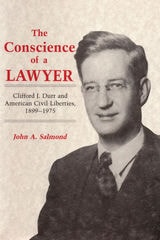
The Conscience of a Lawyer
Clifford J. Durr and American Civil Liberties, 1899–1975John A. Salmond
University of Alabama Press, 1990
A powerful portrait of principle and protest in the life of a Southern lawyer who stood for civil liberties.
Clifford Judkins Durr was an Alabama lawyer who played an important role in defending activists and other accused of disloyalty during the New Deal and McCarthy eras. His uncompromising commitment to civil liberties and civic decency caused him to often take unpopular positions.
In 1933, Durr moved to Washington to work as a lawyer for the Reconstruction Finance Corporation, a creation of Roosevelt’s new Democratic administration, becoming a dedicated New Dealer in the process. He was then appointed by President Franklin D. Roosevelt to the Federal Communications Commission (FCC), a politically sensitive position as FDR sought to counter the increasing power and concentration of broadcasters, many of whom were opponents of the New Deal. Durr resigned from the FCC in 1948 and after brief employment with the National Farmers Union in Colorado, the Durrs eventually returned to Montgomery, Alabama in the hope of returning to a more prosperous, less controversial life.
Durr continued to practice in Montgomery as counsel for black citizens whose rights had been violated and ultimately, in December, 1955, when police arrested Rosa Parks for refusing to give her bus seat to a white man he stepped in and lent his extensive legal prowess to her case and the continuing quest for civil rights. Closing his firm in 1964 Durr began to lecture in the United States and abroad. He died at his grandfather's farm in 1975.
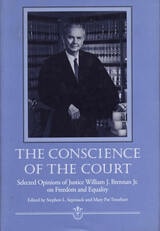
The Conscience of the Court
Selected Opinions of Justice William J. Brennan Jr. on Freedom and EqualityEdited by Stephen L. Sepinuck and Mary Pat Treuthart
Southern Illinois University Press, 1999
The Conscience of the Court celebrates the work of Justice William J. Brennan Jr., who served on the United States Supreme Court for thirty-four years (1956–1990).
Stephen L. Sepinuck and Mary Pat Treuthart introduce and present selected judicial opinions written by Justice Brennan on issues involving personal freedom, civil liberties, and equality. Brennan is ranked by many as the best writer ever to have served on the Supreme Court, and his written opinions depict real people, often in desperate, emotional situations. Remarkable for their clarity of analysis, for their eloquence, and for their forcefulness and persuasiveness, his opinions demonstrate that judicial thought need not be a proprietary enclave of lawyers or the intellectual elite.
The extended excerpts selected by Sepinuck and Treuthart highlight Brennan's approach to judicial decision making. Concerned always with how each decision would actually affect people's lives, Brennan possessed a rare quality of empathy. In Brennan, the editors note, "people and groups who lacked influence in society—Communists and flag burners, children and foreigners, criminal defendants and racial minorities"—found a champion they could count on "to listen to their causes and judge them unmoved by the passions of the politically powerful."
In their introduction to each opinion, the editors provide background facts, discuss how the excerpted opinion transformed the law or otherwise fit into the realm of constitutional jurisprudence, and delve into Justice Brennan's judicial philosophy, his method of constitutional interpretation, and the language he used.
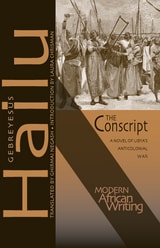
The Conscript
A Novel of Libya’s Anticolonial WarGebreyesus Hailu
Ohio University Press, 2013
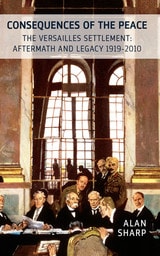
The Consequences of the Peace
The Versailles Settlement: Aftermath and Legacy 1919-2015Alan Sharp
Haus Publishing, 2015
This revised and updated edition of The Consequences of the Peace sets the ramifications of the Paris Peace treaties—for good or ill—within a long-term context. Alan Sharp presents new materials in order to argue that the responsibility for Europe’s continuing interwar instability cannot be wholly attributed to the peacemakers of 1919–23. Marking the centenary of World War I and the approaching centenary of the Peace Conference itself, this book is a clear and concise guide to the global legacy of the Versailles Settlement.

The Conservative Frontier
Texas and the Origins of the New RightJeff Roche
University of Texas Press, 2025
2026 Al Lowman Memorial Prize, Texas State Historical Association (TSHA)
2026 Bonney MacDonald Outstanding Book Award Winner, Center for the Study of the American West at West Texas A&M University (CSAW)
How West Texas business and culture molded the rise of conservatism in the United States.
Much of what we understand as modern American political conservatism was born in West Texas, where today it predominates. How did the people of such a vast region—larger than New England and encompassing big cities like Lubbock and Amarillo, as well as tiny towns from Anson to Dalhart—develop such a uniform political culture? And why and how did it go national?
Jeff Roche finds answers in the history of what he calls cowboy conservatism. Political power players matter in this story, but so do football coaches, newspaper editors, and a breakfast cereal tycoon who founded a capitalist utopia. The Conservative Frontier follows these and other figures as they promoted an ideology grounded in the entrepreneurial and proto-libertarian attitudes of nineteenth-century Texas ranchers, including a fierce devotion to both individualism and small-town notions of community responsibility. This political sensibility was in turn popularized by its association with the mythology and iconography of the cowboy as imagined in twentieth-century mass media. By the 1970s and the rise of Ronald Reagan, Roche shows, it was clear that the cowboy conservatism of West Texas had set the stage for the emergence of the New Right—the more professionalized and tech-savvy operation that dominated national conservative politics for the next quarter century.
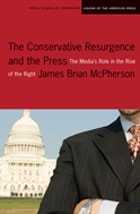
The Conservative Resurgence and the Press
The Media's Role in the Rise of the RightJames Brian McPherson
Northwestern University Press, 2008
Consumers of American media find themselves in a news world that has shifted toward more conservative reporting. This book takes a measured, historical view of the shift, addressing factors that include the greater skill with which conservatives have used the media, the media’s gradual trend toward conservatism, the role of religion, and the effects of media conglomeration. The book makes the case that the media have managed to not only enable today’s conservative resurgence but also ignore, largely, the consequences of that change for the American people.

The Conspiracy Against Hitler in the Twilight War
Harold C. Deutsch
University of Minnesota Press, 1968
The Conspiracy Against Hitler in the Twilight War was first published in 1968. Minnesota Archive Editions uses digital technology to make long-unavailable books once again accessible, and are published unaltered from the original University of Minnesota Press editions.
This is the first detailed account in English of the German anti-Nazi plot of September 1939 - May 1940, a conspiracy which involved the services of Pope Pius XII as in intermediary. Much new information is presented, and the book puts the whole story of the German resistance movement in a clearer light than has been possible before.
Much of the account is based on the testimony of over fifty witnesses whom Professor Deutsch interviewed or interrogated, comprising virtually all the participants or observers who survived the period. He also had access to previously unavailable French and Belgian documents as well as to diaries and other private material.
As the author explains, there were four major rounds of opposition to the Hitler regime, the conspiracy described in this volume being the second. IN many ways it was the round in which circumstances were the most favorable for success. High military quarters were the most fully committed, it was the only plan in which a foreign power at odds with Germany (britain) took a supporting position, and it was the only instance in which a notable outside figure, Pius XII, made his good offices available as an intermediary.
The role of the Pope in this conspiracy has been known in a general way since 1946, but Professor Deutsch's investigation is the first intensive study were at the core of the affair, Josef Muller, the Opposition agent who dealt with the Pope and who later became the Bavarian Minister o Justice, and Rev. Robert Leiber, S.F., the Pope's confidential aide.
In his conclusion Professor Deutsch points out that the story of this conspiracy clearly testifies to the moral nature of the German resistance movement. The author writes: "No term recurred more often in these months to define the conflict with the Third Reich then 'the decent Germany.'"

The Conspiracy Trial of the Chicago Seven
John Schultz
University of Chicago Press, 2009
In 1969, the Chicago Seven were charged with intent to "incite, organize, promote, and encourage" antiwar riots during the chaotic 1968 Democratic National Convention in Chicago. The defendants included major figures of the antiwar and racial justice movements: Abbie Hoffman and Jerry Rubin, the madcap founders of the Yippies; Tom Hayden and Rennie Davis, founders of Students for a Democratic Society and longtime antiwar organizers; David Dellinger, a pacifist and chair of the National Mobilization Committee to End the War in Vietnam; and Bobby Seale, co-founder of the Black Panther Party, who would be bound and gagged in the courtroom before his case was severed from the rest.
The Conspiracy Trial of the Chicago Seven is an electrifying account of the months-long trial that commanded the attention of a divided nation. John Schultz, on assignment for The Evergreen Review, witnessed the whole trial of the Chicago Seven, from the jury selection to the aftermath of the verdict. In his vivid account, Schultz exposes the raw emotions, surreal testimony, and judicial prejudice that came to define one of the most significant legal events in American history.
In October 2020, Aaron Sorkin's film, The Trial of the Chicago Seven, will bring this iconic trial to the screen.
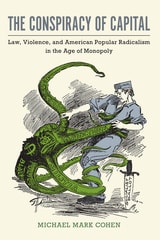
The Conspiracy of Capital
Law, Violence, and American Popular Radicalism in the Age of MonopolyMichael Mark Cohen
University of Massachusetts Press, 2019
In this detailed cultural history, Michael Mark Cohen argues that a legal, ideological, and representational politics of conspiracy contributed to the formation of a genuinely revolutionary mass culture in the United States, starting with the 1886 Haymarket bombing. Drawing on a wealth of primary sources, The Conspiracy of Capital offers a new history of American radicalism and the alliance between the modern business corporation and national security state through a comprehensive reassessment of the role of conspiracy laws and conspiracy theories in American social movements.
The Constitution Besieged
The Rise & Demise of Lochner Era Police Powers JurisprudenceHoward Gillman
Duke University Press, 1993
The Constitution in Congress
Democrats and Whigs, 1829-1861David P. Currie
University of Chicago Press, 2005
Like its predecessors, The Constitution in Congress: Democrats and Whigs will be an invaluable reference for legal scholars and constitutional historians alike.
The Constitution in Congress
Descent into the Maelstrom, 1829-1861David P. Currie
University of Chicago Press, 2005
This acclaimed series serves as a biography of the U.S. Constitution, offering an indispensable survey of the congressional history behind its development. In a rare examination of the role that both the legislative and executive branches have played in the development of constitutional interpretation, The Constitution in Congress shows how the actions and proceedings of these branches reveal perhaps even more about constitutional disputes than Supreme Court decisions of the time.
The centerpiece for the fourth volume in this series is the great debate over slavery and how this divisive issue led the country into the maelstrom of the Civil War. From the Jacksonian revolution of 1829 to the secession of Southern states from the Union, legal scholar David P. Currie provides an unrivaled analysis of the significant constitutional events—the Wilmot Proviso, the Compromise of 1850, the Kansas-Nebraska Act, the Lincoln-Douglas Debates, and "Bleeding Kansas"—that led up to the war. Exploring how slavery was addressed in presidential speeches and debated in Congress, Currie shows how the Southern Democrats dangerously diminished federal authority and expanded states' rights, threatening the nation's very survival.
Like its predecessors, this fourth volume of The Constitution in Congress will be an invaluable reference for legal scholars and constitutional historians alike.
The Constitution in Congress
The Federalist Period, 1789-1801David P. Currie
University of Chicago Press, 1997
"A joy to read."—Appellate Practive Journal and Update
"[A] patient and exemplary analysis of the work of the first six Congresses."—Geoffrey Marshall, Times Literary Supplement
The Constitution in Congress
The Jeffersonians, 1801-1829David P. Currie
University of Chicago Press, 2001
legislative and executive action in the United States, legal scholars
have traditionally looked only to the courts for guidance in
interpreting the Constitution. This, the second book in David P.
Currie's multivolume series, looks to the legislative and executive
branches for insights into the development of constitutional
interpretation.
Currie examines the period of Republican hegemony from the
inauguration of Thomas Jefferson in 1801 to the election of Andrew
Jackson in 1829. During this time of great leadership and
controversy, many benchmark issues—the abolition of the new Circuit
Courts, the Louisiana Purchase, the Burr conspiracy, the War of 1812,
the Monroe Doctrine, and the Missouri Compromise, among others—were
debated and decided almost exclusively in the legislative and
executive arenas. With its uniquely legal perspective and
comprehensive coverage, The Constitution in Congress
illustrates how the executive and legislative branches matched the
Supreme Court in putting flesh and blood onto the skeleton of the
Constitution.
The Constitution in the Supreme Court
The First Hundred Years, 1789-1888David P. Currie
University of Chicago Press, 1985
"A thorough, systematic, and careful assessment. . . . As a reference work for constitutional teachers, it is a gold mine."—Charles A. Lofgren, Constitutional Commentary
The Constitution of Liberty
F. A. Hayek
University of Chicago Press, 1978
"A reflective, often biting, commentary on the nature of our society and its dominant thought by one who is passionately opposed to the coercion of human beings by the arbitrary will of others, who puts liberty above welfare and is sanguine that greater welfare will thereby ensue."—Sidney Hook, New York Times Book Review
In this classic work Hayek restates the ideals of freedom that he believes have guided, and must continue to guide, the growth of Western civilization. Hayek's book, first published in 1960, urges us to clarify our beliefs in today's struggle of political ideologies.
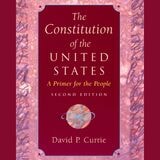
The Constitution of the United States
A Primer for the PeopleDavid P. Currie
University of Chicago Press, 2000
A masterly introduction to the United States Constitution, this slim book leads the reader through a concise overview of the document's individual articles and amendments. With clear and accessible language, Currie then examines each of the three branches of the federal government and explains the relation between the federal and state governments. He analyzes those constitutional provisions that are designed to protect citizens from governmental interference, such as the due process and equal protection clauses and the confusing first amendment provisions respecting the separation of church and state, and includes discussions of judicial review and freedom of speech and of the press.
A sympathetic yet critical guide, Currie's book enables students and laypersons to understand one of the cornerstones of the Western political tradition. The second edition, along with an updated chronology and bibliography, incorporates the Supreme Court decisions over the past decade that have affected constitutional interpretation.
The Constitution of the United States
A Primer for the PeopleDavid P. Currie
University of Chicago Press, 2000
A masterly introduction to the United States Constitution, this slim book leads the reader through a concise overview of the document's individual articles and amendments. With clear and accessible language, Currie then examines each of the three branches of the federal government and explains the relation between the federal and state governments. He analyzes those constitutional provisions that are designed to protect citizens from governmental interference, such as the due process and equal protection clauses and the confusing first amendment provisions respecting the separation of church and state, and includes discussions of judicial review and freedom of speech and of the press.
A sympathetic yet critical guide, Currie's book enables students and laypersons to understand one of the cornerstones of the Western political tradition. The second edition, along with an updated chronology and bibliography, incorporates the Supreme Court decisions over the past decade that have affected constitutional interpretation.
"Superb . . . highly recommended for those seeking a reliable, understandable, and useful introduction to our constitution."—Appellate Practice Journal and Update

The Constitution, the Law, and Freedom of Expression
1787-1987James Brewer Stewart
Southern Illinois University Press, 1987
In recognition of the bicentennial of the Constitution of the United States, former chief justice Warren E. Burger, Justice Antonin Scalia, ACLU president Norman Dorsen, and others delivered papers at the first annual DeWitt Wallace Conference on the Liberal Arts, held at Macalester College, St. Paul.
Joining some of the best legal minds in America were novelist John Edgar Wideman, chemist Harry B. Gray, historian Mary Beth Norton, and psychiatrist and social psychologist Robert Jay Lifton.
Opening the conference and this book, former chief Justice Burger emphasizes the daring of those who drafted the Constitution. Justice Scalia, noting the great reduction in curbs to freedom of expression since World War I, points out that the proliferation of freedom has forced courts to distinguish between types of expression.
Although the views expressed in these essays differ widely, opinion concerning the major issue falls into two definite camps: Burger, Scalia, and Dorsen contend that freedom of expression depends on the legal structure for survival; Wideman, Gray, Lifton, and Norton maintain that social forces determine freedom of expression.
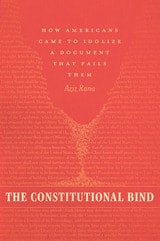
The Constitutional Bind
How Americans Came to Idolize a Document That Fails ThemAziz Rana
University of Chicago Press, 2024
An eye-opening account of how Americans came to revere the Constitution and what this reverence has meant domestically and around the world.
Some Americans today worry that the Federal Constitution is ill-equipped to respond to mounting democratic threats and may even exacerbate the worst features of American politics. Yet for as long as anyone can remember, the Constitution has occupied a quasi-mythical status in American political culture, which ties ideals of liberty and equality to assumptions about the inherent goodness of the text’s design. The Constitutional Bind explores how a flawed document came to be so glorified and how this has impacted American life.
In a pathbreaking retelling of the American experience, Aziz Rana shows that today’s reverential constitutional culture is a distinctively twentieth-century phenomenon. Rana connects this widespread idolization to another relatively recent development: the rise of US global dominance. Ultimately, such veneration has had far-reaching consequences: despite offering a unifying language of reform, it has also unleashed an interventionist national security state abroad while undermining the possibility of deeper change at home.
Revealing how the current constitutional order was forged over the twentieth century, The Constitutional Bind also sheds light on an array of movement activists—in Black, Indigenous, feminist, labor, and immigrant politics—who struggled to imagine different constitutional horizons. As time passed, these voices of opposition were excised from memory. Today, they offer essential insights.

The Constitutional Convention and Formation of Union
Edited by Winton U. Solberg
University of Illinois Press, 1990
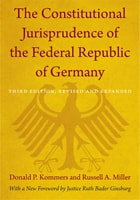
The Constitutional Jurisprudence of the Federal Republic of Germany
Third edition, Revised and ExpandedDonald P. Kommers and Russell A. Miller
Duke University Press, 2012
Compared to previous editions of The Constitutional Jurisprudence of the Federal Republic of Germany, this third edition more closely tracks Germany's Basic Law and, therefore, the systematic approach reflected in the most-respected German constitutional law commentaries. Entirely new chapters address the relationship between German law and European and international law; social and economic rights, including the property and occupational rights cases that have emerged from Reunification; jurisprudence related to issues of equality, particularly gender equality; and the tension between Germany's counterterrorism efforts and its constitutional guarantees of liberty. Kommers and Miller have also updated existing chapters to address recent decisions involving human rights, federalism, European integration, and religious liberty.
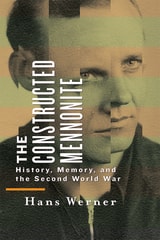
The Constructed Mennonite
History, Memory, and the Second World WarHans Werner
University of Manitoba Press, 2013

The Construction of Gothic Cathedrals
A Study of Medieval Vault ErectionJohn Fitchen
University of Chicago Press, 1981
In The Construction of Gothic Cathedrals, John Fitchen systematically walks readers through the process of erecting the great edifices of the Gothic era. He explains the building equipment and falsework needed, the actual operations undertaken, and the sequence of these operations as specifically as they can be deduced today. In the absence of contemporary accounts of the techniques used by medieval builders, Fitchen's study brilliantly pieces together clues from manuscript illuminations, pictorial representations, and the fabrics of the building themselves. The result is the clearest picture available of the innovations and techniques that enabled these buildings, which still generate awe today, to rise majestically above the low buildings of their surrounding towns. It's a book that will enthrall readers of history, and one that, as Progressive Architecture noted, "no student of architecture should miss."
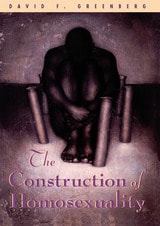
The Construction of Homosexuality
David F. Greenberg
University of Chicago Press, 1990

The Construction of Memory in Interwar France
Daniel J. Sherman
University of Chicago Press, 2000
Sherman shows how a wartime visual culture saturated with images of ordinary foot soldiers, together with contemporary novels, memoirs, and tourist literature, promoted a distinctive notion of combat experience. The contrast between battlefield and home front, soldier and civilian was the basis for memory and collective gratitude. Postwar commemoration, however, also grew directly out of the long and agonized search for the remains of hundreds of thousands of missing soldiers, and the sometimes contentious debates over where to bury them. For this reason, the local monument, with its inscribed list of names and its functional resemblance to tombstones, emerged as the focal point of commemorative practice. Sherman traces every step in the process of monument building as he analyzes commemoration's competing goals—to pay tribute to the dead, to console the bereaved, and to incorporate mourners' individual memories into a larger political discourse.
Extensively illustrated, Sherman's study offers a visual record of a remarkable moment in the history of public art. It is at once a moving account of a culture haunted by war and a sophisticated analysis of the political stakes of memory in the twentieth century.
Winner of the 2000 J. Russell Major Prize of the American Historical Association
The Construction of Minorities
Cases for Comparison Across Time and Around the WorldAndre Burguiere and Raymond Grew, Editors
University of Michigan Press, 2001
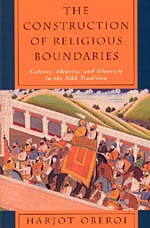
The Construction of Religious Boundaries
Culture, Identity, and Diversity in the Sikh TraditionHarjot Oberoi
University of Chicago Press, 1994
In the closing decades of the nineteenth century, however, the Singh Sabha, a powerful new Sikh movement, began to view the multiplicity in Sikh identity with suspicion and hostility. Aided by social and cultural forces unleashed by the British Raj, the Singh Sabha sought to recast Sikh tradition and purge it of diversity. The ethnocentric logic of a new elite dissolved alternative ideals under the highly codified culture of modern Sikhism.
A study of the process by which a pluralistic religious world view is replaced by a monolithic one, this important book calls into question basic assumptions about the efficacy of fundamentalist claims and the construction of all social and religious identities. An essential book for the field of South Asian religions, this work is also an important contribution to cultural anthropology, postcolonial studies, and the history of religion in general.

The Contact Image
Casts, Imprints, and Other Traces in ArtJohanna Malt
University of Minnesota Press, 2026
A new conceptual tool for understanding the history of art
From ancient cave paintings to contemporary sculpture, forms of indexical trace are vital to the human practice of artmaking. Through this wide-ranging exploration, Johanna Malt shows how casts, molds, and imprints (“contact images”) offer a paradigm for thinking about our relationship to objects and their surfaces as sites of meaning. Engaging and complicating philosophical dualities of absence and presence, art and non-art, original and copy, Malt introduces the contact image as an important new concept for the study of Western art.
Close reading examples from 30,000 years of art history, Malt cuts across eras and media to unite diverse forms of artistic production created through instances of contact with “the objects of the world.” From holy relics to Napoleon’s death mask to life casts of the human body by artists such as Duane Hanson and Janine Antoni, as well as conceptual and performance work by Jasper Johns and Yves Klein, The Contact Image traces themes of selfhood, time, negation, and vestige in these tactile encounters.
Revisiting fundamental questions about representation, perception, and aesthetics, The Contact Image is a sophisticated provocation for a theory of art built on the tension and oscillations that emerge when we explore how artworks embody opposites.
Retail e-book files for this title are screen-reader friendly with images accompanied by short alt text and/or extended descriptions.

The Contemporary African American Novel
Its Folk Roots and Modern Literary BranchesBernard W. Bell
University of Massachusetts Press, 2004