Results by title
18284 books match the query 'United States' and 3764 start with t
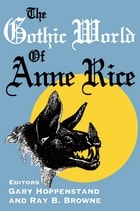
The Gothic World of Anne Rice
Edited by Gary Hoppenstand and Ray B. Browne
University of Wisconsin Press, 1996
This anthology argues for the serious study of the literary oeuvre of Anne Rice, a major figure in today’s popular literature. The essays assert that Rice expands the conventions of the horror genre’s formula to examine important social issues. Like a handful of authors working in this genre, Rice manipulates its otherwise predictable narrative structures so that a larger, more interesting cultural mythology can be developed. Rice searches for philosophical truth, examining themes of good and evil, the influence on people and society of both nature and nurture, and the conflict and dependence of humanism and science.
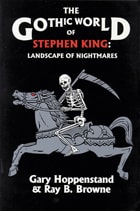
The Gothic World of Stephen King
Landscape of NightmaresEdited by Gary Hoppenstand and Ray B. Browne
University of Wisconsin Press, 1987
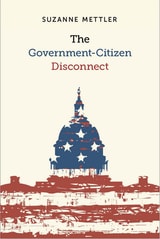
The Government-Citizen Disconnect
Suzanne Mettler
Russell Sage Foundation, 2018
Drawing from original survey data which probed Americans’ experiences of 21 federal social policies -- such as food stamps, Social Security, Medicaid, and the home mortgage interest deduction -- Mettler shows that 96 percent of adults have received benefits from at least one of them, and that the average person has utilized five. Overall usage rates transcend social, economic, and political divisions, and most Americans report positive experiences of their policy experiences. However, the fact that they have benefited from these policies has little positive effect on people’s attitudes toward government. Mettler finds that shared identities and group affiliations, as well as ideological forces, are more powerful and consistent influences. In particular, those who oppose welfare tend to extrapolate their unfavorable views of it to government in general. Deep antipathy toward the government has emerged as the result of a conservative movement that has waged a war on social welfare policies for over forty years, even as economic inequality and benefit use have increased.
Mettler finds that voting patterns exacerbate the government-citizen disconnect, as those holding positive views of federal programs and supporting expanded benefits have lower rates of political participation than those holding more hostile views of the government. As a result, the loudest political voice belongs to those who have benefited from policies but who give government little credit for their economic well-being, seeing their success more as a matter of their own deservingness. This contributes to the election of politicians who advocate cutting federal social programs. According to Mettler, the government-citizen disconnect frays the bonds of representative government and democracy.
The Government-Citizen Disconnect illuminates a paradox that increasingly shapes American politics. Mettler's examination of hostility toward government at a time when most Americans will at some point rely on the social benefits it provides helps us better understand the roots of today's fractious political climate.
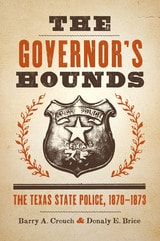
The Governor's Hounds
The Texas State Police, 1870–1873By Barry A. Crouch and Donaly E. Brice
University of Texas Press, 2011
In the tumultuous years following the Civil War, violence and lawlessness plagued the state of Texas, often overwhelming the ability of local law enforcement to maintain order. In response, Reconstruction-era governor Edmund J. Davis created a statewide police force that could be mobilized whenever and wherever local authorities were unable or unwilling to control lawlessness. During its three years (1870–1873) of existence, however, the Texas State Police was reviled as an arm of the Radical Republican party and widely condemned for being oppressive, arrogant, staffed with criminals and African Americans, and expensive to maintain, as well as for enforcing the new and unpopular laws that protected the rights of freed slaves.
Drawing extensively on the wealth of previously untouched records in the Texas State Archives, as well as other contemporary sources, Barry A. Crouch and Donaly E. Brice here offer the first major objective assessment of the Texas State Police and its role in maintaining law and order in Reconstruction Texas. Examining the activities of the force throughout its tenure and across the state, the authors find that the Texas State Police actually did much to solve the problem of violence in a largely lawless state. While acknowledging that much of the criticism the agency received was merited, the authors make a convincing case that the state police performed many of the same duties that the Texas Rangers later assumed and fulfilled the same need for a mobile, statewide law enforcement agency.
The Governors of Arkansas
Essays in Political BiographyJr. Gatewood
University of Arkansas Press, 1995
The Governors of New Jersey
Biographical EssaysBirkner, Michael J
Rutgers University Press, 2014
Rogues, aristocrats, and a future U.S. president. These and other governors are portrayed in this revised and updated edition of the classic reference work on the chief executives of New Jersey. Editors Michael J. Birkner, Donald Linky, and Peter Mickulas present new essays on the governors of the last three decades—Brendan T. Byrne, Thomas Kean, James Florio, Christine Todd Whitman, Donald DiFrancesco, James McGreevey, Richard Codey, and Jon Corzine. The essays included in the original edition are amended, edited, and corrected as necessary in light of new and relevant scholarship.
The authors of each governor’s life story represent a roster of such notable scholars as Larry Gerlach, Stanley Katz, Arthur Link, and Clement Price, as well as many other experts on New Jersey history and politics. As a result, this revised edition is a thorough and current reference work on the New Jersey governorship—one of the strongest in the nation.
Also of Interest:
New Jersey Politics and Government
The Suburbs Come of Age
Fourth Edition
Barbara G. Salmore with Stephen A. Salmore
978-0-8135-6139-4 paper $34.95
A volume in the Rivergate Regionals Collection
Me, Governor?
My Life in the Rough-and-Tumble World of New Jersey Politics
Richard J. Codey
978-0-8135-5045-9 cloth $24.95
The Life and Times of Richard J. Hughes
The Politics of Civility
John B. Wefing
978-0-8135-4641-4 cloth $32.50
Governor Tom Kean
From the New Jersey Statehouse to the 911 Commission
Alvin S. Felzenberg
978-0-8135-3799-3 cloth $29.95
The Governors' Lobbyists
Federal-State Relations Offices and Governors Associations in WashingtonJennifer M. Jensen
University of Michigan Press, 2016
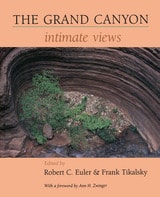
The Grand Canyon
Intimate ViewsEdited by Robert C. Euler and Frank Tikalsky; Foreword by Ann H. Zwinger
University of Arizona Press, 1992
Contents
Foreword, by Ann H. Zwinger
1. The Geologic Record, by Stanley S. Beus
2. The Living Canyon, by Steven W. Carothers
3. Grand Canyon Indians, by Robert C. Euler
4. Historical Explorations, by Robert C. Euler
5. The Canyon by River, by Kim Crumbo
6. Hiking the Canyon, by Frank Tikalsky

The Grasping Hand
"Kelo v. City of New London" and the Limits of Eminent DomainIlya Somin
University of Chicago Press, 2015
In this detailed study of one of the most controversial Supreme Court cases in modern times, Ilya Somin argues that Kelo was a grave error. Economic development and “blight” condemnations are unconstitutional under both originalist and most “living constitution” theories of legal interpretation. They also victimize the poor and the politically weak for the benefit of powerful interest groups and often destroy more economic value than they create. Kelo itself exemplifies these patterns. The residents targeted for condemnation lacked the influence needed to combat the formidable government and corporate interests arrayed against them. Moreover, the city’s poorly conceived development plan ultimately failed: the condemned land lies empty to this day, occupied only by feral cats. The Supreme Court’s unpopular ruling triggered an unprecedented political reaction, with forty-five states passing new laws intended to limit the use of eminent domain. But many of the new laws impose few or no genuine constraints on takings. The Kelo backlash led to significant progress, but not nearly as much as it may have seemed.
Despite its outcome, the closely divided 5-4 ruling shattered what many believed to be a consensus that virtually any condemnation qualifies as a public use under the Fifth Amendment. It also showed that there is widespread public opposition to eminent domain abuse. With controversy over takings sure to continue, The Grasping Hand offers the first book-length analysis of Kelo by a legal scholar, alongside a broader history of the dispute over public use and eminent domain and an evaluation of options for reform.

The Grasping Hand
"Kelo v. City of New London" and the Limits of Eminent DomainIlya Somin
University of Chicago Press, 2015
In this detailed study of one of the most controversial Supreme Court cases in modern times, Ilya Somin argues that Kelo was a grave error. Economic development and “blight” condemnations are unconstitutional under both originalist and most “living constitution” theories of legal interpretation. They also victimize the poor and the politically weak for the benefit of powerful interest groups and often destroy more economic value than they create. Kelo itself exemplifies these patterns. The residents targeted for condemnation lacked the influence needed to combat the formidable government and corporate interests arrayed against them. Moreover, the city’s poorly conceived development plan ultimately failed: the condemned land lies empty to this day, occupied only by feral cats. The Supreme Court’s unpopular ruling triggered an unprecedented political reaction, with forty-five states passing new laws intended to limit the use of eminent domain. But many of the new laws impose few or no genuine constraints on takings. The Kelo backlash led to significant progress, but not nearly as much as it may have seemed.
Despite its outcome, the closely divided 5-4 ruling shattered what many believed to be a consensus that virtually any condemnation qualifies as a public use under the Fifth Amendment. It also showed that there is widespread public opposition to eminent domain abuse. With controversy over takings sure to continue, The Grasping Hand offers the first book-length analysis of Kelo by a legal scholar, alongside a broader history of the dispute over public use and eminent domain and an evaluation of options for reform.

The Graying of America
An Encyclopedia of Aging, Health, Mind, and Behavior (2d ed.)Donald H. Kausler and Barry C. Kausler
University of Illinois Press, 2001
Featuring nontechnical language, user-friendly indexes, and more than 150 new entries, the second edition covers new topics such as acupuncture, wheelchairs, adjusting to bifocals, preparing for traveling, improving communication with physicians, and avoiding eye strain in computer use. Among other updates are more detailed coverage of health problems including arthritis, diabetes, osteoporosis, and various kinds of cancer, as well as advice on reducing the stress of caring for a family member with Alzheimer's disease. In addition to discussing hundreds of common ailments and conditions, Kausler and Kausler provide constructive guidance on regular physical activity, mental stimulation, and other behaviors that promote "successful aging."
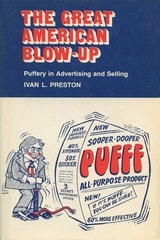
The Great American Blow-Up
Puffery in Advertising and SellingIvan L. Preston
University of Wisconsin Press, 1996
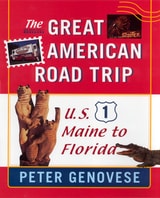
The Great American Road Trip
U.S. 1, Maine to FloridaGenovese, Peter
Rutgers University Press, 1999
Take an unforgettable road trip down one of America’s most fascinating highways, U.S.
On what highway can you find the headquarters of the FBI, Dow Jones Interactive, and the National Enquirer? What road is home to the Bronx Zoo, the Okefenokee Swamp, and Flipper? On the side of what freeway can you find the Super Duper Weenie Wagon, Larry’s Redneck Bar, and the Big Chicken Barn? Peter Genovese found them all, along with about a million other fascinating and bizarre attractions, on U.S. 1, ‘the best damn highway in America,” as he calls it. Join him for the road trip of a lifetime The Great American Road Trip: A Journey Down U.S. 1.
U.S. 1 may not be America’s scenic highway, but it’s certainly the most colorful. It runs through Boston, New York, Baltimore, Washington, D.C., and Miami, in addition to Caribou, Maine, Quonochontaug, Rhode Island, and Alma, Georgia. It zig-zags along the wild and beautiful Maine coast and soars over the Atlantic Ocean as the Overseas Highway, one of the most spectacular stretches of road anywhere. The Star-Spangled Banner is on U.S. 1. Madonna lived on U.S. 1 (until she sold her house to Rosie O'Donnell). U.S. 1 is Main Street and the Miracle Mile, two-lane blacktop and six-lane expressway, straight as an arrow in some places and twistier than a Philadelphia soft pretzel in others.
Genovese spent two years on U.S. 1, talking to everyone from doughnut makers, dolphin trainers, and swamp guides to real Miami vice cops and the keeper of the national parasite collection. His resulting book is the most complete portrait of an American highway ever written. With his unerring eye for detail, sense of humor, and understanding of human nature, Genovese takes readers on a sometimes funny, sometimes sad, always illuminating 2,450-mile journey from Fort Kent, Maine to Key West, Florida.
Ride along with Genovese and grab a drink at the Last Resort Bar or the Last Chance Saloon, then pick up a paperback at the Banned Bookstore. Visit Oscar, the biggest gator in the Okefenokee Swamp, have dinner at Hog Heaven, and take in a Portland Seadogs baseball game. Tour a Budweiser brewery and go into the pit at a NASCAR race. Looking for someplace to stay? How about the world’s only underwater hotel, the Jules’ Undersea Lodge, or in a cabin made entirely from one pine tree at the Maine Idyll Motor Court? If it’s culture you seek, the highway boasts dozens of museums. While you may have heard of the Museum of Natural History and the National Museum of American Art, how about the Blacks in Wax Museum, Tragedy in the United States Museum, and the Mushroom Museum? There’s something for everyone on U.S. 1, and Genovese has written about it all in The Great American Road Trip.
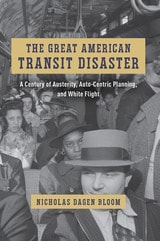
The Great American Transit Disaster
A Century of Austerity, Auto-Centric Planning, and White FlightNicholas Dagen Bloom
University of Chicago Press, 2023
Many a scholar and policy analyst has lamented American dependence on cars and the corresponding lack of federal investment in public transportation throughout the latter decades of the twentieth century. But as Nicholas Dagen Bloom shows in The Great American Transit Disaster, our transit networks are so bad for a very simple reason: we wanted it this way.
Focusing on Baltimore, Atlanta, Chicago, Detroit, Boston, and San Francisco, Bloom provides overwhelming evidence that transit disinvestment was a choice rather than destiny. He pinpoints three major factors that led to the decline of public transit in the United States: municipal austerity policies that denied most transit agencies the funding to sustain high-quality service; the encouragement of auto-centric planning; and white flight from dense city centers to far-flung suburbs. As Bloom makes clear, these local public policy decisions were not the product of a nefarious auto industry or any other grand conspiracy—all were widely supported by voters, who effectively shut out options for transit-friendly futures. With this book, Bloom seeks not only to dispel our accepted transit myths but hopefully to lay new tracks for today’s conversations about public transportation funding.
The Great American Transit Disaster
A Century of Austerity, Auto-Centric Planning, and White FlightNicholas Dagen Bloom
University of Chicago Press, 2023
A potent re-examination of America’s history of public disinvestment in mass transit.
Many a scholar and policy analyst has lamented American dependence on cars and the corresponding lack of federal investment in public transportation throughout the latter decades of the twentieth century. But as Nicholas Dagen Bloom shows in The Great American Transit Disaster, our transit networks are so bad for a very simple reason: we wanted it this way.
Focusing on Baltimore, Atlanta, Chicago, Detroit, Boston, and San Francisco, Bloom provides overwhelming evidence that transit disinvestment was a choice rather than destiny. He pinpoints three major factors that led to the decline of public transit in the United States: municipal austerity policies that denied most transit agencies the funding to sustain high-quality service; the encouragement of auto-centric planning; and white flight from dense city centers to far-flung suburbs. As Bloom makes clear, these local public policy decisions were not the product of a nefarious auto industry or any other grand conspiracy—all were widely supported by voters, who effectively shut out options for transit-friendly futures. With this book, Bloom seeks not only to dispel our accepted transit myths but hopefully to lay new tracks for today’s conversations about public transportation funding.
The Great Brain Suck
And Other American EpiphaniesEugene Halton
University of Chicago Press, 2008
Luckily Halton, with scalpel-sharp wit in one hand and the balm of wisdom in the other, is here to operate on the declining body politic. His initial diagnosis is bleak: fast food and too much time spent sitting, whether in our cars or on our couches, are ruining our bodies, while our minds are weakened by the proliferation of electronic devices—TVs, computers, cell phones, iPods, video games—and their alienating effects. If we are losing the battle between autonomy and automation, he asks, how can our culture regain self-sufficiency? Halton finds the answer in the inspiring visions—deeply rooted in American culture—of an organic and more spontaneous life at the heart of the work of master craftsman Wharton Esherick, legendary blues singer Muddy Waters, urban critic Lewis Mumford, and artist Maya Lin, among others.
A scathing and original jeremiad against modern materialism, The Great Brain Suck is also a series of epiphanies of a simpler but more profound life.
The Great Broadening
How the Vast Expansion of the Policymaking Agenda Transformed American PoliticsBryan D. Jones, Sean M. Theriault, and Michelle Whyman
University of Chicago Press, 2019
With The Great Broadening, Bryan D. Jones, Sean M. Theriault, and Michelle Whyman examine in detail the causes, internal dynamics, and consequences of this extended burst of activity. They argue that the broadening of government responsibilities into new policy areas such as health care, civil rights, and gender issues and the increasing depth of existing government programs explain many of the changes in America politics since the 1970s. Increasing government attention to particular issues was motivated by activist groups. In turn, the beneficiaries of the government policies that resulted became supporters of the government’s activity, leading to the broad acceptance of its role. This broadening and deepening of government, however, produced a reaction as groups critical of its activities organized to resist and roll back its growth.
The Great Confusion in Indian Affairs
Native Americans and Whites in the Progressive EraBy Tom Holm
University of Texas Press, 2005
The United States government thought it could make Indians "vanish." After the Indian Wars ended in the 1880s, the government gave allotments of land to individual Native Americans in order to turn them into farmers and sent their children to boarding schools for indoctrination into the English language, Christianity, and the ways of white people. Federal officials believed that these policies would assimilate Native Americans into white society within a generation or two. But even after decades of governmental efforts to obliterate Indian culture, Native Americans refused to vanish into the mainstream, and tribal identities remained intact.
This revisionist history reveals how Native Americans' sense of identity and "peoplehood" helped them resist and eventually defeat the U.S. government's attempts to assimilate them into white society during the Progressive Era (1890s-1920s). Tom Holm discusses how Native Americans, though effectively colonial subjects without political power, nonetheless maintained their group identity through their native languages, religious practices, works of art, and sense of homeland and sacred history. He also describes how Euro-Americans became increasingly fascinated by and supportive of Native American culture, spirituality, and environmental consciousness. In the face of such Native resiliency and non-Native advocacy, the government's assimilation policy became irrelevant and inevitably collapsed. The great confusion in Indian affairs during the Progressive Era, Holm concludes, ultimately paved the way for Native American tribes to be recognized as nations with certain sovereign rights.
The Great Cyclone at St Louis and East St. Louis, May 27, 1896
Compiled and Edited by Julian Curzon. Foreword by Tim O'Neil
Southern Illinois University Press, 1997
Heavily illustrated by photographs of the damage, The Great Cyclone was compiled from stories in the city’s daily newspapers—the Globe-Democrat, the Post-Dispatch, and, most notably, the old St. Louis Republic. O’Neil points out that "the book’s compilers are not identified, but their glowing praise of the ‘superb descriptive composition’ in the Republic provides a good guess about where most of them worked."

The Great Deception
Anglo-American Power and World OrderMark Curtis
Pluto Press, 1998
The Great Depression
An International Disaster of Perverse Economic PoliciesThomas E. Hall and J. David Ferguson
University of Michigan Press, 1998
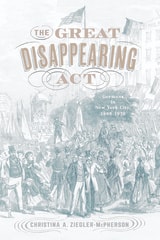
The Great Disappearing Act
Germans in New York City, 1880-1930Christina A. Ziegler-McPherson
Rutgers University Press, 2022
This study examines these questions in relation to the German immigrant community in New York City between 1880-1930, and seeks to understand how German-American New Yorkers assimilated into the larger American society in the early twentieth century.
By the turn of the twentieth century, New York City was one of the largest German-speaking cities in the world and was home to the largest German community in the United States. This community was socio-economically diverse and increasingly geographically dispersed, as upwardly mobile second and third generation German Americans began moving out of the Lower East Side, the location of America’s first Kleindeutschland (Little Germany), uptown to Yorkville and other neighborhoods. New York’s German American community was already in transition, geographically, socio-economically, and culturally, when the anti-German/One Hundred Percent Americanism of World War I erupted in 1917.
This book examines the structure of New York City’s German community in terms of its maturity, geographic dispersal from the Lower East Side to other neighborhoods, and its ultimate assimilation to the point of invisibility in the 1920s. It argues that when confronted with the anti-German feelings of World War I, German immigrants and German Americans hid their culture – especially their language and their institutions – behind closed doors and sought to make themselves invisible while still existing as a German community.
But becoming invisible did not mean being absorbed into an Anglo-American English-speaking culture and society. Instead, German Americans adopted visible behaviors of a new, more pluralistic American culture that they themselves had helped to create, although by no means dominated. Just as the meaning of “German” changed in this period, so did the meaning of “American” change as well, due to nearly 100 years of German immigration.
The Great Encyclopedia of Nineteenth-Century Major League Baseball
David Nemec
University of Alabama Press, 2006

The Great Enrichment
A New History of American Growth and Inequality, 1865–1945Vincent Geloso
University of Chicago Press, 2027
A revelatory economic history of America's Gilded Age—and how it wasn't just the Robber Barons who benefited.
The Gilded Age, spanning the late nineteenth and early twentieth centuries, was when Americans got rich. Or, rather, some Americans got rich. Because as much as the era is synonymous with staggering economic growth, it also doubles as America’s cautionary tale for the perils of leaving rich people and institutions unregulated. It was the time of extractive industrialists, worker exploitation, stifled economic mobility, and racial exclusion—lessons that the United States learned the hard way.
Vincent Geloso contests this traditional narrative by revisiting the math in this new empirical account of the Gilded Age. The Great Enrichment is an economic history of America’s rise to affluence, a period that doubled as a remarkable rise of the country’s economic floor. The conventional contrast of Robber Barons against huddled masses is, in Geloso’s analysis, unsubstantiated by economic data. The Gilded Age was the first egalitarian enrichment that humanity witnessed—a time when both rich and poor benefited in ways that were seismic, albeit unequal. Yet the net result was a great leap forward, not the lamentable birth of modern inequality.
Geloso marshals an expanded set of economic measures to account for factors not typically included in the Gilded Age economic story. The Great Enrichment sets a new standard for empirical history in one of America’s most consequential—and perhaps misunderstood—periods.
The Great Global Transformation
The United States, China, and the Remaking of the World Economic OrderBranko Milanovic
University of Chicago Press, 2026
The world’s two great economic powers are on opposite trajectories. In the United States, decades of neoliberal policies produced a small class of rich elites and gutted the middle class. In China, the same global forces have created a massive new upper class. The result is the greatest reshuffling of global incomes since the Industrial Revolution—a dramatic shakeup of each country’s political order. As the two powers retreat from one another, the implications for their futures, and for the world economy, are uncertain.
In The Great Global Transformation, acclaimed economist Branko Milanovic draws on original research to chart how these seismic shifts will shape the next century of the global economy. As both the US and China retreat into protectionism, Milanovic shows how a new and multipolar world order will follow—and how rising nationalism will have dramatically different effects on the two countries. And he shows us the fight ahead: as plutocracy returns, global war threatens, and a new system silently shapes our nations, driving populist discontent to the breaking point.
A worthy successor to Capitalism, Alone and his other landmark works, Milanovic’s new book announces the arrival of a new era he terms “national market liberalism,” in which liberalism survives in domestic economies, but not necessarily in the social arena. The Great Global Transformation is Milanovic’s indispensable account of the new twenty-first century now underway.
The Great Global Transformation
The United States, China, and the Remaking of the World Economic OrderBranko Milanovic
University of Chicago Press, 2026
From the essential chronicler of the world economy, a portrait of the Great Powers in transition.
The world’s two great economic powers are on opposite trajectories. In the United States, decades of neoliberal policies produced a small class of rich elites and gutted the middle class. In China, the same global forces have created a massive new upper class. The result is the greatest reshuffling of global incomes since the Industrial Revolution—a dramatic shakeup of each country’s political order. As the two powers retreat from one another, the implications for their futures, and for the world economy, are uncertain.
In The Great Global Transformation, acclaimed economist Branko Milanovic draws on original research to chart how these seismic shifts will shape the next century of the global economy. As both the US and China retreat into protectionism, Milanovic shows how a new and multipolar world order will follow—and how rising nationalism will have dramatically different effects on the two countries. And he shows us the fight ahead: as plutocracy returns, global war threatens, and a new system silently shapes our nations, driving populist discontent to the breaking point.
A worthy successor to Capitalism, Alone and his other landmark works, Milanovic’s new book announces the arrival of a new era he terms “national market liberalism,” in which liberalism survives in domestic economies, but not necessarily in the social arena. The Great Global Transformation is Milanovic’s indispensable account of the new twenty-first century now underway.
The Great Gypsy Moth War
A History of the First Campaign in Massachusetts to Eradicate the Gypsy Moth, 1890-1901Robert J. Spear
University of Massachusetts Press, 2005
During the Civil War, when the supply of cotton from southern fields was disrupted, the owners of northern textile mills looked elsewhere for raw fiber. One source was silk. Among those experimenting with silkworm production was a Frenchman named Etienne Leopold Trouvelot, who had settled outside of Boston. It was Trouvelot who imported the gypsy moths and inadvertently allowed them to escape. Soon the invasion was on and a counteroffensive was required.
Spear reveals the turbulent undercurrents in the eradication campaign when the enthusiasm of the entomologists in charge turned into desperation upon the discovery that their alien adversary was much tougher than they thought. Fighting a war they could not win and dared not lose, the leaders of the campaign resorted to political maneuvering, cheap tricks, and outright misrepresentation to maintain a façade of success, urging the Commonwealth to continue funding the war long after any chance of victory had faded.
More than just reviewing the important events of this historic episode, Spear tells the story in an engaging way, often through the first-hand accounts of those who were directly involved. Much of what Spear has written is new, the recounting is lively, and the information he presents shows that almost all of the previous beliefs about the campaign to eradicate the gypsy moths are myths. In the process, he also traces the rise of modern economic entomology and the birth of the pesticide industry.
The Great Heart of the Republic
St. Louis and the Cultural Civil WarAdam Arenson
University of Missouri Press, 2011
The Civil War revealed what united as well as what divided Americans in the nineteenth century—not only in its deadly military conflict, but also in the broader battle of ideas, dueling moral systems, and competing national visions. Adam Arenson focuses this cultural civil war in St. Louis, the largest city along the border of slavery and freedom. From this vantage point, the Civil War era looks less like a fight between North and South over slavery or the West as a prize, and more like a messy struggle between northerners, southerners, and westerners, a clash among three incompatible regional visions, whose leaders argued about the definition and importance of Manifest Destiny and slavery politics. Arenson weaves this political history with analyses of paintings, architecture, and other cultural products, paying particular attention to institutions such as universities and railroads. The result is a vibrant history of the Civil War era from the heart of the Republic that enriches our understanding of America at a crossroads.
The Great Hummingbird Chase
John P. Schaefer and Ken Lamberton
University of Arizona Press, 2027
Southern Arizona is a world-renown hummingbird destination. The Great Hummingbird Chase chronicles John P. Schaefer and Ken Lamberton’s passionate quest to photograph all fifteen of Arizona’s hummingbird species.
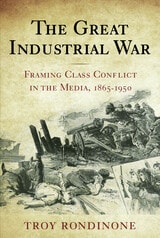
The Great Industrial War
Framing Class Conflict in the Media, 1865-1950Rondinone, Troy
Rutgers University Press, 2011
Examining how the mainstream press along with the writings of a select group of influential reformers and politicians framed strike news, Rondinone argues that the Civil War, coming on the cusp of a revolution in industrial productivity, offered a gruesome, indelible model for national conflict. He follows the heated discourse on class war through the nineteenth century until its general dissipation in the mid-twentieth century. Incorporating labor history, cultural studies, linguistic anthropology, and sociology, The Great Industrial War explores the influence of historical experience on popular perceptions of social order and class conflict and provides a reinterpretation of the origins and meaning of the Taft-Hartley Act and the industrial relations regime it supported.
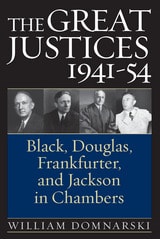
The Great Justices, 1941-54
Black, Douglas, Frankfurter, and Jackson in ChambersWilliam Domnarski
University of Michigan Press, 2006
This is rare and little-examined territory: in the public consciousness the Supreme Court is usually seen as an establishment whose main actors, the justices, remain above emotion, vitriol, and gossip, the better to interpret our nation of laws. Yet the Court's work is always an interchange of ideas and individuals, and the men and women who make up the Court, despite or because of their best intentions, are as human as the rest of us. Appreciating that human dimension helps us to discover some of the Court's secrets, and a new way to understand the Court and its role.
Comparing four brilliant but very different jurists of the Roosevelt Court-Hugo Black, William O. Douglas, Felix Frankfurter, and Robert Jackson-William Domnarski paints a startling picture of the often deeply ambiguous relationship between ideas and reality, between the law and the justices who interpret and create it. By pulling aside the veil of decorous tradition, Domnarski brings to light the personalities that shaped one of the greatest Courts of our time-one whose decisions continue to affect judicial thinking today.
William Domnarski is the author of In the Opinion of the Court (1996), a study of the history and nature of federal court judicial opinions. He holds a J.D. from the University of Connecticut and a Ph.D. in English from the University of California. Domnarski currently practices law in California, where he is also working on a forthcoming biography of legendary Hollywood lawyer Bert Fields.
The Great Lobster War
Ron Formisano
University of Massachusetts Press, 1997
This groundbreaking historical account documents the little-known but significant conflict that erupted among Maine lobstermen in the 1950s—a pivotal clash that pitted independent small-scale fishermen against powerful dealers and federal government regulators. Written by distinguished historian Ronald P. Formisano, this work reconstructs a dramatic struggle over prices and economic power within Maine's vital lobster fishery.
Capturing the reality of the Lobster War strike and its subsequent legal proceedings, Formisano's narrative explores how independent owner-operators of the Maine lobster fishery, facing economic pressures from middlemen dealers and federal intervention, banded together in a coordinated effort to secure fair prices and maintain control over their livelihoods.
Through meticulous historical research, Formisano illuminates the economic realities of commercial fishing, the dynamics between laborers and processors, and the role of government regulation in shaping resource management policies.The Great Lobster War serves as both a detailed historical study and an accessible story of working-class agency and collective action in the postwar era.
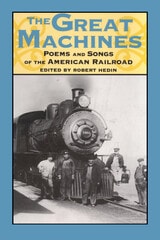
The Great Machines
Poems and Songs from the Age of the American RailroadRobert Hedin
University of Iowa Press, 1996
Here, for the first time, is a feast for anyone who has ever been beguiled by the trains that formerly thrummed through the landscapes of our lives. This entertaining and evocative anthology presents the amazing variety of poems and songs written about the American railroad in the last century and a half. Comprised of selections from both oral and written traditions, the volume celebrates the historical and cultural significance of this marvel of engineering skills. Hedin's anthology allows all readers, from the most avid railroad buff to anyone who has fond memories of train travel, to enjoy the romance of trains.
The Great Melding
War, the Dixiecrat Rebellion, and the Southern Model for America's New ConservatismGlenn Feldman
University of Alabama Press, 2015
CHOICE OUTSTANDING ACADEMIC TITLE
Tracing the Southern Origins of Modern American Conservatism.
Audacious in its scope, subtle in its analysis, and persuasive in its arguments, The Great Melding is the second book in Glenn Feldman’s magisterial recounting of the South’s transformation from a Reconstruction-era citadel of Democratic Party inertia to a cauldron of GOP agitation. In this pioneering study, Feldman shows how the transitional years after World War II, the Dixiecrat episode, and the early 1950s formed a pivotal sequence of events that altered America’s political landscape in profound, fundamental, and unexpected ways.
Feldman’s landmark work The Irony of the Solid South dismantled the myth of the New Deal consensus, proving it to be only a fleeting alliance of fissiparous factions; The Great Melding further examines how the South broke away from that consensus. Exploring issues of race and white supremacy, Feldman documents and explains the roles of economics, religion, and emotive appeals to patriotism in southern voting patterns. His probing and original analysis includes a discussion of the limits of southern liberalism and a fresh examination of the Dixiecrat Revolt of 1948.
Feldman convincingly argues that the Dixiecrats—often dismissed as a transitory footnote in American politics—served as a template for the modern conservative movement. Now a predictable Republican stronghold, Alabama at the time was viewed by national political strategists as a battleground and bellwether. Masterfully synthesizing a vast range of sources, Feldman shows that Alabama was then one of the few states where voters made unpredictable choices between the competing ideologies of the Democrats, Republicans, and Dixiecrats.
Writing in his lively and provocative style, Feldman demonstrates that the events he recounts in Alabama between 1942 and Dwight Eisenhower’s 1952 election encapsulate a rare moment of fluidity in American politics, one in which the New Deal consensus shattered and the Democratic and Republican parties fought off a third-party revolt only to find themselves irrevocably altered by their success. The Great Melding will fascinate historians, political scientists, political strategists, and readers of political nonfiction.
The Great Migration and the Democratic Party
Black Voters and the Realignment of American Politics in the 20th CenturyKeneshia N. Grant
Temple University Press, 2020
Where Black people live has long been an important determinant of their ability to participate in political processes. The Great Migration significantly changed the way Democratic Party elites interacted with Black communities in northern cities, Detroit, New York, and Chicago. Many white Democratic politicians came to believe the growing pool of Black voters could help them reach their electoral goals—and these politicians often changed their campaign strategies and positions to secure Black support. Furthermore, Black migrants were able to participate in politics because there were fewer barriers to Black political participations outside the South.
The Great Migration and the Democratic Party frames the Great Migration as an important economic and social event that also had serious political consequences. Keneshia Grant created one of the first listings of Black elected officials that classifies them based on their status as participants in the Great Migration. She also describes some of the policy/political concerns of the migrants. The Great Migration and the Democratic Party lays the groundwork for ways of thinking about the contemporary impact of Black migration on American politics.

The Great Orchestrator
Arthur Judson and American Arts ManagementJames M. Doering
University of Illinois Press, 2013
The Great Paleolithic War
How Science Forged an Understanding of America's Ice Age PastDavid J. Meltzer
University of Chicago Press, 2015
In The Great Paleolithic War, David J. Meltzer tells the story of a scientific quest that set off one of the longest-running feuds in the history of American anthropology, one so vicious at times that anthropologists were deliberately frightened away from investigating potential sites. Through his book, we come to understand how and why this controversy developed and stubbornly persisted for as long as it did; and how, in the process, it revolutionized American archaeology.
The Great Peshtigo Fire
An Eyewitness AccountPeter Pernin
Wisconsin Historical Society Press, 1999
The Great Peshtigo Fire
Stories and Science from America’s Deadliest FireScott Knickelbine
Wisconsin Historical Society Press, 2012
On the night of October 8, 1871, a whirlwind of fire swept through northeastern Wisconsin, destroying the bustling frontier town of Peshtigo. Trees, buildings, and people burst into flames. Metal melted. Sand turned into glass. People thought the end of the world had come. When the “tornado of fire” was over, 2,500 people were dead, and Peshtigo was nothing but a smoking ruin. It was the deadliest wildfire in U.S. history.
The Great Peshtigo Fire: Stories and Science from America’s Deadliest Firestorm explores the history, science, and legacy of the 1871 Peshtigo Fire at a fourth-grade reading level. Readers will learn about the history of settlement, agriculture, and forestry in 19th-century Wisconsin. This illuminating text covers a diverse range of topics that will enrich the reader’s understanding of the Peshtigo Fire, including the building and land-use practices of the time that made the area ripe for such a fire, the weather patterns that fostered widespread fires throughout the upper Midwest in the summer and fall of 1871, and exciting first-person accounts that vividly bring the `victims’ stories to life. Connections made between the Peshtigo Fire and the history of fire prevention in the United States encourage critical thinking about issues that remain controversial to this day, such as planned burns and housing development restrictions near forested areas. The Great Peshtigo Fire: Stories and Science from America’s Deadliest Firestorm will inform and captivate its readers as it journeys through the horrifying history of the Peshtigo Fire.
The Great Recession
David B. Grusky
Russell Sage Foundation, 2012
The Great Reporters
David Randall
Pluto Press, 2005
This unique book is the first to try and answer this question. Author David Randall searched nearly two centuries of newspapers and magazines, consulted editors and journalism experts worldwide, and the result is The Great Reporters---13 in-depth profiles of the best journalists who ever lived. They include nine Americans and four Britons, ten men and three women, whose lives were full of adventure, wit, and the considerable ingenuity required to bring the story home. Among chapters are those on the reporter who:
Booked himself onto a ship likely to be sunk by the Germans so he could report its torpedoing Was called out to a multiple shooting, who interviewed 50 witnesses, went back to the office, and wrote a Pulitzer Prize-winning story of 4,000 words in two and a half hours Was deemed useless by her teacher but who went on to become the greatest crime reporter in history Wrote a story that changed the map of Europe Out-bluffed a top Soviet official to get into Russia so he could cover the appalling famine there Feigned madness to get herself locked up in an asylum so she could expose its terrible conditions Was the best ever to apply words to newsprint Became a national hero in America because he stood up for the little guy and his war reporting told it like it really was At the age of 63, and after three major operations, went under-cover in Iran so she could report on the regime's repression Was nearly fired for fouling up his first major assignment, but went on to shock his nation with his courageous war reporting Wrote faster than anyone who could write better and better than anyone who could write faster Single-handedly took on the tobacco industry Said no to William Randolph Hearst
Each profile tells of the reporter's life and his or her major stories, how they were obtained, and their impact. Packed with anecdotes, and inspiring accounts of difficulties overcome, the book quotes extensively from each reporter's work. It also includes an essay on the history of reporting, charting the technologies, economics, and attitudes that made it the way it is---from the invention of the telegraph to the Internet. The Great Reporters is not just the story of 13 remarkable people, it is the story of how society's information hunter-gatherers succeed in bringing us all what we need to know.
The Great Salt Lake
Dale L. Morgan
University of Utah Press, 2002
Approached as history, geography, geology, or high adventure, The Great Salt Lake is fascinating reading. From the first Americans, through mountain men, religious empires, railroads, and resorts, the remnant of ancient Lake Bonneville has been a nexus for human history, uniting a haunting beauty with raw desolation, 'strangely removed from common experience.'
The Great Satan vs. the Mad Mullahs
How the United States and Iran Demonize Each OtherWilliam O. Beeman
University of Chicago Press, 2008
“William Beeman’s analysis of dissonant perceptions of Iran and the USA is compelling and important. . . . I am particularly grateful for this work.”—James Peacock, University of North Carolina at Chapel Hill
“[Beeman] is more interested in informing the reader than in impressing his peers. The other strength of the book lies in the author’s knowledge of Iranian history and culture. . . . It challenges the reader and forces him to question stereotypes about Iran and Washington’s perspective on the country.”—Abbas William Samii, Middle East Journal

The Great Society and Its Legacy
Twenty Years of U.S. Social PolicyMarshall Kaplan and Peggy Cuciti, eds.
Duke University Press, 1986
The Great Society and the High Tide of Liberalism
Sidney M. Milkis
University of Massachusetts Press, 2005
In this volume of original essays, a distinguished group of scholars and activists reassess the mixed legacy of this third major reform period of the last century. They examine not only the policies and programs that were part of LBJ's Great Society, but also the underlying ideological and political shifts that changed the nature of liberalism. Some of the essays focus on Lyndon Johnson himself and the institution of the modern presidency, others on specific reform measures, and still others on the impact of these initiatives in the decades that followed. Perspectives, methodologies, and conclusions differ, yet all of the contributors agree that the Great Society represented an important chapter in the story of the American republic and its ongoing struggle to reconcile the power of the state with the rights of individuals—a struggle that has continued into the twenty-first century.
In addition to the editors, contributors include Henry J. Abraham, Brian Balogh, Rosalyn Baxandall, Edward Berkowitz, Eileen Boris, Richard A. Cloward, Hugh Davis Graham, Hugh Heclo, Frederick Hess, William E. Leuchtenburg, Nelson Lichtenstein, Patrick McGuinn, Wilson Carey McWilliams, R. Shep Melnick, Frances Fox Piven, and David M. Shribman.
The Great Starvation Experiment
Ancel Keys and the Men Who Starved for ScienceTodd Tucker
University of Minnesota Press, 2007
“The Great Starvation Experiment is wide-ranging, weaving progress in the war into the day-to-day suffering of the hungry volunteers.” —Saint Paul Pioneer Press
“Fascinating . . .” —Minneapolis Star Tribune
Near the end of World War II, thirty-six conscientious objectors volunteered to be systematically starved for renowned scientist Ancel Keys’s study at the University of Minnesota in the basement of Memorial Stadium. Aimed to benefit relief efforts in war-ravaged Europe and Asia, the study sought the best way to rehabilitate starving citizens. Tucker captures a lost moment in American history—a time when stanch idealism and a deep willingness to sacrifice trumped even basic human needs.
“Tucker provides a fascinating and moving history of the experiment, centering on the lives and experiences of the volunteers and the formidable obstacles they overcame. Tucker tells the story with verve and economy. . . . Keys, his experiment and his 36 starving men form a compelling combination.” —Publishers Weekly
Todd Tucker is the author of several books, including Notre Dame vs. the Klan: How the Fighting Irish Defeated the Ku Klux Klan (2004). He served on the legendary Navy submarine USS Alabama before moving to Valparaiso, Indiana.
The Great Strikes of 1877
Edited by David O. Stowell
University of Illinois Press, 2007
A spectacular example of collective protest, the Great Strike of 1877--actually a sequence of related actions--was America's first national strike and the first major strike against the railroad industry. In some places, non-railroad workers also abandoned city businesses, creating one of the nation's first general strikes. Mobilizing hundreds of thousands of workers, the Great Strikes of 1877 transformed the nation's political landscape, shifting the primary political focus from Reconstruction to labor, capital, and the changing role of the state.
Probing essays by distinguished historians explore the social, political, regional, and ethnic landscape of the Great Strikes of 1877: long-term effects on state militias and national guard units; ethnic and class characterization of strikers; pictorial representations of poor laborers in the press; organizational strategies employed by railroad workers; participation by blacks; violence against Chinese immigrants; and the developing tension between capitalism and racial equality in the United States.
Contributors: Joshua Brown, Steven J. Hoffman, Michael Kazin, David Miller, Richard Schneirov, David O. Stowell, and Shelton Stromquist.
The Great Texas Stamp Collection
How Some Stubborn Texas Confederate Postmasters, a Handful of Determined Texas Stamp Collectors, and a Few of the World's Greatest Philatelists Created, Discovered, and Preserved Some of the World's Most Valuable Postage StampsBy Charles W. Deaton
University of Texas Press, 2012
Among the many difficulties the newly formed Confederate States of America endured in the summer of 1861 was the failure of its post office department to provide sufficient numbers of that item most crucial to its service: the postage stamp. Faced with the resulting din of customer complaints, a handful of industrious Texas postmasters solved the problem by simply making their own homemade stamps.
In this thoroughly researched history of these rare and highly coveted stamps, The Great Texas Stamp Collection traces their journey from creation through their rediscovery years later by local, and then international, stamp collectors—a journey that culminated in the sale of a few pieces at a recent auction in New York that fetched more than $250,000. Weaving the larger contexts of Texas and U.S. postal history together with individual tales of greed, intrigue, forgery, and discovery, Deaton’s book is rich with characters from European royalty to early stamp dealers to common criminals, while also providing detailed examinations of the stamps themselves, including a complete census of the stamps now known as the Texas Confederate Postmasters’ Provisionals.
Appealing at once to devoted philatelists, Texas and U.S. history buffs, and amateur collectors of all kinds, The Great Texas Stamp Collection offers a unique vantage point from which to view our history as well as the very nature of collecting.
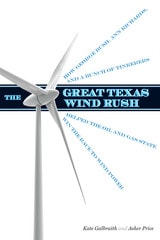
The Great Texas Wind Rush
How George Bush, Ann Richards, and a Bunch of Tinkerers Helped the Oil and Gas State Win the Race to Wind PowerBy Kate Galbraith and Asher Price
University of Texas Press, 2013
In the late 1990s, West Texas was full of rundown towns and pumpjacks, aging reminders of the oil rush of an earlier era. Today, the towns are thriving as 300-foot-tall wind turbines tower above those pumpjacks. Wind energy has become Texas’s latest boom, with the Lone Star State now leading the nation. How did this dramatic transformation happen in a place that fights federal environmental policies at every turn? In The Great Texas Wind Rush, environmental reporters Kate Galbraith and Asher Price tell the compelling story of a group of unlikely dreamers and innovators, politicos and profiteers.
The tale spans a generation and more, and it begins with the early wind pioneers, precocious idealists who saw opportunity after the 1970s oil crisis. Operating in an economy accustomed to exploiting natural resources and always looking for the next big thing, their ideas eventually led to surprising partnerships between entrepreneurs and environmentalists, as everyone from Enron executives to T. Boone Pickens, as well as Ann Richards, George W. Bush and Rick Perry, ended up backing the new technology. In this down-to-earth account, the authors explain the policies and science that propelled the “windcatters” to reap the great harvest of Texas wind. They also explore what the future holds for this relentless resource that is changing the face of Texas energy.
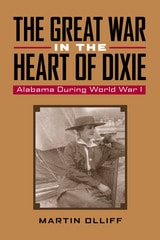
The Great War in the Heart of Dixie
Alabama During World War IMartin T. Olliff
University of Alabama Press, 2008