Results by title
1218 books match the query 'African Americans' and 234 start with t
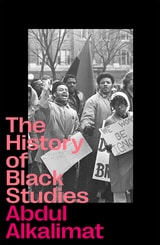
The History of Black Studies
Abdul Alkalimat
Pluto Press, 2021
A surge of African American enrolment and student activism brought Black Studies to many US campuses in the 1960s. Sixty years later, Black Studies programs are taught at more than 1,300 universities worldwide. This book is the first history of how that happened.
Black Studies founder and movement veteran Abdul Alkalimat offers a comprehensive history of the discipline that will become a key reference for generations to come. Structured in three broadly chronological sections - Black Studies as intellectual history; as social movement; and as academic profession - the book demonstrates how Black people themselves established the field long before its institutionalization in university programs.
At its heart, Black Studies is profoundly political. Black Power, the New Communist Movement, the Black women’s and students’ movements – each step in the journey for Black liberation influenced and was influenced by this revolutionary discipline.
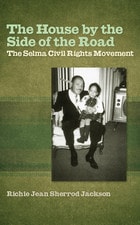
The House by the Side of the Road
The Selma Civil Rights MovementRichie Jean Sherrod Jackson
University of Alabama Press, 2011
King’s informal headquarters in Selma was the home of Dr. Sullivan and Richie Jean Sherrod Jackson and their young daughter, Jawana. The House by the Side of the Road is Richie Jean’s firsthand account of the private meetings King and his lieutenants, including Ralph David Abernathy and John Lewis, held in the haven of the Jackson home.
Sullivan Jackson was an African American dentist in Selma and a prominent supporter of the civil rights movement. Richie Jean was a close childhood friend of King’s wife, Coretta Scott King, a native of nearby Marion, Alabama. Richie Jean’s fascinating account narrates how, in the fraught months of 1965 that preceded the Voting Rights March, King and his inner circle held planning sessions and met with Assistant Attorney General John Doar to negotiate strategies for the event.
Just eight days after Bloody Sunday, President Lyndon Johnson made a televised addressed to a joint session of Congress on Monday, March 15. Jackson relates the intimate scene of King and his lieutenants watching as Johnson called the nation to dedicate itself to equal rights for all and ending his address with the words: “We shall overcome.” Five months later, Congress passed the 1965 Voting Rights Act on August 6.
The major motion picture Selma now commemorates the fiftieth anniversary of Bloody Sunday and the 1965 Voting Rights Act. In it, Niecy Nash and Kent Faulcon star as Sullivan and Richie Jean Jackson among a cast including Oprah Winfrey, Tom Wilkinson, and Cuba Gooding Jr. A gripping primary source, The House by the Side of the Road illuminates the private story whose public outcomes electrified the world and changed the course of American history.
The House on Rondo
Debra J Stone
University of Minnesota Press, 2025
A young girl reckons with the demolition of a Black Saint Paul neighborhood to make way for the Interstate in the early 1960s
When thirteen-year-old Zenobia has to leave her friends and spend the summer at Grandma’s while Mama recovers from a stroke, life seems so unfair. But then the eviction letters start arriving throughout her grandparents’ neighborhood, and white men chalk arrows to mark the gas and water lines, and a new world of unfairness unfolds before her. It’s 1963, and Zenobia’s grandparents’ house on Rondo Avenue in Saint Paul—like all the homes in this thriving Black community—is targeted for demolition to make way for the new Interstate Highway 94.
As Zenobia gradually learns about what’s planned for the Rondo neighborhood and what this means for everyone who lives there, she discovers how her story is intertwined with the history of her family, all the way back to Great Grandma Zenobia and the secrets Grandma Essie held close about the reason for her light skin. With the destruction of the neighborhood looming, Zenobia takes a stand on behalf of her community, joining her no-nonsense neighbor, onetime cowgirl Mrs. Ruby Pearl, in a protest and ultimately getting arrested. Though Zenobia is grounded for a month, her punishment seems of little consequence in comparison to what is happening all around her. Even though the demolition continues, she is proud to discover the power and connection in protesting injustice.
The House on Rondo captures the heartbreak, resistance, and resilience that marks a community sacrificed in the name of progress—a “progress” that never seems to favor Black families and neighborhoods and that haunts cities like Saint Paul to this day. As Zenobia learns what can be destroyed and what cannot, her story teaches us that joy, community, and love persist, even amid violence and loss.
The Human in Bits
Graphical Computers, Black AbstractionsKris Cohen
Duke University Press, 2025
The Insistent Call
Rhetorical Moments in Black Anticolonialism, 1929-1937Aric Putnam
University of Massachusetts Press, 2012
Throughout the nineteenth century, African heritage played an important role in black America, as personal memories and cultural practices continued to shape the everyday experience of people of African descent living under the shadow of slavery. Resisting efforts to de-Africanize their values, customs, and beliefs, Black Americans invoked their African roots in public arguments about their identity and place in the “new” world. At the outset of the twentieth century many still saw Africa primarily as the source of a common cultural and spiritual past. But after the 1920s, the meaning of African heritage changed as people of African descent expressed new relationships between themselves, the United States, and the African Diaspora.
In The Insistent Call, Aric Putnam studies the rhetoric of newspapers, literature, and political pamphlets that expressed this shift. He demonstrates that as people of African descent debated the United States' occupation of Haiti, the Liberian labor crisis, and the Italian invasion of Ethiopia, they formed a new collective identity, one that understood the African Diaspora in primarily political rather than cultural terms. In addition to uncovering a neglected period in the history of Black rhetoric, Putnam shows how rhetoric that articulates the interests of a population not defined by the boundaries of a state can still motivate collective action and influence policies.
The Internal Colony
Race and the American Politics of Global DecolonizationSam Klug
University of Chicago Press, 2025
In The Internal Colony, Sam Klug reveals the central but underappreciated importance of global decolonization to the divergence between mainstream liberalism and the Black freedom movement in postwar America. Klug reconsiders what has long been seen as a matter of primarily domestic policy in light of a series of debates concerning self-determination, postcolonial economic development, and the meanings of colonialism and decolonization. These debates deeply influenced the discord between Black activists and state policymakers and formed a crucial dividing line in national politics in the 1960s and 1970s.
The result is a history that broadens our understanding of ideological formation—particularly how Americans conceptualized racial power and political economy—by revealing a much wider and more dynamic network of influences. Linking intellectual, political, and social movement history, The Internal Colony illuminates how global decolonization transformed the terms of debate over race and social class in the twentieth-century United States.
The Interpreter
Alice Kaplan
University of Chicago Press, 2007
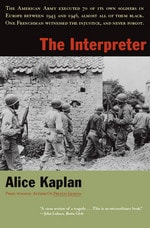
No story of World War II is more triumphant than the liberation of France, made famous in countless photos of Parisians waving American flags and kissing GIs as columns of troops paraded down the Champs Élysées. But one of the least-known stories from that era is also one of the ugliest chapters in the history of Jim Crow. In The Interpreter, celebrated author Alice Kaplan recovers this story both as eyewitnesses first saw it, and as it still haunts us today.
The American Army executed 70 of its own soldiers between 1943 and 1946—almost all of them black, in an army that was overwhelmingly white. Through the French interpreter Louis Guilloux’s eyes, Kaplan narrates two different trials: one of a white officer, one of a black soldier, both accused of murder. Both were court-martialed in the same room, yet the outcomes could not have been more different.
Kaplan’s insight into character and setting creates an indelible portrait of war, race relations, and the dangers of capital punishment.
“A nuanced historical account that resonates with today’s controversies over race and capital punishment.” Publishers Weekly
“American racism could become deadly for black soldiers on the front. The Interpreter reminds us of this sad component of a heroic chapter in American military history.” Los Angeles Times
“With elegance and lucidity, Kaplan revisits these two trials and reveals an appallingly separate and unequal wartime U.S. military justice system.” Minneapolis Star Tribune
“Kaplan has produced a compelling look at the racial disparities as they were played out…She explores both cases in considerable and vivid detail.” Sacramento Bee
The Jemima Code
Two Centuries of African American CookbooksBy Toni Tipton-Martin; forewords by John Egerton and Barbara Haber
University of Texas Press, 2015
Winner, James Beard Foundation Book Award, 2016
Art of Eating Prize, 2015
BCALA Outstanding Contribution to Publishing Citation, Black Caucus of the American Library Association, 2016
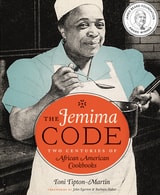
Women of African descent have contributed to America’s food culture for centuries, but their rich and varied involvement is still overshadowed by the demeaning stereotype of an illiterate “Aunt Jemima” who cooked mostly by natural instinct. To discover the true role of black women in the creation of American, and especially southern, cuisine, Toni Tipton-Martin has spent years amassing one of the world’s largest private collections of cookbooks published by African American authors, looking for evidence of their impact on American food, families, and communities and for ways we might use that knowledge to inspire community wellness of every kind.
The Jemima Code presents more than 150 black cookbooks that range from a rare 1827 house servant’s manual, the first book published by an African American in the trade, to modern classics by authors such as Edna Lewis and Vertamae Grosvenor. The books are arranged chronologically and illustrated with photos of their covers; many also display selected interior pages, including recipes. Tipton-Martin provides notes on the authors and their contributions and the significance of each book, while her chapter introductions summarize the cultural history reflected in the books that follow. These cookbooks offer firsthand evidence that African Americans cooked creative masterpieces from meager provisions, educated young chefs, operated food businesses, and nourished the African American community through the long struggle for human rights. The Jemima Code transforms America’s most maligned kitchen servant into an inspirational and powerful model of culinary wisdom and cultural authority.

The Journey Back
Houston A. Baker Jr.
University of Chicago Press, 1984
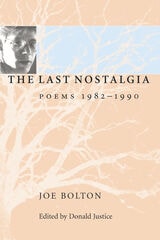
The Last Nostalgia
Poems, 1982–1990Joe Bolton
University of Arkansas Press, 1999
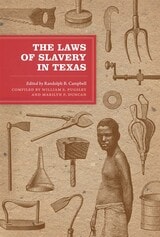
The Laws of Slavery in Texas
Historical Documents and EssaysEdited by Randolph B. Campbell
University of Texas Press, 2010
The laws that governed the institution of slavery in early Texas were enacted over a fifty-year period in which Texas moved through incarnations as a Spanish colony, a Mexican state, an independent republic, a part of the United States, and a Confederate state. This unusual legal heritage sets Texas apart from the other slave-holding states and provides a unique opportunity to examine how slave laws were enacted and upheld as political and legal structures changed. The Laws of Slavery in Texas makes that examination possible by combining seminal historical essays with excerpts from key legal documents from the slave period and tying them together with interpretive commentary by the foremost scholar on the subject, Randolph B. Campbell.
Campbell's commentary focuses on an aspect of slave law that was particularly evident in the evolving legal system of early Texas: the dilemma that arose when human beings were treated as property. As Campbell points out, defining slaves as moveable property, or chattel, presented a serious difficulty to those who wrote and interpreted the law because, unlike any other form of property, slaves were sentient beings. They were held responsible for their crimes, and in numerous other ways statute and case law dealing with slavery recognized the humanness of the enslaved. Attempts to protect the property rights of slave owners led to increasingly restrictive laws—including laws concerning free blacks—that were difficult to uphold. The documents in this collection reveal both the roots of the dilemma and its inevitable outcome.
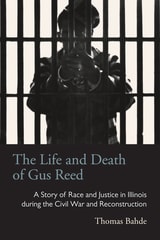
The Life and Death of Gus Reed
A Story of Race and Justice in Illinois during the Civil War and ReconstructionThomas Bahde
Ohio University Press, 2014
Gus Reed was a freed slave who traveled north as Sherman’s March was sweeping through Georgia in 1864. His journey ended in Springfield, Illinois, a city undergoing fundamental changes as its white citizens struggled to understand the political, legal, and cultural consequences of emancipation and black citizenship. Reed became known as a petty thief, appearing time and again in the records of the state’s courts and prisons. In late 1877, he burglarized the home of a well-known Springfield attorney—and brother of Abraham Lincoln’s former law partner—a crime for which he was convicted and sentenced to the Illinois State Penitentiary.
Reed died at the penitentiary in 1878, shackled to the door of his cell for days with a gag strapped in his mouth. An investigation established that two guards were responsible for the prisoner’s death, but neither they nor the prison warden suffered any penalty. The guards were dismissed, the investigation was closed, and Reed was forgotten.
Gus Reed’s story connects the political and legal cultures of white supremacy, black migration and black communities, the Midwest’s experience with the Civil War and Reconstruction, and the resurgence of nationwide opposition to African American civil rights in the late nineteenth century. These experiences shaped a nation with deep and unresolved misgivings about race, as well as distinctive and conflicting ideas about justice and how to achieve it.
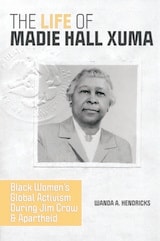
The Life of Madie Hall Xuma
Black Women's Global Activism during Jim Crow and ApartheidWanda A. Hendricks
University of Illinois Press, 2022
The Lonely Letters
Ashon T. Crawley
Duke University Press, 2020
The Making of "Mammy Pleasant"
A Black Entrepreneur in Nineteenth-Century San FranciscoLynn M. Hudson
University of Illinois Press, 2002
Investigating Mary Ellen Pleasant's convoluted legacy
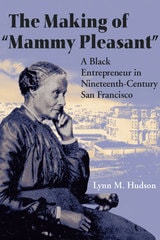
Mary Ellen Pleasant arrived in Gold Rush-era San Francisco a free black woman with abolitionist convictions and a predilection for entrepreneurial success. Behind the convenient and trusted disguise of "Mammy," she transformed domestic labor into enterprise, amassed remarkable real estate, wealth, and power, and gained notoriety for her work in fighting Jim Crow.
Pleasant's legacy is steeped in scandals and lore. Was she a voodoo queen who traded in sexual secrets? A madam? A murderer? In The Making of "Mammy Pleasant," Lynn M. Hudson examines the folklore of Pleasant's real and imagined powers. Emphasizing the significance of her life in the context of how it has been interpreted or ignored in the larger trends of American history, Hudson integrates fact and speculation culled from periodicals, court cases, diaries, letters, Pleasant's interviews with the San Francisco press, and various biographical and fictional accounts.
Addressing the lack of a historical record of black women's lives, the author argues that the silences and mysteries of Pleasant's past, whether never recorded or intentionally omitted, reveal as much about her life as what has been documented. Through Pleasant's life, Hudson also interrogates the constructions of race, gender, and sexuality during the formative years of California's economy and challenges popular mythology about the liberatory sexual culture of the American West.
The Making of a Black Communist
The Selected Writings of Eugene GordonLouis J. Parascandola, Editor
University of Massachusetts Press, 2025
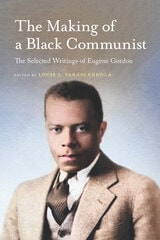
Eugene Gordon (1891–1974) was a major writer involved in the development of the burgeoning Black literary scene in Boston in the 1920s, an active player in the Harlem Renaissance, and a longtime member of the Communist Party. Despite his credentials as a reporter, editor, fiction writer, and political activist, he is rarely mentioned in studies of the Harlem Renaissance or Marxist politics. Here, Louis J. Parascandola has pulled together Gordon’s journalism, autobiographical writing, and fiction. This new collection, featuring both previously published pieces from a wide variety of publications as well as material that has never before been published, demonstrates his range and his skill while establishing his importance as a critical voice of his time.
Gordon was born and raised in the South but made his way north at a young age. In Boston, he founded the Saturday Evening Quill Club, an African American literary group that included other notable writers such as Helene Johnson and Dorothy West. He later became editor of and contributor to two major publications coming out of the era: the Messenger and Opportunity: A Journal of Negro Life. As he grew more political, he joined the Communist Party in the 1930s and became editor of and contributor to the New Masses. Scholars looking to research him have struggled to find disparate writings to get a fuller sense of his literary stylings as well as his political commitments. This welcome new volume establishes Gordon as a significant, understudied figure.
The Making of a Black Scholar
From Georgia to the Ivy LeagueHorace A. Porter
University of Iowa Press, 2003
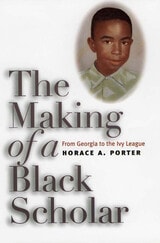
The Making of a Black Scholar is structured around schools. Porter attends Georgia's segregated black schools until he enters the privileged world of Amherst College. He graduates (spending one semester at Morehouse College) and moves on to graduate study at Yale. He starts his teaching career at Detroit's Wayne State University and spends the 1980s at Dartmouth College and the 1990s at Stanford University.
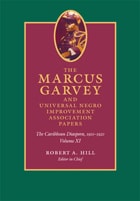
The Marcus Garvey and Universal Negro Improvement Association Papers, Volume XI
The Caribbean Diaspora, 1910–1920Marcus Garvey
Duke University Press, 2011
Praise for the Previous Volumes:
“The Marcus Garvey and Universal Negro Improvement Association Papers will take its place among the most important records of the Afro-American experience. . . . ‘The Marcus Garvey Papers’ lays the groundwork for a long overdue reassessment of Marcus Garvey and the legacy of racial pride, nationalism and concern with Africa he bequeathed to today’s black community.”—Eric Foner, the New York Times Book Review
“Until the publication of The Marcus Garvey and Universal Negro Improvement Association Papers, many of the documents necessary for a full assessment of Garvey’s thought or of his movement’s significance have not been easily accessible. Robert A. Hill and his staff . . . have gathered over 30,000 documents from libraries and other sources in many countries. . . . The Garvey papers will reshape our understanding of the history of black nationalism and perhaps increase our understanding of contemporary black politics.”—Clayborne Carson, the Nation
“Now is our chance, through these important volumes, to finally begin to come to terms with the significance of Garvey’s complex, fascinating career and the meaning of the movement he built.”—Lawrence W. Levine, the New Republic
The Marengo Jake Stories
The Tales of Jake Mitchell and Robert Wilton BurtonJake Mitchell and Robert Wilton Burton, collected by Kathryn Sport and Bert Hitchcock
University of Alabama Press, 2007
Between 1885 and 1894 The Montgomery Advertiser, The Birmingham-Age Herald, and The New Orleans Times Democrat featured a series of about 80 humorous black-dialect sketches by Robert Wilton Burton, a bookseller and writer from Auburn, Alabama. According to Burton, these tales were based on various characters in the black community of Auburn, and 36 of them were devoted exclusively to a character called "Marengo Jake." Probably originally from Virginia, Jake Mitchell was brought to the Drake Plantation in Marengo county as a boy in the 1850's. After the Civil War, the Drake family moved to Auburn and many former slaves followed, forming a fairly large expatriate Marengo County community. The theme of the stories, usually related by Jake, centers on the superiority of all things from Marengo County, especially over those in Lee County, in which Auburn is located.
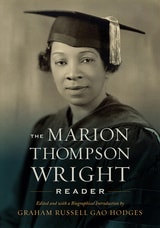
The Marion Thompson Wright Reader
Edited and with a Biographical Introduction by Graham Russell Gao HodgesGraham Russell Gao Hodges
Rutgers University Press, 2022
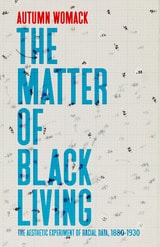
The Matter of Black Living
The Aesthetic Experiment of Racial Data, 1880–1930Autumn Womack
University of Chicago Press, 2022
As the nineteenth century came to a close and questions concerning the future of African American life reached a fever pitch, many social scientists and reformers approached post-emancipation Black life as an empirical problem that could be systematically solved with the help of new technologies like the social survey, photography, and film. What ensued was nothing other than a “racial data revolution,” one which rendered African American life an inanimate object of inquiry in the name of social order and racial regulation. At the very same time, African American cultural producers and intellectuals such as W. E. B. Du Bois, Kelly Miller, Sutton Griggs, and Zora Neale Hurston staged their own kind of revolution, un-disciplining racial data in ways that captured the dynamism of Black social life.
The Matter of Black Living excavates the dynamic interplay between racial data and Black aesthetic production that shaped late nineteenth-century social, cultural, and literary atmosphere. Through assembling previously overlooked archives and seemingly familiar texts, Womack shows how these artists and writers recalibrated the relationship between data and Black life. The result is a fresh and nuanced take on the history of documenting Blackness. The Matter of Black Living charts a new genealogy from which we can rethink the political and aesthetic work of racial data, a task that has never been more urgent.
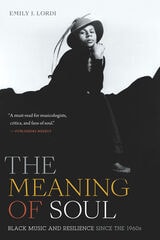
The Meaning of Soul
Black Music and Resilience since the 1960sEmily J. Lordi
Duke University Press, 2020
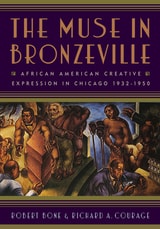
The Muse in Bronzeville
African American Creative Expression in Chicago, 1932-1950Bone, Robert
Rutgers University Press, 2011
The Muse in Bronzeville, a dynamic reappraisal of a neglected period in African American cultural history, is the first comprehensive critical study of the creative awakening that occurred on Chicago's South Side from the early 1930s to the cold war. Coming of age during the hard Depression years and in the wake of the Great Migration, this generation of Black creative artists produced works of literature, music, and visual art fully comparable in distinction and scope to the achievements of the Harlem Renaissance.
This highly informative and accessible work, enhanced with reproductions of paintings of the same period, examines Black Chicago's "Renaissance" through richly anecdotal profiles of such figures as Richard Wright, Gwendolyn Brooks, Margaret Walker, Charles White, Gordon Parks, Horace Cayton, Muddy Waters, Mahalia Jackson, and Katherine Dunham. Robert Bone and Richard A. Courage make a powerful case for moving Chicago's Bronzeville, long overshadowed by New York's Harlem, from a peripheral to a central position within African American and American studies.
The Muse is Music
Jazz Poetry from the Harlem Renaissance to Spoken WordMeta DuEwa Jones
University of Illinois Press, 2013
This wide-ranging, ambitiously interdisciplinary study traces jazz's influence on African American poetry from the Harlem Renaissance to contemporary spoken word poetry. Examining established poets such as Langston Hughes, Ntozake Shange, and Nathaniel Mackey as well as a generation of up-and-coming contemporary writers and performers, Meta DuEwa Jones highlights the intersections of race, gender, and sexuality within the jazz tradition and its representation in poetry. Applying prosodic analysis to emphasize the musicality of African American poetic performance, she examines the gendered meanings evident in collaborative performances and in the criticism, images, and sounds circulating within jazz cultures.
The Negro in Illinois
The WPA PapersEdited by Brian Dolinar
University of Illinois Press, 2013
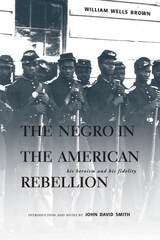
The Negro in the American Rebellion
His Heroism and His FidelityWilliam Wells Brown
Ohio University Press, 1997
In 1863, as the Civil War raged, the escaped slave, abolitionist, and novelist William Wells Brown identified two groups most harmful to his race. “The first and most relentless,” he explained, “are those who have done them the greatest injury, by being instrumental in their enslavement and consequent degradation. They delight to descant upon the ‘natural inferiority’ of the blacks, and claim that we were destined only for a servile condition, entitled neither to liberty nor the legitimate pursuit of happiness.”
“The second class,” Brown concluded, “are those who are ignorant of the characteristics of the race, and are the mere echoes of the first.” Four years later, Brown wrote the first military history of African Americans, The Negro in the American Rebellion. This text assailed those whose hatred and ignorance inclined them to keep blacks oppressed after Appomattox.
This critical edition of The Negro in the American Rebellion, one of Brown’s least-analyzed texts, is the first to appear in more than three decades. In his introduction, historian John David Smith identifies the text’s Anglo-American abolitionist roots, sets it in the context of Brown’s other writings, appraises it as military history, analyzes its interpretation of black masculinity and honor, and focuses closely on Brown’s assessment of contemporary racial tensions.
Largely ignored by scholars, The Negro in the American Rebellion, Smith argues, is a powerful transitional text, one that confronted squarely the neo-slavery of the Reconstruction era.
“Whites,” Brown wrote, “appear determined to reduce the blacks to a state of serfdom if they cannot have them as slaves.” His important text was a call to arms in the ongoing race struggle. Smith’s analysis, framed within recent scholarship on slavery, emancipation, and African American participation in the U.S. army, is long overdue.
The New Black Middle Class in the Twenty-First Century
Landry, Bart
Rutgers University Press, 2018
The New Book of Plots
Constructing Engaging Narratives for Oral and Written StorytellingLoren Niemi
Parkhurst Brothers, Inc., 2012
In the space of the thirty-some years I have called myself a storyteller, the balance of what I tell has shifted from children’s stories and traditional folk and fairy tales told in schools, churches, and community centers to stories drawn directly from my own experiences. But I also understand that by adapting and re-imagining traditional folk and fairy tale material, you can provide a point of entry for contemporary listeners to experience, as psychologist Bruno Bettelheim has suggested in his book The Uses of Enchantment, the continuing power of the old stories to speak to the imagination and heart.
Wanting to make a connection between the older stories and our existential circumstance, I sought to re-interpret folk and fairy tales by placing them in a more contemporary context. The confusing Black Forest of the Brothers Grimm became the crowded shopping mall. Rapunzel’s mother sought a more familiar drug than the painkilling herbs of the witch’s garden. I also created stories that were in the style of the older folk and fairy tales. One featured a lowly cucumber plant that, after consuming radioactive water and junk-food compost, became the glowing, green Godzilla of pickles. Another featured a boy named Jack, who found fame and fortune racing inner-city cockroaches.
In creating and performing original stories and reimagined folk tales, as well as teaching stories to students of all ages, it has become clear to me that how we tell the story, as much as why, is at the very heart of the art. By “how,” I do not mean how we use voice and gesture, etc., but how we organize stories to get across their meanings to an audience.
There are two central facts at the heart of the oral story. The first is that it begins when the teller begins and ends when the teller ends it, though I could argue that it actually ends when the audience dismisses it. This is fundamentally different from the written story, where a reader can go back and read the same words again. With the spoken word, we are in the moment. Even if we could ask the teller to go back and say something again, the very act of asking would alter the way in which the information is conveyed to us. This leads directly to the second basic fact: the act of telling is an expression of the relationship of the teller to the audience. We always tell to someone, even if it is to ourselves. It is incumbent upon us to recognize that the choice we make about how we tell a story to a given audience is as much about our understanding of who that audience is as it is about what we are saying to the audience.
It is this crucial understanding of how the narrative is shaped and the choices we make as tellers to share a particular version of a story with a particular audience that I wish to explore with you. Whether we are working with a live audience in performance or with an imagined one while typing away on our laptops, the creation of compelling fiction and non-fiction begins with how to frame the story.
This book is for storytellers and would-be storytellers, whether you call yourself a writer, minister, politician, journalist, lawyer, teacher, therapist, or street-corner b.s.’er. Whatever the name, the benefit you derive from the application of this material to your creative process will come from understanding how narrative is shaped and making conscious decisions about shaping that narrative content. This book was developed in workshops and classes I’ve conducted with storytellers and writers since 1986. In the course of those years, this teaching practice has refined my thinking and improved my ability to help participants discover new approaches to creating powerful, authentic, and entertaining stories.
Much of what I say will be framed around the creation of stories as oral performance, but the concepts and exercises I suggest apply to written material as well. Whether the stories are oral or written, this book is about three things: the choice of an appropriate narrative form to provide the story’s structure, the choice of an appropriate point of view and timeframe to support the story’s emotional arc, and how those choices help or hinder the transmission of the meaning of the story to an audience.
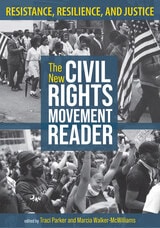
The New Civil Rights Movement Reader
Resistance, Resilience, and JusticeEdited by Traci Parker and Marcia Walker-McWilliams
University of Massachusetts Press, 2023
In the United States, the fight to secure full civil rights for African American people has endured for centuries. The movement has included many voices, among them, working people, charismatic activists, musicians and artists, the LGBTQIA community, veterans, suburbanites, and elected officials. Moving from the labor struggles of the 1930s to the sit-ins and boycotts of midcentury, and the Black Lives Matter protests of today, this expansive volume brings together first-person accounts, political documents and speeches, and historical photographs from each region of the country.
Designed for use in courses and engaging for general readers, this new compilation is the most diverse, most inclusive, and most comprehensive resource available for teaching and learning about the civil rights movement. With chronological and geographical depth, The New Civil Rights Movement Reader addresses a range of key topics, including youth activism, regional and local freedom struggles, voting rights, economic inequality, gender, sexuality, and culture, and the movement’s global reach.
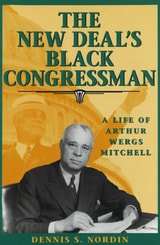
The New Deal's Black Congressman
A Life of Arthur Wergs MitchellDennis S. Nordin
University of Missouri Press, 1997
In this fascinating biography, Dennis S. Nordin chronicles the life of Arthur Wergs Mitchell, the first black Democrat to be elected to Congress. Although he is now one of history's forgotten figures, Mitchell was once almost as well known among black college students as Jesse Owens and Joe Louis. Nordin, however, shows that Mitchell's achievements and thus his fame were the direct result of his dishonorable deeds.
Mitchell's life began humbly in rural Alabama in 1883. After a memorable boyhood, he studied briefly at Tuskegee Institute, which had a major effect on Mitchell's outlook. He went on to study law in Washington, D.C., and thereafter became involved in politics when the Republicans sent him to Chicago in 1928 to campaign for Herbert Hoover. Impressed by Chicago's ward system and patronage politics, he returned to the city and made a bid for a congressional seat, changing political parties in an effort to oust black Republican Congressman Oscar DePriest. To accomplish this, Mitchell resorted to "Uncle Tomming," ingratiating himself with the white bosses of the Chicago Machine.
Within five years a Machine nomination was in hand, and Mitchell found himself owing his political success and thus his loyalty to the Chicago Machine. Because he was under strict orders from Chicago Mayor Ed Kelly not to cause problems or be confrontational, Mitchell rarely, if ever, supported the interests of his constituents.
It was only in the later years of his political career that Mitchell began to show opposition to his Machine backing. He had been an opponent of the NAACP in his first years in Congress, but later became a strong supporter of an NAACP antilynching bill. In 1937, Mitchell sued three railroad companies for not offering equal treatment and accommodations for all passengers. The case went to the Supreme Court, which gave Mitchell a favorable ruling. As a result of these "confrontational" acts, the Chicago Machine quickly decided not to endorse Mitchell in the elections of 1942.
In his research, Nordin relies on such primary sources as manuscripts, newspapers, and court records, as well as information from interviews with Mitchell's friends, neighbors, colleagues, political rivals, and widow. Woven tightly together, these sources form a narrative that reveals a most complex and intriguing individual, a man whose political and moral views and acts were strongly linked to the goals of the great Chicago political Machine.
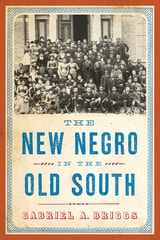
The New Negro in the Old South
Briggs, Gabriel A
Rutgers University Press, 2015
In this groundbreaking historical study, Gabriel A. Briggs makes the compelling case that the New Negro first emerged long before the Great Migration to the North. The New Negro in the Old South reconstructs the vibrant black community that developed in Nashville after the Civil War, demonstrating how it played a pivotal role in shaping the economic, intellectual, social, and political lives of African Americans in subsequent decades. Drawing from extensive archival research, Briggs investigates what made Nashville so unique and reveals how it served as a formative environment for major black intellectuals like Sutton Griggs and W.E.B. Du Bois.
The New Negro in the Old South makes the past come alive as it vividly recounts little-remembered episodes in black history, from the migration of Colored Infantry veterans in the late 1860s to the Fisk University protests of 1925. Along the way, it gives readers a new appreciation for the sophistication, determination, and bravery of African Americans in the decades between the Civil War and the Harlem Renaissance.
The New Real
Media and Mimesis in Japan from Stereographs to EmojiJonathan E. Abel
University of Minnesota Press, 2022
Unlocking a vital understanding of how literary studies and media studies overlap and are bound together
A synthetic history of new media reception in modern and contemporary Japan, The New Real positions mimesis at the heart of the media concept. Considering both mimicry and representation as the core functions of mediation and remediation, Jonathan E. Abel offers a new model for media studies while explaining the deep and ongoing imbrication of Japan in the history of new media.
From stereoscopy in the late nineteenth century to emoji at the dawn of the twenty-first, Abel presents a pioneering history of new media reception in Japan across the analog and digital divide. He argues that there are two realities created by new media: one marketed to us through advertising that proclaims better, faster, and higher-resolution connections to the real; and the other experienced by users whose daily lives and behaviors are subtly transformed by the presence and penetration of the content carried through new media. Intervening in contemporary conversations about virtuality, copyright, copycat violence, and social media, each chapter unfolds with a focus on a single medium or technology, including 3D photographs, the phonograph, television, videogames, and emoji.
By highlighting the tendency of the mediated to copy the world and the world to copy the mediated, The New Real provides a new path for analysis of media, culture, and their function in the world.
The Nigrescent Beyond
Mexico, the United States, and the Psychic Vanishing of BlacknessRicardo A. Wilson II
Northwestern University Press, 2020
Wilson models a practice of reading that honors the disruptive possibilities offered by an ever-present awareness of that which lies, irretrievable, beyond the horizon of vanishing itself. In doing so, he engages with historical accounts detailing maroon activities in early New Spain, contemporary coverage of the push to make legible Afro-Mexican identities, the electronic archives of the Obama presidency, and the work of Carlos de Sigüenza y Góngora, Octavio Paz, Ivan Van Sertima, Miguel Covarrubias, Steven Spielberg, and Colson Whitehead, among others.

The Northern Stories of Charles W. Chesnutt
Charles W. Chesnutt
Ohio University Press, 2004
The first African American fiction writer to earn a national reputation, Charles W. Chesnutt remains best known for his depictions of Southern life before and after the Civil War. But he also produced a large body of what might best be called his “Northern” writings, and those works, taken together, describe the intriguing ways in which America was reshaping itself at the turn of the last century.
The Northern Stories of Charles W. Chesnutt collects for the first time eighteen Chesnutt stories—several of them first appearing in Northern magazines or newspapers—that portray life in the North in the period between the Civil War and World War I. Living in Ohio from 1883 until his death in 1932, Chesnutt witnessed and wrote about the social, cultural, and racial upheavals taking place in the North during a crucial period of American history. His Northern stories thus reflect his vision of a newly reconstituted America, one recommitted to the ideals of freedom and economic opportunity inherent in our national heritage.
The stories, compiled and edited with critical introductions to each by Professor Charles Duncan, offer a new Chesnutt, one fascinated by the evolution of America into an urban, multiracial, economically driven democracy.
The Northern Stories of Charles W. Chesnutt presents richly imagined characters, both black and white, working to make better lives for themselves in the turbulent and stimulating universe of the turn-of-the-century North. Indeed, Chesnutt stands virtually alone as the first African American chronicler of Northern culture, anticipating such figures as James Weldon Johnson, Langston Hughes, Ralph Ellison, James Baldwin, and Toni Morrison. This critical edition of The Northern Stories of Charles W. Chesnutt is a significant addition to the body of African American literature.
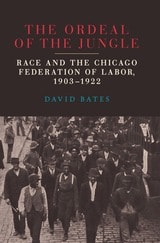
The Ordeal of the Jungle
Race and the Chicago Federation of Labor, 1903–1922David Bates
Southern Illinois University Press, 2019
By organizing workers into neighborhood locals, which connected workplace struggles to ethnic and religious identities, the CFL facilitated a surge in the organization’s membership, particularly among African American workers, and afforded the federation the opportunity to aggressively confront employers. The CFL’s innovative structure, however, was ultimately its demise. Linking union locals to neighborhoods proved to be a form of de facto segregation. Over time union structures, rank-and-file conflicts, and employer resistance combined to turn the union’s hopeful calls for solidarity into animosity and estrangement. Tensions were exacerbated by violent shop floor confrontations and exploded in the bloody 1919 Chicago Race Riot. By the early 1920s, the CFL had collapsed.
The Ordeal of the Jungle explores the choices of a variety of people while showing a complex, overarching interplay of black and white workers and their employers. In addition to analyzing union structures and on-the-ground relations between workers, Bates synthesizes and challenges previous scholarship on interracial organizing to explain the failure of progressive unionism in Chicago.
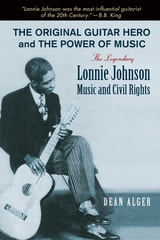
The Original Guitar Hero and the Power of Music
The Legendary Lonnie Johnson, Music, and Civil RightsDean Alger
University of North Texas Press, 2014
The Other Brahmins
Boston's Black Upper Class 1750-1950Adelaide Cromwell
University of Arkansas Press, 1995
Adelaide Cromwell’s pioneering work explores race and the social caste system in an atypical northern environment over a period of two centuries. Based on scholarly sources, interviews, and questionnaires, the study identifies those blacks in Boston who exercised political, economic, and social leadership from the end of the eighteenth century to the middle of the twentieth. The central focus is a comparison of black and white upper-class women in the 1940s.
This rare look at a black social microcosm not located in the South is seminal and timely. Because it concludes at a critical period in American history, The Other Brahmins paints a colorful backdrop for evaluating subsequent changes in urban sociology and stratification. In a groundbreaking study, Cromwell effectively challenges the simplistic notions of hierarchy as they pertain to race.
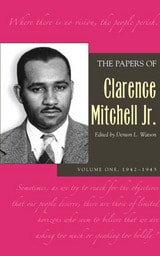
The Papers of Clarence Mitchell Jr., Volume I
1942–1943Clarence Mitchell Jr.
Ohio University Press, 2005
Clarence Mitchell Jr. was the driving force in the movement for passage of civil rights laws in America. The foundation for Mitchell’s struggle was laid during his tenure at the Fair Employment Practice Committee, where he led implementation of President Roosevelt’s policy barring racial discrimination in employment in the national defense and war industry programs. Mitchell’s FEPC reports and memoranda chart the beginning of the modern civil rights movement.
The first two volumes of a projected five-volume documentary edition of The Papers of Clarence Mitchell Jr. illuminate the FEPC’s work as a federal affirmative-action agency and the government’s struggle to enforce the nation’s antidiscrimination policy in industry, federal agencies, and labor unions.
Subsequent volumes will trace Mitchell’s successive enlistment of seven presidents in establishing and enforcing a permanent national nondiscrimination policy. Through his efforts, Congress passed the 1957, 1960, and 1964 Civil Rights Acts prohibiting discrimination in public accommodations, federal spending, and employment based on race, color, sex, and national origin; the 1965 Voting Rights Act; and the 1968 Fair Housing Act.
Editor Denton L. Watson introduces and annotates Mitchell’s writings, providing context and insight for students and scholars of civil rights history, government, law, and sociology.
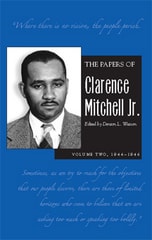
The Papers of Clarence Mitchell Jr., Volume II
1944–1946Clarence Mitchell Jr.
Ohio University Press, 2005
Clarence Mitchell Jr. was the driving force in the movement for passage of civil rights laws in America. The foundation for Mitchell’s struggle was laid during his tenure at the Fair Employment Practice Committee, where he led implementation of President Roosevelt’s policy barring racial discrimination in employment in the national defense and war industry programs. Mitchell’s FEPC reports and memoranda chart the beginning of the modern civil rights movement.
The first two volumes of a projected five-volume documentary edition of The Papers of Clarence Mitchell Jr. illuminate the FEPC’s work as a federal affirmative-action agency and the government’s struggle to enforce the nation’s antidiscrimination policy in industry, federal agencies, and labor unions.
Subsequent volumes will trace Mitchell’s successive enlistment of seven presidents in establishing and enforcing a permanent national nondiscrimination policy. Through his efforts, Congress passed the 1957, 1960, and 1964 Civil Rights Acts prohibiting discrimination in public accommodations, federal spending, and employment based on race, color, sex, and national origin; the 1965 Voting Rights Act; and the 1968 Fair Housing Act.
Editor Denton L. Watson introduces and annotates Mitchell’s writings, providing context and insight for students and scholars of civil rights history, government, law, and sociology.
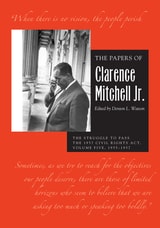
The Papers of Clarence Mitchell Jr., Volume V
The Struggle to Pass the 1957 Civil Rights Act, 1955–1958Clarence Mitchell Jr.
Ohio University Press, 2021
Volume V of The Papers of Clarence Mitchell Jr. records the successful effort to pass the 1957 Civil Rights Act: the first federal civil rights legislation since 1875.
Prior to the US Supreme Court’s landmark 1954 decision in Brown v. Board of Education, the NAACP had faced an impenetrable wall of opposition from southerners in Congress. Basing their assertions on the court’s 1896 “separate but equal” decision in Plessy v. Ferguson, legislators from the South maintained that their Jim Crow system was nondiscriminatory and thus constitutional. In their view, further civil rights laws were unnecessary. In ruling that legally mandated segregation of public schools was unconstitutional, the Brown decision demolished the southerners’ argument. Mitchell then launched the decisive stage of the struggle to pass modern civil rights laws.
The passage of the Civil Rights Act of 1957 was the first comprehensive lobbying campaign by an organization dedicated to that purpose since Reconstruction. Coming on the heels of the Brown decision, the 1957 law was a turning point in the struggle to accord Black citizens full equality under the Constitution. The act’s passage, however, was nearly derailed in the Senate by southern opposition and Senator Strom Thurmond’s record-setting filibuster, which lasted more than twenty-four hours. Congress later weakened several provisions of the act but—crucially—it broke a psychological barrier to the legislative enactment of such measures.
The Papers of Clarence Mitchell Jr. is a detailed record of the NAACP leader’s success in bringing the legislative branch together with the judicial and executive branches to provide civil rights protections during the twentieth century.
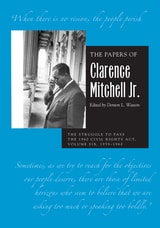
The Papers of Clarence Mitchell Jr., Volume VI
The Struggle to Pass the 1960 Civil Rights Act, 1959–1960Clarence Mitchell Jr.
Ohio University Press, 2021
The Civil Rights Act of 1960 aimed to close loopholes in its 1957 predecessor that had allowed continued voter disenfranchisement for African Americans and for Mexicans in Texas.
In early 1959, the newly seated Eighty-Sixth Congress had four major civil rights bills under consideration. Eventually consolidated into the 1960 Civil Rights Act, their purpose was to correct the weaknesses in the 1957 law. Mitchell’s papers from 1959 to 1960 show the extent to which congressional resistance to the passage of meaningful civil rights laws contributed to the lunch counter sit-ins in Greensboro, North Carolina, and to subsequent demonstrations. The papers reveal how the repercussions of these events affected the NAACP’s work in Washington and how, despite their dislike of demonstrations, NAACP officials used them to intensify the civil rights struggle.
Among the act’s seven titles were provisions authorizing federal inspection of local voter registration rolls and penalties for anyone attempting to interfere with voters on the basis of race or color. The law extended the powers of the US Commission on Civil Rights and broadened the legal definition of the verb to vote to encompass all elements of the process: registering, casting a ballot, and properly counting that ballot. Ultimately, Mitchell considered the 1960 act unsuccessful because Congress had failed to include key amendments that would have further strengthened the 1957 act. In the House, representatives used parliamentary tactics to stall employment protections, school desegregation, poll-tax elimination, and other meaningful civil rights reforms. The fight would continue.
The Papers of Clarence Mitchell Jr. series is a detailed record of the NAACP leader’s success in bringing the legislative branch together with the judicial and executive branches to provide civil rights protections during the twentieth century.
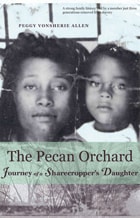
The Pecan Orchard
Journey of a Sharecropper's DaughterPeggy Vonsherie Allen
University of Alabama Press, 2011
This is a true story of the struggle, survival, and ultimate success of a large black family in south Alabama who, in the middle decades of the 20th century, lifted themselves out of poverty to achieve the American dream of property ownership. Descended from slaves and sharecroppers in the Black Belt region, this family of hard-working parents and their thirteen children is mentored by its matriarch, Moa, the author’s beloved great grandmother, who passes on to the family, along with other cultural wealth, her recipe for moonshine.
Without rancor or blame, and even with occasional humor, The Pecan Orchard offers a window into the inequities between blacks and whites in a small southern town still emerging from Jim Crow attitudes.
Told in clean, straightforward prose, the story radiates the suffocating midday heat of summertime cotton fields and the biting winter wind sifting through porous shanty walls. It conveys the implicit shame in “Colored Only” restrooms, drinking fountains, and eating areas; the beaming satisfaction of a job well done recognized by others; the “yessum” manners required of southern society; and the joyful moments, shared memories, and loving bonds that sustain—and even raise—a proud family.
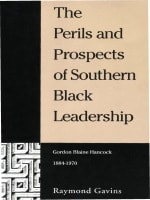
The Perils and Prospects of Southern Black Leadership
Gordon Blaine Hancock, 1884–1970Raymond Gavins
Duke University Press, 1993
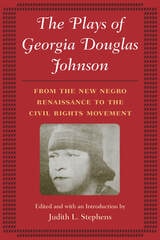
The Plays of Georgia Douglas Johnson
From the New Negro Renaissance to the Civil Rights MovementEdited and with an Introduction by Judith L. Stephens
University of Illinois Press, 2006
Recovering the stage work of one of America's finest black female writers
This volume collects twelve of Georgia Douglas Johnson's one-act plays, including two never-before-published scripts found in the Library of Congress. As an integral part of Washington, D.C.'s, thriving turn-of-the-century literary scene, Johnson hosted regular meetings with Harlem Renaissance writers and other artists, including Countee Cullen, Langston Hughes, May Miller, and Jean Toomer, and was herself considered among the finest writers of the time. Johnson also worked for U.S. government agencies and actively supported women's and minorities' rights.
As a leading authority on Johnson, Judith L. Stephens provides a brief overview of Johnson's career and significance as a playwright; sections on the creative environment in which she worked; her S Street Salon; "The Saturday Nighters," and its significance to the New Negro Theatre; selected photographs; and a discussion of Johnson's genres, themes, and artistic techniques.
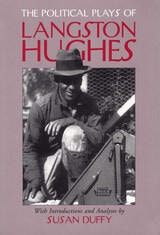
The Political Plays of Langston Hughes
Introductions and Analyses by Susan Duffy
Southern Illinois University Press, 2000
Among the most influential poets of the Harlem Renaissance, Langston Hughes is perhaps best remembered for the innovative use of jazz rhythms in his writing. While his poetry and essays received much public acclaim and scholarly attention, Hughes’ dramas are relatively unknown. Only five of the sixty-three plays Hughes scripted alone or collaboratively have been published (in 1963).
Published here, for the first time, are four of Hughes’ most poignant, poetic, and political dramas, Scottsboro Limited, Harvest (also known as Blood on the Fields), Angelo Herndon Jones, and De Organizer. Each play reflects Hughes’ remarkable professionalism as a playwright as well as his desire to dramatize the social history of the African American experience, especially in the context of the labor movements of the 1930s and their attempts to attract African American workers. Hughes himself counted prominent members of these leftist groups among his close friends and patrons; he formed a theater group with Whittaker Chambers, prompting an FBI investigation of Hughes and his writing in the 1930s. These plays, while easily read as idealistic propaganda pieces for the left, are nonetheless reflective of Hughes’ other more influential and studied works.
The first scholar to offer a systematic study of Hughes’ plays, Susan Duffy provides an informed introduction as well as a detailed analysis of each of the four plays. Duffy also establishes that De Organizer, a collaboration with noted jazz pianist and composer James P. Johnson (who also wrote its score) was indeed performed by the Labor Stage.
By making these forgotten texts available, and by presenting them within a scholarly discussion of 1930s leftist political movements, Duffy seeks to spark a renewed interest in Langston Hughes as an American playwright and political figure.
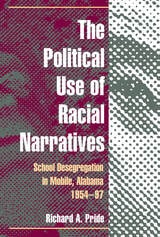
The Political Use of Racial Narratives
School Desegregation in Mobile, Alabama, 1954-97Richard A. Pride
University of Illinois Press, 2002
Exploring who benefits and who pays when different narratives are accepted as true, Pride offers a step-by-step account of how Mobile's culture changed each time a new and more forceful narrative was used to justify inequality. More than a retelling of Mobile's story of desegregation, The Political Use of Racial Narratives promotes the value of rhetorical and narrative analysis in the social sciences and history.
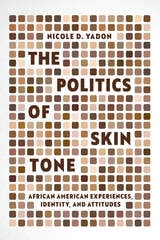
The Politics of Skin Tone
African American Experiences, Identity, and AttitudesNicole D. Yadon
University of Chicago Press, 2025
A nuanced examination of the salience of skin tone within African American politics.
Research shows that skin tone is associated with significant differences in life experiences. On average, African Americans with darker skin earn lower wages, suffer worse health outcomes, and endure more negative criminal justice experiences than lighter-skinned African Americans. Nicole D. Yadon conceptualizes skin tone as one facet of the multidimensional construct of race that powerfully influences racialized experiences which, in turn, can influence political identities and attitudes.
Drawing on evidence from one hundred in-depth interviews, multiple surveys, and a survey experiment, The Politics of Skin Tone investigates the political associations of skin tone. Yadon finds that skin tone correlates with political attitudes, particularly on issues where color-based disparities are especially pronounced such as criminal justice. Moreover, a sizable number of African Americans adopt a skin tone-based identity. In an era of shifting racial boundaries and growing color-based discrimination, The Politics of Skin Tone examines the implications for both scholars and policymakers.
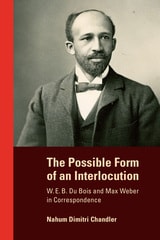
The Possible Form of an Interlocution
W. E. B. Du Bois and Max Weber in CorrespondenceNahum Dimitri Chandler
Duke University Press, 2025
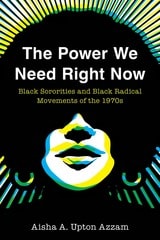
The Power We Need Right Now
Black Sororities and Black Radical Movements of the 1970sAisha A. Upton Azzam
Temple University Press, 2026
There is a long history of sororities such as Alpha Kappa Alpha (AKA) and Delta Sigma Theta (Delta) participating in activism and social justice efforts—from the Civil Rights Movement in the 1960s to Kamala Harris’s recent political campaigns. But radical movements like Black Lives Matter have posed more challenging questions for these organizations.
In The Power We Need Right Now, Aisha Upton Azzam investigates the legacies of AKA and Delta to understand the considerations that weigh on their engagement with present day Black movements. These organizations wield a significant amount of political power to mobilize in support of their causes. The response each sorority has had to movements fifty years apart is strikingly similar—even if their approaches are quite different.
Using a Black feminist theoretical framework, Upton Azzam brings context and meaning to the interactions of these sororities with Black radical movements. She highlights the costs communities bear from sororities’ adherence to respectability and racial uplift ideologies by tracing each sorority’s history and response to emerging Black feminist and Black Power movements during the tumultuous 1970s.
The Power We Need Right Now emphasizes that Black communities still have the ability to wield their political power and influence to further the struggle for Black liberation.