Results by title
615 books match the query 'England' and 143 start with t
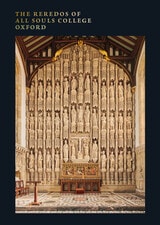
The Reredos of All Souls College Oxford
Edited by Peregrine Horden
Paul Holberton Publishing, 2021
The Ruins of Allegory
Paradise Lost and the Metamorphosis of Epic ConventionCatherine Gimelli Martin
Duke University Press, 1998
Martin shows how Paradise Lost, written at the threshold of the enormous imaginative shift that accompanied the Protestant, scientific, and political revolutions of the seventeenth century, conforms to a prophetic baroque model of allegory similar to that outlined by Walter Benjamin. As she demonstrates, Milton’s experimentation with baroque forms radically reformulates classical epic, medieval romance, and Spenserian allegory to allow for both a naturalistic, empirically responsible understanding of the universe and for an infinite and incomprehensible God. In this way, the resulting poetic world of Paradise Lost is like Milton’s God, an allegorical “ruin” in which the divine is preserved but at the price of a loss of certainty. Also, as Martin suggests, the poem affirmatively anticipates modernity by placing the chief hope of human progress in the fully self-authored subject.
Maintaining a dialogue with a critical tradition that extends from Johnson and Coleridge to the best contemporary Milton scholarship, Martin sets Paradise Lost in both the early modern and the postmodern worlds. Ruins of Allegory will greatly interest all Milton scholars, as well as students of literary criticism and early modern studies.
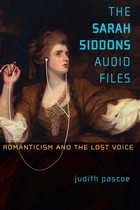
The Sarah Siddons Audio Files
Romanticism and the Lost VoiceJudith Pascoe
University of Michigan Press, 2013
“The theatre scholar’s daunting but irresistible quest to recover some echoes of performance of the past has never been more engagingly presented than in Pascoe’s account of tracing the long-silenced voice of Sarah Siddons. Her report is a warm, witty, and highly informative exploration of the methodology and the pleasures of historical research.”
—Marvin Carlson, author of The Haunted Stage: The Theatre as Memory Machine
During her lifetime (1755–1831), English actress Sarah Siddons was an international celebrity acclaimed for her performances of tragic heroines. We know what she looked like—an endless number of artists asked her to sit for portraits and sculptures—but what of her famous voice, reported to cause audiences to hyperventilate or faint? In The Sarah Siddons Audio Files, Judith Pascoe takes readers on a journey to discover how the actor’s voice actually sounded. In lively and engaging prose, Pascoe retraces her quixotic search, which leads her to enroll in a “Voice for Actors” class, to collect Lady Macbeth voice prints, and to listen more carefully to the soundscape of her life.
Bringing together archival discoveries, sound recording history, and media theory, Pascoe shows how romantic poets’ preoccupation with voices is linked to a larger cultural anxiety about the voice’s ephemerality. The Sarah Siddons Audio Files contributes to a growing body of work on the fascinating history of sound and will engage a broad audience interested in how recording technology has altered human experience.

The Saving Remnant
RELIGION AND THE SETTLING OF NEW ENGLANDCedric B. Cowing
University of Illinois Press, 1995
Cedric Cowing demonstrates that there were two Englands, one evangelistic and one rationalistic. In the northwest of the British Isles was a society that was pastoral, westering, otherworldly, and revivalist--in the southeast was another, more established and mercantile. These two strains set the stage and powered the action for the biggest religious event of the eighteenth century--the Great Awakening.
The leaders of the New Light in the Great Awakening were the Saving Remnant, mostly ministers with liberal education who retained their evangelical and seeker religiosity. The clearly identifiable regional religious parallels between old England and New are still discernable today and give a new slant to heretofore unresolved historiographical issues. Cowing shows how regionalism influenced the nature of New England Puritanism and how the presence of a strong and persistent link between regional origins and religious behavior led to the inevitability of the Salem witch trials.
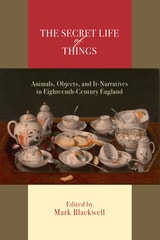
The Secret Life of Things
Animals, Objects, and It-Narratives in Eighteenth-Century EnglandMark Blackwell
Bucknell University Press, 2023
Published by Bucknell University Press.
Distributed worldwide by Rutgers University Press.
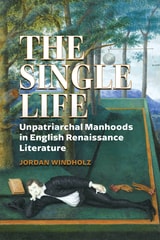
The Single Life
Unpatriarchal Manhoods in English Renaissance LiteratureJordan Windholz
University of Alabama Press, 2025
Exploring the Varied Roles of Bachelors during the Renaissance
What if the Renaissance bachelor wasn’t just a social outlier but a literary lens through which early modern masculinity reveals its cracks? In The Single Life: Unpatriarchal Manhoods in English Renaissance Literature, Jordan Windholz examines the overlooked and often subversive roles played by never-married men in shaping gender, sexuality, and social order.
Windholz challenges conventional views on gender and sexuality, identifying five archetypes of bachelorhood that complicate our understanding of patriarchal success: the chaste youth, the journeyman bachelor, the true gallant, the incel scholar, and the unmarried eunuch. These figures don’t conform to ideals of marriage, legacy, or economic productivity, but they also weren’t merely left behind. Instead, they served to define what early modern society valued by embodying what it resisted. Windholz shows how Renaissance texts constructed, contained, and occasionally celebrated these “unpatriarchal manhoods.”
By examining the intersections of sexuality, labor, gentility, emotion, and gender, the book provides a nuanced understanding of how single men both upheld and resisted patriarchal norms. Each chapter offers a detailed analysis of literary texts, blending historical and literary analysis with feminist and queer theory. The first study of its kind, Windholz’s work is essential reading for anyone interested in Renaissance literature, gender studies, or those looking to understand the margins of masculinity and the meanings of singledom—then and now.
The Snobs of England and Punch's Prize Novelists
William Makepeace Thackeray
University of Michigan Press, 2005
This volume of The Snobs of England and Punch's Prize Novelists is an addition to The Thackeray Edition collection, the first full-scale scholarly edition of William Makepeace Thackeray's works to appear in over seventy years, and the only one ever to be based on an examination of manuscripts and relevant printed texts. It is also a concrete attempt to put into practice a theory of scholarly editing that gives new insight into Thackeray's own compositional process. In The Snobs of England, a series of amusing satirical sketches, Thackeray provides a panoramic awareness of the many varieties of human folly, identifying snobbery not as a social attitude but as the unworthy admiration of foolish things. Punch's Prize Novelists presents a series of illustrated burlesque parodies of Thackeray's contemporary writers, including Edward Bulwer, Benjamin Disraeli, Mrs. Catherine Gore, G.P.R. James, Charles Lever, and James Fenimore Cooper. The works are edited here from a comparative study of all relevant documents: from the first published appearances to the last editions touched by the author.
The Spirit of the Oxford Movement
Christopher Dawson
Catholic University of America Press, 2022

The Story of All Things
Writing the Self in English Renaissance Narrative PoetryMarshall Grossman
Duke University Press, 1998
Relating subjectivity to the nature of language, Grossman uses the theories of Lacan to analyze the concept of the self as it encounters a transforming environment. He shows how ideological tensions arose from the reorganization and "modernization" of social life in revolutionary England and how the major poets of the time represented the division of the self in writings that are suspended between lyric and narrative genres. Beginning with the portrayals of the self inherited from Augustine, Dante, and Petrarch, he describes the influence of historic developments such as innovations in agricultural technology, civil war and regicide, and the emergence of republican state institutions on the changing representation of characters in the works of Spenser, Donne, Marvell, and Milton. Furthering this psychoanalytic critique of literary history, Grossman probes the linguistic effects of social and personal factors such as Augustine’s strained relationship with his mother and the marital disharmony of Milton and Mary Powell. With its focus on these and other "literary historical events," The Story of All Things not only proposes a new structural theory of narrative but constitutes a significant challenge to New Historicist conceptions of the self.
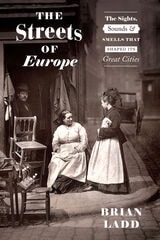
The Streets of Europe
The Sights, Sounds, and Smells That Shaped Its Great CitiesBrian Ladd
University of Chicago Press, 2020
Merchants’ shouts, jostling strangers, aromas of fresh fish and flowers, plodding horses, and friendly chatter long filled the narrow, crowded streets of the European city. As they developed over many centuries, these spaces of commerce, communion, and commuting framed daily life. At its heyday in the 1800s, the European street was the place where social worlds connected and collided.
Brian Ladd recounts a rich social and cultural history of the European city street, tracing its transformation from a lively scene of trade and crowds into a thoroughfare for high-speed transportation. Looking closely at four major cities—London, Paris, Berlin, and Vienna—Ladd uncovers both the joys and the struggles of a past world. The story takes us up to the twentieth century, when the life of the street was transformed as wealthier citizens withdrew from the crowds to seek refuge in suburbs and automobiles. As demographics and technologies changed, so did the structure of cities and the design of streets, significantly shifting our relationships to them. In today’s world of high-speed transportation and impersonal marketplaces, Ladd leads us to consider how we might draw on our history to once again build streets that encourage us to linger.
By unearthing the vivid descriptions recorded by amused and outraged contemporaries, Ladd reveals the changing nature of city life, showing why streets matter and how they can contribute to public life.
The Subject of Modernism
Narrative Alterations in the Fiction of Eliot, Conrad, Woolf, and JoyceTony E. Jackson
University of Michigan Press, 1994

The Subversion of Romance in the Novels of Barbara Pym
University of Wisconsin Press, 1998
This book seeks to explore how Barbara Pym subverts the discourse of the romance novel through her use of food, clothes, heroine and hero characterizations, and marriage customs.
The Sylph
Georgiana, Duchess of Devonshire
Northwestern University Press, 2007
This ranging epistolary novel follows Julia Grenville, a Welsh beauty who knows little of the world until her marriage to the older Lord Stanley. Through Julia’s letters to her sister, readers learn more of Julia’s new life in London—her unfaithful husband, her miscarriage, her disillusionment with the city and its fashions. Other letters reveal that Julia has a longtime admirer, Harry Woodley, from her former life, as well as a mysterious guardian angel: her Sylph. This character guides Julia away from the depravities of her life in London, including her gambling problem. The Sylph is also another sympathetic ear to Julia’s increasing marital dissatisfaction and growing affinity for another man, the Baron Ton-hausen. As Julia nearly falls prey to the overzealous admirations of one of her husband’s associates, her husband is consumed by gambling debts to that same associate. She is shocked to discover the depths of her husband’s ruin and plans to flee to Wales before she too can be claimed in payment. Her disgraced husband takes the ultimate way out and Julia goes home to her father and sister in Wales. Her Sylph is not far behind, however, and soon reveals himself to Julia to be more than she could have ever imagined.

The Tenth Muse
Victorian Philology and the Genesis of the Poetic Language of Gerard Manley HopkinsBy Cary H. Plotkin
Southern Illinois University Press, 1989
With authority and sensitivity Plotkin traces the close relationship between Hopkins’s poetry and the theories of language suggested in his Journals and expounded by Victorian philologists such as Max Müller and George Marsh.
Plotkin seeks to determine what changed Hopkins’s perception of language between the writing of such early poems as "The Habit of Perfection" and "Nondum" (1866) and his creation of The Wreck of the Deutschland (1875–76). Did the language of the ode, and of Hopkins’s mature poetry generally, arise as spontaneously as it appears to have done, or does it have a traceable genesis in the ways in which language as a whole was conceived and studied in mid-century England? In answer, Plotkin fixes the development of Hopkins’s singular poetic language in the philological context of his time.
If one is to understand Hopkins’s writings and poetic language in the context in which they developed rather than in the terms of a present-day theory of history or textuality, then that movement in all of its complexity must be considered. Hopkins "translates" into the language of poetry patterns and categories common to Victorian language study.
The Theater of Devotion
East Anglian Drama and Society in the Late Middle AgesGail McMurray Gibson
University of Chicago Press, 1989
The Theological-Political Origins of the Modern State
The Controversy between James I of England and Cardinal BellarmineBernard Bourdin
Catholic University of America Press, 2010
The Tiger in the Attic
Memories of the Kindertransport and Growing Up EnglishEdith Milton
University of Chicago Press, 2006
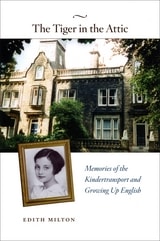
In this illuminating chronicle, Edith describes how she struggled to fit in and to conquer self-doubts about her German identity. Her realistic portrayal of the seemingly mundane yet historically momentous details of daily life during World War II slowly reveals istelf as a hopeful story about the kindness and generosity of strangers. She paints an account rich with colorful characters and intense relationships, uncanny close calls and unnerving bouts of luck that led to survival. Edith's journey between cultures continues with her final passage to America—yet another chapter in her life that required adjustment to a new world—allowing her, as she narrates it here, to visit her past as an exile all over again.
The Tiger in the Attic is a literary gem from a skilled fiction writer, the story of a thoughtful and observant child growing up against the backdrop of the most dangerous and decisive moment in modern European history. Offering a unique perspective on Holocaust studies, this book is both an exceptional and universal story of a young German-Jewish girl caught between worlds.
“Milton is brilliant at the small stroke . . . as well as broader ones.”—Alana Newhouse, New York Times Book Review

The Trial of Charles I
A Documentary HistoryEdited by David Lagomarsino and Charles T. Wood
Dartmouth College Press, 1989
The Wake of Wellington
Englishness in 1852Peter W. Sinnema
Ohio University Press, 2006
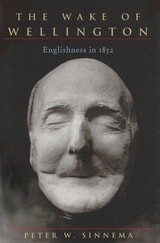
Soldier, hero, and politician, the Duke of Wellington is one of the best-known figures of nineteenth-century England. From his victory at Waterloo over Napoleon in 1815, he rose to become prime minister of his country. But Peter Sinnema finds equal fascination in Victorian England’s response to the duke’s death.
The Wake of Wellington considers Wellington’s spectacular funeral pageant in the fall of 1852—an unprecedented event that attracted one and a half million spectators to London—as a threshold event against which the life of the soldier-hero and High Tory statesman could be re-viewed and represented.
Canvassing a profuse and dramatically proliferating Wellingtoniana, Sinnema examines the various assumptions behind, and implications of, the Times’s celebrated claim that the Irish-born Wellington “was the very type and model of an Englishman.” The dead duke, as Sinnema demonstrates, was repeatedly caught up in interpretive practices that stressed the quasi-symbolic relations between hero and nation.
The Wake of Wellington provides a unique view of how in death Wellington and his career were promoted as the consummation of a national destiny intimately bound up with Englishness itself, and with what it meant to be English at midcentury.
The Wild Girl, Natural Man, and the Monster
Dangerous Experiments in the Age of EnlightenmentJulia V. Douthwaite
University of Chicago Press, 2002
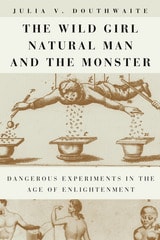
A variety of educational experiments failed to tame these feral children by the standards of the day. After telling their stories, Douthwaite turns to literature that reflects on similar experiments to perfect human subjects. Her examples range from utopian schemes for progressive childrearing to philosophical tales of animated statues, from revolutionary theories of regenerated men to Gothic tales of scientists run amok. Encompassing thinkers such as Rousseau, Sade, Defoe, and Mary Shelley, Douthwaite shows how the Enlightenment conceived of mankind as an infinitely malleable entity, first with optimism, then with apprehension. Exposing the darker side of eighteenth-century thought, she demonstrates how advances in science gave rise to troubling ethical concerns, as parents, scientists, and politicians tried to perfect mankind with disastrous results.
The Wit of Seventeenth-Century Poetry
Edited by Claude J. Summers & Ted-Larry Pebworth
University of Missouri Press, 1994
As the twelve original essays collected in this volume demonstrate, to study the wit of seventeenth-century poetry is necessarily to address concerns at the very heart of the period's shifting literary culture. It is a topic that raises persistent questions of thematics and authorial intent, even as it interrogates a wide spectrum of cultural practices. These essays by some of the most renowned scholars in seventeenth-century studies illuminate important authors and engage issues of politics and religion, of secular and sacred love, of literary theory and poetic technique, of gender relations and historical consciousness, of literary history and social change, as well as larger concerns of literary production and smaller ones of local effects. Collectively, they illustrate the vitality of the topic, both in its own right and as a means of understanding the complexity and range of seventeenth-century English poetry.
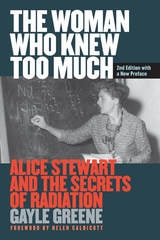
The Woman Who Knew Too Much, Revised Ed.
Alice Stewart and the Secrets of RadiationGayle Greene
University of Michigan Press, 2017
Author Gayle Greene traces Stewart's life and career as she came up against ever more powerful authorities, first the British medical profession, then the U.S. nuclear industry, and finally the regulatory agencies that set radiation safety standards throughout the world. Stewart endured the fate of other women scientists in having her findings dismissed and funding cut, but today is recognized as a pioneering figure in epidemiological research on the dangers of nuclear radiation. In her preface to the second edition, Greene looks at new information that’s come out about the forces and individuals responsible for marginalizing her as a scientist and downplaying the disturbing implications of her research.
The Woman Who Knew Too Much
Alice Stewart and the Secrets of RadiationGayle Greene
University of Michigan Press, 2001
This biography illuminates the life and achievements of the remarkable woman scientist who revolutionized the concept of radiation risk.
In the 1950s Alice Stewart began research that led to her discovery that fetal X rays double a child's risk of developing cancer. Two decades later---when she was in her seventies---she again astounded the scientific world with a study showing that the U.S. nuclear weapons industry is about twenty times more dangerous than safety regulations permit. This finding put her at the center of the international controversy over radiation risk. In 1990, the New York Times called Stewart "perhaps the Energy Department's most influential and feared scientific critic."
The Woman Who Knew Too Much traces Stewart's life and career from her early childhood in Sheffield to her medical education at Cambridge to her research positions at Oxford University and the University of Birmingham.
Gayle Greene is Professor of Women's Studies and Literature, Scripps College.
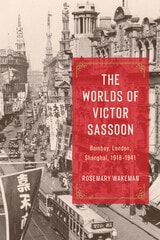
The Worlds of Victor Sassoon
Bombay, London, Shanghai, 1918–1941Rosemary Wakeman
University of Chicago Press, 2024
In this book, historian Rosemary Wakeman brings to life the frenzied, crowded streets, markets, ports, and banks of Bombay, London, and Shanghai. In the early twentieth century, these cities were at the forefront of the sweeping changes taking the world by storm as it entered an era of globalized commerce and the unprecedented circulation of goods, people, and ideas. Wakeman explores these cities and the world they helped transform through the life of Victor Sassoon, who in 1924 gained control of his powerful family’s trading and banking empire. She tracks his movements between these three cities as he grows his family’s fortune and transforms its holdings into a global juggernaut. Using his life as its point of entry, The Worlds of Victor Sassoon paints a broad portrait not just of wealth, cosmopolitanism, and leisure but also of the discrimination, exploitation, and violence wreaked by a world increasingly driven by the demands of capital.
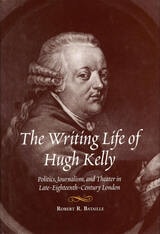
The Writing Life of Hugh Kelly
Politics, Journalism, and Theatre in Late-Eighteenth-Century LondonRobert R. Bataille
Southern Illinois University Press, 2000
Robert R. Bataille demonstrates convincingly that between 1767 and 1777, Anglo-Irish writer Hugh Kelly made major contributions in three areas of British culture: politics, journalism, and theater. Bataille shows how all three activities were integrated in Kelly’s life, suggesting that such interrelationships often existed in the rough and ready London culture during the early reign of King George III.
When he discovered several newspaper campaigns that Kelly orchestrated as a paid political propagandist for George III and his ministers, Bataille understood in part how important Kelly was to his era. In his capacity as propagandist, Kelly defended Hanoverian colonial policies on the eve of the American Revolution, served as a key opponent of the radical Wilkites, and promoted the acceptance of the 1774 Quebec Bill, which established, among other things, the right of the recently defeated French citizens of Quebec to maintain the French language.
A belletristic journalist, Kelly published theater reviews and essays that played a major role in shaping the taste of his era. He wrote in defense of the controversial sentimental drama, and whenever he could, he promoted the major theatrical figure of the age, David Garrick. Under his editorship, the newspaper Public Ledger became a leading source of theater information. Seeking to raise the status of the profession of journalism, he wrote essays and articles that provided his middle-class readers with an insider’s view of the operations of the journalist.
Assessing Kelly’s contributions to the novel and drama, Bataille argues that this powerful journalist stands in the vanguard in the larger struggle against traditional attitudes supporting male superiority and aristocratic privilege. Kelly wrote in favor of gender equality and middle-class respectability, striving to inculcate what modern scholars refer to as the values of sensibility. Bataille also argues, however, that Kelly knew his audience. Instrumental in the rise of professional writing and popular culture, he understood that he had to observe the needs of his audience, detecting cultural trends and using the skills of the rhetorician.
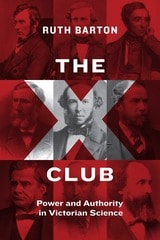
The X Club
Power and Authority in Victorian ScienceRuth Barton
University of Chicago Press, 2018
These six ambitious professionals and three wealthy amateurs—J. D. Hooker, T. H. Huxley, John Tyndall, John Lubbock, William Spottiswoode, Edward Frankland, George Busk, T. A. Hirst, and Herbert Spencer—wanted to guide the development of science and public opinion on issues where science impinged on daily life, religious belief, and politics. They formed a private dining club, which they named the X Club, to discuss and further their plans. As Ruth Barton shows, they had a clear objective: they wanted to promote “scientific habits of mind,” which they sought to do through lectures, journalism, and science education. They devoted enormous effort to the expansion of science education, with real, but mixed, success.
For twenty years, the X Club was the most powerful network in Victorian science—the men succeeded each other in the presidency of the Royal Society for a dozen years. Barton’s group biography traces the roots of their success and the lasting effects of their championing of science against those who attempted to limit or control it, along the way shedding light on the social organization of science, the interactions of science and the state, and the places of science and scientific men in elite culture in the Victorian era.
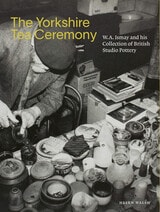
The Yorkshire Tea Ceremony
W. A. Ismay and His Collection of British Studio PotteryHelen Walsh
Paul Holberton Publishing, 2021
In the latter half of the twentieth century, “professional Yorkshireman” W. A. Ismay (1910–2001) amassed over 3,600 pieces by more than 500 potters. Surrounded by his family of pots, he lived in a tiny terraced house in Wakefield, Yorkshire, and left his collection and its associated archive to the city of York upon his death. This eclectic group of works contains objects created by many of the most significant potters working in the United Kingdom, including Lucie Rie, Hans Coper, Bernard Leach, and Michael Cardew, as well as lesser-known makers.
With new academic research into this little-studied collection and archive, Yorkshire Tea Ceremony explores Ismay’s journey as a collector and offers fresh perspectives on a marginalized area of British Modernism. Tracing the collection’s journey from private to public ownership illuminates issues surrounding the acquisition and reveals the transformative effect it has had on both curatorial practice and the ambition of regional public institutions. The W. A. Ismay Collection offers a well-documented example of the valuable contribution collectors can make to the British studio ceramics movement.
Published to coincide with the twentieth anniversary of the collection’s move from private to public ownership, this volume accompanies an exhibition at York Art Gallery’s Centre of Ceramic Art (CoCA).
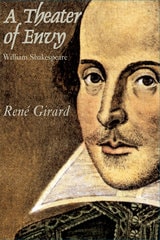
Theater Of Envy
William ShakespeareRene Girard
St. Augustine's Press, 2004
In this ground-breaking work, one of our foremost literary and cultural critics turns to the major figure in English literature, William Shakespeare, and proposes a dramatic new reading of nearly all his plays and poems. The key to A Theater of Envy is Girard's novel reinterpretation of "mimesis." For Girard, people desire objects not for their intrinsic value, but because they are desired by someone else - we mime or imitate their desires. This envy - or "mimetic desire" - he sees as one of the foundations of the human condition.
Bringing such proocative and iconoclastic insights to bear on Shakespeare, Girard reveals the previously overlooked coherence of problem plays like Troilus and Cressida, and makes a convincing argument for elevating A Midsummer Night's Dream from the status of a chaotic comedy to a masterpiece. The book abounds with novel and provocative interpretations: Shakespeare becomes "a prophet of modern advertising," and the threat of nuclear disaster is read in the light of Hamlet. Most intriguing of all, perhaps, is a brief, but brilliant aside in which an entirely new perspective is brought to the chapter on Joyce's Ulysses in which Stephen Dedalus gives a lecture on Shakespeare. In Girard's view only Joyce, perhaps the greatest of twentieth-century novelists, comes close to understanding the greatest of Renaissance playwrights.
Throughout this impressively sustained reading of Shakespeare, Girard's prose is sophisticated, but contemporary, and accessible to the general reader.
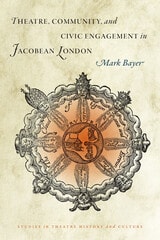
Theatre, Community, and Civic Engagement in Jacobean London
Mark Bayer
University of Iowa Press, 2011
Taking to heart Thomas Heywood’s claim that plays “persuade men to humanity and good life, instruct them in civility and good manners, showing them the fruits of honesty, and the end of villainy,” Mark Bayer’s captivating new study argues that the early modern London theatre was an important community institution whose influence extended far beyond its economic, religious, educational, and entertainment contributions. Bayer concentrates not on the theatres where Shakespeare’s plays were performed but on two important amphitheatres, the Fortune and the Red Bull, that offer a more nuanced picture of the Jacobean playgoing industry. By looking at these playhouses, the plays they staged, their audiences, and the communities they served, he explores the local dimensions of playgoing.
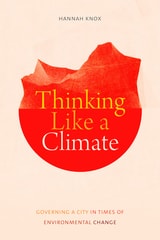
Thinking Like a Climate
Governing a City in Times of Environmental ChangeHannah Knox
Duke University Press, 2020
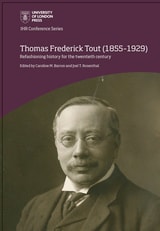
Thomas Frederick Tout (1855–1929)
refashioning history for the twentieth centuryEdited by Joel T. Rosenthal and Caroline M. Barron
University of London Press, 2019
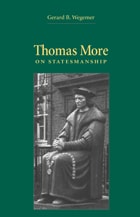
Thomas More on Statesmanship
Gerard Wegemer
Catholic University of America Press, 1996
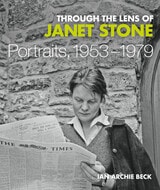
Through the Lens of Janet Stone
Portraits, 1953-1979Ian Archie Beck
Bodleian Library Publishing, 2018
Included between these pages are portraits of the composers, actors, novelists, poets, and philosophers in the Stones’ milieu—from Benjamin Britten to Siegfried Sassoon and Frances Partridge—as well as members of the Stone family. Although not a trained photographer, Janet instinctively knew to click the shutter when her subjects were off-guard and at their most informal, capturing an array of candid shots—like one of John Bayley trying on a headscarf and a young Daniel Day-Lewis dressed up as a knight.
These unique portraits offer beguiling insight into a special set of circumstances: an idyllic place and time and a group of people drawn together by two contrasting but complimentary personalities, the shy genius of Reynolds met by the outgoing style and glamour of Janet Stone.
Tough Love
Amazon Encounters in the English RenaissanceKathryn Schwarz
Duke University Press, 2000
Despite seeming to function as signs for what is outside the social—the alien, the exotic, the other—Amazons in sixteenth- and seventeenth-century texts were often represented in conventionally domestic roles, as mothers and lovers, wives and queens, Schwarz demonstrates. She traces this pattern in works by Shakespeare, Spenser, Sidney, Raleigh, and Jonson, as well as in such materials as conduct manuals, explorers’ accounts, court spectacles, and political tracts. Through readings of these texts, Schwarz shows that the Amazon myth provided a language both for setting forth and for challenging the terms of social logic. In representations of Amazon encounters, she argues, homosocial bonds became indistinguishable from heterosexual desires, masculine agency attached itself as logically to women as it did to men, and sexual difference was made nearly impossible to sustain or define. Schwarz’s analysis unveils the Amazon as a theoretical term, one that illuminates the tensions and paradoxes through which ideologies of the domestic take shape.
Tough Love contributes to the ongoing discussion of gendered identity and sexual desire in the early modern period. It will interest students of queer theory, cultural studies, early modern history, feminism, and literature.
Toward a Theater of the Oppressed
The Dramaturgy of John ArdenJaved Malick
University of Michigan Press, 1995
Malick situates Arden's dramaturgy in the wider context of the radical alternative tradition in Western drama, drawing connections to Brecht, Piscator, the radical playwrights of the 1960s. He then explores the formal structure, ideological implications, and historical significance of Arden's work, treating his stage plays as one dramaturgically coherent opus- from the early Waters of Babylon to his and Margaretta D'Arcy's ambitious trilogy, The Island of the Mighty. Finally, he discusses the last phase of Arden and D'Arcy's political and artistic development, which led them to turn their backs on the professional theater circuit. He argues that Arden's rejection of the institutional stage was the logical outcome of his persistent search for alternative forms of political theater.
Toward a Theater of the Oppressed will be invaluable reading for those interested in modern drama, political theater, and popular performance, as well as students of contemporary British drama.
Javed Malick is Reader in English, Khalsa College, University of Delhi, India.
Towards Reading Freud
Self-Creation in Milton, Wordsworth, Emerson, and Sigmund FreudMark Edmundson
University of Chicago Press, 2007
“Marvelous. . . . Edmundson’s book offers an extraordinary challenge both to practicing analysts and to a scholarly community which all too uncomplainingly inhabits and reinforces the Freudian paradigm of interpretation. Edmundson reinvents an adventurous and dissident Freud as an antidote to . . . weary psychoanalytic commonplaces.”—Malcolm Bowie, Raritan
“This book takes a distinguished place in the ongoing effort to recontextualize Freud by stressing the literary, rather than the scientific roots and character of his theory.”—Virginia Quarterly Review
Trading Tongues
Merchants, Multilingualism, and Medieval LiteratureJonathan Hsy
The Ohio State University Press, 2013
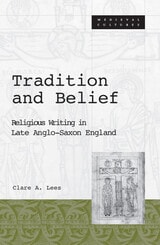
Tradition And Belief
Religious Writing in Late Anglo-Saxon EnglandClara A. Lees
University of Minnesota Press, 1999
Looks at early religious texts and their influence on medieval literature and culture.
Looks at early religious texts and their influence on medieval literature and culture.
In this major study of Anglo-Saxon religious texts-sermons, homilies, and saints’ lives written in Old English-Clare A. Lees reveals how the invention of preaching transformed the early medieval church, and thus the culture of medieval England. By placing Anglo-Saxon prose within a social matrix, her work offers a new way of seeing medieval literature through the lens of culture.To show how the preaching mission of the later Anglo-Saxon church was constructed and received, Lees explores the emergence of preaching from the traditional structures of the early medieval church-its institutional knowledge, genres, and beliefs. Understood as a powerful rhetorical, social, and epistemological process, preaching is shown to have helped define the sociocultural concerns specific to late Anglo-Saxon England.The first detailed study of traditionality in medieval culture, Tradition and Belief is also a case study of one cultural phenomenon from the past. As such-and by concentrating on the theoretically problematic areas of history, religious belief, and aesthetics-the book contributes to debates about the evolving meaning of culture.ISBN 0-8166-3002-X Cloth £34.50 $49.95xxISBN 0-8166-3003-8 Paper £14.00 $19.95x232 Pages 5 7/8 x 9 NovemberMedieval Cultures Series, volume 19Translation inquiries: University of Minnesota Press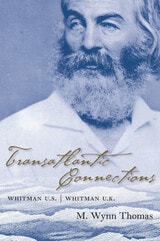
Transatlantic Connections
Whitman U.S., Whitman U.K.Thomas, M. Wynn
University of Iowa Press, 2005
The book’s contrasting sections reflect the two locations studied: the first shows Whitman in his time and place, while the second repositions him within the cultures of England and Wales from the late 19th to the late 20th century. In the opening chapter he is placed against the vivid, outrageous background of the New York of his time; the second finds evidence in his poetry of a critique of the new urban politics of the emerging city boss; the third radically redefines Whitman's relationship to his famous contemporary Longfellow. Other chapters deal with the Civil War poet, exploring the ways in which his poetic responses were in part shaped by his relationship to his soldier brother George, and his use of the meteorological discoveries of his day to fashion metaphors for imaging the different phases of the conflict.
The second section ponders the paradox that this Whitman, who was so much the product of his specific time and limited “local” culture, should come to be accepted as an international visionary. The United Kingdom is taken as offering striking instances of this phenomenon, and his transatlantic admirers are shown to have been engaged in an unconscious process of “translating” Whitman into the terms of their own culturally specific social, political, and sexual preoccupations. Some of the connections explored are those between Whitman and Edward Carpenter, the so-called English Whitman; between Whitman and perhaps his greatest English critic, D. H. Lawrence; and between Whitman and the Welsh poets Ernest Rhys, Amanwy (David Rees Griffiths), Niclas y Glais (T. E. Nicholas), Waldo Williams, Glyn Jones, Dylan Thomas, and R. S. Thomas.
This bold and original study, offering new points of entry into understanding Whitman as the product of his time and place as well as understanding the reception of Whitman in the U.K. as a process of cultural translation, should fascinate scholars of Whitman and students of comparative literature.
Transforming Early Childhood in England
Towards a Democratic EducationEdited by Claire Cameron and Peter Moss
University College London, 2020
Transforming Early Childhood in England offers a critical analysis of the current system and proposes change based on a universal right to education. The book calls for revisions built on democratic principles, where all learning by all children is visible and recognized, educators are trusted and respected, and outcomes-driven targets are replaced. Combining criticism and hope, and drawing on inspiring research, the book is essential reading for students, educators, practitioners, parents, academics, and policymakers.
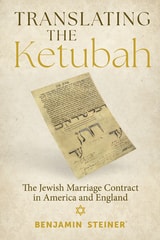
Translating the Ketubah
The Jewish Marriage Contract in America and EnglandBenjamin Steiner
University of Alabama Press, 2025
A groundbreaking exploration of the Jewish marriage contract and its evolution in English translation
Translating the Ketubah offers a fresh perspective on the ketubah, the Jewish marriage contract. Traditionally composed in Aramaic, ketubot have been examined in other books within the frameworks of Jewish law and Jewish art. Here, however, Benjamin Steiner shows how translations of the ketubah into English helped Jews adapt to changing social and economic circumstances across more than two centuries.
Steiner uses ketubot to trace the intricate relationship between religious law and secular law, the changing status of women within and outside Judaism, and the complex desire of Jews to be both authentically Jewish and fully acculturated. Steiner further shows how ketubah translation aided Jews to achieve different cultural goals. It has been used to uphold rabbinic law in communities where religious affiliation was voluntary to ensure women's economic security. It has also facilitated socialization with non-Jews and addressed perceived crises within the Jewish family.
Through a nuanced analysis of ketubah translations from England and various regions of the United States from the late eighteenth century to the present, Steiner offers a detailed look at how Jews have adapted ancient tradition to meet the challenges and opportunities of different historical contexts. His work sheds new light on the rich history of American and British Jewry.
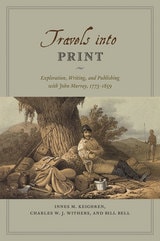
Travels into Print
Exploration, Writing, and Publishing with John Murray, 1773-1859Innes M. Keighren, Charles W. J. Withers, and Bill Bell
University of Chicago Press, 2015
Drawing on detailed examination of the John Murray Archive of manuscripts, images, and the firm’s correspondence with its many authors—a list that included such illustrious explorers and scientists as Charles Darwin and Charles Lyell, and literary giants like Jane Austen, Lord Byron, and Sir Walter Scott—Travels into Print considers how journeys of exploration became published accounts and how travelers sought to demonstrate the faithfulness of their written testimony and to secure their personal credibility. This fascinating study in historical geography and book history takes modern readers on a journey into the nature of exploration, the production of authority in published travel narratives, and the creation of geographical authorship—a journey bound together by the unifying force of a world-leading publisher.
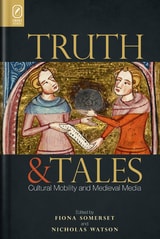
Truth and Tales
Cultural Mobility and Medieval MediaEdited by Fiona Somerset and Nicholas Watson
The Ohio State University Press, 2015
Truth and Tales includes fourteen essays by medieval literary scholars and historians. Some essays focus on written artifacts that convey high or popular learning in unexpected ways. Others address a social problem of concern to all, demonstrating the genres and media through which it was negotiated. Still others are centered on one or more texts, detailing their investments in popular as well as learned knowledge, in performance as well as writing. This collective archaeology of medieval media provides fresh insight for medieval scholars and media theorists alike.