Results by title
1832 books match the query 'Essays' and 450 start with t
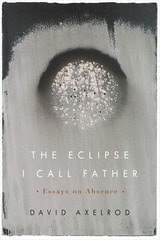
The Eclipse I Call Father
Essays on AbsenceDavid Axelrod
Oregon State University Press, 2019
The essays in this collection grew from a ten-year period when the author found himself periodically living and working abroad, wondering why foreign landscapes haunted him more than the familiar landscapes of the inland Pacific Northwest he called home. Each place had a long history of habitation, but at home he was blind, unable to see past the surfaces of things. Axelrod examines many aspects of that phenomenon in these pages, framing surface realities and imagining the scale and scope of that surface, but also trying to sense what is absent or changed, and how, despite its absence, the unseen accretes to ever-greater densities and persists as something uncanny.
Curious, alert, and keenly observant, these essays probe the boundaries between what is here and what is gone, what is present and what is past, in elegant prose. Readers familiar with Axelrod’s poetry will find a new facet of his lyrical gifts, while those encountering his work for the first time will be richly rewarded by the discovery of this Northwest literary talent.
The Economic Sociology of Immigration
Essays on Networks, Ethnicity, and EntrepreneurshipAlejandro Portes
Russell Sage Foundation, 1995
The Edda
A Collection of EssaysR.J. Glendinning
University of Manitoba Press, 1983
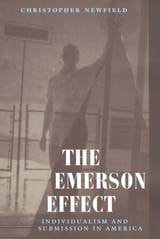
The Emerson Effect
Individualism and Submission in AmericaChristopher Newfield
University of Chicago Press, 1995
Christopher Newfield analyzes the interplay of liberal and authoritarian impulses in Emerson's work in various domains: domestic life, the changing New England economy, theories of poetic language, homoerotic friendship, and racial hierarchy. Focusing on neglected later writings, Newfield shows how Emerson explored the tensions between autonomy and community—and consistently resolved these tensions by "abandoning crucial elements of both" and redefining autonomy as a kind of liberating subjection. He argues that in Emersonian individualism, self-determination is accompanied by submission to authority, and examines the influence of this submissive individualism on the history of American liberalism. In a provocative reading of Emerson's early and neglected later works, Newfield analyzes Emerson's emphasis on collective, or "corporate", world-building, rather than private possession. Tracing the development of this corporate individualism, he illuminates contradictions in Emerson's political outlook, and the conjunctions of liberal and authoritarian ideology they produced.

The Endless Fountain
Essays on Classical HumanismMark Morford
The Ohio State University Press, 1900
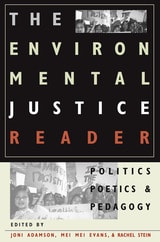
The Environmental Justice Reader
Politics, Poetics, and PedagogyEdited by Joni Adamson, Mei Mei Evans, and Rachel Stein
University of Arizona Press, 2002
This book examines environmental justice in its social, economic, political, and cultural dimensions in both local and global contexts, with special attention paid to intersections of race, gender, and class inequality. The first book to link political studies, literary analysis, and teaching strategies, it offers a multivocal approach that combines perspectives from organizations such as the Southwest Network for Environmental and Economic Justice and the International Indigenous Treaty Council with the insights of such notable scholars as Devon Peña, Giovanna Di Chiro, and Valerie Kuletz, and also includes a range of newer voices in the field.
This collection approaches environmental justice concerns from diverse geographical, ethnic, and disciplinary perspectives, always viewing environmental issues as integral to problems of social inequality and oppression. It offers new case studies of native Alaskans' protests over radiation poisoning; Hispanos' struggles to protect their land and water rights; Pacific Islanders' resistance to nuclear weapons testing and nuclear waste storage; and the efforts of women employees of maquiladoras to obtain safer living and working environments along the U.S.-Mexican border.
The selections also include cultural analyses of environmental justice arts, such as community art and greening projects in inner-city Baltimore, and literary analyses of writers such as Jimmy Santiago Baca, Linda Hogan, Barbara Neely, Nez Perce orators, Ken Saro-Wiwa, and Karen Yamashita—artists who address issues such as toxicity and cancer, lead poisoning of urban African American communities, and Native American struggles to remove dams and save salmon. The book closes with a section of essays that offer models to teachers hoping to incorporate these issues and texts into their classrooms. By combining this array of perspectives, this book makes the field of environmental justice more accessible to scholars, students, and concerned readers.
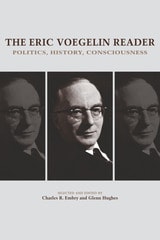
The Eric Voegelin Reader
Politics, History, ConsciousnessCharles R. Embry
University of Missouri Press, 2023
Drawing from the University of Missouri Press’s thirty-four-volume edition of The Collected Works of Eric Voegelin (1990-2009), Charles Embry and Glenn Hughes have assembled a selection of representative works of Voegelin, satisfying a longstanding need for a single volume that can serve as a general introduction to Voegelin’s philosophy. The collection includes writings that demonstrate the range and creativity of Voegelin’s thought as it developed from 1956 until his death in 1985 in his search for the history of order in human society.
The Reader begins with excerpts from Autobiographical Reflections (1973), which include an orienting mixture of biographical information, philosophical motivations, and the scope of Voegelin’s project. It reflects key periods of Voegelin’s philosophical development, pivoting on his flight from the Gestapo.
The next section focuses on Voegelin’s understanding of the contemporary need to re-ground political science in a non-positivistic, post-Weberian outlook and method. It begins with Voegelin’s historical survey of science and scientism, followed by his explanation of what political science now requires in his introduction to The New Science of Politics. Also included are two essays that exemplify the practice of this “new science.” Voegelin started his academic career as a political scientist, and these early essays indicate his wide philosophical vision.
Voegelin recognized that a fully responsible “new science of politics” would require the development of a philosophy of history. This led to the writing of his magnum opus, the five-volume Order and History (1956–1985). This section of the Reader includes his introductions to volumes 1, 2 and 4 and his most essential accounts of the theoretical requirements and historical scope of a philosophy of history adequate to present-day scholarship and historical discoveries.
In the course of his career, Voegelin came to understand that political science, political philosophy, and philosophy of history must have as their theoretical nucleus a sound philosophical anthropology based on an accurate philosophy of human consciousness. The next set of writings consists of one late lecture and four late essays that exemplify how Voegelin recovers the wisdom of classical philosophy and the Western religious tradition while criticizing modern misrepresentations of consciousness. The result is Voegelin’s contemporary accounts of the nature of reason, the challenge of truly rational discussion, and the search for divine origins and the life of the human spirit.
During his philosophical journey, Voegelin addressed the historical situatedness of human existence, explicating the historicity of human consciousness in a manner that gave full due to the challenges of acknowledging both human immersion in the story of history and the ability of consciousness to arrive at philosophically valid truths about existence that are transhistorical. The essays in this final section present the culmination of his philosophical meditation on history, consciousness, and reality.
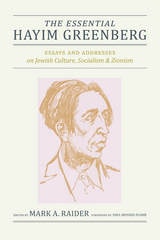
The Essential Hayim Greenberg
Essays and Addresses on Jewish Culture, Socialism, and ZionismHayim Greenberg, Edited and introduced by Mark Raider, Foreword by Paul Mendes-Flohr
University of Alabama Press, 2016
This collection of thoroughly annotated essays, spanning the 1920s to the early 1950s, includes Greenberg’s meditations on socialism and ethics, profiles of polarizing twentieth-century figures (among them Trotsky, Lenin, and Gandhi), and several essays investigating the compatibility of socialism and communism. Greenberg always circles back, however, to the recurring question of how Jews might situate themselves in modernity, both before and after the Holocaust, and how Labor Zionist ideology might reshape the imbalances of Jewish economic life.
Alongside his role as an American Zionist leader, Greenberg maintained a lifelong commitment to the vitality of the Jewish diaspora. Rather than promoting Jewish autonomy and statehood, he argued for fidelity to the Jewish spirit. This volume not only seeks to restore Greenberg to his previous stature in the field of Judaic studies but also to return a vital and authentic voice, long quieted, to the continuing debate over what it means to be Jewish.
The Essential Hayim Greenberg provides an accessible text for scholars, historians, and students of Jewish studies, religion, and theology.
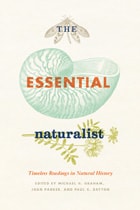
The Essential Naturalist
Timeless Readings in Natural HistoryEdited by Michael H. Graham, Joan Parker, and Paul K. Dayton
University of Chicago Press, 2011
Like nearly every area of scholarly inquiry today, the biological sciences are broken into increasingly narrow fields and subfields, its practitioners divided into ecologists, evolutionary biologists, taxonomists, paleontologists, and much more. But all these splintered pieces have their origins in the larger field of natural history—and in this era where climate change and relentless population growth are irrevocably altering the world around us, perhaps it’s time to step back and take a new, fresh look at the larger picture.
The Essential Naturalist offers exactly that: a wide-ranging, eclectic collection of writings from more than eight centuries of observations of the natural world, from Leeuwenhoek to E. O. Wilson, from von Humboldt to Rachel Carson. Featuring commentaries by practicing scientists that offer personal accounts of the importance of the long tradition of natural history writing to their current research, the volume serves simultaneously as an overview of the field’s long history and as an inspirational starting point for new explorations, for trained scientists and amateur enthusiasts alike.
The Essential Paul Simon
Timeless Lessons for Today's PoliticsEdited by John S. Jackson. Foreword by David Yepsen
Southern Illinois University Press, 2012
While Simon covered a broad spectrum of topics in his written works, his mission throughout the years remained the same: to urge his constituents to study and understand issues that affected their daily lives and to make the complexities of politics accessible to the average citizen. An indispensable volume for voters and politicians alike, The Essential Paul Simon compiles some of the most thought-provoking writings from one of the keenest political minds in our nation’s history. Years after their publication, Simon’s eloquent and energetic conversations continue to provide witty, informative guidance through the maze of American politics and inspire the development of spirited public discussion and debate.
Certificate of Excellence from the Illinois State Historical Society, 2013
The Ethical Condition
Essays on Action, Person, and ValueMichael Lambek
University of Chicago Press, 2015
Organized chronologically, the essays begin among Malagasy speakers on the island of Mayotte and in northwest Madagascar. Building from ethnographic accounts there, they synthesize Aristotelian notions of practical judgment and virtuous action with Wittgensteinian notions of the ordinariness of ethical life and the importance of language, everyday speech, and ritual in order to understand how ethics are lived. They illustrate the multiple ways in which ethics informs personhood, character, and practice; explore the centrality of judgment, action, and irony to ethical life; and consider the relation of virtue to value. The result is a fully fleshed-out picture of ethics as a deeply rooted aspect of the human experience.
The European Identity
Historical and Cultural Realities We Cannot DenyStephen Green
Haus Publishing, 2015
Green points out that Europeans can readily define the differences that separate them from others around the globe, but they have yet to clearly define their own similarities across member states. He argues that Europe has something distinctive and vitally important to offer: the experience of a unique journey through centuries of exploration and conflict, errors and lessons, soul-searching and rebuilding—an evolution of universal significance.
Coming at a time when the divisions in European culture have been laid bare by recent financial crises and calls for independence, The European Identity identifies one of the biggest challenges for all of the member states of the European Union.
The Experimental Side of Modeling
Isabelle F. Peschard
University of Minnesota Press, 2018
An innovative, multifaceted approach to scientific experiments as designed by and shaped through interaction with the modeling process
The role of scientific modeling in mediation between theories and phenomena is a critical topic within the philosophy of science, touching on issues from climate modeling to synthetic models in biology, high energy particle physics, and cognitive sciences. Offering a radically new conception of the role of data in the scientific modeling process as well as a new awareness of the problematic aspects of data, this cutting-edge volume offers a multifaceted view on experiments as designed and shaped in interaction with the modeling process.
Contributors address such issues as the construction of models in conjunction with scientific experimentation; the status of measurement and the function of experiment in the identification of relevant parameters; how the phenomena under study are reconceived when accounted for by a model; and the interplay between experimenting, modeling, and simulation when results do not mesh. Highlighting the mediating role of models and the model-dependence (as well as theory-dependence) of data measurement, this volume proposes a normative and conceptual innovation in scientific modeling—that the phenomena to be investigated and modeled must not be precisely identified at the start but specified during the course of the interactions arising between experimental and modeling activities.
Contributors: Nancy D. Cartwright, U of California, San Diego; Anthony Chemero, U of Cincinnati; Ronald N. Giere, U of Minnesota; Jenann Ismael, U of Arizona; Tarja Knuuttila, U of South Carolina; Andrea Loettgers, U of Bern, Switzerland; Deborah Mayo, Virginia Tech; Joseph Rouse, Wesleyan U; Paul Teller, U of California, Davis; Michael Weisberg, U of Pennsylvania; Eric Winsberg, U of South Florida.
The Eye of the Mammoth
New and Selected EssaysBy Stephen Harrigan; foreword by Nicholas Lemann
University of Texas Press, 2013
History—natural history, human history, and personal history—and place are the cornerstones of The Eye of the Mammoth. Stephen Harrigan's career has taken him from the Alaska Highway to the Chihuahuan Desert, from the casinos of Monaco to his ancestors' village in the Czech Republic. And now, in this new edition, he movingly recounts in "Off Course" a quest to learn all he can about his father, who died in a plane crash six months before he was born.
Harrigan's deceptively straightforward voice belies an intense curiosity about things that, by his own admission, may be "unknowable." Certainly, we are limited in what we can know about the inner life of George Washington, the last days of Davy Crockett, the motives of a caged tiger, or a father we never met, but Harrigan's gift—a gift that has also made him an award-winning novelist—is to bring readers closer to such things, to make them less remote, just as a cave painting in the title essay eerily transmits the living stare of a long-extinct mammoth.
The Far Edges of the Fourth Genre
An Anthology of Explorations in Creative NonfictionSean Prentiss
Michigan State University Press, 2014
Contributors: Nancer Ballard, H. Lee Barnes, Kim Barnes, Mary Clearman Blew, Joy Castro, Robin Hemley, Judith Kitchen, Brenda Miller, Ander Monson, Dinty W. Moore, Sean Prentiss, Lia Purpura, Erik Reece, Jonathan Rovner, Bob Shacochis, and Joe Wilkins.
The Fittingness of the Incarnation
Essays in Analytic Thomistic Philosophy and TheologyDavid Braine, David
Catholic University of America Press, 2025
The Flight from Ambiguity
Essays in Social and Cultural TheoryDonald N. Levine
University of Chicago Press, 1985
The Folklore Muse
Poetry, Fiction, and Other Reflections by FolkloristsFrank de Caro
Utah State University Press, 2008
Folklore—the inherently creative expression, transmission, and performance of cultural traditions—has always provided a deep well of material for writers, musicians, and artists of all sorts. Folklorists usually employ descriptive and analytical prose, but they, like scholars in other social sciences, have increasingly sought new, creative and reflexive modes of discourse. Many folklorists are also creative writers, some well known as such, and the folk traditions they research often provide shape and substance to their work. This collection of creative writing grounded in folklore and its study brings together some of the best examples of such writing.
Contributors to this collection include Teresa Bergen, John Burrison, Norma E. Cantu, Frank de Caro, Holly Everett, Danusha Goska, Neil R. Grobman, Carrie Hertz, Edward Hirsch, Laurel Horton, Rosan Augusta Jordan, Paul Jordan-Smith, Elaine J. Lawless, Cynthia Levee, Jens Lund, Mary Magoulick, Bernard McCarthy, Joanne B. Mulcahy, Kirin Narayan, Ted Olson, Daniel Peretti, Leslie Prosterman, Jo Radner, Susan Stewart, Jeannie Banks Thomas, Jeff Todd Titon, Libby Tucker, Margaret Yocom, and Steve Zeitlin.
The Forts Henry and Donelson Campaign
February 6–16, 1862Edited by Steven E. Woodworth and Charles D. Grear
Southern Illinois University Press, 2026
New perspectives on the battles that opened the Confederacy to invasion
In early 1862, the Civil War had been raging for almost ten months, and the Confederacy had enjoyed virtually uninterrupted success. From seizing federal property to early battlefield victories, Southern forces had effectively expelled Union authority from nearly all of the Confederacy’s eleven states. The Union suffered repeated setbacks, while modest victories in western Virginia and Kentucky had little strategic impact. By the end of February, however, much had changed.
On February 6, Union gunboats under the joint command of Brigadier General Ulysses S. Grant and Flag Officer Andrew H. Foote captured Fort Henry on the Tennessee River, opening a crucial waterway into the Confederacy. Just days later, Grant moved against Fort Donelson on the Cumberland River. After several days of fighting, the fort surrendered on the 16th, along with more than 13,000 Confederate troops—the largest surrender in US history to that point. These twin victories shattered Confederate control of Kentucky and western Tennessee, allowing Federal soldiers and sailors to use the rivers to threaten the Confederacy’s interior. This first major strategic breakthrough of the war signaled a dramatic shift in momentum and elevated Grant’s national profile.
In this essay collection, leading and emerging scholars provide in-depth analyses of previously overlooked aspects of the Forts Henry and Donelson campaign. Contributors examine how ecological forces influenced the campaign, the effectiveness of the joint command between the Union army and navy, and Union brigadier general Charles F. Smith’s assault that doomed Fort Donelson. They also explore the battle’s impact on the military career of Nathan Bedford Forrest, the effects of surprise during the Confederate breakout attempt from Fort Donelson, Confederate colonel Gabriel Wharton’s memoir, and how the loss of the forts showed Texans that the fight to preserve the enslaved South would cost them more than they had imagined.
In the aftermath of the Forts Henry and Donelson campaign, most of the Civil War still lay ahead. The Confederacy would have many opportunities to regain its momentum and exhaust the Union will to prevail. However, with a few key exceptions, for the rest of the war, the Confederacy fought to defend itself rather than to take new territory. It was in this massive shift of momentum during ten days in 1862 that the war’s military outcome was foreshadowed.
The Fortunes of Liberalism
Essays on Austrian Economics and the Ideal of FreedomF. A. Hayek
University of Chicago Press, 1991
The Reagan and Thatcher "revolutions." The collapse of Eastern Europe dramatically captured in the tearing down of the Berlin Wall. F. A. Hayek, "grand old man of capitalism" and founder of the classical liberal, free-market revival which ignited and inspired these world events, forcefully predicted their occurrence in writings such as The Road to Serfdom, first published in 1944.
Hayek's well-known social and political philosophy—in particular his long-held pessimistic view of the prospects of socialism, irrefutably vindicated by the recent collapse of the Eastern bloc—is fully grounded in the Austrian approach to economics. In this new collection, Hayek traces his intellectual roots to the Austrian school, the century-old tradition founded at the University of Vienna by Carl Menger, and links it to the modern rebirth of classical liberal or libertarian thought.
As Hayek reminds us, the cornerstone of modern economics—the theory of value and price—"represents a consistent continuation of the fundamental principles handed down by the Vienna school." Here, in this first modern collection of essays on the Austrian school by one of its preeminent figures, is the genesis of this tradition and its place in intellectual history.
Reflections on Hayek's days as a young economic theorist in Vienna, his opening address to the inaugural meeting of the Mont Pèlerin Society, and essays on former teachers and other leading figures in the Austrian school are included in volume 4. Two hitherto unavailable memoirs, "The Economics of the 1920s as Seen from Vienna," published here for the first time, and "The Rediscovery of Freedom: Personal Recollections," available for the first time in English, make this collection invaluable for Hayek scholars.
Hayek's writings continue to provide an invaluable education in a subject which is nothing less than the development of the modern world.
The Fragile Dialogue
New Voices of Liberal ZionismRabbi Stanley M. Davids and Rabbi Lawrence A. Englander, DHL
Central Conference of American Rabbis, 2018

The Future of Humanity
From Global Civilization to Great CivilizationZhouying Jin
Intellect Books, 2022
This book seeks to underscore the importance of dealing with our planet’s common crises—climate change, species extinction, land and food shortages, water pollution, and many more global catastrophes. In the face of these calamities, this book calls for the transformation of human development model and civilization paradigm: Promote the transformation from industrial civilization to global Civilization and then strive to realize the great civilization.
The far-reaching effects of the COVID-19 pandemic have gone beyond the fields of health, deeply impacting economic, social, and geopolitical affairs worldwide. The still-unfolding health crisis has forced many to rethink the axioms of what they know as “civilization.” In this book, Zhouying Jin contends that if the human beings who share the earth cannot guide the direction of technological innovation to create a more advanced human civilization, then they are doomed to move toward self-destruction. The Future of Humanity calls on human beings to prepare for the future by altering their destructive relationship with nature and abandoning people-centered thinking to promote an awakening of all mankind.
The Game Changed
Essays and Other ProseLawrence Joseph
University of Michigan Press, 2011
Praise for Lawrence Joseph:
"Poetry of great dignity, grace, and unrelenting persuasiveness… Joseph gives us new hope for the resourcefulness of humanity, and of poetry."
---John Ashbery
"Like Henry Adams, Joseph seems to be writing ahead of actual events, and that makes him one of the scariest writers I know."
---David Kirby, The New York Times Book Review
"The most important lawyer-poet of our era."
---David Skeel, Legal Affairs
A volume in the Poets on Poetry series, which collects critical works by contemporary poets, gathering together the articles, interviews, and book reviews by which they have articulated the poetics of a new generation.
Essays on poetry by the most important poet-lawyer of our era
The Game Changed: Essays and Other Prose presents works by prominent poet and lawyer Lawrence Joseph that focus on poetry and poetics, and on what it is to be a poet. Joseph takes the reader through the aesthetics of modernism and postmodernism, a lineage that includes Wallace Stevens, William Carlos Williams, and Gertrude Stein, switching critical tracks to major European poets like Eugenio Montale and Hans Magnus Enzensberger, and back to American masters like James Schuyler and Adrienne Rich.
Always discerning, especially on issues of identity, form, and the pressures of history and politics, Joseph places his own poetry within its critical contexts, presenting narratives of his life in Detroit, where he grew up, and in Manhattan, where he has lived for 30 years. These pieces also portray Joseph’s Lebanese, Syrian, and Catholic heritages, and his life as a lawyer, distinguished law professor, and legal scholar.
The Garden at the End of Time
Getting By in the Age of Climate ChangeJohn Hanson Mitchell
University of Massachusetts Press, 2025
John Hanson Mitchell has long written about his garden outside of Boston, and about the plants and animals with whom he shares this land. In 2022, the United Nations and others started reporting the true severity of the climate crisis as the Earth passed a point of no return. All across the globe it was the worst year on record for climate-related disasters, including extinctions, deadly floods, massive fires, and dramatic droughts, all of which have worsened since that year. Mitchell, like so many, felt overwhelmed. He looked to the story of Voltaire’s Candide, and settled on the famous aphorism from that book: “We must cultivate our garden.”
The Garden at the End of Time features Mitchell’s trademark blend of science, literature, and anecdote as he processes both the information he is reading from various sources and what it prompts him to do in his own small corner of the world. The story that unfolds is one of Mitchell diversifying his plantings; fighting what he sees as unnecessary local development; walking through and observing changes in the wild lands nearby; continuing to read the news from around the world; and meditating on other moments, real and imagined, when people sought refuge even as they did their part to improve a personally and collectively stressful situation.
Readers discover the impossibility of separating gardening from global warming, while also seeing the solace that exposure to plants can offer, in addition to their contribution to carbon consumption. With gravitas, kindness, and wit, Mitchell offers a model for maintaining a connection to nature even as it reels from manmade threats.
The Glen Canyon Reader
Mathew Barrett Gross
University of Arizona Press, 2003
The Governors of Arkansas
Essays in Political BiographyJr. Gatewood
University of Arkansas Press, 1995
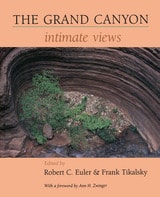
The Grand Canyon
Intimate ViewsEdited by Robert C. Euler and Frank Tikalsky; Foreword by Ann H. Zwinger
University of Arizona Press, 1992
Contents
Foreword, by Ann H. Zwinger
1. The Geologic Record, by Stanley S. Beus
2. The Living Canyon, by Steven W. Carothers
3. Grand Canyon Indians, by Robert C. Euler
4. Historical Explorations, by Robert C. Euler
5. The Canyon by River, by Kim Crumbo
6. Hiking the Canyon, by Frank Tikalsky
The Grand Old Man and the Great Tradition
Essays on Tanizaki Jun’ichiro in Honor of Adriana BoscaroLuisa Bienati and Bonaventura Ruperti, Editors
University of Michigan Press, 2009
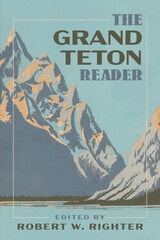
The Grand Teton Reader
Robert W. Righter
University of Utah Press, 2021
Editor Robert Righter has selected thirty-five contributors whose work takes readers from the Tetons’ geological origins to the time of Euro-American encroachment and the park’s politically tumultuous creation. Selections range from Laine Thom’s Shoshone legend of the Snake River and Owen Wister’s essay “Great God! I’ve Just Killed a Bear,” to Grace Gallatin Seton-Thompson’s humorous yet fearful account of crossing the Snake River, and William Owen’s first attempt to climb the Grand Teton. Conservationists, naturalists, and environmentalists are also represented: Terry Tempest Williams chronicles her multiyear encounter with her “Range of Memory,” and Olaus and Mardy Murie recount the difficulties of “park-making” in an often-hostile human environment.
Anyone seeking a deeper understanding of the park’s wild beauty and controversial past will want to read these stories by people who lived it.
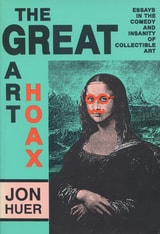
The Great Art Hoax
Essays in the Comedy and Insanity of Collectible ArtJon Huer
University of Wisconsin Press, 1990
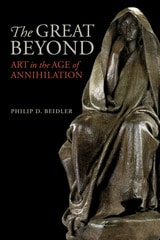
The Great Beyond
Art in the Age of AnnihilationPhilip D. Beidler
University of Alabama Press, 2022
Essays mapping how modern art confronts mortality in an age of war and annihilation.
While much about modernism remains up for debate, there can be no dispute about the connection between modernist art and death. The long modern moment was and is an age of war, genocide, and annihilation. Two world wars killed perhaps as many as 100 million people, through combat, famine, holocaust, and ghastly attacks on civilians. The ongoing COVID-19 pandemic is the fifth global pandemic since 1918, with more than a half-million American deaths and counting.
It can hardly come as a surprise, then, that many of the touchstones of modernism reflect on death and devastation. In Philip D. Beidler’s exploration of the modernist canon, he illuminates how these singular voices looked extinction in the eye and tried to reckon with our finitude—and their own. The Great Beyond: Art in the Age of Annihilation catalogs through lively prose an eclectic selection of artists, writers, and thinkers. In 16 essays, Beidler takes nuanced and surprising approaches to well-studied figures—the haunting sculpture by Saint-Gaudens commissioned by Henry Adams for his late wife; Luchino Visconti’s adaptation of Mann’s Death in Venice; and the author’s own long fascination with Beckett’s Waiting for Godot.
The threads and recurring motifs that emerge through Beidler’s analysis bridge the different media, genres, and timeframes of the works under consideration. Protomodernists Crane and Twain connect with near-contemporary voices like Sebald and Morrison. Robert MacFarlane’s 21st-century nonfiction about what lies underneath the earth echoes the Furerbunker and the poetry of Gertrud Kolmar. Learned but lively, somber but not grim, The Great Beyond is not a comfortable read, but it is in a way comforting. In tracing how his subjects confronted nothingness, be it personal or global, Beidler draws a brilliant map of how we see the end of the road.
The Great Game
Essays on PoeticsAmit Majmudar
Acre Books, 2024
In The Great Game, poet, critic, translator, and literary omnivore Amit Majmudar ranges widely, writing with characteristic verve on canonical authors such as Milton, Byron, and Emily Dickinson, contemporaries like Kay Ryan, and other traditions of world literature. He examines verse drama and philosophy and even touches on writers of popular prose like Robert Ludlum and Ray Bradbury. A radiologist as well as a writer, Majmudar brings together the diagnostician’s precision with the poet’s imagination and an encyclopedic base of knowledge. He practices literary criticism as a global art, one with the intensity of verse, the depth of philosophy, and the scope of history—and does so with the infectious curiosity of a passionate reader.
Some of the most powerful essays here are synoptic meditations on science and poetry in which Majmudar shows that anyone trying to make fresh sense of the world, be it Milton or Kepler or Dickinson or Darwin, is practicing something like poetic meaning-making. The collection’s diverse inquiries are held together by Majmudar’s sustained, thoughtful, delightfully inventive attention to poetic form as an idea, to specific forms like the ghazal and the epic, and by his nimble, empathetic readings of individual writers. The Great Game is an intellectually thrilling tour of poetry across centuries, geographic divides, and even the disciplinary boundaries that separate science from philosophy from poetry.
The Great Hummingbird Chase
John P. Schaefer and Ken Lamberton
University of Arizona Press, 2027
Southern Arizona is a world-renown hummingbird destination. The Great Hummingbird Chase chronicles John P. Schaefer and Ken Lamberton’s passionate quest to photograph all fifteen of Arizona’s hummingbird species.
The Great Lakes Forest
An Environmental and Social HistorySusan Flader
University of Minnesota Press, 1983
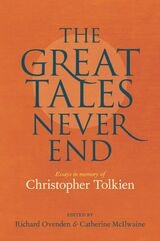
The Great Tales Never End
Essays in Memory of Christopher TolkienEdited by Richard Ovenden and Catherine McIlwaine
Bodleian Library Publishing, 2022
Over more than four decades, J. R. R. Tolkien’s son and literary executor Christopher Tolkien completed some twenty-four volumes of his father’s work, much more than his father had succeeded in publishing during his own lifetime. Thanks to Christopher’s extraordinary publishing efforts and scholarship, readers today can survey and understand the vast landscape of Tolkien’s legendarium.
The Great Tales Never End sheds new light on J. R. R. Tolkien’s work and the debt owed to Christopher by the many Tolkien scholars who were privileged to work with him. Essays by world-renowned scholars and Tolkien family reminiscences offer unique insights into the publication process. What was Tolkien’s intended ending for The Lord of the Rings, and did it leave echoes in the stripped-down version that was actually published? What was the audience’s response to the first-ever adaptation of The Lord of the Rings—a radio dramatization that has now been deleted forever from the BBC’s archives?
The book is illustrated with color reproductions of J. R. R. Tolkien’s manuscripts, maps, drawings, and letters, as well as photographs of Christopher Tolkien and extracts from his works. Many of these documents have never been seen before, making this volume essential reading for Tolkien scholars, readers, and fans.
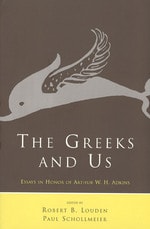
The Greeks and Us
Essays in Honor of Arthur W. H. AdkinsEdited by Robert B. Louden and Paul Schollmeier
University of Chicago Press, 1996
The timely subjects addressed by the contributors include the relation between literature and moral understanding, moral and nonmoral values, and the contemporary meaning of ancient Greek ethics. The volume also includes an essay from the late Adkins himself illustrating his methodology in an analysis of the "Speech of Lysias" in Plato's Phaedrus.
The Greeks and Us will interest all those concerned with how ancient moral values do or do not differ from our own.
Contributors include Arthur W. H. Adkins, Stephanie Nelson, Martha C. Nussbaum, Paul Schollmeier, James Boyd White, Bernard Williams, and Lee Yearley.
Commentaries by Wendy Doniger, Charles M. Gray, David Grene, Robert B. Louden, Richard Posner, and Candace Vogler.
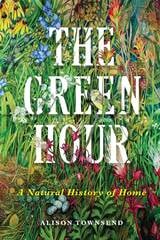
The Green Hour
A Natural History of HomeAlison Townsend
University of Wisconsin Press, 2021
With sparkling, lyrical prose, The Green Hour undulates effortlessly through time like a red-winged blackbird. Inspired by five beloved settings—eastern Pennsylvania, Vermont, California, western Oregon, and the spot atop the Wisconsin hill where she now resides—Townsend considers the role that place plays in shaping the self. She reveals the ways that a fresh perspective or new experience in any environment can incite wonder, build unexpected connections, and provide solace or salvation.
Mesmerizingly attentive to nature—its beauty, its fragility, and its redeeming powers—she asks what it means to live in community with wilderness and to allow our identities to be shaped by our interactions with it: our story as its story.
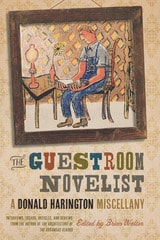
The Guestroom Novelist
A Donald Harington MiscellanyDonald Harington
University of Arkansas Press, 2019
Donald Harington, best known for his fifteen novels, was also a prolific writer of essays, articles, and book reviews.
The Guestroom Novelist: A Donald Harington Miscellany gathers a career-spanning and eclectic selection of nonfiction by the Arkansawyer novelist Donald Harington that reveals how a life of devastating losses and disappointments inspired what the Boston Globe called the “quirkiest, most original body of work in contemporary US letters.”
This extensive collection of interviews and other works of prose—many of which are previously unpublished—offers glimpses into Harington’s life, loves, and favorite obsessions, replays his minor (and not so minor) dramas with literary critics, and reveals the complicated and sometimes contentious relationship between his work of the writers he most admired. The Guestroom Novelist, which takes its title from an essay that serves as a love letter to his fellow underappreciated writers, paints a rich portrait of the artist as a young, middle-aged, and fiercely funny old man, as well as comic, sentimentalist, philosopher, and critic, paying testimony to the writer’s magnificent ability to transform the seemingly crude stuff of our material existence into enduring art.
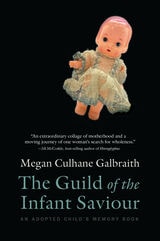
The Guild of the Infant Saviour
An Adopted Child's Memory BookMegan Culhane Galbraith
The Ohio State University Press, 2021
Shortly before Roe v. Wade legalized abortion, adoptee Megan Culhane Galbraith was born in a Catholic charity hospital in New York City to a teenaged resident of the Guild of the Infant Saviour, a home for unwed mothers. Decades later, on the eve of becoming a mother herself, she would travel to the former guild site; to her birth mother’s home in Scotland; and to Cornell University, where she discovered the startling history of its Domestic Economics program. There, from 1919 to 1969, coeds applied scientific principles to domesticity as they collectively mothered a rotating cast of babies awaiting adoption. The babies shared the last name Domecon and provided the inspiration for Galbraith’s art project, The Dollhouse.
The Guild of the Infant Saviour is a dizzyingly inventive hybrid memoir of one adoptee’s quest for her past. Galbraith pairs narrative with images from The Dollhouse as she weaves a personal and cultural history of adoption as it relates to guilt, shame, grief, identity, and memory itself. Ultimately, she connects her experiences to those of generations of adoptees, to the larger stories America tells about sex and motherhood, and to the shadows those stories cast on us all.

The Hajj and the Arts of Pilgrimage
Essays in Honour of Nasser David KhaliliEdited by Qaisra M. Khan and Nahla Nassar
Gingko, 2023
Hajj and the Arts of Pilgrimage consists of twenty-seven essays addressing objects in the remarkable collection of Nasser David Khalili. The collection features more than five thousand objects relating to the arts of pilgrimage, from the eighth century to today, and includes Qur’ans, illustrated manuscripts, rare books, scientific instruments, textiles, coins, paintings, prints, and photo-postcards, as well as archival material, unique historical documents, and examples of the work of some of the earliest Muslim photographers of Hajj. Together the essays collected in Hajj and the Arts of Pilgrimage provide a comprehensive overview of Hajj, illustrating the religious, spiritual, cultural, and artistic aspects of pilgrimage to the Holy Sanctuaries of Islam and the cosmopolitan nature of Hajj itself. Each essay is written by a prominent specialist in the field and beautifully illustrated with full-color images of objects from the collection, some of which have never been seen in print before. Taking readers from the early history of Islam to the fascinating story of the Western view of Muslim pilgrimage, these essays will transform our perception of Hajj.
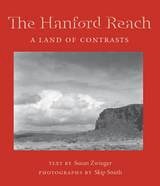
The Hanford Reach
A Land of ContrastsText by Susan Zwinger; Photographs by Skip Smith
University of Arizona Press, 2004
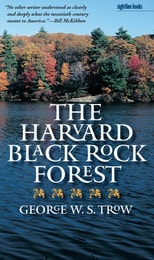
The Harvard Black Rock Forest
George W.S. Trow
University of Iowa Press, 2004
Originally published in the June 11, 1984, New Yorker, this lengthy essay is a sharp-edged inquiry into the generational institutions of our national life. With the same iconoclastic spirit and multilayered prose that he interwove in his classic Within the Context of No Context, George Trow tells the story of upstate New York’s Black Rock Forest—a thirty-eight-hundred-acre site overlooking the Hudson River—through the lives of the men who were connected to it and through the larger histories of Harvard University, U.S. conservation policies, and physics and biology.
The men: banker James Stillman; his son, Ernest Stillman, a medical doctor who inherited the land that would become the Black Rock Forest in 1928 and who wanted to make it healthy and useful; the legendary Gifford Pinchot, appointed chief forester of the U.S. in 1898; and Richard Thornton Fisher, for many years the head of the Harvard Forest and the man who suggested to Ernest Stillman that he turn his inherited land into another demonstration forest. Harvard University: a more financially focused, less collegial environment than the one that had accepted the gift of the forest in 1949, now looking to shed responsibility for the forest without shedding the money its sale would bring. The challenge: How to manage, how to value, a wilderness area of great biological diversity.
In his brilliantly elastic fashion, Trow maneuvers images, symbols, ambiguities, ethics, journalistic wordplay, advertising tricks, and corporate doublespeak to create an intensely perceptive analysis of the cultural, political, and scientific communities. His richly developed story of the Harvard Black Rock Forest is ultimately a symbolic tale that bears upon some of the most significant institutions, professions, and legacies in contemporary American life.
A publisher’s note reveals the fate of the forest.
The Heart Is a Little to the Left
Essays on Public MoralityWilliam Sloane Coffin
Dartmouth College Press, 2011
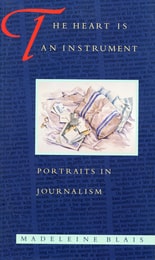
The Heart Is an Instrument
Portraits in JournalismMadeleine Blais
University of Massachusetts Press, 1992
From the Foreword by Geneva Overholser
What is it about really fine writers, how they delight, intrigue, compel us?
Style, you say. But style is not something you begin with. Rather, it's what you end up with, a result of far more fundamental traits. Traits such as an ear and an eye and a heart, traits that Madeleine Blais has honed superbly well.
This is a book well named: The Heart Is an Instrument: Portraits in Journalism. The heart is surely first among Blais's gifts. Whether she is writing about the famous—playwright Tennessee Williams, novelist Mary Gordon—or about the least elevated among us—a teenage prostitute infected with the AIDS virus, a homeless schizophrenic—she brings to her subjects an incomparable empathy.
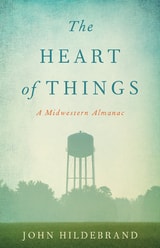
The Heart of Things
A Midwestern AlmanacJohn Hildebrand
Wisconsin Historical Society Press, 2014
In this remarkable book of days, John Hildebrand charts the overlapping rings—home, town, countryside—of life in the Midwest. Like E. B. White, Hildebrand locates the humor and drama in ordinary life: church suppers, Friday night football, outdoor weddings, garden compost, family reunions, roadside memorials, camouflage clothing. In these wry, sharply observed essays, the Midwest isn’t The Land Time Forgot but a more complicated (and vastly more interesting) place where the good life awaits once we figure exactly out what it means. From his home range in northwestern Wisconsin, Hildebrand attempts to do just that by boiling down a calendar year to its rich marrow of weather, animals, family, home—in other words, all the things that matter.
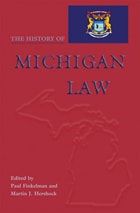
The History of Michigan Law
Paul Finkelman
Ohio University Press, 2006
The History of Michigan Law offers the first serious survey of Michigan’s rich legal past. Michigan legislators have played a leading role in developing modern civil rights law, protecting the environment, and assuring the right to counsel for those accused of crimes. Michigan was the first jurisdiction in the English-speaking world to abolish the death penalty. As the state industrialized, its legal system responded to the competing demands and interests of farmers, railroads, entrepreneurs, and workers.
Michigan was a beacon of liberty for fugitive slaves and free blacks before the Civil War and an early leader in the adoption of laws to protect civil rights and prohibit discrimination after that conflict. The state was the site of the Ossian Sweet murder trial, which illustrated the tensions in Michigan between law and popular ideology. The History of Michigan Law documents and analyzes these legal developments and others, including the history of labor law, women’s rights, and legal education.
This landmark volume will serve as the entry point for all future studies that involve law and society in Michigan and will be invaluable in the comparative study of state law. As the Michigan Supreme Court enters its third century, The History of Michigan Law has relevance beyond the legal community, for scholars and students of American history.
The Hopwood Lectures
Edited and with an introduction by Nicholas Delbanco
University of Michigan Press, 2009
The prestigious Hopwood Creative Writing Awards were established in 1931 from a bequest of the will of Avery Hopwood, a University of Michigan graduate and one of the most popular and successful dramatists of his time. Hopwood left one-fifth of his estate to his alma mater, an endowment that now awards approximately $135,000 each year in prize money. Annual awards are offered to both undergraduate and graduate students in drama, screenplay, nonfiction, novel, short fiction, and poetry. Among the program's most famous recipients are Robert Hayden, Arthur Miller, Frank O'Hara, and Marge Piercy.
In addition to the prize ceremony, the Hopwood Awards are celebrated each year with a lecture delivered by a prominent literary figure. Past Hopwood speakers include such luminaries as Saul Bellow, Richard Ford, Louise Glück, Nadine Gordimer, Robert Hass, Norman Mailer, Joyce Carol Oates, and John Crowe Ransom. Their speeches have been collected in five previous volumes published by the University of Michigan Press over the past half-century: The Writer and His Craft: The Hopwood Lectures 1932-1952, edited by Roy W. Cowden; To The Young Writer: Hopwood Lectures, Second Series, edited by A. L. Bader; The Writer's Craft, edited by Robert A. Martin; Speaking of Writing: Selected Hopwood Lectures, edited by Nicholas Delbanco; and The Writing Life: The Hopwood Lectures, Fifth Series, edited by Nicholas Delbanco.
The present collection contains the ten lectures delivered since the last publication and includes work by Andrea Barrett, Charles Baxter, Mary Gordon, Donald Hall, Richard Howard, Lawrence Kasdan, Susan Orlean, Susan Stamberg, and Edmund White. The tenth lecture was delivered in spring 2008 by Charles Johnson.
Nicholas Delbanco is Robert Frost Collegiate Professor of English Language and Literature and Chair of the Hopwood Committee. Delbanco is the author of twenty books of fiction and nonfiction, including, most recently, Spring and Fall: A Novel. As editor he has compiled the work of, among others, John Gardner and Bernard Malamud. In addition to directing the MFA Program and the Hopwood Awards Program at the University of Michigan, he has served as Chair of the Fiction Panel for the National Book Awards and has received a Guggenheim Fellowship and, twice, a National Endowment for the Arts Writing Fellowship. He lives in Ann Arbor, Michigan.
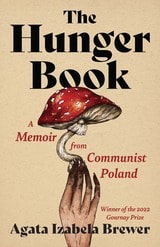
The Hunger Book
A Memoir from Communist PolandAgata Izabela Brewer
The Ohio State University Press, 2023
“A searing memoir about growing up behind the Iron Curtain, motherhood, addiction, and finding sustenance in the natural world.” —Kirkus
In The Hunger Book, Agata Izabela Brewer evokes her Polish childhood under Communism, where the warmth of her grandparents’ love and the scent of mushrooms drying in a tiny apartment are as potent as the deprivations and traumas of life with a terrifyingly unstable, alcoholic single mother. Brewer indelibly renders stories of foraging for food, homemade potato vodka (one of the Eastern Bloc’s more viable currencies), blood sausage, sparrows plucked and fried with linseed oil, and the respite of a country garden plot, all amid Stalinist-era apartment buildings, food shortages, martial law, and nuclear disaster in nearby Ukraine.
Brewer reflects on all of this from her immigrant’s vantage point, as she wryly tries to convince her children to enjoy the mushrooms she gathers from a roadside and grieves when they choose to go by Americanized versions of their Polish names. Hunting mushrooms, like her childhood, carried both reward and mortal peril. The Hunger Book, which includes recipes, is an unforgettable meditation on motherhood and addiction, resilience and love.
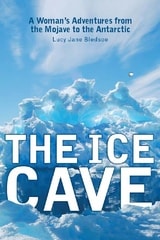
The Ice Cave
A Woman’s Adventures from the Mojave to the AntarcticLucy Jane Bledsoe
University of Wisconsin Press, 2006
These are Bledsoe’s gripping tales of fending off wolves in Alaska, encountering UFOs in the Colorado Desert, and searching for mountain lions in Berkeley. Her memorable story “The Breath of Seals” takes readers to Antarctica, the wildest continent on earth, where she camped out with geologists, biologists, and astrophysicists. These fresh and deeply personal narratives remind us what it means to be simply one member of one species, trying to find food and shelter—and moments of grace—on our planet.
The Imaginary Present
Essays in Quantum PoeticsAmy Catanzano
University of Michigan Press, 2025
19th Annual National Indie Excellence Awards Poetry Finalist
The Imaginary Present by award-winning poet and professor Amy Catanzano explores cutting-edge scientific fields such as particle physics and astrophysics, and branches of physics such as quantum theory and relativity, through a poetic vision equally loyal to the imagination and rationality. Drawing upon her groundbreaking research and artist residencies at major scientific research centers like CERN and the U.S. National Science Foundation’s NOIRLab, as well as talks and poetry readings at esteemed institutions, Catanzano invites enthusiasts of poetry and science to consider what can be achieved through greater collaboration between these fields.
In linked chapters that fluidly blend lyric essay, literary and scientific analysis, poetry, theory, and memoir, The Imaginary Present offers refreshing new insights on a wide range of thinkers over the past 100 years, including poets Rae Armantrout and M. NourbeSe Philip, novelists Alfred Jarry and Virginia Woolf, comic book writer Grant Morrison, and physicists Albert Einstein and Werner Heisenberg. The introduction explores why poetry and physics are capable of jointly investigating our most fundamental questions about the universe and discusses the history of the art-science connection in addition to the author’s own journey. In searching for the groundbreaking ways that artists and scientists can collaborate, The Imaginary Present offers readers both reasoned grounding and poetic framing for an interdisciplinary poetics and praxis based on science.