Results by title
477 books match the query 'Italy' and 136 start with t
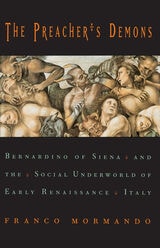
The Preacher's Demons
Bernardino of Siena and the Social Underworld of Early Renaissance ItalyFranco Mormando
University of Chicago Press, 1999
His story of the Parisian vigilante was a recommendation. Sexual deviants were the objects of relentless, unconditional persecution in Bernardino's sermons. Other targets of the preacher's venom were witches, Jews, and heretics. Mormando takes us into the social underworld of early Renaissance Italy to discover how one enormously influential figure helped to dramatically increase fear, hatred, and intolerance for those on society's margins.
This book is the first on Bernardino to appear in thirty-five years, and the first ever to consider the preacher's inflammatory role in Renaissance social issues.
The Presence of Myth
Leszek Kolakowski
University of Chicago Press, 1989
With The Presence of Myth, Kolakowski demonstrates that no matter how hard man strives for purely rational thought, there has always been-and always will be-a reservoir of mythical images that lend "being" and "consciousness" a specifically human meaning.
"Kolakowski undertakes a philosophy of culture which extends to all realms of human intercourse—intellectual, artistic, scientific, and emotional. . . . [His] book has real significance for today, and may well become a classic in the philosophy of culture."—Anglican Theological Review
The Rain's Falling Up
Luca Rastello
Seagull Books, 2022
What was it really like to be a teenager growing up in Italy in the 1970s, during a time it has become all too easy to file away under “years of lead,” as the fathers’ betrayed ideals came face to face with the sons’ and daughters’ rebellions? What was happening in schools, in assemblies, social centers, and occupied factories as the postwar “economic miracle” was being dismantled from within? What moved the foremost French intellectuals of the time to sign an appeal against the repression of the student and workers’ movement in Italy? What did the bullets and heroin bring to a halt, and where did they come from? How does it feel when strategies of terror and police brutality become as ordinary as a TV dinner and as eerie as the plots of the science fiction novels you are plagiarizing to impress a girl? How are metropolitan geographies alchemized in the muscles of a young body crossing the shady lines between ages and sexes?
Luca Rastello raises these and other questions in an astonishing novel that splices chunks of plot and historical reconstruction into the free flow of memory and dream. Rain’s Falling Up tracks the trajectory of a generation while refusing to romanticize its protagonists or resolve the tensions that powered its volatile energy.
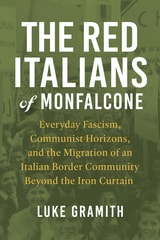
The Red Italians of Monfalcone
Everyday Fascism, Communist Horizons, and the Migration of an Italian Border Community Beyond the Iron CurtainLuke Gramith
University of Wisconsin Press, 2026
Between 1946 and 1948, roughly five thousand ethnic Italians from the northern Adriatic shipbuilding town of Monfalcone relocated to the newly communist Yugoslavia. This rare case of eastward Cold War migration demonstrates how ordinary people conceived of liberation during the transitional years between World War II and the early Cold War—a time when Monfalcone was both the object of competing Italian and Yugoslav territorial claims and the subject of Anglo-American military occupation.
In The Red Italians of Monfalcone, Luke Gramith undertakes a deep and detailed analysis—based on archival sources in Italy, Slovenia, and the United States—of how the Monfalconesi came to understand Fascism and communism through everyday experience and how those emergent ideologies affected and were affected by their migration. In the course of his analysis, Gramith also examines the failure of “defascistization” and how it fueled strong (but ultimately unsuccessful) pro-Yugoslav and communist movements.
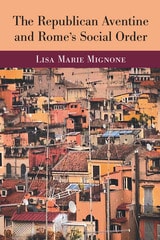
The Republican Aventine and Rome’s Social Order
Lisa Marie Mignone
University of Michigan Press, 2016
The myth of the “plebeian Aventine” became embedded not only in classical scholarship, but also in modern political and cultural consciousness; it has even been used by modern figures to support their political agenda. Yet The Republican Aventine and Rome’s Social Order makes bold new claims regarding the urban design and social history of ancient Rome and raises a significant question about ancient urbanism and social stability more generally: Did social integration reduce violence in premodern cities and promote urban concord?
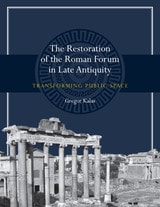
The Restoration of the Roman Forum in Late Antiquity
Transforming Public SpaceBy Gregor Kalas
University of Texas Press, 2015
In The Restoration of the Roman Forum in Late Antiquity, Gregor Kalas examines architectural conservation during late antiquity period at Rome’s most important civic center: the Roman Forum. During the fourth and fifth centuries CE—when emperors shifted their residences to alternate capitals and Christian practices overtook traditional beliefs—elite citizens targeted restoration campaigns so as to infuse these initiatives with political meaning. Since construction of new buildings was a right reserved for the emperor, Rome’s upper echelon funded the upkeep of buildings together with sculptural displays to gain public status. Restorers linked themselves to the past through the fragmentary reuse of building materials and, as Kalas explores, proclaimed their importance through prominently inscribed statues and monuments, whose placement within the existing cityscape allowed patrons and honorees to connect themselves to the celebrated history of Rome.
Building on art historical studies of spolia and exploring the Forum over an extended period of time, Kalas demonstrates the mutability of civic environments. The Restoration of the Roman Forum in Late Antiquity maps the evolution of the Forum away from singular projects composed of new materials toward an accretive and holistic design sensibility. Overturning notions of late antiquity as one of decline, Kalas demonstrates how perpetual reuse and restoration drew on Rome’s venerable past to proclaim a bright future.
The Round Dance
A NovelCarmine Abate
Rutgers University Press, 2024
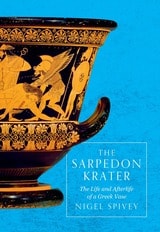
The Sarpedon Krater
The Life and Afterlife of a Greek VaseNigel Spivey
University of Chicago Press, 2019
Spivey takes the reader on a dramatic journey, beginning with the krater’s looting from an Etruscan tomb in 1971 and its acquisition by the Metropolitan Museum of Art, New York, followed by a high-profile lawsuit over its status and its eventual return to Italy. He explains where, how, and why the vase was produced, retrieving what we know about the life and legend of Sarpedon. Spivey also pursues the figural motif of the slain Sarpedon portrayed on the vase and traces how this motif became a standard way of representing the dead and dying in Western art, especially during the Renaissance.
Fascinating and informative, The Sarpedon Krater is a multifaceted introduction to the enduring influence of Greek art on the world.
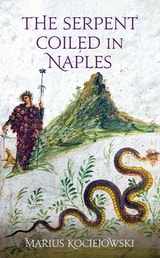
The Serpent Coiled in Naples
Marius Kociejowski
Haus Publishing, 2023
In recent years Naples has become, for better or worse, the new destination in Italy. While many of its more unusual features are on display for all to see, the stories behind them remain largely hidden. In Marius Kociejowski’s portrait of this baffling city, the serpent can be many things: Vesuvius, the mafia-like Camorra, the outlying Phlegrean Fields (which, geologically speaking, constitute the second most dangerous area on the planet). It is all these things that have, at one time or another, put paid to the higher aspirations of Neapolitans themselves. Naples is simultaneously the city of light, sometimes blindingly so, and the city of darkness, although often the stuff of cliché. The boundary that separates death from life is porous in the extreme: the dead inhabit the world of the living and vice versa. The Serpent Coiled in Naples is a travelogue, a meditation on mortality, and much else besides.
The Story of Tonle
Mario Rigoni Stern
Northwestern University Press, 1998
The Strozzi of Florence
Widowhood and Family Solidarity in the RenaissanceAnn Crabb
University of Michigan Press, 2000
The Strozzi correspondence tells the story of the decline and recovery of one Florentine patrician family. Eventually, the Strozzi brothers earned the greatest fortune of their era, and, after the repeal of their exile, Filippo, the eldest, most successful, and longest lived, spent the last years of his life in Florence as one of its foremost citizens. Set in the context of other documentary evidence and of modern historical and anthropological studies, Crabb's study illuminates the role of women, kinship, solidarity, honor, and profit. These letters provide nuanced insights into values and practices that more impersonal sources cannot rival.
As well as appealing to those interested in the Renaissance, Florence, and Italy, this book will attract those wanting to read about topics in social history that cross time periods: women, family and kinship, business, and honor. It confronts issues of Renaissance Florentine historiography by presenting a more positive view of the role of women than does current orthodoxy, by providing evidence of the impact of extended kinship ties, a controversial issue, and by illuminating further the value placed on honor and profit.
Ann Crabb teaches medieval history at James Madison University.
The Theater of Narration
From the Peripheries of History to the Main Stages of ItalyJuliet Guzzetta
Northwestern University Press, 2021
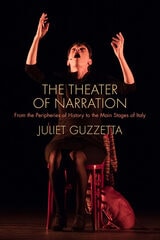
This book examines the theater of narration, an Italian performance genre and aesthetic that revisits historical events of national importance from local perspectives, drawing on the rich relationship between personal experiences and historical accounts. Incorporating original research from the private archives of leading narrators—artists who write and perform their work—Juliet Guzzetta argues that the practice teaches audiences how ordinary people aren’t simply witnesses to history but participants in its creation.
The theater of narration emerged in Italy during the labor and student protests, domestic terrorism, and social progress of the 1970s. Developing Dario Fo and Franca Rame’s style of political theater, influenced by Jerzy Grotowski and Bertolt Brecht, and following in the freewheeling actor‑author traditions of the commedia dell’arte, narrators created a new form of popular theater that grew in prominence in the 1990s and continues to gain recognition. Guzzetta traces the history of the theater of narration, contextualizing its origins—both political and intellectual—and centers the contributions of Teatro Settimo, a performance group overlooked in previous studies. She also examines the genre’s experiments in television and media.
The first full-length book in English on the subject, The Theater of Narration leverages close readings and a wealth of primary sources to examine the techniques used by narrators to remake history—a process that reveals the ways in which history itself is a theater of narration.
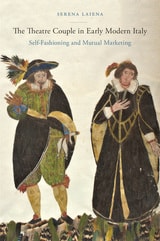
The Theatre Couple in Early Modern Italy
Self-Fashioning and Mutual MarketingSerena Laiena
University of Delaware Press, 2024
Who were the first celebrity couples? How was their success forged? Which forces influenced their self-fashioning and marketing strategies?
These questions are at the core of this study, which looks at the birth of a phenomenon, that of the couple in show business, with a focus on the promotional strategies devised by two professional performers: Giovan Battista Andreini (1576–1654) and Virginia Ramponi (1583–ca.1631). This book examines their artistic path – a deliberately crafted and mutually beneficial joint career – and links it to the historical, social, and cultural context of post-Tridentine Italy. Rooted in a broad research field, encompassing theatre history, Italian studies, celebrity studies, gender studies, and performance studies, The Theatre Couple in Early Modern Italy revises the conventional view of the Italian diva, investigates the deployment of Catholic devotion as a marketing tool, and argues for the importance of the couple system in the history of Commedia dell’Arte, a system that continues to shape celebrity today.
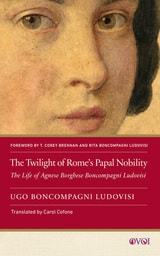
The Twilight of Rome's Papal Nobility
The Life of Agnese Borghese Boncompagni LudovisiUgo Boncompagni Ludovisi (1856–1935)
Rutgers University Press, 2025
First privately published in 1921, The Twilight of Rome's Papal Nobility provides an intimate look at a family who grew up accustomed to almost unimaginable wealth, power, and glamour. A descendant of two popes, Ugo Boncompagni Ludovisi recounts the life story of his mother Agnese, who was raised in a palace full of priceless artwork, including pieces by Caravaggio and Michelangelo. We get a window into Agnese's private life—her girlhood, marriage, and raising of several children—as her public life becomes increasingly tumultuous amid the family’s struggles to retain its property. A tender elegy to a bygone era, Boncompagni Ludovisi's story provides a unique perspective on Italian history and Rome’s urban redevelopment.
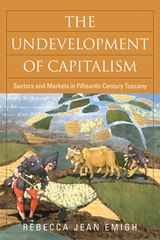
The Undevelopment of Capitalism
Sectors and Markets in Fifteenth-Century TuscanyRebecca Jean Emigh
Temple University Press, 2008
As a lucid explanation of capitalism that turns back the clock even further on its birth, The Undevelopment of Capitalism makes a significant contribution to the studies of capitalism, historical sociology, and theories of markets as economic and cultural institutions.
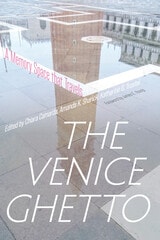
The Venice Ghetto
A Memory Space that TravelsEdited by Chiara Camarda, Amanda K. Sharick, and Katharine G. Trostel
University of Massachusetts Press, 2022
This interdisciplinary collection engages with questions about the history, conditions, and lived experience of the Venice Ghetto, including its legacy as a compulsory, segregated, and enclosed space. Contributors also consider the ghetto's influence on the figure of the Renaissance moneylender, the material culture of the ghetto archive, the urban form of North Africa's mellah and hara, and the ghetto's impact on the writings of Primo Levi and Marjorie Agosín.
In addition to the volume editors, The Venice Ghetto features a foreword from James E. Young and contributions from Shaul Bassi, Murray Baumgarten, Margaux Fitoussi, Dario Miccoli, Andrea Yaakov Lattes, Federica Ruspio, Michael Shapiro, Clive Sinclair, and Emanuela Trevisan Semi.
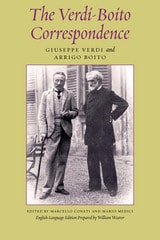
The Verdi-Boito Correspondence
Giuseppe Verdi and Arrigo Boito
University of Chicago Press, 1994
This new edition of the landmark Carteggio Verdi/Boito is at once a valuable resource for all students, teachers, and scholars of opera and a fascinating glimpse of the daily life of European art and artists during the fertile last decades of the 19th century.
Embarking on a 20-year collaboration, Verdi and Boito produced a successful revision of Simon Boccanegra, and two new operas, Otello and Falstaff. They created what many consider to be Verdi's greatest operas, thanks both to Boito's poetry and to his handling of the composer. Here are the day-to-day tasks of creation: poet and composer debating problems of dramatic structure, words, phrases, and meters; altering dialogue as, at the same time, they converse about the wider worlds of art and music. The give and take of artistic creation is rendered fascinatingly.
This edition features a new introduction by Marcello Conati, improvements and updatings to the original edition, and an appendix of undated correspondence. William Weaver's translation is characteristically pitch-perfect; he also provides a short closing sketch of Boito's life after the death of his beloved maestro. Explanatory "linking texts" between the letters create a narrative.
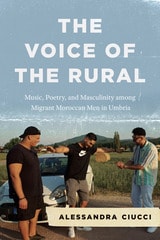
The Voice of the Rural
Music, Poetry, and Masculinity among Migrant Moroccan Men in UmbriaAlessandra Ciucci
University of Chicago Press, 2022
Umbria is known to most Americans for its picturesque rolling hills and medieval villages, but to the many migrant Moroccan men who travel there, Umbria is better known for the tobacco fields, construction sites, small industries, and the outdoor weekly markets where they work. Marginalized and far from their homes, these men turn to Moroccan traditions of music and poetry that evoke the countryside they have left— l-‘arubiya, or the rural. In this book, Alessandra Ciucci takes us inside the lives of Moroccan workers, unpacking the way they share a particular musical style of the rural to create a sense of home and belonging in a foreign and inhospitable nation. Along the way, she uncovers how this culture of belonging is not just the product of the struggles of migration, but also tied to the reclamation of a noble and virtuous masculine identity that is inaccessible to Moroccan migrants in Italy.
The Voice of the Rural allows us to understand the contemporary experiences of migrant Moroccan men by examining their imagined relationship to the rural through sound, shedding new light on the urgent issues of migration and belonging.
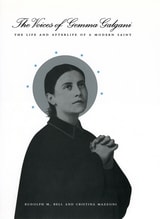
The Voices of Gemma Galgani
The Life and Afterlife of a Modern SaintRudolph M. Bell and Cristina Mazzoni
University of Chicago Press, 2002
Gemma Galgani was the first person who lived in the twentieth century to become a saint. Born in Lucca to a pharmacist and his wife, Gemma died of tuberculosis at the young age of twenty-five after a life of intense personal spirituality. Jesus caressed her as lovers do; the Virgin Mary was her affectionate Mom; Brother Gabriel playfully teased her about whether she preferred his visits to those of Jesus; and she even received all of Christ's wounds in her hands, feet, and side. At the same time, she was mocked by her family and labeled a hysteric by doctors and the local bishop. Her trials and the intimate details of her supernatural encounters—the voices of Gemma Galgani—are revealed here in this marvelous book by Rudolph M. Bell and Cristina Mazzoni.
Bell and Mazzoni have chosen and translated the most important of Gemma's words: her autobiographical account of her childhood, her diary, and key selections from her "ecstasies" and letters. Gemma emerges as a very modern saint indeed: confident, grandiose, manipulative, childish, admired, and with this book, no longer forgotten. Following Gemma's own voice, Bell carefully contextualizes her life and passion and explores her afterlife, specifically the complicated process of her canonization. Mazzoni closes the book with a "Saint's Alphabet" that finds, through Gemma's voice, spiritual meaning for women in the twenty-first century.
Far more than the reinvigoration of a neglected historical figure, The Voices of Gemma Galgani is a portrait of a complex girl-woman caught between the medieval and the modern and a potent reminder of spirituality in a supposedly secular age.
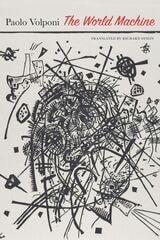
The World Machine
Paolo Volponi
Seagull Books, 2024
A small-time farmer living in central Italy in the 1960s is the keeper of a great truth: that people are machines built by other beings who are machines themselves. Our true destiny is to build ever better machines so that society can become a techno-utopia in which friendship can be established among all people on earth. These ideas bring him into conflict with everyone, especially his wife, against whom he is accused of ill-treatment. His quest takes him to Rome, where he presents his truth, hoping it will bring him worldwide recognition. Behind his poetical reveries and unfathomable scientific notions lies the disturbing fragility of a lone, paranoid, and deluded man in conflict with everyone, including himself.
Paolo Volponi’s unique novel The World Machine examines the relationship between rural life and the modern city, as well as the subversive idealism of a society still firmly anchored in the past, dominated by the Church, and unable to grasp the need for change.
The Wretch, Otherwise Known as Guerrino
A Bilingual EditionTullia d'Aragona
Iter Press, 2024
This is an unabridged bilingual, fully annotated edition of Tullia d’Aragona’s epic poem The Wretch. This mid-century epic reflects the many historical and religious changes taking place in the first half of the sixteenth century in Europe and the burgeoning literary debates following the publication of another Italian epic poem, Ariosto’s Orlando Furioso. The Wretch recounts the adventures of Guerrino, a nobleman captured by pirates as an infant and sold into slavery. His famous quest in search of his parents and his identity involves abductions, same-sex seductions, and skirmishes with fantastical beasts as he travels through Europe, Turkey, Africa, India, Arabia, and the Purgatory of St. Patrick. The poem occupies an important position in the development of the prestigious epic genre, the highest step on the ladder to literary recognition and fame, and Tullia’s work paved the way for the epics of other women writers in subsequent decades.

They Fought at Anzio
John S. D. Eisenhower
University of Missouri Press, 2025
Italy, from the toe to the Alps, was the scene of the longest, bloodiest, most frustrating, and least understood series of battles fought by the Western Allies during World War II. Now, John S. D. Eisenhower offers a new look at the Italian campaign, emphasizing the Anzio offensive—an operation pushed by Winston Churchill that fell largely to American troops to carry out. It was visualized as an amphibious landing of two Allied divisions behind German lines that would force the Wehrmacht to evacuate all of Italy. But the Germans held on and, with the arrival of reinforcements, nearly wiped out the Allied troops pinned down at Anzio Beach.
By portraying that struggle from the perspectives of both commanders and foot soldiers, this prominent military historian focuses on the experiences of the individuals who fought in the Italian campaign to reveal what the battle at Anzio was all about. But more than the account of one operation, They Fought at Anzio covers the entire Italian campaign, from the landings at Salerno to the capture of Rome.
Eisenhower brings a trained eye to reconstructing the difficult terrain of battle, approaching the Anzio campaign as a contest between opposing commands striving to anticipate and counter the opponent’s moves—not as a field exercise but as a deadly struggle for survival. He analyzes the command decisions that brought about the Anzio stalemate, interspersing his account with personal experiences of the men in the trenches, the nurses of the 56th Evacuation Hospital, and the young officers witnessing the horrors of war for the first time.
As a study in command, Eisenhower’s narrative gives new credit to generals Lucian Truscott and Fred Walker and assesses both the strengths and weaknesses of General Mark Clark, allowing us to grasp the situation as it appeared to those in command. He also offers compelling portraits of German commanders Field Marshal Albert Kesselring and General Frido von Senger und Etterlin.
It has been said that Anzio was a soldier’s battle, remembered more for blood shed than for military objectives achieved. By focusing on the experiences of the soldiers who fought there and the decisions of commanders in perilous circumstances, They Fought at Anzio offers a new appreciation of the contributions of both and a new understanding of this unheralded theater of the war.
Tiber
Eternal River of RomeBruce Ware Allen
University Press of New England, 2018
Tight Knit
Global Families and the Social Life of Fast FashionElizabeth L. Krause
University of Chicago Press, 2018
Krause offers a revelatory look into how families involved in the fashion industry are coping with globalization based on longterm research in Prato, the historic hub of textile production in the heart of metropolitan Tuscany. She brings to the fore the tensions—over value, money, beauty, family, care, and belonging—that are reaching a boiling point as the country struggles to deal with the same migration pressures that are triggering backlash all over Europe and North America. Tight Knit tells a fascinating story about the heterogeneity of contemporary capitalism that will interest social scientists, immigration experts, and anyone curious about how globalization is changing the most basic of human conditions—making a living and making a life.
Timira
A NovelWu Ming Wu Ming 2
Rutgers University Press, 2027
Isabella Marincola lived between two cultures. The child of an Italian military officer father and a Somali mother, she was never fully part of either culture. In Somalia, she was seen as a child of the ruling colonizers, while in Italy her darker skin made her an object of both fascination and contempt. Even as she worked as an actress and model in postwar Italy, she was valued for her exotically beautiful body, not her keen mind or her captivating voice.
Titled after Isabella’s Somali name, Timira is a unique combination of novel, archival sources, and oral history. It finally gives her a chance to articulate her experiences of being a Black Italian woman in different epochs of Italian history, from Fascism to the 1990s, in all of which italianità was assumed to be exclusively white.
Cowritten by her son Antar Mohamed Marincola and a founding member of the Wu Ming writers’ collective, it is based on a series of writings and interviews Isabella gave towards the end of her long, eventful life. A compelling novel rooted in truth, Timira reflects on Italy’s colonial legacy and ingrained racism, while telling the story of a courageous woman and her struggles to assert herself in a nation unprepared to accommodate its Black citizens.
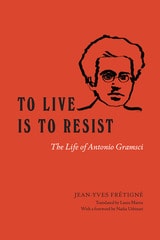
To Live Is to Resist
The Life of Antonio GramsciJean-Yves Frétigné
University of Chicago Press, 2021
One of the most influential political thinkers of the twentieth century, Antonio Gramsci (1891–1937) has left an indelible mark on philosophy and critical theory. His innovative work on history, society, power, and the state has influenced several generations of readers and political activists, and even shaped important developments in postcolonial thought. But Gramsci’s thinking is scattered across the thousands of notebook pages he wrote while he was imprisoned by Italy’s fascist government from 1926 until shortly before his death.
To guide readers through Gramsci’s life and works, historian Jean-Yves Frétigné offers To Live Is to Resist, an accessible, compelling, and deeply researched portrait of an extraordinary figure. Throughout the book, Frétigné emphasizes Gramsci’s quiet heroism and his unwavering commitment to political practice and resistance. Most powerfully, he shows how Gramsci never surrendered, even in conditions that stripped him of all power—except, of course, the power to think.
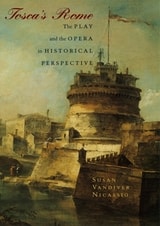
Tosca's Rome
The Play and the Opera in Historical PerspectiveSusan Vandiver Nicassio
University of Chicago Press, 1999
By far the most "historical" opera in the active repertoire, Tosca is set in a very specific time and place: Rome, from June 17 to 18, 1800. But as Nicassio demonstrates, history in Tosca is distorted by nationalism and by the vehement anticlerical perceptions of papal Rome shared by Sardou, Puccini, and the librettists. To provide the historical background necessary for understanding Tosca, Nicassio takes a detailed look at Rome in 1800 as each of Tosca's main characters would have seen it—the painter Cavaradossi, the singer Tosca, and the policeman Scarpia. Finally, she provides a scene-by-scene musical and dramatic analysis of the opera.
"[Nicassio] must be the only living historian who can boast that she once sang the role of Tosca. Her deep knowledge of Puccini's score is only to be expected, but her understanding of daily and political life in Rome at the close of the 18th century is an unanticipated pleasure. She has steeped herself in the period and its prevailing culture-literary, artistic, and musical-and has come up with an unusual, and unusually entertaining, history."—Paul Bailey, Daily Telegraph
"In Tosca's Rome, Susan Vandiver Nicassio . . . orchestrates a wealth of detail without losing view of the opera and its pleasures. . . . Nicassio aims for opera fans and for historians: she may well enthrall both."—Publishers Weekly
"This is the book that ranks highest in my estimation as the most in-depth, and yet highly entertaining, journey into the story of the making of Tosca."—Catherine Malfitano
"Nicassio's prose . . . is lively and approachable. There is plenty here to intrigue everyone-seasoned opera lovers, musical novices, history buffs, and Italophiles."—Library Journal

Transatlantic Conversations
Nineteenth-Century American Women’s Encounters with Italy and the Atlantic WorldBeth L. Lueck
University of New Hampshire Press, 2017
This unique interdisciplinary essay collection offers a fresh perspective on the active involvement of American women authors in the nineteenth-century transatlantic world. Internationally diverse contributors explore topics ranging from women's social and political mobility to their authorship and activism. While a number of essays focus on such well-known writers as Margaret Fuller, Catharine Maria Sedgwick, Harriet Beecher Stowe, George Eliot, Louisa May Alcott, and Charlotte Perkins Gilman, other, perhaps lesser-known authors are also included, such as E. D. E. N. Southworth, Elizabeth Stuart Phelps, Elizabeth Peabody, Jeannette Hart, and Laura Richards.
These essays show the spectrum of interests and activities in which nineteenth-century women were involved as they moved, geographically and metaphorically, toward gaining their independence and the right to control their lives. Traveling far and wide—to Italy, France, Great Britain, and the Bahamas—these writers came into contact with realities far different from their own. On topics ranging from homeopathy and literary endeavors to politics and revolution, they conversed with others, reaching and inspiring transnational audiences with their words and deeds, and creating a space for self-expression in the rapidly changing transatlantic world.
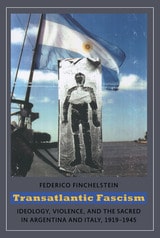
Transatlantic Fascism
Ideology, Violence, and the Sacred in Argentina and Italy, 1919-1945Federico Finchelstein
Duke University Press, 2010
As Finchelstein explains, nacionalismo, the right-wing ideology that developed in Argentina, was not the wholesale imitation of Italian fascism that Mussolini wished it to be. Argentine nacionalistas conflated Catholicism and fascism, making the bold claim that their movement had a central place in God’s designs for their country. Finchelstein explores the fraught efforts of nationalistas to develop a “sacred” ideological doctrine and political program, and he scrutinizes their debates about Nazism, the Spanish Civil War, imperialism, anti-Semitism, and anticommunism. Transatlantic Fascism shows how right-wing groups constructed a distinctive Argentine fascism by appropriating some elements of the Italian model and rejecting others. It reveals the specifically local ways that a global ideology such as fascism crossed national borders.
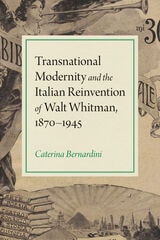
Transnational Modernity and the Italian Reinvention of Walt Whitman, 1870-1945
Caterina Bernardini
University of Iowa Press, 2021
Studying Whitman’s reception from a transnational perspective shows how many countries were simultaneously carving out a new modernity in literature and culture. In this sense, Bernardini not only shows the interconnectedness of various international agents in understanding and contributing to the spread of Whitman’s work, but, more largely, illustrates a constellation of similar pre-modernist and modernist sensibilities. This stands in contrast to the notion of sudden innovation: modernity was not easy to achieve, and it did not imply a complete refusal of tradition. Instead, a continuous and fruitful negotiation between tradition and innovation, not a sudden break with the literary past, is at the very heart of the Italian and transnational reception of Whitman. The book is grounded in archival studies and the examination of primary documents of noteworthy discovery.

Traumatic Encounters in Italian Film
Locating the Cinematic UnconsciousFabio Vighi
Intellect Books, 2006
Always stylistically innovative, thematically defiant and driven by a strong political agenda, Italian cinema lends itself particularly well to a critical investigation aimed at radicalising the impact of psychoanalysis on film. In doing exactly that, the book deliberately avoids the standard cultural and historical approaches to film. Instead, it moves freely amongst some of the most widely celebrated – as well as lesser-known – Italian films of the post-war period, discussing the ways in which they tackle such themes as desire, fantasy, sexuality, violence and the law, to mention but a few. The main focus is on the work of those directors who most effectively engage with the divisive nature of the moving image: Antonioni, Pasolini and Rossellini. In addition, the book provides ample and insightful references to films by Visconti, Bertolucci, Bellocchio, Moretti, Petri, Fellini, Ferreri, and many more.
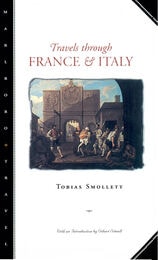
Travels Through France and Italy
Tobias Smollett
Northwestern University Press, 1997
Travels through France and Italy is a landmark work in travel literature. Full of prejudice, grousing, sharp observation, and caustic satire, it is the first travel book in modern literature to go beyond the simple conveyance of information to reflect the writer's state of mind.

Turin 1564-1680
Urban Design, Military Culture, and the Creation of the Absolutist CapitalMartha D. Pollak
University of Chicago Press, 1991
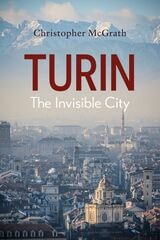
Turin
The Invisible CityChristopher McGrath
Haus Publishing, 2026
A history of Turin, home to Fiat, the Einaudi publishing house, and writers including Italo Calvino, Primo Levi, Cesare Pavese, and Natalia Ginzburg.
Unknown to most foreigners, as they follow each other around Florence and Siena, Rome and Venice, the Italy they see today is the result of a second renaissance. And its seat was a city they needed to discover, in all its enigmatic allure, if they were truly to understand the nation it brought into being. As Umberto Eco says, “Without Italy, Turin would have been more or less the same. But without Turin, Italy would have been very different.” This baroque jewel at the foot of the Alps provides a unique prism on the story of modern Italy: not just as a founding capital, but also in kindling a political, cultural, and economic regeneration after the tragedies of dictatorship and civil war.
Their emergence as a dynamo of national industrialization, symbolized by Fiat, had made the factories of Turin the original seat of both Italian capitalism and socialism, and, accordingly, the heart of resistance to Mussolini. After the Second World War, the city experienced parallel revivals. On the one hand, Fiat proved a foundation stone for Italy’s famous “economic miracle"; on the other, the Einaudi publishing house became a platform for the greatest local flowering of Italian culture since the days of the Medicis, not least through several of its own employees, including Natalia Ginzburg, Cesare Pavese, and Italo Calvino. These competing energies were personified by the respective enigmas who presided over these agencies of renewal, Gianni Agnelli and Giulio Einaudi.
But their rivalry also only demonstrated the polarities that have long defined this royal city of arcaded streets and squares, with its wild mountain backdrop. That contrast is expressed even by the city’s rival football teams: the seigneurial Juventus, long bankrolled by the Agnelli family, its perennial success toasted throughout the peninsula; and Torino, the fallen giants whose tragic legacy commands the underdog fidelity of local nostalgics, workers, and rebels.
Exploring the contribution of Turin to modern Italy, Chris McGrath entwines some of the nation’s most celebrated names with less familiar citizens who illuminate the gaps: from the forgotten poet who bears exquisite witness to the city’s crepuscular atmosphere at the turn of the last century, to the Torino footballer who fought with the partisans before becoming a star of neorealist cinema.
Risorgimento, resistance, reconstruction: none of these decisive phases in Italy’s modern evolution would have been the same without this unsung city.
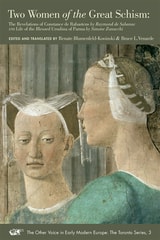
Two Women of the Great Schism
The Revelations of Constance de Rabastens by Raymond de Sabanac and Life of the Blessed Ursulina of Parma by Simone ZanacchiRaymond de Sabanac and Simone Zanacchi
Iter Press, 2010
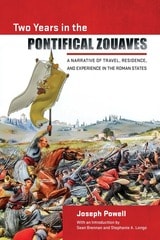
Two Years in the Pontifical Zouaves
A Narrative of Travel, Residence, and Experience in the Roman StatesJoseph Powell
Catholic University of America Press, 2026