Results by title
754 books match the query 'Native American Studies' and 144 start with t
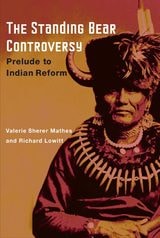
The Standing Bear Controversy
PRELUDE TO INDIAN REFORMValerie Sherer Mathes and Richard Lowitt
University of Illinois Press, 2003
In this book Valerie Sherer Mathes and Richard Lowitt examine how the national publicity surrounding the trial of Chief Standing Bear, as well as a speaking tour by the chief and others, brought the plight of his tribe, and of tribespeople across America, to the attention of the general public, serving as a catalyst for the nineteenth-century Indian reform movement.
As the authors show, the eventual ramifications of the removal, flight, and trial of Standing Bear were extensive, and included the rise of an organized humanitarian reform movement, significant changes in the administration of Indian affairs, and the passage of the General Allotment Act in 1887.
This is the first full-length study of the Standing Bear trial and its consequences, and Mathes and Lowitt draw on a vast array of manuscript, diary, and journalistic sources in order to chronicle the events of 1877, as well as the effect the trial had on broader American popular opinion, on the federal government, and finally on the Native American population as a whole.
The Story of Act 31
How Native History Came to Wisconsin ClassroomsJ P Leary
Wisconsin Historical Society Press, 2018
Since its passage in 1989, a state law known as Act 31 requires that all students in Wisconsin learn about the history, culture, and tribal sovereignty of Wisconsin’s federally recognized tribes.
The Story of Act 31 tells the story of the law’s inception—tracing its origins to a court decision in 1983 that affirmed American Indian hunting and fishing treaty rights in Wisconsin, and to the violent public outcry that followed the court’s decision. Author J P Leary paints a picture of controversy stemming from past policy decisions that denied generations of Wisconsin students the opportunity to learn about tribal history.
The Tewa World
Space, Time, Being and Becoming in a Pueblo SocietyAlfonso Ortiz
University of Chicago Press, 1972
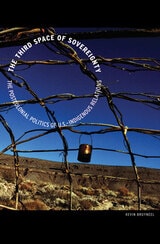
The Third Space of Sovereignty
The Postcolonial Politics of U.S.–Indigenous RelationsKevin Bruyneel
University of Minnesota Press, 2007
The imposition of modern American colonial rule has defined U.S.–indigenous relations since the time of the American Civil War. In resistance, Kevin Bruyneel asserts, indigenous political actors work across American spatial and temporal boundaries, demanding rights and resources from the government while also challenging the imposition of colonial rule over their lives. This resistance engenders what he calls a “third space of sovereignty,” which resides neither inside nor outside the U.S. political system but rather exists on its boundaries, exposing both the practices and limitations of American colonial rule.
The Third Space of Sovereignty offers fresh insights on such topics as the crucial importance of the formal end of treaty-making in 1871, indigenous responses to the prospect of U.S. citizenship in the 1920s, native politics during the tumultuous civil rights era of the 1960s, the question of indigenousness in the special election of California’s governor in 2003, and the current issues surrounding gaming and casinos.
In this engaging and provocative work, Bruyneel shows how native political actors have effectively contested the narrow limits that the United States has imposed on indigenous people’s ability to define their identity and to develop economically and politically on their own terms.
Kevin Bruyneel is assistant professor of politics at Babson College.
The Tombigbee Watershed in Southeastern Prehistory
Ned J. Jenkins
University of Alabama Press, 1986
Representing the synthesis of approximately ten years of archaeological research along the central Tombigbee River, this book offers new theoretical and interpretive contributions to the study of human activity in the Tombigbee River Valley from 1000 B.C. to A.D. 1450. The authors have devised a new taxonomic approach that allows them to portray cultures as they gathered momentum and peaked in their potential as social, economic, and political structures. The data acquired for this study are from the massive cultural resource management program that accompanied the construction of the Tennessee-Tombigbee Waterway.

The Transit of Empire
Indigenous Critiques of ColonialismJodi A. Byrd
University of Minnesota Press, 2011
In 1761 and again in 1768, European scientists raced around the world to observe the transit of Venus, a rare astronomical event in which the planet Venus passes in front of the sun. In The Transit of Empire, Jodi A. Byrd explores how indigeneity functions as transit, a trajectory of movement that serves as precedent within U.S. imperial history. Byrd argues that contemporary U.S. empire expands itself through a transferable “Indianness” that facilitates acquisitions of lands, territories, and resources.
Examining an array of literary texts, historical moments, and pending legislations—from the Cherokee Nation of Oklahoma’s vote in 2007 to expel Cherokee Freedmen to the Native Hawaiian Government Reorganization bill—Byrd demonstrates that inclusion into the multicultural cosmopole does not end colonialism as it is purported to do. Rather, that inclusion is the very site of the colonization that feeds U.S. empire.
Byrd contends that the colonization of American Indian and indigenous nations is the necessary ground from which to reimagine a future where the losses of indigenous peoples are not only visible and, in turn, grieveable, but where indigenous peoples have agency to transform life on their own lands and on their own terms.
The Truth About Stories
A Native NarrativeThomas King
University of Minnesota Press, 2005
The Voice of the Dawn
An Autohistory of the Abenaki NationFrederick Matthew Wiseman
University Press of New England, 2001
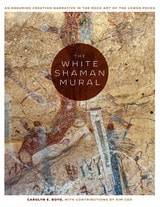
The White Shaman Mural
An Enduring Creation Narrative in the Rock Art of the Lower PecosBy Carolyn E. Boyd, with contributions by Kim Cox
University of Texas Press, 2016
Winner, Society for American Archaeology Book Award, 2017
San Antonio Conservation Society Publication Award, 2019
The prehistoric hunter-gatherers of the Lower Pecos Canyonlands of Texas and Coahuila, Mexico, created some of the most spectacularly complex, colorful, extensive, and enduring rock art of the ancient world. Perhaps the greatest of these masterpieces is the White Shaman mural, an intricate painting that spans some twenty-six feet in length and thirteen feet in height on the wall of a shallow cave overlooking the Pecos River. In The White Shaman Mural, Carolyn E. Boyd takes us on a journey of discovery as she builds a convincing case that the mural tells a story of the birth of the sun and the beginning of time—making it possibly the oldest pictorial creation narrative in North America.
Unlike previous scholars who have viewed Pecos rock art as random and indecipherable, Boyd demonstrates that the White Shaman mural was intentionally composed as a visual narrative, using a graphic vocabulary of images to communicate multiple levels of meaning and function. Drawing on twenty-five years of archaeological research and analysis, as well as insights from ethnohistory and art history, Boyd identifies patterns in the imagery that equate, in stunning detail, to the mythologies of Uto-Aztecan-speaking peoples, including the ancient Aztec and the present-day Huichol. This paradigm-shifting identification of core Mesoamerican beliefs in the Pecos rock art reveals that a shared ideological universe was already firmly established among foragers living in the Lower Pecos region as long as four thousand years ago.
The Winged
An Upper Missouri River Ethno-ornithologyKaitlyn Chandler, Wendi Field Murray, María Nieves Zedeño, Samrat Clements, and Robert James
University of Arizona Press, 2017
The Missouri River Basin is home to thousands of bird species that migrate across the Great Plains of North America each year, marking the seasonal cycle and filling the air with their song. In time immemorial, Native inhabitants of this vast region established alliances with birds that helped them to connect with the gods, to learn the workings of nature, and to live well.
This book integrates published and archival sources covering archaeology, ethnohistory, historical ethnography, folklore, and interviews with elders from the Blackfoot, Assiniboine, Mandan, Hidatsa, Arikara, and Crow communities to explore how relationships between people and birds are situated in contemporary practice, and what has fostered its cultural persistence. Native principles of ecological and cosmological knowledge are brought into focus to highlight specific beliefs, practices, and concerns associated with individual bird species, bird parts, bird objects, the natural and cultural landscapes that birds and people cohabit, and the future of this ancient alliance.
Detailed descriptions critical to ethnohistorians and ethnobiologists are accompanied by thirty-four color images. A unique contribution, The Winged expands our understanding of sets of interrelated dependencies or entanglements between bird and human agents, and it steps beyond traditional scientific and anthropological distinctions between humans and animals to reveal the intricate and eminently social character of these interactions.
The Worlds between Two Rivers
Perspectives on American Indians in IowaGretchen M. Bataille
University of Iowa Press, 2000
The Yale Indian
The Education of Henry Roe CloudJoel Pfister
Duke University Press, 2009
Roe Cloud’s white-collar activism was entwined with the Progressive Era formation of an Indian professional and managerial class, a Native “talented tenth,” whose members strategically used their contingent entry into arenas of white social, intellectual, and political power on behalf of Indians without such access. His Yale training provided a cross-cultural education in class-structured emotions and individuality. While at Yale, Roe Cloud was informally adopted by a white missionary couple. Through them he was schooled in upper-middle-class sentimentality and incentives. He also learned how interracial romance could jeopardize Indian acceptance into their class. Roe Cloud expanded the range of what modern Indians could aspire to and achieve.
The Ópatas
In Search of a Sonoran PeopleDavid A. Yetman
University of Arizona Press, 2010
David Yetman, a leading ethnobotanist who has traveled extensively in Sonora, consulted more than two hundred archival sources to answer this question. The result is an accessible ethnohistory of the Ópatas, one that embraces historical complexity with an eye toward Opatan strategies of resistance and assimilation. Yetman’s account takes us through the Opatans’ initial encounters with the conquistadors, their resettlement in Jesuit missions, clashes with Apaches, their recruitment as miners, and several failed rebellions, and ultimately arrives at an explanation for their “disappearance.”
Yetman’s account is bolstered by conversations with present-day residents of the Opatería and includes a valuable appendix on the languages of the Opatería by linguistic anthropologist David Shaul. One of the few studies devoted exclusively to this indigenous group, The Ópatas: In Search of a Sonoran People marks a significant contribution to the literature on the history of the greater Southwest.
Theft Is Property!
Dispossession and Critical TheoryRobert Nichols
Duke University Press, 2020
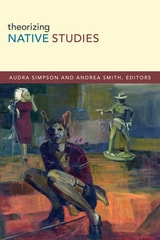
Theorizing Native Studies
Audra Simpson and Andrea Smith, eds.
Duke University Press, 2014
Contributors. Christopher Bracken, Glen Coulthard, Mishuana Goeman, Dian Million, Scott Morgensen, Robert Nichols, Vera Palmer, Mark Rifkin, Audra Simpson, Andrea Smith, Teresia Teaiwa
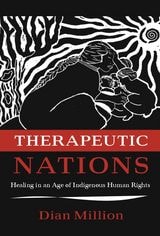
Therapeutic Nations
Healing in an Age of Indigenous Human RightsDian Million
University of Arizona Press, 2013
Million contends that nation-state relations are influenced by a theory of trauma ascendant with the rise of neoliberalism. Such use of trauma theory regarding human rights corresponds to a therapeutic narrative by Western governments negotiating with Indigenous nations as they seek self-determination.
Focusing on Canada and drawing comparisons with the United States and Australia, Million brings a genealogical understanding of trauma against a historical filter. Illustrating how Indigenous people are positioned differently in Canada, Australia, and the United States in their articulation of trauma, the author particularly addresses the violence against women as a language within a greater politic. The book introduces an Indigenous feminist critique of this violence against the medicalized framework of addressing trauma and looks to the larger goals of decolonization. Noting the influence of humanitarian psychiatry, Million goes on to confront the implications of simply dismissing Indigenous healing and storytelling traditions.
Therapeutic Nations is the first book to demonstrate affect and trauma’s wide-ranging historical origins in an Indigenous setting, offering insights into community healing programs. The author’s theoretical sophistication and original research make the book relevant across a range of disciplines as it challenges key concepts of American Indian and Indigenous studies.
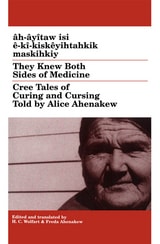
They Knew Both Sides of Medicine
Cree Tales of Curing and Cursing Told by Alice AhenakewH.C. Wolfart
University of Manitoba Press, 2000
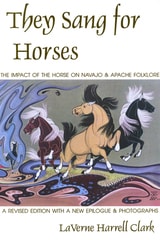
They Sang for Horses
The Impact of the Horse on Navajo and Apache FolkloreLaVerne Harrell Clark
University Press of Colorado, 2001
No Native American groups placed more emphasis on the horse in their lives than did the Navajo and Apache of the Southwest. They Sang for Horses, first published in 1966 and now considered a classic, remains the only comprehensive treatment of the profound mystical influence that the horse has exerted for more than 300 years.
In this completely redesigned and expanded edition, LaVerne Harrell Clark examines how storytellers, singers, medicine men, and painters created the animal's evolving symbolic significance by adapting existing folklore and cultural symbols. Exploring the horse's importance in ceremonies, songs, prayers, customs, and beliefs, she investigates the period of the horse's most pronounced cultural impact on the Navajo and the Apache, starting from the time of its acquisition from the Spanish in the seventeenth century and continuing to the mid-1960s, when the pickup truck began to replace it as the favored means of transportation. In addition, she presents a look at how Navajos and Apaches today continue to redefine the horse's important role in their spiritual as well as material lives.
This classic work is a must for historians, readers interested in Native American folklore and mythology, and anyone who has ever been captivated by the magic and romance of the horse.
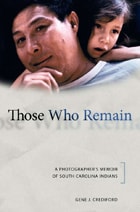
Those Who Remain
A Photographer's Memoir of South Carolina IndiansGene J. Crediford
University of Alabama Press, 2009
Through interviews and a generous photograph montage stretching over two decades, reveals the commonality and diversity among these people of Indian identity
When DeSoto (in 1540) and later Juan Pardo (in 1567) marched through what was known as the province of Cofitachequi (which covered the southern part of today’s North Carolina and most of South Carolina), the native population was estimated at well over 18,000. Most shared a common Catawba language, enabling this confederation of tribes to practice advanced political and social methods, cooperate and support each other, and meet their common enemy. The footprint of the Cofitachequi is the footprint of this book.
The contemporary Catawba, Midland, Santee, Natchez-Kusso, Varnertown, Waccamaw, Pee Dee, and Lumbee Indians of North and South Carolina, have roots in pre-contact Cofitachequi. Names have changed through the years; tribes split and blended as the forces of nature, the influx of Europeans, and the imposition of federal government authority altered their lives. For a few of these tribes, the system has worked well—or is working well now. For others, the challenge continues to try to work with and within the federal government’s system for tribal recognition—a system governing Indians but not created by them. Through interviews and a generous photograph montage stretching over two decades, Gene Crediford reveals the commonality and diversity among these people of Indian identity; their heritage, culture, frustrations with the system, joys in success of the younger generation, and hope for the future of those who come after them. This book is the story of those who remain.

Till the Extinction of This Rebellion
George Rogers Clark, Frontier Warfare, and the Illinois Campaign of 1778–1779Eric Sterner
Westholme Publishing, 2026
Clark’s expedition was sanctioned by Virginia in order to protect its western border, and the author provides an overview of this rationale along with the strategies, tactics, and logistics Clark employed, particularly his ability to operate over great distances in remote areas. In particular, the author pays close attention to the psychological battlefield and how Clark combined mobility, surprise, and a calculated reputation for violence—a tactic respected by the Native peoples—to achieve dominance over his adversaries, often enabling the Americans to achieve their goals without harming anyone. The book culminates with the capture of Fort Sackville/Vincennes, in which Clark and his men fought the only pitched battle of the Illinois Campaign. The resounding success of Clark’s expedition laid the foundation for credible American postwar claims to lands as far west as the Mississippi, opening even more territory to new settlements at the expense of the Native peoples. Till the Extinction of This Rebellion is an important contribution to understanding the impact of the American Revolution on both Native peoples and westward expansion.
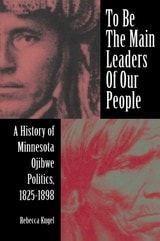
To Be the Main Leaders of Our People
A History of Minnesota Ojibwe Politics, 1825-1898Rebecca Kugel
Michigan State University Press, 1998
In the spring of 1868, people from several Ojibwe villages located along the upper Mississippi River were relocated to a new reservation at White Earth, more than 100 miles to the west. In many public declarations that accompanied their forced migration, these people appeared to embrace the move, as well as their conversion to Christianity and the new agrarian lifestyle imposed on them. Beneath this surface piety and apparent acceptance of change, however, lay deep and bitter political divisions that were to define fundamental struggles that shaped Ojibwe society for several generations.
In order to reveal the nature and extent of this struggle for legitimacy and authority, To Be The Main Leaders of Our People reconstructs the political and social history of these Minnesota Ojibwe communities between the years 1825 and 1898. Ojibwe political concerns, the thoughts and actions of Ojibwe political leaders, and the operation of the Ojibwe political system define the work's focus. Kugel examines this particular period of time because of its significance to contemporary Ojibwe history. The year 1825, for instance, marked the beginning of a formal alliance with the United States; 1898 represented not an end, but a striking point of continuity, defying the easy categorizations of Native peoples made by non-Indians, especially in the closing years of the nineteenth century.
In this volume, the Ojibwe "speak for themselves," as their words were recorded by government officials, Christian missionaries, fur traders, soldiers, lumbermen, homesteaders, and journalists. While they were nearly always recorded in English translation, Ojibwe thoughts, perceptions, concerns, and even humor, clearly emerge. To Be The Main Leaders of Our People expands the parameters of how oral traditions can be used in historical writing and sheds new light on a complex, but critical, series of events in ongoing relations between Native and non-Native people.
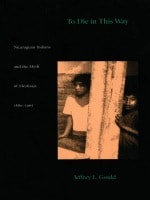
To Die in this Way
Nicaraguan Indians and the Myth of Mestizaje, 1880-1965Jeffrey L. Gould
Duke University Press, 1998
Through interviews with indigenous peoples and records of the elite discourse that suppressed the expression of cultural differences and rationalized the destruction of Indian communities, Gould tells a story of cultural loss. Land expropriation and coerced labor led to cultural alienation that shamed the indigenous population into shedding their language, religion, and dress. Beginning with the 1870s, Gould historicizes the forces that prompted a collective movement away from a strong identification with indigenous cultural heritage to an “acceptance” of a national mixed-race identity.
By recovering a significant part of Nicaraguan history that has been excised from the national memory, To Die in This Way critiques the enterprise of third world nation-building and thus marks an important step in the study of Latin American culture and history that will also interest anthropologists and students of social and cultural historians.
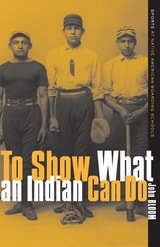
To Show What an Indian Can Do
Sports at Native American Boarding SchoolsJohn Bloom
University of Minnesota Press, 2005

To Win the Indian Heart
Music at Chemawa Indian SchoolMelissa D. Parkhurst
Oregon State University Press, 2014
In To Win the Indian Heart: Music at Chemawa Indian School, Melissa Parkhurst records the history of the school’s musical life. She explores the crucial role music was meant to play in the total transformation of Indian children, and the cultural recovery and resiliency it often inspired instead. Parkhurst chronicles the complex ways in which students, families, faculty, and administrators employed music, both as a tool for assimilation and, conversely, as a vehicle for student resistance—a subject long overlooked in literature on Indian education and the assimilation campaign.
Combining oral histories of Chemawa alumni with archival records of campus life, the book examines the prominent forms of music making at Chemawa—school band, choirs, private lessons, pageants, dance, garage bands, and powwows. Parkhurst traces the trajectory of federal Indian policy, highlighting students’ creative responses and the ways in which music reveals the inherent contradictions in the U.S. government’s assimilation practices.
Tony Hillerman's Navajoland
Hideouts, Haunts, and Havens in the Joe Leaphorn and Jim Chee MysteriesLaurance D. Linford
University of Utah Press, 2005
Tony Hillerman's Navajoland
Hideouts, Haunts, and Havens in the Joe Leaphorn and Jim Chee MysteriesLaurance D. Linford
University of Utah Press, 2011
Tony Hillerman is beloved for his novels of intrigue in the American Southwest. In Tony Hillerman’s Navajoland, Laurance Linford takes readers on a journey through the Four Corners region to the haunts of Hillerman’s characters. Offered in encyclopedic form, each entry gives the common name of a particular location, the Navajo name and history, and a description of the location’s significance in various Hillerman novels. An understanding of the Navajo names and their relations to the landscape will lend a new dimension to the characters and events Tony Hillerman created.
Traditional Navajo Teachings
Sacred Narratives and CeremoniesRobert S. McPherson
University Press of Colorado, 2020
—Cindy Yurth, The Navajo Times
"In Sacred Narratives and Ceremonies, the authors lay the foundation of traditional Navajo beliefs and practices. They provide an inside perspective rarely discussed by non-medicine people and share the beauty and power of a system that unites humans to the holy beings—through teachings, rituals, materials, and daily behavior. This book is pure gold. It is full of traditional wisdom available to those wanting to understand Navajo culture as seen through the eyes of its elders. I highly recommend this book as a treasure trove for the Diné people."
—Clayton Long, participant/creator of the Navajo Rosetta Stone; Bilingual Education Director (retired), San Juan School District, Utah; and curriculum developer for the Navajo Nation
Traditional Navajo Teachings
The Earth Surface PeopleRobert S. McPherson
University Press of Colorado, 2020
—Clayton Long, a participant/creator of the Navajo Rosetta Stone; Bilingual Education Director (retired), San Juan School District, Utah; and curriculum developer for the Navajo Nation.
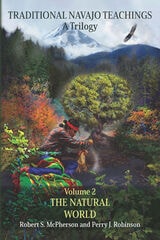
Traditional Navajo Teachings
The Natural WorldRobert S. McPherson
University Press of Colorado, 2020
"Navajo teachings provide a classic study of a land-based religion that involves every aspect of the physical world in a spiritual universe. Nothing is too big or small—everything holds a power, provides a teaching, and responds through an inner form. Beyond the material life of daily existence, there lies a world of interconnected relations made apparent in Volume II, The Natural World. This book graphically describes elements of life rooted in the Navajo philosophy of hózhǫ́. A unified harmony results. I highly recommend this book as a study in understanding the power of relationships that populate the Diné worldview."
—Clayton Long, a participant/creator of the Navajo Rosetta Stone; Bilingual Education Director (retired), San Juan School District, Utah; and curriculum developer for the Navajo Nation.
"For days after reading The Natural World, I found myself looking at my surroundings in a different way. The vibrant spirit of the earth and every plant or animal I encountered seemed to glow through a translucent shell. I have always been a nature-lover and gotten a sense of peace from being outdoors, but since reading these beautiful Navajo teachings I am filled with a profound sense of joy and gratitude every time I walk outside."
—Cindy Yurth, The Navajo Times
Traditional, National, and International Law and Indigenous Communities
Edited by Marianne O. Nielsen and Karen Jarratt-Snider
University of Arizona Press, 2020
While all of these issues are rooted in colonization, Indigenous peoples are using their own solutions to demonstrate the resilience, persistence, and innovation of their communities. With chapters focusing on the use and misuse of law as it pertains to Indigenous peoples in North America, Latin America, Canada, Australia, and New Zealand, this book offers a wide scope of global injustice. Despite proof of oppressive legal practices concerning Indigenous peoples worldwide, this book also provides hope for amelioration of colonial consequences.
Trans-Indigenous
Methodologies for Global Native Literary StudiesChadwick Allen
University of Minnesota Press, 2012
What might be gained from reading Native literatures from global rather than exclusively local perspectives of Indigenous struggle? In Trans-Indigenous, Chadwick Allen proposes methodologies for a global Native literary studies based on focused comparisons of diverse texts, contexts, and traditions in order to foreground the richness of Indigenous self-representation and the complexity of Indigenous agency.
Through demonstrations of distinct forms of juxtaposition—across historical periods and geographical borders, across tribes and nations, across the Indigenous–settler binary, across genre and media—Allen reclaims aspects of the Indigenous archive from North America, Hawaii, Aotearoa New Zealand, and Australia that have been largely left out of the scholarly conversation. He engages systems of Indigenous aesthetics—such as the pictographic discourse of Plains Indian winter counts, the semiotics of Navajo weaving, and Maori carving traditions, as well as Indigenous technologies like large-scale North American earthworks and Polynesian ocean-voyaging waka—for the interpretation of contemporary Indigenous texts. The result is a provocative reorienting of the call for Native intellectual, artistic, and literary sovereignty that fully prioritizes the global Indigenous.
Transforming Diné Education
Innovations in Pedagogy and PracticeEdited by Pedro Vallejo and Vincent Werito
University of Arizona Press, 2022
Bringing together decades of teaching experience, contributors offer perspectives from school- and community-based programs, as well as the tribal, district, and university level. They address special education, language revitalization, wellness, self-determination and sovereignty, and university-tribal-community partnerships. These contributions foreground Diné ways of knowing both as an educational philosophy and as an active practice applied in the innovative programs the book highlights. The contributors deepen our understanding of the state of Navajo education by sharing their perspectives about effective teaching practices and the development of programs that advance educational opportunities for Navajo youth.
This work provides stories of Diné resilience, resistance, and survival. It articulates a Diné-centered pedagogy that will benefit educators and learners for generations to come. Transforming Diné Education fills a need in the larger literature of curricular and programmatic development and provides tools for academic success for all American Indian students.
Contributors
Berlinda Begay
Lorenda Belone
Michael “Mikki” Carroll
Quintina “Tina” Deschenie
Henry Fowler
Richard Fulton
Davis E. Henderson
Kelsey Dayle John
Lyla June Johnston
Tracia Keri Jojola
Tiffany S. Lee
Shawn Secatero
Michael Thompson
Pedro “Pete” Vallejo
Christine B. Vining
Vincent Werito
Duane “Chili” Yazzie
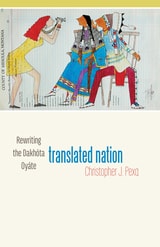
Translated Nation
Rewriting the Dakhóta OyáteChristopher J. Pexa
University of Minnesota Press, 2019
How authors rendered Dakhóta philosophy by literary means to encode ethical and political connectedness and sovereign life within a settler surveillance state
Translated Nation examines literary works and oral histories by Dakhóta intellectuals from the aftermath of the 1862 U.S.–Dakota War to the present day, highlighting creative Dakhóta responses to violences of the settler colonial state. Christopher Pexa argues that the assimilation era of federal U.S. law and policy was far from an idle one for the Dakhóta people, but rather involved remaking the Oyáte (the Očéti Šakówiŋ Oyáte or People of the Seven Council Fires) through the encrypting of Dakhóta political and relational norms in plain view of settler audiences.
From Nicholas Black Elk to Charles Alexander Eastman to Ella Cara Deloria, Pexa analyzes well-known writers from a tribally centered perspective that highlights their contributions to Dakhóta/Lakhóta philosophy and politics. He explores how these authors, as well as oral histories from the Spirit Lake Dakhóta Nation, invoke thióšpaye (extended family or kinship) ethics to critique U.S. legal translations of Dakhóta relations and politics into liberal molds of heteronormativity, individualism, property, and citizenship. He examines how Dakhóta intellectuals remained part of their social frameworks even while negotiating the possibilities and violence of settler colonial framings, ideologies, and social forms.
Bringing together oral and written as well as past and present literatures, Translated Nation expands our sense of literary archives and political agency and demonstrates how Dakhóta peoplehood not only emerges over time but in everyday places, activities, and stories. It provides a distinctive view of the hidden vibrancy of a historical period that is often tied only to Indigenous survival.
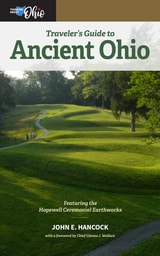
Traveler's Guide to Ancient Ohio
John E. Hancock
Ohio University Press, 2026
Featuring Hopewell Ceremonial Earthworks
Traveler’s Guide to Ancient Ohio is a compact, richly illustrated, and in-depth travel guide to the Indigenous earthwork wonders of southern Ohio—some of the most extraordinary ancient monuments in North America. Featuring the eight newly inscribed UNESCO World Heritage sites, this is the first publication to present these places from a traveler’s perspective, offering deeply informative site descriptions alongside curated routes to historical, scenic, and natural treasures across the region.
Southern Ohio’s landscape is layered with millennia of human history. At its heart are the monumental Adena and Hopewell earthworks—vast ceremonial constructions that reflect the ingenuity and spiritual life of ancient Indigenous cultures. This guide helps readers understand these sites as rewarding architectural experiences, enriched by archaeological, historical, and Indigenous knowledge gathered over three decades of collaborative work.
Organized into eight scenic driving routes—including the World Heritage Route and seven tributary paths—the book connects earthworks with nearby historic towns, nature preserves, waterways, and cultural landmarks. Each route emphasizes two-lane roads and includes road-tested site addresses, with links to local tourism resources for updated travel information.
Introductory sections provide essential context on regional geography, Indigenous cultures, archaeological terminology, and travel logistics. The guide’s focus on on-site appreciation is rare among existing resources, making it invaluable for both pre-visit planning and on-the-ground exploration.
Detailed route and trail descriptions are coordinated with all-new maps, plans, and photographs. The book links to multimedia assets, including animated flyovers that help visualize the earthworks and interview excerpts that deepen interpretive storytelling through Indigenous and interdisciplinary voices.
For first-time visitors and seasoned explorers, Traveler’s Guide to Ancient Ohio offers a fresh, immersive way to experience the region’s ancient wonders and the landscapes that continue to tell their story.
Travelling Knowledges
Positioning the Im/Migrant Reader of Aboriginal Literatures in CanadaRenate Eigenbrod
University of Manitoba Press, 2005
Trespassing
An Inquiry into the Private Ownership of LandJohn Hanson Mitchell
University Press of New England, 2015
Tribal Government Today, Revised Edition
James J. Lopach
University Press of Colorado, 1998
An account of Fourth World peoples within a First World nation, Tribal Government Today, Revised Edition is a critical analysis of the contemporary progress of Indian tribes toward self-government and economic sufficiency. Focusing on seven reservations in Montana representing the diverse opportunities and problems facing Indian tribes in the West, this book approaches tribal government from the twin perspectives of reservation politics and the legal context within which reservation conflicts must be solved.
Unlike previous studies of Indian politics, Tribal Government Today is neither a critique of American Indian policy over the years nor an analysis of federal, state, and tribal jurisdictional ambiguities. The authors—a political scientist, a lawyer, and a historian—focus instead on the distinctive political culture that has evolved on each reservation in terms of the reservation settings, governmental structures and procedures, and a particular brand of politics. The critical inquiry is how far the reservations are from genuine self-determination and whether that goal is impossibility for some. The authors conclude with suggestions for reforming tribal government within three main areas: the separation of powers, the role of the Bureau of Indian Affairs, and tribal acceptance of the concept of fundamental law.
The contents include: The Contours of Reservations Politics, Indian Law and Tribal Government; The Blackfeet: Their Own Government to Help Them; The Crow: A Politics of Rick; The Northern Cheyenne: A Politics of Values; The Fort Peck Reservation: The Factor of Leadership; The Fort Belknap Reservation: The Reality of Poverty; The Rocky Boy's Reservation: A Struggle for Government; The Flathead Reservation: A Struggle for Government; The Flathead Reservation: From Enclave to Self-Government; and Reflection on Tribal Government.
There has been surprisingly little writing about the condition of contemporary tribal government. Library shelves are filled with works on other American and foreign governments, but an inquirer must learn about tribal government incidentally and in piecemeal fashion. This state of scholarship is regrettable because of the importance of the modern Indian self-determination movement. Reservation politics certainly affect the quality of life in Indian communities, and the outlook for Indian self-determination cannot be assessed without an understanding of tribal government.
Tribal Policing
Asserting Sovereignty, Seeking JusticeEileen Luna-Firebaugh
University of Arizona Press, 2007
Author Eileen Luna-Firebaugh answers these and other questions in this well-documented text about tribal government and law enforcement in America. Based on extensive research with tribal police departments conducted over a period of eight years, Tribal Policing reveals the complicated role of police officials in Indian country and the innovative methods they are developing to address crime within their borders and to advance tribal sovereignty in the United States.
Tribal police departments face many challenges, such as heightened crime rates, a lack of resources (working patrol vehicles, 911 systems, access to police radios), and vast patrol areas. Luna-Firebaugh demonstrates that tribal officers see themselves as members of the tribal community and that tribal law enforcement is a complex balance of tribal position and authority within the community. Among other topics, Luna-Firebaugh analyzes the structure of tribal law enforcement and the ways it differs from mainstream policing; the role of women, tribal members, and others who comprise tribal law enforcement personnel; tribal jails and corrections; police training; and the legal, political, cultural, and historical issues that affect American Indian tribal policing.
This informative text addresses the scarcity of published material regarding tribal law enforcement and will be a welcome addition to courses in criminal justice, the administration of justice, law enforcement, and Native American studies.
Tribal Secrets
Recovering American Indian Intellectual TraditionsRobert Allen Warrior
University of Minnesota Press, 1994
Tribes, Treaties, and Constitutional Tribulations
By Vine Deloria, Jr., and David E. Wilkins
University of Texas Press, 2000
"Federal Indian law . . . is a loosely related collection of past and present acts of Congress, treaties and agreements, executive orders, administrative rulings, and judicial opinions, connected only by the fact that law in some form has been applied haphazardly to American Indians over the course of several centuries. . . . Indians in their tribal relation and Indian tribes in their relation to the federal government hang suspended in a legal wonderland."
In this book, two prominent scholars of American Indian law and politics undertake a full historical examination of the relationship between Indians and the United States Constitution that explains the present state of confusion and inconsistent application in U.S. Indian law. The authors examine all sections of the Constitution that explicitly and implicitly apply to Indians and discuss how they have been interpreted and applied from the early republic up to the present. They convincingly argue that the Constitution does not provide any legal rights for American Indians and that the treaty-making process should govern relations between Indian nations and the federal government.
Trickster Academy
Jenny L. Davis
University of Arizona Press, 2022
Trickster Academy is a collection of poems that explore being Native in Academia—from land acknowledgement statements, to mascots, to the histories of using Native American remains in anthropology. Jenny L. Davis’ collection brings humor and uncomfortable realities together in order to challenge the academy and discuss the experience of being Indigenous in university classrooms and campuses. Organized around the premise of the Trickster Academy— a university space run by, and meant for training, Tricksters— this collection moves between the personal dynamics of a Two-Spirit/queer Indigenous woman in spaces where there are few, if any, others and a Trickster’s critique of those same spaces.
Trickster Academy is playful at times, yet more complicated and salient issues are at the heart of these poems. Davis’ Trickster Academy deeply challenges the institutions that still hold Indigenous remains in their archives and storage rooms, and the insincerities of the academy when it comes to acknowledging Indigenous peoples. The realities that the poems in Trickster Academy address are not only relevant to people in academic positions. From leaving home, to being the only Indian in the room, to having to deal with the constant pressures to being a ‘real Indian’, these poems illuminate the shared experiences of Indians across many regions, and all of us who live amongst Tricksters.
Trust in the Land
New Directions in Tribal ConservationBeth Rose Middleton
University of Arizona Press, 2011
—Cayuse Chief Young Chief, Walla Walla Council of 1855
America has always been Indian land. Historically and culturally, Native Americans have had a strong appreciation for the land and what it offers. After continually struggling to hold on to their land and losing millions of acres, Native Americans still have a strong and ongoing relationship to their homelands. The land holds spiritual value and offers a way of life through fishing, farming, and hunting. It remains essential—not only for subsistence but also for cultural continuity—that Native Americans regain rights to land they were promised.
Beth Rose Middleton examines new and innovative ideas concerning Native land conservancies, providing advice on land trusts, collaborations, and conservation groups. Increasingly, tribes are working to protect their access to culturally important lands by collaborating with Native and non- Native conservation movements. By using private conservation partnerships to reacquire lost land, tribes can ensure the health and sustainability of vital natural resources. In particular, tribal governments are using conservation easements and land trusts to reclaim rights to lost acreage. Through the use of these and other private conservation tools, tribes are able to protect or in some cases buy back the land that was never sold but rather was taken from them.
Trust in the Land sets into motion a new wave of ideas concerning land conservation. This informative book will appeal to Native and non-Native individuals and organizations interested in protecting the land as well as environmentalists and government agencies.
Twelve Millennia
Archaeology of the Upper Mississippi River ValleyJames L Theler
University of Iowa Press, 2003
The people of Taquile Island on the Peruvian side of beautiful Lake Titicaca, the highest navigable lake in the Americas, are renowned for the hand-woven textiles that they both wear and sell to outsiders. One thousand seven hundred Quechua-speaking peasant farmers, who depend on potatoes and the fish from the lake, host the forty thousand tourists who visit their island each year. Yet only twenty-five years ago, few tourists had even heard of Taquile. In Weaving a Future: Tourism, Cloth, and Culture on an Andean Island, Elayne Zorn documents the remarkable transformation of the isolated rocky island into a community-controlled enterprise that now provides a model for indigenous communities worldwide.
Over the course of three decades and nearly two years living on Taquile Island, Zorn, who is trained in both the arts and anthropology, learned to weave from Taquilean women. She also learned how gender structures both the traditional lifestyles and the changes that tourism and transnationalism have brought. In her comprehensive and accessible study, she reveals how Taquileans used their isolation, landownership, and communal organizations to negotiate the pitfalls of globalization and modernization and even to benefit from tourism. This multi-sited ethnography set in Peru, Washington, D.C., and New York City shows why and how cloth remains central to Andean society and how the marketing of textiles provided the experience and money for Taquilean initiatives in controlling tourism.
The first book about tourism in South America that centers on traditional arts as well as community control, Weaving a Future will be of great interest to anthropologists and scholars and practitioners of tourism, grassroots development, and the fiber arts.

Two-Spirit People
Native American Gender Identity, Sexuality, and SpiritualityEdited by Sue-Ellen Jacobs; Wesley Thomas; and Sabine Lang
University of Illinois Press, 1997
1997 Winner of the Ruth Benedict Prize for an edited book given by the Society of Lesbian and Gay Anthropologists.