Results by title
1095 books match the query 'Rhetoric' and 192 start with t
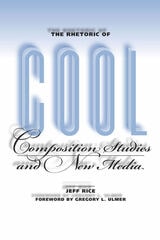
The Rhetoric of Cool
Composition Studies and New MediaJeff Rice
Southern Illinois University Press, 2007
The Rhetoric of Cool addresses the disciplinary claim that composition studies underwent a rebirth in 1963. At that time, three writers reviewed technology, cultural studies, and visual writing outside composition studies and independently used the word cool to describe each position. Starting from these three positions, Rice focuses on chora, appropriation, commutation, juxtaposition, nonlinearity, and imagery—rhetorical gestures conducive to new media work-- to construct the rhetoric of cool.
An innovative work that approaches computers and writing issues from historical, critical, theoretical, and practical perspectives, The Rhetoric of Cool challenges current understandings of writing and new media and proposes a rhetorical rather than an instrumental response for teaching writing in new media contexts.
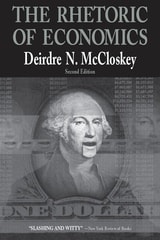
The Rhetoric of Economics
Deirdre N. McCloskey
University of Wisconsin Press, 1998
A classic in its field, this pathbreaking book humanized the scientific rhetoric of economics to reveal its literary soul. Economics needs to admit that it, like other sciences, works with metaphors and stories. Its most mathematical and statistical moments are properly dominated by comparison and narration, that is to say, human persuasion. The book was McCloskey's opening move in the development of a "humanomics," and unification of the sciences and the humanities on the field of ordinary business life.
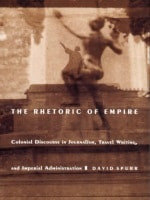
The Rhetoric of Empire
Colonial Discourse in Journalism, Travel Writing, and Imperial AdministrationDavid Spurr
Duke University Press, 1993
Despite historical differences among British, French, and American versions of colonialism, their rhetoric had much in common. The Rhetoric of Empire identifies these shared features—images, figures of speech, and characteristic lines of argument—and explores them in a wide variety of sources. A former correspondent for the United Press International, the author is equally at home with journalism or critical theory, travel writing or official documents, and his discussion is remarkably comprehensive. Ranging from T. E. Lawrence and Isak Dineson to Hemingway and Naipaul, from Time and the New Yorker to the National Geographic and Le Monde, from journalists such as Didion and Sontag to colonial administrators such as Frederick Lugard and Albert Sarraut, this analysis suggests the degree to which certain rhetorical tactics penetrate the popular as well as official colonial and postcolonial discourse.
Finally, Spurr considers the question: Can the language itself—and with it, Western forms of interpretation--be freed of the exercise of colonial power? This ambitious book is an answer of sorts. By exposing the rhetoric of empire, Spurr begins to loosen its hold over discourse about—and between—different cultures.
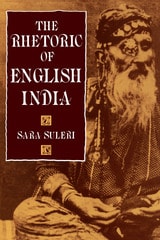
The Rhetoric of English India
Sara Suleri Goodyear
University of Chicago Press, 1992
"A dense, witty, and richly allusive book . . . an extremely valuable contribution to postcolonial cultural studies as well as to the whole area of literary criticism."—Jean Sudrann, Choice
The Rhetoric of Faith
Irenaeus and the Structure of the Adversus HaeresesScott D. Moringiello
Catholic University of America Press, 2019
The argument focuses on the Adversus Haereses, although it does begin with some discussion to put Irenaeus in the context of second century Christian literature. Moringiello concludes with a discussion of Irenaeus’s Demonstration of the Apostolic Preaching.Other scholars have provided introductions to Irenaeus’s work, and other scholars have argued for the structural unity of the Adversus Haereses. No other scholar, though, has argued that the faith of the Church is the basis of Irenaeus’s argument. This argument, then, presents an important contribution to the field of Irenaeus studies.
The Rhetoric of Fascism
Edited by Nathan Crick
University of Alabama Press, 2022
Decoding the discourse: Rhetorical foundations of authoritarian power.
Fascism has resurfaced as one of the most pressing problems of our time. The rise of extremist parties and candidates in Europe, the United States, and around the globe has led even mainstream political commentators to begin using the term “fascism” to describe dangerous movements that have revived and repackaged many of the strategies long thought to have been relegated to the margins of political rhetoric. No longer just confined to the state regimes of the past, fascism thrives today as a globally self-augmenting, self-propagating rhetorical phenomenon with a variety of faces and expressions.
The Rhetoric of Fascism defines and interprets the common persuasive devices that characterize fascist discourse to understand the nature of its enduring appeal. By approaching fascism from a rhetorical perspective, this volume complements established political and sociological understandings of fascism as a movement or regime. A rhetorical approach studies fascism less as a party one joins than as a set of persuasive strategies one adopts. Fascism spreads precisely because it is not a coherent entity. Instead, it exists as a loosely bound and often contradictory collection of persuasive trajectories that have attained enough coherence to mobilize and channel the passions of a self-constituted mass of individuals.
Introductory chapters focus on general theories of fascism drawn from twentieth-century history and theory. Contributors investigate specific historical figures and their relationship to contemporary rhetorics, focusing on a specific rhetorical device that is characteristic of fascist rhetoric. A common thread throughout every chapter is that fascist devices are appealing because they speak to us in the familiar language of our culture. As we are seduced by one device at a time, we soon find ourselves part of a movement, a group, or a campaign that makes us act in ways we might never have imagined. This volume reveals that fascism may be closer to home than we think.
CONTRIBUTORS
Patrick D. Anderson / Rya Butterfield / Nathan Crick / Elizabeth R. Earle / Zac Gershberg / Stephen J. Hartnett / Marie-Odile N. Hobeika / Sean Illing / Jacob A. Miller / Fernando Ismael Quiñones Valdivia / Patricia Roberts-Miller / Raquel M. Robvais / Bradley A. Serber / Ryan Skinnell
The Rhetoric of Fiction
Wayne C. Booth
University of Chicago Press, 1983
For this new edition, Wayne C. Booth has written an extensive Afterword in which he clarifies misunderstandings, corrects what he now views as errors, and sets forth his own recent thinking about the rhetoric of fiction. The other new feature is a Supplementary Bibliography, prepared by James Phelan in consultation with the author, which lists the important critical works of the past twenty years—two decades that Booth describes as "the richest in the history of the subject."
The Rhetoric of Fictionality
Narrative Theory and the Idea of FictionRichard Walsh
The Ohio State University Press, 2007

The Rhetoric of Interpretation and the Interpretation of Rhetoric
Paul Hernadi, ed.
Duke University Press, 1989
The Rhetoric of Law
Austin Sarat and Thomas R. Kearns, Editors
University of Michigan Press, 1996

The Rhetoric of Modernist Fiction
From a New Point of ViewMorton Levitt
University Press of New England, 2005
The Rhetoric of Morality and Philosophy
Plato's Gorgias and PhaedrusSeth Benardete
University of Chicago Press, 1991
The Rhetoric of Morality and Philosophy, one of the most groundbreaking works of twentieth-century Platonic studies, is now back in print for a new generation of students and scholars to discover. In this volume, distinguished classicist Seth Benardete interprets and pairs two important Platonic dialogues, the Gorgias and the Phaedrus, illuminating Socrates’ notion of rhetoric and Plato’s conception of morality and eros in the human soul.
Following his discussion of the Gorgias as a dialogue about the rhetoric of morality, Benardete turns to the Phaedrus as a discourse about genuine rhetoric, namely the science of eros, or true philosophy. This novel interpretation addresses numerous issues in Plato studies: the relation between the structure of the Gorgias and the image of soul/city in the Republic, the relation between the structure of Phaedrus and the concept of eros, and Socrates’ notion of ignorance, among others.
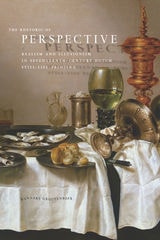
The Rhetoric of Perspective
Realism and Illusionism in Seventeenth-Century Dutch Still-Life PaintingHanneke Grootenboer
University of Chicago Press, 2005
Aided by a stunning full-color gallery, Hanneke Grootenboer proposes a new theory of perspective based on the phenomenological aspects of non-narrative still-life, trompe l'oeil, and anamorphic imagery. Drawing on playful and mesmerizing baroque images, Grootenboer characterizes what she calls their "sophisticated deceit," asserting that painting is more about visual representation than about its supposed objects.
Offering an original theory of perspective's impact on pictorial representation, the act of looking, and the understanding of truth in painting, Grootenboer shows how these paintings both question the status of representation and explore the limits and credibility of perception.
The Rhetoric of Plato's Republic
Democracy and the Philosophical Problem of PersuasionJames L. Kastely
University of Chicago Press, 2015
As Kastely shows, the Republic begins with two interrelated crises: one rhetorical, one philosophical. In the first, democracy is defended by a discourse of justice, but no one can take this discourse seriously because no one can see—in a world where the powerful dominate the weak—how justice is a value in itself. That value must be found philosophically, but philosophy, as Plato and Socrates understand it, can reach only the very few. In order to reach its larger political audience, it must become rhetoric; it must become a persuasive part of the larger culture—which, at that time, meant epic poetry. Tracing how Plato and Socrates formulate this transformation in the Republic, Kastely isolates a crucial theory of persuasion that is central to how we talk together about justice and organize ourselves according to democratic principles.
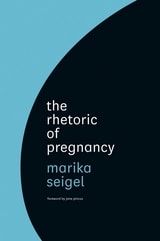
The Rhetoric of Pregnancy
Marika Seigel
University of Chicago Press, 2013
Using a sophisticated rhetorical analysis, Marika Seigel works to deconstruct pregnancy manuals while also identifying ways to improve communication about pregnancy and healthcare. She traces the manuals’ evolution from early twentieth-century tomes that instructed readers to unquestioningly turn their pregnancy management over to doctors, to those of the women’s health movement that encouraged readers to engage more critically with their care, to modern online sources that sometimes serve commercial interests as much as the mother’s.
The first book-length study of its kind, The Rhetoric of Pregnancy is a must-read for both users and designers of our prenatal systems—doctors and doulas, scholars and activists, and anyone interested in encouraging active, effective engagement.
The Rhetoric of Reason
Writing and the Attractions of ArgumentJames Crosswhite
University of Wisconsin Press, 1996
To those who have lost faith in the abilities of people to reach reasoned mutual agreements, and to others who have attacked the right-or-wrong model of formal logic, this book offers the reminder that the rhetorical tradition has always viewed argumentation as a dialogue, a response to changing situations, an exchange of persuading, listening, and understanding. Crosswhite’s aim is to give new purpose to writing instruction and to students’ writing, to reinvest both with the deep ethical interests of the rhetorical tradition. In laying out the elements of argumentation, for example, he shows that claiming, questioning, and giving reasons are not simple elements of formal logic, but communicative acts with complicated ethical features. Students must learn not only how to construct an argument, but the purposes, responsibilities, and consequences of engaging in one.
Crosswhite supports his aims through a rhetorical reconstruction of reason, offering new interpretations of Plato and Aristotle and of the concepts of reflection and dialogue from early modernity through Hegel to Gadamer. And, in his conclusion, he ties these theoretical and historical underpinnings to current problems of higher education, the definition of the liberal arts, and, especially, the teaching of written communication.
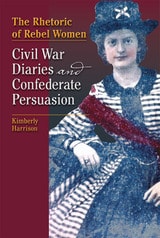
The Rhetoric of Rebel Women
Civil War Diaries and Confederate PersuasionKimberly Harrison
Southern Illinois University Press, 2013
Informed by more than one hundred diaries, this study provides insight into how women cultivated rhetorical agency, challenging traditional gender expectations while also upholding a cultural status quo. Author Kimberly Harrison analyzes the rhetorical choices these women made and valued in wartime and postwar interactions with Union officers and soldiers, slaves and former slaves, local community members, and even their God. In their intimate accounts of everyday war, these diarists discussed rhetorical strategies that could impact their safety, their livelihoods, and those of their families. As they faced Union soldiers in attempts to protect their homes and property, diarists saw their actions as not only having local, immediate impact on their well-being but also as reflecting upon their cause and the character of the southern people as a whole. They instructed themselves through their personal writing, allowing insight into how southern women prepared themselves to speak and act in new and contested contexts.
The Rhetoric of Rebel Women highlights the contributions of privileged white southern women in the development of the Confederate national identity, presenting them not as passive observers but as active participants in the war effort.
The Rhetoric of Safety, Volume 107
Lawrence Schehr
Duke University Press, 0
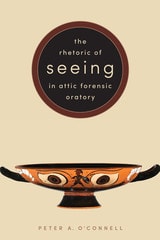
The Rhetoric of Seeing in Attic Forensic Oratory
By Peter A. O'Connell
University of Texas Press, 2017

The Rhetoric of Social Research
Understood and BelievedEdited by Albert Hunter
Rutgers University Press, 1990
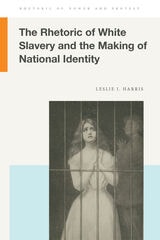
The Rhetoric of White Slavery and the Making of National Identity
Leslie J Harris
Michigan State University Press, 2023

The Rhetoric of the "Other" Literature
W. Ross Winterowd
Southern Illinois University Press, 1990
Using traditional and contemporary rhetorical theory, Winterowd argues that the fiction-nonfiction division of literature is unjustified and destructive.
He would bridge the gap between literary scholars and rhetoricians by including both fiction (imaginative literature) and nonfiction (literature of fact) in the canon. The actual difference in literary texts, he notes, lies not in their factuality but in their potential for eliciting an aesthetic response.
With speech act and rhetorical theory as a basis, Winterowd argues that presentational literature gains its power on the basis of its ethical and pathetic appeal, not because of its assertions or arguments.
The Rhetoric of the New Political Documentary
Edited by Thomas W. Benson and Brian J. Snee
Southern Illinois University Press, 2008
The Rhetoric of the New Political Documentary explores the most visible and volatile element in the 2004 presidential campaign—the partisan documentary film. This collection of original critical essays by leading scholars and critics—including Shawn J. and Trevor Parry-Giles, Jennifer L. Borda, and Martin J. Medhurst—analyzes a selection of political documentaries that appeared during the 2004 election season. The editors examine the new political documentary with the tools of rhetorical criticism, combining close textual analysis with a consideration of the historical context and the production and reception of the films.
The essays address the distinctive rhetoric of the new political documentary, with the films typically having been shot with relatively low budgets, in video, and using interviews and stock footage rather than observation of uncontrolled behavior. The quality was often good enough and interest was sufficiently intense that the films were shown in theaters and on television, which provided legitimacy and visibility before they were released soon afterwards on DVD and VHS and marketed on the Internet.
The volume reviews such films as Michael Moore’s Fahrenheit 9/11; two refutations of Moore’s film, Fahrenhype 9/11 and Celsius 41.11;Unprecedented: The 2000 Presidential Election; and George W. Bush: Faith in the White House—films that experimented with a variety of angles and rhetorics, from a mix of comic disparagement and earnest confrontation to various emulations of traditional news and documentary voices.
The Rhetoric of the New Political Documentary represents the continued transformation of American political discourse in a partisan and contentious time and showcases the independent voices and the political power brokers that struggled to find new ways to debate the status quo and employ surrogate “independents” to create a counterrhetoric.
The Rhetorical Invention of Diversity
Supreme Court Opinions, Public Arguments, and Affirmative ActionM. Kelly Carr
Michigan State University Press, 2018
The Rhetorical Turn
Invention and Persuasion in the Conduct of InquiryEdited by Herbert W. Simons
University of Chicago Press, 1990
The Rhetorical Turn moves from biology to politics via excursions into the rhetorics of psychoanalysis, decision science, and conversational analysis. Topics explored include how rhetorical invention guides scientific invention, how rhetoric assists political judgment, and how it integrates varying approaches to meta-theory. Concluding with four philosophical essays, this volume of case studies demonstrates how the inventive and persuasive dimensions of scholarly discourse point the way to forms of argument appropriate to our postmodern age.
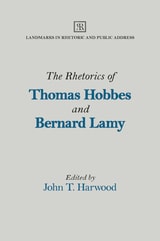
The Rhetorics of Thomas Hobbes and Bernard Lamy
John T. Harwood
Southern Illinois University Press, 1986
Makes accessible to modern readers the 17th-century rhetorics of Thomas Hobbes (1588–1677) and Bernard Lamy (1640–1715)
Hobbes’ A Briefe of the Art of Rhetorique, the first English translation of Aristotle’s rhetoric, reflects Hobbes’ sense of rhetoric as a central instrument of self-defense in an increasingly fractious Commonwealth. In its approach to rhetoric, which Hobbes defines as “that Faculty by which wee understand what will serve our turne, concerning any subject, to winne beliefe in the hearer,” the Briefe looks forward to Hobbes’ great political works De Cive and Leviathan.
Published anonymously in France as De l’art de parler, Lamy’s rhetoric was translated immediately into English as The Art of Speaking. Lamy’s long association with the Port Royalists made his works especially attractive to English readers because Port Royalists were engaged in a vicious quarrel with the Jesuits during the last half of the 17th century.
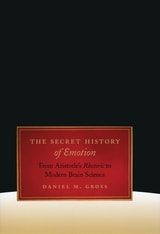
The Secret History of Emotion
From Aristotle's Rhetoric to Modern Brain ScienceDaniel M. Gross
University of Chicago Press, 2006
Through a radical rereading of Aristotle, Seneca, Thomas Hobbes, Sarah Fielding, and Judith Butler, among others, Daniel M. Gross reveals a persistent intellectual current that considers emotions as psychosocial phenomena. In Gross’s historical analysis of emotion, Aristotle and Hobbes’s rhetoric show that our passions do not stem from some inherent, universal nature of men and women, but rather are conditioned by power relations and social hierarchies. He follows up with consideration of how political passions are distributed to some people but not to others using the Roman Stoics as a guide. Hume and contemporary theorists like Judith Butler, meanwhile, explain to us how psyches are shaped by power. To supplement his argument, Gross also provides a history and critique of the dominant modern view of emotions, expressed in Darwinism and neurobiology, in which they are considered organic, personal feelings independent of social circumstances.
The result is a convincing work that rescues the study of the passions from science and returns it to the humanities and the art of rhetoric.
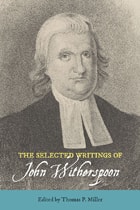
The Selected Writings of John Witherspoon
Edited by Thomas P. Miller
Southern Illinois University Press, 1990
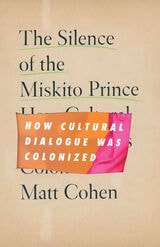
The Silence of the Miskito Prince
How Cultural Dialogue Was ColonizedMatt Cohen
University of Minnesota Press, 2022
Confronting the rifts created by our common conceptual vocabulary for North American colonial studies
How can we tell colonial histories in ways that invite intercultural conversation within humanistic fields that are themselves products of colonial domination? Beginning with a famous episode of failed communication from the narrative of the freed slave Olaudah Equiano, The Silence of the Miskito Prince explores this question by looking critically at five concepts frequently used to imagine solutions to the challenges of cross-cultural communication: understanding, cosmopolitanism, piety, reciprocity, and patience.
Focusing on the first two centuries of North American colonization, Matt Cohen traces how these five concepts of cross-cultural relations emerged from, and continue to evolve within, colonial dynamics. Through a series of revealing archival explorations, he argues the need for a new vocabulary for the analysis of past interactions drawn from the intellectual and spiritual domains of the colonized, and for a historiographical practice oriented less toward the illusion of complete understanding and scholarly authority and more toward the beliefs and experiences of descendant communities.
The Silence of the Miskito Prince argues for new ways of framing scholarly conversations that use past interactions as a site for thinking about intercultural relations today. By investigating the colonial histories of these terms that were assumed to promote inclusion, Cohen offers both a reflection on how we got here and a model of scholarly humility that holds us to our better or worse pasts.
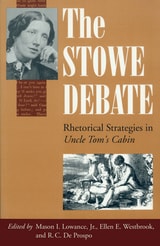
The Stowe Debate
Rhetorical Strategies in "Uncle Tom's Cabin"Mason I. Lowance
University of Massachusetts Press, 1994
The thirteen contributors to this volume enter these debates from a variety of critical perspectives. They address questions of language and ideology, the tradition of the sentimental novel, biblical influences, and the rhetoric of antislavery discourse. As much as they disagree on various points, they share a keen interest in the cultural work that texts can do and an appreciation of the enduring power of Uncle Tom's Cabin.
The Syntax of Sports, Class 7
Information FlowPatrick Barry
Michigan Publishing Services, 2025
The Terministic Screen
Rhetorical Perspectives on FilmEdited by David Blakesley
Southern Illinois University Press, 2003
The Terministic Screen: Rhetorical Perspectives on Film examines the importance of rhetoric in the study of film and film theory. Rhetorical approaches to film studies have been widely practiced, but rarely discussed until now. Taking on such issues as Hollywood blacklisting, fascistic aesthetics, and postmodern dialogics, editor David Blakesley presents fifteen critical essays that examine rhetoric’s role in such popular films as The Fifth Element, The Last Temptation of Christ, The Usual Suspects, Deliverance, The English Patient, Pulp Fiction, The Music Man, Copycat, Hoop Dreams,and A Time to Kill.
Aided by sixteen illustrations, these insightful essays consider films rhetorically, as ways of seeing and not seeing, as acts that dramatize how people use language and images to tell stories and foster identification.
Contributors include David Blakesley, Alan Nadel, Ann Chisholm, Martin J. Medhurst, Byron Hawk, Ekaterina V. Haskins, James Roberts, Thomas W. Benson, Philip L. Simpson, Davis W. Houck, Caroline J.S. Picart, Friedemann Weidauer, Bruce Krajewski, Harriet Malinowitz, Granetta L. Richardson, and Kelly Ritter.
The Text and Beyond
Essays in Literary LinguisticsCynthia Bernstein
University of Alabama Press, 1997
A groundbreaking collection that bridges linguistics and literature, offering powerful tools to uncover how language shapes meaning, identity, and power in literary texts.
The Text and Beyond: Essays in Literary Linguistics, edited by Cynthia Bernstein, presents a groundbreaking collection of essays that demonstrate how linguistic tools can enrich literary analysis. The volume brings together scholars who explore the intersections of language, literature, and culture—examining how syntax, discourse, gender, power, and regional dialects shape meaning in texts. From Tennessee Williams to Harry Crews, from Dickens to immigrant literature, the essays offer models for integrating linguistic theory with literary interpretation. This book is essential for scholars of stylistics, discourse analysis, and anyone interested in the evolving relationship between language and literature.
The View From On the Road
The Rhetorical Vision of Jack KerouacOmar Swartz
Southern Illinois University Press, 2000
Through careful analysis of Jack Kerouac’s On the Road, Omar Swartz argues that Kerouac’s influence on American society is largely rhetorical. Kerouac’s significance as a cultural icon can be best understood, Swartz asserts, in terms of traditional rhetorical practices and principles.
To Swartz, Kerouac is a rhetor who symbolically reconstructs his world and offers arguments and encouragements for others to follow. Swartz proposes that On the Road constitutes a “rhetorical vision,” a reality-defining discourse suggesting alternative possibilities for growth and change. Swartz asserts that the reader of Kerouac’s On theRoadbecomes capable of responding to the larger, confusing culture in a strategic manner. Kerouac's rhetorical vision of an alternative social and cultural reality contributes to the identity of localized cultures within the United States.
The Vocation of a Teacher
Rhetorical Occasions, 1967-1988Wayne C. Booth
University of Chicago Press, 1989
"[Booth] is unusually adept at addressing a wide variety of audiences. From deep in the heart of this academic jungle, he shows a clear eye and a firm step."—Alison Friesinger Hill, New York Times Book Review
"A cause for celebration. . . . What an uncommon man is Wayne Booth. What an uncommon book he has provided for our reflection."—James Squire, Educational Leadership
"This book stands as a vigorous reminder of the traditional virtues of the scholar-teacher."—Brian Cox, Times Literary Supplement
The Vulnerability of Public Higher Education
Michael Bernard-Donals
The Ohio State University Press, 2023
Reduced state funding to public institutions. The removal of tenure from state statutes. Attempts to silence faculty. Michael Bernard-Donals takes on these issues and other crises in higher education in The Vulnerability of Public Higher Education, exploring how values once used to justify higher education—the democratization of knowledge, the fostering of expertise, the creation of well-informed citizens, and critical engagement with issues—have been called into question.
Bernard-Donals argues that public higher education, especially the work of faculty, has become vulnerable—socially, politically, professionally—and this book takes seriously the idea of vulnerability, suggesting that university faculty see it not as an encumbrance to their work but as an opportunity to form relations of solidarity with one another through mutual recognition and shared, albeit different forms of, precarity. Through a series of case studies on faculty rights and responsibilities, the efficacy of diversity initiatives, and tenure and academic freedom, Bernard-Donals employs a rhetorical perspective to show how vulnerability can reshape faculty work and provide ways to shift the relations of materiality and power while opening up new forms of deliberation, engagement, and knowledge production.
The Wandering Signifier
Rhetoric of Jewishness in the Latin American ImaginaryErin Graff Zivin
Duke University Press, 2008
In her readings of Spanish American and Brazilian fiction, Graff Zivin highlights inventions of Jewishness in which the concept is constructed as a rhetorical device. She argues that Jewishness functions as a wandering signifier that while not wholly empty, can be infused with meaning based on the demands of the textual project in question. Just as Jews in Latin America possess distinct histories relative to their European and North American counterparts, they also occupy different symbolic spaces in the cultural landscape. Graff Zivin suggests that in Latin American fiction, anxiety, desire, paranoia, attraction, and repulsion toward Jewishness are always either in tension with or representative of larger attitudes toward otherness, whether racial, sexual, religious, national, economic, or metaphysical. She concludes The Wandering Signifier with an inquiry into whether it is possible to ethically represent the other within the literary text, or whether the act of representation necessarily involves the objectification of the other.
The Wealth of Reality
An Ecology of CompositionMargaret A. Syverson
Southern Illinois University Press, 1999
Margaret A. Syverson discusses the ways in which a theory of composing situations as ecological systems might productively be applied in composition studies. She demonstrates not only how new research in cognitive science and complex systems can inform composition studies but also how composing situations can provide fruitful ground for research in cognitive science.
Syverson first introduces theories of complex systems currently studied in diverse disciplines. She describes complex systems as adaptive, self-organizing, and dynamic; neither utterly chaotic nor entirely ordered, these systems exist on the boundary between order and chaos. Ecological systems are "metasystems" composed of interrelated complex systems. Writers, readers, and texts, together with their environments, constitute one kind of ecological system.
Four attributes of complex systems provide a theoretical framework for this study: distribution, embodiment, emergence, and enaction. Three case studies provide evidence for the application of these concepts: an analysis of a passage from an autobiographical poem by Charles Reznikoff, a study of first-year college students writing collaboratively, and a conflict in a computer forum of social scientists during the Gulf War. The diversity of these cases tests the robustness of theories of distributed cognition and complex systems and suggests possibilities for wider application.
The Weimar Origins of Rhetorical Inquiry
David L. Marshall
University of Chicago Press, 2020
The Will of a People
A Critical Anthology of Great African American SpeechesEdited with Introductions by Richard W. Leeman and Bernard K. Duffy
Southern Illinois University Press, 2012
Normal0falsefalsefalseEN-USX-NONEX-NONE
Drawing upon nearly two hundred years of recorded African American oratory, The Will of a People: A Critical Anthology of Great African American Speeches,edited by Richard W. Leeman and Bernard K. Duffy, brings together in one unique volume some of this tradition’s most noteworthy speeches, each paired with an astute introduction designed to highlight its most significant elements.
Arranged chronologically, from Maria Miller Stewart’s 1832 speech “Why Sit Ye Here and Die?” to President Barack Obama’s 2009 inaugural address, these orations are tied to many of the key themes and events of American history, as well as the many issues and developments in American race relations. These themes, events, and issues include the changing roles of women, Native American relations, American “manifest destiny,” abolitionism, the industrial revolution, Jim Crow, lynching, World War I and American self-determination, the rise of the New Deal and government social programs, the Civil Rights Movement and desegregation, the Vietnam War, Nixon and Watergate, gay and lesbian rights, immigration, and the rise of a mediated culture. Leeman and Duffy have carefully selected the most eloquent and relevant speeches by African Americans, including those by Sojourner Truth, Frederick Douglass, Frances Ellen Watkins Harper, Ida B. Wells-Barnett, Booker T. Washington, Mary Church Terrell, W. E. B. Du Bois, Marcus Garvey, Martin Luther King Jr., Malcolm X, Stokely Carmichael, Barbara Jordan, Jesse Jackson, and Marian Wright Edelman, many of which have never received significant scholarly attention.
The Will of a People is the first book to pair the full texts of the most important African American orations with substantial introductory essays intended to guide the reader’s understanding of the speaker, the speech, its rhetorical interpretation, and the historical context in which it occurred. Broadly representative of the African American experience, as well as what it means to be American, this valuable collectionwill serve as an essential guide to the African American oratory tradition.
The World Is Our Stage
The Global Rhetorical Presidency and the Cold WarAllison M. Prasch
University of Chicago Press, 2023
Crowds swarm when US presidents travel abroad, though many never hear their voices. The presidential body, moving from one secured location to another, communicates as much or more to these audiences than the texts of their speeches. In The World is Our Stage, Allison M. Prasch considers how presidential appearances overseas broadcast American superiority during the Cold War. Drawing on extensive archival research, Prasch examines five foundational moments in the development of what she calls the “global rhetorical presidency:” Truman at Potsdam, Eisenhower’s “Goodwill Tours,” Kennedy in West Berlin, Nixon in the People’s Republic of China, and Reagan in Normandy. In each case, Prasch reveals how the president’s physical presence defined the boundaries of the “Free World” and elevated the United States as the central actor in Cold War geopolitics.
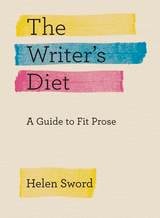
The Writer's Diet
A Guide to Fit ProseHelen Sword
University of Chicago Press, 2016
Helen Sword dispenses with excessive explanations and overwrought analysis. Instead, she offers an easy-to-follow set of writing principles: use active verbs whenever possible; favor concrete language over vague abstractions; avoid long strings of prepositional phrases; employ adjectives and adverbs only when they contribute something new to the meaning of a sentence; and reduce your dependence on four pernicious “waste words”: it, this, that, and there.
Sword then shows the rules in action through examples from William Shakespeare, Emily Dickinson, Martin Luther King Jr., John McPhee, A. S. Byatt, Richard Dawkins, Alison Gopnik, and many more. A writing fitness test encourages you to assess your own writing and get immediate advice on addressing problem areas. While The Writer’s Diet is as sleek and concise as the writing ideals contained within, this slim volume packs a powerful punch.
With Sword’s coaching writers of all levels can strengthen and tone their sentences with the stroke of a pen or the click of a mouse. As with any fitness routine, adhering to the rules requires energy and vigilance. The results, however, will speak for themselves.
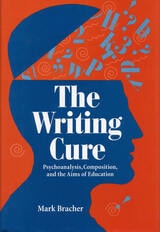
The Writing Cure
Psychoanalysis, Composition, and the Aims of EducationMark Bracher
Southern Illinois University Press, 1999
Psychoanalysis and writing instruction have much to offer each other, asserts Mark Bracher. In this book, Bracher examines the intersection between these two fields and proposes pedagogical uses of psychoanalytic technique for writing instruction.
Psychoanalysis reveals that the writing process is profoundly affected by factors that current theories have largely neglected—forces such as enjoyment, desire, fantasy, and anxiety, which, moreover, are often unconscious. Articulating an approach based on the work of Jacques Lacan, Bracher shows how a psychoanalytic perspective can offer useful insights into the nature of the writing process, the sources of writing problems, and the dynamics of writing instruction. He further demonstrates that writing instruction constitutes the most favorable venue outside of individual psychoanalytic treatment for pursuing psychoanalytic research and practice. Like psychoanalytic treatment proper, writing instruction can function as a way of reducing psychological conflict and as a means of pursuing psychoanalytic research into the workings of the mind. Empirical studies and personal testimonies have demonstrated the psychological (and even the physical) benefits of writing about personal conflict in an academic setting; such benefits promise to be enhanced and consolidated through the application of psychoanalytic principles to the teaching of writing.
The Writing Studio Sampler
Stories about ChangeMark Sutton
University Press of Colorado, 2018
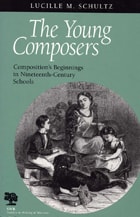
The Young Composers
Composition's Beginnings in Nineteenth-Century SchoolsLucille M. Schultz
Southern Illinois University Press, 1999
Lucille M. Schultz's The Young Composers: Composition's Beginnings in Nineteenth-Century Schools is the first full-length history of school-based writing instruction. Schultz demonstrates that writing instruction in nineteenth-century American schools is much more important in the overall history of writing instruction than we have previously assumed.
Drawing on primary materials that have not been considered in previous histories of writing instruction—little-known textbooks and student writing that includes prize-winning essays, journal entries, letters, and articles written for school newspapers—Schultz shows that in nineteenth-century American schools, the voices of the British rhetoricians that dominated college writing instruction were attenuated by the voice of the Swiss education reformer Johann Heinrich Pestalozzi. Partly through the influence of Pestalozzi's thought, writing instruction for children in schools became child-centered, not just a replica or imitation of writing instruction in the colleges.
It was also in these nineteenth-century American schools that personal or experience-based writing began and where the democratization of writing was institutionalized. These schools prefigured some of our contemporary composition practices: free writing, peer editing, and the use of illustrations as writing prompts. It was in these schools, in fact, where composition instruction as we know it today began, Schultz argues.
This book features a chapter on the agency of textbook iconography, which includes illustrations from nineteenth-century composition books as well as a cultural analysis of those illustrations. Schultz also includes a lengthy bibliography of nineteenth-century composition textbooks and student and school newspapers.
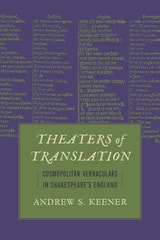
Theaters of Translation
Cosmopolitan Vernaculars in Shakespeare's EnglandAndrew S. Keener
University of Alabama Press, 2025
Explores the profound influence of multilingual dictionaries, dialogues, and grammars on English Renaissance playwrights
In Theaters of Translation, Andrew S. Keener offers a fascinating account of the ways that plays by Thomas Kyd, Mary Sidney Herbert, Ben Jonson, and their fellow English contemporaries were shaped by and part of a multilingual Europe where dictionaries, grammars, and language-learning materials circulated widely. He proposes a fresh, multilingual approach to English Renaissance drama that challenges the histories of early modern European languages as sites of national and linguistic cohesion.
Covering the period between 1570 and 1640, when England’s drama and the English language itself were evolving, Keener uses the term “cosmopolitan vernaculars” to examine how nonclassical European languages modeled transnational forms of belonging for playgoers, readers, and authors in Renaissance England. Combining recent contributions to cosmopolitan theory and transnational studies of early modern literature and culture, Keener highlights both the ways in which cosmopolitanism manifests through Europe’s vernacular languages—in print and performance—and the ways languages themselves can exhibit cosmopolitanism for those who encounter them on the page or on the stage.
Theaters of Translation opens up new transnational interpretations of English Renaissance plays and casts fresh light on historical anecdotes, such as Jonson inscribing a copy of Pietro Aretino’s scandalous Italian dialogues or Shakespeare’s First Folio being advertised for sale in Germany before its London publication. It offers much of interest to readers and scholars of Renaissance Europe, early modern drama, and the development of national European languages.
Theorizing Histories of Rhetoric
Edited by Michelle Ballif
Southern Illinois University Press, 2013
During the decades of the 1980s and 1990s, historians of rhetoric, composition, and communication vociferously theorized historiographical motivations and methodologies for writing histories in their fields. After this fertile period of rich, contested, and impassioned theorization, scholars busily undertook the composition of numerous historical works, complicating master narratives and recovering silenced voices and rhetorical practices. Yet, though historians in these fields have gone about the business of writing histories, the discussion of theorization has been quiet. In this welcome volume, fifteen scholars consider, once again, the theory of historiography, asking difficult questions about the purposes and methodologies of writing histories of rhetoric, broadly defined, and questioning what it means, what it should mean, what it could mean to write histories of rhetoric, composition, and communication.
The topics addressed include the privileging of the literary and the textual over material artifacts as prime sources of evidence in the study of classical rhetoric, the use of rhetorical hermeneutics as a methodology for interpreting past practices, the investigation of feminist methodologies that do not fit into the dominant modes of feminist historiographical work and the examination of archives with a queer eye to better construct nondiscriminatory narratives. Contributors also explore the value of approaching historiography through the lenses of jazz improvisation and complexity theory, and the historiographical method of writing the future in ways that refigure our relationships to time and to ourselves.
Consistently thoughtful and carefully argued, these essays successfully revive the discussion of historiography in rhetoric, inspiring fresh avenues of exploration in the field.
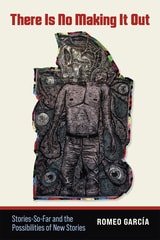
There Is No Making It Out
Stories-So-Far and the Possibilities of New StoriesRomeo García
Utah State University Press, 2025
They Will Know Us by Our Horses
Shenk Robert
St. Augustine's Press, 2021
Shenk notes that Aristotle equips his doctrine of rhetoric with a forward-looking dimension, often overlooked or ignored by scholars. There is stasis, but also forestasis, which amounts to a way not only of “getting to the point” of an event, but of a manner of forming decisions. The ancient rhetoricians, says Shenk, all discussed deliberative rhetoric as well as forensic rhetoric, and even though they differed in their respective descriptions they all generally agreed on its three main elements: possibility (often including difficulty or ease of execution), expedience (also called utility or benefit, even profit), and honor (or morality in general depending on the conversation). One places these elements into play when considering the viability of a proposal: “Is it possible? Is it beneficial? Is it honorable?” This pertains to deliberative rhetoric, or arguments that touch upon the future. It is not just grasping things that have been, but also understanding the core of that which is to come through formulating our decisions to act.
Laying the foundations for this broader view of stasis that, while depending on the ancient rhetoricians, includes a forward-posed heuristic that can, Shenk argues, reinvigorate the concept of rhetorical stasis and expand its theoretical reach. His intention is to show how rhetorical invention (discovery of the argument) is meant to look both directions. Rhetoric that properly presents what has passed can also be employed to identify the best next move. Or, as Shakespeare reminds us in Prince Hal’s decision to participate in the robbery at Gadshill, “Yea, but ‘tis like that they will know us by our horses, by our habits, and by every other appointment to be ourselves.”
In addition to examples drawn from his naval background, Shenk references Homer, Shakespeare and Milton in demonstrating forestasis to be a widely useful parallel to traditional stasis. Shenk argues that both deserve to be widely taught as prime, complementary modern techniques of invention. Doing so would make stasis more relevant and lead students, especially, to discover the crux of any matter that requires deliberative action. This is an essential and yet largely missing element of contemporary education. This ancient method, Shenk asserts, is a habit that although rhetorical leads to actual discoveries that in turn yield real outcomes, both abstract and practical.
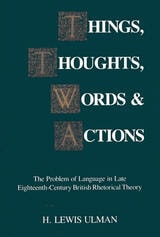
Things, Thoughts, Words, and Actions
The Problem of Language in Late Eighteenth-Century British Rhetorical TheoryH. Lewis Ulman
Southern Illinois University Press, 1994
H. Lewis Ulman here examines the roles of language theory in eighteenth-century British rhetorics, linking those roles to philosophical issues informing twentieth-century rhetorical theory. In doing so, Ulman develops a general model of the "problem of language" for rhetorical theory, a model that transcends the impasse between realism and skepticism that marks both eighteenth- and twentieth-century rhetorical theory.
The nature of language was never more central to rhetorical theory than in the second half of the eighteenth century. Yet, until now, the articulation of theories of language and the arts of rhetoric in eighteenth-century Britain has received little attention. Ulman examines the role of grammar and theories of language in the formation of eighteenth-century rhetorical theory, investigating the significance of language theory for such key concerns of eighteenth-century rhetoric as verbal criticism, style, and elocution. His study highlights what he understands as the central motive of late eighteenth-century British rhetoricians—to construct for their particular cultural context philosophically rigorous accounts of verbal communication based on carefully articulated theories of thought and language.
Toward this end, Ulman examines three eighteenth-century British rhetorical treatises: George Campbell’s Philosophy of Rhetoric, Hugh Blair’s Lectures on Rhetoric and Belles Lettres, and Thomas Sheridan’s Course of Lectures on Elocution. He then identifies the continuities and discontinuities between the problem of language for eighteenth- and twentieth-century rhetorical theory and proposes a pluralistic stance toward the problem of language in rhetoric as an alternative to the theoretical standoff that currently characterizes the debate between realist and antirealist rhetorics.