Results by title
944 books match the query 'Indians of North America' and 180 start with t
Through an Indian's Looking-Glass
A Cultural Biography of William Apess, PequotDrew Lopenzina
University of Massachusetts Press, 2017
The life of William Apess (1798–1839), a Pequot Indian, Methodist preacher, and widely celebrated writer, provides a lens through which to comprehend the complex dynamics of indigenous survival and resistance in the era of America's early nationhood. Apess's life intersects with multiple aspects of indigenous identity and existence in this period, including indentured servitude, slavery, service in the armed forces, syncretic engagements with Christian spirituality, and Native struggles for political and cultural autonomy. Even more, Apess offers a powerful and provocative voice for the persistence of Native presence in a time and place that was long supposed to have settled its “Indian question” in favor of extinction.
Through meticulous archival research, close readings of Apess's key works, and informed and imaginative speculation about his largely enigmatic life, Drew Lopenzina provides a vivid portrait of this singular Native American figure. This new biography will sit alongside Apess's own writing as vital reading for those interested in early America and indigeneity.
Time's River
Archaeological Syntheses from the Lower Mississippi ValleyEdited by Janet Rafferty and Evan Peacock
University of Alabama Press, 2008
An archaeologically rich region, in advance of impending disturbance
This volume stands as a key general resource for archaeologists working in the region extending from Louisiana through Mississippi north to Missouri and Kentucky, and it represents an opportunity to influence for decades a large part of the archaeological work to take place in the Southeast.
The book responds to a need for a comprehensive archaeological overview of the Lower Mississippi Valley that forms a portion of an interstate corridor spanning nine states that will run from southern Michigan to the Texas-Mexico border. The culturally sensitive Mississippi Delta is one of the richest archaeological areas in North America, and it is crucial that research designs be comprehensive, coordinated, and meet current preservation and future research needs. The authors are well-respected researchers from both within and outside the region with expertise in the full range of topics that comprise American archaeology. They examine matters of method and theory, the application of materials science, geophysics, and other high-tech tools in archaeology that provide for optimum data-recovery.
Time, Trees, and Prehistory
Tree Ring dating and the Development of NA Archaeology 1914 to 1950Stephen E Nash
University of Utah Press, 2006
Dendrochronology, the science of assigning precise calendar dates to annual growth rings in trees, provided accurate dates at a time when North American archaeologists had no absolute dating techniques available to guide their analyses. Time, Trees, and Prehistory examines the growth, development, application, and interpretive implications of North American archaeological tree-ring dating from 1914 to 1950.
The development of dendrochronology forced archaeologists to radically revise their understanding of the prehistoric past, compressing by nearly fifty percent the time scale of the archaeological record. Basketmaker sites, for instance, were once thought to be four thousand years old; tree-ring application demonstrated that these sites dated well into the present millennium. Classic sites in Chaco Canyon and Mesa Verde were believed occupied for nearly a thousand years, but tree-ring dates demonstrated that such sites were often built, occupied, and abandoned in just over a century. Other similar changes in temporal scale forced archaeologists to reconsider their interpretations of the rate of prehistoric cultural change, population growth, and the degree of social and political complexity in the Southwest.
Time, Trees, and Prehistory examines archaeological practices of the 1920s, 30s, and 40s and demonstrates that tree-ring dating set the stage that enabled revolutionary developments in archaeological method and theory in succeeding decades.
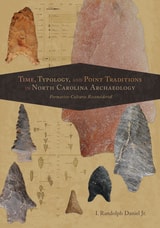
Time, Typology, and Point Traditions in North Carolina Archaeology
Formative Cultures ReconsideredI. Randolph Daniel Jr.
University of Alabama Press, 2021
Revisiting the stone tools that reshaped our understanding of North Carolina's prehistoric past.
In the 1964 landmark publication The Formative Cultures of the Carolina Piedmont, Joffre Coe established a projectile point typology and chronology that, for the first time, allowed archaeologists to identify the relative age of a site or site deposit based on the point types recovered there. Consistent with the cultural-historical paradigm of the day, the “Coe axiom” stipulated that only one point type was produced at one moment in time in a particular location. Moreover, Coe identified periods of “cultural continuity” and “discontinuity” in the chronology based on perceived similarities and differences in point styles through time.
In Time, Typology, and Point Traditions in North Carolina Archaeology: Formative Cultures Reconsidered, I. Randolph Daniel Jr. reevaluates the Coe typology and sequence, analyzing their strengths and weaknesses. Daniel reviews the history of the projectile point type concept in the Southeast and revisits both Coe’s axiom and his notions regarding cultural continuity and change based on point types. In addition, Daniel updates Coe’s typology by clarifying or revising existing types and including types unrecognized in Coe’s monograph. Daniel also adopts a practice-centered approach to interpreting types and organizes them into several technological traditions that trace ancestral-descendent communities of practice that relate to our current understanding of North Carolina prehistory.
Appealing to professional and avocational archaeologists, Daniel provides ample illustrations of points in the book as well as color versions on a dedicated website. Daniel dedicates a final chapter to a discussion of the ethical issues related to professional archaeologists using private artifact collections. He calls for greater collaboration between professional and avocational communities, noting the scientific value of some private collections.
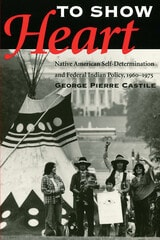
To Show Heart
Native American Self-Determination and Federal Indian Policy, 1960-1975George Pierre Castile
University of Arizona Press, 1998
To Show Heart is a detailed and unbiased account of one of the least understood periods in Indian affairs. It tells how "termination" became a political embarrassment during the civil rights movement, how Lyndon Johnson's War on Poverty prompted politicians to rethink Indian policy, and how championing self-determination presented an opportunity for Presidents Nixon and Ford to "show heart" toward Native Americans. Along the way, Castile assesses the impact of the Indian activism of the 1960s and 1970s and offers an objective view of the American Indian Movement and the standoff at Wounded Knee. He also discusses the recent history of individual tribes, which gives greater meaning to decisions made at the national level. Castile's work greatly enhances our understanding of the formulation of current Indian policy and of the changes that have occurred since 1975. To Show Heart is an important book not only for anthropologists and historians but also for Native Americans themselves, who will benefit from this inside look at how bureaucrats have sought to determine their destinies.
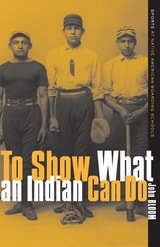
To Show What an Indian Can Do
Sports at Native American Boarding SchoolsJohn Bloom
University of Minnesota Press, 2005

To Win the Indian Heart
Music at Chemawa Indian SchoolMelissa D. Parkhurst
Oregon State University Press, 2014
In To Win the Indian Heart: Music at Chemawa Indian School, Melissa Parkhurst records the history of the school’s musical life. She explores the crucial role music was meant to play in the total transformation of Indian children, and the cultural recovery and resiliency it often inspired instead. Parkhurst chronicles the complex ways in which students, families, faculty, and administrators employed music, both as a tool for assimilation and, conversely, as a vehicle for student resistance—a subject long overlooked in literature on Indian education and the assimilation campaign.
Combining oral histories of Chemawa alumni with archival records of campus life, the book examines the prominent forms of music making at Chemawa—school band, choirs, private lessons, pageants, dance, garage bands, and powwows. Parkhurst traces the trajectory of federal Indian policy, highlighting students’ creative responses and the ways in which music reveals the inherent contradictions in the U.S. government’s assimilation practices.
Tohopeka
Rethinking the Creek War and the War of 1812Edited by Kathryn E. Holland Braund
University of Alabama Press, 2012
Reexamining the Creek War, the War of 1812, and the Making of the American South.
Tohopeka contains a variety of perspectives and uses a wide array of evidence and approaches, from scrutiny of cultural and religious practices to literary and linguistic analysis, to illuminate this troubled period. Almost two hundred years ago, the territory that would become Alabama was both ancient homeland and new frontier where a complex network of allegiances and agendas was playing out. The fabric of that network stretched and frayed as the Creek Civil War of 1813-14 pitted a faction of the Creek nation known as Red Sticks against those Creeks who supported the Creek National Council. The war began in July 1813, when Red Stick rebels were attacked near Burnt Corn Creek by Mississippi militia and settlers from the Tensaw area in a vain attempt to keep the Red Sticks’ ammunition from reaching the main body of disaffected warriors. A retaliatory strike against a fortified settlement owned by Samuel Mims, now called Fort Mims, was a Red Stick victory. The brutality of the assault, in which 250 people were killed, outraged the American public and “Remember Fort Mims” became a national rallying cry.
During the American-British War of 1812, Americans quickly joined the war against the Red Sticks, turning the civil war into a military campaign designed to destroy Creek power. The battles of the Red Sticks have become part of Alabama and American legend and include the famous Canoe Fight, the Battle of Holy Ground, and most significantly, the Battle of Tohopeka (also known as Horseshoe Bend)—the final great battle of the war. There, an American army crushed Creek resistance and made a national hero of Andrew Jackson.
New attention to material culture and documentary and archaeological records fills in details, adds new information, and helps disabuse the reader of outdated interpretations.
Contributors
Susan M. Abram / Kathryn E. Holland Braund/Robert P. Collins / Gregory Evans Dowd / John E. Grenier / David S. Heidler / Jeanne T. Heidler / Ted Isham / Ove Jensen / Jay Lamar / Tom Kanon / Marianne Mills / James W. Parker / Craig T. Sheldon Jr. / Robert G. Thrower / Gregory A. Waselkov
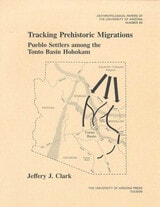
Tracking Prehistoric Migrations
Pueblo Settlers among the Tonto Basin HohokamJeffery J. Clark
University of Arizona Press, 2001
Puebloan migration was initially limited in scale, resulting in the co-residence of migrants and local groups within a single community. Once this co-residence settlement pattern is reconstructed, relations between the two groups are examined and the short-term and long-term impacts of migration are assessed. The early Classic period is associated with the appearance of the Salado horizon in the Tonto Basin. The results of this research suggest that migration and co-residence was common throughout the basins and valleys in the region defined by the Salado horizon, although each local sequence relates a unique story. The methodological and theoretical implications of Clark's work extend well beyond the Salado and the Southwest and apply to any situation in which the scale and impact of prehistoric migration are contested.
Traditional, National, and International Law and Indigenous Communities
Edited by Marianne O. Nielsen and Karen Jarratt-Snider
University of Arizona Press, 2020
While all of these issues are rooted in colonization, Indigenous peoples are using their own solutions to demonstrate the resilience, persistence, and innovation of their communities. With chapters focusing on the use and misuse of law as it pertains to Indigenous peoples in North America, Latin America, Canada, Australia, and New Zealand, this book offers a wide scope of global injustice. Despite proof of oppressive legal practices concerning Indigenous peoples worldwide, this book also provides hope for amelioration of colonial consequences.
Traditions, Transitions, and Technologies
Themes in Southwestern ArchaeologySarah H. Schlanger
University Press of Colorado, 2016
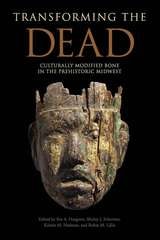
Transforming the Dead
Culturally Modified Bone in the Prehistoric MidwestEve A. Hargrave
University of Alabama Press, 2015
Revealing how the dead continued to shape the spiritual and social worlds of prehistoric North America.
Transforming the Dead is a collection of essays that examines culturally modified human bones and their roles as “cultural and ritual objects” among prehistoric Eastern Woodland cultures. Previous scholarship has explored the role of human body parts in Native American cultures as trophies of war and revered ancestors. This collection discusses new evidence that human elements were also important components of daily and ritual activities across the Eastern Woodlands. The contributors to this volume discuss each case study within the unique regional and temporal contexts of the material, rather than seeking universal answers to how these objects were used.
Most research addressing modified human bone has focused on cut marks and trauma associated with warfare, trophy taking, and burial practices. The editors and contributors of Transforming the Dead document the varied and often overlooked ways that human bone was intentionally modified through drilling, incising, cutting, and polishing for utilitarian, ornamental, spiritual, or ritual use. Examples include bracelets and gorgets to be worn, as well as musical rasps, pipe stems, masks, and protective talismans. The form and function of these objects are not unusual; their construction from the remains of “another” sets them apart.
Through a flexible but systematic analysis of the archaeological record, the contributors bring into focus how the careful selection, modification, and retention of particular bones or body parts of an individual after death offer insights into concepts of personhood, the body, life, and death among the prehistoric Native Americans in the Midwest.
Transit
Serpent Mound Crossing Space, Time, DiscourseChadwick Allen
University of Chicago Press, 2026
In Transit, Chadwick Allen chronicles the surprising history of how the ancient snake effigy known as Serpent Mound, located in what is now southern Ohio, traveled to Seattle, Washington in the 1970s, at the height of American Indian activism associated with the Red Power movement. Allen considers Indigenous earthworks built for thousands of years across the eastern half of the North American continent, questioning what it would mean if they were understood not as static entities fixed in space and time, but as animate forces with the ability to travel. Allen also looks at the origins of the “modern” effigy in the nineteenth century, when archaeologists reconstructed Serpent Mound’s deteriorating form to create a static icon suitable for touristic display within the confines of a settler state memorial.
Drawing from archival research, interviews, and site-specific encounters, Transit meditates on the significance of building an earthen effigy in the Pacific Northwest, as part of what became the Daybreak Star Indian Cultural Center, and on the complexity of the mound’s generative contexts. Allen’s research intersects the mid-twentieth century, when artist Robert Smithson created his iconic Spiral Jetty earth sculpture and when the Muscogee (Creek) Nation designed its innovative Mound Building. The story remains ongoing in the twenty-first century, as new mounds are rising in Oklahoma and artists, activists, and intellectuals are again asserting the power of Indigenous design.
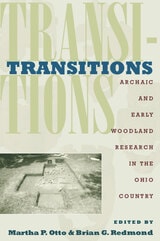
Transitions
Archaic and Early Woodland Research in the Ohio CountryMartha P. Otto
Ohio University Press, 2008
The late archaic and early woodland peoples lived in the Ohio region between 5,000 and 2,000 years ago. This was a time of transition, when hunters and gatherers began to grow native seed crops, establish more permanent settlements, and develop complex forms of ritual and ceremonialism, sometimes involving burial mound construction.
The focused archaeological studies described in Transitions: Archaic and Early Woodland Research in the Ohio Country shed light on this important episode in human cultural development. The authors describe important archaeological sites such as the rich Late Archaic settlements of southwestern Ohio and the early Adena Dominion Land Company enclosure in Franklin County. They present detailed accounts of Native American behavior, such as the use of smoking pipes by Adena societies and a reconstruction of mound use and ritual.
Transitions is the result of a comprehensive, long-term study focusing on particular areas of Ohio with the most up-to-date and detailed treatment of Ohio’s native cultures during this important time of change. This book will be of great value to students and other readers who wish to go beyond the general and often dated treatments of Ohio archaeology currently available.
Trespassing
An Inquiry into the Private Ownership of LandJohn Hanson Mitchell
University Press of New England, 2015
Tribal Administration Handbook
A Guide for Native Nations in the United StatesRebecca M. Webster
Michigan State University Press, 2022
Tribal Government Today, Revised Edition
James J. Lopach
University Press of Colorado, 1998
An account of Fourth World peoples within a First World nation, Tribal Government Today, Revised Edition is a critical analysis of the contemporary progress of Indian tribes toward self-government and economic sufficiency. Focusing on seven reservations in Montana representing the diverse opportunities and problems facing Indian tribes in the West, this book approaches tribal government from the twin perspectives of reservation politics and the legal context within which reservation conflicts must be solved.
Unlike previous studies of Indian politics, Tribal Government Today is neither a critique of American Indian policy over the years nor an analysis of federal, state, and tribal jurisdictional ambiguities. The authors—a political scientist, a lawyer, and a historian—focus instead on the distinctive political culture that has evolved on each reservation in terms of the reservation settings, governmental structures and procedures, and a particular brand of politics. The critical inquiry is how far the reservations are from genuine self-determination and whether that goal is impossibility for some. The authors conclude with suggestions for reforming tribal government within three main areas: the separation of powers, the role of the Bureau of Indian Affairs, and tribal acceptance of the concept of fundamental law.
The contents include: The Contours of Reservations Politics, Indian Law and Tribal Government; The Blackfeet: Their Own Government to Help Them; The Crow: A Politics of Rick; The Northern Cheyenne: A Politics of Values; The Fort Peck Reservation: The Factor of Leadership; The Fort Belknap Reservation: The Reality of Poverty; The Rocky Boy's Reservation: A Struggle for Government; The Flathead Reservation: A Struggle for Government; The Flathead Reservation: From Enclave to Self-Government; and Reflection on Tribal Government.
There has been surprisingly little writing about the condition of contemporary tribal government. Library shelves are filled with works on other American and foreign governments, but an inquirer must learn about tribal government incidentally and in piecemeal fashion. This state of scholarship is regrettable because of the importance of the modern Indian self-determination movement. Reservation politics certainly affect the quality of life in Indian communities, and the outlook for Indian self-determination cannot be assessed without an understanding of tribal government.
Tribal Secrets
Recovering American Indian Intellectual TraditionsRobert Allen Warrior
University of Minnesota Press, 1994
Tribal Strengths and Native Education
Voices from the Reservation ClassroomTerry Huffman
University of Massachusetts Press, 2018
In 1889, Sitting Bull addressed the formal, Western-style education of his people. “When you find something good in the white man's road, pick it up,” he intoned. “When you find something that is bad . . . leave it alone. We shall master his machinery, and his inventions, his skills, his medicine, his planning, but we will retain our beauty and still be Indians.”
Sitting Bull's vision—that cultural survival and personal perseverance derive from tribal resilience—lies at the heart of Tribal Strengths and Native Education. Basing his account on the insights of six veteran American Indian educators who serve in three reservation schools on the Northern Plains, Terry Huffman explores how Native educators perceive pedagogical strengths rooted in their tribal heritage and personal ethnicity. He recounts their views on the issues facing students and shows how tribal identity can be a source of resilience in academic and personal success. Throughout, Huffman and the educators emphasize the importance of anchoring the formal education of Indian children in Native values and worldviews—in “tribal strengths.”
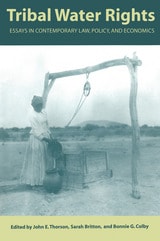
Tribal Water Rights
Essays in Contemporary Law, Policy, and EconomicsEdited by John E. Thorson, Sarah Britton, and Bonnie G. Colby
University of Arizona Press, 2006
Tribes, Treaties, and Constitutional Tribulations
By Vine Deloria, Jr., and David E. Wilkins
University of Texas Press, 2000
"Federal Indian law . . . is a loosely related collection of past and present acts of Congress, treaties and agreements, executive orders, administrative rulings, and judicial opinions, connected only by the fact that law in some form has been applied haphazardly to American Indians over the course of several centuries. . . . Indians in their tribal relation and Indian tribes in their relation to the federal government hang suspended in a legal wonderland."
In this book, two prominent scholars of American Indian law and politics undertake a full historical examination of the relationship between Indians and the United States Constitution that explains the present state of confusion and inconsistent application in U.S. Indian law. The authors examine all sections of the Constitution that explicitly and implicitly apply to Indians and discuss how they have been interpreted and applied from the early republic up to the present. They convincingly argue that the Constitution does not provide any legal rights for American Indians and that the treaty-making process should govern relations between Indian nations and the federal government.

Trickster Academy
Jenny L. Davis
University of Arizona Press, 2022
Trickster Academy is a collection of poems that explore being Native in Academia—from land acknowledgement statements, to mascots, to the histories of using Native American remains in anthropology. Jenny L. Davis’ collection brings humor and uncomfortable realities together in order to challenge the academy and discuss the experience of being Indigenous in university classrooms and campuses. Organized around the premise of the Trickster Academy— a university space run by, and meant for training, Tricksters— this collection moves between the personal dynamics of a Two-Spirit/queer Indigenous woman in spaces where there are few, if any, others and a Trickster’s critique of those same spaces.
Trickster Academy is playful at times, yet more complicated and salient issues are at the heart of these poems. Davis’ Trickster Academy deeply challenges the institutions that still hold Indigenous remains in their archives and storage rooms, and the insincerities of the academy when it comes to acknowledging Indigenous peoples. The realities that the poems in Trickster Academy address are not only relevant to people in academic positions. From leaving home, to being the only Indian in the room, to having to deal with the constant pressures to being a ‘real Indian’, these poems illuminate the shared experiences of Indians across many regions, and all of us who live amongst Tricksters.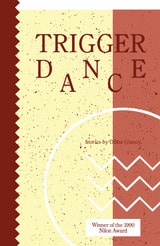
Trigger Dance
Diane Glancy
University of Alabama Press, 1991
1990 Winner of the Mildren P. Nilon Award for Minority Fiction
In Trigger Dance, her first collection of stories, Diane Glancy takes us to uneasy places where both the environment and the characters are at risk, where even the animals grieve. Sometimes the author's voice, sometimes the voices of the characters, tell us about their migrations, symbolic or literal. Diane Glancy's characters walk in two worlds and try to build a middle ground between white and native cultures. They are the offspring of those who survived the Trail of Tears. Some of the young men dance at powwows in tune with the dead. Filo and Parnetta buy a fridge at the Hardware Store on Muskogee Street, in Tahleqah, Oklahoma. Farther west, near Chickasha, Keyo can't read, while Joseph Sink, an Indian hermit, learns a word a day. Anna America remembers her shortcomings as a mother and her hard life as she waits in the Northeastern Cherokee County Shelter for her wings to unfold so she can leave this earth. In the title story, Roan mourns the fact that human beings have the power to destroy the earth. He's astonished that creation and cremation could be so closely linked. Even his father, when he feels death approach, demands to be cremated because "it's autumn in outer space." Roan's final vision in the sweat lodge is of the air red as leaves. He admonishes his people to be strong and responsible, to acknowledge that life is a sizeable endeavor. it.
Trincheras Sites in Time, Space, and Society
Edited by Suzanne K. Fish, Paul R. Fish, and M. Elisa Villalpando
University of Arizona Press, 2008
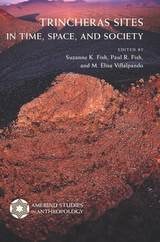
This multi-author volume integrates a remarkable body of new data representing a textbook-like array of current research issues and methodologies in the archaeology of the region. Scholars from the United States and Mexico offer original research on trincheras sites in Chihuahua, Sonora, Arizona, and New Mexico. Scales of focus range from intensive intrasite sampling to the largest contiguous survey in the region. Authors incorporate spatial analyses, artifact studies, environmental and subsistence data, ethnographic analogs, ethnohistorical records, cross-cultural comparisons, archaeology, and archival resources.
The volume’s discussions contribute innovative approaches to worldwide interpretations of landscapes marked by hilltop sites. Contributors present meticulous research arguing that many trincheras sites were primarily used for habitation and ceremonial rites, in addition to previously predominant views of them as defensive refuges. Because trincheras occupations date from the late preceramic era to shortly before Spanish contact, authors relate them to early forms of agriculture, the emergence of village life, the appearance of differentiated settlement systems, and tendencies toward political and ritual centralization.
Detailed maps and figures illustrate the text, and close-up aerial photographs capture the visual essence of the sites, highlighted by a section that includes color photographs and an essay by renowned photographer Adriel Heisey.
Contributors:
Christian E. Downum
Paul R. Fish
Suzanne K. Fish
Robert J. Hard
Adriel Heisey
Stephen A. Kowalewski
Randall H. McGuire
Ben A. Nelson
John R. Roney
Judith Taylor
M. Elisa Villalpando
Joseph Vogel
Henry Wallace
David R. Wilcox
J. Scott Wood
Trust in the Land
New Directions in Tribal ConservationBeth Rose Middleton
University of Arizona Press, 2011
—Cayuse Chief Young Chief, Walla Walla Council of 1855
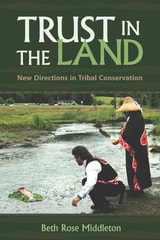
America has always been Indian land. Historically and culturally, Native Americans have had a strong appreciation for the land and what it offers. After continually struggling to hold on to their land and losing millions of acres, Native Americans still have a strong and ongoing relationship to their homelands. The land holds spiritual value and offers a way of life through fishing, farming, and hunting. It remains essential—not only for subsistence but also for cultural continuity—that Native Americans regain rights to land they were promised.
Beth Rose Middleton examines new and innovative ideas concerning Native land conservancies, providing advice on land trusts, collaborations, and conservation groups. Increasingly, tribes are working to protect their access to culturally important lands by collaborating with Native and non- Native conservation movements. By using private conservation partnerships to reacquire lost land, tribes can ensure the health and sustainability of vital natural resources. In particular, tribal governments are using conservation easements and land trusts to reclaim rights to lost acreage. Through the use of these and other private conservation tools, tribes are able to protect or in some cases buy back the land that was never sold but rather was taken from them.
Trust in the Land sets into motion a new wave of ideas concerning land conservation. This informative book will appeal to Native and non-Native individuals and organizations interested in protecting the land as well as environmentalists and government agencies.
Trusteeship in Change
Toward Tribal Autonomy in Resource ManagementRichmond L. Clow
University Press of Colorado, 2001
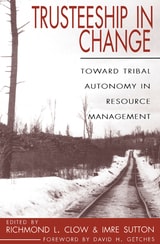
This book also includes case studies focused on wildlife management, forest preservation, tribal hunting laws, and other specific concerns in management, preservation and utilization of Native American land. An excellent source for scholars in the fields of Native American and environmental studies, Trusteeship in Change is sure to spark debate and to be an important reference book for years to come.
Twelve Millennia
Archaeology of the Upper Mississippi River ValleyJames L Theler
University of Iowa Press, 2003
The people of Taquile Island on the Peruvian side of beautiful Lake Titicaca, the highest navigable lake in the Americas, are renowned for the hand-woven textiles that they both wear and sell to outsiders. One thousand seven hundred Quechua-speaking peasant farmers, who depend on potatoes and the fish from the lake, host the forty thousand tourists who visit their island each year. Yet only twenty-five years ago, few tourists had even heard of Taquile. In Weaving a Future: Tourism, Cloth, and Culture on an Andean Island, Elayne Zorn documents the remarkable transformation of the isolated rocky island into a community-controlled enterprise that now provides a model for indigenous communities worldwide.
Over the course of three decades and nearly two years living on Taquile Island, Zorn, who is trained in both the arts and anthropology, learned to weave from Taquilean women. She also learned how gender structures both the traditional lifestyles and the changes that tourism and transnationalism have brought. In her comprehensive and accessible study, she reveals how Taquileans used their isolation, landownership, and communal organizations to negotiate the pitfalls of globalization and modernization and even to benefit from tourism. This multi-sited ethnography set in Peru, Washington, D.C., and New York City shows why and how cloth remains central to Andean society and how the marketing of textiles provided the experience and money for Taquilean initiatives in controlling tourism.
The first book about tourism in South America that centers on traditional arts as well as community control, Weaving a Future will be of great interest to anthropologists and scholars and practitioners of tourism, grassroots development, and the fiber arts.
Two Terminal Archaic/Early Woodland Sites in Central Michigan
Scott G. Beld
University of Michigan Press, 1991
Two-Moon Journey
The Potawatomi Trail of DeathPeggy King Anderson
Indiana Historical Society Press, 2018

Two-Spirit People
Native American Gender Identity, Sexuality, and SpiritualityEdited by Sue-Ellen Jacobs; Wesley Thomas; and Sabine Lang
University of Illinois Press, 1997
1997 Winner of the Ruth Benedict Prize for an edited book given by the Society of Lesbian and Gay Anthropologists.